The next solstice or equinox is the December solstice on Monday, December 21, 2026, at 20:50 UTC: 3:50 p.m. Eastern, 2:50 p.m. Central, 1:50 p.m. Mountain and 12:50 p.m. Pacific standard time. The four events of 2027 follow on March 20 (20:25 UTC), June 21 (14:11 UTC), September 23 (06:02 UTC) and December 22 (02:42 UTC). Every time on this page was checked against the US Naval Observatory’s published table, and the page adds what most date lists leave out: all four US time zones for every event from 2026 to 2030, how many hours of daylight nine US cities get on each date, why the seasons are different lengths, and which of these moments is also a change of Sun sign.
This is the calendar and seasons view. It does not repeat the twelve-sign tables on our zodiac sign dates guide and the individual zodiac sign pages, which answer the “what sign am I” question. Four of the Sun’s twelve sign changes, Aries, Cancer, Libra and Capricorn, are the equinoxes and solstices, so those pages and this one share four timestamps; here they are the main subject, and the questions are “when does summer start” and “how long is the day”.
Key takeaways
- The December solstice 2026 is Monday, December 21 at 20:50 UTC (3:50 p.m. EST, 12:50 p.m. PST). Daylight that day is 9 h 15 min in New York, 8 h 25 min in Seattle and 5 h 27 min in Anchorage.
- The 2027 events: spring equinox Saturday, March 20 at 4:25 p.m. EDT; summer solstice Monday, June 21 at 10:11 a.m. EDT; fall equinox Thursday, September 23 at 2:02 a.m. EDT, which is still Wednesday, September 22 at 11:02 p.m. in Pacific time; winter solstice Tuesday, December 21 at 9:42 p.m. EST.
- The dates move because a calendar year of 365 days is about a quarter of a day short of the Sun’s cycle. Each event arrives roughly 5 hours 45 minutes later on the clock than a year before, until a leap day pulls it back. In UTC, the March equinox fell on March 20 in 120 of the 200 years from 1900 to 2099, on March 21 in 60 and on March 19 in 20.
- The four seasons of 2027 last 92.74, 93.66, 89.86 and 88.98 days, because Earth moves fastest when it passes closest to the Sun in early January.
- The winter solstice is the shortest day but not the earliest sunset: in New York sunset bottoms out near 4:28 p.m. around December 8. On the equinox, day and night are not equal either: New York gets 12 h 08 min of daylight on March 20, 2027.
- In astrology each of the four is a cardinal Sun ingress, the Sun entering Aries, Cancer, Libra or Capricorn. That link is tradition and the timing is astronomy.
In this guide
- The 2026 winter solstice and the four events of 2027, by time zone
- What exactly is happening at that instant
- Every date and time from 2026 to 2030
- Why the dates shift from year to year
- Why the four seasons are different lengths
- Hours of daylight on each date in nine US cities
- Why the earliest sunset comes before the winter solstice
- The astrology of the four turning points
- How the four dates were fixed: a short history
- How these numbers were checked
- Frequently asked questions
- Sources
The 2026 winter solstice and the four events of 2027, by time zone
Almanacs usually print one time zone. The table gives the same instants in UTC and in the four contiguous US zones, with daylight saving time applied where it is in force on that date. The March, June and September events fall in daylight time (UTC minus 4 hours in Eastern, minus 7 in Pacific); both December solstices fall in standard time (minus 5 and minus 8). The “Sun enters” column names the sign that begins at that instant in the tropical zodiac.
| Event | Sun enters | UTC | Eastern | Central | Mountain | Pacific |
|---|---|---|---|---|---|---|
| December solstice 2026 | Capricorn | Dec 21, 20:50 | Mon, Dec 21, 3:50 p.m. EST | Dec 21, 2:50 p.m. CST | Dec 21, 1:50 p.m. MST | Dec 21, 12:50 p.m. PST |
| March equinox 2027 | Aries | Mar 20, 20:25 | Sat, Mar 20, 4:25 p.m. EDT | Mar 20, 3:25 p.m. CDT | Mar 20, 2:25 p.m. MDT | Mar 20, 1:25 p.m. PDT |
| June solstice 2027 | Cancer | Jun 21, 14:11 | Mon, Jun 21, 10:11 a.m. EDT | Jun 21, 9:11 a.m. CDT | Jun 21, 8:11 a.m. MDT | Jun 21, 7:11 a.m. PDT |
| September equinox 2027 | Libra | Sep 23, 06:02 | Thu, Sep 23, 2:02 a.m. EDT | Sep 23, 1:02 a.m. CDT | Sep 23, 12:02 a.m. MDT | Sep 22, 11:02 p.m. PDT |
| December solstice 2027 | Capricorn | Dec 22, 02:42 | Tue, Dec 21, 9:42 p.m. EST | Dec 21, 8:42 p.m. CST | Dec 21, 7:42 p.m. MST | Dec 21, 6:42 p.m. PST |
Two rows deserve a second look. The September 2027 equinox arrives at 06:02 UTC on Thursday, which is 2:02 a.m. on the East Coast but 11:02 p.m. on Wednesday, September 22, in California; Alaska (10:02 p.m.) and Hawaii (8:02 p.m.) are also still on Wednesday. So the “first day of fall” is September 23 in the East and Midwest and September 22 in the West, and neither is wrong. The December 2027 solstice is the opposite case: it is December 22 in UTC and every almanac that prints UTC shows it, but in all US time zones it falls on the evening of Tuesday, December 21.
Arizona, apart from the Navajo Nation, stays on Mountain standard time all year, so its clocks read the Pacific column in March, June and September and the Mountain column in December. Alaska is one hour behind the Pacific column and Hawaii, which does not use daylight saving, is UTC minus 10.
What exactly is happening at that instant
An equinox and a solstice are instants, not days. Measured along the ecliptic, the Sun’s yearly path, the Sun is at 0 degrees at the March equinox, 90 degrees at the June solstice, 180 degrees at the September equinox and 270 degrees at the December solstice. At the equinoxes the Sun crosses the plane of Earth’s equator; at the solstices it reaches its farthest point north (June) or south (December), about 23.4 degrees from that plane. These are the four longitudes this page computed and then compared with the Naval Observatory.
The cause is the tilt of Earth’s axis, not Earth’s distance from the Sun. NASA’s educational Space Place puts it in one line:
“Earth’s tilted axis causes the seasons.”
NASA Space Place, What Causes the Seasons?
Because the instant is the same for everyone, the time differs only by clock. The Naval Observatory publishes it as UTC, and its Earth’s Seasons data service returns the four 2027 times for any year you ask for.
Every date and time from 2026 to 2030
These four tables list each event from 2026 to 2030 in UTC and in the four US zones. Use the one that matches the season you are looking for. Weekdays are given for the Eastern date.
March equinox (spring equinox) 2026 to 2030
| Year | UTC | Eastern | Central | Mountain | Pacific |
|---|---|---|---|---|---|
| 2026 | Mar 20, 14:46 | Fri, Mar 20, 10:46 a.m. EDT | Mar 20, 9:46 a.m. CDT | Mar 20, 8:46 a.m. MDT | Mar 20, 7:46 a.m. PDT |
| 2027 | Mar 20, 20:25 | Sat, Mar 20, 4:25 p.m. EDT | Mar 20, 3:25 p.m. CDT | Mar 20, 2:25 p.m. MDT | Mar 20, 1:25 p.m. PDT |
| 2028 | Mar 20, 02:17 | Sun, Mar 19, 10:17 p.m. EDT | Mar 19, 9:17 p.m. CDT | Mar 19, 8:17 p.m. MDT | Mar 19, 7:17 p.m. PDT |
| 2029 | Mar 20, 08:02 | Tue, Mar 20, 4:02 a.m. EDT | Mar 20, 3:02 a.m. CDT | Mar 20, 2:02 a.m. MDT | Mar 20, 1:02 a.m. PDT |
| 2030 | Mar 20, 13:52 | Wed, Mar 20, 9:52 a.m. EDT | Mar 20, 8:52 a.m. CDT | Mar 20, 7:52 a.m. MDT | Mar 20, 6:52 a.m. PDT |
2027 is the year to plan for: Saturday, March 20, at 4:25 p.m. EDT. The 2028 equinox is the one that surprises people. It is March 20 at 02:17 UTC, but in every US zone it is the evening of Sunday, March 19, so Americans get a “March 19” spring equinox.
June solstice (summer solstice) 2026 to 2030
| Year | UTC | Eastern | Central | Mountain | Pacific |
|---|---|---|---|---|---|
| 2026 | Jun 21, 08:24 | Sun, Jun 21, 4:24 a.m. EDT | Jun 21, 3:24 a.m. CDT | Jun 21, 2:24 a.m. MDT | Jun 21, 1:24 a.m. PDT |
| 2027 | Jun 21, 14:11 | Mon, Jun 21, 10:11 a.m. EDT | Jun 21, 9:11 a.m. CDT | Jun 21, 8:11 a.m. MDT | Jun 21, 7:11 a.m. PDT |
| 2028 | Jun 20, 20:02 | Tue, Jun 20, 4:02 p.m. EDT | Jun 20, 3:02 p.m. CDT | Jun 20, 2:02 p.m. MDT | Jun 20, 1:02 p.m. PDT |
| 2029 | Jun 21, 01:48 | Wed, Jun 20, 9:48 p.m. EDT | Jun 20, 8:48 p.m. CDT | Jun 20, 7:48 p.m. MDT | Jun 20, 6:48 p.m. PDT |
| 2030 | Jun 21, 07:31 | Fri, Jun 21, 3:31 a.m. EDT | Jun 21, 2:31 a.m. CDT | Jun 21, 1:31 a.m. MDT | Jun 21, 12:31 a.m. PDT |
The summer solstice 2027 is Monday, June 21, at 10:11 a.m. EDT. In 2028 it falls on June 20 everywhere in the United States, and in 2029 it is 01:48 UTC on June 21, which is still the evening of June 20 on the American clock.
September equinox (fall equinox) 2026 to 2030
| Year | UTC | Eastern | Central | Mountain | Pacific |
|---|---|---|---|---|---|
| 2026 | Sep 23, 00:05 | Tue, Sep 22, 8:05 p.m. EDT | Sep 22, 7:05 p.m. CDT | Sep 22, 6:05 p.m. MDT | Sep 22, 5:05 p.m. PDT |
| 2027 | Sep 23, 06:02 | Thu, Sep 23, 2:02 a.m. EDT | Sep 23, 1:02 a.m. CDT | Sep 23, 12:02 a.m. MDT | Sep 22, 11:02 p.m. PDT |
| 2028 | Sep 22, 11:45 | Fri, Sep 22, 7:45 a.m. EDT | Sep 22, 6:45 a.m. CDT | Sep 22, 5:45 a.m. MDT | Sep 22, 4:45 a.m. PDT |
| 2029 | Sep 22, 17:38 | Sat, Sep 22, 1:38 p.m. EDT | Sep 22, 12:38 p.m. CDT | Sep 22, 11:38 a.m. MDT | Sep 22, 10:38 a.m. PDT |
| 2030 | Sep 22, 23:27 | Sun, Sep 22, 7:27 p.m. EDT | Sep 22, 6:27 p.m. CDT | Sep 22, 5:27 p.m. MDT | Sep 22, 4:27 p.m. PDT |
The 2026 fall equinox is Tuesday, September 22, at 8:05 p.m. EDT, which is September 23 in UTC. For 2027 the date depends on where you are, as described above, and from 2028 to 2030 it is September 22 across the whole country.
December solstice (winter solstice) 2026 to 2030
| Year | UTC | Eastern | Central | Mountain | Pacific |
|---|---|---|---|---|---|
| 2026 | Dec 21, 20:50 | Mon, Dec 21, 3:50 p.m. EST | Dec 21, 2:50 p.m. CST | Dec 21, 1:50 p.m. MST | Dec 21, 12:50 p.m. PST |
| 2027 | Dec 22, 02:42 | Tue, Dec 21, 9:42 p.m. EST | Dec 21, 8:42 p.m. CST | Dec 21, 7:42 p.m. MST | Dec 21, 6:42 p.m. PST |
| 2028 | Dec 21, 08:19 | Thu, Dec 21, 3:19 a.m. EST | Dec 21, 2:19 a.m. CST | Dec 21, 1:19 a.m. MST | Dec 21, 12:19 a.m. PST |
| 2029 | Dec 21, 14:14 | Fri, Dec 21, 9:14 a.m. EST | Dec 21, 8:14 a.m. CST | Dec 21, 7:14 a.m. MST | Dec 21, 6:14 a.m. PST |
| 2030 | Dec 21, 20:09 | Sat, Dec 21, 3:09 p.m. EST | Dec 21, 2:09 p.m. CST | Dec 21, 1:09 p.m. MST | Dec 21, 12:09 p.m. PST |
The winter solstice 2026 is Monday, December 21, at 3:50 p.m. EST. In all five years the solstice is December 21 on a US clock; only the 2027 event is December 22 in UTC.
Why the dates shift from year to year
The Sun’s cycle from one March equinox to the next, the tropical year, is about 365.2422 days. In our calculation, the interval between the March equinoxes of the years 2000 and 2100 averages 365.2423 days. A calendar year has 365 days, so in an ordinary year each equinox or solstice arrives about a quarter of a day later on the clock than the year before. The Naval Observatory’s March equinoxes show it: each one comes 365 days plus 5 h 39 min, 5 h 52 min, 5 h 45 min and 5 h 50 min after the previous one for 2027, 2028, 2029 and 2030. Then February 29 adds a whole day to the calendar and pulls the clock reading back by about 18 hours. Across one four-year cycle the event ends up about 54 minutes earlier in the day (14:46 UTC in 2026, 13:52 UTC in 2030). That is why the date wanders between two or three values rather than marching steadily forward.
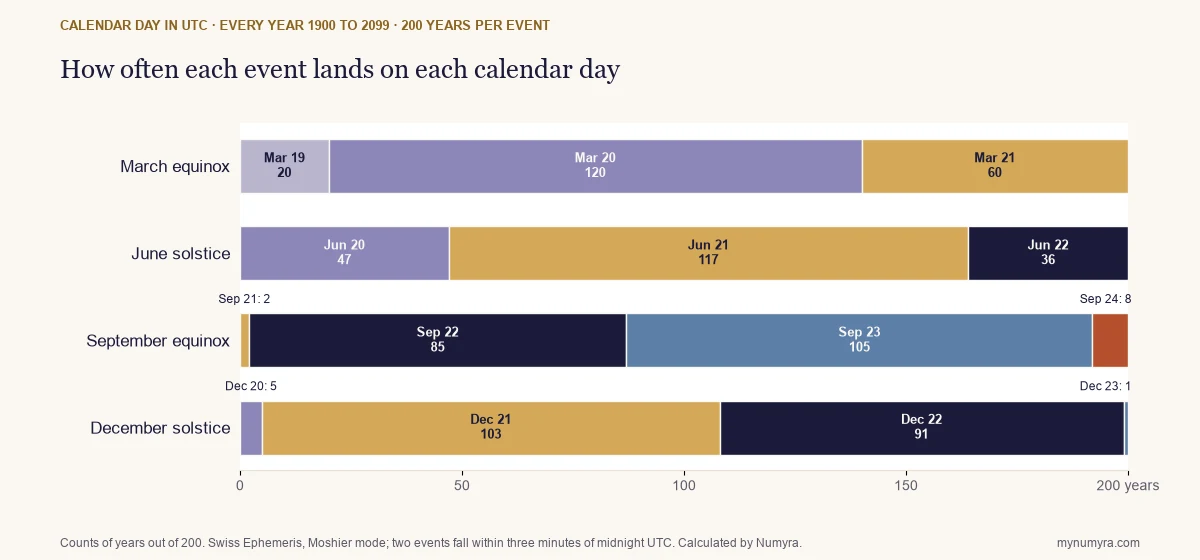
Over a longer span the pattern is stable but not flat, because the Gregorian calendar skips a leap day in century years that are not divisible by 400. We computed all four events for every year from 1900 to 2099 and counted the calendar day in UTC. The June solstice fell on June 21 in 117 of 200 years, on June 20 in 47 and on June 22 in 36. The September equinox fell on September 23 in 105 years and on September 22 in 85. The December solstice was on December 21 in 103 years and on December 22 in 91. Two things stand out for this century: in our 1900 to 2099 range the last March equinox on March 21 in UTC was in 2007, and from 2044 some March equinoxes begin landing on March 19 in UTC (20 such years, 2044 to 2097). Two of the 800 events fall within three minutes of midnight UTC, so their day depends on seconds of ephemeris accuracy and the counts are good to within one or two years.
Why the four seasons are different lengths
Spring, summer, fall and winter are the intervals between the four events, and they are not equal. From the Naval Observatory times, the seasons from March 2027 to March 2028 last 92.74, 93.66, 89.86 and 88.98 days. Summer is 4.68 days longer than winter. The reason is the shape of Earth’s orbit: the planet is closest to the Sun at perihelion, which the Observatory gives as January 3, 2027 at 02:33 UTC, and farthest at aphelion, July 5, 2027 at 05:06 UTC. Near perihelion Earth moves faster, so the northern winter passes in fewer days; near aphelion it moves slower and the northern summer drags.
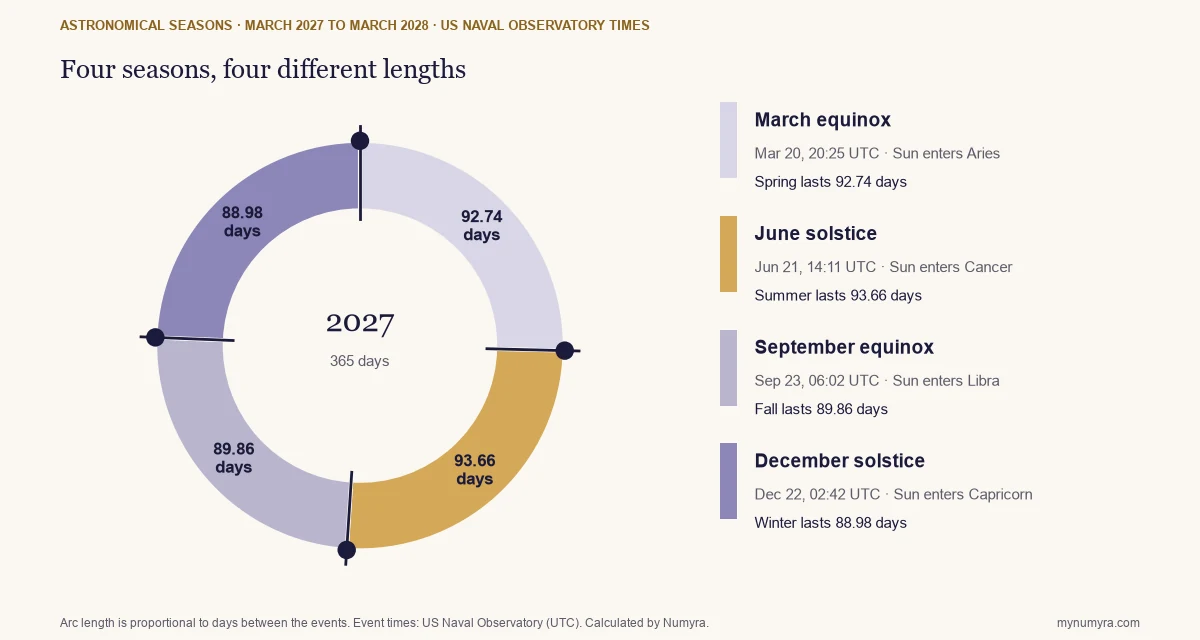
| Year (starts at March equinox) | Spring | Summer | Fall | Winter |
|---|---|---|---|---|
| 2026 | 92.73 | 93.65 | 89.86 | 88.98 |
| 2027 | 92.74 | 93.66 | 89.86 | 88.98 |
| 2028 | 92.74 | 93.65 | 89.86 | 88.99 |
| 2029 | 92.74 | 93.66 | 89.86 | 88.98 |
Distance does not cause the seasons, as NASA stresses, and the closest approach comes in northern winter. It only decides how many days each season gets. The lengths shift by less than a hundredth of a day from year to year across 2026 to 2029.
Hours of daylight on each date in nine US cities
For each city we calculated sunrise and sunset on the local calendar date of every event, defined the usual way (the Sun’s upper edge on the horizon, standard atmospheric refraction), and subtracted. The 2027 September row uses September 22 for the four western cities, since that is the local date of the equinox there.
| City | Latitude | Dec 21, 2026 | Mar 20, 2027 | Jun 21, 2027 | Sep 22 or 23, 2027 | Dec 21, 2027 |
|---|---|---|---|---|---|---|
| Miami | 25.8° N | 10 h 32 min | 12 h 07 min | 13 h 45 min | 12 h 06 min | 10 h 32 min |
| Honolulu | 21.3° N | 10 h 50 min | 12 h 07 min | 13 h 26 min | 12 h 07 min (Sep 22) | 10 h 50 min |
| Houston | 29.8° N | 10 h 14 min | 12 h 07 min | 14 h 03 min | 12 h 07 min | 10 h 14 min |
| Los Angeles | 34.1° N | 9 h 53 min | 12 h 08 min | 14 h 25 min | 12 h 09 min (Sep 22) | 9 h 53 min |
| Denver | 39.7° N | 9 h 21 min | 12 h 08 min | 14 h 59 min | 12 h 07 min | 9 h 21 min |
| New York | 40.7° N | 9 h 15 min | 12 h 08 min | 15 h 06 min | 12 h 07 min | 9 h 15 min |
| Chicago | 41.9° N | 9 h 08 min | 12 h 08 min | 15 h 14 min | 12 h 07 min | 9 h 08 min |
| Seattle | 47.6° N | 8 h 25 min | 12 h 10 min | 15 h 59 min | 12 h 11 min (Sep 22) | 8 h 25 min |
| Anchorage | 61.2° N | 5 h 27 min | 12 h 14 min | 19 h 22 min | 12 h 15 min (Sep 22) | 5 h 27 min |
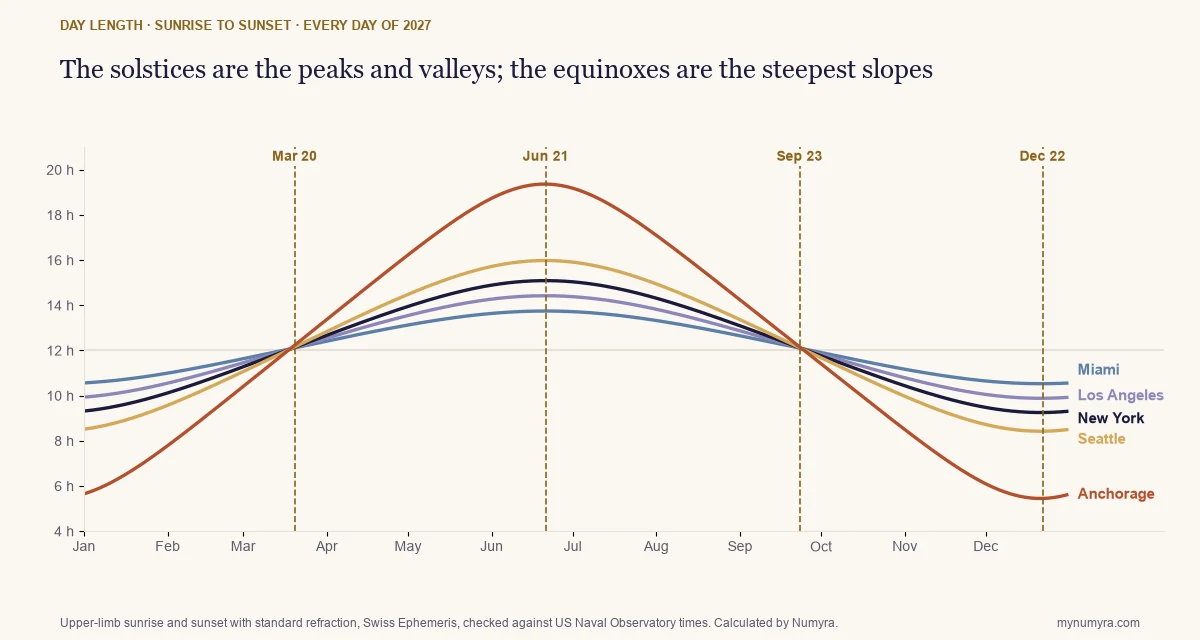
Two patterns are worth knowing. First, the swing between the solstices grows quickly with latitude: Miami gains 3 h 13 min between the December and June solstices, New York 5 h 51 min, Seattle 7 h 34 min and Anchorage 13 h 55 min. Second, no city has 12 hours of daylight on an equinox. New York has 12 h 08 min on March 20, 2027 and 12 h 07 min on September 23, 2027, Seattle 12 h 10 min on March 20, and Anchorage 12 h 14 min. The extra minutes come from the definition of sunrise and sunset, since the Sun’s upper edge counts and the atmosphere bends its light over the horizon, and the effect is bigger at high latitudes. The day closest to a true 12 hours, called the equilux, comes days earlier in spring and later in fall.
| City | Spring equilux | Fall equilux | Daylight gained per day, March 20 |
|---|---|---|---|
| Miami | Mar 15 | Sep 27 | 1 min 31 s |
| Honolulu | Mar 14 | Sep 28 | 1 min 14 s |
| Houston | Mar 16 | Sep 27 | 1 min 48 s |
| Los Angeles | Mar 16 | Sep 26 | 2 min 08 s |
| Denver | Mar 17 | Sep 26 | 2 min 38 s |
| New York | Mar 17 | Sep 26 | 2 min 43 s |
| Chicago | Mar 17 | Sep 26 | 2 min 50 s |
| Seattle | Mar 17 | Sep 25 | 3 min 28 s |
| Anchorage | Mar 18 | Sep 25 | 5 min 45 s |
Planetary-hour systems depend on the same sunrise and sunset times, which is why the Chaldean hours in our planetary hours guide are exactly 60 minutes only on the few days when daylight is exactly 12 hours. If you want to see your own city’s hour lengths, the planetary hours calculator uses the same method.
Why the earliest sunset comes before the winter solstice
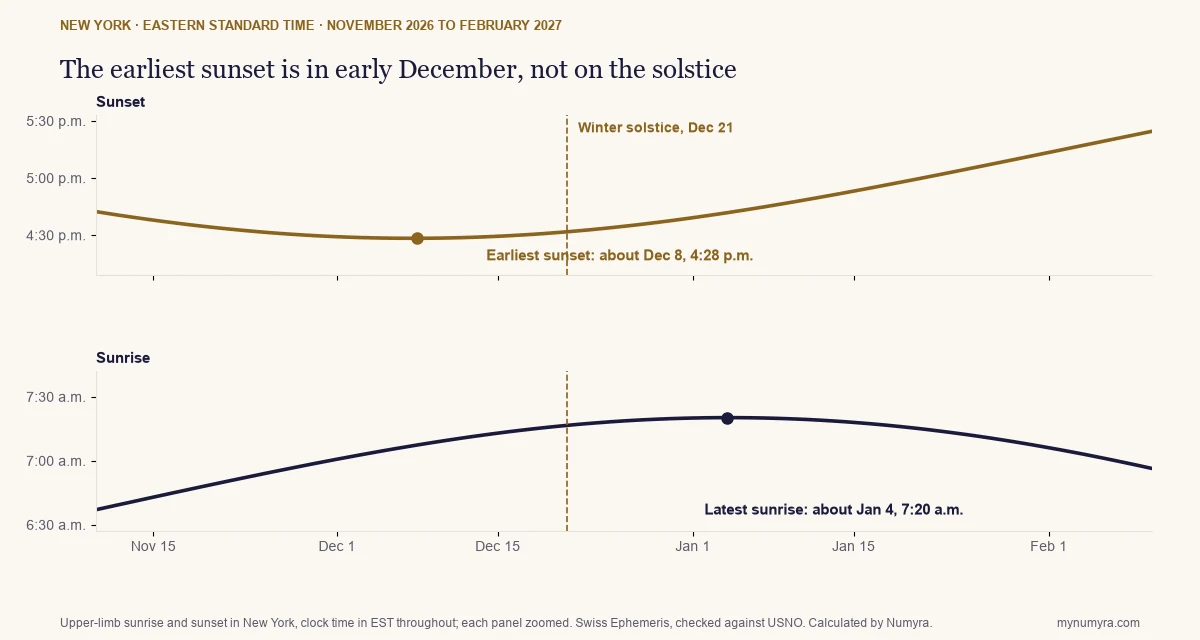
The solstice has the least daylight, but the earliest sunset arrives roughly two weeks before it and the latest sunrise roughly two weeks after. For New York in 2026 and 2027, the sunset time reaches its minimum, 4:28 p.m. EST, in the days around December 8, and the sunrise time peaks at 7:20 a.m. around January 4. The cause is that solar noon, when the Sun is highest, does not stay at the same clock time. Our calculation puts it at 11:47:59 a.m. in New York on December 8, 11:54:11 on December 21 and 12:00:57 p.m. on January 4, so it moves about 30 seconds later each day in this stretch. On December 8 the day is shortening by 52 seconds, which takes about 26 seconds off the half-day after noon, and the later noon cancels that out almost exactly. By the solstice the day length has stopped changing, so the later noon drags sunrise and sunset both later.
| City | Earliest sunset | Days at that time | Latest sunrise | Days at that time |
|---|---|---|---|---|
| Miami | 5:29 p.m. | Nov 25 to Dec 4 | 7:09 a.m. | Jan 6 to Jan 19 |
| Honolulu | 5:48 p.m. | Nov 21 to Dec 1 | 7:12 a.m. | Jan 14 to Jan 18 |
| Houston | 5:22 p.m. | Nov 25 to Dec 9 | 7:18 a.m. | Jan 5 to Jan 15 |
| Los Angeles | 4:43 p.m. | Dec 2 to Dec 7 | 6:59 a.m. | Jan 1 to Jan 14 |
| Denver | 4:35 p.m. | Dec 4 to Dec 10 | 7:21 a.m. | Dec 29 to Jan 11 |
| New York | 4:28 p.m. | Dec 6 to Dec 10 | 7:20 a.m. | Dec 29 to Jan 10 |
| Chicago | 4:19 p.m. | Dec 5 to Dec 11 | 7:18 a.m. | Dec 28 to Jan 10 |
| Seattle | 4:18 p.m. | Dec 5 to Dec 16 | 7:58 a.m. | Dec 30 to Jan 2 |
| Anchorage | 3:40 p.m. | Dec 14 to Dec 18 | 10:16 a.m. | Dec 25 to Dec 27 |
In Miami and Honolulu the earliest sunset comes in late November, and in Anchorage only a week before the solstice. We spot-checked New York against Naval Observatory sunrise and sunset times for December 6, 8, 10 and 21, 2026 and January 4, 2027, Chicago and Denver for December 8 and Seattle for December 10, and every time agreed to within one minute.
The astrology of the four turning points
In the tropical zodiac the signs are fixed to these four moments. The March equinox is 0 degrees Aries, the June solstice 0 degrees Cancer, the September equinox 0 degrees Libra and the December solstice 0 degrees Capricorn. The Sun’s entry into each is called an ingress, and the four signs that begin a season are the cardinal signs, the group our guide to the elements and modalities explains. The sign pages carry the exact entry times and the season’s length: Aries, Cancer, Libra and Capricorn.
| Event | Sun enters | Ptolemy’s name | Eastern time, 2027 |
|---|---|---|---|
| March equinox | Aries | Equinoctial | Mar 20, 4:25 p.m. EDT |
| June solstice | Cancer | Solstitial | Jun 21, 10:11 a.m. EDT |
| September equinox | Libra | Equinoctial | Sep 23, 2:02 a.m. EDT |
| December solstice | Capricorn | Solstitial | Dec 21, 9:42 p.m. EST |
The oldest surviving textbook of Western astrology already ties the signs to these moments. In the Tetrabiblos, written in the second century, Ptolemy calls Cancer and Capricorn the solstitial signs, Aries and Libra the equinoctial ones, and explains the names:
“For the sun turns when he is at the beginning of these signs and reverses his latitudinal progress, causing summer in Cancer and winter in Capricorn.”
Ptolemy, Tetrabiblos, Book I, chapter 11, trans. F. E. Robbins (Loeb Classical Library, 1940), via LacusCurtius
Our article on the Tetrabiblos covers the book, and the history of the zodiac signs covers how the twelve divisions arose. Astrologers have long cast a chart for the moment of an ingress, most often the Aries ingress, and read it as a picture of the coming season. That is a tradition of interpretation. We know of no test showing that such charts predict anything, and the times on this page make no claim beyond the astronomy.
Two practical points. First, the tropical zodiac does not depend on the hemisphere: the Sun enters Aries at the March equinox for everyone, which is autumn in Australia. The sidereal zodiac used in Vedic astrology starts its signs about 24 days later. Second, Sun signs change on a minute, not a day; if you were born on or near one of these four dates, the exact time and place of birth decide your sign, as our zodiac sign dates guide shows in detail. The same four times also open the first decan of each cardinal sign.
How the four dates were fixed: a short history
The calendar problem started when the Julian calendar, with a year of exactly 365.25 days, ran slightly longer than the 365.2423-day tropical year. We compute the difference at about 0.0077 days a year, a full day roughly every 131 years. Between the Council of Nicaea in 325 and 1582, 1,257 years, that comes to about 9.6 days. Pope Gregory XIII’s bull Inter gravissimas in 1582 states the problem in the same terms:
“to restore the vernal equinox to its original place from which it has already receded by about ten days since the Council of Nicaea”
Pope Gregory XIII, Inter gravissimas (1582), English translation on Wikisource
The bull says the equinox “was placed by the fathers of the Council of Nicaea at the twelfth day before the Kalends of April”, which the translator glosses as March 21. It orders ten days removed from October 1582, so that the day after October 4 became October 15, and then changes the leap-year rule: century years are leap years only when divisible by 400, so 1700, 1800 and 1900 were not and 2000 was. That rule of 97 leap years in every 400 gives an average year of 365.2425 days, within about 20 seconds of the tropical year, so another full day of drift takes thousands of years.
The March 21 of the bull is a calendar convention, and the real equinox keeps moving around it. In UTC the March equinox fell on March 21 in 60 of the 200 years from 1900 to 2099, the last time in 2007, and it is on March 20 in every year from 2008 to 2043. The old schoolbook “March 21” is therefore out of date, and a date-only list cannot be trusted: the Sun follows the tropical year and the calendar only approximates it.
How these numbers were checked
The event times in the tables are those published by the US Naval Observatory’s Astronomical Applications Department, fetched from its seasons service on October 27, 2026, for each year from 2026 to 2030. We computed the same 20 events independently with the Swiss Ephemeris (Moshier mode), finding the instant the Sun’s apparent longitude reaches 0, 90, 180 and 270 degrees. All 20 agree with the Observatory within one minute: 16 are identical to the minute and four are one minute apart (June 2026, December 2028, September 2029 and December 2030). The Observatory’s minute is the one printed here.
That has a visible effect on the rest of this site. Our twelve sign pages carry the Sun’s entry times from our own ephemeris run, and for six of the 20 events from 2026 to 2030 they differ from the Observatory by one minute (March 2026, March, June and September 2027, March 2029 and September 2030). The pages are not wrong to the day, but if you need the minute, use the times in this guide.
The daylight figures come from the same ephemeris with sunrise and sunset computed for each city’s latitude and longitude, and the 45 city and date combinations in the day-length table, 90 sunrise and sunset times in all, were each compared with the Observatory’s Sun and Moon data for that city and date. The largest difference was 32 seconds, within the one-minute rounding of the Observatory’s output. Times convert with the current US daylight saving rules; Alaska and Hawaii are noted but not tabulated. This page is educational and astronomical, not navigation or religious-observance advice; for a ceremony that depends on the minute, consult the Observatory directly.
Frequently asked questions
When is the winter solstice in 2026?
Monday, December 21, 2026, at 20:50 UTC. That is 3:50 p.m. Eastern, 2:50 p.m. Central, 1:50 p.m. Mountain and 12:50 p.m. Pacific standard time. It is the shortest day of the year in the Northern Hemisphere and the first day of astronomical winter.
When is the spring equinox in 2027?
Saturday, March 20, 2027, at 20:25 UTC, which is 4:25 p.m. EDT, 3:25 p.m. CDT, 2:25 p.m. MDT and 1:25 p.m. PDT. The Sun enters Aries at that moment.
When is the summer solstice in 2027?
Monday, June 21, 2027, at 14:11 UTC: 10:11 a.m. EDT, 9:11 a.m. CDT, 8:11 a.m. MDT and 7:11 a.m. PDT. New York gets 15 h 06 min of daylight that day and Seattle 15 h 59 min.
Is the fall equinox in 2027 on September 22 or 23?
Both, depending on where you are. The instant is 06:02 UTC on September 23, which is 2:02 a.m. EDT on the 23rd in the East but 11:02 p.m. PDT on the 22nd on the West Coast. Almanacs that print Eastern time or UTC say September 23.
Do day and night last exactly 12 hours at the equinox?
No. Sunrise and sunset are counted from the Sun’s upper edge and the atmosphere bends its light, so the day is a few minutes longer than the night: 12 h 08 min in New York on March 20, 2027. The day closest to 12 hours, the equilux, falls around March 17 and September 26 in most of the lower 48.
Why is the earliest sunset not on the winter solstice?
Because solar noon drifts later on the clock through December. In New York sunset is earliest, about 4:28 p.m., around December 8, while the solstice has the least total daylight. Sunrise keeps getting later until about January 4.
Is the solstice the first day of the season?
Astronomically yes: the four events start spring, summer, fall and winter. Weather services use a different convention, meteorological seasons, which begin on the first of March, June, September and December. Both are in use.
What do solstices and equinoxes mean in astrology?
They are the four cardinal ingresses, when the Sun enters Aries, Cancer, Libra and Capricorn and a new season begins. Astrologers read ingress charts and the cardinal signs as beginnings. That is tradition, not tested prediction.
Are the times the same in the Southern Hemisphere?
The instants are identical worldwide, but the seasons are reversed: the December solstice starts summer in Australia and the June solstice starts winter. The zodiac signs keep the same dates, so the Sun enters Aries in the Australian autumn.
Sources
- US Naval Observatory, Astronomical Applications Department. Earth’s Seasons data service (API, years 2026 to 2030, in UTC), and API documentation. Equinox, solstice, perihelion and aphelion times; the same service’s sunrise and sunset data was used to check our daylight figures.
- Astrodienst. Swiss Ephemeris, Moshier mode, for the independent solar longitudes, sunrise, sunset and solar-noon calculations (Numyra Methodology Desk).
- Ptolemy. Tetrabiblos, Book I, chapter 11, trans. F. E. Robbins (Loeb Classical Library, 1940), via LacusCurtius.
- Pope Gregory XIII. Inter gravissimas (1582), English translation on Wikisource, from the Latin text in Clavius, Opera Mathematica (1612).
- NASA Space Place. What Causes the Seasons?