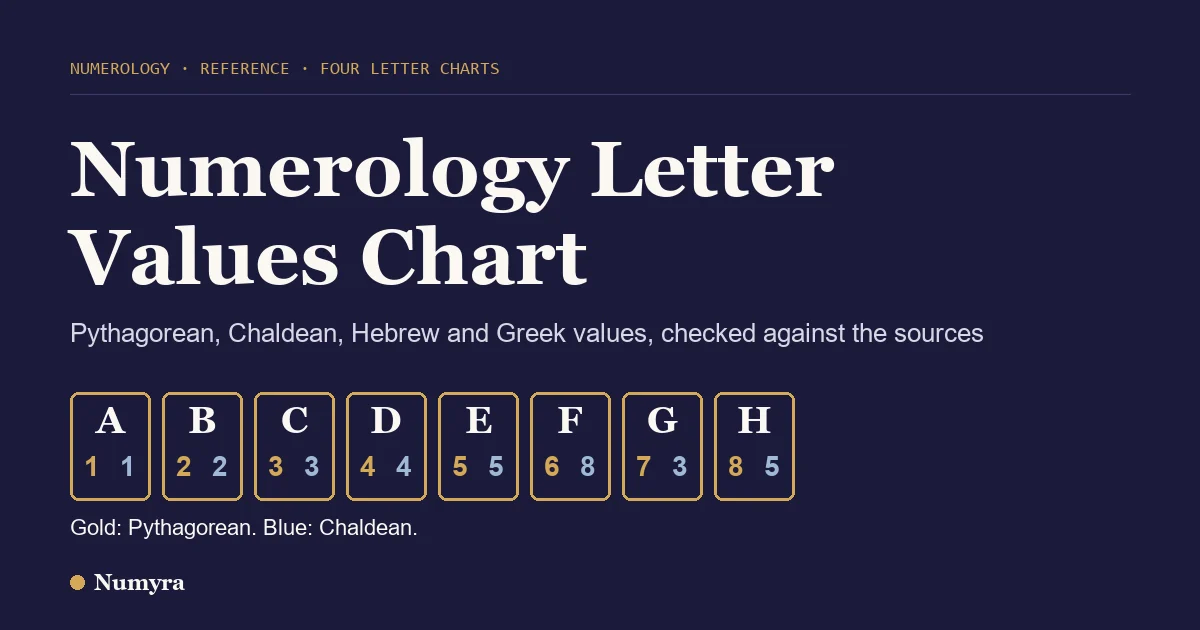
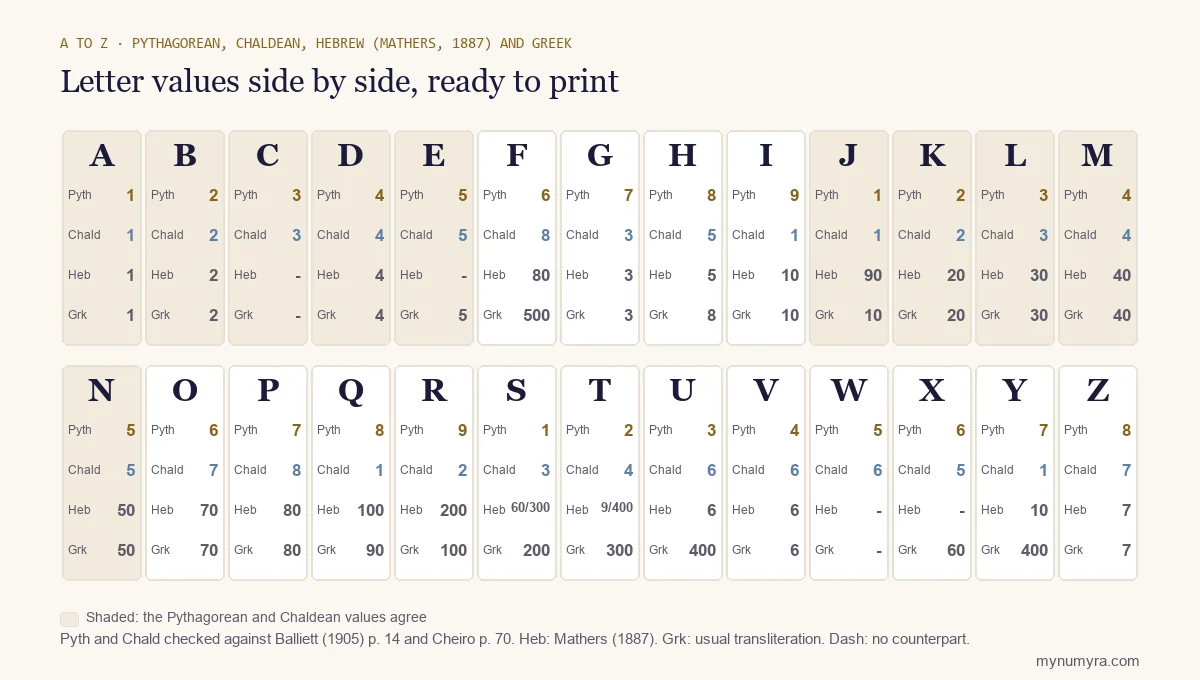
The two charts used for English names assign these values: Pythagorean, A to I = 1 to 9 and then the cycle repeats (J = 1 again); Chaldean, 1 to 8 by sound, with nothing worth 9. They agree on only 10 of the 26 letters (A to E and J to N) and differ on the other 16, which is why the same name can give two different numbers. The older Hebrew and Greek systems give each letter a value from 1 to 9, then 10 to 90, then 100 to 400 (Hebrew) or 900 (Greek), so their totals run into the hundreds. This page sets all four side by side, shows where each chart first appears in print, and records that we checked every entry against page scans of the sources.
Key takeaways
- The Pythagorean chart in today’s calculators is letter for letter the chart printed by L. Dow Balliett on page 14 of her 1905 book, and the Chaldean chart is letter for letter the table on page 70 of Cheiro’s Book of Numbers. We checked all 26 letters in each against the page scans.
- The two charts give the same value for 10 letters and different values for 16. For popular first names (5,024 name and sex pairs, 1950 to 2008) they give the same final number for 8.1% of names, weighted by popularity and keeping 11, 22 and 33.
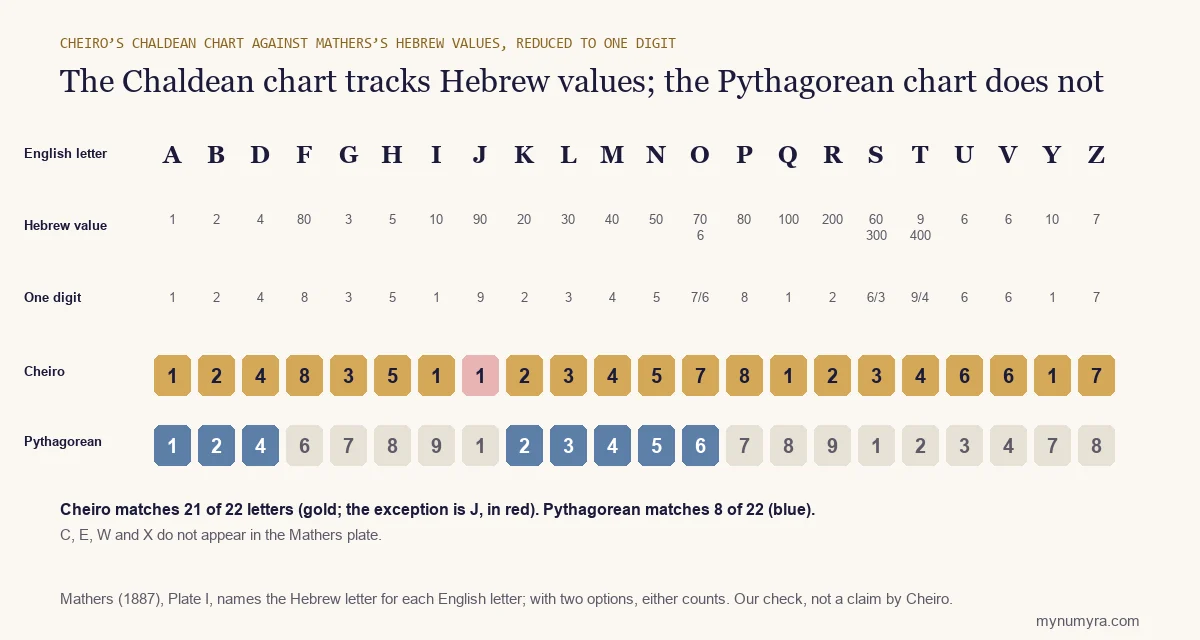
- Cheiro called his chart the “ancient Chaldean and Hebrew alphabet”. In our check, 21 of the 22 English letters that Mathers’s 1887 table matches to a Hebrew letter get the Chaldean value that equals that Hebrew letter’s value reduced to one digit; the Pythagorean chart matches 8 of the 22.
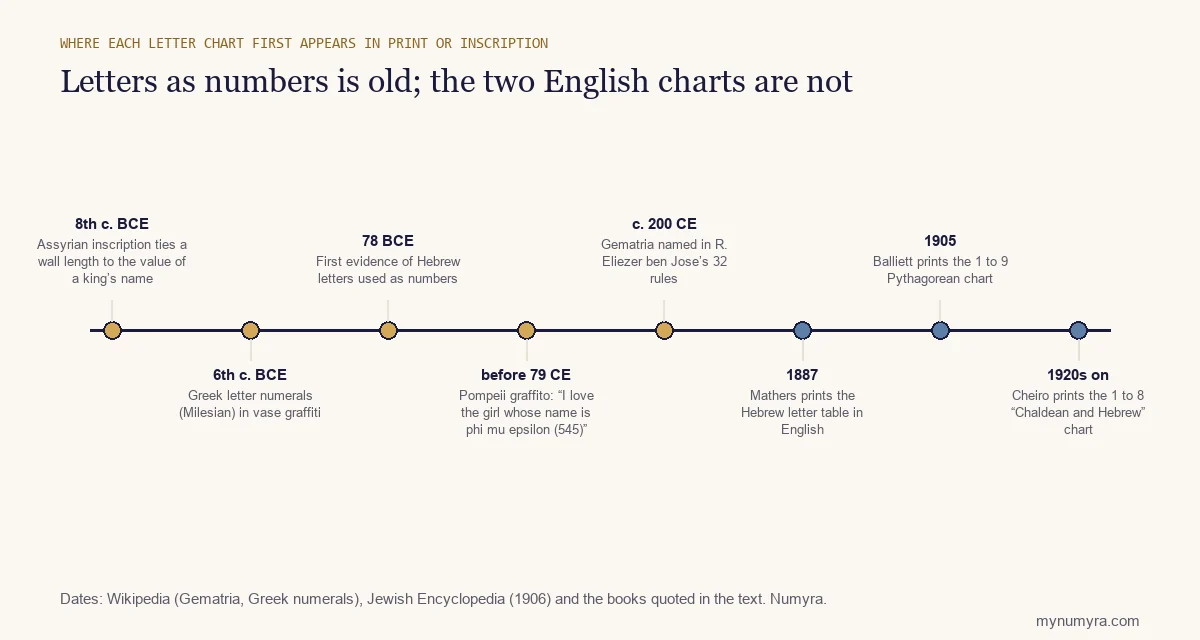
- Hebrew gematria (standard values), Greek isopsephy and the English charts all turn letters into numbers, but only the first two are ancient. The earliest print source we found for the Pythagorean chart is a 1905 book, and for the Chaldean chart Cheiro’s Book of Numbers, which our Cheiro profile dates to 1926.
- No chart has been shown to describe personality or predict events; our review of whether numerology is real covers the tests that exist. These are reference tables for a tradition.
In this guide
- The A to Z chart in four systems
- Where the Pythagorean and Chaldean charts disagree
- Where the Pythagorean chart comes from
- Where the Chaldean chart comes from
- Hebrew gematria values
- Greek isopsephy values
- Other versions of these charts
- Using the chart on a name
- How we checked every entry
- Frequently asked questions
The A to Z chart in four systems
Hebrew has 22 letters and Greek has 24, so there is no single answer to “what is the value of Q in Hebrew”. The Hebrew column below uses the equivalents in the English-letter table that S. L. MacGregor Mathers printed in 1887, and the Greek column uses the usual transliteration. Where English has no letter in the table, we show a dash rather than guess. Print the image or the table below as a quick reference.
| Letter | Pythagorean | Chaldean | Same value? | Hebrew (Mathers, 1887) | Greek |
|---|---|---|---|---|---|
| A | 1 | 1 | yes | 1 | 1 |
| B | 2 | 2 | yes | 2 | 2 |
| C | 3 | 3 | yes | none | none |
| D | 4 | 4 | yes | 4 | 4 |
| E | 5 | 5 | yes | none | 5 |
| F | 6 | 8 | no | 80 | 500 |
| G | 7 | 3 | no | 3 | 3 |
| H | 8 | 5 | no | 5 | 8 |
| I | 9 | 1 | no | 10 | 10 |
| J | 1 | 1 | yes | 90 | 10 |
| K | 2 | 2 | yes | 20 | 20 |
| L | 3 | 3 | yes | 30 | 30 |
| M | 4 | 4 | yes | 40 | 40 |
| N | 5 | 5 | yes | 50 | 50 |
| O | 6 | 7 | no | 70 or 6 | 70 |
| P | 7 | 8 | no | 80 | 80 |
| Q | 8 | 1 | no | 100 | 90 |
| R | 9 | 2 | no | 200 | 100 |
| S | 1 | 3 | no | 60 or 300 | 200 |
| T | 2 | 4 | no | 9 or 400 | 300 |
| U | 3 | 6 | no | 6 | 400 |
| V | 4 | 6 | no | 6 | 6 |
| W | 5 | 6 | no | none | none |
| X | 6 | 5 | no | none | 60 |
| Y | 7 | 1 | no | 10 | 400 |
| Z | 8 | 7 | no | 7 | 7 |
Notes: the Hebrew values for S (Samekh 60 or Shin 300) and T (Teth 9 or Tau 400) are both listed because Mathers gives two equivalents for each. For O he lists Ayin (70) first and Vau (6) as the second option. The Greek values for H (Eta), J (Iota), Q (Koppa), V (the old letter digamma, written as stigma), X (Xi) and Y (Upsilon) are conventions of transliteration, not ancient rules.
Where the Pythagorean and Chaldean charts disagree
Both charts agree on A, B, C, D, E, J, K, L, M and N. They disagree on F, G, H, I, O, P, Q, R, S, T, U, V, W, X, Y and Z, and the gaps are large: I is 9 in one chart and 1 in the other, R is 9 against 2, and Y is 7 against 1. The Chaldean chart never uses 9 as a letter value, though a name can still add up to a 9.
The effect on real names is large. We calculated both numbers for the 5,024 distinct first-name and sex pairs that appear in the US Social Security Administration’s yearly top-1,000 lists from 1950 to 2008. Using the same rule our calculators use (add every letter, reduce, keep 11, 22 and 33), the charts give the same number for 445 of them (8.9%), or 8.1% when each name is weighted by how often it was given. Reducing every name to a single digit instead gives 498 names (9.9%), or 8.6% weighted. That 8.1% is the figure on our Destiny Number pages, and our comparison of the two systems explains why the two charts exist.
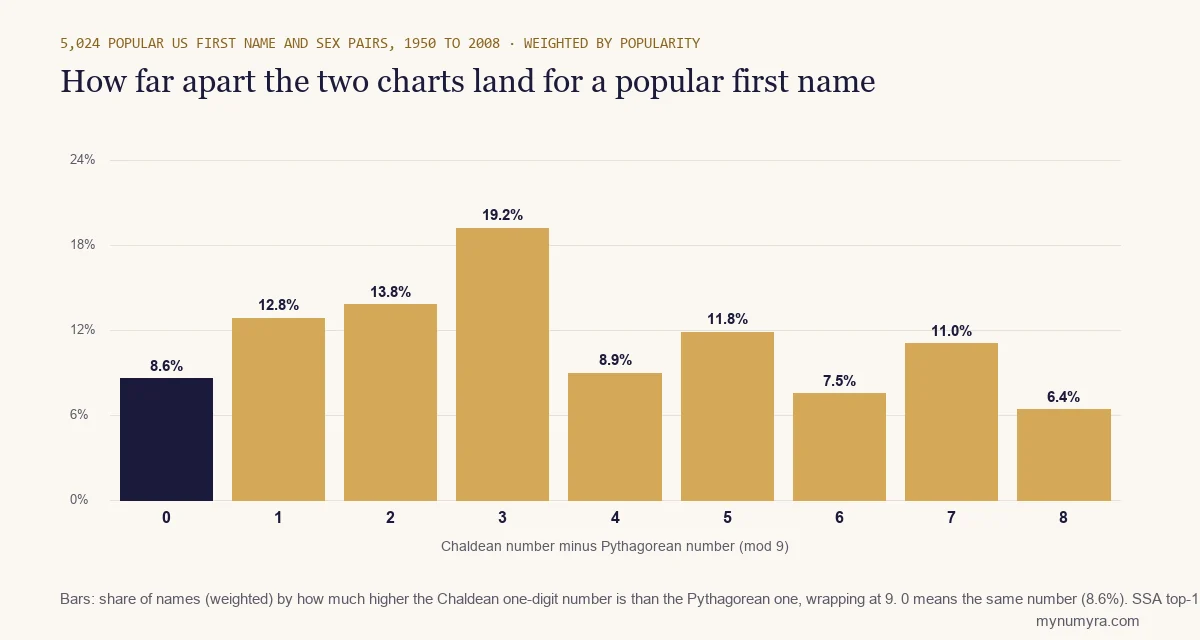
Why so low when ten letters agree? Those ten are common: they make up 56% of all letters in these names, weighted. But a name needs every one of its letters to agree to be safe, and only 211 of the 5,024 names (4.2%) are built entirely from those ten letters. Across all the names, the Chaldean number is most often 3 above the Pythagorean one (19.2% of names, weighted, counting around the cycle of 9), and the two numbers match for fewer than one name in ten.
Where the Pythagorean chart comes from
The chart is printed in How to Attain Success Through the Strength of Vibration (Atlantic City, 1905; we read the 1913 printing) by Mrs. L. Dow Balliett. She introduces it by attributing it to Pythagoras:
Pythagoras says every letter of the alphabet has its own rate of vibration and color. He divided numbers in this way:
L. Dow Balliett, How to Attain Success Through the Strength of Vibration, 1905, p. 11 (Internet Archive scan)
On page 14 she tells the reader to “divide the alphabet into nine parts” and prints the grid: A, J, S under 1; B, K, T under 2; C, L, U under 3; D, M, V under 4; E, N, W under 5; F, O, X under 6; G, P, Y under 7; H, Q, Z under 8; and I, R under 9. It is identical to our Pythagorean column, letter for letter. The passage cites no ancient text for the grid, and our history of numerology explains why the modern chart is dated to her book rather than to Pythagoras himself. Her worked example, a name she calls John Ellicott, gives J = 1, O = 6, H = 8 and N = 5 for the first name, which matches the chart.
Where the Chaldean chart comes from
The Chaldean chart appears in Cheiro’s Book of Numbers (London: Herbert Jenkins; we read the seventh impression). Cheiro, the pen name of William John Warner, prints it as a table on page 70 and says where he thinks it came from:
This ancient Chaldean and Hebrew alphabet sets out the number or value of each letter. It is the best system I know for this purpose, its origin is lost in antiquity, but it is believed that it was originated by the Chaldeans, who were masters in all magical arts, and by them passed to the Hebrews.
Cheiro, Cheiro’s Book of Numbers, p. 70 (Internet Archive scan)
His values are A = 1, B = 2, C = 3, D = 4, E = 5, F = 8, G = 3, H = 5, I or J = 1, K = 2, L = 3, M = 4, N = 5, O = 7, P = 8, Q = 1, R = 2, S = 3, T = 4, U, V and W = 6, X = 5, Y = 1 and Z = 7, the same 26 values as our Chaldean column. He explains the missing 9 in religious terms: “there is no number 9 given in the above alphabet” because the ancient masters “knew that in the ‘Highest Sphere’ the number 9 represents the 9-lettered name of God” (pp. 70 to 71). Our profile of Cheiro covers what is and is not documented about him, and the claim that he learned the system in India rests on his own account. We have not found a printed chart earlier than his book, but we have not searched every earlier source.
His statement that the chart is “Hebrew” can be tested. Mathers’s 1887 table pairs English letters with Hebrew ones and gives each Hebrew letter’s standard value. We reduced each of those values to one digit (90 becomes 9, 100 becomes 1) and compared with the two charts:
| English letter | Hebrew letter and value (Mathers) | One digit | Cheiro (Chaldean) | Pythagorean | Cheiro matches? |
|---|---|---|---|---|---|
| A | Aleph 1 | 1 | 1 | 1 | yes |
| B | Beth 2 | 2 | 2 | 2 | yes |
| D | Daleth 4 | 4 | 4 | 4 | yes |
| F | Pe 80 | 8 | 8 | 6 | yes |
| G | Gimel 3 | 3 | 3 | 7 | yes |
| H | He 5 | 5 | 5 | 8 | yes |
| I | Yod 10 | 1 | 1 | 9 | yes |
| J | Tzaddi 90 | 9 | 1 | 1 | no |
| K | Caph 20 | 2 | 2 | 2 | yes |
| L | Lamed 30 | 3 | 3 | 3 | yes |
| M | Mem 40 | 4 | 4 | 4 | yes |
| N | Nun 50 | 5 | 5 | 5 | yes |
| O | Ayin 70 or Vau 6 | 7/6 | 7 | 6 | yes |
| P | Pe 80 | 8 | 8 | 7 | yes |
| Q | Qoph 100 | 1 | 1 | 8 | yes |
| R | Resh 200 | 2 | 2 | 9 | yes |
| S | Samekh 60 or Shin 300 | 6/3 | 3 | 1 | yes |
| T | Teth 9 or Tau 400 | 9/4 | 4 | 2 | yes |
| U | Vau 6 | 6 | 6 | 3 | yes |
| V | Vau 6 | 6 | 6 | 4 | yes |
| Y | Yod 10 | 1 | 1 | 7 | yes |
| Z | Zayin 7 | 7 | 7 | 8 | yes |
For 21 of the 22 letters in Mathers’s table, Cheiro’s value is the one-digit form of the Hebrew value (for S and T, taking Shin and Tau). The Pythagorean chart matches for 8: seven are letters on which the two English charts already agree, and the eighth is O, through the option Vau. The exception is J, which Cheiro treats as I (1) while Mathers lists J with the Hebrew letter Tzaddi (90). Four letters, C, E, W and X, are not in Mathers’s table at all. This is our observation: neither Cheiro nor Mathers states the link, and a reduced-Hebrew origin would not make the chart ancient. It does explain why there is no 9: the two Hebrew letters worth 9 and 90, Teth and Tzaddi, are not the ones Cheiro’s English letters line up with.
Hebrew gematria values
Hebrew gematria assigns the 22 letters the values 1 to 9, 10 to 90 and 100 to 400. This standard method is called mispar hechrachi, and a variant, mispar gadol, counts the five final letter forms as 500 to 900. The 1906 Jewish Encyclopedia also lists a “cyclical or minor value” in which tens and hundreds are reduced to units, which is the same one-digit reduction numerologists use.
| Letter | Name | Standard value | One-digit (minor) value | Final form value (mispar gadol) |
|---|---|---|---|---|
| א | Aleph | 1 | 1 | |
| ב | Bet | 2 | 2 | |
| ג | Gimel | 3 | 3 | |
| ד | Dalet | 4 | 4 | |
| ה | He | 5 | 5 | |
| ו | Vav | 6 | 6 | |
| ז | Zayin | 7 | 7 | |
| ח | Het | 8 | 8 | |
| ט | Tet | 9 | 9 | |
| י | Yod | 10 | 1 | |
| כ | Kaf | 20 | 2 | ך 500 |
| ל | Lamed | 30 | 3 | |
| מ | Mem | 40 | 4 | ם 600 |
| נ | Nun | 50 | 5 | ן 700 |
| ס | Samekh | 60 | 6 | |
| ע | Ayin | 70 | 7 | |
| פ | Pe | 80 | 8 | ף 800 |
| צ | Tsadi | 90 | 9 | ץ 900 |
| ק | Qof | 100 | 1 | |
| ר | Resh | 200 | 2 | |
| ש | Shin | 300 | 3 | |
| ת | Tav | 400 | 4 |
Letters as numbers are old. A widely quoted Assyrian inscription from the 8th century BCE says Sargon II built a wall 16,283 cubits long to match the numerical value of his name, and the first evidence of Hebrew letters used as numbers dates to 78 BCE (both from Wikipedia’s article on gematria, which cites its sources). The Jewish Encyclopedia says the term first occurs in the 29th of the 32 hermeneutic rules of R. Eliezer ben Jose the Galilean, about the year 200, and that “in the Bible itself there is no reference to numerical gemaṭria”. Its example is Genesis 14:14, where the number 318 equals the value of “Eliezer”.
Mathers explains why Hebrew letters can serve as numbers:
There are no separate numeral characters in Hebrew and Chaldee; therefore, as is also the case in Greek, each letter has its own peculiar numerical value, and from this circumstance results the important fact that every word is a number, and every number is a word.
S. L. MacGregor Mathers, The Kabbalah Unveiled, Introduction, p. 4 (Internet Archive scan of the 1912 printing)
One link people assume does not hold. The Sefer Yetzirah, the early text on the 22 letters (our comparison with Kabbalah numerology gives its dating), sorts them into “Three Mothers, Seven Pairs, and Twelve Simple Letters”. In the English translation we searched, the words “numerical”, “value” and “gematria” do not appear. The letter values come from the gematria tradition, not from that book.
Greek isopsephy values
Greek letters also double as numbers, a system called Milesian numerals. Units run from alpha to theta, tens from iota to koppa, and hundreds from rho to sampi. Three letters that dropped out of everyday spelling, stigma (or digamma), koppa and sampi, keep their places as 6, 90 and 900.
| Letter | Name | Value | One digit | Usual Latin equivalent |
|---|---|---|---|---|
| α | Alpha | 1 | 1 | A |
| β | Beta | 2 | 2 | B |
| γ | Gamma | 3 | 3 | G |
| δ | Delta | 4 | 4 | D |
| ε | Epsilon | 5 | 5 | E |
| ϛ | Stigma (digamma) | 6 | 6 | V or W |
| ζ | Zeta | 7 | 7 | Z |
| η | Eta | 8 | 8 | long E, H |
| θ | Theta | 9 | 9 | TH |
| ι | Iota | 10 | 1 | I |
| κ | Kappa | 20 | 2 | K |
| λ | Lambda | 30 | 3 | L |
| μ | Mu | 40 | 4 | M |
| ν | Nu | 50 | 5 | N |
| ξ | Xi | 60 | 6 | X |
| ο | Omicron | 70 | 7 | O |
| π | Pi | 80 | 8 | P |
| ϟ | Koppa | 90 | 9 | Q |
| ρ | Rho | 100 | 1 | R |
| σ | Sigma | 200 | 2 | S |
| τ | Tau | 300 | 3 | T |
| υ | Upsilon | 400 | 4 | U or Y |
| φ | Phi | 500 | 5 | PH or F |
| χ | Chi | 600 | 6 | CH |
| ψ | Psi | 700 | 7 | PS |
| ω | Omega | 800 | 8 | long O |
| ϡ | Sampi | 900 | 9 | none |
The practice of adding up the letters of a name or phrase is called isopsephy. Wikipedia records early Greek letter-number graffiti on 6th-century BCE vases and a Pompeii graffito, from before 79 CE, reading “I love the girl whose name is phi mu epsilon (545)”. The best-known example is the number of the beast. The King James translation of Revelation 13:18 reads: “Let him that hath understanding count the number of the beast: for it is the number of a man; and his number is Six hundred threescore and six.” In medieval manuscripts the number is written χξϛ, that is 600 + 60 + 6, using the same stigma that appears in the table.
Other versions of these charts
None of these charts is one fixed standard. One numerology site (Astronumero) notes that Walter Gibson, described there as Cheiro’s younger English contemporary, gave some letters different values, quoted there as X = 6, C = 2, H = 8, CH = 8 and TH = 9, and offers its own “improved” chart with H = 8, S = 6, T = 9 and E = 9. We could not check Gibson’s book, so these changes are reported as that site states them. Its argument is that the 9 is not missing in Hebrew, because Teth is worth 9, which fits the Hebrew link shown above.
Smaller differences are common. Some pages treat Y as a vowel, others as a consonant. Our calculators count Y as a vowel only when no other vowel appears in its syllable. Hebrew gematria has the mispar gadol variant for final forms, and the “Kabbalah” chart on many English sites, A = 1 to Z = 26, is a modern ordinal scheme, not the Hebrew values; see Pythagorean, Chaldean and Kabbalah numerology.
Using the chart on a name
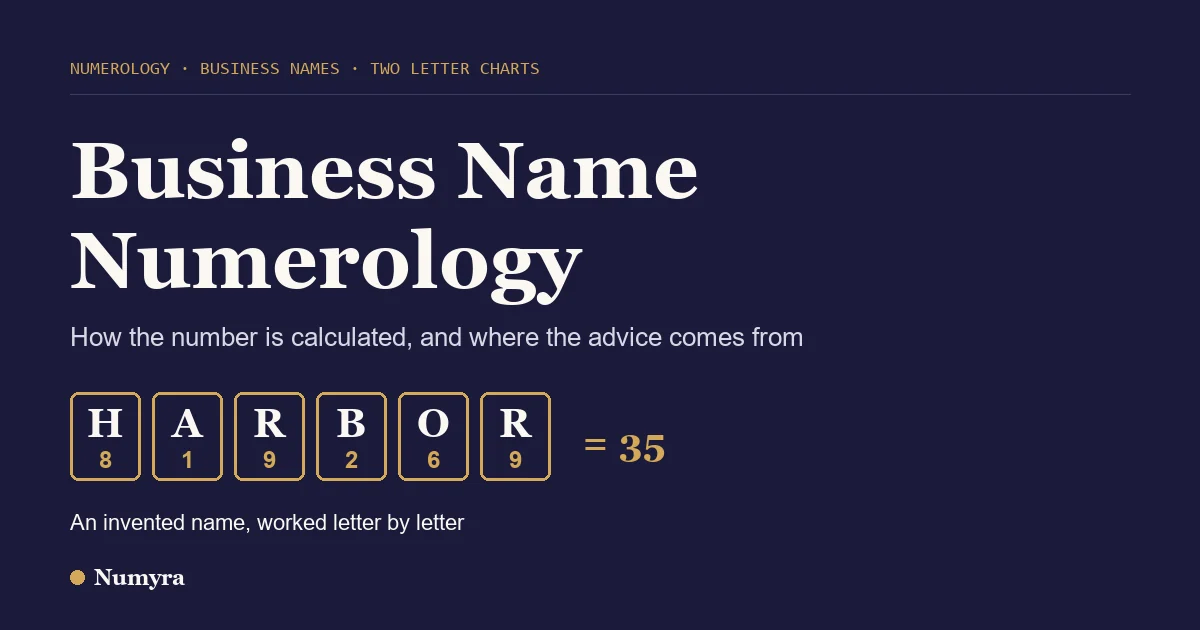
Write the letters, look up each value in the column you chose, add them and reduce the total, keeping 11, 22 and 33 (see why they are master numbers). For the invented name Owen Park, the Pythagorean values are 6, 5, 5, 5 and 7, 1, 9, 2, which total 40 and reduce to 4. The Chaldean values are 7, 6, 5, 5 and 8, 1, 2, 2, which total 36 and reduce to 9. One name, two numbers, as the 8.1% figure predicts. Say which chart you used wherever you quote a result.
The name numerology calculator does the addition in either chart, calculating a chart by hand shows the full process, and Expression, Soul Urge and Personality explains which letters count for which number. The same arithmetic applies to business names, where the chart choice changes the number for nine names in ten.
How we checked every entry
Pythagorean and Chaldean. We read page 14 of Balliett (1905) and page 70 of Cheiro from the Internet Archive page images and compared all 26 letters in each with the chart our calculators use; both match exactly. Hebrew. Values come from Wikipedia’s table of mispar hechrachi and gadol and were checked against Plate I in Mathers (1887), read from its page image. Greek. Values come from Wikipedia’s article on Greek numerals. The Latin equivalents are the usual transliteration, a convention. Names. The Social Security Administration top-1,000 lists for 1950 to 2008, as compiled in the open “data-baby-names” repository: 5,024 distinct name and sex pairs, weighted by the sum of yearly percentages. This reproduces the 8.1% on our Destiny Number pages. Limits. We checked the English charts against two printed sources but did not search for earlier ones, we did not read Gibson, and the Hebrew link is our own comparison.
Frequently asked questions
What is the value of each letter in numerology?
In the Pythagorean chart A to I are 1 to 9 and the cycle repeats, so J = 1, K = 2 and so on to Z = 8. In the Chaldean chart the values run 1 to 8 by sound (A, I, J, Q, Y = 1; B, K, R = 2; C, G, L, S = 3; D, M, T = 4; E, H, N, X = 5; U, V, W = 6; O, Z = 7; F, P = 8). The table above has all 26 letters.
Why does the Chaldean chart skip 9?
Cheiro wrote that the ancient masters knew the number 9 stands for the 9-lettered name of God, so no single letter was given it. A name can still total 9. Our own comparison suggests another reason, that the Hebrew letters worth 9 and 90 are not the ones the English letters line up with.
How many letters do the Pythagorean and Chaldean charts agree on?
Ten: A, B, C, D, E, J, K, L, M and N. They disagree on the other 16. For popular first names, the final numbers match for about 8 to 10% of names, depending on the rule used.
What are the Hebrew gematria values of the letters?
Aleph to Tet are 1 to 9, Yod to Tsadi are 10 to 90, and Qof, Resh, Shin and Tav are 100, 200, 300 and 400. In the larger scheme (mispar gadol) the five final forms are 500 to 900.
What are the Greek isopsephy values?
Alpha to theta are 1 to 9, iota to koppa are 10 to 90, and rho to sampi are 100 to 900. The old letters stigma, koppa and sampi stand for 6, 90 and 900.
Is the Chaldean chart really ancient?
Cheiro says it is, but the earliest printed chart we found is in his own book. Its values match reduced Hebrew letter values, which suggests a Hebrew source, though that is our comparison and not a documented history.
Did Pythagoras create the Pythagorean chart?
The earliest printed source we found for the chart is Balliett’s 1905 book, which attributes it to Pythagoras without citing a text. We found no ancient source for the grid, so treat the name as a label.
Which chart should I use?
Neither has been shown to work better, and our review of whether numerology is real found no tests of either. Pick one, say which, and use it consistently. The Pythagorean chart is the default in our calculators.
Sources
- Balliett, L. Dow. How to Attain Success Through the Strength of Vibration. Atlantic City: L. N. Fowler, 1905 (1913 printing). Internet Archive scan.
- Cheiro. Cheiro’s Book of Numbers. London: Herbert Jenkins, seventh impression. Internet Archive scan (Digital Library of India).
- Mathers, S. L. MacGregor. The Kabbalah Unveiled. London: G. Redway, 1887 translation (1912 printing), Introduction, Plate I. Internet Archive scan.
- Schechter, S., and Levias, C. “Gemaṭria.” The Jewish Encyclopedia, 1906.
- Wikipedia. “Gematria.” Hebrew letter values, mispar hechrachi and mispar gadol, and the history cited above.
- Wikipedia. “Greek numerals.” Greek letter values.
- Sefer Yetzirah, Sefaria Community Translation (CC0), read 22 October 2026.
- Revelation 13:18, King James Version (public domain).
- Astronumero. “Numerology Charts: Converting Letters Into Numbers.” Cited for variant Chaldean charts.
- hadley/data-baby-names, top-1,000 US baby names by year from the Social Security Administration.