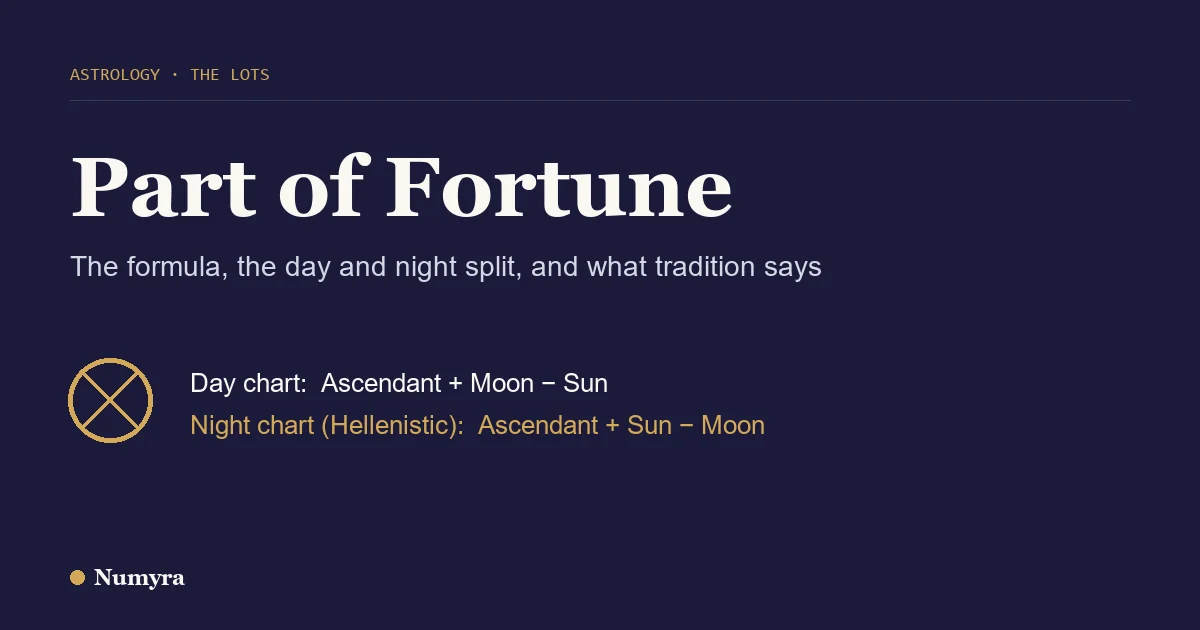
The Part of Fortune, also called the Lot of Fortune or Pars Fortunae, is a calculated point in a birth chart, not a planet: it is found by measuring the distance from the Sun to the Moon and laying that same distance off from the Ascendant. In a day chart that is Ascendant + Moon − Sun. In a night chart, many traditional sources reverse it to Ascendant + Sun − Moon, while Ptolemy and most modern software use the day formula for everyone. Tradition links the point to the body, health and material circumstances. That is an interpretation, not a measured effect.
Key takeaways
- Day chart (Sun above the horizon): Ascendant + Moon − Sun. Night chart (Sun below it): Ascendant + Sun − Moon in the Hellenistic method. Ptolemy and William Lilly use the day formula by night as well.
- In our sample of 60,000 random birth moments in New York, about 46% of charts get a different Part of Fortune sign depending on which night rule a calculator uses (the rest are day charts, where the rules agree).
- Day-formula Fortune sits as many degrees past the Ascendant as the Moon is past the Sun: on the Ascendant at New Moon, on the Descendant at Full Moon.
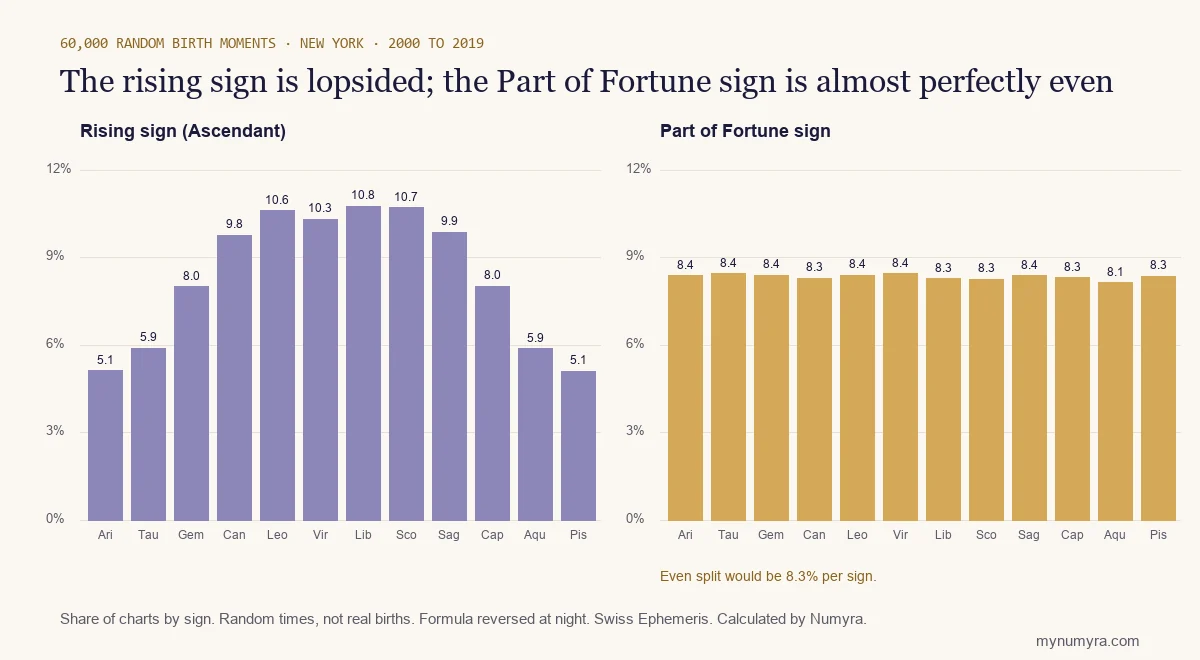
- No sign or house is rare: Fortune lands in each of the 12 signs in 8.1% to 8.4% of charts, even though rising signs are lopsided.
- Fortune travels fast, about 15 degrees an hour, so it needs an accurate birth time. With the day formula it changes sign about every 1 hour 56 minutes.
In this guide
- What the Part of Fortune is
- The formula for day and night charts
- Why sources disagree about night charts
- Worked examples: a 1647 chart and two NASA launches
- How to find yours
- How the Part of Fortune moves through a day and a month
- How common each sign and house is
- What it traditionally means
- Frequently asked questions
What the Part of Fortune is
A Lot (or Part) is a point built by arithmetic from three places in the chart, usually the Ascendant plus the distance between two other points. The Part of Fortune is the oldest and best known. Its Greek name is klēros tychēs and its Latin name Pars Fortunae, from the Roman goddess Fortuna. Medieval astrologers assumed the Arabs had invented the Lots and called them “Arabic Parts,” but, as astrologer David Plant notes on Skyscript, the technique was inherited from Greek and Roman astrology and appears in the Roman author Firmicus Maternus’s Mathesis in the 4th century. Wikipedia’s article on the Arabic parts adds that the Lots were an established tenet of Hellenistic practice by the time of Dorotheus of Sidon in the first century.
The reasoning behind the formula is geometric. Ptolemy, writing in the second century, explains it in Book III of his Tetrabiblos (our guide to the Tetrabiblos covers the book as a whole):
“Take as the Lot of Fortune always the amount of the number of degrees, both by night and by day, which is the distance from the sun to the moon” … “and that it may be as it were a lunar horoscope.”
Ptolemy, Tetrabiblos, Book III, chapter 10, trans. F. E. Robbins (Loeb Classical Library, 1940), via LacusCurtius
“Lunar horoscope” means this. The Ascendant is where the Sun stands relative to the horizon at birth. Fortune is placed so that the Moon bears the same relationship to Fortune that the Sun bears to the Ascendant. It is the Moon’s own rising point, which is why it is treated as a companion to the Ascendant rather than as a planet.
The formula for day and night charts
All positions are written as ecliptic longitude from 0° Aries, where each sign is 30°: 0° Taurus is 30°, 0° Gemini is 60°, and so on to 360°. Add and subtract the longitudes, then add or subtract 360° until the answer is between 0° and 360°. The result converts back to a sign and degree.
| Chart type | Sun position | Formula (sect-reversing method) | Formula (single-formula method) |
|---|---|---|---|
| Day chart | Above the horizon (houses 7 to 12) | Ascendant + Moon − Sun | Ascendant + Moon − Sun |
| Night chart | Below the horizon (houses 1 to 6) | Ascendant + Sun − Moon | Ascendant + Moon − Sun |
The day or night status of a chart is called its sect. To read it, check where the Sun is: in a chart drawn with the Ascendant at the left, the Sun is above the horizon if it sits in the upper half, between the Descendant and the Ascendant going over the Midheaven. The two methods are identical for day charts and differ only for night charts. If you are new to chart angles, our guide to astrological houses and the Midheaven show where they sit.
Why sources disagree about night charts
The most common reason two websites give different Part of Fortune signs is the night rule, and the split is old. Ptolemy’s wording above says “always … both by night and by day,” so the arc runs from Sun to Moon in every chart. The Loeb edition’s footnote records that some manuscripts add a gloss about reversing the direction of the count, and its editor judges that gloss to be a later marginal note, not Ptolemy’s own words. The reversing rule comes from the Hellenistic tradition: Wikipedia’s Arabic parts article gives the Lot of Fortune for Paulus Alexandrinus as Ascendant + Moon − Sun by day and Ascendant + Sun − Moon by night, and David Plant describes the same day and night rule for Firmicus.
English astrology followed Ptolemy. William Lilly’s Christian Astrology (1647) gives the single formula, mentions the other method, and says which one practitioners then used:
“Ptolomie, day and night takes it as above directed, with whom al Practicioners at this day consent.”
William Lilly, Christian Astrology (London, 1647), chapter 23, “Of the Part of Fortune, and how to take it, either by Day or Night,” p. 144
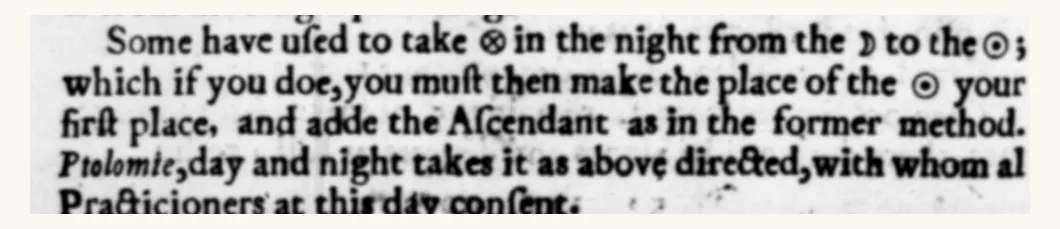
The scan above is the passage; Lilly writes that “some have used” the Moon-to-Sun arc at night, which is the Hellenistic reversal. That is why modern software often shows the day formula for every chart, and why traditional-leaning calculators reverse it. Cafe Astrology’s calculator, for example, states on its page that it uses the reversal, and astrologer Steven Forrest describes learning the day formula first and later finding that the traditional method had two. When your result differs from a friend’s, check this before anything else. Sect matters elsewhere in traditional astrology too, for example in the triplicity rulerships covered in our guide to essential dignities.
How much does it matter? We drew 60,000 random moments between 2000 and 2019 at New York’s latitude and longitude, using the Swiss Ephemeris. Half (50.2%) were day charts. For the other half, the two night rules put Fortune in the same sign only 8.2% of the time. Across all charts that is about 46% of people whose sign changes with the rule. The gap is twice the Moon’s angle from the Sun: nothing at New Moon and Full Moon, and a half circle (180°) at the quarters. These are random clock times, not real births; the real mix of birth hours may shift the share.
Worked examples: a 1647 chart and two NASA launches
Lilly’s own sum, step by step
Lilly’s chapter works an example from a chart he had in front of him. The Moon is at 21°18′ Virgo, the Sun at 4°18′ Aries and the Ascendant at 23°27′ Leo. Converting to longitude, the Moon is 171°18′, the Sun 4°18′ and the Ascendant 143°27′.
- Moon − Sun = 171°18′ − 4°18′ = 167°00′. Lilly writes this as 5 signs 17°.
- Add the Ascendant: 143°27′ + 167°00′ = 310°27′.
- 310°27′ is 10°27′ Aquarius, which is where Lilly places Fortune (“the eleventh in order,” counting from Aries).
We repeated his arithmetic from the printed figures and got the same degree and minute.
A day chart and a night chart, with published times
To show both rules with data anyone can check, we calculated charts for two documented moments, using the launch times NASA publishes: Apollo 11 lifted off at 9:32 a.m. EDT on July 16, 1969, and Apollo 17 at 12:33 a.m. EST on December 7, 1972, both from Launch Complex 39 at Kennedy Space Center (28.608° N, 80.604° W for pad 39A). These are event charts, not people’s charts, which makes them a clean test: one clearly in daylight, one clearly in darkness. Positions come from the Swiss Ephemeris and are rounded to the minute.
| Chart | Ascendant | Sun | Moon | Sect | Fortune: Asc + Moon − Sun | Fortune: Asc + Sun − Moon |
|---|---|---|---|---|---|---|
| Apollo 11 launch | 0°45′ Virgo | 23°49′ Cancer | 15°25′ Leo | Day (Sun in the 11th house, Placidus) | 22°20′ Virgo | 9°10′ Leo (not used) |
| Apollo 17 launch | 20°05′ Virgo | 15°13′ Sagittarius | 0°13′ Capricorn | Night (Sun in the 3rd house, Placidus) | 5°05′ Libra (day formula) | 5°05′ Virgo (night formula) |
For Apollo 11 the Moon is 21.6° ahead of the Sun, so Fortune sits 21.6° past the Ascendant, at 22°20′ Virgo. For Apollo 17 the Moon is 15.0° ahead of the Sun, so the two night rules land exactly 30° apart, 5°05′ Virgo against 5°05′ Libra: the same degree in neighboring signs. The wheel drawings show it.
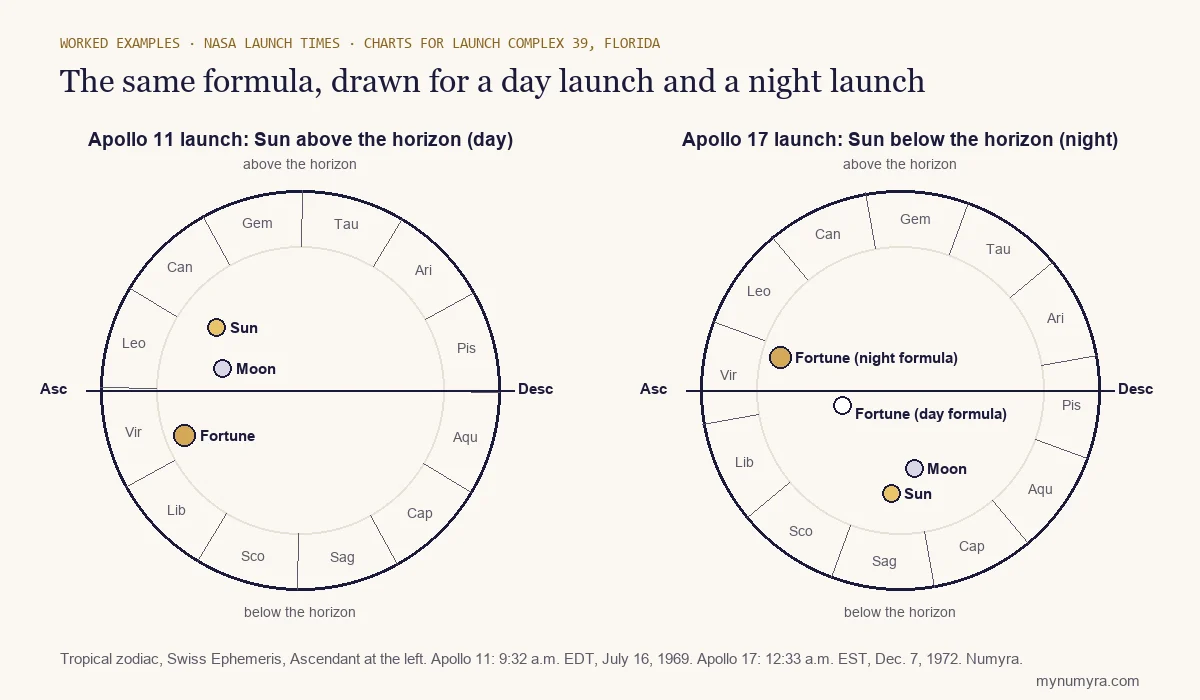
The house system matters too. Using whole-sign houses, Apollo 17’s Virgo Fortune falls in the same sign as the Ascendant (1st house) and the Libra version in the 2nd. With Placidus houses, 5°05′ Virgo sits 15° before the Ascendant and so falls in the 12th. The degree is fixed; the house label depends on the system.
How to find yours
- Get an accurate birth time and place. Without the time you cannot know the Ascendant, so you cannot know Fortune.
- Cast the chart. Our birth chart calculator gives your Sun, Moon and rising sign. To go deeper, see rising signs and Moon signs, and our comparison of the three.
- Decide day or night from the Sun’s position, and decide which night rule you want to follow. State it when you compare notes with anyone.
- Do the sum in degrees from 0° Aries and convert back, as in the examples above.
- Check which zodiac the tool uses. Everything here is tropical; sidereal (Vedic) charts shift every sign about 24 degrees (see sidereal vs. tropical).
If a tool does not show the Part of Fortune, you can get it by hand from the three positions. Our Part of Fortune calculator shows it by both night rules.
How the Part of Fortune moves through a day and a month
Because Fortune is built from the Ascendant, it turns around the chart once a day. We counted its sign changes at New York’s latitude on every fifth day of 2026. With the single day formula, Fortune changed sign 12.5 times a day on average, once every 1 hour 56 minutes, which equals about 373° of travel, or 15.5° an hour. Every four minutes of birth-time error moves Fortune about 1°. A ten-minute error moves Fortune about 2.6°, and a two-hour error can move it a whole sign.
The sect-reversing method adds something unusual. At sunrise and sunset, when the Sun’s center crosses the Ascendant, the point jumps. On October 14, 2026 in New York the Sun’s center reaches the Ascendant at 7:10 a.m. EDT (21°08′ Libra). Just before, the night formula puts Fortune at 7°05′ Virgo. Just after, the day formula puts it at 5°10′ Sagittarius, a leap of 88°. At 6:12 p.m. EDT the jump is 98°. The size is always twice the Sun-Moon angle at that moment (44.0° and 49.1° that day). The sect-reversing method therefore changes Fortune twice a day, and this is why people born close to sunrise or sunset should check both rules.
Over a month, the Moon phase sets where the day-formula point sits relative to the horizon. Day-formula Fortune is always as many degrees past the Ascendant as the Moon is past the Sun; we checked this across all 60,000 sample charts, with a maximum difference of about a ten-trillionth of a degree. That gives the four fixed points below, which match the rule of thumb in Lilly’s book: Fortune is in the Ascendant at a New Moon, in the fourth house at the first quarter, in the seventh at the Full Moon and in the tenth at the last quarter.
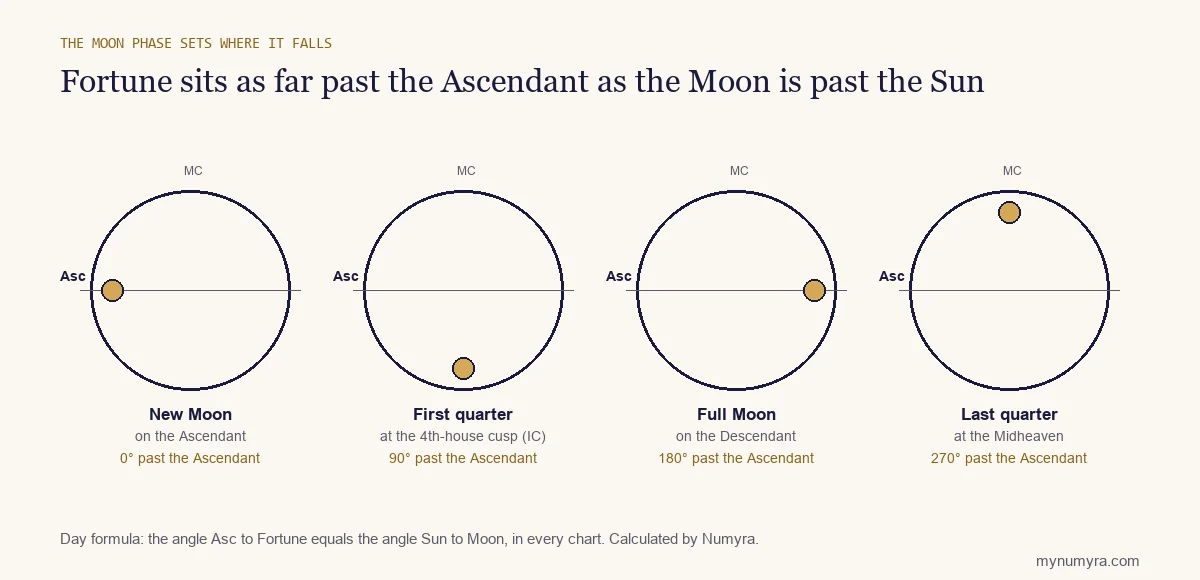
| Phase (Oct. to Nov. 2026) | Moon past Sun | Fortune is at |
|---|---|---|
| New Moon, Oct 10, 15:50 UT | 0° | The Ascendant (1st house cusp) |
| First quarter, Oct 18, 16:13 UT | 90° | The Imum Coeli (4th house cusp) |
| Full Moon, Oct 26, 04:12 UT | 180° | The Descendant (7th house cusp) |
| Last quarter, Nov 1, 20:28 UT | 270° | The Midheaven (10th house cusp) |
The Moon moves 12.2° from the Sun each day on average, ranging from 10.8° to 14.4° over 2026, so Fortune slides that much farther from the Ascendant each day. Reversing the formula at night flips this pattern, so a night chart’s Fortune goes the other way around the chart through the month. For the Moon’s phases themselves, see our piece on moon phases and astrology.
How common each sign and house is
Popular pages sometimes call a Part of Fortune placement rare. The numbers do not support that. In the same sample, Fortune fell in each sign between 8.1% and 8.4% of the time and in each whole-sign house between 8.2% and 8.5%; an even split is 8.3%, and the statistical noise at 60,000 samples is about 0.1 percentage points. The reason is that Fortune adds the Moon’s phase angle, which cycles evenly through all 360°, to the Ascendant. Rising signs are not even at New York’s latitude: Aries and Pisces rise 5.1% of the time, Libra 10.8%.
| Whole-sign house of Fortune | Share of charts | Whole-sign house of Fortune | Share of charts |
|---|---|---|---|
| 1st | 8.3% | 7th | 8.2% |
| 2nd | 8.2% | 8th | 8.2% |
| 3rd | 8.3% | 9th | 8.4% |
| 4th | 8.5% | 10th | 8.4% |
| 5th | 8.4% | 11th | 8.3% |
| 6th | 8.2% | 12th | 8.3% |
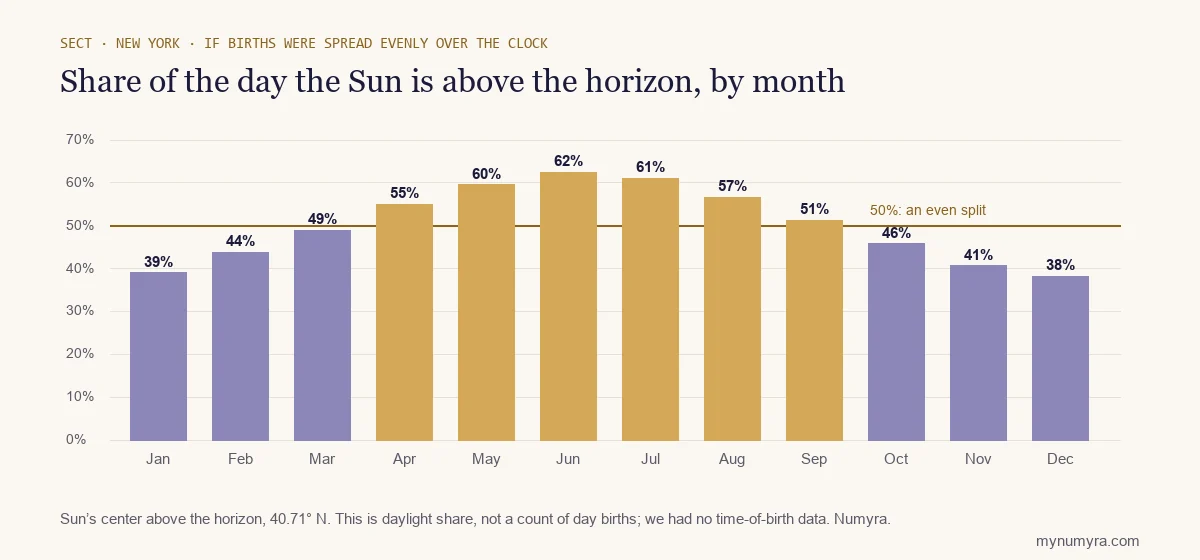
What fraction of births is day births? We cannot say from the data on hand. The US birth datasets we hold (CDC and Social Security Administration counts for 2000 to 2014) give dates, not hours. What we can compute is the share of the clock that is daylight. Weighting each calendar day by its real birth count, and assuming births spread evenly through the 24 hours, the Sun is above the horizon about 50.4% of the time in New York, and between 50.1% and 50.3% in Chicago, Houston and Los Angeles. The seasons swing it far more, from 38% in December to 62% in June in New York. Real births are not evenly spread over the clock, so treat this as a baseline for the sun, not a count of day births.
What it traditionally means
These are interpretive traditions. Nothing here has been shown to predict events, and none of it replaces judgment about your own life.
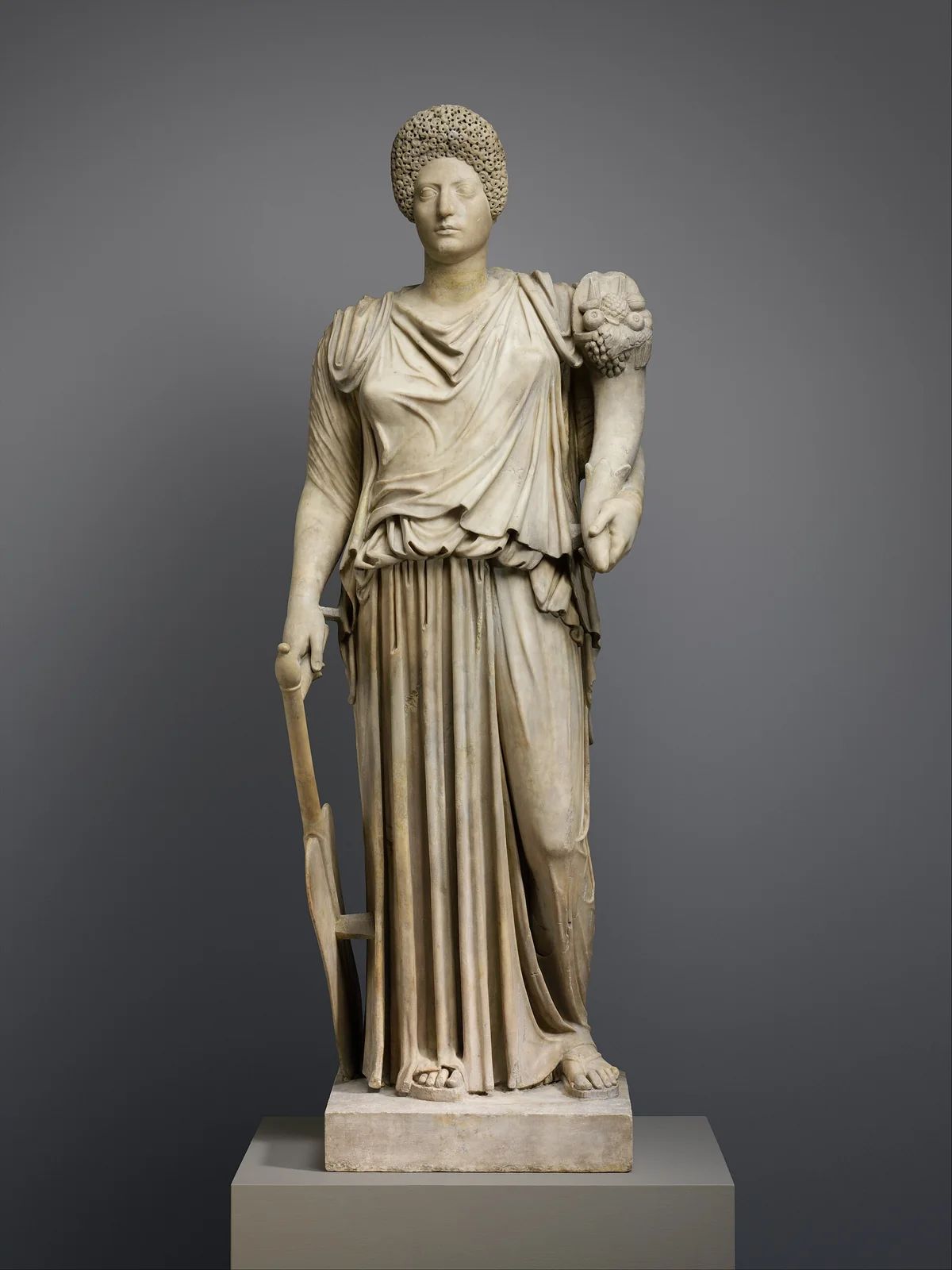
In the Hellenistic and later traditions the Part of Fortune stands for the body, fortune and health, in contrast to its partner, the Lot of Spirit, which represents the initiative a person takes (a reading Wikipedia summarizes). Plant reports that Firmicus saw Fortune as showing the quality of life, and Forrest notes that traditionally it is a lucky point tied to material success and health. Lilly used it in horary and other chart work as a quick check of someone’s circumstances:
“if we find it well placed in the heaven, in a good house, or in a good aspect of a Benevolent Planet”
William Lilly, Christian Astrology (London, 1647), chapter 23, p. 143
Lilly goes on to say that a well-placed Fortune points to a sound and firm estate for the person asking, and the reverse if it is badly placed. Today’s readings are looser. Cafe Astrology associates the point with worldly success and the physical body, and Steven Forrest reads it psychologically, as a place to align outer life with inner purpose. The house gives the setting:
| House | Area traditionally highlighted |
|---|---|
| 1st | Body, self, how you meet the world |
| 2nd | Money, possessions, resources |
| 3rd | Learning, siblings, short trips |
| 4th | Home, family, property |
| 5th | Creativity, romance, children |
| 6th | Work routines, health habits |
| 7th | Partnerships |
| 8th | Shared money, deep change |
| 9th | Travel, study, belief |
| 10th | Career and public standing |
| 11th | Friends, groups, hopes |
| 12th | Rest, retreat, the hidden (see the 12th house) |
The Lot of Spirit is the mirror image: Ascendant + Sun − Moon by day and Ascendant + Moon − Sun by night. Other calculated points include the North Node and Black Moon Lilith; like them, Fortune is a derived point with no body behind it, which is also why charts disagree about it.
A sensible next step is to cast your chart, note which night rule your calculator used, and compare both results before reading any interpretation.
Frequently asked questions
How do I calculate my Part of Fortune?
Convert your Ascendant, Sun and Moon to longitude from 0° Aries. For a day chart, compute Ascendant + Moon − Sun. For a night chart use either the same formula or the reversed one, Ascendant + Sun − Moon. Then add or subtract 360° to get a number from 0 to 360 and convert it back to a sign and degree.
What is the Part of Fortune formula for a night birth?
The Hellenistic method reverses it to Ascendant + Sun − Moon. Ptolemy and William Lilly keep Ascendant + Moon − Sun at night. Modern software varies, so check which one yours uses.
Is the Lot of Fortune the same as the Part of Fortune?
Yes. “Lot” is the older term from Greek astrology and “Part” is the Latin and medieval one. Pars Fortunae and Fortuna are other names for it.
Do I need an exact birth time?
Yes. Fortune moves about 15 degrees an hour, so a birth time that is two hours off can put it in a different sign, and a ten-minute error moves it about 2.6 degrees.
Why do two calculators give me different Part of Fortune signs?
Usually because one reverses the formula for night births and the other does not. Other causes are different birth times, tropical versus sidereal zodiacs, and rounding. In our New York sample, about 46% of charts change sign between the two night rules.
What does the Part of Fortune in the 1st house mean?
Traditionally, a 1st-house Fortune ties the point to the body and the way you present yourself. By the day formula, Fortune can only fall in the Ascendant’s sign when the Moon is less than 30° ahead of the Sun, within about two and a half days after a New Moon. These are traditional readings, not predictions.
What is the luckiest Part of Fortune placement?
Traditional sources do not name one. They say Fortune is stronger when it is in a good house or aspected by a benefic planet, as Lilly puts it, but this is a judgment about circumstances, not a promise of luck. Every house is about equally common (8.2% to 8.5% of charts).
What is the Part of Fortune symbol?
A circle with a diagonal cross (⊗), the symbol visible in the 1647 scan above. Unicode lists it at U+1F774.
Sources
- Ptolemy. Tetrabiblos, Book III, chapter 10, trans. F. E. Robbins (Loeb Classical Library, 1940), via LacusCurtius. Quoted for the Lot of Fortune rule and the textual footnote.
- William Lilly. Christian Astrology (London, 1647), chapter 23, pp. 143 to 144, scan on the Internet Archive. Quoted from the scan.
- David Plant. Fortuna, Spirit and the Lunation Cycle, Skyscript (first published in The Traditional Astrologer, 1995). Background on Firmicus and the Lots.
- Wikipedia. Arabic parts. History of the Lots and the Paulus Alexandrinus day and night formulas.
- Cafe Astrology. Part of Fortune and Steven Forrest. The Part of Fortune. Modern interpretations and the day/night note.
- NASA. Apollo 17 launch and Apollo 11 liftoff. Published launch times for the worked examples.
- Astrodienst. Swiss Ephemeris. All positions, sign-change counts, jumps, lunar phases and the 60,000-chart sample (calculations by the Numyra Methodology Desk).
- FiveThirtyEight. US births data, from the CDC National Center for Health Statistics and the Social Security Administration. Used only to weight days of the year.