Rising Sign Meanings: What Each One Means
Your Rising sign (Ascendant) is traditionally read as first impression and outward presentation: sometimes called the "mask" others see before they know you well.
Key takeaways
- Your Rising sign needs your exact birth time and location to calculate correctly: it's the most time-sensitive of the three "Big Three" placements. The rising sign calculator finds yours, or lists every sign that rose on your birth date if you do not know the time.
- The Rising sign changes every 1 to 2¾ hours at US latitudes. Signs from Cancer to Sagittarius rise slowly, so Scorpio rising is about twice as common as Aries rising in New York.
- Each Rising sign is traditionally read for first impressions, body language, and how a sign's energy shows up outwardly: a different angle from the same sign's Sun-sign reading.
- A birth time rounded to the hour leaves about a 50% chance that a Rising sign change falls within that margin, in Miami, New York and Seattle alike; for the Moon sign it is under 2%.
- Nothing here is medical, financial, legal, or psychological advice. It is a cultural tradition, presented for reflection.
Every Rising sign
| Sign | Traditionally read as | Time to rise, New York |
|---|---|---|
| Aries | Traditionally read as the most energetic, ready-to-act first impression in the zodiac: a directness that shows up before anyone knows much else. | 1 h 11 min |
| Taurus | Traditionally read as the calmest, most grounded first impression in the zodiac: an unhurried steadiness that's hard to rattle. | 1 h 26 min |
| Gemini | Traditionally read as the quickest, most talkative first impression in the zodiac: instantly engaging, before anything deeper is known. | 1 h 54 min |
| Cancer | Traditionally read as the softest, most quietly nurturing first impression in the zodiac: caring energy that's felt before it's said. | 2 h 23 min |
| Leo | Traditionally read as the warmest, most immediately noticeable first impression in the zodiac: confidence that arrives in the room before a word is spoken. | 2 h 32 min |
| Virgo | Traditionally read as the neatest, most understated first impression in the zodiac: competence that speaks for itself without needing to announce it. | 2 h 32 min |
| Libra | Traditionally read as the most socially graceful first impression in the zodiac: an instinct to put the other person at ease from the very first exchange. | 2 h 31 min |
| Scorpio | Traditionally read as the most magnetic and guarded first impression in the zodiac: a quiet intensity that's felt before anything is actually said. | 2 h 33 min |
| Sagittarius | Traditionally read as the most open, enthusiastic first impression in the zodiac: friendly and easy-going before anyone has to work for it. | 2 h 22 min |
| Capricorn | Traditionally read as the most composed, put-together first impression in the zodiac: a seriousness that often reads as older or more capable than the person's actual age, especially when young. | 1 h 54 min |
| Aquarius | Traditionally read as the most distinctive, independent first impression in the zodiac: original in a way that's felt even before it's explained. | 1 h 26 min |
| Pisces | Traditionally read as the softest, most dreamlike first impression in the zodiac: gentle and a little hard to pin down. | 1 h 12 min |
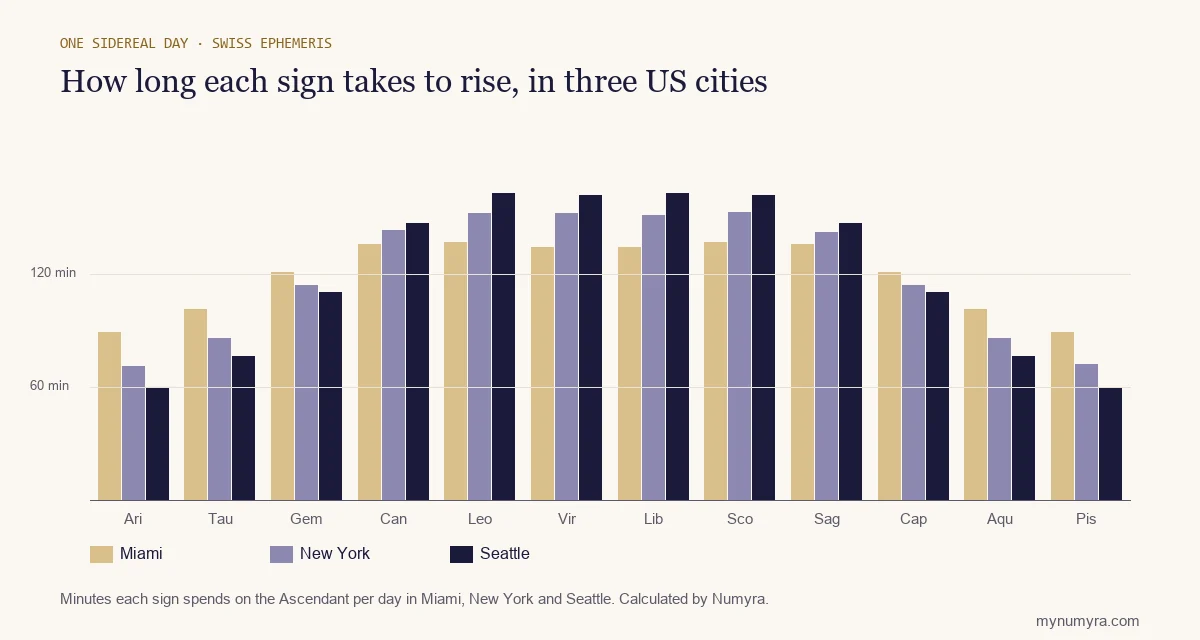
How long each sign takes to rise in three US cities
The chart above as a table, with each sign's share of the day. One full turn of the sky, a sidereal day, lasts 1,436 minutes. If births were spread evenly over the day, each share would be how common that Rising sign is in that city.
| Rising sign | Miami | New York | Seattle |
|---|---|---|---|
| Aries | 89 min (6.2%) | 71 min (4.9%) | 60 min (4.2%) |
| Taurus | 101 min (7.0%) | 86 min (6.0%) | 76 min (5.3%) |
| Gemini | 121 min (8.4%) | 114 min (7.9%) | 110 min (7.7%) |
| Cancer | 136 min (9.5%) | 143 min (10.0%) | 147 min (10.2%) |
| Leo | 137 min (9.5%) | 152 min (10.6%) | 163 min (11.4%) |
| Virgo | 134 min (9.3%) | 152 min (10.6%) | 162 min (11.3%) |
| Libra | 134 min (9.3%) | 151 min (10.5%) | 163 min (11.4%) |
| Scorpio | 137 min (9.5%) | 153 min (10.7%) | 162 min (11.3%) |
| Sagittarius | 136 min (9.5%) | 142 min (9.9%) | 147 min (10.2%) |
| Capricorn | 121 min (8.4%) | 114 min (7.9%) | 110 min (7.7%) |
| Aquarius | 101 min (7.0%) | 86 min (6.0%) | 76 min (5.3%) |
| Pisces | 89 min (6.2%) | 72 min (5.0%) | 60 min (4.2%) |
The gap grows with latitude. In Miami the slowest sign, Scorpio, takes about one and a half times as long to rise as Aries; in New York about twice as long; in Seattle nearly three times as long. Near the equator every sign would take close to two hours.
How accurate your birth time needs to be
Many recorded birth times are rounded to the half hour or the hour. We worked out how often a sign change falls close enough to a birth moment that a rounded time could give the wrong sign:
| If the birth time could be off by | Moon sign | Rising sign, Miami | Rising sign, New York | Rising sign, Seattle |
|---|---|---|---|---|
| Up to 15 minutes either way (time rounded to the half hour) | 0.9% | 25% | 25% | 25% |
| Up to 30 minutes either way (time rounded to the hour) | 1.8% | 50% | 50% | 50% |
| Up to an hour either way | 3.7% | 93% | 88% | 84% |
Each figure is the chance that a sign change falls inside that margin around a random birth moment, so the sign could be the neighbouring one. Moon: all 206 Moon sign changes from October 2026 to January 2028. Rising sign: minutes each sign takes to rise in each city. Calculated by Numyra with the Swiss Ephemeris.
A birth time rounded to the hour leaves about a coin-flip chance that the Rising sign is near enough to a boundary to be in doubt, wherever in the US you were born, and an hour's uncertainty puts most births in doubt. The Moon sign barely moves over the same margins. If your rising sign sits close to a change, the honest answer is to read both neighbouring signs.
Frequently asked questions
Can I find my Rising sign from my birth date alone?
No. Your rising sign is the sign on the eastern horizon at the moment you were born, and it changes every 1 to 2¾ hours, so you need your birth time and place. Our Birth Chart calculator works it out for you.
How is a Rising sign different from a Sun sign?
Your Sun sign is traditionally read as core identity; your Rising sign (the Ascendant) as how you come across: first impressions, body language and style. See our Sun, Moon and Rising explainer.
Which rising sign is the most common?
In the US, the signs from Cancer to Sagittarius take longest to rise, so they are on the Ascendant for more of the day. At New York's latitude Scorpio takes about 153 minutes and Aries only 71, so Scorpio rising is roughly twice as common, if births are spread evenly over the day. In the Southern Hemisphere the pattern reverses.
Why do I need my exact birth time?
Because the Ascendant moves fast: a full sign in about an hour for Aries or Pisces at northern US latitudes. A birth time off by even 30 minutes can change the rising sign if you were born near a boundary.
Is a birth time rounded to the hour good enough for my rising sign?
Often, but not reliably. If the real time could be up to 30 minutes either side of the recorded one, there is about a 50% chance a Rising sign change falls inside that window, whether you were born in Miami, New York or Seattle. Rounded to the half hour, it is about 25%. If yours is near a change, read both neighbouring signs.
Sources
- "Ascendant." Wikipedia. Technical definition and calculation mechanism.
- Numyra Editorial Desk. Sun, Moon and Rising Sign: What Each One Actually Means.
- Astrodienst. Swiss Ephemeris. Used for the rise times on these pages.
- Numyra Methodology Desk. Astrology calculation standard.