A Saturn return is the moment Saturn comes back to the exact degree of the zodiac it occupied when you were born. It takes Saturn about 29.4 years to get there, so your first Saturn return falls between the ages of 28.4 and 29.9, the second between 58.2 and 59.0. In astrology it is read as a coming-of-age checkpoint. Below: the exact ages measured for every birth date from 1930 to 2010, who is having one in 2026, and why some people get it in one pass and others in three.
Key takeaways
- Your first exact Saturn return comes at age 28 (22% of birth dates) or 29 (78%), never 27 or 30. The popular “27 to 30” window counts from when Saturn first enters your Saturn sign, usually at 27 or 28.
- 63% of people get one exact pass. The other 37% get three, spread over about 8 months, because Saturn turns retrograde over their natal degree.
- In 2026, exact first returns land on people born between March 7, 1996 and January 21, 1998, except those born May 7 to November 8, 1997. That is about 5.3 million US births.
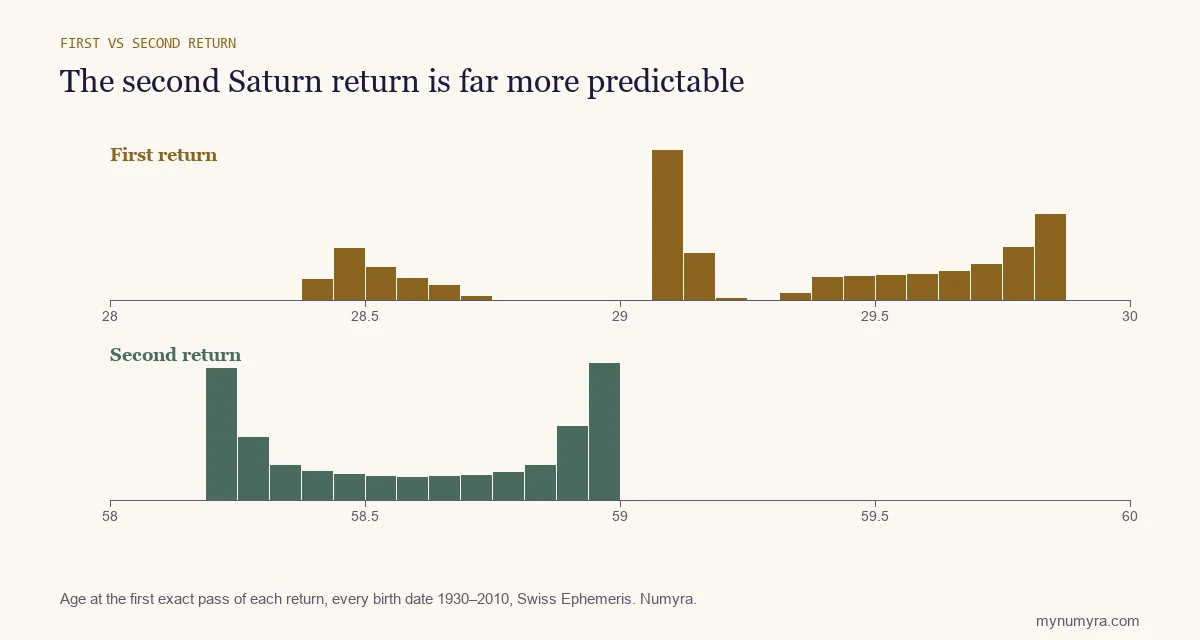
- The second return is far more predictable: age 58.2 to 59.0. The third comes at 87.3 to 88.8.
- The meaning is an astrological tradition, offered for reflection, not as a prediction or advice.
In this guide
- What a Saturn return actually is
- At what age is your Saturn return: 27, 28 or 29?
- One pass or three
- Who is having a Saturn return in 2026?
- Why the exact age varies
- The second and third Saturn returns
- What a Saturn return traditionally means
- How to find your own Saturn return
- Frequently asked questions
What a Saturn return actually is
Saturn is the slowest of the planets known since antiquity. NASA gives its tropical orbit period, the time it takes to come back to the same point of the zodiac, as 10,746.94 days, or 29.42 years. When Saturn reaches the degree it held at your birth, astrologers call it your Saturn return. Astrologers have tracked that period for centuries. In 1647 William Lilly gave it in Christian Astrology, one of the first major astrology textbooks written in English:
“finishing his Course through the twelve Signes of the Zodiack in 29 yeers, 157 dayes, or thereabouts”
William Lilly, Christian Astrology, London, 1647, chapter VIII, p. 57
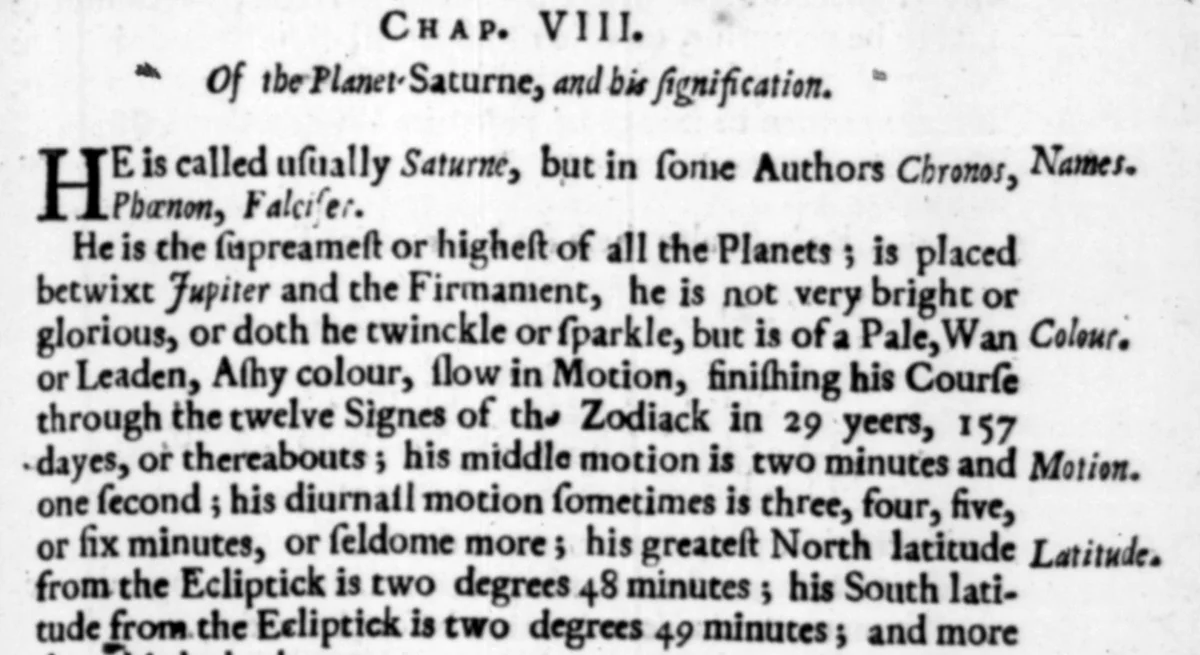
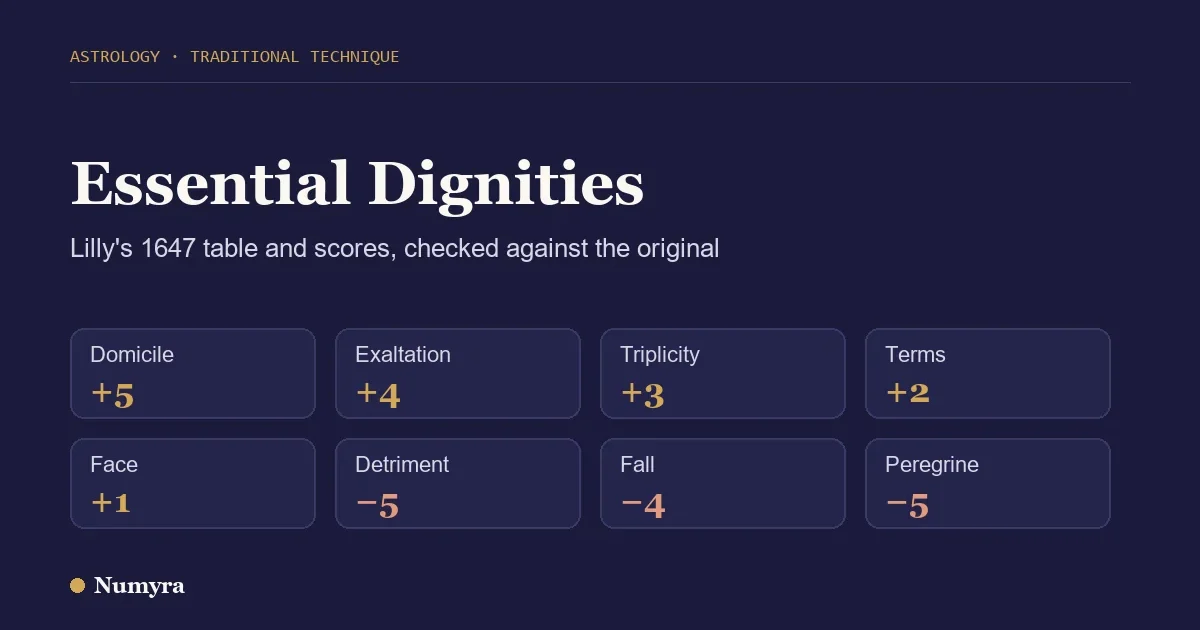
Lilly’s 29 years and 157 days comes to about 10,749 days, within two or three days of NASA’s modern figure. Saturn’s sign matters in the tradition too: it rules Capricorn and Aquarius and, as the same page says, it “receives his Fall” in Aries, its weakest placement in the system of essential dignities.
At what age is your Saturn return: 27, 28 or 29?
We calculated Saturn’s position for every birth date from 1930 to 2010, 29,585 days, then found when Saturn came back to that exact degree. The first exact return never fell before age 28.4 or after 29.9, and averaged 29.2. Measured in whole years, 22% of people have it at 28 and 78% at 29.
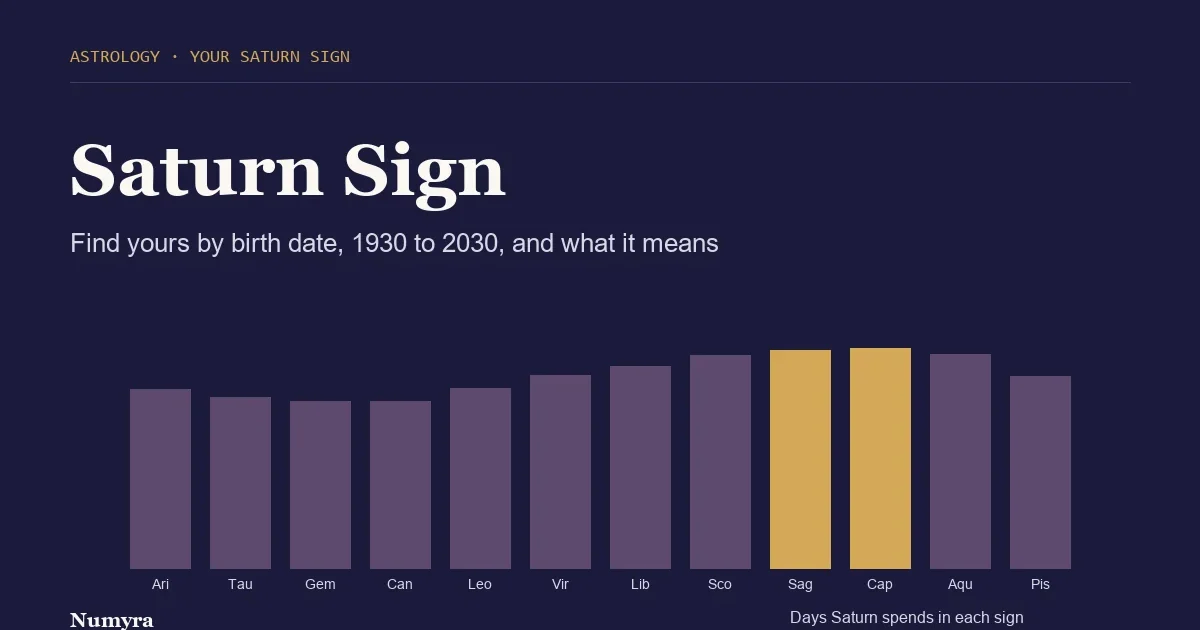
So where do 27 and 30 come from? From the sign rather than the degree. Many astrologers say the return starts when Saturn enters your natal Saturn sign, and that happens at 27 for 40% of people and at 28 for 41%, with the rest at 26 or 29. Saturn then spends about two and a half years in that sign, which is where the familiar “two to three years” comes from.
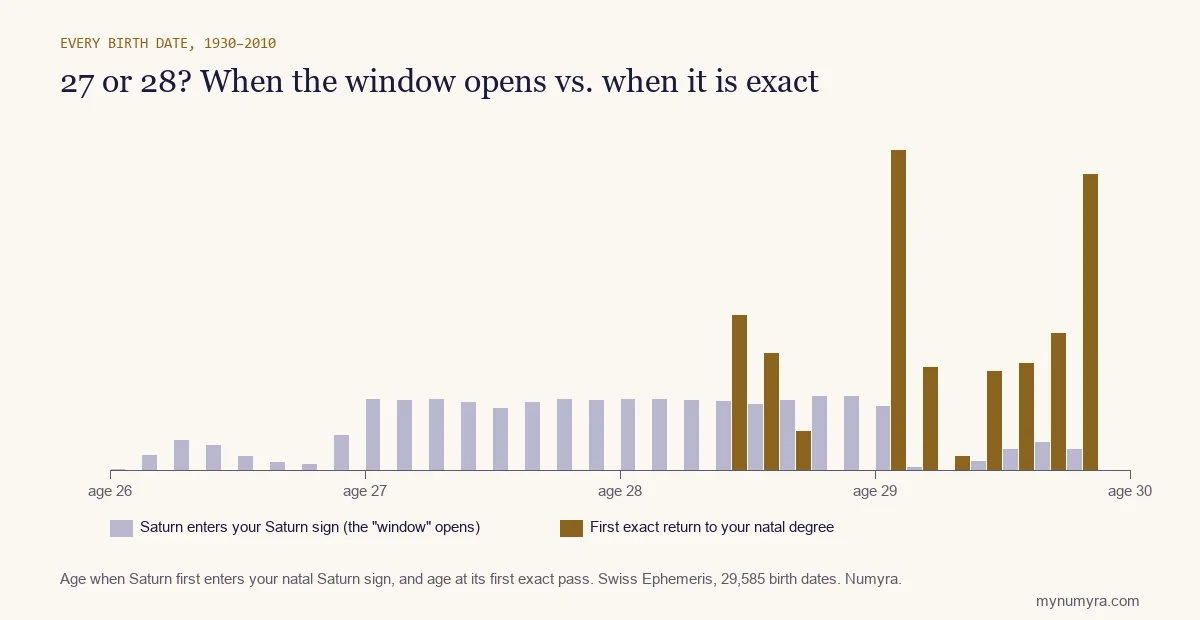
| Age | Saturn enters your Saturn sign | First exact return |
|---|---|---|
| 26 | 9.4% | 0% |
| 27 | 39.6% | 0% |
| 28 | 40.6% | 22.3% |
| 29 | 10.4% | 77.7% |
One pass or three
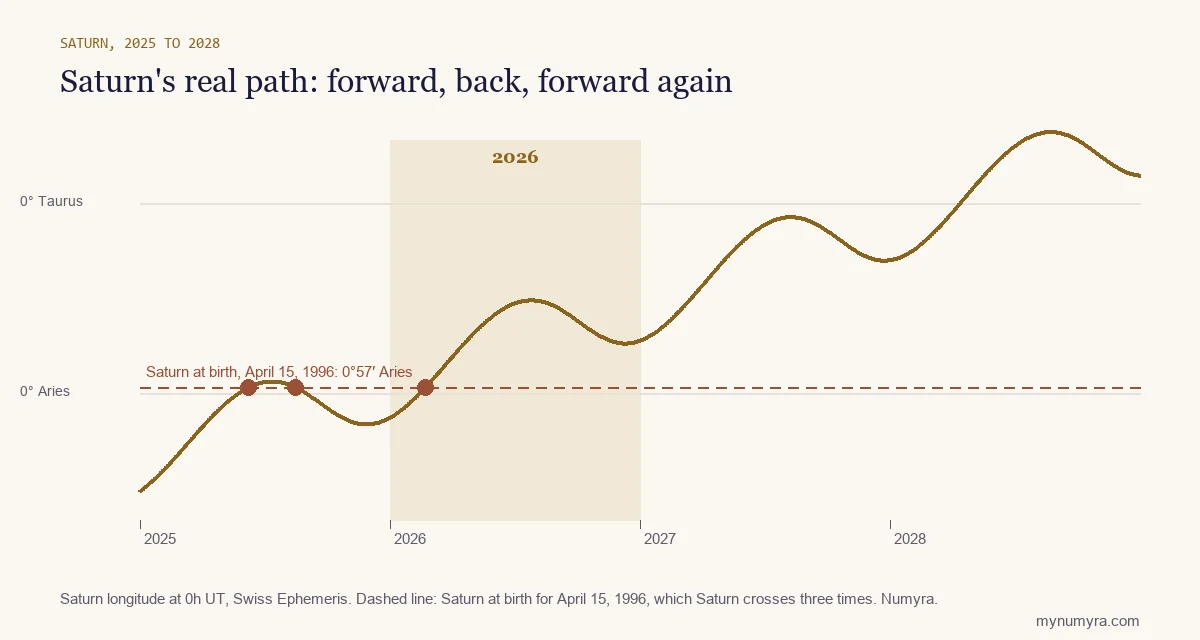
Saturn spends about four and a half months of every year moving backward, or retrograde, the same optical effect explained in our Mercury retrograde guide. If that backward loop happens right over your natal degree, Saturn crosses it three times: forward, back, then forward again. That was true for 37.4% of the birth dates we checked; the other 62.6% get a single exact pass. A three-pass return stretches over 8.5 months on average.
Someone born on April 15, 1996, for example, has Saturn at 0°57′ Aries and gets three passes: June 8, 2025, August 16, 2025 and February 22, 2026.
Who is having a Saturn return in 2026?
Saturn starts 2026 at 26°11′ of Pisces, moves into Aries on February 14, turns retrograde on July 27 at 14°44′ Aries and turns direct again on December 11 at 7°55′ Aries. Anyone whose natal Saturn sits between 26°11′ Pisces and 14°44′ Aries has an exact pass this year. In birth dates, that means March 7, 1996 to January 21, 1998, except May 7 to November 8, 1997, whose returns come in 2027. Using CDC and Social Security birth counts, that is about 5.3 million Americans.
Because Saturn is in Aries for these returns, the tradition would call them returns with Saturn in its fall, a slightly harder version of the classic test. People born between May 5, 1966 and March 30, 1968 (except September 20, 1966 to January 28, 1967) are having their second Saturn return in 2026.
Find your birth date below. Dates within a day of a boundary can shift with your birth time, because the table uses Saturn’s position at noon Universal Time.
| Born | Exact first Saturn return in |
|---|---|
| January 1 to March 1, 1995 | 2024 |
| March 2 to April 11, 1995 | 2024 and 2025 |
| April 12 to October 10, 1995 | 2025 |
| October 11 to December 31, 1995 | 2024 and 2025 |
| January 1 to March 6, 1996 | 2025 |
| March 7 to April 23, 1996 | 2025 and 2026 |
| April 24 to October 24, 1996 | 2026 |
| October 25, 1996 to January 10, 1997 | 2025 and 2026 |
| January 11 to March 15, 1997 | 2026 |
| March 16 to May 6, 1997 | 2026 and 2027 |
| May 7 to November 8, 1997 | 2027 |
| November 9, 1997 to January 21, 1998 | 2026 and 2027 |
| January 22 to March 25, 1998 | 2027 |
| March 26 to May 19, 1998 | 2027 and 2028 |
| May 20 to November 23, 1998 | 2028 |
| November 24, 1998 to February 2, 1999 | 2027 and 2028 |
| February 3 to April 8, 1999 | 2028 |
| April 9 to June 2, 1999 | 2028 and 2029 |
| June 3 to December 8, 1999 | 2029 |
Why the exact age varies
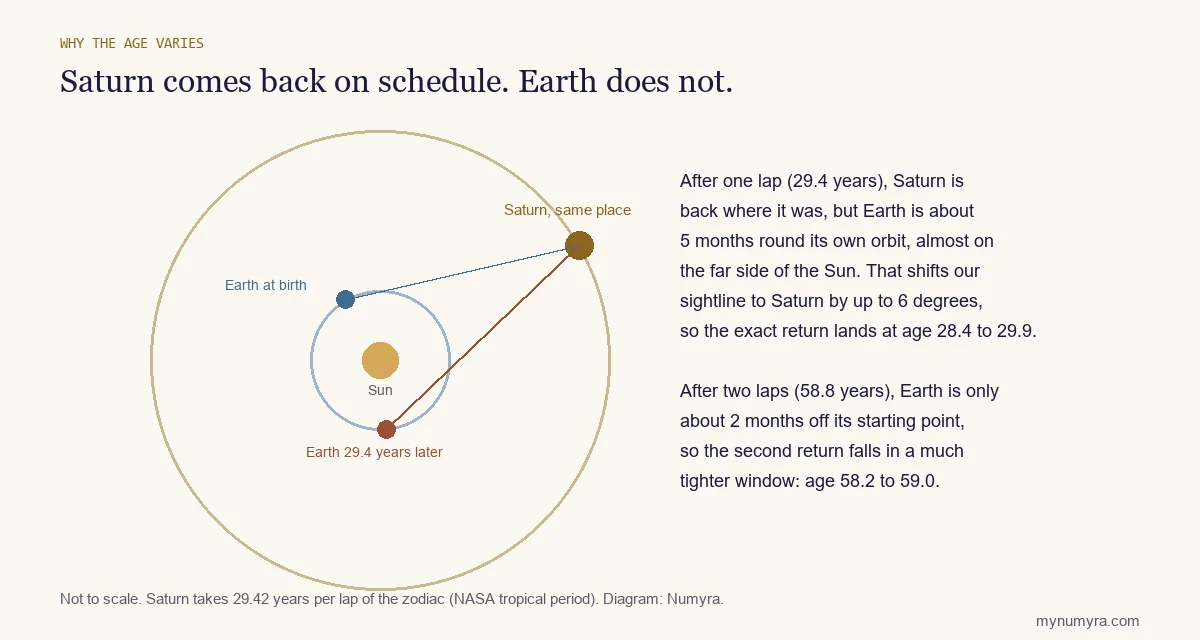
If Saturn returns on a fixed 29.42-year schedule, why does the exact return land anywhere from 28.4 to 29.9? Because we watch from a moving Earth. After one lap, Saturn is back where it was, but Earth is usually on a different side of the Sun, about five months further round its own orbit. That changes our line of sight to Saturn by up to six degrees, which Saturn takes months to cover.
The second and third Saturn returns
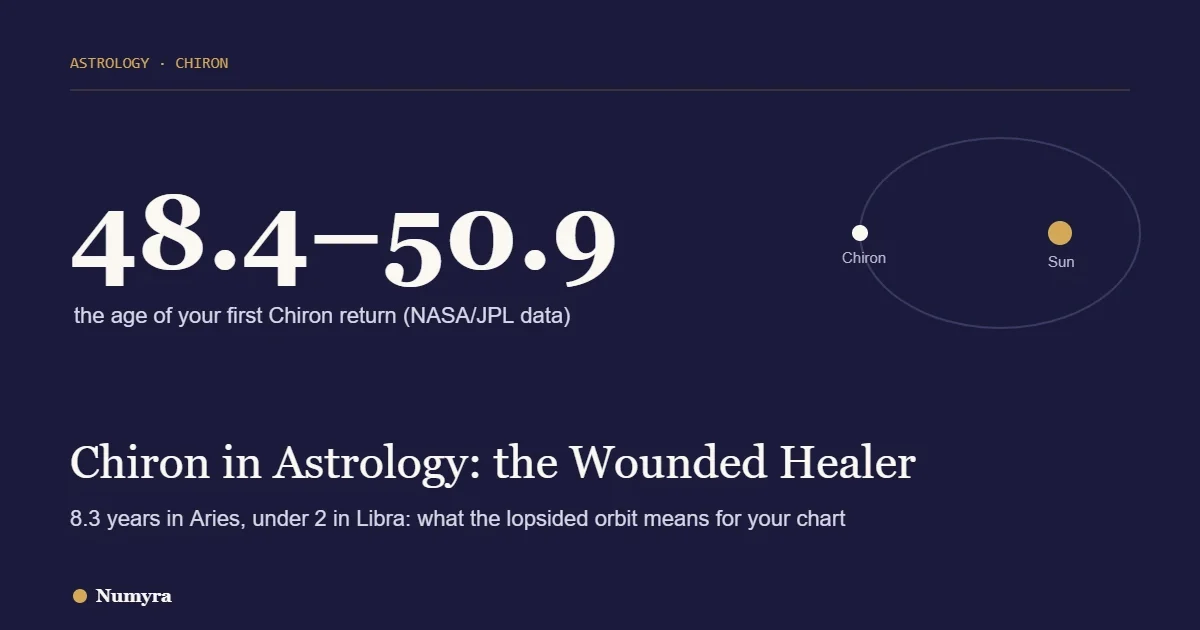
After two laps, 58.8 years, Earth is only about two months off its starting point, so the sightline problem nearly cancels out. The result is a much tighter window: every second return we measured fell between age 58.2 and 59.0. The third return comes between 87.3 and 88.8. Astrologers read the second as the start of elderhood and a review of what the first return built; the third, for those who reach it, as a time of legacy. The same method puts the Chiron return between ages 48.4 and 50.9.
What a Saturn return traditionally means
In astrology Saturn stands for structure, limits, time, responsibility and consequence. The first return is read as a test of whether the life you have built in your twenties actually fits you: careers, relationships and homes get re-examined, and things that do not hold up are said to fall away. Popular accounts describe it as a crash course in adulthood, often uncomfortable, often clarifying.
The link between Saturn and the late stages of life is much older than the modern “Saturn return” itself. In Ptolemy’s division of a lifetime into planetary ages, Saturn comes last:
“Saturn, moving in the last sphere, regulates the final old age, as agreeing with its chilliness.”
Ptolemy, Tetrabiblos, Book IV, chapter X, trans. J. M. Ashmand (1822). See our guide to the Tetrabiblos.

The specific focus on the return at 29 is a modern development. It is worth holding lightly: the late twenties are a time of big decisions for most people anyway, whatever Saturn is doing. Read it as a prompt to ask what you are building and why, rather than as a forecast.
How to find your own Saturn return
The quickest way is our Saturn return calculator: enter your birth date and city, and it finds every exact pass for your first three returns, plus when Saturn enters and leaves your Saturn sign. To see Saturn alongside the other nine planets, our stellium calculator lists the sign and degree of all ten. If you were born within a few days of a sign change, a birth time helps. For the wider picture of how one planet in one sign fits into a chart, see our guide to the astrological houses, which also tells you which area of life a return is said to touch.
Frequently asked questions
At what age is your Saturn return?
The first exact return comes between 28.4 and 29.9, at 28 for 22% of people and 29 for 78%. The second comes between 58.2 and 59.0, the third between 87.3 and 88.8.
Is your Saturn return at 27 or 28?
Those are the ages when Saturn usually enters your natal Saturn sign (40% at 27, 41% at 28), which many astrologers count as the start. The exact return to your birth degree comes later, at 28 or 29.
Is 2026 a Saturn return year?
Yes for people born between March 7, 1996 and January 21, 1998, except May 7 to November 8, 1997. Saturn is moving through late Pisces and early Aries, reaching 14°44′ Aries before turning back.
What happens during your Saturn return?
Astrologically, it is read as a reckoning with responsibility: commitments, work and relationships get tested, and what does not fit is said to fall away. These are traditional interpretations, not predictions of specific events.
How long does a Saturn return last?
Counted from when Saturn enters your Saturn sign to when it leaves, about two and a half years. The exact return itself is a single day for 63% of people, or three days spread over about 8 months for the other 37%.
When is the second Saturn return?
Between ages 58.2 and 59.0, in a much narrower window than the first because Earth is back near the same point in its orbit.
Is a Saturn return bad?
It has a hard reputation, but astrologers usually describe it as demanding rather than unlucky: a period that rewards honesty about what is working. Nothing about Saturn’s position has been shown to cause events in anyone’s life.
Sources
- NASA Space Science Data Coordinated Archive. Saturn Fact Sheet. Tropical orbit period 10,746.94 days; sidereal 10,755.70 days.
- Astrodienst. Swiss Ephemeris. All ages, dates and shares on this page were calculated with it by the Numyra Methodology Desk.
- Lilly, William. Christian Astrology. London, 1647. Chapter VIII, p. 57. Internet Archive scan of the first edition.
- Ptolemy, Claudius. Tetrabiblos, Book IV, chapter X. Trans. J. M. Ashmand, 1822.
- FiveThirtyEight. US births data, 1994–2014, compiled from the CDC National Center for Health Statistics and the Social Security Administration.