Synastry Calculator
Compare two birth charts. Enter both birth dates (times and places if you have them) to see every aspect between your planets, the key relationship contacts, where each person's planets land in the other's houses, and how common each contact is across 100,000 random pairs.
Key takeaways
- Synastry compares two birth charts planet by planet: the angles (aspects) between one person's planets and the other's are read as attraction, comfort and friction.
- Astrologers weight the Sun, Moon, Venus and Mars most, and tight orbs within 1° or 2° most of all.
- Across 100,000 random pairs the typical pair had 21 aspects involving a personal planet, and 66.3% had a hard Saturn contact to a Sun, Moon or Venus: difficult aspects are the normal case, not a warning sign.
- Nothing here is medical, financial, legal, or psychological advice — this is a cultural tradition, presented for entertainment and reflection, not relationship advice.
Your synastry
For entertainment and self-reflection. Numerology is a cultural tradition, not a science, and nothing here is medical, financial, legal, or psychological advice.
How common are the classic synastry contacts?
Synastry guides and calculators list "the best" and "the worst" aspects without saying how often they happen, which matters: a contact most couples share can't be what makes one couple special. So we measured it. We paired 100,000 random people, each with a random US birth date from 1994 to 2014 (weighted by the births on each date) and a random birth time, worked out all ten bodies with the Swiss Ephemeris, and counted the aspects between each pair with the orbs below.
| Contact between two random people | Share of pairs |
|---|---|
| Any aspect between one person’s Sun and the other’s Moon | 55.5% |
| Sun–Moon trine or sextile (Ptolemy’s “harmonious” aspect) | 28.9% |
| Sun–Moon conjunction | 8.7% |
| Any aspect between the two Moons | 33.5% |
| Any aspect between one person’s Venus and the other’s Mars | 42.8% |
| Venus–Mars both ways round (a “double whammy”) | 5.8% |
| Hard Saturn contact (conjunction, square or opposition) to a Sun, Moon or Venus | 66.3% |
| No hard aspect at all involving a personal planet | 4 pairs in 100,000 |
Any one specific contact between personal planets, such as your Venus trine their Mars, turns up in only about 3% to 9% of random pairs, which is why the calculator shows a figure next to each one. The total number of contacts varies much less than people expect:
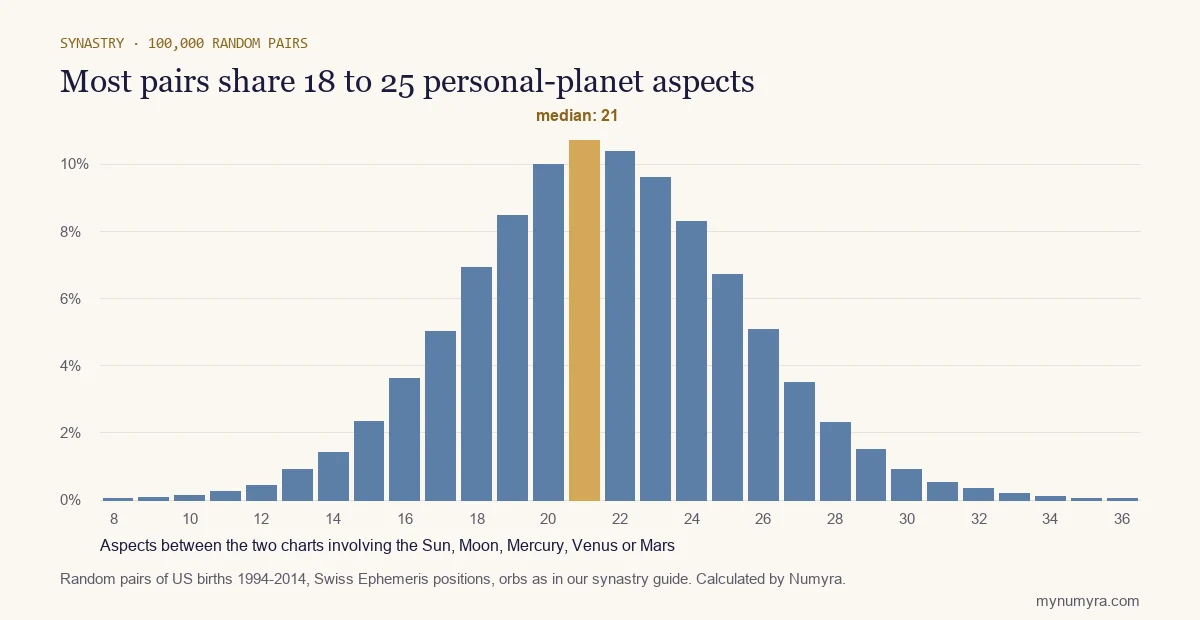
| Aspects involving a personal planet | Share of pairs |
|---|---|
| 15 or fewer | 5.6% |
| 16 to 18 | 15.6% |
| 19 to 21 | 29.2% |
| 22 to 24 | 28.3% |
| 25 to 27 | 15.3% |
| 28 or more | 6.0% |
Two lessons follow. Every couple has difficult aspects, so the so-called worst synastry aspects, such as Saturn square the Moon, are the normal case. And the rarer contacts are the ones that stand out: a Sun–Moon conjunction (fewer than one pair in ten) or a Venus–Mars double whammy (about one pair in seventeen). Our synastry guide covers the study and a worked example in full.
How to read your synastry result
- Start with the key contacts. Sun–Moon links are read as the core of compatibility: one person's sense of self meeting the other's emotional needs. Moon–Moon contacts describe how your moods and habits fit at home.
- Then Venus and Mars. Venus is how each of you shows affection, Mars is drive and desire; contacts between them are the traditional signature of attraction. Our guides to Venus signs and Mars signs explain each one.
- Weigh the orb. The tighter the aspect, the stronger it is read to be. The table lists personal contacts first and the tightest at the top of each group.
- Read Mercury for conversation and Saturn for commitment. Mercury contacts show how easily you talk; Saturn contacts are read as weight and staying power, sometimes as restriction.
- Add the house overlays if you have birth times. A partner's Sun or Venus in your 7th house is the classic partnership overlay; the 5th is romance, the 4th home. Our guide to the twelve houses explains each one.
Synastry keeps both people whole and asks how each affects the other. A composite chart instead merges two charts into a single chart of the relationship, and Sun-sign compatibility compares only one placement each.
The aspects and orbs this calculator uses
Five major aspects, each with a margin called an orb. Orbs vary between astrologers; these are a common middle ground and the same ones used in our study, so your result and the "how common" figures are measured the same way.
| Aspect | Angle | Orb | Traditional reading |
|---|---|---|---|
| Conjunction | 0° | 8° with Sun or Moon, otherwise 6° | The two energies act as one |
| Sextile | 60° | 6° with Sun or Moon, otherwise 4° | Easy, low-key support |
| Square | 90° | 8° with Sun or Moon, otherwise 6° | Friction that pushes for change |
| Trine | 120° | 8° with Sun or Moon, otherwise 6° | Natural ease and flow |
| Opposition | 180° | 8° with Sun or Moon, otherwise 6° | Attraction across a difference |
How this calculator works, and how accurate it is
Planet positions come from Paul Schlyter's published method, the same engine as our Stellium Calculator, which starts from each planet's orbit and converts it to the view from Earth. Birth times are converted to Universal Time with your city's historical time-zone rules, including daylight saving time. Houses use the whole-sign system, in which the rising sign is the 1st house. Everything runs in your browser.
To test it, we ran 5,000 random pairs born between 1930 and 2010 through both this calculator and the Swiss Ephemeris, the reference behind professional astrology software. 94.1% of pairs got exactly the same list of aspects. Of 138,350 aspects in total, 305 (0.22%) differed, and every one of them sat right at the edge of its orb, where a planet off by a few arcminutes tips an aspect in or out. The largest position error for any planet was 6.5 arcminutes, about a tenth of a degree.
Frequently asked questions
What is a synastry calculator?
A tool that compares two birth charts. It works out where the Sun, Moon and planets were when each person was born, then lists the angles (aspects) between one person’s planets and the other’s. Astrologers read those aspects as the points of attraction, comfort and friction in a relationship.
Do I need both birth times?
No. Birth dates are enough for every planet except the Moon, which moves about 13° a day. Without a time the calculator places the Moon at noon, marks its aspects as approximate and skips that person’s house overlays. With a time and city it also gives the rising sign and where each person’s planets fall in the other’s houses.
What is a good synastry aspect?
Astrologers give the most weight to contacts between the Sun, Moon, Venus and Mars, and to tight orbs within 1° or 2°. A Sun–Moon trine or sextile is the classic harmonious link and appears in 28.9% of random pairs; a Sun–Moon conjunction appears in 8.7%. No single aspect makes or breaks a relationship.
Are hard aspects in synastry bad?
Not in themselves. In our 100,000 random pairs, 66.3% had a hard Saturn contact to a Sun, Moon or Venus, and only 4 pairs had no hard aspect at all involving a personal planet. Squares and oppositions are read as friction and growth, and every couple has them.
Is my birth data stored?
No. The calculation runs in your browser using the city’s public coordinates and time zone. Names and birth details are never sent to our servers or saved.
How accurate is this synastry calculator?
We compared it with the Swiss Ephemeris, the reference behind professional astrology software, for 5,000 random pairs born 1930 to 2010. 94.1% of pairs got exactly the same aspect list, and only 0.22% of all aspects differed, every one of them right at the edge of its orb.
Sources
- Schlyter, Paul. How to Compute Planetary Positions. The position method used by this calculator.
- Astrodienst. Swiss Ephemeris. Reference used to test the calculator and for the 100,000-pair study.
- FiveThirtyEight. US births data, 1994–2014, compiled from the CDC National Center for Health Statistics and the Social Security Administration.
- Davison, Ronald C. Synastry: Understanding Human Relations through Astrology (1983 edition).
- Numyra Methodology Desk. Astrology calculation standard.