A synastry chart compares two people’s birth charts by laying one over the other and measuring the angles between every planet in the first chart and every planet in the second. Each close angle, called an aspect, is read as one way the two people affect each other. The catch nobody mentions is how many there are: in our simulation of 100,000 random pairs, the average couple had 28 major aspects between their charts. Reading synastry well means knowing which few matter.
Key takeaways
- Synastry compares two separate birth charts planet by planet; it is different from a composite chart, which merges them into one.
- Start with the Sun, Moon and Ascendant contacts, then Venus and Mars, then Saturn, then where each person’s planets fall in the other’s houses.
- “Hard” aspects are universal: only 4 of our 100,000 random pairs had no square, opposition or conjunction involving a personal planet, and 66.3% had a hard Saturn contact to someone’s Sun, Moon or Venus.
- The idea goes back to Ptolemy, who wrote in the 2nd century that marriages tend to last when the two people’s Sun and Moon are in harmonious aspect. 28.9% of our random pairs have one.
- This is a cultural tradition, presented for reflection, not relationship advice.
In this guide
- What a synastry chart is
- What you need to make one
- The planets that matter most
- The five aspects and their orbs
- How to read a synastry chart, step by step
- House overlays
- How common are the classic contacts?
- A worked example
- Where synastry comes from
- Is synastry accurate?
- Frequently asked questions
What a synastry chart is
Your birth chart records where the Sun, Moon and planets were at the moment you were born. A synastry chart, usually drawn as a bi-wheel, puts a second person’s planets around the outside of your chart so you can see how the two line up. Where a planet in one chart sits at a meaningful angle to a planet in the other, astrologers read a point of contact: attraction, comfort, friction or growth.
It answers a different question from the two other common relationship techniques. Sign compatibility, which our article on how zodiac compatibility really works covers, compares only two Sun signs. A composite chart merges two charts into a single chart of the relationship. Synastry keeps both people whole and asks how each one affects the other.
What you need to make one
You need both people’s birth date, time and place. The date fixes the Sun and the slow planets; the time matters for the Moon, which changes sign every two to three days, and for the Ascendant and houses, since the Ascendant moves about a degree every four minutes. Without a birth time you can still read the planets, but treat the Moon as approximate and skip houses and the Ascendant. Our Stellium Calculator lists the sign and degree of all ten bodies for a birth date, which is enough to compare two people’s planets by hand, and the Birth Chart calculator adds the rising sign when the time is known.
The planets that matter most
Every planet takes part, but astrologers weight some far more than others in a relationship:
| Point | What it is read as in a relationship |
|---|---|
| Sun | Identity and vitality: whether each person feels seen and supported |
| Moon | Emotional needs, comfort and day-to-day ease; the most cited planet in synastry |
| Ascendant | First impressions and physical chemistry (needs a birth time) |
| Mercury | How the two talk, argue and make decisions |
| Venus | Affection, taste, what each finds beautiful and how they show love |
| Mars | Desire, drive, anger and sexual attraction |
| Saturn | Commitment, duty and pressure: the “glue” or the weight in a relationship |
| Jupiter to Pluto | Growth, change and intensity; slow planets, so read mainly when they touch a personal planet |
Our guide to your Venus sign explains why Venus is the planet of love in astrology, and our Sun, Moon and Rising explainer covers the three most personal points.
The five aspects and their orbs
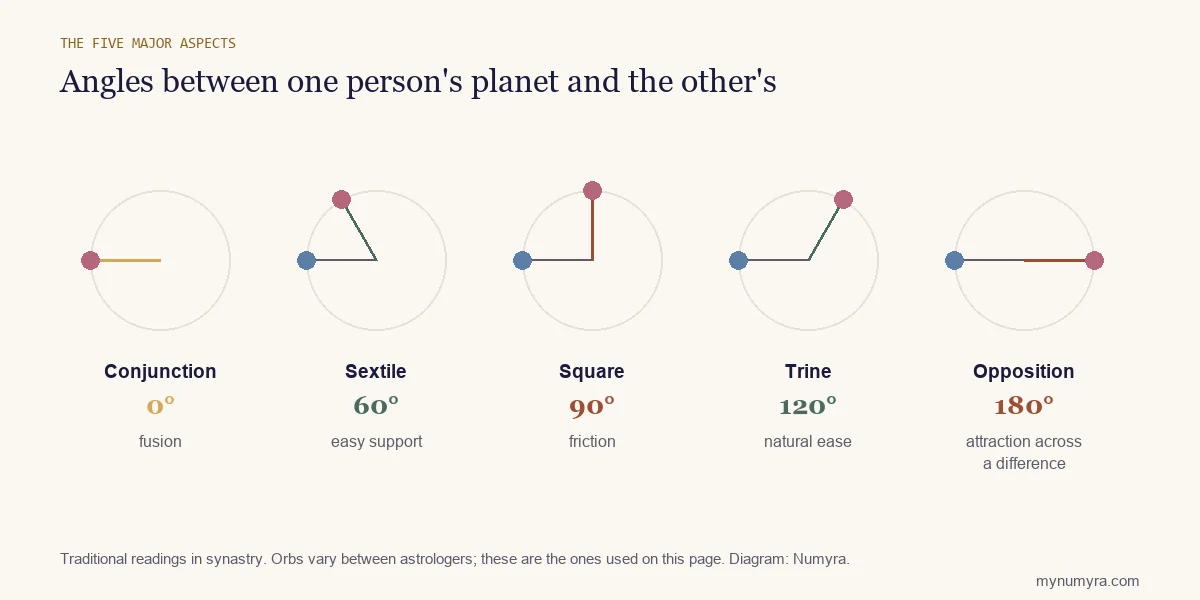
An aspect is an angle between two planets, measured around the zodiac. Five major aspects are used in synastry, each allowed a margin called an orb. Orbs vary between astrologers; the ones below are a common middle ground, and they are the ones we used for the data on this page.
| Aspect | Angle | Orb we use | Traditional reading in synastry |
|---|---|---|---|
| Conjunction | 0° | 8° with Sun or Moon, otherwise 6° | fusion: the two energies act as one |
| Sextile | 60° | 6° with Sun or Moon, otherwise 4° | easy, low-key support |
| Square | 90° | 8° with Sun or Moon, otherwise 6° | friction that pushes for change |
| Trine | 120° | 8° with Sun or Moon, otherwise 6° | natural ease and flow |
| Opposition | 180° | 8° with Sun or Moon, otherwise 6° | attraction across a difference |
The tighter the orb, the stronger the contact is read to be: an aspect within 1° or 2° is treated as a defining feature, one at the edge of its orb as background. Our article on sign compatibility explains where these angles come from.
How to read a synastry chart, step by step
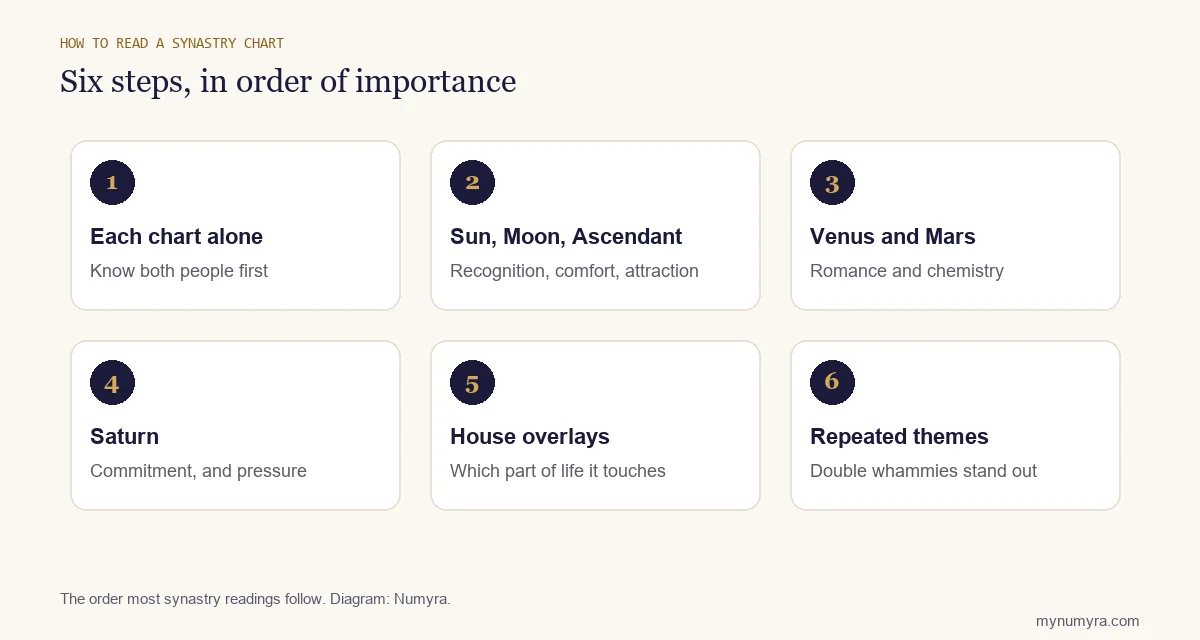
- Read each chart on its own first. A contact means little until you know what each person’s Moon or Venus is like in their own chart.
- Check the Sun, Moon and Ascendant contacts. These are read as the core of compatibility: whether the two feel recognized (Sun), comfortable (Moon) and drawn to each other (Ascendant).
- Look at Venus and Mars. Venus–Mars contacts, in either direction, are read as romantic and physical chemistry.
- Look at Saturn. Saturn on a personal planet is read as seriousness, commitment and sometimes heaviness. As the data below shows, nearly every couple has one, so read the whole picture rather than fearing it.
- Check house overlays. Where one person’s planets land in the other person’s houses shows which area of life the relationship touches.
- Look for repeats. When the same theme appears in both directions, called a double whammy (her Venus on his Mars and his Venus on her Mars), it is read as especially strong.
House overlays
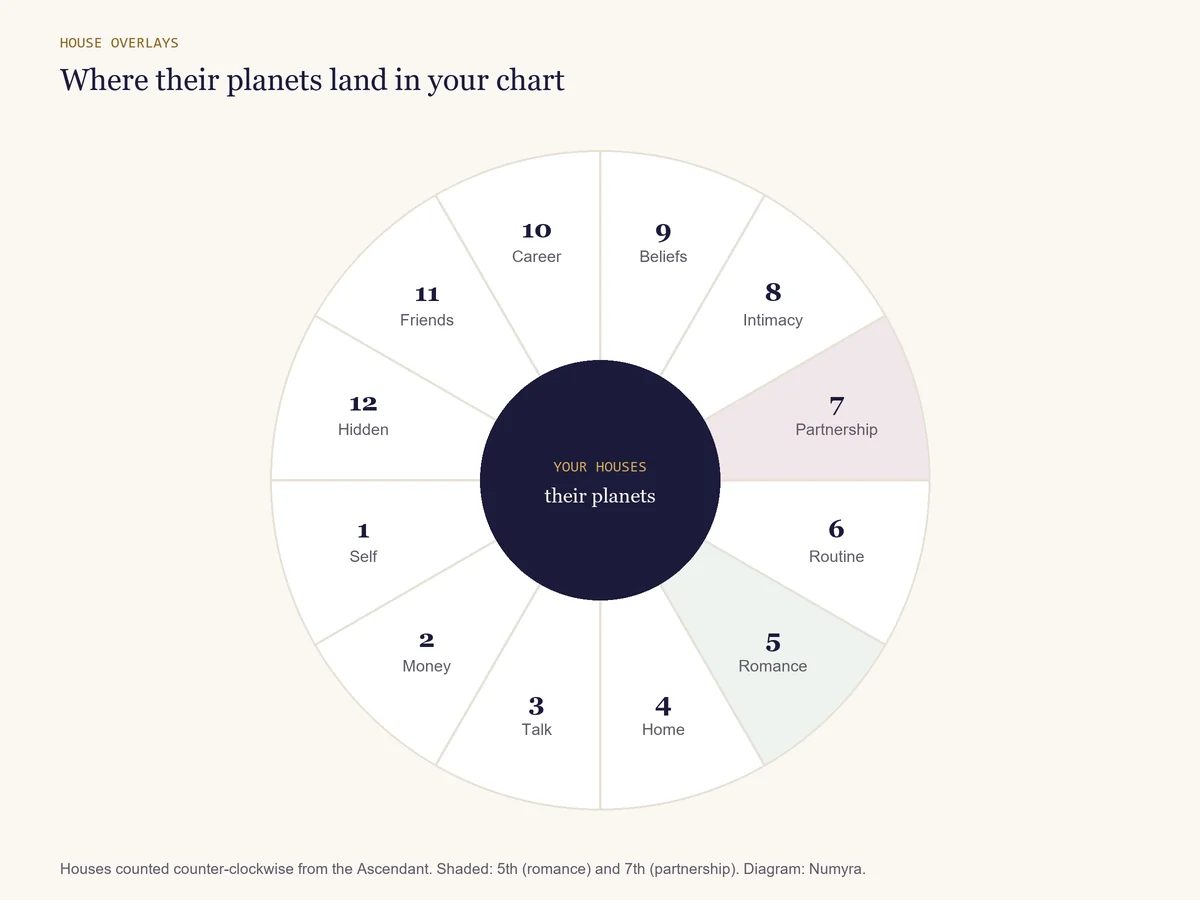
If you have both birth times, place each person’s planets in the other person’s houses. A house overlay shows which part of your life the other person’s planet activates. The traditional keywords, drawn from the meanings in our guide to the twelve houses:
| Their planet in your… | Traditionally read as |
|---|---|
| 1st house | They notice you, affect how you see yourself |
| 2nd house | Money, possessions and self-worth come into play |
| 3rd house | Conversation, ideas, everyday contact |
| 4th house | Home, family and a sense of belonging |
| 5th house | Romance, fun, creativity, play |
| 6th house | Routines, work and practical care |
| 7th house | Partnership and commitment: a classic marriage indicator |
| 8th house | Intimacy, shared resources, intensity |
| 9th house | Beliefs, travel, learning from each other |
| 10th house | Career, reputation and public life |
| 11th house | Friendship, shared goals and social circles |
| 12th house | Hidden, private or spiritual bonds (see our 12th house guide) |
How common are the classic contacts?
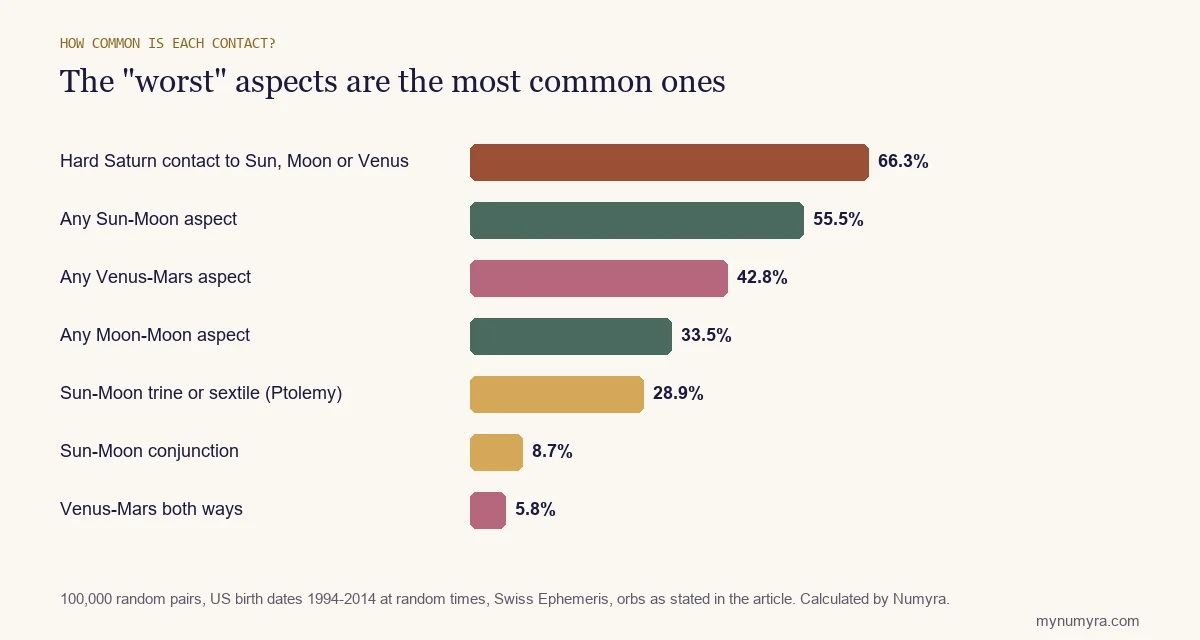
Synastry guides list “the best” and “the worst” aspects without saying how often they occur, which matters: a contact that most couples share cannot explain why one particular couple works or struggles. So we measured it. We paired 100,000 random people, each given a random US birth date from 1994 to 2014 (weighted by the number of births on each date) and a random birth time, worked out all ten bodies with the Swiss Ephemeris, and counted the aspects between each pair using the orbs above.
| Contact between two random people | Share of pairs |
|---|---|
| Any aspect between one person’s Sun and the other’s Moon | 55.5% |
| Sun–Moon trine or sextile (Ptolemy’s “harmonious aspect”) | 28.9% |
| Sun–Moon conjunction | 8.7% |
| Any aspect between the two Moons | 33.5% |
| Any aspect between one person’s Venus and the other’s Mars | 42.8% |
| Venus–Mars in both directions (a double whammy) | 5.8% |
| Hard Saturn contact (conjunction, square or opposition) to a Sun, Moon or Venus | 66.3% |
| No hard aspect at all involving a personal planet | 4 in 100,000 |
The average pair had 27.5 major aspects between their charts, 21.5 of them involving the Sun, Moon, Mercury, Venus or Mars. Two lessons follow. First, every couple has difficult aspects; the so-called worst synastry aspects, such as Saturn square the Moon, are the normal case, not a warning sign. Second, the rarer contacts are the ones that stand out: a Sun–Moon conjunction (fewer than one pair in ten) or a Venus–Mars double whammy (about one in seventeen).
A worked example
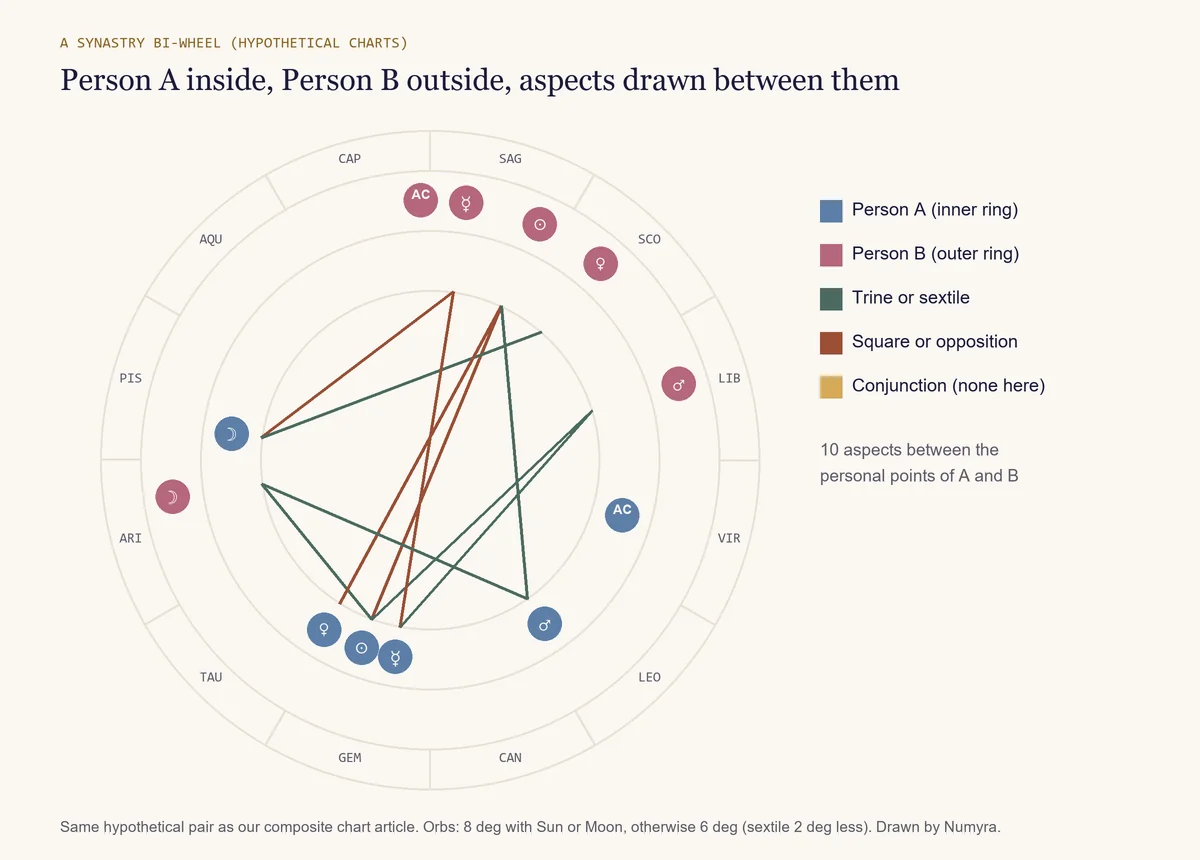
Here are the personal points from two hypothetical charts, the same pair used in our composite chart worked example, compared with the orbs above. Every aspect between them:
| Person A | Aspect | Person B | Orb |
|---|---|---|---|
| Person A’s Sun (10° Gemini) | opposition | Person B’s Sun (5° Sagittarius) | 5.0° |
| Person A’s Sun (10° Gemini) | sextile | Person B’s Moon (8° Aries) | 1.8° |
| Person A’s Sun (10° Gemini) | trine | Person B’s Mars (17° Libra) | 7.0° |
| Person A’s Moon (22° Pisces) | square | Person B’s Mercury (22° Sagittarius) | 0.5° |
| Person A’s Moon (22° Pisces) | trine | Person B’s Venus (19° Scorpio) | 3.5° |
| Person A’s Mercury (20° Gemini) | opposition | Person B’s Mercury (22° Sagittarius) | 2.0° |
| Person A’s Mercury (20° Gemini) | trine | Person B’s Mars (17° Libra) | 3.0° |
| Person A’s Venus (28° Taurus) | opposition | Person B’s Sun (5° Sagittarius) | 7.0° |
| Person A’s Mars (5° Leo) | trine | Person B’s Sun (5° Sagittarius) | 0.0° |
| Person A’s Mars (5° Leo) | trine | Person B’s Moon (8° Aries) | 3.2° |
Read in order of importance: A’s Sun sextile B’s Moon is exactly the harmonious Sun–Moon link Ptolemy singled out, and A’s Moon trine B’s Venus adds emotional warmth. A’s Mars trine B’s Sun, exact to the degree, is read as A energizing B. The square between A’s Moon and B’s Mercury, within half a degree, is the friction point: one person’s feelings meeting the other’s words. There is no Venus–Mars contact, which is true of most real couples too. An astrologer would call this an easy, affectionate match whose main work is in communication.
Where synastry comes from
Comparing two people’s charts is as old as written horoscopes. In the 2nd century, Claudius Ptolemy’s Tetrabiblos set out how to judge a marriage from the charts of both partners, starting with the Sun and Moon:
“Marriages for the most part are lasting when in both the genitures the luminaries happen to be in harmonious aspect, that is, in trine or in sextile with one another”
— Ptolemy, Tetrabiblos IV.5, “Of Marriage”, trans. F. E. Robbins (Loeb Classical Library, 1940)
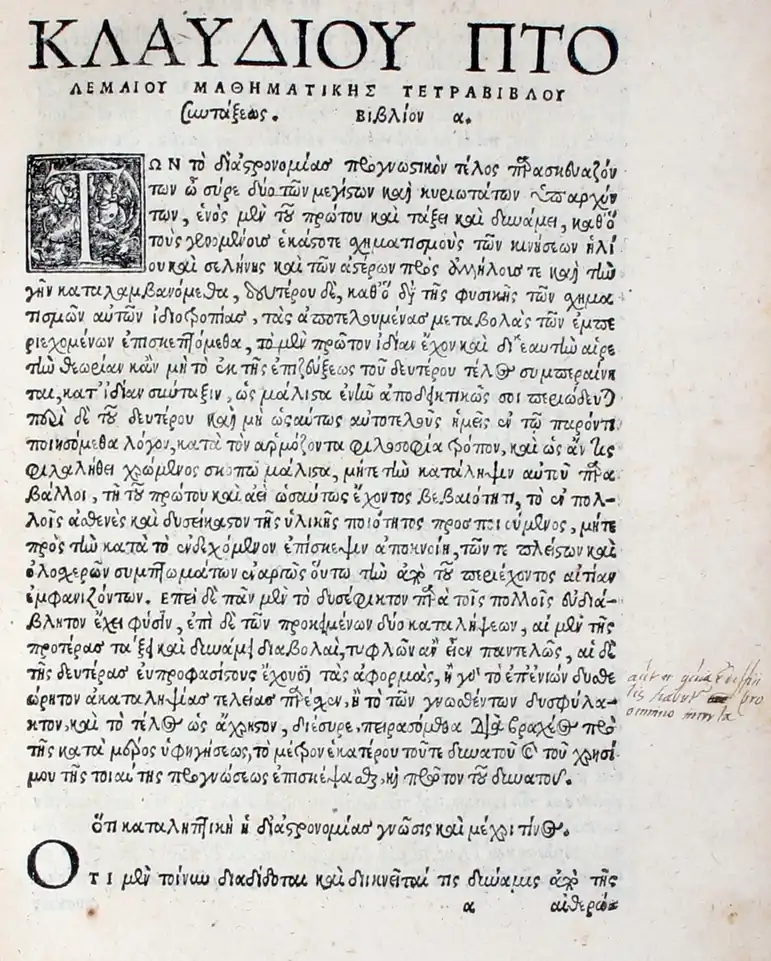
He adds that the bond is stronger still “when the husband’s moon is in such aspect with the wife’s sun”, and that “divorces on slight pretexts” follow when the luminaries are in opposition or square. Almost every modern synastry guide still starts with Sun–Moon contacts, usually without saying where the idea comes from. Our article on Ptolemy’s Tetrabiblos covers the book in full. In the 20th century the psychiatrist Carl Jung tested the tradition statistically, comparing horoscopes of married couples in batches of 180 and 220 pairs for his 1952 essay on synchronicity (The Interpretation of Nature and the Psyche, English edition 1955).
Is synastry accurate?
There is no good evidence that synastry predicts which relationships will last. It is a symbolic language for talking about two people, not a measurement. That is also why the frequency table matters: if a contact appears in most random pairs, it cannot be the reason a particular couple is happy or unhappy. Used honestly, a synastry chart is a prompt for conversation about needs, differences and habits, not a verdict. Numyra’s own zodiac compatibility calculator stays deliberately simple for the same reason.
Frequently asked questions
What is a synastry chart?
A comparison of two birth charts, usually drawn as one chart inside the other, showing the angles (aspects) between each person’s planets. Astrologers read those aspects as the ways the two people affect each other.
What are the worst synastry aspects?
Traditionally, hard aspects (squares, oppositions and some conjunctions) from Saturn, Mars or Pluto to the other person’s Sun, Moon or Venus. But they are the norm: in our simulation 66.3% of random pairs had a hard Saturn contact to someone’s Sun, Moon or Venus, so no single aspect should be read as a deal-breaker.
What are the strongest synastry indicators for marriage?
The oldest one is Ptolemy’s: the two people’s Sun and Moon in trine or sextile, especially one partner’s Moon to the other’s Sun. Modern astrologers add Venus–Mars contacts, Saturn on a personal planet as a sign of commitment, and planets in each other’s 7th house.
What are the hottest synastry aspects?
Venus–Mars contacts, especially conjunctions, are the classic sign of attraction, along with Mars to the other’s Ascendant and Mars–Pluto contacts. A Venus–Mars aspect in both directions is rarer: about 5.8% of random pairs.
Can I do synastry without a birth time?
Yes, for the planets. Without a birth time, skip the Ascendant and houses and treat the Moon’s position as approximate, since it can change sign during the day.
What is the difference between synastry and a composite chart?
Synastry compares two separate charts to see how each person affects the other. A composite chart merges the two into one chart, built from midpoints, that describes the relationship itself. Most astrologers use both.
Are synastry charts accurate?
There is no good evidence that they predict relationship outcomes. Treat a synastry chart as a structured way to talk about two people’s needs and differences, not as a forecast.
Sources
- Ptolemy. Tetrabiblos IV.5, “Of Marriage”, trans. F. E. Robbins. Loeb Classical Library, 1940. LacusCurtius.
- Jung, C. G., and W. Pauli. The Interpretation of Nature and the Psyche. 1955. Includes Jung’s “Synchronicity: An Acausal Connecting Principle” (1952). Internet Archive.
- Astrodienst. Swiss Ephemeris. Used for the 100,000-pair simulation.
- FiveThirtyEight. US births data, 1994–2014, compiled from the CDC National Center for Health Statistics and the Social Security Administration.
- Numyra Methodology Desk. Simulation method and orbs as stated on this page.