Uranus Opposition Calculator
Enter your birth date and city to get the exact dates Uranus is square, opposite and back at its birth position: your Uranus square at about 21, your Uranus opposition (the half return) at about 42 and your Uranus return at about 84. For every birth date from 1900 to 2010 the first opposition fell between ages 38.0 and 44.5, and for 91% of people it comes in three separate passes.
Key takeaways
- A Uranus opposition is the day Uranus reaches the point exactly opposite its position at your birth, the half-way mark of its 84-year orbit. The calculator finds every pass of the Uranus square (90 degrees), opposition (180) and return (360), your age on each, and how long Uranus stays within one degree of the exact point.
- Across 40,542 birth dates from 1900 to 2010, the first exact opposition fell between ages 38.0 and 44.5 (average 41.9), not at a fixed 42. For births from 1950 to 1995 the range is 38.0 to 44.5 and 95.5% of dates get three passes.
- Tested against the Swiss Ephemeris on 5,133 exact passes: 32% matched within 6 hours and 91% within a day. Uranus is the least precise of the three planets we test, because it moves slowest.
- Nothing here is medical, financial, legal, or psychological advice. This is a cultural tradition, presented for entertainment and reflection.
Your Uranus cycle
For entertainment and self-reflection. Numerology is a cultural tradition, not a science, and nothing here is medical, financial, legal, or psychological advice.
What your result shows
Your result starts with Uranus's position at your birth, its sign and degree. For the Uranus square (90 degrees from that position), the opposition (180) and the return (360) you get the exact dates Uranus crosses the point, your age on each date, the degree and sign Uranus crosses, and the stretch of time Uranus spends within one degree of the exact point, counted from its first entry to its last exit.
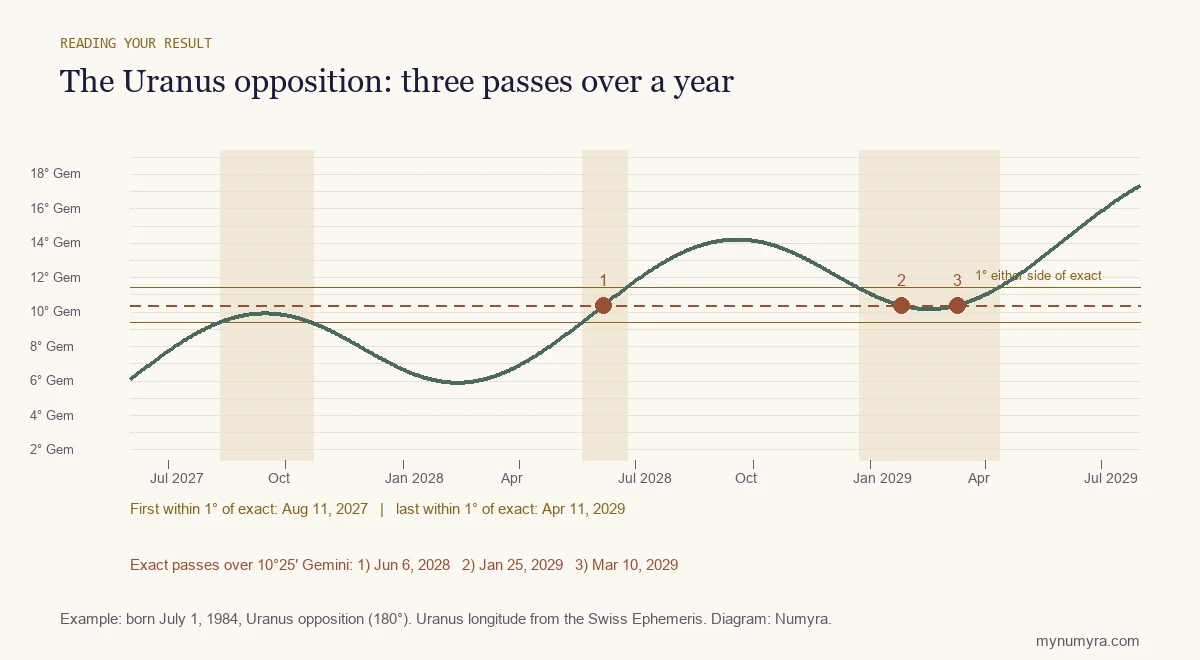
Whether you get one exact date or three depends on Uranus's retrograde loop. Uranus appears to move backward for about five months a year, the same illusion behind Mercury retrograde. For Uranus the loop is wide compared with the planet's slow progress, so three passes is the normal case: 91% of the 40,542 birth dates from 1900 to 2010 get three at the opposition, and 95.5% of those born from 1950 to 1995. No birth date gets two. See our Uranus opposition guide for what the opposition is said to mean.
At what age do the Uranus points come?
Uranus takes about 84 years to circle the zodiac, so the half-way point averages 42, but it is only an average. This table gives the first exact pass of each point for every birth date from 1900 to 2010 (40,542 dates, Uranus at noon Universal Time).
| Point | Angle | First exact pass: ages (average) | Three passes |
|---|---|---|---|
| Uranus square | 90° | 18.4 to 23.2 (21.0) | 93.7% |
| Uranus opposition | 180° | 38.0 to 44.5 (41.9) | 91.4% |
| Uranus return | 360° | 82.4 to 84.0 (83.3) | 94.4% |
Uranus moves faster in some parts of its orbit than others, so the age depends on where your natal Uranus sits: births in the 1950s meet the opposition at 38 to 42, and births from 1976 on at 43 to 45. The Uranus return at about 83 to 84 falls after the year 2100 for anyone born after about 2013, and the calculator marks it that way.
Who has a Uranus opposition from 2026 to 2030?
Uranus entered Gemini for good on April 25, 2026, so the points it opposes are in Sagittarius, with a few births from late 1980 and 1981 in Scorpio. This table lists, for each calendar year, the birth dates with at least one exact opposition pass that year (Uranus at noon Universal Time, so a birthday on an edge can fall either side).
| Year | Born between |
|---|---|
| 2026 | Dec 14, 1980 and Sep 21, 1983 |
| 2027 | Dec 14, 1981 and Sep 18, 1984 |
| 2028 | Dec 15, 1982 and Sep 17, 1985 |
| 2029 | Dec 16, 1983 and Sep 17, 1986 |
| 2030 | Dec 17, 1984 and Sep 21, 1987 |
The windows overlap because the three passes of one person can fall in different calendar years. Many of the same people have a second Saturn opposition in these years; see the Saturn opposition calculator.
How this calculator works, and how accurate it is
Uranus's position comes from Paul Schlyter's published method, the same engine as our stellium calculator, including its correction terms for the pull of Saturn and Jupiter on Uranus. The calculator steps through every day from your birth to four years past your last Uranus point, finds each moment Uranus crosses it, and narrows each crossing down to the minute. It all runs in your browser, so nothing you enter leaves your device. To check it, we ran the same code for 600 random birth moments from 1900 to 2010 and compared every exact pass of all three points with the Swiss Ephemeris:
| Check | Result |
|---|---|
| Birth moments tested | 600 random, 1900 to 2010 |
| Exact passes compared | 5,133 |
| Same date within 6 hours | 32.3% |
| Same date within 1 day | 90.6% |
| Difference: median, 95th percentile | 9.3 hours, 31 hours |
| Largest difference | 8.7 days, at a turning point |
| Uranus at birth, largest difference | 2.4′ (arcminutes) |
| Crossing point in the same sign and degree | 100% sign, 99.2% degree |
| One pass vs three disagreed | 0.83% of points, all flagged by the calculator's warning |
| One-degree window edges within 1 day | 90.4% |
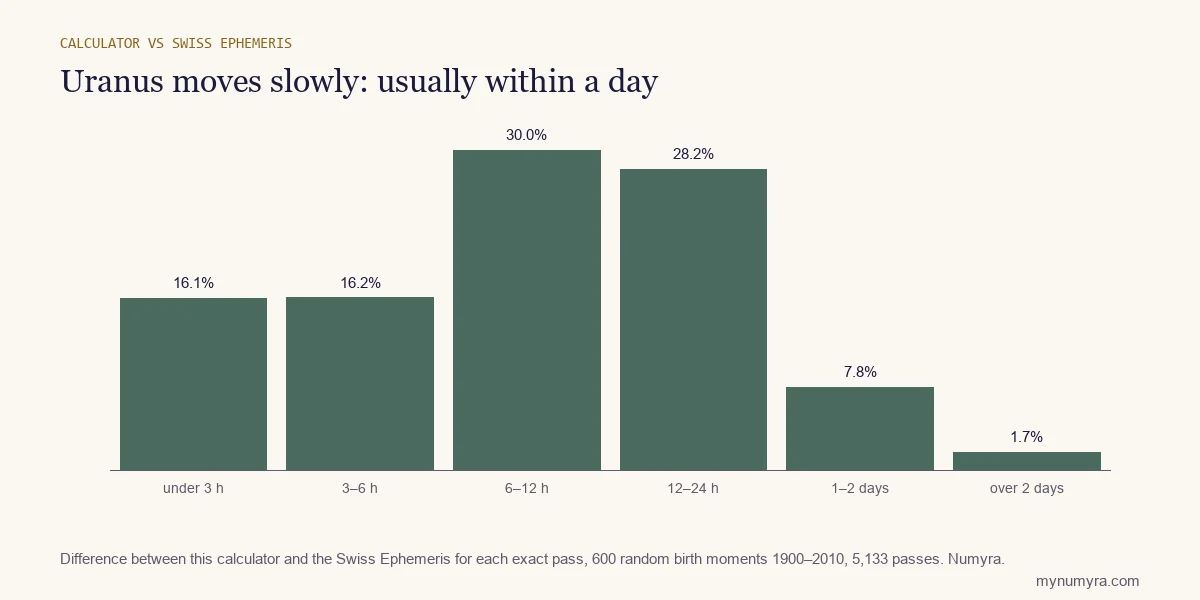
Uranus moves slowest of the three planets, so the same small error in its position costs more time here than for Jupiter or Saturn: expect most dates to be within a day, a few to be two days out, and the rare worst case, where Uranus turns around almost on the point, to differ by more. When Uranus turns around within 0.1 degree of a point, two programs can disagree on whether you get one pass or three; the calculator tells you when that applies. The one-degree window edges can move by months for the same reason. If you do not know your birth time, the calculator places Uranus at noon and checks whether the start or end of the day would change your dates. Nothing is calculated past the year 2100. Dates are shown in your device's time zone.
Frequently asked questions
What does the Uranus opposition calculator show?
For your birth date it finds the Uranus square (90 degrees), the opposition (180) and the return (360). For each it shows every exact pass, your age, the degree and sign Uranus crosses, and how long Uranus stays within one degree. Points that fall after 2100 are marked as beyond the tested range.
At what age is the Uranus opposition?
On average at 42, since Uranus orbits in about 84 years, but it ranges with your birth year. In our measurement of every birth date from 1900 to 2010 the first exact pass averages 41.9 and falls between ages 38.0 and 44.5.
Is the Uranus opposition the same as the Uranus half return?
Yes. The opposition is the half-way point of the 84-year cycle, which is why it is also called the half return. The full Uranus return comes at about 83 to 84, and the Uranus square, the quarter-way point, at about 21.
Why does my Uranus opposition show three dates?
Uranus turns retrograde for about five months a year, and for most birth dates that loop passes over the opposite point, so Uranus crosses it forward, back and forward again. 91% of birth dates from 1900 to 2010 get three passes (95.5% for 1950 to 1995) and the rest get one. It is never two.
Do I need my exact birth time?
Often not. For 89% of 300 random birth dates we tested, any birth time on the day gave the same passes to within two days. For the other 11%, the start and the end of the day gave a different result (a pass more than two days apart, or one pass versus three), and the calculator tells you when your date is one of them.
How long does the Uranus opposition last?
The exact passes of one person span about nine months on average. Counting from the first time Uranus comes within one degree of the exact point to the last time it leaves, the stay averages 1.25 years in our measurement for births from 1950 to 1995, and the calculator shows this span for your dates.
Who has a Uranus opposition in 2026?
People born between December 14, 1980 and September 21, 1983 have at least one exact pass in 2026. In 2027 the window is December 14, 1981 to September 18, 1984, and it moves forward about a year at a time to 2030.
How accurate is this calculator?
We compared it with the Swiss Ephemeris for 600 random birth moments and 5,133 exact passes: 32% matched within 6 hours and 91% within a day, with a median difference of 9.3 hours. Uranus is the slowest planet we test, so the dates are looser than for Jupiter or Saturn. In 0.8% of points the two disagreed on one pass versus three, and the calculator flags those.
Sources
- Schlyter, Paul. How to Compute Planetary Positions. The position method used by this calculator.
- Astrodienst. Swiss Ephemeris. Reference used to test the calculator and to compute the ages of every Uranus point from 1900 to 2010.
- NASA Space Science Data Coordinated Archive. Uranus Fact Sheet. Sidereal orbit period 30,685.4 days (84.011 years).
- Numyra. Uranus opposition guide. The measured ages, three-pass shares, one-degree windows and worked example this calculator reproduces.
- Numyra Methodology Desk. Astrology calculation standard.