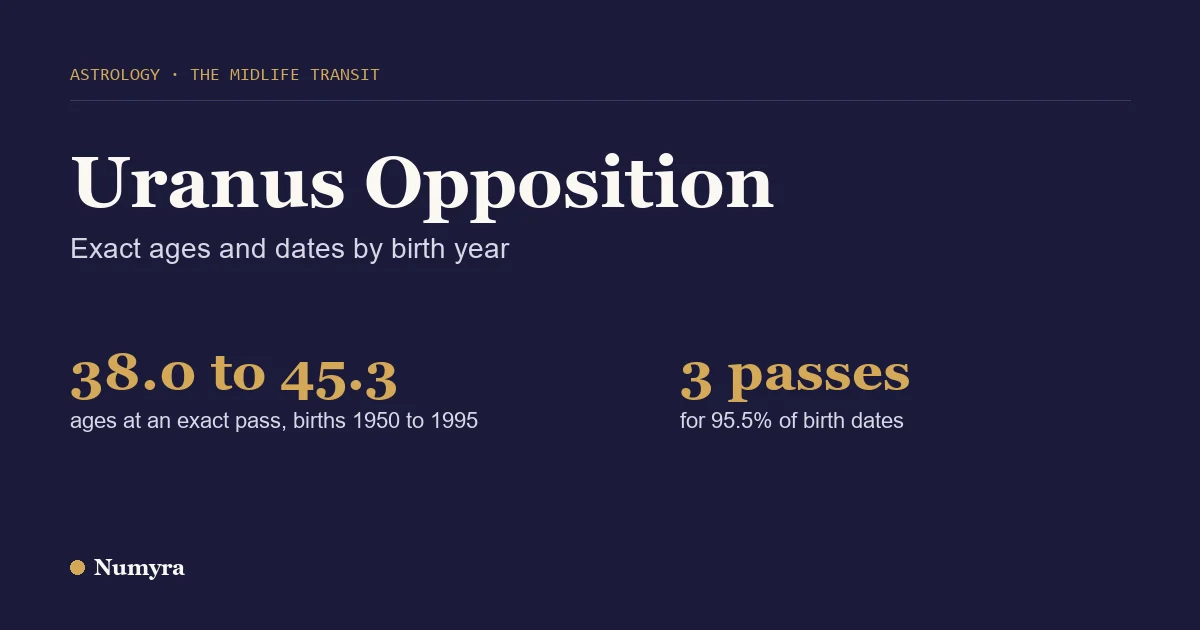
The Uranus opposition is the moment transiting Uranus reaches the point exactly opposite its position at your birth, and for people born from 1950 to 1995 it first happens between ages 38.0 and 44.5, not at a fixed 42. Most birth dates (95.5%) get three exact passes spread over about nine months, because Uranus turns retrograde for roughly five months each year. Anyone born between December 14, 1980 and September 21, 1987 has at least one of those passes between 2026 and 2030. All dates and ages here are calculated for every single birth date, and the psychology of the “midlife crisis” is set against them at the end.
Key takeaways
- Uranus orbits in 84.01 years (NASA), so the half-way point, the Uranus opposition or half return (the nodes have their own nodal return and half return), averages 42 years. For the 16,801 birth dates from 1950 to 1995 the first exact pass falls between 38.0 and 44.5 and the last between 38.7 and 45.3.
- The age drifts upward with birth year: 38 to 42 for people born in the 1950s, 43 to 45 for everyone born from 1976 on. Uranus moves fastest near its closest point to the Sun (1966) and slowest on the far side of its orbit.
- 95.5% of birth dates get three exact passes (direct, retrograde, direct) and 4.5% get one. The three passes span 0.75 years (about nine months) on average and never more than 0.81.
- People born December 14, 1980 to September 21, 1983 have an exact pass in 2026; the window then slides forward a year at a time, to December 17, 1984 to September 21, 1987 for 2030. Uranus is retrograde in Gemini at about 5 degrees today and turns direct on February 8, 2027.
- The “midlife crisis” reading is astrological tradition. The best-known US survey, Wethington (2000), found 26% of 724 adults said they had had one, at ages that were widely spread, and it did not test planets.
In this guide
- What age is the Uranus opposition?
- Why the age moves between 38 and 45
- Uranus opposition age by birth year, 1950 to 1995
- Three passes, not one: how the retrograde works
- Who has the Uranus opposition from 2026 to 2030
- What astrologers say the Uranus opposition means
- The midlife crisis: what the research found
- How these numbers were calculated
- Frequently asked questions
What age is the Uranus opposition?
Uranus takes 84.01 years to circle the zodiac, which is 30,685.4 days in NASA’s Uranus Fact Sheet. Half of that is 42 years, so the Uranus opposition (also called the Uranus half return) averages 42, and it sits between the Uranus square at about 22 and the return at about 84, set against the yearly solar return and the Saturn return at about 29. Our guide to Uranus and Neptune signs has the milestone ages for the whole cycle and the sign tables; this page is about the opposition alone and about your exact timing.
Forty-two is only the average. Calculating every birth date from January 1, 1950 to December 31, 1995, the first exact pass comes at an average age of 42.1 and ranges from 38.0 to 44.5, and the last pass averages 42.9 and ranges from 38.7 to 45.3. About one person in five meets it before 40 (18.5%), about one in five at 44 or later (19.4%), and 37.8% between 42 and 44.
The same day-by-day method applied to births from 1900 to 1945 gives a first pass from 38.1 to 44.5, wider than the 39.5 to 44.1 in the milestone table of the guide above, which summarises one figure per birth year. The averages agree (42.1 in both), so the extra width comes from counting every date in the year.
Why the age moves between 38 and 45
Uranus does not move at a constant speed. Its orbit is slightly elongated, with an eccentricity of 0.0469, so it is 2,732.7 million km from the Sun at its closest and 3,001.4 million km at its farthest (NASA). A planet moves faster when it is nearer the Sun, so Uranus covers the same arc of zodiac more quickly on one side of its orbit than the other. By our calculation its last closest approach was in 1966 at about 21 degrees of Virgo and the next is in 2050; the farthest point, in 2092, is near 23 degrees of Pisces.
That is why the age depends on where your natal Uranus sits. Someone born in 1950 with Uranus in Cancer has a half-orbit that crosses the fast stretch around Virgo and Libra, so the opposition arrives early, from about 38. Someone born in the 1980s with Uranus in Sagittarius has a half-orbit that runs through the slow stretch around Pisces and Aries, so it arrives late, at 43 to 45. The shift is gradual from one birth year to the next, with steps when Uranus changes sign.
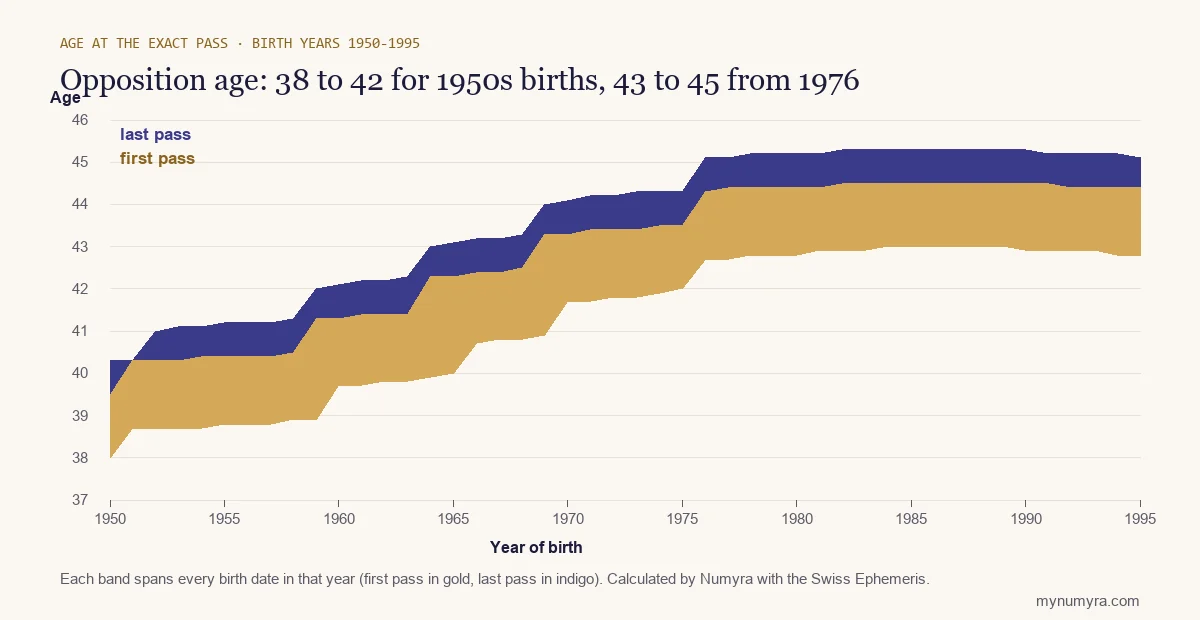
Uranus opposition age by birth year, 1950 to 1995
Each row covers every birth date in that calendar year. “First pass” is the age at the first exact opposition and “last pass” the age at the final one; the range is the earliest to the latest birthday in the year. If your birthday falls near the end of a Uranus sign (see the sign tables in our Uranus and Neptune signs guide), expect the upper end of the range.
| Born | Natal Uranus in | Age at first pass | Age at last pass | Calendar years of the passes |
|---|---|---|---|---|
| 1950 | Cancer | 38.0 to 39.5 | 38.7 to 40.3 | 1988 to 1990 |
| 1951 | Cancer | 38.7 to 40.3 | 38.7 to 40.3 | 1989 to 1992 |
| 1952 | Cancer | 38.7 to 40.3 | 39.5 to 41.0 | 1991 to 1993 |
| 1953 | Cancer | 38.7 to 40.3 | 39.5 to 41.1 | 1992 to 1994 |
| 1954 | Cancer | 38.7 to 40.4 | 39.5 to 41.1 | 1993 to 1995 |
| 1955 | Cancer, Leo | 38.8 to 40.4 | 39.6 to 41.2 | 1994 to 1996 |
| 1956 | Cancer, Leo | 38.8 to 40.4 | 39.6 to 41.2 | 1995 to 1997 |
| 1957 | Leo | 38.8 to 40.4 | 39.6 to 41.2 | 1996 to 1999 |
| 1958 | Leo | 38.9 to 40.5 | 39.6 to 41.3 | 1997 to 2000 |
| 1959 | Leo | 38.9 to 41.3 | 39.7 to 42.0 | 1998 to 2001 |
| 1960 | Leo | 39.7 to 41.3 | 40.5 to 42.1 | 2000 to 2002 |
| 1961 | Leo, Virgo | 39.7 to 41.4 | 40.5 to 42.2 | 2001 to 2004 |
| 1962 | Leo, Virgo | 39.8 to 41.4 | 40.6 to 42.2 | 2002 to 2005 |
| 1963 | Virgo | 39.8 to 41.4 | 40.6 to 42.3 | 2003 to 2006 |
| 1964 | Virgo | 39.9 to 42.3 | 40.7 to 43.0 | 2004 to 2007 |
| 1965 | Virgo | 40.0 to 42.3 | 40.7 to 43.1 | 2005 to 2009 |
| 1966 | Virgo | 40.7 to 42.4 | 41.5 to 43.2 | 2007 to 2010 |
| 1967 | Virgo | 40.8 to 42.4 | 41.6 to 43.2 | 2008 to 2011 |
| 1968 | Virgo, Libra | 40.8 to 42.5 | 41.6 to 43.3 | 2009 to 2012 |
| 1969 | Virgo, Libra | 40.9 to 43.3 | 41.7 to 44.0 | 2010 to 2014 |
| 1970 | Libra | 41.7 to 43.3 | 42.5 to 44.1 | 2012 to 2015 |
| 1971 | Libra | 41.7 to 43.4 | 42.6 to 44.2 | 2013 to 2016 |
| 1972 | Libra | 41.8 to 43.4 | 42.6 to 44.2 | 2014 to 2017 |
| 1973 | Libra | 41.8 to 43.4 | 42.6 to 44.3 | 2015 to 2018 |
| 1974 | Libra, Scorpio | 41.9 to 43.5 | 42.7 to 44.3 | 2016 to 2019 |
| 1975 | Libra, Scorpio | 42.0 to 43.5 | 42.7 to 44.3 | 2017 to 2020 |
| 1976 | Scorpio | 42.7 to 44.3 | 43.5 to 45.1 | 2019 to 2022 |
| 1977 | Scorpio | 42.7 to 44.4 | 43.6 to 45.1 | 2020 to 2023 |
| 1978 | Scorpio | 42.8 to 44.4 | 43.6 to 45.2 | 2021 to 2024 |
| 1979 | Scorpio | 42.8 to 44.4 | 43.6 to 45.2 | 2022 to 2025 |
| 1980 | Scorpio | 42.8 to 44.4 | 43.6 to 45.2 | 2023 to 2026 |
| 1981 | Scorpio, Sagittarius | 42.9 to 44.4 | 43.6 to 45.2 | 2024 to 2027 |
| 1982 | Sagittarius | 42.9 to 44.5 | 43.7 to 45.3 | 2025 to 2028 |
| 1983 | Sagittarius | 42.9 to 44.5 | 43.7 to 45.3 | 2026 to 2029 |
| 1984 | Sagittarius | 43.0 to 44.5 | 43.7 to 45.3 | 2027 to 2030 |
| 1985 | Sagittarius | 43.0 to 44.5 | 43.7 to 45.3 | 2028 to 2031 |
| 1986 | Sagittarius | 43.0 to 44.5 | 43.7 to 45.3 | 2029 to 2032 |
| 1987 | Sagittarius | 43.0 to 44.5 | 43.7 to 45.3 | 2030 to 2033 |
| 1988 | Sagittarius, Capricorn | 43.0 to 44.5 | 43.7 to 45.3 | 2031 to 2033 |
| 1989 | Capricorn | 43.0 to 44.5 | 43.7 to 45.3 | 2032 to 2034 |
| 1990 | Capricorn | 42.9 to 44.5 | 43.7 to 45.3 | 2033 to 2035 |
| 1991 | Capricorn | 42.9 to 44.5 | 43.7 to 45.2 | 2034 to 2036 |
| 1992 | Capricorn | 42.9 to 44.4 | 43.6 to 45.2 | 2035 to 2037 |
| 1993 | Capricorn | 42.9 to 44.4 | 43.6 to 45.2 | 2036 to 2038 |
| 1994 | Capricorn | 42.8 to 44.4 | 43.6 to 45.2 | 2037 to 2039 |
| 1995 | Capricorn, Aquarius | 42.8 to 44.4 | 43.6 to 45.1 | 2038 to 2040 |
Born after 1995? The table stops at 1995, but for the 85.4 million US births from 1994 to 2014 (the CDC and Social Security data used in the Uranus sign tables) the first exact pass falls between ages 39.9 and 44.4, averages 42.2 when weighted by births, and arrives between 2037 and 2055.
Three passes, not one: how the retrograde works
Seen from Earth, Uranus appears to move backward for about five months every year (see the 2027 retrograde calendar), as Earth overtakes it (the same effect behind Mercury retrograde, only slower). The current retrograde runs from September 10, 2026 to February 8, 2027, 151 days. If the opposite point lies inside the stretch of sky Uranus covers during that loop, the planet crosses it going forward, backward and forward again.
That is the normal case. In our calculation 16,048 of the 16,801 birth dates (95.5%) get three exact passes and 753 (4.5%) get one; no birth date gets two. The three passes of a single chart are 0.75 years apart on average, from first to last, and never more than 0.81 years. For someone born July 1, 1984 they fall on June 6, 2028, January 25, 2029 and March 10, 2029, with the retrograde running from September 18, 2028 to February 16, 2029.
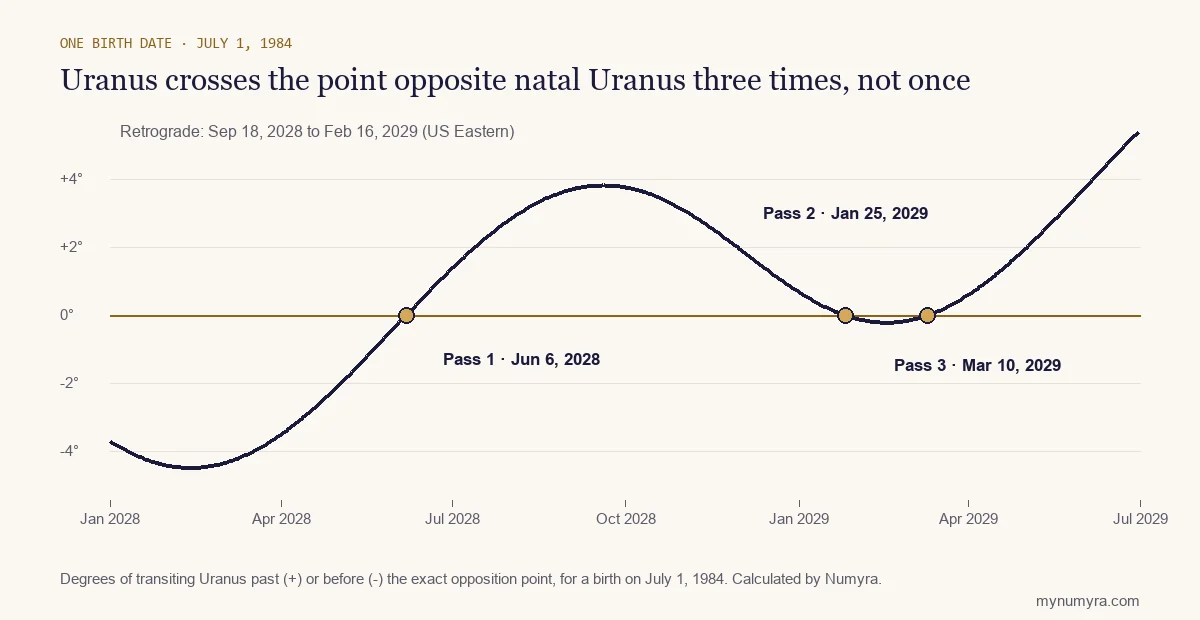
How long the transit “lasts” depends on how wide a margin you allow. Counting from the first entry to the last exit, Uranus stays within 1 degree of the exact opposition point for 1.25 years on average (0.88 to 1.70), within 3 degrees for 2.2 years (1.86 to 2.72) and within 5 degrees for 3.19 years (2.81 to 3.73). Astrologers who say the opposition lasts “a year or two” are describing roughly the 1-degree to 3-degree figures. For a comparison with another long-running transit, see the Saturn return, which comes at 28.4 to 29.9.
Who has the Uranus opposition from 2026 to 2030
Uranus entered Gemini for good on April 25, 2026, so the planet doing the opposing is in Gemini and the natal planets being opposed are in Sagittarius, with a few people from late 1980 and 1981 having Scorpio. The table lists, for each calendar year, the birth dates that have at least one exact pass in that year.
| Year | Born between | Natal Uranus in | Transiting Uranus covers, that year |
|---|---|---|---|
| 2026 | Dec 14, 1980 and Sep 21, 1983 | Scorpio, Sagittarius | 27°28′ Taurus to 5°42′ Gemini |
| 2027 | Dec 14, 1981 and Sep 18, 1984 | Sagittarius | 1°41′ to 9°57′ Gemini |
| 2028 | Dec 15, 1982 and Sep 17, 1985 | Sagittarius | 5°56′ to 14°14′ Gemini |
| 2029 | Dec 16, 1983 and Sep 17, 1986 | Sagittarius | 10°12′ to 18°33′ Gemini |
| 2030 | Dec 17, 1984 and Sep 21, 1987 | Sagittarius | 14°30′ to 22°54′ Gemini |
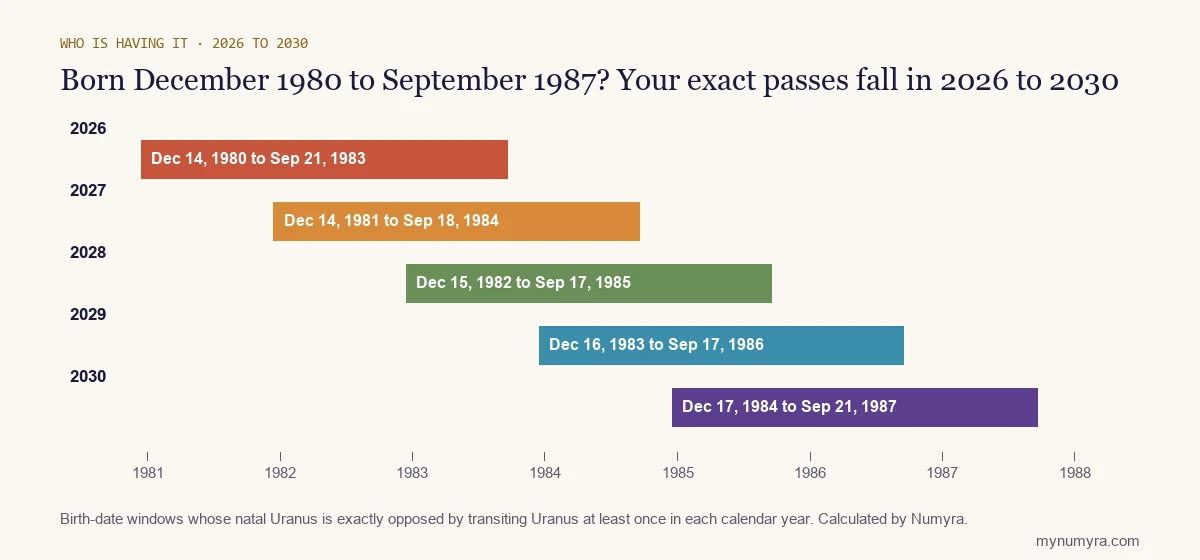
Each window covers about 2.8 years of birthdays, and the windows overlap because the three passes of one person can fall in different calendar years. As of October 14, 2026, Uranus is at about 5 degrees 14 minutes of Gemini and retrograde, turning direct on February 8, 2027 at 1 degree 41 minutes of Gemini. People whose natal Uranus is between those two degrees of Sagittarius have the retrograde loop passing over their opposition point this winter; they were born in three stretches: December 14, 1981 to June 16, 1982, September 30 to December 10, 1982, and July 6 to September 21, 1983.
The calculation uses noon UT on the birth date and ignores birth time, so a date near an edge of a window can be off by a day. For exact dates from your own chart, a birth chart calculator gives your natal Uranus degree, and the opposite degree is that number plus 180. Or skip the arithmetic with the Uranus opposition calculator.
What astrologers say the Uranus opposition means
Astrologers read Uranus as the planet of change, independence and disruption, so an aspect from Uranus to its own natal position is taken as a checkpoint on how much freedom a life has made room for. The opposition is the half-way point of that relationship, the moment of greatest distance from where you began, and tradition treats it as a time when what you have built and what you want to change pull against each other. One widely used reference puts it this way:
“With transiting Uranus opposite natal Uranus, you arrive at crossroads in terms of career, life path, or general direction.”
Cafe Astrology, Uranus Transits to the Natal Chart, section “Uranus Transits Opposite Uranus”
Most modern accounts add that the effect depends on the house where the opposition falls and on aspects to your personal planets, which is why they send readers to a full chart (see our guide to the astrological houses). Some sites also group it with the Neptune square, which comes at about 40.4 (see the milestone table), as part of a single midlife cluster (see also the Saturn opposition at about 44). These are interpretive traditions, not measured effects, and nothing in this section is a prediction. Uranus is modern, found in 1781, so there is no classical text on it to quote.
The midlife crisis: what the research found
“Midlife crisis” is the phrase most pages attach to the Uranus opposition, so it is fair to ask what psychologists have found. The most cited US study of what people mean by it is Elaine Wethington’s 2000 paper in Motivation and Emotion, based on interviews with 724 adults aged 28 to 78 in 1997 and 1998, drawn from the national MIDUS sample (the Midlife in the United States study). Its abstract reports that 26% of respondents said they had had a midlife crisis, a much higher figure than the roughly 10% of American men that an earlier review had estimated. Respondents gave an average of 45.0 (men) and 47.6 (women) as the age of their own crisis; the difference between the sexes was not statistically significant.
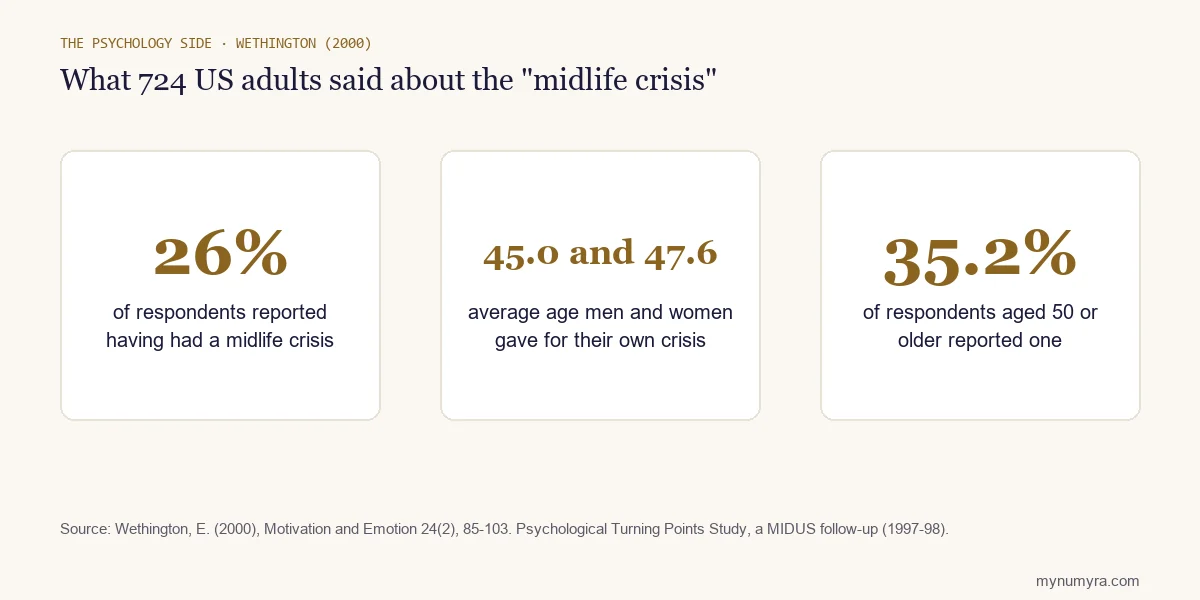
“Despite the identification of this term with male personality development, women were as likely as men to report having had a midlife crisis. In addition, crises occurring well before age 40 and well after age 50 were frequently nominated as midlife crises.”
Elaine Wethington, “Expecting Stress: Americans and the ‘Midlife Crisis'”, Motivation and Emotion 24(2), 2000, abstract
Two further points from the paper matter here. People who reported a crisis were slightly more likely to be in the 39 to 43 or 49 to 53 age groups, but the paper says this pattern is not statistically significant, and it says relatively few people reported a crisis in the period suggested by stage theories of midlife. Most participants also tied their crisis to major life events rather than to aging itself. Nothing in the paper involves planets, so it can neither support nor refute the Uranus reading; what it does show is that a crisis reported at 42 is not special to 42.
A later review of longitudinal MIDUS data points the same way for midlife in general:
“The picture of well-being in midlife based on longitudinal data from the Midlife in the United States (MIDUS) study is a more positive one than portrayed in previous cross-sectional studies.”
Margie E. Lachman, Salom Teshale and Stefan Agrigoroaei, “Midlife as a pivotal period in the life course”, International Journal of Behavioral Development 39(1), 2015, abstract
A reasonable reading is that midlife is a period of real reassessment for many people, that a minority label it a crisis at ages spread well beyond 38 to 45, and that the Uranus opposition is a symbolic frame some people find useful for that reassessment, not a cause. If you read it that way, the exact date is a prompt for reflection, not a deadline.
How these numbers were calculated
Every figure comes from our own calculation with the Swiss Ephemeris (Moshier mode), using geocentric tropical longitudes of Uranus at noon UT for each day. For each birth date from January 1, 1950 to December 31, 1995 (16,801 dates) we located every day in the following years when transiting Uranus crossed the point 180 degrees from the natal position, interpolating between days, and recorded the ages. We checked the method against NASA’s JPL Horizons system: for a July 1, 1984 birth, Horizons puts Uranus at 250.4171 degrees on the natal date and within 0.004 degrees of 180 degrees away on each of the three pass dates above, and its daily positions put the 2028 and 2029 retrograde stations on the same days as ours, to within a day. The US births figures use 85.4 million births from 1994 to 2014 (CDC/NCHS and Social Security Administration data via FiveThirtyEight); we did not use births before 1994. Our Uranus opposition calculator runs the same method for your own birth date and lists every pass.
Frequently asked questions
At what age is the Uranus opposition?
On average at 42, since Uranus orbits in 84.01 years. For people born 1950 to 1995 the first exact pass falls between ages 38.0 and 44.5 and the last between 38.7 and 45.3, depending on birth year.
Why is my Uranus opposition at 44 when everyone says 42?
Uranus moves faster in some parts of its orbit than others. If you were born from 1976 on, your half-orbit crosses its slow stretch, so the opposition comes at 43 to 45, not 42. People born in the 1950s meet it at 38 to 42.
Does the Uranus opposition happen once or three times?
Three times for 95.5% of birth dates and once for 4.5%, in our calculation of 16,801 birth dates from 1950 to 1995. The three passes are direct, retrograde, direct, spread over about nine months.
How long does the Uranus opposition last?
The three exact passes span about nine months. Counting every time Uranus is within 1 degree of the exact point, it averages 1.25 years; within 3 degrees, 2.2 years; within 5 degrees, 3.19 years.
Who has the Uranus opposition in 2026?
People born between December 14, 1980 and September 21, 1983 have at least one exact pass in 2026. In 2027 the window is December 14, 1981 to September 18, 1984, and it moves forward about a year at a time to 2030.
Is the Uranus opposition the same as the Uranus half return?
Yes. The opposition is the half-way point of Uranus’s 84-year cycle, which is why it is also called the Uranus half return. The full Uranus return comes at about 84.
Is the Uranus opposition really a midlife crisis?
That is the astrological tradition, not a finding. In Wethington’s 2000 survey of 724 US adults, 26% said they had had a midlife crisis, with a self-reported average age of 45.0 for men and 47.6 for women, and a clustering at ages 39 to 43 that was not statistically significant.
How do I find my exact Uranus opposition dates?
Find your natal Uranus degree in a birth chart, add 180 degrees, and look in an ephemeris for the dates transiting Uranus reaches that degree. The table above gives the age range for your birth year. Remember there will usually be three dates, not one.
Sources
- Astrodienst. Swiss Ephemeris. Every position, pass, age and station on this page (calculations by the Numyra Methodology Desk).
- NASA. Uranus Fact Sheet. Sidereal orbit period 30,685.4 days (84.011 years), eccentricity, perihelion and aphelion.
- NASA JPL. Horizons System. Independent positions of Uranus used to cross-check our pass dates and stations.
- Wethington, E. (2000). Expecting Stress: Americans and the “Midlife Crisis.” Motivation and Emotion, 24(2), 85-103.
- Lachman, M. E., Teshale, S. and Agrigoroaei, S. (2015). Midlife as a pivotal period in the life course. International Journal of Behavioral Development, 39(1), 20-31.
- Cafe Astrology. Uranus Transits to the Natal Chart. The traditional reading of Uranus opposite natal Uranus.
- FiveThirtyEight. US births data, 1994 to 2014, from the CDC National Center for Health Statistics and the Social Security Administration.