Saturn Opposition Calculator
Enter your birth date and city to get the exact dates Saturn is square, opposite and back at its birth position: all eight quarter points of the Saturn cycle, from the first square at about 7 to the second return at about 59. For every birth date from 1900 to 2010 the first opposition fell between ages 12.8 and 16.3, and for 54% of people it comes in three separate passes.
Key takeaways
- A Saturn opposition is the day Saturn reaches the point exactly opposite its position at your birth. The calculator finds every pass of all eight quarter points (squares at 90 and 270 degrees, opposition at 180, return at 360, then the same four again), your age on each, and how long Saturn stays within one degree of the exact point.
- Across 40,542 birth dates from 1900 to 2010, the first exact opposition fell between ages 12.8 and 16.3 (average 14.5) and the second between 42.7 and 45.4 at its first pass. The quarter points narrow to 28.4 to 29.9 for the return.
- Tested against the Swiss Ephemeris on 9,887 exact passes: 70% matched within 6 hours and 98% within a day.
- Nothing here is medical, financial, legal, or psychological advice. This is a cultural tradition, presented for entertainment and reflection.
Your Saturn quarter points
For entertainment and self-reflection. Numerology is a cultural tradition, not a science, and nothing here is medical, financial, legal, or psychological advice.
What your result shows
Your result starts with Saturn's position at your birth, its sign and degree. Each of the eight quarter points is a fixed angle from that position: the opening square at 90 degrees, the opposition at 180, the closing square at 270 and the return at 360, then the same four again for the second lap (450, 540, 630 and 720). For each you get the exact dates Saturn crosses that point, your age on each date, the degree and sign Saturn crosses, and the stretch of time Saturn spends within one degree of the exact point.

Whether you get one exact date or three depends on Saturn's retrograde loop. Each year Saturn appears to move backward for about four and a half months, the same illusion behind Mercury retrograde. For Saturn it is close to a coin flip: of the 40,542 birth dates from 1900 to 2010, 54.1% of first oppositions and 50.5% of second oppositions had three passes, and none had two. The one-degree stretch is counted from the first time Saturn comes within a degree of the exact point to the last time it leaves. See our Saturn opposition guide for what the opposition is said to mean.
The eight quarter points, by age
Saturn moves 90 degrees about every 7.4 years, so a lap against your natal Saturn has four quarter points in about 29.4 years. This table gives the first exact pass of each for every birth date from 1900 to 2010 (40,542 dates, Saturn at noon Universal Time), the same figures as in the guide.
| Quarter point | Angle | First exact pass: ages (average) | Three passes |
|---|---|---|---|
| 1. Opening square | 90° | 5.7 to 8.2 (7.2) | 47.6% |
| 2. First opposition | 180° | 12.8 to 16.3 (14.5) | 54.1% |
| 3. Closing square | 270° | 20.9 to 23.4 (21.8) | 55.9% |
| 4. Saturn return | 360° | 28.4 to 29.9 (29.2) | 37.9% |
| 5. Second opening square | 450° | 35.5 to 38.1 (36.5) | 59.1% |
| 6. Second opposition | 540° | 42.7 to 45.4 (43.9) | 50.5% |
| 7. Second closing square | 630° | 50.0 to 52.6 (51.2) | 56.8% |
| 8. Second Saturn return | 720° | 58.2 to 59.0 (58.6) | 58.9% |
The return has the narrowest range of the eight (28.4 to 29.9), which is why "29" works as shorthand for it, while the opposition spreads over 3.5 years, so "14" and "44" are looser. The waning square that people sometimes place at 36 is really the opening square of the second lap: the closing square of the first lap comes at about 22.
Who has a Saturn opposition from 2026 to 2028?
Saturn entered Aries for good on February 13, 2026 and leaves for Taurus on April 12, 2028, so the points it opposes are in Libra and its neighbours. This table lists, for each calendar year, the birth dates with at least one exact opposition pass that year (Saturn at noon Universal Time, so a birthday on an edge can fall either side).
| Year | First opposition: born between | Second opposition: born between |
|---|---|---|
| 2026 | Sep 27, 2009 and Aug 27, 2011 | Dec 7, 1979 and Oct 21, 1981 |
| 2027 | Oct 6, 2010 and Sep 16, 2012 | Dec 9, 1980 and Jul 14, 1983 |
| 2028 | Oct 21, 2011 and Oct 12, 2013 | Dec 26, 1981 and Aug 27, 1984 |
The windows overlap because the three passes of one person can fall in different calendar years. For everyone else, the calculator above gives the exact dates. People born from December 1980 also have a Uranus opposition in the same years; see the Uranus opposition calculator.
How this calculator works, and how accurate it is
Saturn's position comes from Paul Schlyter's published method, the same engine as our Saturn return calculator and stellium calculator, including the main correction for Jupiter's pull on Saturn. The calculator steps through every day from your birth to four years past your last quarter point, finds each moment Saturn crosses each point, and narrows each crossing down to the minute. It all runs in your browser, so nothing you enter leaves your device. To check it, we ran the same code for 600 random birth moments from 1900 to 2010 and compared every exact pass of all eight quarter points with the Swiss Ephemeris:
| Check | Result |
|---|---|
| Birth moments tested | 600 random, 1900 to 2010 |
| Exact passes compared | 9,887 |
| Same date within 6 hours | 70.0% |
| Same date within 1 day | 97.7% |
| Difference: median, 95th percentile | 3.7 hours, 17 hours |
| Largest difference | 4.0 days, at a turning point |
| Saturn at birth, largest difference | 2.5′ (arcminutes) |
| Crossing point in the same sign and degree | 100% sign, 98.5% degree |
| One pass vs three disagreed | 0.27% of quarter points, all flagged by the calculator's warning |
| One-degree window edges within 1 day | 95.7% |
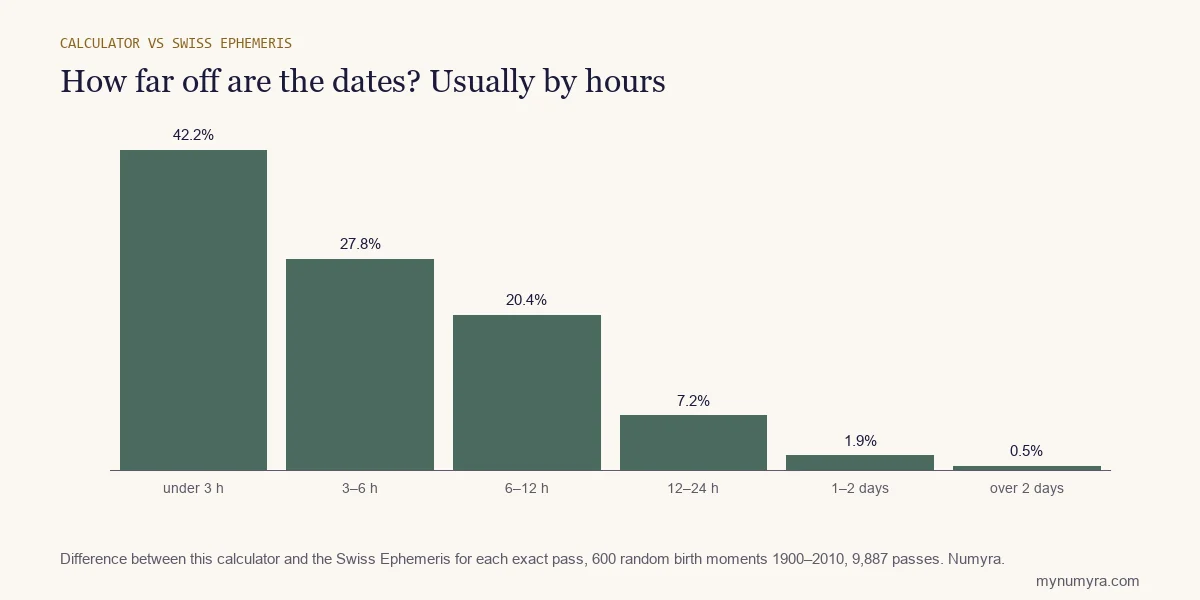
The biggest differences come where Saturn is almost standing still at a turning point, so a tiny difference in position moves the crossing by days. When Saturn turns around within 0.1 degree of a quarter point, two programs can disagree on whether you get one pass or three; the calculator tells you when that applies. The one-degree window edges can move by months for the same reason, when Saturn turns around almost exactly one degree from the point. If you do not know your birth time, the calculator places Saturn at noon and checks whether the start or end of the day would change your dates. Nothing is calculated past the year 2100. Dates are shown in your device's time zone.
Frequently asked questions
What does the Saturn opposition calculator show?
For your birth date it finds all eight quarter points of the Saturn cycle: the squares at 90 and 270 degrees, the opposition at 180, the return at 360, and the same four again for the second lap. For each it shows every exact pass, your age, the degree Saturn crosses, and how long Saturn stays within one degree.
At what age is the Saturn opposition?
About 14 to 15 for the first and 43 to 45 for the second. In our measurement of every birth date from 1900 to 2010 the first exact pass averages 14.5 (range 12.8 to 16.3) and the second 43.9 (range 42.7 to 45.4).
Why does one Saturn opposition show three dates?
Saturn's retrograde loop can carry it back over your opposite point, so it crosses forward, back and forward again. 54.1% of first oppositions and 50.5% of second oppositions are three passes, and the rest are one. It is never two.
Is the Saturn opposition the same as the Saturn return?
No. The return is the conjunction, at 360 degrees, when Saturn comes back to its birth position at about 28.4 to 29.9. The opposition is the half-way point, 180 degrees away, at about 14.5 and 44. This calculator shows both, with the squares between them.
What are the waxing and waning Saturn squares?
The opening (waxing) square is the 90-degree point, at an average age of 7.2 for the first lap and 36.5 for the second. The closing (waning) square is the 270-degree point, at 21.8 and 51.2. The "waning square at 36" is really the second lap's opening square.
Do I need my exact birth time?
Often not. For 84% of 300 random birth dates we tested, any birth time on the day gave the same passes to within two days. For the other 16%, the start and the end of the day gave a different result (a pass more than two days apart, or one pass versus three), and the calculator tells you when your date is one of them.
Who has a Saturn opposition in 2026?
For the first opposition, people born between September 27, 2009 and August 27, 2011; for the second, people born between December 7, 1979 and October 21, 1981. The windows for 2027 and 2028 are in the table above.
How accurate is this calculator?
We compared it with the Swiss Ephemeris for 600 random birth moments and 9,887 exact passes: 70% matched within 6 hours and 98% within a day, with a median difference of 3.7 hours. In 0.3% of quarter points the two disagreed on one pass versus three, always where Saturn turns around on the point, and the calculator flags those.
Sources
- Schlyter, Paul. How to Compute Planetary Positions. The position method used by this calculator.
- Astrodienst. Swiss Ephemeris. Reference used to test the calculator and to compute the ages of every quarter point from 1900 to 2010.
- NASA Space Science Data Coordinated Archive. Saturn Fact Sheet. Sidereal orbit period 10,755.699 days (29.447 years).
- Numyra. Saturn opposition guide. The measured ages, three-pass shares, one-degree windows and worked examples this calculator reproduces.
- Numyra Methodology Desk. Astrology calculation standard.