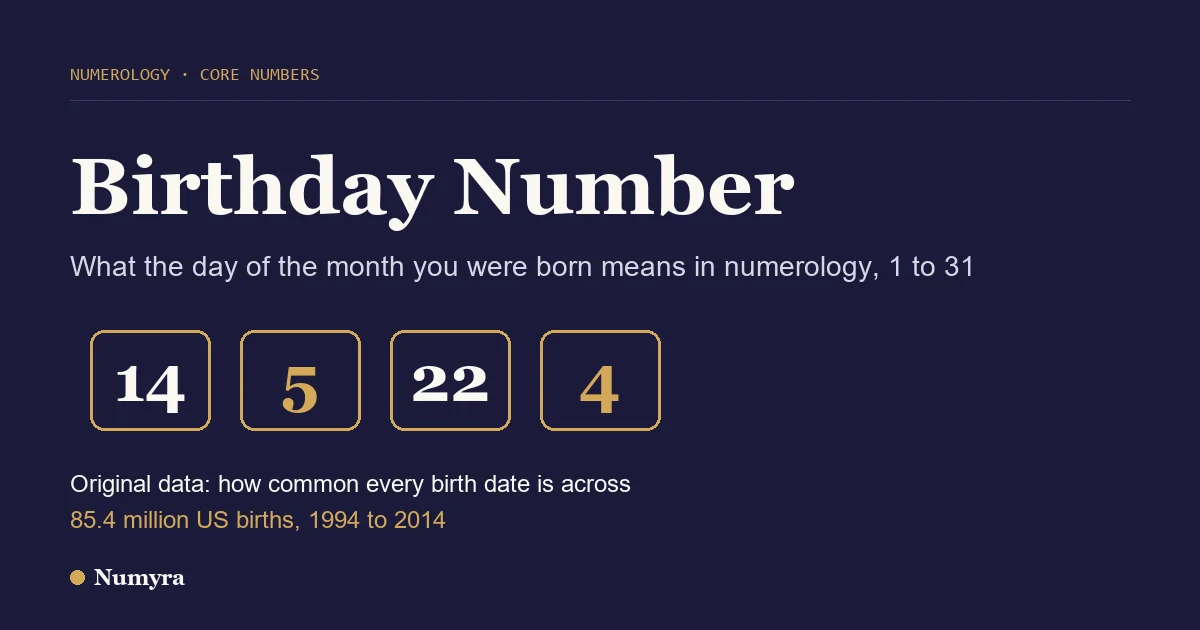
Your birthday number in numerology is the day of the month you were born, from 1 to 31, reduced to a single digit unless it is 11 or 22. Someone born on the 14th has a birthday number of 14/5; someone born on the 29th has 29/11, a master number. Traditional numerologists read it as a specific talent you were born with, the one core number that needs no calculation and is fixed by one fact. This is an interpretive tradition, not a tested science, and nothing in it predicts events. We also counted how the 31 birthdays are spread across 85.4 million US births, and how rarely the birthday number matches the Life Path.
Key takeaways
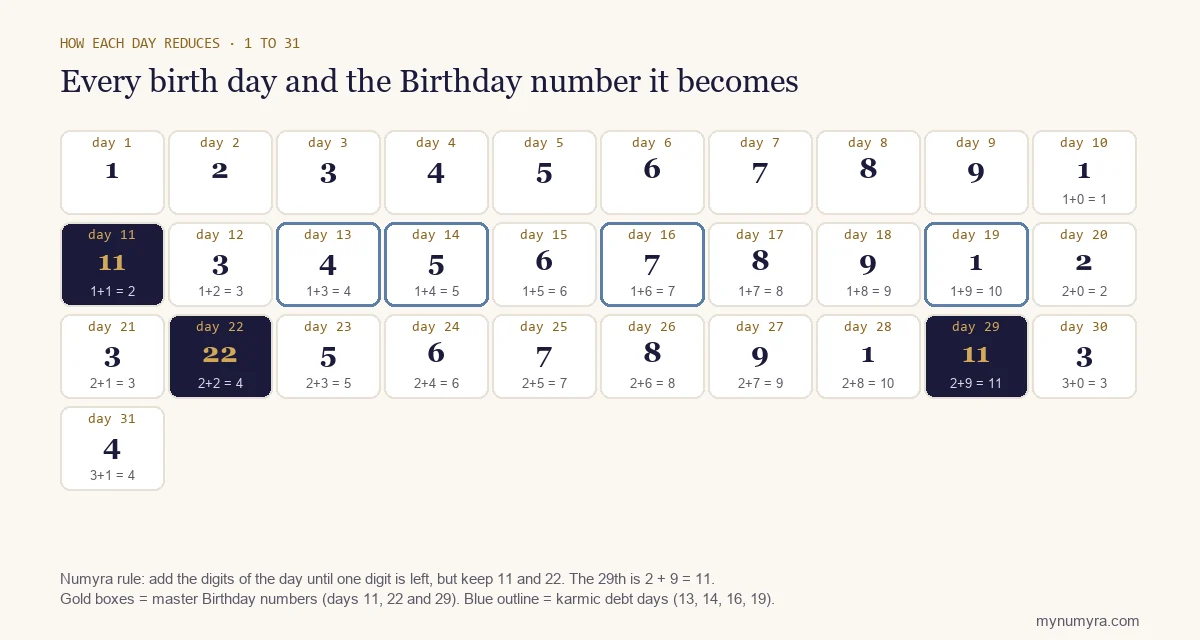
- The birthday number is your day of birth. Days 1 to 9 stand as they are. Days 10 to 31 are added digit by digit (the 17th is 1 + 7 = 8), except 11 and 22, which are kept, and the 29th, which adds to 11 and is kept as 11.
- Traditional sources, including Hans Decoz and Numerologist.com, read it as one natural talent, a “lane” within the Life Path, not a direction for the whole life. Numerologist.com puts its weight at roughly 10% of the core numbers, without saying how that figure was reached.
- Birthday numbers are not equally common. The 1 and the 3 are the most common, at 13.2% and 13.0% of US births, because each collects four birth days; 5 to 9 have three days each and about 9.8% to 9.9% apiece. The master birthday numbers 11 and 22 together cover 9.7%.
- Original data, 1994 to 2014: the 20th is the most common birth date (11,329 births per date; the same data ranks every zodiac sign by US births) and the 25th the least (10,754). The 13th has fewer births than the 12th and 14th on all seven weekdays, 5.8% fewer on Fridays.
- Only 9.7% of people have the same number for their birthday and their Life Path, almost exactly what chance predicts. A day-22 birthday can never produce a Life Path 22 under our rules.
In this guide
- What the birthday number is
- How to calculate it, including 11, 22 and 29
- Birthday number vs Life Path
- What each birthday means, day 1 to 31
- Where traditional sources agree and differ
- How common each birthday is (original data)
- The 13th, Christmas and the 31st: which days are rarest
- How often the birthday number equals the Life Path
- Using it with your other numbers
- Frequently asked questions
What the birthday number is
Numerology builds five core numbers: the Life Path, Expression (Destiny), Soul Urge, Personality and the Birthday. Four need arithmetic or a name chart. The Birthday does not. Hans Decoz, whose World Numerology site is the most-cited reference for the modern Pythagorean method, defines it in one line:
“Your Birthday number is simply the day of your birth.”
Hans Decoz, Birthday Number Meanings, World Numerology
Decoz adds that it “indicates some special talent you possess” and calls it perhaps the most specific of the five, since it reveals one ability. Numerologist.com, which publishes its own guide, contrasts it with the Life Path using a road image: the Life Path is a highway and the birthday number divides it into lanes. It also notes that the birthday is the only core number that, in its words, “requires no calculation at all”. Both are claims of the tradition, and neither site cites a study behind them.
Terminology causes confusion. This page uses “birthday number” the way Decoz and Numerologist.com do: the day of the month alone. Some calculator pages use the same phrase for the whole birth date added together, which is the Life Path number. If a result looks different from ours, check which of the two the site means.
How to calculate it, including 11, 22 and 29
You need only the day. Numyra follows the rule on our methodology page: the day is reduced by adding its digits until one digit is left, and the master numbers 11 and 22 are kept. There are three cases.
- Days 1 to 9: the day is the number. The 6th is a 6.
- Days 10 to 31: add the two digits, and add again if the sum has two digits. The 10th is 1 + 0 = 1, the 19th is 1 + 9 = 10, then 1, and the 31st is 3 + 1 = 4.
- Master days: the 11th and 22nd stay as 11 and 22, written 11/2 and 22/4. The 29th adds to 2 + 9 = 11, so it is also a master birthday, written 29/11/2 here and 11/2 in the sources we read. The largest day is 31, so 33 can never be a birthday number.
Two-digit days are normally read twice, as the compound and as the digit it reduces to. Decoz explains that a person born on day 15 “can be said to have a 6 Birthday number,” but the 1 and the 5 suggest other abilities that the 6 does not show, which is why the 15 differs from the 24, another 6. The map below shows all 31 days.
A worked example (fictional): someone born on March 14, 1990 has a birthday number of 14/5 and, because 14 is one of the karmic debt numbers, a karmic note in sources that use it. Their Life Path, which uses the month (3), the day (14, so 5) and the year (1990, so 1), is 3 + 5 + 1 = 9. Same birth date, two different numbers: 5 for the birthday and 9 for the Life Path. If you prefer to do the whole chart by hand, see our guide to calculating a chart by hand.
Birthday number vs Life Path
Both come from your birth date, but they describe different things in the tradition. The Life Path adds the month, day and year, and is read as the main lesson of a life. The birthday number is the day alone and is read as a single gift. Decoz also uses the day in other places: his Attitude number adds the month to the day, which is the same sum as the first pinnacle, as our guide to pinnacle numbers explains. So the day of birth quietly appears in your Life Path, your first pinnacle and your personal year as well.
The practical difference is variety. There are only 31 possible birthday numbers but over 46,000 possible birth dates between 1900 and 2025, so thousands of people with different Life Paths share a birthday. The profiles for Life Path 1 or Life Path 22 describe the whole life; the table below describes one day.
What each birthday means, day 1 to 31
These summaries are our wording of what two traditional sources say: Decoz’s one-line descriptions for each day and the day-by-day section of Numerologist.com’s guide. They are interpretation, not fact. The last column is original data, the share of all US births from 1994 to 2014 that fell on that day. Days marked with an asterisk are the karmic debt days 13, 14, 16 and 19 in the Numerologist.com guide.
| Day | Reduces to | Traditional theme | Share of US births |
|---|---|---|---|
| 1 | 1 | Leadership, independence and a self-starting streak; a person who goes first. | 3.23% |
| 2 | 2 | Diplomacy, warmth and patience; reads people and works toward harmony. | 3.27% |
| 3 | 3 | Creative expression and social ease; charm and a feel for art and words. | 3.28% |
| 4 | 4 | Discipline, thoroughness and reliability; builds things that last. | 3.23% |
| 5 | 5 | Adaptability, curiosity and love of change; thrives when things shift. | 3.27% |
| 6 | 6 | Caregiving and responsibility; focus on family, relationships and healing. | 3.28% |
| 7 | 7 | Analysis and introspection; a drive to understand what lies beneath the surface. | 3.31% |
| 8 | 8 | Organization and executive ability; sound judgment about work, money and power. | 3.31% |
| 9 | 9 | Compassion and a wide view; a role that serves a larger group. | 3.29% |
| 10 | 1 + 0 = 1 | A 1 amplified by the zero: independence and the stamina to win your own way. | 3.32% |
| 11 | 1 + 1 = 2 | Master number: heightened intuition and sensitivity; reads people before they speak. | 3.30% |
| 12 | 1 + 2 = 3 | Creative expression, often visible in everyday things such as home or cooking. | 3.32% |
| 13* | 1 + 3 = 4 | Practical and grounded, with an artistic side; the karmic note is that shortcuts do not work. | 3.22% |
| 14* | 1 + 4 = 5 | Sociable and restless, a lover of variety; the karmic note is using freedom responsibly. | 3.33% |
| 15 | 1 + 5 = 6 | A pull toward family and community, pulled against wanderlust. | 3.33% |
| 16* | 1 + 6 = 7 | Analytical, concentrated and probing; the karmic note is ego tested by experience. | 3.32% |
| 17 | 1 + 7 = 8 | Strategic business sense; sees the larger picture and how each detail fits. | 3.33% |
| 18 | 1 + 8 = 9 | Broad-minded, drawn to learning and the arts; organizes help at scale. | 3.33% |
| 19* | 1 + 9 = 10 → 1 | Independence set against interdependence; the karmic note is ethical use of power. | 3.31% |
| 20 | 2 + 0 = 2 | A 2 amplified by the zero: sensitivity to what others feel but do not say. | 3.34% |
| 21 | 2 + 1 = 3 | Imaginative and expressive; a charming communicator who leads through warmth. | 3.34% |
| 22 | 2 + 2 = 4 | Master number: the master builder, a vision large enough to build institutions. | 3.31% |
| 23 | 2 + 3 = 5 | Versatile and adaptable; easy with people and change. | 3.27% |
| 24 | 2 + 4 = 6 | Responsible and helpful; the shadow is over-involvement in other lives. | 3.22% |
| 25 | 2 + 5 = 7 | Researcher and analyst; does not take things at face value. | 3.17% |
| 26 | 2 + 6 = 8 | Balance between material goals and compassion; works through people and purpose. | 3.22% |
| 27 | 2 + 7 = 9 | Draws on exposure to many kinds of people; a late bloomer whose career may shift. | 3.27% |
| 28 | 2 + 8 = 10 → 1 | Ambitious and unconventional; leads best through cooperation, and needs encouragement. | 3.30% |
| 29 | 2 + 9 = 11 | Master number (reduces to 11): a spiritual, intuitive drive and a strong emotional tone. | 3.09% |
| 30 | 3 + 0 = 3 | A 3 amplified by the zero: artistic and communicative, a writer or performer at heart. | 3.03% |
| 31 | 3 + 1 = 4 | Organizer and builder; steady, detail-minded work, with a creative streak. | 1.86% |
You can compare a birthday with the whole-life profiles, such as Life Path 11, but remember that a birthday number describes a single talent and a Life Path describes a lifetime. Treat all of it as a prompt for reflection. If a reading says a trait is “yours,” that is a description from a tradition, not a measurement of you.
Where traditional sources agree and differ
The two largest English-language references agree on the core: a day reduces to one of nine digits, the 11th and 22nd are master numbers, and the 29th carries an 11. Beyond that they differ in ways worth knowing.
- The 29th. Numerologist.com writes it as reducing to 11/2 and calls it one of the most emotionally intense birthdays; Decoz titles it “The Psychic” and describes a life driven by spiritual pursuits. Both treat it as an 11. A source that reduces every day to one digit would call it a 2.
- Karmic debt days. Numerologist.com marks the 13th, 14th, 16th and 19th as karmic debt birthdays. Decoz’s one-line descriptions for those days do not mention karmic debt, and we read the summaries rather than every full day page, so we cannot say how he treats it in the longer texts. Our karmic debt guide covers the numbers themselves.
- Tone. For the 28th, Decoz stresses an unconventional, ambitious character; Numerologist.com stresses leadership that works through cooperation. These are readings of the same number that point in different directions, which shows how much of the meaning is authorial.
- Weight. Numerologist.com says the birthday carries roughly 10% of the core weight and is the least dominant of the five core numbers. Decoz does not give a weighting in the page we read. We could not trace either claim to a test.
We read Decoz’s index of all 31 days (plus his page for the 31st) and the Numerologist.com guide in full, and skimmed a third long page that lists meanings for all 31 days (a Kabbalistic numerology site that gives titles such as “Day of Persistence” for the 4th and “Day of Justice” for the 26th). We did not use it for the table, since it uses a different system. Print sources, such as Decoz’s book Numerology: Key to Your Inner Self, were not available to us, so we cannot say whether older authors read the days differently.
How common each birthday is (original data)
None of the pages we read says how many people share each birthday number, so we counted. The method: for every calendar day from January 1, 1994 to December 31, 2014 (7,670 days), we took the number of US births recorded that day and added it to the total for that day of the month, 85,386,227 births in all. The birth counts are from the CDC National Center for Health Statistics for 1994 to 2003 and the Social Security Administration for 2004 to 2014, as compiled by FiveThirtyEight. The sample is the same one we used in our pinnacle numbers guide.
What this is not: it covers US births only, and only the years 1994 to 2014, so it describes people who are now in their twenties to forties. It says nothing about whether any number fits any personality.
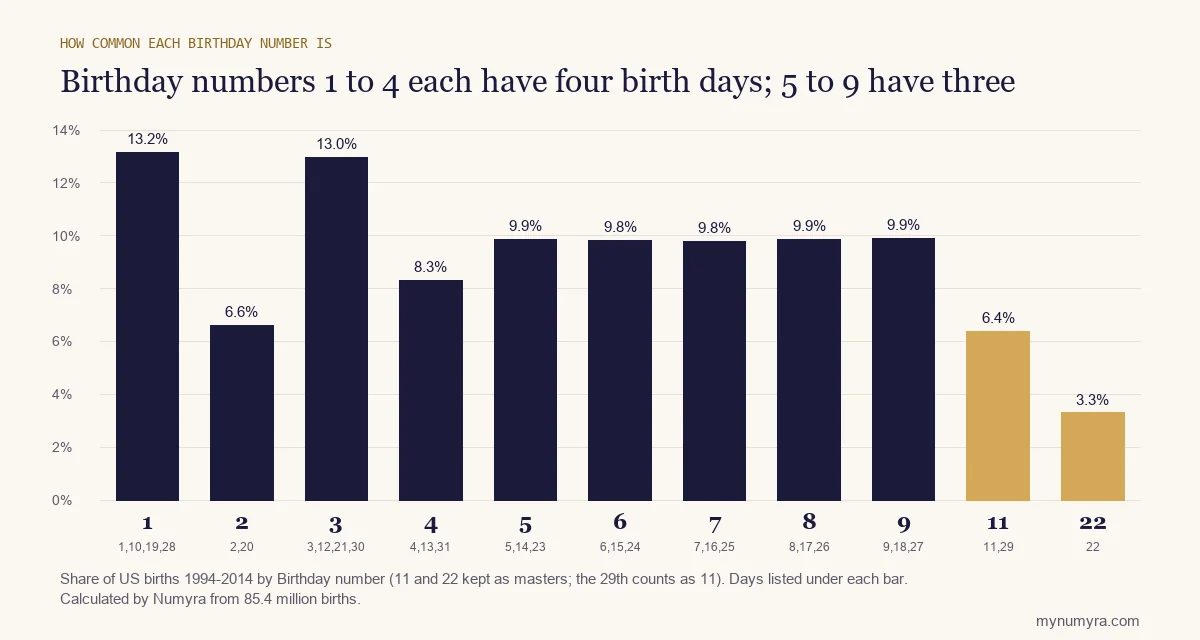
The pattern is structural. Numbers 1 to 4 each collect four days (1, 10, 19, 28; 2, 11, 20, 29; 3, 12, 21, 30; 4, 13, 22, 31), while 5 to 9 collect only three each. If the master numbers are folded back into the digits, the shares are 13.2% for a 1, 13.0% for a 2, 13.0% for a 3 and 11.6% for a 4, against 9.8% to 9.9% for each of 5 to 9. With the master rule, the 11th and 29th form the 11 (6.4% of births) and the 22nd the 22 (3.3%), so people with a master birthday number make up 9.7% of the sample, about one in ten. A calendar with every date counted once gives almost the same answer (9.65%), so this is arithmetic, not a US birth pattern.
So if you were born on the 22nd, your birthday number is the least common of all, shared by about one American in 30. Your Life Path is a different story: our guide to the master numbers explains why the three are special in the first place.
The 13th, Christmas and the 31st: which days are rarest
The births themselves are not spread evenly across the month. Averaged over 1994 to 2014, there were 11,132 US births per calendar date. By the raw average per date, the most common birth dates were the 20th (11,329), the 21st (11,317) and the 18th (11,294), and the rarest were the 25th (10,754), the 31st (10,832) and the 24th (10,898). The 13th and 26th come next, both at 10,902.
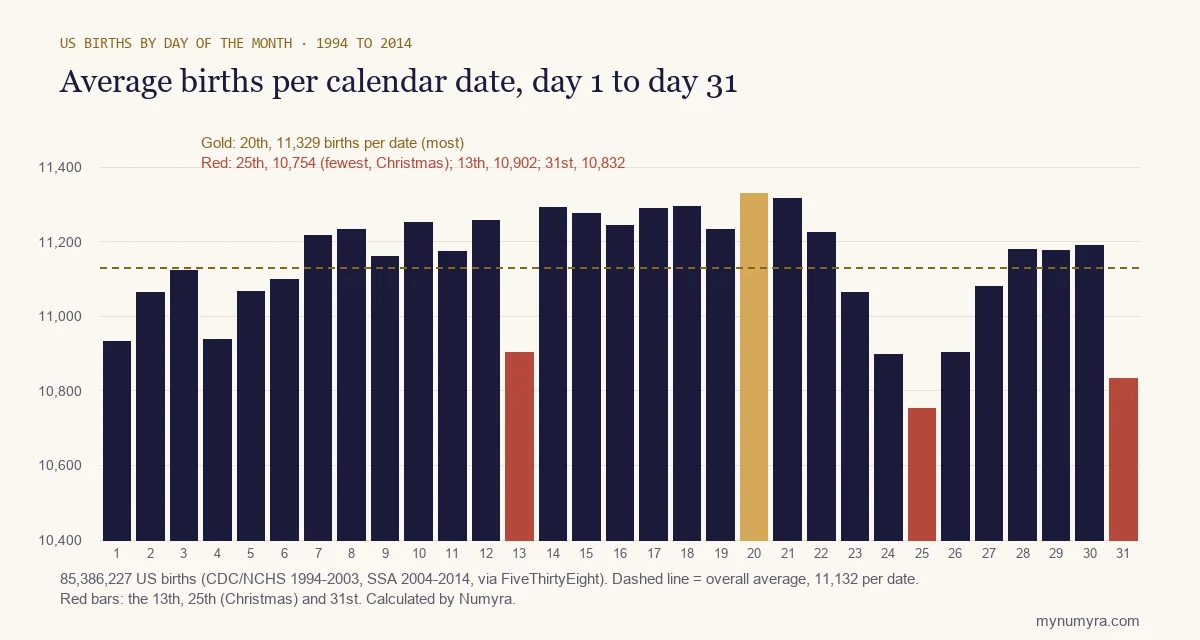
Much of the low end is calendar noise. A day of the month falls on every weekday, and weekends have far fewer births (Saturday and Sunday are 11.0% and 9.8% of births against 14.8% to 16.4% for each weekday). Holidays also matter. We adjusted each date by comparing it with the average for its weekday in the same year, then averaged by day of the month, with and without eight holiday dates (January 1 and 2, July 4, November 11, and December 24, 25, 26 and 31). The 25th is 3.3% below normal in raw terms, but only 0.2% below once December 25 is removed. The 1st and the 24th likewise fall back to normal once January 1 and December 24 are removed. In plain terms, babies are less often born on Christmas Day, New Year’s Day and Christmas Eve, and those dates pull their day numbers down.
Two days stay low after that correction. The 31st, with a weekday-adjusted index of 97.9, appears in only seven months, so there are 147 such dates in the sample against 252 for most days. The other is the 13th, at 98.2, where the 12th and 14th sit at 101.0 and 101.2. The gap holds for each weekday:
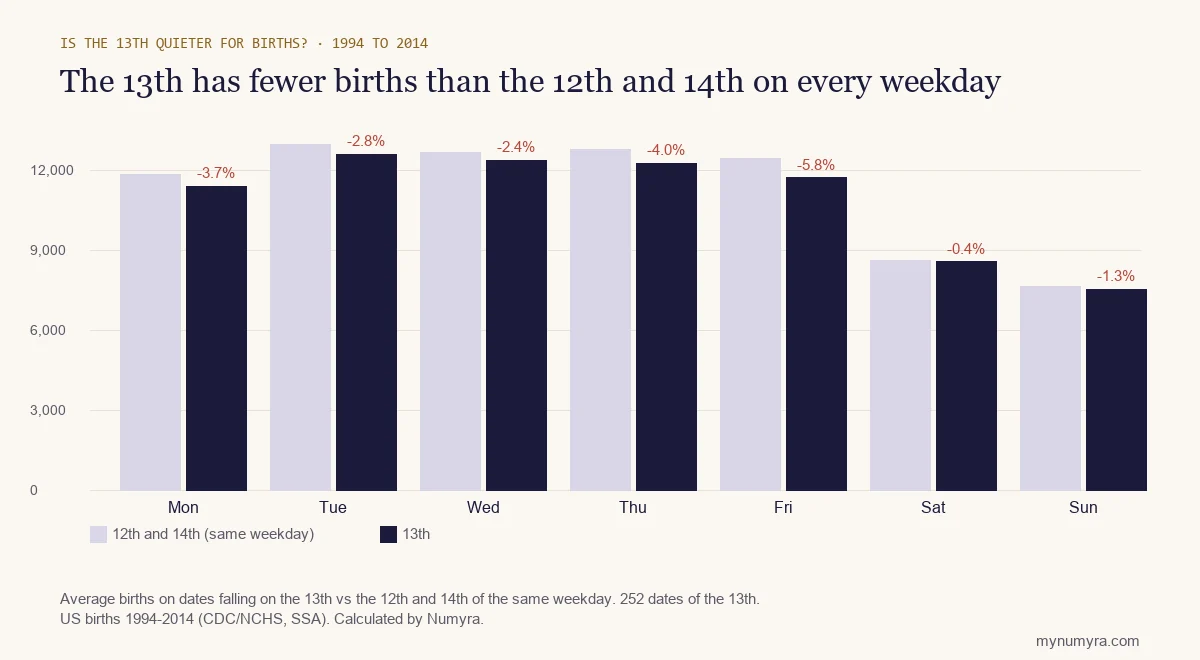
On Fridays that fall on the 13th, the average was 11,708 births, against 12,428 on Fridays that fell on the 12th or 14th, a deficit of 5.8% across 35 such Fridays. On Saturdays the deficit is only 0.4%, and on Sundays 1.3%. We do not know why. Possibilities include scheduled inductions and cesarean births being steered away from a date some parents and doctors regard as unlucky, but our data cannot tell, and we make no claim about causes. It is a real effect in the counts, and a modest one, about two babies fewer in every hundred.
Two further facts about the edges of the month. The 29th, 30th and 31st together take 8.0% of all births because they are missing from some months. And February 29 is the rarest birth date of all: 52,311 births across the five leap days in the sample (1996, 2000, 2004, 2008 and 2012), 10,462 per leap day and about 0.061% of all births, roughly one in 1,630.
How often the birthday number equals the Life Path
A common reader question is how often the two numbers match. We computed the Life Path for every date in the sample with Numyra’s rules (month, day and year each reduced with 11, 22 and 33 kept, then added and reduced) and compared it with the birthday number:
| Comparison | Share of US births | Same test on every calendar date, 1900 to 2025 |
|---|---|---|
| Birthday number equals Life Path exactly (masters included) | 9.7% | 9.4% |
| Same single digit (11 counted as 2, 22 as 4) | 11.4% | 11.1% |
Matching exactly happens for about one person in ten, which is what chance gives when each number is spread over nine or so values, so the birthday number adds information that your Life Path does not already hold for nine people in ten. The master numbers behave oddly. Of people with a birthday number of 11 (born on the 11th or 29th), only 2.5% have a Life Path 11, while 7.9% have a Life Path 22 and 0.4% a 33. And a birthday on the 22nd can never give a Life Path of 22: the month and year parts always add enough that the total cannot land on 22, and none of the 46,021 dates between 1900 and 2025 does. About 8% of people born on the 22nd have a Life Path 33.
Using it with your other numbers
Read the birthday number as the smallest, most personal layer of your chart. The Life Path gives the long direction, the three name numbers, covered in our guide to Expression, Soul Urge and Personality, come from letters, and the maturity number blends the Life Path with your Expression. The birthday number is also one of the numbers that can fill a gap in a name: our guide to karmic lessons explains the “modified” lesson, where a missing number appears among your core numbers, birthday included.
The simplest use is reflective. Read the one-line theme for your day, decide whether it describes a talent you recognize, and note the “shadow” side that the sources add. If it does not fit, that says something about the tradition, not about you. Numerology and astrology are cultural traditions, not sciences, and our disclaimer applies; every calculation is documented on the methodology page.
Frequently asked questions
How do you find your birthday number in numerology?
Take the day of the month you were born. Days 1 to 9 stand as they are; for days 10 to 31, add the digits until one digit is left, unless the result is 11 or 22, which are kept. The 17th is 8, the 22nd is 22 and the 29th is 11.
Is the birthday number the same as the Life Path number?
No. The birthday number is the day alone, read as one talent. The Life Path adds the month, day and year. In US births from 1994 to 2014 the two are identical for only 9.7% of people.
Is 29 a master birthday number?
In the Decoz and Numerologist.com tradition, yes: 2 + 9 = 11, which is kept, so the 29th is written 29/11/2. A system that reduces every day to a single digit would call it a 2.
Why is there no birthday number 33?
The highest day of a month is 31, and no day adds to 33. Only 11 (from the 11th and 29th) and 22 (from the 22nd) can appear as master birthday numbers.
Which birthday number is the most common?
The 1, which collects days 1, 10, 19 and 28, covering 13.2% of US births from 1994 to 2014. The 3 is close behind at 13.0%. The rarest is the master 22 at 3.3%.
Which birthday is the rarest in the United States?
February 29 is the rarest date, about one birth in 1,630. Among ordinary days of the month, the 25th is lowest (10,754 births per date), mainly because of Christmas, and the 13th and 31st stay low after correcting for weekdays and holidays.
Are births on the 13th really lower?
Yes, modestly. From 1994 to 2014 the 13th had fewer US births than the 12th and 14th on every weekday, 5.8% fewer on Fridays. The data do not show why.
Do the 13th, 14th, 16th and 19th have a karmic meaning?
Some sources, such as Numerologist.com, call them karmic debt birthdays that add a lesson to the basic gift. Others describe them without that layer. It is a tradition, not a finding.
Does the birthday number predict anything?
No. It is an interpretive tradition for reflection, and nothing here is evidence about personality, talent or the future.
Sources
- Decoz, Hans. Birthday Number Meanings: All 31 Birth Days. World Numerology. Source of the definition quoted above, the double-digit reading, the Attitude number link and the one-line day descriptions.
- Andrews, Blair. The Birthday Number: Your Innate Gifts and Natural Talents. Numerologist.com, published April 22, 2025, updated July 20, 2026. Source of the day-by-day section, the karmic debt days, the 29/11 reading and the 10% weighting claim.
- Decoz, Hans. Numerology Meaning of a 31 Birthday. World Numerology. Cross-check of the 31st.
- Goday, Cora. What Your Day of Birth Says About You: Kabbalistic Numerology. Cited only to note that a Kabbalistic system uses different day titles.
- FiveThirtyEight. US births data, 1994 to 2014, from the CDC National Center for Health Statistics and the Social Security Administration. Birth counts for the original data.