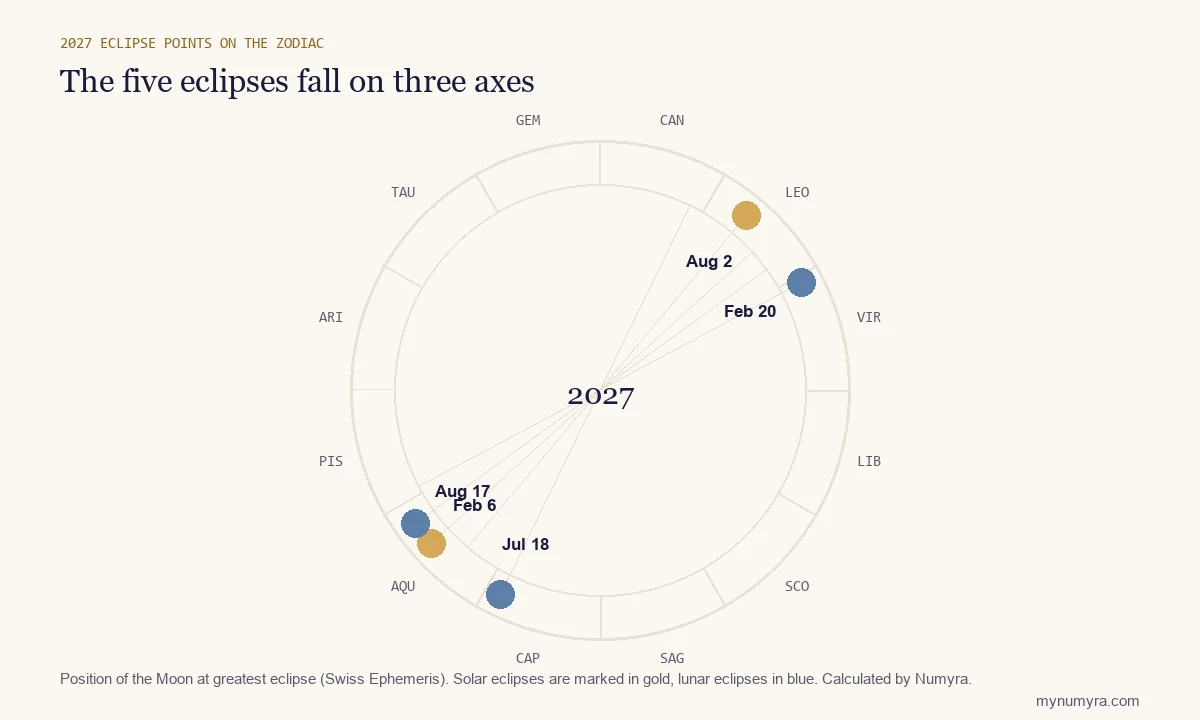
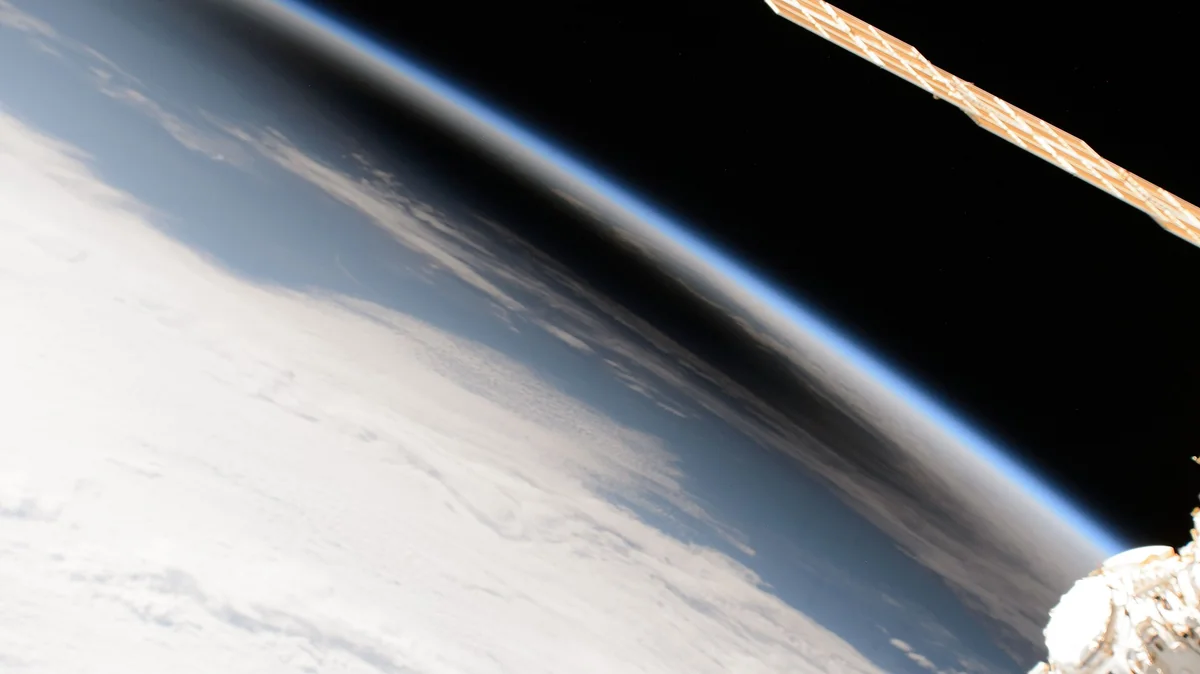
There are five eclipses in 2027: two of the Sun and three of the Moon. The one everyone is waiting for is the total solar eclipse of August 2, 2027, at 9°55′ Leo, with up to 6 minutes 23 seconds of totality, the second-longest total eclipse of the 21st century; the other solar eclipse is an annular “ring of fire” on February 6 at 17°39′ Aquarius.
Key takeaways
- 2027 has five eclipses: an annular solar eclipse on February 6 (17°39′ Aquarius), a total solar eclipse on August 2 (9°55′ Leo) and three penumbral lunar eclipses on February 20, July 18 and August 17.
- Totality on August 2 crosses southern Spain, Morocco and Libya, Egypt, Saudi Arabia and Yemen. It lasts 6 minutes 23.2 seconds at its longest point (NASA), the longest until 2114, and from our calculation, 6 minutes 21 seconds in Luxor but under 2 minutes in Málaga. No totality is visible from the United States.
- All three lunar eclipses are penumbral, the faintest kind. The July 18 one has a magnitude of 0.001, so slight that almost no one will see it.
- Each eclipse touches a similar share of people: about 6% have their Sun within 5° of the eclipse degree or its opposite, and 24% to 26% have the Sun, Moon, Mercury, Venus or Mars within 5° (US births 1994 to 2014).
- Ptolemy’s rule, from the 2nd century, is that a solar eclipse’s effects last as many years as the eclipse lasts in hours, and a lunar eclipse’s as many months, counted only where it is visible. Eclipse readings are an astrological tradition, offered for reflection, not as prediction or advice.
In this guide
- All five eclipses of 2027
- The total solar eclipse of August 2, 2027
- The annular solar eclipse of February 6
- The three lunar eclipses
- What the signs are, and why these three axes
- Who is touched: birthdays and houses
- Which house each eclipse falls in
- How Ptolemy timed an eclipse’s effects
- Frequently asked questions
All five eclipses of 2027
Times are Universal Time (UT) at the moment of greatest eclipse, calculated with the Swiss Ephemeris, the reference behind professional astrology software. The degree is the position of the Moon then, in the tropical zodiac. For a solar eclipse that is also the position of the Sun; for a lunar eclipse the Sun sits at the opposite degree. Our degrees agree to within a few arcminutes with the ones published by Bonnie Sorsby and Cafe Astrology.
| Date (UT) | Type | Position at greatest eclipse | Size | Where it can be seen |
|---|---|---|---|---|
| February 6, 15:59 | Annular solar | 17°39′ Aquarius | Magnitude 0.928; ring up to 7 min 53 s (NASA) | Ring across southern Chile and Argentina and the Atlantic; partial in South America, Antarctica and parts of Africa |
| February 20, 23:12 | Penumbral lunar | 1°58′ Virgo (Sun at 1°58′ Pisces) | Penumbral magnitude 0.93, about 4 hours | Americas, Europe, Africa, Asia |
| July 18, 16:03 | Penumbral lunar | 25°57′ Capricorn (Sun in Cancer) | Penumbral magnitude 0.001, about 11 minutes | East Africa, Asia, Australia, Pacific |
| August 2, 10:06 | Total solar | 9°55′ Leo | Magnitude 1.079; totality up to 6 min 23 s (NASA) | Totality: Spain to Somalia; partial across Europe, Africa, Asia and parts of the Atlantic |
| August 17, 07:13 | Penumbral lunar | 24°04′ Aquarius (Sun in Leo) | Penumbral magnitude 0.55, about 3.6 hours | Pacific, Americas |
The total solar eclipse of August 2, 2027
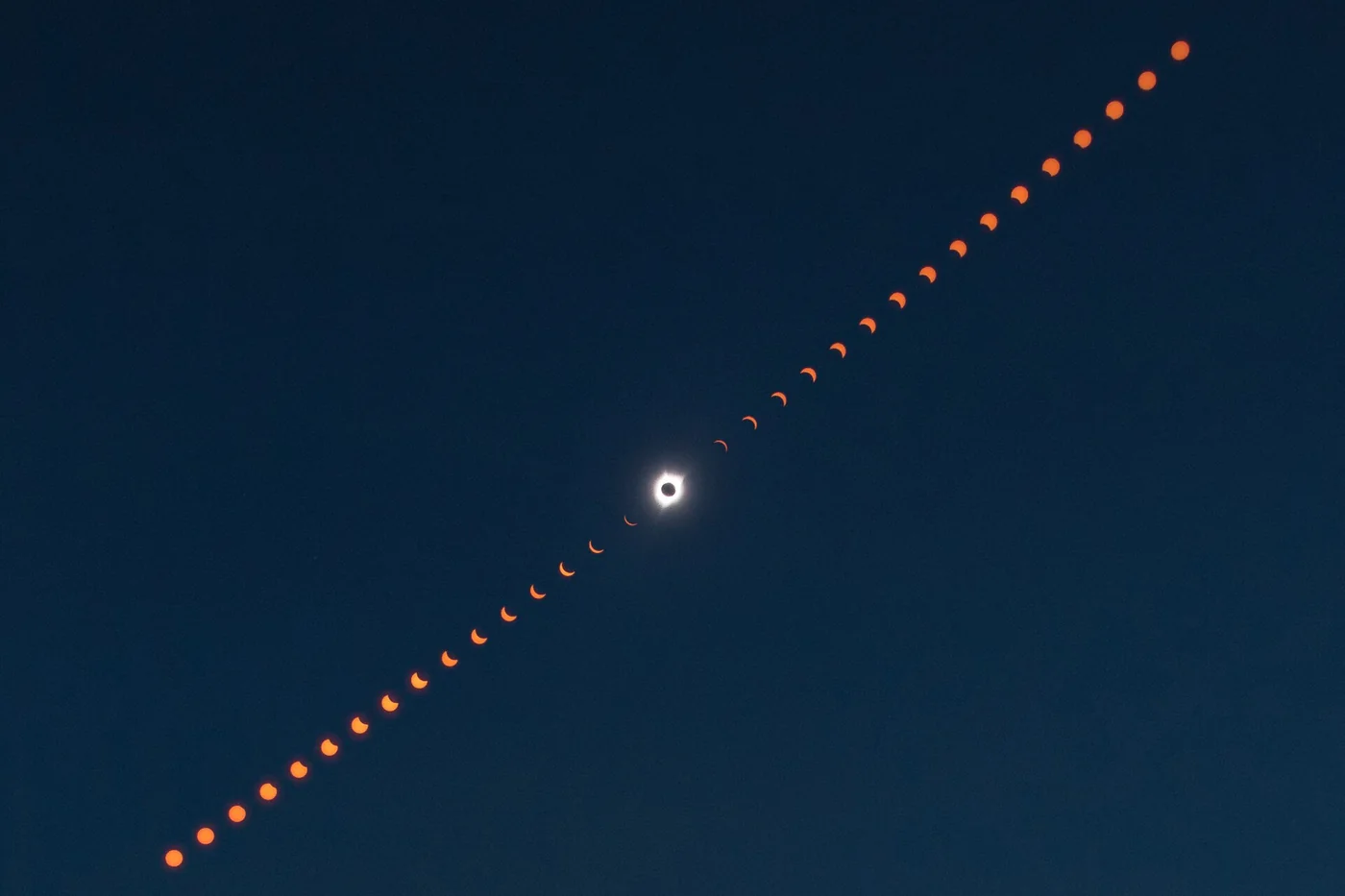
NASA lists it as a total eclipse of Saros series 136 with a magnitude of 1.079 and a greatest duration of 6 minutes 23.2 seconds, the second-longest total eclipse of the 21st century after July 22, 2009, with none longer until June 3, 2114 (Wikipedia). Totality runs through southern Spain and Gibraltar, northern Morocco, Algeria, Tunisia and Libya, Egypt, Saudi Arabia, Yemen and Somalia. In astrology, an eclipse of the Sun is a New Moon at its most extreme: the Moon covers the Sun, so it is read as a reset, an ending or a beginning in the area of life that sign and house govern.
How long totality lasts depends on where you stand. We calculated it for the centre of eight cities on the path:
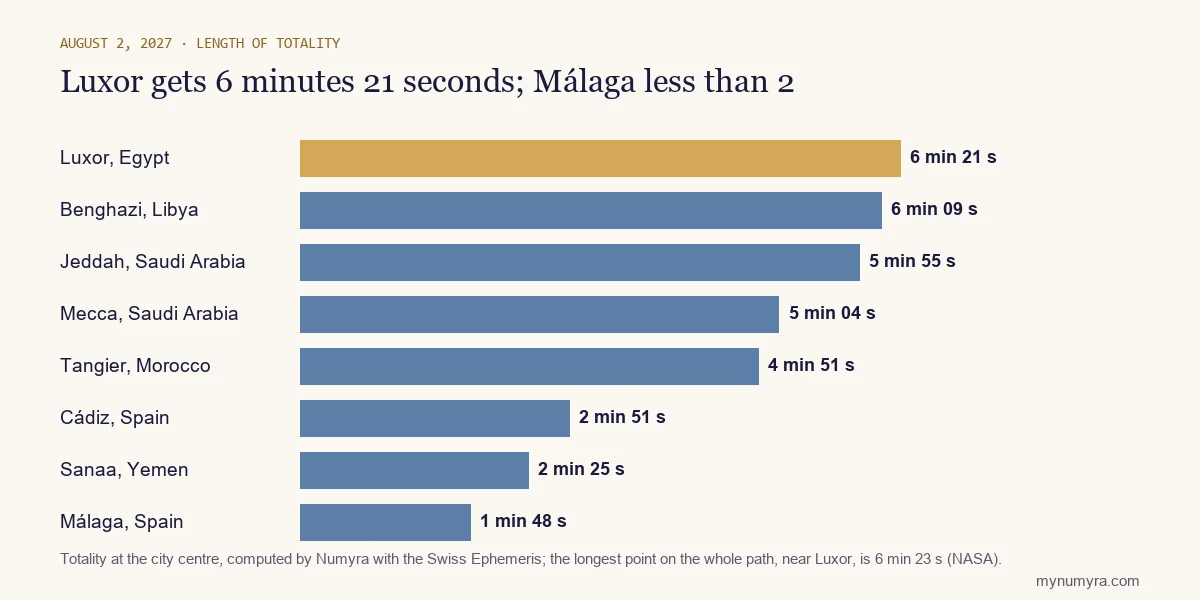
The pattern is simple: the closer to the centre line, the longer the totality. Luxor, near the point of greatest duration, gets 6 minutes 21 seconds; Cádiz gets 2 minutes 51 seconds; Málaga, near the northern edge of the path, 1 minute 48 seconds. Our figures are for the city centre and ignore the Moon’s mountains and valleys, so published local times can differ by several seconds.
If you live in the United States, there is no totality, and the next total solar eclipse in the contiguous United States is not until August 23, 2044, over Montana, North Dakota and a corner of South Dakota. Our calculation gives the northeastern US only a small partial eclipse on the morning of August 2: from New York the Moon covers about 9% of the Sun’s width (magnitude 0.09) around 11 a.m. EDT.
The annular solar eclipse of February 6
On February 6 the Moon is too far from Earth to cover the Sun completely, so a thin ring of sunlight remains. NASA lists it as annular, Saros 131, with a greatest duration of 7 minutes 53.5 seconds, longer than the total eclipse that follows. It falls at 17°39′ Aquarius and is the first of the year’s two solar eclipses. Astrologers read it as a new beginning in the themes of Aquarius: friends, groups, technology and shared ideals, along with the house it lands in for each person (see below). The path crosses the far south of Chile and Argentina and the Atlantic, so few people will see the ring; most of South America and parts of Africa and Antarctica see a partial eclipse.
The three lunar eclipses
All three lunar eclipses of 2027 are penumbral: the Moon passes only through the faint outer part of Earth’s shadow and never enters the dark inner part. A penumbral eclipse is easy to miss, because the Moon just looks a little dimmer, and many astrologers give it less weight than a total or partial lunar eclipse. Three very different sizes:
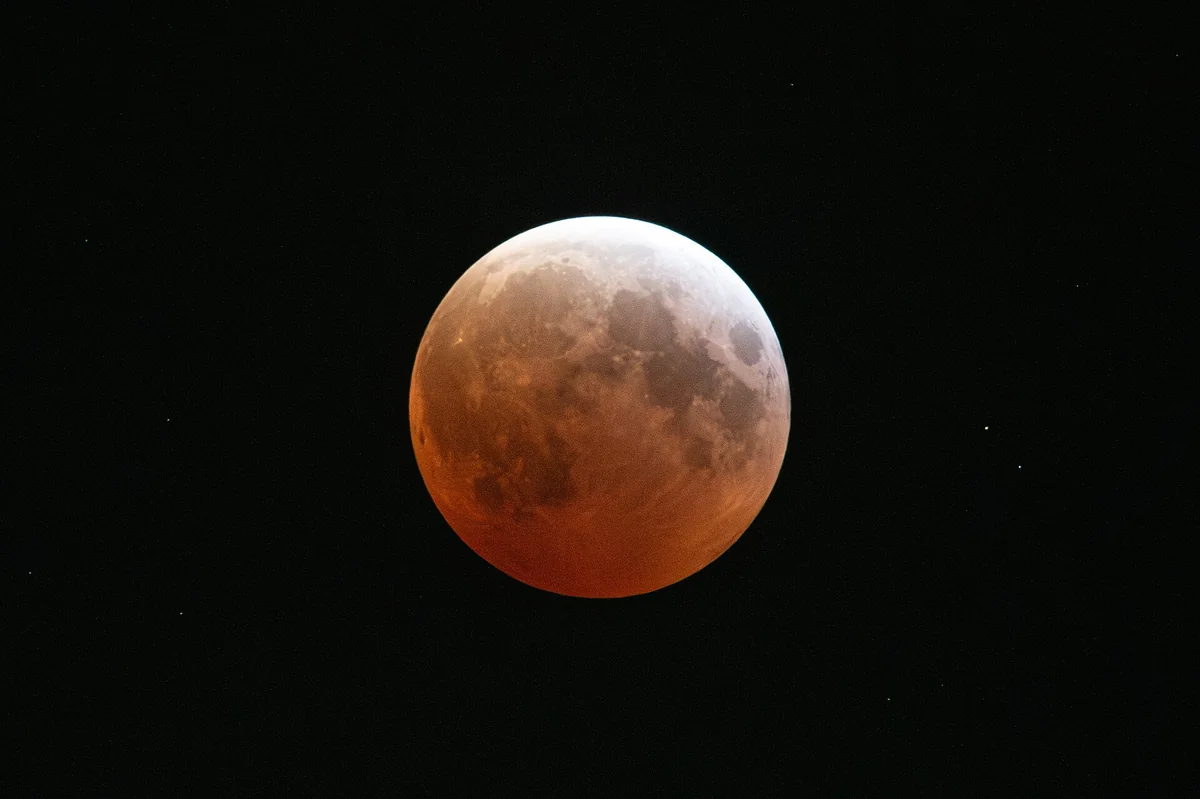
- February 20 (1°58′ Virgo) is the biggest, with a penumbral magnitude of 0.93 over about 4 hours, visible from the Americas, Europe, Africa and Asia. The Sun is at the opposite degree, 1°58′ Pisces.
- July 18 (25°57′ Capricorn) is almost no eclipse at all: a penumbral magnitude of 0.001 lasting roughly 11 minutes. It will be essentially invisible, though it still counts as an eclipse in the tables.
- August 17 (24°04′ Aquarius) follows the total solar eclipse by two weeks, with a penumbral magnitude of 0.55 over about 3.6 hours, visible from the Pacific and the Americas.
Our guide to Moon phases explains how astrology reads the Full Moon in general; an eclipse is the version where the alignment is exact enough for a shadow. Every full and new Moon of the year, with signs and US times, is in our 2027 Moon calendar.
What the signs are, and why these three axes
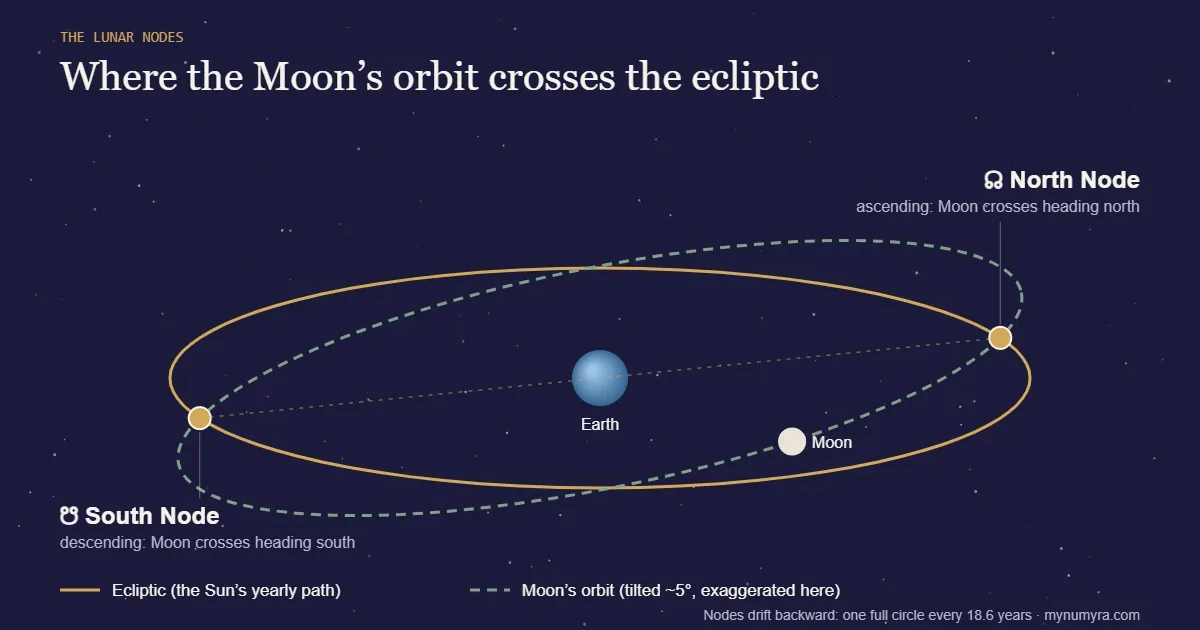
Eclipses happen only when a New or Full Moon is close to the Moon’s nodes, the two points where its orbit crosses the Sun’s path, which is why they come in pairs two weeks apart about twice a year. Our North Node guide explains the nodes. The result for 2027 is that the five eclipses sit on three zodiac axes: Aquarius–Leo (February 6, August 2 and August 17), Pisces–Virgo (February 20) and Cancer–Capricorn (July 18). The first is the one that carries the year’s two main eclipses, and some astrologers describe the Aquarius–Leo axis in terms of the individual against the group, or the creative self against the collective. Whether you find that meaningful or not, you can check the degrees yourself with our Stellium Calculator, which lists every planet in your birth chart to the degree.
Who is touched: birthdays and houses
The usual astrological rule is that an eclipse affects you most when it falls near a planet or angle in your birth chart, typically within a few degrees, on either end of the axis. We tested how many people that is, using the Swiss Ephemeris for 60,000 random people with US birth dates from 1994 to 2014 (weighted by the number of births each day) and counting a hit when a body was within the orb of the eclipse degree or its opposite degree:
| Eclipse | Birthdays with the Sun within 5° of the axis | Share with the Sun within 5° | Share with the Sun, Moon, Mercury, Venus or Mars within 3° / 5° |
|---|---|---|---|
| Feb 6, annular solar | Feb 02 to Feb 11, and Aug 06 to Aug 15 | 5.6% | 16% / 25% |
| Feb 20, penumbral lunar | Aug 21 to Aug 30, and Feb 16 to Feb 25 | 5.7% | 17% / 26% |
| Jul 18, penumbral lunar | Jan 12 to Jan 21, and Jul 14 to Jul 24 | 5.7% | 15% / 24% |
| Aug 2, total solar | Jul 29 to Aug 07, and Jan 26 to Feb 04 | 5.6% | 15% / 24% |
| Aug 17, penumbral lunar | Feb 09 to Feb 17, and Aug 12 to Aug 22 | 5.8% | 15% / 25% |
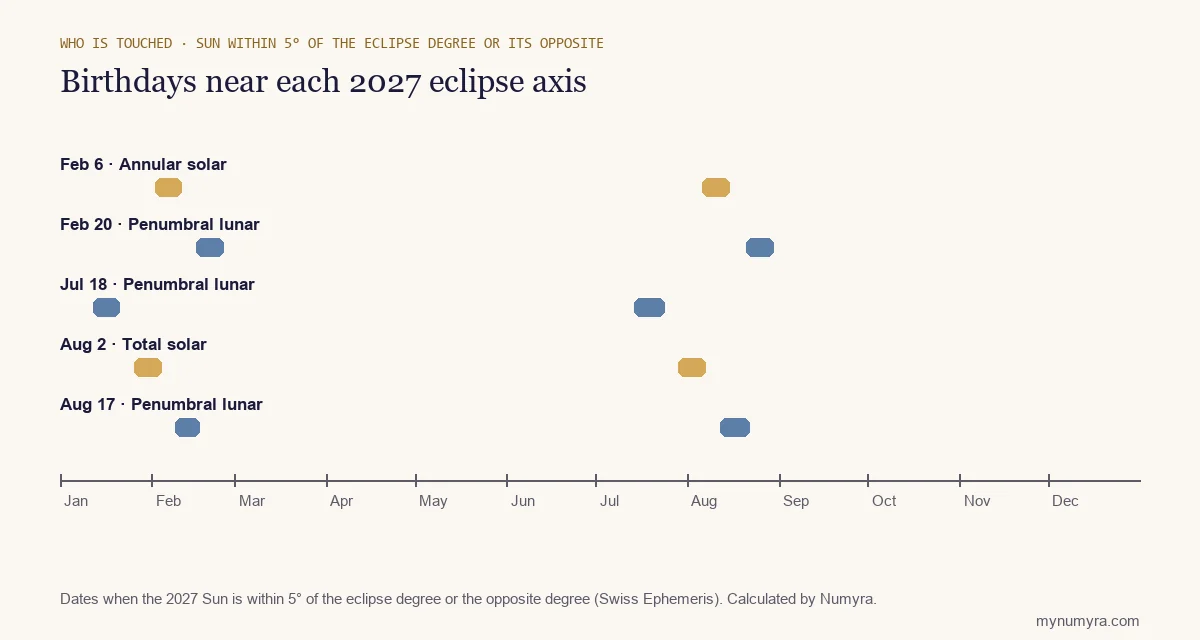
The numbers are nearly the same for every eclipse, because any 20° stretch of the zodiac holds roughly the same share of people. That is the first lesson: each eclipse “touches” about one person in four through a personal planet or the Sun, which is why astrologers who say that an eclipse “affects everyone born in a certain sign” are claiming something very broad. A tight orb, a planet right on the degree, narrows it to one in six.
The second lesson is about the Moon: because it moves about 13° a day, whether the Moon is within 5° of an eclipse point on your birth date depends on your birth time. For the birthday windows above, use the Sun, which only moves one degree a day. To see where the Sun, Moon and planets were at your birth, use our Birth Chart calculator, or the Stellium Calculator if you want all ten bodies.
Which house each eclipse falls in
Besides your planets, astrologers read the house the eclipse falls in. Using whole-sign houses, in which your rising sign is the 1st house and each sign after it the next, the table shows the house for every rising sign. For a solar eclipse the house is where the new beginning is said to start; for a lunar eclipse, where something is said to come to a head or be released. Our guide to the twelve houses explains what each house covers, and our rising sign profiles help you find yours.
| Rising sign | Feb 6 (Aquarius) | Feb 20 (Virgo) | Jul 18 (Capricorn) | Aug 2 (Leo) | Aug 17 (Aquarius) |
|---|---|---|---|---|---|
| Aries | 11th | 6th | 10th | 5th | 11th |
| Taurus | 10th | 5th | 9th | 4th | 10th |
| Gemini | 9th | 4th | 8th | 3rd | 9th |
| Cancer | 8th | 3rd | 7th | 2nd | 8th |
| Leo | 7th | 2nd | 6th | 1st | 7th |
| Virgo | 6th | 1st | 5th | 12th | 6th |
| Libra | 5th | 12th | 4th | 11th | 5th |
| Scorpio | 4th | 11th | 3rd | 10th | 4th |
| Sagittarius | 3rd | 10th | 2nd | 9th | 3rd |
| Capricorn | 2nd | 9th | 1st | 8th | 2nd |
| Aquarius | 1st | 8th | 12th | 7th | 1st |
| Pisces | 12th | 7th | 11th | 6th | 12th |
Two rising signs get both big eclipses in the same house: Leo rising has the Aquarius eclipses in the 7th house of partnerships and the Leo eclipse in the 1st house of the self, and Aquarius rising the reverse. Scorpio rising gets the total eclipse in the 10th house of career, and Cancer rising in the 2nd house of money.
How Ptolemy timed an eclipse’s effects
The most detailed ancient rule for eclipses comes from the 2nd-century astrologer Claudius Ptolemy, who gave a way of timing how long an eclipse’s effects last:
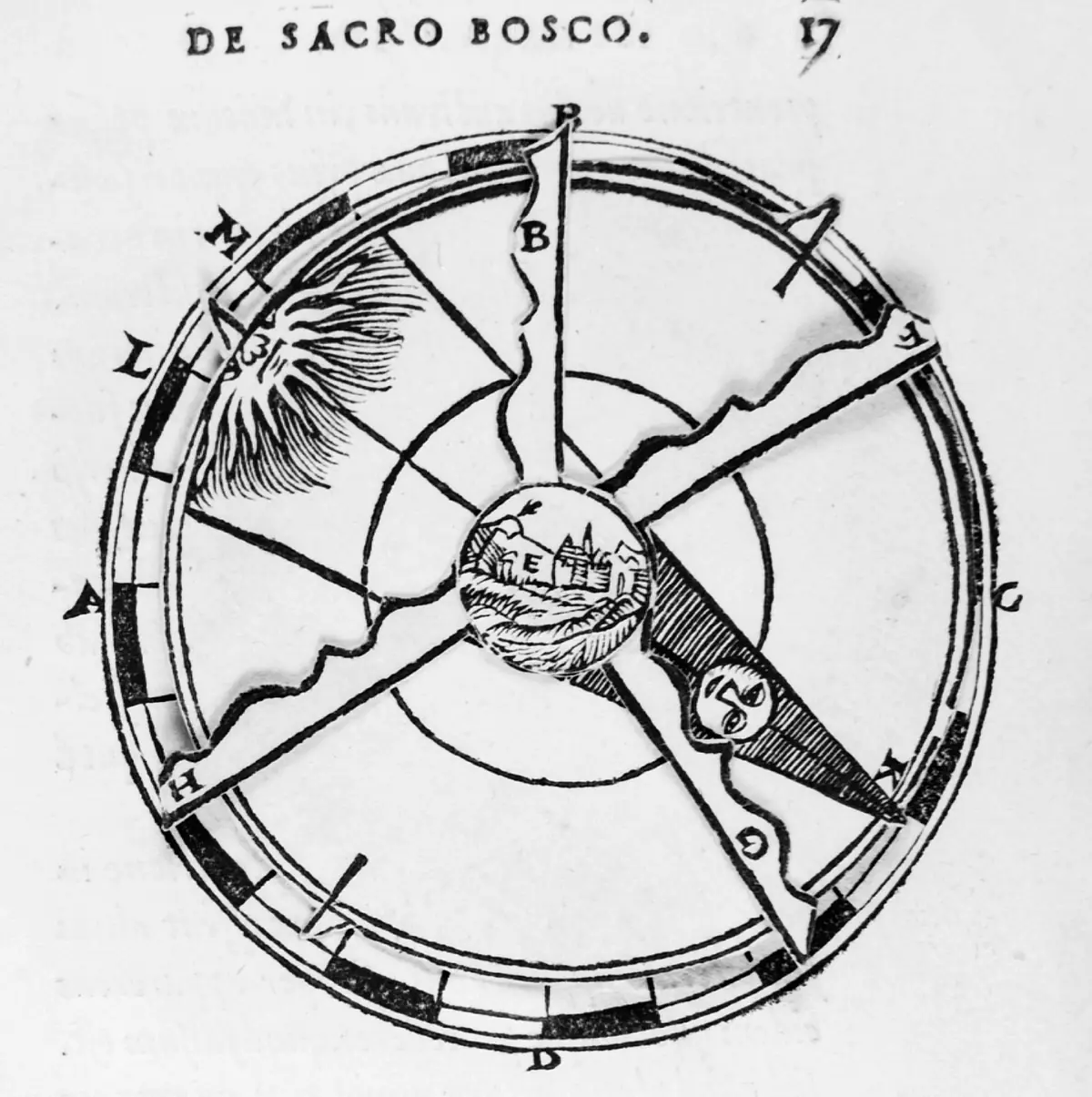
“For when these data are examined, if it is a solar eclipse, we shall understand that the predicted event lasts as many years as the equinoctial hours which we discover, and if a lunar eclipse, as many months.”
Ptolemy, Tetrabiblos, Book II, chapter 6, “Of the Time of the Predicted Events,” trans. F. E. Robbins, Loeb Classical Library (1940), via LacusCurtius
“Equinoctial hours” are ordinary 60-minute hours. In the same chapter he says the hours must be counted at the place concerned, since “the same solar eclipses do not everywhere have the same degree of obscuration or the same time of duration,” and an editorial note in the Loeb text adds that Ptolemy takes no account of eclipses not visible at the place concerned. In other words, an eclipse counts for you only if you could have seen it. Ptolemy gives no worked example, so applying it needs a reading of “the hours of the eclipse.” Taking the whole eclipse from first to last contact, our calculation gives these durations for August 2:
| Place | What you see on August 2 | Eclipse duration (first to last contact) | Ptolemy’s rule gives |
|---|---|---|---|
| Luxor, Egypt | Total, 6 min 21 s | 2.8 hours | about 2.8 years |
| Tangier, Morocco | Total, 4 min 51 s | 2.3 hours | about 2.3 years |
| London, UK | Partial, magnitude 0.52 | 1.9 hours | about 1.9 years |
| New York, USA | Small partial, magnitude 0.09 | 1.5 hours | about 1.5 years |
So by Ptolemy’s own rule the same eclipse would last 1.5 years for a New Yorker and nearly 3 for someone in Luxor. That is the kind of detail missing from most modern eclipse forecasts, which describe one outcome for everyone born under a sign. It also shows why the tradition has always been a framework for reflection: no controlled study has found that eclipses predict events in anyone’s life, and this page presents the traditional readings as culture, not as prediction. Our guide to Ptolemy’s Tetrabiblos explains the rest of his system.
Frequently asked questions
How many eclipses are there in 2027?
Five: two solar and three lunar. The solar eclipses are the annular eclipse of February 6 and the total eclipse of August 2. The lunar eclipses, all penumbral, are on February 20, July 18 and August 17.
When is the total solar eclipse in 2027?
August 2, 2027, with greatest eclipse at 10:06 UT. Totality lasts up to 6 minutes 23 seconds (NASA), the second longest of the 21st century, and crosses southern Spain, northern Africa, Egypt, Saudi Arabia, Yemen and Somalia.
Can I see the August 2, 2027 eclipse from the United States?
Not totality. Our calculation gives the northeastern United States only a small partial eclipse in the morning (about 9% of the Sun’s width from New York). The next total solar eclipse in the contiguous United States is on August 23, 2044.
What sign is the August 2027 solar eclipse in?
Leo, at 9°55′. The February 6 annular eclipse is in Aquarius at 17°39′.
Are the 2027 lunar eclipses visible?
All three are penumbral, the faintest kind: the Moon only dims slightly. February 20 (magnitude 0.93) is the most noticeable, from the Americas, Europe, Africa and Asia. July 18 has a magnitude of 0.001, essentially invisible.
How do I know whether an eclipse affects me astrologically?
Traditionally, an eclipse is read as strongest when it falls within a few degrees of a planet or angle in your birth chart, or in a house you can identify from your rising sign. About one person in four has the Sun, Moon, Mercury, Venus or Mars within 5° of a given eclipse axis, so it is common rather than special.
How long do eclipse effects last, according to astrology?
Ptolemy’s rule is as many years as the eclipse lasts in hours for a solar eclipse, and as many months for a lunar one, counted only where the eclipse was visible. Many modern astrologers use looser windows of six months or a year.
Do eclipses really predict events?
No controlled study has found that they do. Eclipse astrology is a cultural tradition with an ancient history, which people use for reflection; the dates and positions on this page are calculated astronomy, the meanings are interpretation.
Sources
- NASA. Solar Eclipses 2021 to 2030. Types, Saros series, magnitudes and durations of the February 6 and August 2, 2027 eclipses.
- NASA. Total Solar Eclipse of 2027 Aug 02. Greatest duration 6 min 23.2 s.
- Wikipedia. Solar eclipse of August 23, 2044 and of August 2, 2027, for the ranking of the 2027 eclipse, the countries on its path and the next US total eclipse.
- Astrodienst. Swiss Ephemeris. Every time, degree, magnitude and local duration on this page, and the birth-date statistics (calculations by the Numyra Methodology Desk).
- FiveThirtyEight. US births data, 1994–2014, from the CDC National Center for Health Statistics and the Social Security Administration.
- Ptolemy, Tetrabiblos, trans. F. E. Robbins, Loeb Classical Library 435 (1940), Book II, chapter 6, via LacusCurtius.
- Cafe Astrology. 2027 Eclipse Charts and Bonnie Sorsby. Two Eclipses in February 2027, used to cross-check the degrees.