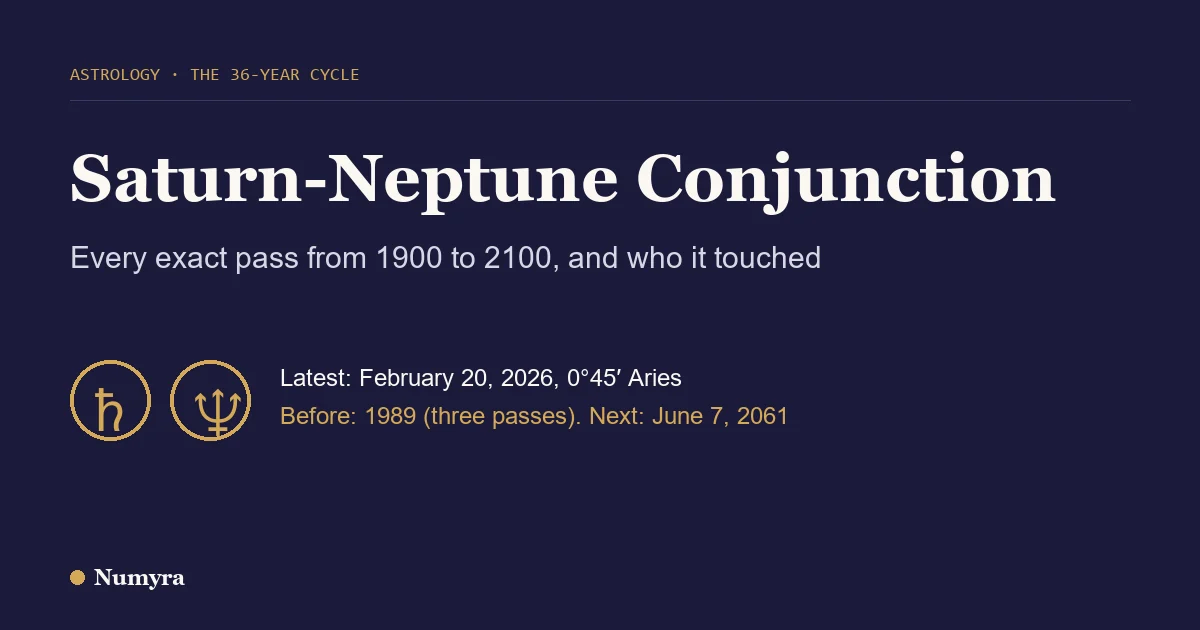
A Saturn-Neptune conjunction is the moment Saturn and Neptune sit at the same degree of the zodiac, and it comes round every 35 to 37 years. The latest one was on February 20, 2026 at 11:52 a.m. EST (8:52 a.m. PST), at 0°45′ Aries, and it was a single exact pass. The one before it was 1989 (three passes in Capricorn), and the next is June 7, 2061 at 20°24′ Gemini. This page lists every pass from 1900 to 2100, the four phases of the cycle with their dates, and who was born close to each meeting. Dates use the Western tropical zodiac and US Eastern time unless marked UTC.
Key takeaways
- Between 1900 and 2100 Saturn and Neptune meet six times: 1917, 1952-53, 1989, 2026, 2061 and 2096. Two of those meetings were triple passes (1952-53 and 1989); the other four, including 2026, were single.
- The 2026 conjunction had exactly one exact pass, on February 20. In July 2025 Saturn came within 13 arcminutes (0.21°) of Neptune and turned back without touching it, so 2025 was a near miss, not a conjunction.
- Intervals between first passes were 35.3, 36.3, 37.0, 35.3 and 35.2 years. The cycle has four checkpoints: waxing square about 9 years in, opposition about 17 to 18, waning square about 26 to 27, then the next conjunction.
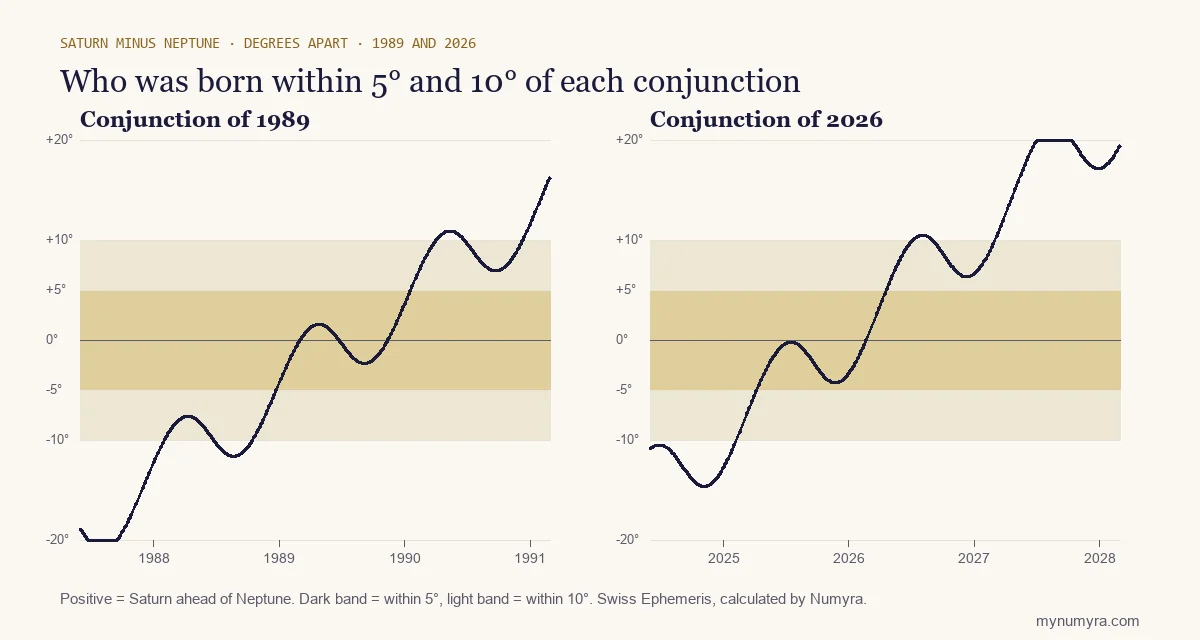
- You were born inside 5° of the 1989 conjunction if your birthday falls between December 23, 1988 and January 18, 1990, and inside 5° of the 2026 one between April 8, 2025 and April 20, 2026. The next phase point is a single sextile on June 27, 2031.
- What the conjunction means is tradition, not measurement. Astrologers read it as structure meeting dissolution; we checked every date, and the interpretation is symbolic only.
In this guide
- Every Saturn-Neptune conjunction, 1900 to 2100
- The 2026 conjunction: one pass and a near miss
- The cycle: conjunction, square, opposition, square
- What comes next, 2026 to 2061
- Who was born close to a conjunction
- What tradition says about the cycle
- Frequently asked questions
Every Saturn-Neptune conjunction, 1900 to 2100
We found the moments when the difference between Saturn’s and Neptune’s apparent ecliptic longitude reaches 0°, using the Swiss Ephemeris. Neither planet moves in a straight line as seen from Earth, because both go retrograde for part of each year. When a meeting happens near Saturn’s turn, the two can pass three times in one year instead of once, which is what happened in 1952-53 and 1989.
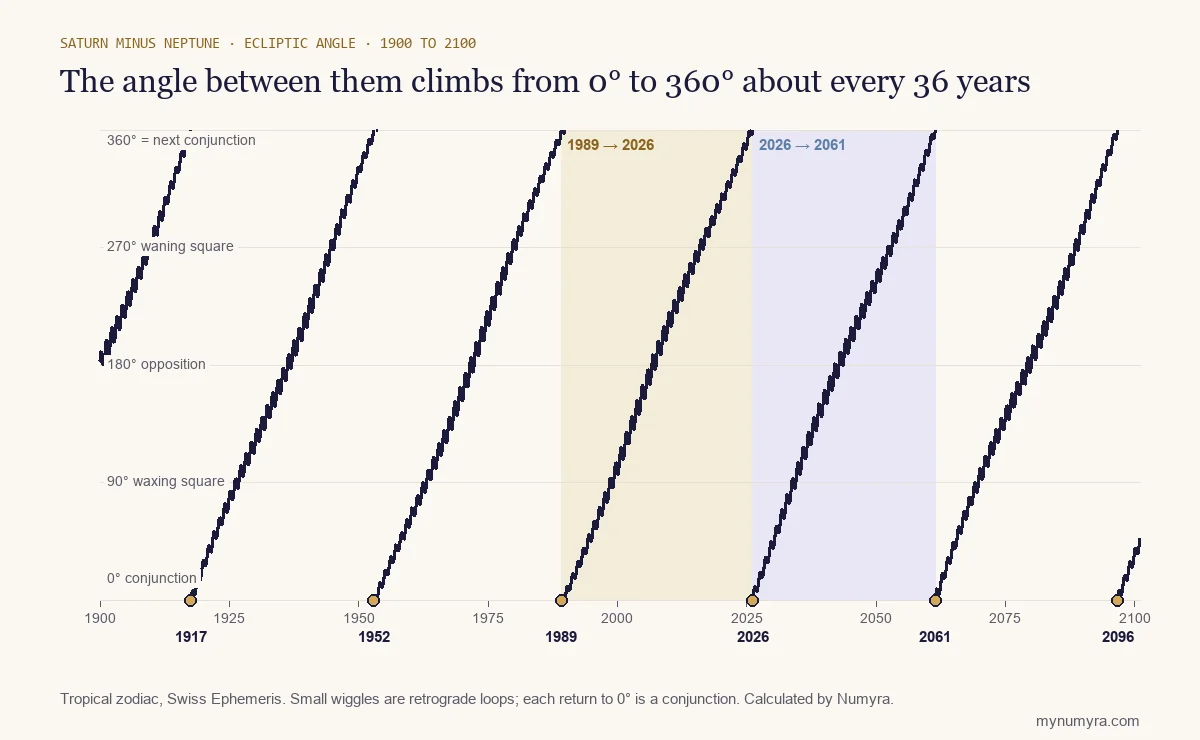
| Pass | US Eastern | UTC (ours) | JPL Horizons check (UTC) | Position | Retrograde | Years from previous |
|---|---|---|---|---|---|---|
| 1917 (single pass) | Aug 1, 1917, 12:18 a.m. EST | 1917-08-01 05:18 UTC | 1917-Aug-01 05:20 to 05:21 | 4°45′ Leo | neither | – |
| 1952, pass 1 of 3 | Nov 21, 1952, 8:17 a.m. EST | 1952-11-21 13:17 UTC | 1952-Nov-21 13:17 to 13:18 | 22°47′ Libra | neither | 35.3 |
| 1953, pass 2 of 3 | May 17, 1953, 1:27 p.m. EDT | 1953-05-17 17:27 UTC | 1953-May-17 17:28 to 17:29 | 21°38′ Libra | both | same conjunction |
| 1953, pass 3 of 3 | Jul 21, 1953, 9:21 p.m. EDT | 1953-07-22 01:21 UTC | 1953-Jul-22 01:21 to 01:22 | 21°12′ Libra | neither | same conjunction |
| 1989, pass 1 of 3 | Mar 3, 1989, 5:43 a.m. EST | 1989-03-03 10:43 UTC | 1989-Mar-03 10:43 to 10:44 | 11°55′ Capricorn | neither | 36.3 |
| 1989, pass 2 of 3 | Jun 23, 1989, 11:12 p.m. EDT | 1989-06-24 03:12 UTC | 1989-Jun-24 03:11 to 03:12 | 11°14′ Capricorn | both | same conjunction |
| 1989, pass 3 of 3 | Nov 13, 1989, 6:38 a.m. EST | 1989-11-13 11:38 UTC | 1989-Nov-13 11:38 to 11:39 | 10°22′ Capricorn | neither | same conjunction |
| 2026 (single pass) | Feb 20, 2026, 11:52 a.m. EST | 2026-02-20 16:52 UTC | 2026-Feb-20 16:54 to 16:55 | 0°45′ Aries | neither | 37.0 |
| 2061 (single pass) | Jun 7, 2061, 12:08 a.m. EDT | 2061-06-07 04:08 UTC | 2061-Jun-07 04:12 to 04:13 | 20°24′ Gemini | neither | 35.3 |
| 2096 (single pass) | Aug 27, 2096, 2:42 a.m. EDT | 2096-08-27 06:42 UTC | 2096-Aug-27 06:50 to 06:51 | 8°09′ Virgo | neither | 35.2 |
We checked all ten passes against NASA’s JPL Horizons service, using its Saturn and Neptune barycenter bodies and their apparent ecliptic longitudes from Earth’s center. For every pass Horizons found the crossing within one to eight minutes of ours; the gap is under three minutes through 2026 and widens in 2061 and 2096, the far edge of what is predicted. We also compared the 1917 to 1989 rows, degree by degree and date by date, with the appendix of A. E. O’Neill’s 2005 PlanetWaves article, and every date and degree matched (O’Neill gives July 22, 1953, which is our UTC date). Earlier meetings, by our calculation: March 28, 1703 (Aries), July 2, 1738 (Cancer), September 27, 1773 (Virgo), December 1, 1809 (Sagittarius), 1846 (three passes in Aquarius, April 4, September 5 and December 11 UTC) and May 12, 1882 (Taurus). The Astrology Podcast’s list of year-only conjunctions (1773, 1809, 1846, 1882, 1917, 1952/53, 1989) agrees.
The 2026 conjunction: one pass and a near miss
Neptune crossed into Aries for the last time on January 26, 2026 at 12:40 p.m. EST, after a first visit from March 30 to October 22, 2025. Saturn followed on February 13, 2026, and the two met seven days later at 0°45′ Aries. They did not meet again: Saturn’s retrograde, from July 26 to December 10, 2026, brings it back to 7°56′ Aries, still about 6.3° ahead of Neptune on December 10.
The reason 2026 is a single pass and 1989 was triple is timing against Saturn’s loop. In 1989 the first pass (March 3) came while Saturn was still direct, the second (June 24) while both planets were retrograde, and the third (November 13) once Saturn was direct again. In 2026 the meeting fell in February, well before Saturn’s retrograde began, and Saturn had pulled away by the time it turned.
The summer of 2025 is worth knowing about because it often gets counted as a conjunction. On July 16, 2025 Saturn stood at 1°55′ Aries and Neptune at 2°08′ Aries, 0.21° apart. Saturn had turned retrograde on July 13 and the gap opened again, so there was no exact pass. Counting it, the planets were within 1° of each other from June 9 to August 24, 2025 and again from February 8 to March 5, 2026, which is why some writers describe the conjunction as running for a year or more. See our Saturn in Aries guide for Saturn’s own ingress dates and the house table for your rising sign.
As of October 14, 2026, Saturn is at 10°31′ Aries moving backward and Neptune is at 2°30′ Aries, 8.0° apart. The separation stays under 10° until March 2, 2027, so the “within 10°” window below is still open to births. For where Neptune sits for your birth year see Uranus and Neptune signs by birth date.
The cycle: conjunction, square, opposition, square
Astrologers split the roughly 36-year cycle at the angles 90°, 180° and 270° between the two planets. The table gives the first and last exact pass of each phase for the three completed cycles (1917, 1952-53 and 1989), the one that began in 2026 and the one after it. A square is a 90° angle and an opposition is 180°; each usually takes three passes because of the retrograde loops, but not always (the 1963 square and the 2026 conjunction were single).
| Cycle starting | Waxing square (90°) | Opposition (180°) | Waning square (270°) |
|---|---|---|---|
| Aug 1, 1917 (Leo) | Jan 16, 1926 to Nov 6, 1926 (3 passes, Scorpio) | Mar 21, 1936 to Jan 18, 1937 (3 passes, Pisces) | Jul 2, 1944 to Apr 6, 1945 (3 passes, Cancer) |
| Nov 21, 1952 to Jul 22, 1953 (Libra) | Feb 18, 1963 (1 pass, Aquarius) | Jun 25, 1971 to Apr 19, 1972 (3 passes, Gemini) | Sep 14, 1979 to Jun 22, 1980 (3 passes, Virgo) |
| Mar 3, 1989 to Nov 13, 1989 (Capricorn) | Jun 25, 1998 to Apr 6, 1999 (3 passes, Aries and Taurus) | Aug 31, 2006 to Jun 25, 2007 (3 passes, Leo) | Nov 26, 2015 to Sep 10, 2016 (3 passes, Sagittarius) |
| Feb 20, 2026 (Aries) | Sep 16, 2033 to Jun 25, 2034 (3 passes, Cancer) | Jan 6, 2042 to Aug 15, 2043 (5 passes, Scorpio) | Apr 1, 2052 to Jan 13, 2053 (3 passes, Aquarius and Pisces) |
| Jun 7, 2061 (Gemini) | Jan 11, 2069 to Oct 10, 2069 (3 passes, Libra) | Feb 17, 2079 to Dec 24, 2079 (3 passes, Capricorn and Aquarius) | May 17, 2088 to Feb 22, 2089 (3 passes, Taurus) |
Counted from the first pass, the 1989 cycle reached its square about 9.3 years later (June 25, 1998), its opposition at 17.5 years (August 31, 2006) and its waning square at 26.7 years (November 26, 2015). The cycle that began in 2026 hits the same checkpoints in 2033, 2042 and 2052. The 2042-43 opposition has five passes, which ties the 1899-1900 opposition for the most passes (five) of any phase we found.
What comes next, 2026 to 2061
These are the exact passes still ahead of us, calculated the same way. We checked each date against JPL Horizons at daily resolution, and Horizons agreed on the day for every pass in the table.
| Phase | Exact pass dates (UTC) | Saturn’s sign |
|---|---|---|
| Waxing sextile (60°) | Jun 27, 2031 | Gemini |
| Waxing square (90°) | Sep 16, 2033, Jan 13, 2034, Jun 25, 2034 | Cancer |
| Opposition (180°) | Jan 6, 2042, Mar 10, 2042, Oct 29, 2042, Jun 30, 2043, Aug 15, 2043 | Scorpio |
| Waning square (270°) | Apr 1, 2052, Jul 6, 2052, Jan 13, 2053 | Aquarius and Pisces |
| Conjunction (0°) | Jun 7, 2061 | Gemini |
Neptune does not leave Aries until 2038-39: it first reaches Taurus on May 22, 2038, steps back to Aries on October 21, 2038 and moves on for good on March 23, 2039. So the sextile and the square fall with Neptune in Aries; by the 2042-43 opposition it is in Taurus. Saturn will meanwhile have left Aries on April 12, 2028; see your Saturn sign by birth date for where it is in your chart.
Who was born close to a conjunction
There is no single agreed orb, so we give three measures: within 1°, within 5° and within 10° of an exact conjunction, using the Saturn-Neptune difference on the day of birth. A window can be split because the retrograde loops carry the planets in and out of range; gaps are marked. Ages are as of October 14, 2026.
| Conjunction | Within 1° | Within 5° | Within 10° |
|---|---|---|---|
| 1917 (Leo) | Jul 21, 1917 to Aug 12, 1917 | Oct 11, 1916 to May 31, 1918 (outside the orb: Dec 18, 1916 to Jun 5, 1917; Sep 29, 1917 to Feb 10, 1918) | Aug 1, 1916 to Aug 2, 1918 |
| 1952-53 (Libra) | Nov 8, 1952 to Aug 13, 1953 (outside the orb: Dec 5, 1952 to Apr 24, 1953) | Sep 22, 1952 to Oct 8, 1953 | Nov 8, 1951 to Aug 11, 1954 (outside the orb: Apr 23, 1952 to Jul 11, 1952; Dec 8, 1953 to Jun 2, 1954) |
| 1989 (Capricorn) | Feb 14, 1989 to Nov 28, 1989 (outside the orb: Mar 26, 1989 to May 30, 1989; Jul 16, 1989 to Oct 27, 1989) | Dec 23, 1988 to Jan 18, 1990 | Feb 2, 1988 to Dec 11, 1990 (outside the orb: Jun 24, 1988 to Oct 15, 1988; Apr 3, 1990 to Jun 24, 1990) |
| 2026 (Aries) | Jun 9, 2025 to Mar 5, 2026 (outside the orb: Aug 24, 2025 to Feb 8, 2026) | Apr 8, 2025 to Apr 20, 2026 | Feb 7, 2025 to Mar 2, 2027 (outside the orb: Jul 7, 2026 to Sep 1, 2026) |
The 1989 group, born between December 23, 1988 and January 18, 1990 (ages 36 to 37), has Saturn and Neptune within 5° of each other in Capricorn and are turning 37 as the 36-year cycle closes. The 2026 group is now infants. The 1952-53 group (within 5° of each other from September 22, 1952 to October 8, 1953) is aged 73 to 74.
The US births data we use for other Numyra studies, the CDC and Social Security Administration files, begins in 1994, so we cannot count how many Americans were born inside the 1989 window, and 2026 births are not yet published. We have not estimated them.
Which phase you were born in
Every person was born during one of the four quarters of the cycle, which tradition treats as a generational mood: how far Saturn is ahead of Neptune in the sky on your birthday. The dates use first exact passes, so birthdays within a few months of a boundary can fall either side.
| Cycle | Conjunction to square (0° to 90°) | Square to opposition (90° to 180°) | Opposition to square (180° to 270°) | Square to conjunction (270° to 360°) |
|---|---|---|---|---|
| After the 1952 conjunction | Nov 21, 1952 to Feb 18, 1963 | Feb 18, 1963 to Jun 25, 1971 | Jun 25, 1971 to Sep 14, 1979 | Sep 14, 1979 to Mar 3, 1989 |
| After the 1989 conjunction | Mar 3, 1989 to Jun 25, 1998 | Jun 25, 1998 to Aug 31, 2006 | Aug 31, 2006 to Nov 26, 2015 | Nov 26, 2015 to Feb 20, 2026 |
| After the 2026 conjunction | Feb 20, 2026 to Sep 16, 2033 | Sep 16, 2033 to Jan 6, 2042 | Jan 6, 2042 to Apr 1, 2052 | Apr 1, 2052 to Jun 7, 2061 |
To find where Saturn and Neptune were in your own chart, enter your birth date in our birth chart calculator. For Saturn’s own cycle in your life see the Saturn return guide.
What tradition says about the cycle
In modern mundane astrology, the study of nations and societies, Saturn stands for structure and Neptune for dissolution and ideals. One modern reference puts it this way:
Saturn builds, defines, and maintains structuresKerykeion, Saturn-Neptune Cycles in Mundane Astrology
The same page says Neptune dissolves and imagines, and treats the conjunction as the seed of a new cycle, the squares as tests, and the opposition as the point of greatest tension. Another source, A. E. O’Neill quoting Eric Francis, calls it:
one of history’s most important clocks to watchEric Francis, quoted in A. E. O’Neill, “Heavy Water: The Saturn-Neptune Cycle”
Writers commonly attach events to each meeting: the Russian Revolution to 1917, the death of Stalin to 1952-53, and the fall of communist governments in Eastern Europe to 1989. The US State Department’s historian describes that last event this way: the Berlin Wall fell on November 9, 1989. On our dates that was four days before the third and last exact pass on November 13, and about four and a half months after the second, so the “conjunction year” matches only loosely to any single day. Associations like these are chosen after the fact, from a long history with many events available, and we treat them as tradition, not evidence of cause. For the sign pairing now in play see Pluto in Aquarius and the Uranus opposition, two other slow cycles running alongside this one in the 2020s.
The 2026 pass is an unusual start to a cycle because it falls at 0°45′ Aries, within the first degree of the tropical zodiac, so astrologers who count the zodiac from there describe it as a reset. That reading belongs to the tradition and cannot be tested.
Frequently asked questions
When was the last Saturn-Neptune conjunction?
February 20, 2026 at 11:52 a.m. EST (8:52 a.m. PST, 16:52 UTC), at 0°45′ Aries. Before that, 1989 had three passes (March 3, June 24 and November 13) in Capricorn.
How many exact passes did the 2026 conjunction have?
One. Saturn came within 0.21° of Neptune on July 16, 2025 but turned back, so 2025 was a near miss, and in 2026 Saturn pulled away before its own retrograde began.
When is the next Saturn-Neptune conjunction?
June 7, 2061 at 12:08 a.m. EDT (04:08 UTC), at 20°24′ Gemini, a single pass. After that comes August 27, 2096 at 8°09′ Virgo.
How often do Saturn and Neptune meet?
About every 36 years. The gaps between first passes from 1917 to 2096 are 35.2 to 37.0 years, averaging 35.8.
Who is most affected by the 2026 conjunction?
Astrologers usually look at natal planets or angles within a few degrees of 0°45′ Aries, and at planets near 0° to 2° of Cancer, Libra and Capricorn, which sit at 90° and 180° to it. People born within 5° of the conjunction (April 8, 2025 to April 20, 2026) will have it in their birth chart. No orb is standard, and any effect is a matter of tradition.
What is the next Saturn-Neptune aspect after the conjunction?
A single waxing sextile on June 27, 2031 at 15°30′ Gemini (Saturn) and Aries (Neptune), then the waxing square in 2033-34, the opposition in 2042-43 and the waning square in 2052-53.
Did the Berlin Wall fall at a Saturn-Neptune conjunction?
It fell on November 9, 1989, between the second pass (June 24) and the third (November 13) of the 1989 conjunction. Astrologers link the two, but the match is a reading made afterward, not a measured cause.
Are Saturn and Neptune still close together now?
On October 14, 2026 they are 8.0° apart (Saturn at 10°31′ Aries, Neptune at 2°30′ Aries). Their separation stays under 10° until March 2, 2027.
Sources
- Astrodienst. Swiss Ephemeris. Every conjunction, phase pass and orb window (calculations by the Numyra Methodology Desk, converted with historical US time-zone rules).
- NASA JPL. Horizons API documentation. Independent check of all ten conjunction passes (bodies 699 and 899, apparent ecliptic longitude) and of the 2031 to 2053 phase dates.
- O’Neill, A. E. “Heavy Water: The Saturn-Neptune Cycle” (PlanetWaves, December 2005, as hosted on MsPink.com), appendix of exact dates 1899 to 2007 compared with ours; epigraph by Eric Francis.
- Kerykeion. Saturn-Neptune Cycles in Mundane Astrology (curated by Giacomo Battaglia), the phase descriptions and the 1917, 1953 and 1989 associations.
- The Astrology Podcast. Saturn-Neptune Conjunctions in History (Chris Brennan and Nick Dagan Best, March 25, 2025), list of conjunction years back to 1773.
- US Department of State, Office of the Historian. Fall of Communism in Eastern Europe, 1989, date of the fall of the Berlin Wall.