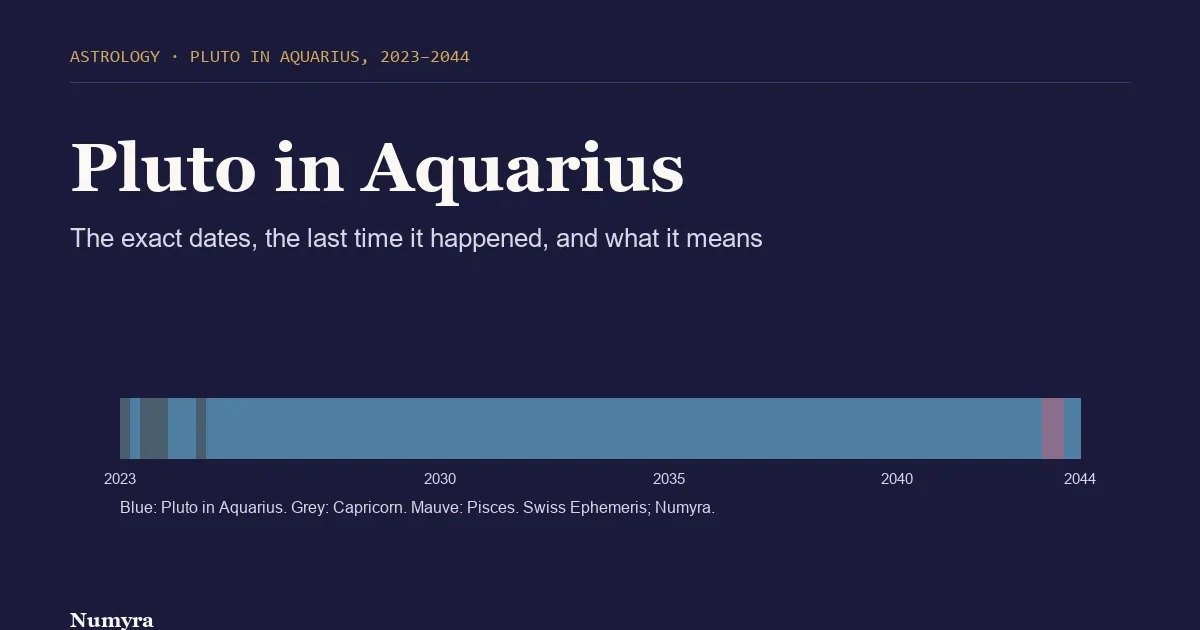
Pluto is in Aquarius from November 19, 2024 to March 8, 2043, after two short visits in 2023 and 2024 and before a final stretch from August 31, 2043 to January 19, 2044. Astrologers read Pluto as the planet of power, breakdown and renewal, and Aquarius as the sign of groups, technology and ideals, so the transit is read as a twenty-year remaking of how people organize, connect and share power. The last time Pluto was in Aquarius, from 1777 to 1798, the United States wrote its Constitution, France had its revolution and the planet Uranus was discovered.
Key takeaways
- Pluto first entered Aquarius on March 23, 2023, settled in on November 19, 2024, and leaves for good on January 19, 2044. Every entry and exit, to the minute, is in the table below (Swiss Ephemeris, US Eastern time).
- Pluto stays about 20 years in Aquarius but only 12 in Scorpio and 31 in Taurus, because its orbit is so stretched. Everyone born from 2023 to 2044 will share Pluto in Aquarius as a generational placement.
- Pluto’s 2026 retrograde ended on October 15 at 3°04′ Aquarius. It turns retrograde again on May 8, 2027, as it does every May, and spends about 163 days a year moving backward.
- Its last visit ran from April 4, 1777 to December 26, 1798, and it has now visited Aquarius five times since 1041, each stay lasting 20 to 21 years from first entry to first Pisces crossing.
- Pluto makes a conjunction, square or opposition only to a planet at the same degree of Aquarius, Leo, Taurus or Scorpio. A Sun at 0 to 5 degrees of those signs (birthdays January 20-24, July 23-27, April 20-24 and October 23-27) has Pluto on it between 2023 and 2027; the table below runs to 2044.
- Astrologers have kept Pluto since the IAU made it a dwarf planet in 2006. Readings here are an astrological tradition, offered for reflection, not prediction.
In this guide
- What Pluto in Aquarius means
- Pluto in Aquarius compared with Pluto in Capricorn
- The exact dates, 2023 to 2044
- Where Pluto is in Aquarius each year
- Where Pluto is now: the 2026 retrograde and what comes next
- The last time: 1777 to 1798, and every visit since 1041
- Why Pluto takes 20 years in Aquarius but 12 in Scorpio
- The Pluto generations
- Pluto in Aquarius in your own chart
- Pluto in Aquarius by Sun sign: who gets a hard aspect, and when
- Is Pluto still a planet?
- Frequently asked questions
What Pluto in Aquarius means
Pluto was discovered in 1930 and was soon taken up by astrologers, who gave it the themes of the Roman god of the underworld it was named after: death and rebirth, hidden power, obsession, purging and transformation. Because it moves so slowly, astrologers read its sign less as a personal trait and more as the deep current of an era, the thing a whole generation is forced to confront and remake. Aquarius is the fixed air sign of the collective: friends and networks, science and technology, equality, reform and the future. Its traditional ruler is Saturn, the planet of structure (see your Saturn sign); modern astrologers add Uranus, the planet of sudden change.
Put together, the common reading is that Pluto in Aquarius transforms the Aquarian parts of life: how groups organize and hold power, how technology shapes society, who gets to belong, and what people believe about progress. Astrologers expect old institutions to be hollowed out and rebuilt, networks to gain power over hierarchies, and science and technology to change daily life in ways that are hard to control. The shadow side in these readings is power exercised through systems and crowds rather than kings: surveillance, mob movements and technology used for control. In a birth chart, the transit is read through whichever house holds Aquarius, which we cover below.
Pluto in Aquarius compared with Pluto in Capricorn
Pluto spent the 15 years before this in Capricorn, from January 25, 2008 until March 23, 2023 (with short returns to Capricorn in 2023 and 2024, ending on November 19, 2024). Astrologers set the two transits side by side because they read as a handover: Cafe Astrology describes the Capricorn years as “an intense period of breaking down, exposing, renovating, and rebuilding structures, governments, traditions, and rules,” and the Aquarius years as a time to overhaul friendship, social structures and networks, community and scientific progress. Capricorn is an earth sign that astrologers tie to institutions, hierarchy and money; Aquarius is a fixed air sign tied to groups, ideas and technology. Bonnie Sorsby puts the handover in one line: Capricorn was about “dismantling traditional hierarchies” and Aquarius is about “rebuilding from the ground up.”
| Pluto in Capricorn | Pluto in Aquarius | |
|---|---|---|
| Years (first entry to first exit) | Jan 25, 2008 to Mar 23, 2023 (15.2 years) | Mar 23, 2023 to Mar 8, 2043 (20.0 years) |
| Element and mode | Earth, cardinal | Air, fixed |
| Traditional ruler of the sign | Saturn | Saturn (modern astrologers add Uranus) |
| Themes astrologers assign | Governments, institutions, hierarchy, rules, money | Groups, networks, technology, equality, reform |
| Common reading | Dismantling traditional hierarchies | Rebuilding from the ground up |
The exact dates, 2023 to 2044
Pluto does not change sign cleanly. Each year it spends about five months moving backward (retrograde), and when that loop straddles a sign boundary it steps into the new sign, slips back, and steps in again. Here is every crossing of the Capricorn–Aquarius and Aquarius–Pisces boundaries, calculated by the Numyra Methodology Desk with the Swiss Ephemeris, in US Eastern time:
| Date | Time (Eastern) | Pluto enters |
|---|---|---|
| Mar 23, 2023 | 8:26 a.m. | Aquarius |
| Jun 11, 2023 | 5:31 a.m. | Capricorn (retrograde) |
| Jan 20, 2024 | 7:58 p.m. | Aquarius |
| Sep 1, 2024 | 7:51 p.m. | Capricorn (retrograde) |
| Nov 19, 2024 | 3:45 p.m. | Aquarius |
| Mar 8, 2043 | 9:03 p.m. | Pisces |
| Aug 31, 2043 | 11:08 p.m. | Aquarius (retrograde) |
| Jan 19, 2044 | 4:52 a.m. | Pisces |
So the transit has three parts: a first taste from March 23 to June 11, 2023; a second from January 20 to September 1, 2024; and the long stay from November 19, 2024 to March 8, 2043, followed by a last return from August 31, 2043 to January 19, 2044. All told, Pluto spends about 19.5 years in Aquarius this time.
Why some sites print different dates. Two of these ingresses happen late in the evening in the US, so they are already the next day in Universal Time: the January 20, 2024 entry (7:58 p.m. EST) is January 21 in UT, and the March 8, 2043 exit (9:03 p.m. EDT) is March 9. Calendars that print UT dates therefore show January 21, 2024 and March 9, 2043, and a few list March 10. Our dates are US Eastern, the way an American reader lives them.
Where Pluto is in Aquarius each year
Pluto crosses Aquarius at about one and a half degrees a year, so the transit touches different birth charts at different times. If you have a planet or angle in Aquarius, Pluto’s conjunction to it, the year it reaches that degree, is the part of the transit astrologers watch most closely. Its position each July 1 at noon UT, to the whole degree (astrologers count 4°51′ as 4°, not 5°):
| Year | Pluto on July 1 |
|---|---|
| 2024 | 1° Aquarius |
| 2025 | 3° Aquarius |
| 2026 | 4° Aquarius |
| 2027 | 6° Aquarius |
| 2028 | 8° Aquarius |
| 2029 | 9° Aquarius |
| 2030 | 11° Aquarius |
| 2031 | 13° Aquarius |
| 2032 | 14° Aquarius |
| 2033 | 16° Aquarius |
| 2034 | 17° Aquarius |
| 2035 | 19° Aquarius |
| 2036 | 20° Aquarius |
| 2037 | 22° Aquarius |
| 2038 | 23° Aquarius |
| 2039 | 25° Aquarius |
| 2040 | 26° Aquarius |
| 2041 | 28° Aquarius |
| 2042 | 29° Aquarius |
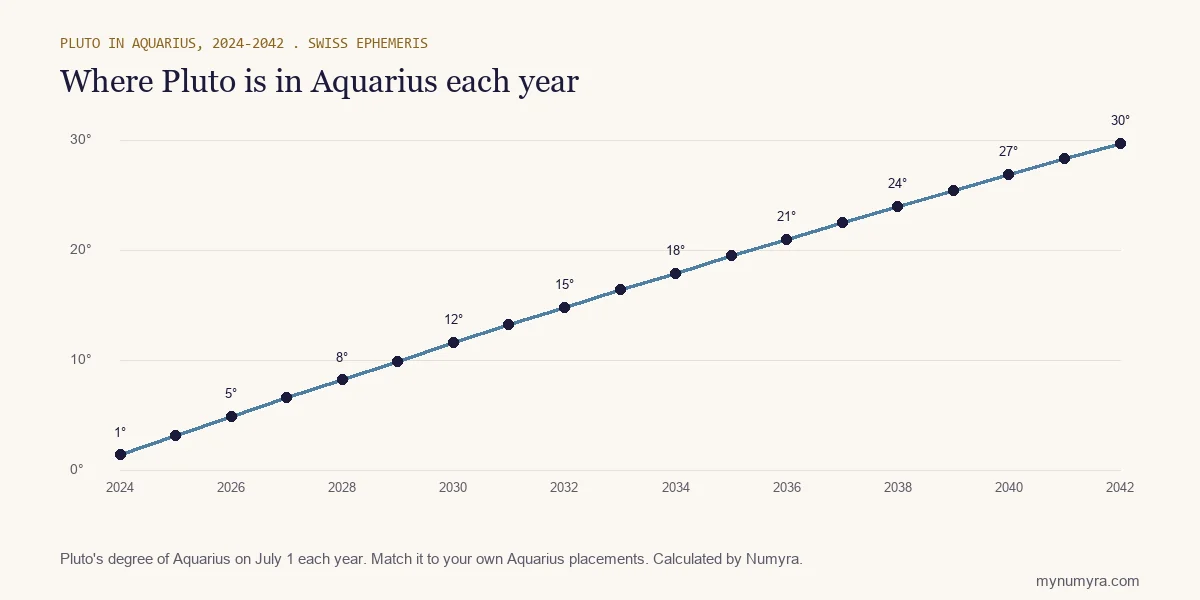
Because of the yearly retrograde loop, Pluto passes each degree three times over about a year, moving forward, then back, then forward again. Our stellium calculator lists the sign and degree of every planet for your birth date, and the birth chart calculator adds your Moon, rising sign and Midheaven.
Where Pluto is now: the 2026 retrograde and what comes next
Pluto turned retrograde on May 6, 2026 at 5°30′ Aquarius and turned direct on October 15, 2026 at 10:40 p.m. EDT at 3°04′, after 162 days of apparent backward motion. On October 22, 2026 it is still at 3°04′, because a planet that has just changed direction barely moves: Pluto reaches 4° Aquarius on December 19, 2026 and 5° on January 21, 2027, then turns retrograde again on May 8, 2027 and direct on October 17, 2027. The whole cycle is in our 2027 retrograde calendar, alongside the other planets.
Retrograde motion is an illusion of viewpoint. NASA’s StarChild page explains that “retrograde occurs roughly when a faster moving planet catches up to and passes a slower moving planet,” which is what Earth does to Pluto every year. That is why Pluto’s loop is so regular: it lasts 162 to 164 days every year through 2043 and carries Pluto back about 2.4 degrees, while the rest of the year it gains about 4 degrees, a net forward step of about 1.7 degrees a year at present. Astrologers read the retrograde months as a time when, in the words of astrologer Bonnie Sorsby, Pluto is “shifting its work from external transformation to internal recalibration,” and the direct months as the stretch when its themes move into events. It is a symbolic reading, not something the astronomy says.
| Year | Turns retrograde (Eastern) | Turns direct (Eastern) | Days | Position |
|---|---|---|---|---|
| 2026 | May 6, 2026, 11:34 a.m. | Oct 15, 2026, 10:40 p.m. | 162 | 5° to 3° Aquarius |
| 2027 | May 8, 2027, 8:54 a.m. | Oct 17, 2027, 11:52 p.m. | 163 | 7° to 4° Aquarius |
| 2028 | May 9, 2028, 5:29 a.m. | Oct 18, 2028, 11:45 p.m. | 163 | 8° to 6° Aquarius |
| 2029 | May 11, 2029, 12:14 a.m. | Oct 20, 2029, 11:56 p.m. | 163 | 10° to 8° Aquarius |
| 2030 | May 12, 2030, 7:10 p.m. | Oct 22, 2030, 11:06 p.m. | 163 | 12° to 9° Aquarius |
| 2031 | May 14, 2031, 4:27 p.m. | Oct 24, 2031, 7:12 p.m. | 163 | 13° to 11° Aquarius |
Pluto’s aspects to Jupiter, Saturn, Uranus and Neptune
Astrologers also watch the angles Pluto makes to the other slow planets, because two heavy planets meeting at a fixed angle is read as a shared theme for the whole period. Because Pluto and the other planet each turn retrograde, most of these angles are exact two or three times rather than once. Here is every one from 2026 to the end of 2029, with the date it is exact (US Eastern) and Pluto’s whole degree of Aquarius:
| Aspect | Exact on | Pluto at |
|---|---|---|
| Saturn sextile Pluto | Mar 28, 2026 | 5° |
| Jupiter opposite Pluto | Jul 20, 2026 | 4° |
| Uranus trine Pluto | Jul 18, 2026; Nov 29, 2026; Jun 15, 2027; Jan 13, 2028; May 9, 2028 | 4°, 3°, 6°, 6°, 8° |
| Neptune sextile Pluto | Jul 25 and Sep 15, 2026; Jun 28 and Oct 16, 2027; Jun 9 and Nov 7, 2028; May 22 and Nov 30, 2029 | 4°, 3°, 6°, 4°, 8°, 6°, 10°, 8° |
| Jupiter trine Pluto | Sep 24, 2028 | 6° |
| Saturn square Pluto | Jun 23 and Nov 15, 2028; Mar 29, 2029 | 8°, 6°, 10° |
| Jupiter square Pluto | Oct 31, 2029 | 8° |
We checked these against the aspect list on Cafe Astrology’s Pluto in Aquarius page: every date agrees to the day (Cafe stops at 10°, so it leaves out May 22, 2029), and Pluto’s position agrees to within one arcminute. The next one to arrive is the second pass of Uranus trine Pluto on November 29, 2026. Saturn and Jupiter’s partners in these aspects are covered in our guides to Saturn in Aries and Jupiter in Leo, and the other generational planets in Uranus and Neptune signs by birth date. For the cycles astrologers read alongside Pluto, see our guides to Chiron, the North Node in Aquarius and the Saturn return.
The last time: 1777 to 1798, and every visit since 1041
Pluto’s orbit takes about 248 years, so its previous passage through Aquarius is the one astrologers compare this transit with. The Swiss Ephemeris puts it from April 4, 1777 to December 26, 1798, with the same stuttering entries and exits:

| Date | Time (Eastern) | Pluto enters |
|---|---|---|
| Apr 4, 1777 | 2:51 p.m. | Aquarius |
| May 27, 1777 | 6:34 a.m. | Capricorn (retrograde) |
| Jan 26, 1778 | 8:28 p.m. | Aquarius |
| Aug 20, 1778 | 8:14 a.m. | Capricorn (retrograde) |
| Dec 1, 1778 | 5:32 p.m. | Aquarius |
| Apr 11, 1797 | 9:30 a.m. | Pisces |
| Jul 20, 1797 | 7:00 p.m. | Aquarius (retrograde) |
| Feb 17, 1798 | 7:57 p.m. | Pisces |
| Sep 28, 1798 | 3:55 a.m. | Aquarius (retrograde) |
| Dec 26, 1798 | 10:55 a.m. | Pisces |
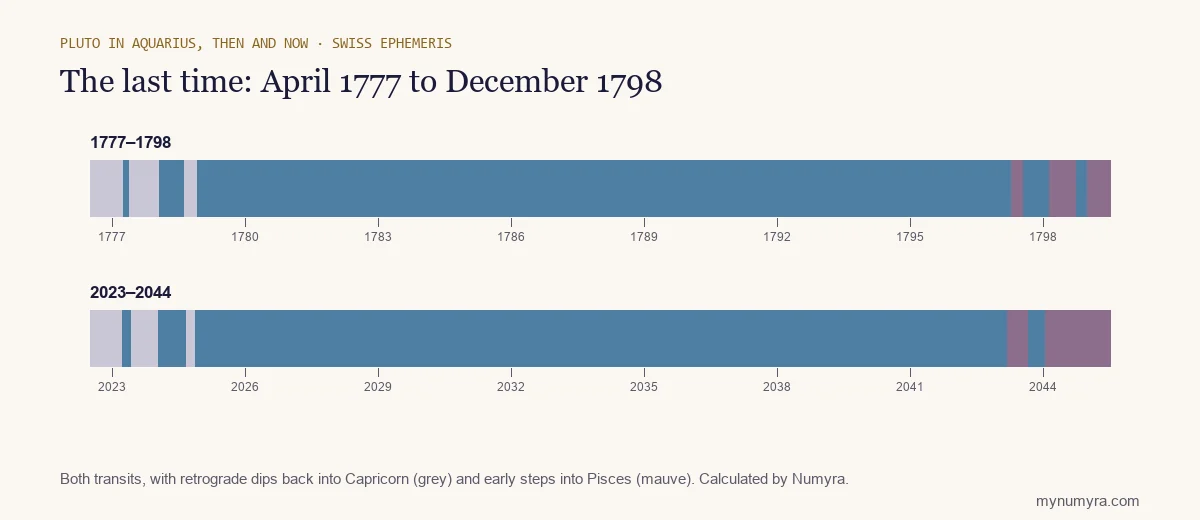
Astrologers point to what happened in those years: the American Revolution was still being fought when the transit began, and the Constitution was signed on September 17, 1787; the French Revolution began with the storming of the Bastille on July 14, 1789; the Haitian Revolution began in 1791; and William Herschel discovered Uranus on March 13, 1781, the planet modern astrologers assign to Aquarius. Whether or not you read meaning into the overlap, it is why so many writers describe this transit in terms of revolutions, constitutions and new technologies. The comparison has limits: history does not repeat on a 248-year clock, and the same years held plenty that fits no Aquarian theme.
Every visit since the 11th century
Pluto’s orbit brings it back to Aquarius about every 248 years, so there have been five visits since the year 1041. We calculated each with the Swiss Ephemeris, giving the month for the medieval ones (dates before October 1582 are in the Julian calendar, the one people then used). The last column is the time from first entering Aquarius to first crossing into Pisces, the same measure as the generation table below.
| Visit | First entered Aquarius | First crossing into Pisces | Last left Aquarius | Years |
|---|---|---|---|---|
| 11th century | Feb 1041 | Mar 1062 | Dec 1063 | 21.1 |
| 13th century | Feb 1286 | Mar 1307 | Nov 1308 | 21.1 |
| 16th century | Feb 1532 | Mar 1552 | Dec 1553 | 20.1 |
| 18th century | Apr 4, 1777 | Apr 11, 1797 | Dec 26, 1798 | 20.0 |
| Now | Mar 23, 2023 | Mar 8, 2043 | Jan 19, 2044 | 20.0 |
In our calculation the stays have shortened from just over 21 years to 20. Astrologers who study the earlier visits point to the East-West Schism between the Roman and Greek churches in 1054, the mass arrest of the Knights Templar in France on October 13, 1307, and, in the 16th-century visit, England’s Act of Supremacy of 1534 and Copernicus’s De revolutionibus, printed in 1543. Treat such lists with care. Every 21-year window of history contains momentous events, and the neat dates are often contested: the Christian History Institute notes that “no serious scholar maintains that the schism began in 1054.” A pattern you can only see after choosing which events count is an observation, not a test.
Why Pluto takes 20 years in Aquarius but 12 in Scorpio
Pluto’s orbit is far from a circle. NASA’s fact sheet gives its eccentricity as 0.244, by far the largest of the classical planets, with a perihelion (closest approach to the Sun) of 4,435 million km and an aphelion of 7,304 million km. The perihelion lies at a longitude of 224°, which is 14° Scorpio: Pluto was last there in 1989, and from 1979 to 1999 it was actually closer to the Sun than Neptune. Planets move fastest near perihelion, so Pluto rushes through Scorpio and Sagittarius and crawls through the opposite side of the zodiac, Taurus and Aries. From first entry to final exit, its average stay in each sign over 1700 to 2099 is (Taurus through Leo were visited only once in that span):
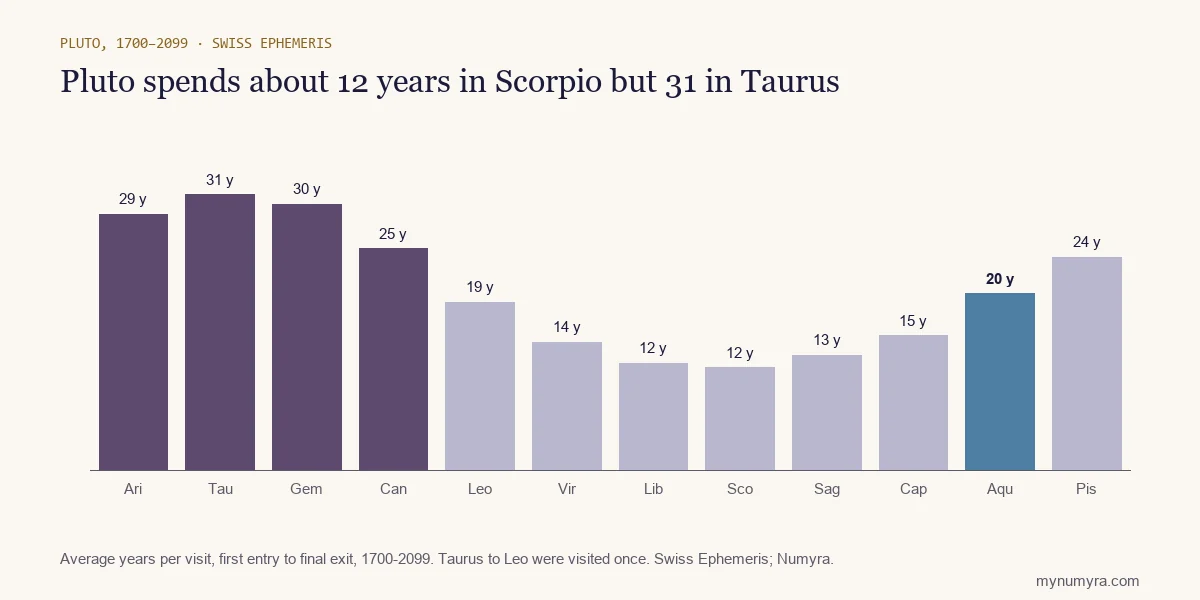
| Sign | Years per visit |
|---|---|
| Aries | 29.0 |
| Taurus | 31.2 |
| Gemini | 30.1 |
| Cancer | 25.1 |
| Leo | 19.0 |
| Virgo | 14.5 |
| Libra | 12.1 |
| Scorpio | 11.6 |
| Sagittarius | 13.0 |
| Capricorn | 15.2 |
| Aquarius | 20.0 |
| Pisces | 24.1 |
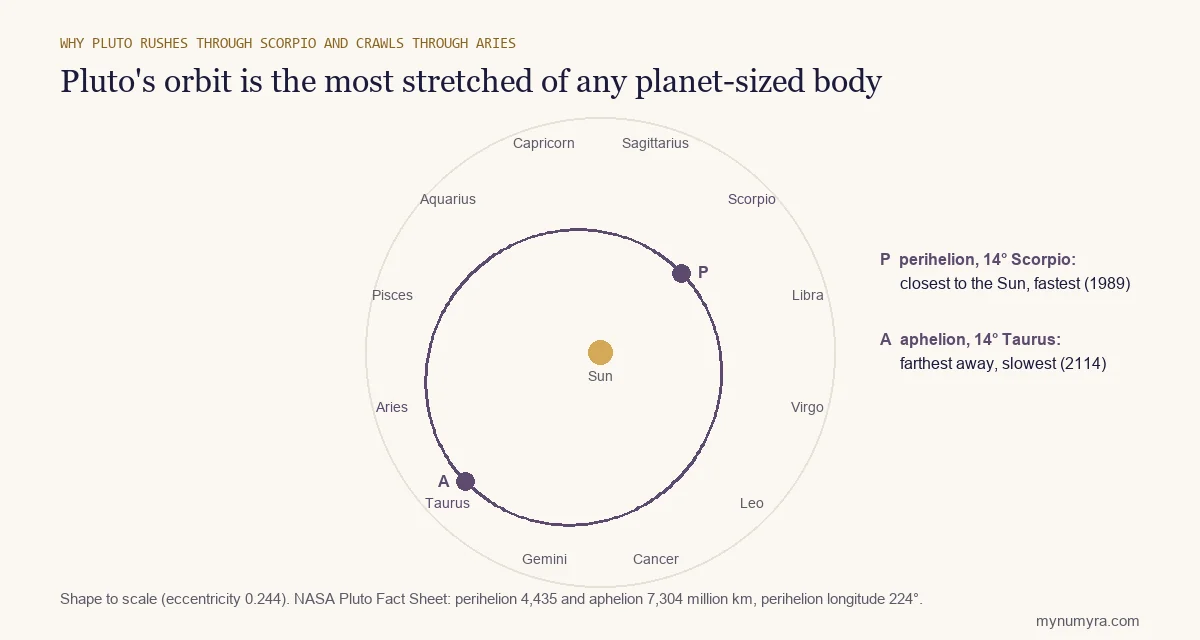
That is why the Pluto in Scorpio generation covers only twelve birth years while Pluto in Aquarius will cover about twenty, and why the Pluto in Aries generation, from 2066 to 2097, will be the longest of the century.
The Pluto generations
Because Pluto spends so long in each sign, everyone born in the same stretch of years shares a Pluto sign, and astrologers read those cohorts as generations with a shared theme. The windows below run from Pluto’s first entry into a sign to its final exit (retrograde dips back into the previous sign fall inside them; see the full table above for the exact crossings):
| Pluto in | First entry | Final exit | Years |
|---|---|---|---|
| Gemini | Jul 21, 1882 | Sep 10, 1912 | 30.1 |
| Cancer | Sep 10, 1912 | Oct 7, 1937 | 25.1 |
| Leo | Oct 7, 1937 | Oct 20, 1956 | 19.0 |
| Virgo | Oct 20, 1956 | Oct 5, 1971 | 15.0 |
| Libra | Oct 5, 1971 | Nov 5, 1983 | 12.1 |
| Scorpio | Nov 5, 1983 | Jan 17, 1995 | 11.2 |
| Sagittarius | Jan 17, 1995 | Jan 25, 2008 | 13.0 |
| Capricorn | Jan 25, 2008 | Mar 23, 2023 | 15.2 |
| Aquarius | Mar 23, 2023 | Mar 8, 2043 | 20.0 |
| Pisces | Mar 8, 2043 | Jun 17, 2066 | 23.3 |
| Aries | Jun 17, 2066 | Jun 9, 2095 | 29.0 |
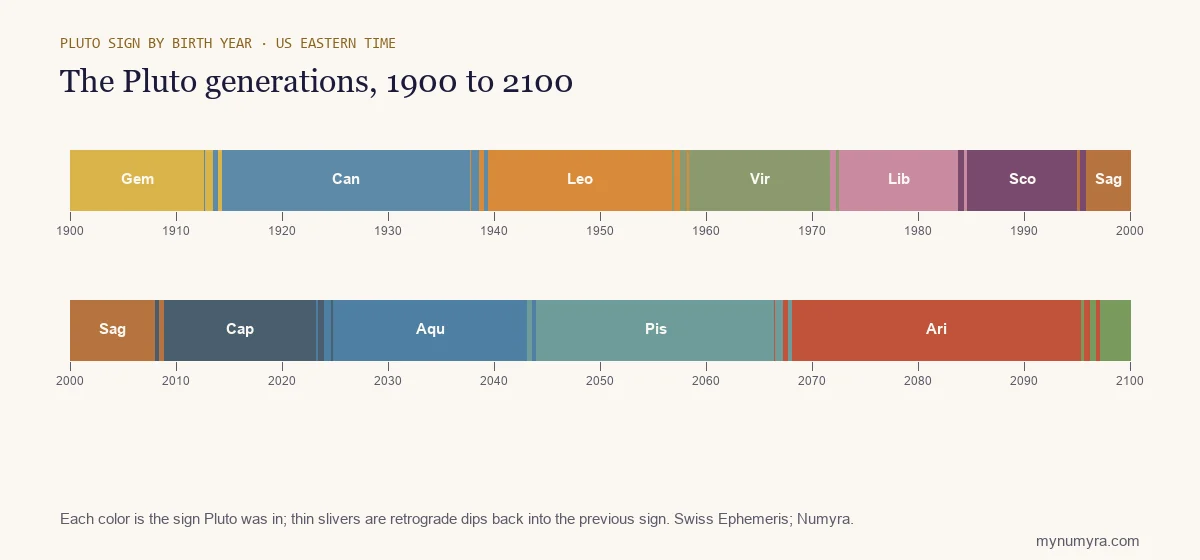
Children born from 2023 onward are the first Pluto in Aquarius generation since the 1790s. Astrologers read the Capricorn generation (2008–2023) as remaking institutions and the Aquarius generation as remaking the networks and technologies that replace them. How that plays out for an individual depends on the rest of the chart, which is where the slow outer planets are read alongside the fast personal ones.
Do not confuse this with the generation names used in the news. The demographer Mark McCrindle, who coined them, uses 2010 to 2024 for Generation Alpha and 2025 to 2039 for Generation Beta, a proposed name rather than an official one. Pluto in Aquarius children are therefore split across two of those groups (births in 2023 and 2024 fall in Alpha, 2025 to 2039 in Beta) and spill into a cohort not yet named after 2039, because sociologists cut generations at about 15 years and Pluto at about 20.
Pluto in Aquarius in your own chart
For anyone already born, Pluto in Aquarius is a transit, not a placement: it moves through one house of your birth chart for the whole twenty years, and that house is where the transformation is read. With whole-sign houses (see our guide to whole sign versus Placidus houses for what changes if your chart uses another system), the house depends only on your rising sign:
| Your rising sign | Aquarius is your | The transit is read as reshaping |
|---|---|---|
| Aries rising | 11th house | friends, groups and long-term goals |
| Taurus rising | 10th house | career and public standing |
| Gemini rising | 9th house | beliefs, travel and higher learning |
| Cancer rising | 8th house | shared money, intimacy and deep change |
| Leo rising | 7th house | partnership and marriage |
| Virgo rising | 6th house | work, routines and health |
| Libra rising | 5th house | creativity, romance and children |
| Scorpio rising | 4th house | home, family and roots |
| Sagittarius rising | 3rd house | communication, learning and siblings |
| Capricorn rising | 2nd house | money, possessions and self-worth |
| Aquarius rising | 1st house | identity, body and how you come across |
| Pisces rising | 12th house | the inner life, rest and endings |
Astrologers also look for anything in your chart at the degree Pluto is passing: a planet, the Ascendant or the Midheaven in Aquarius, or at the same degree of Leo (opposite), Taurus or Scorpio (square). Those years are read as the personal peak of the transit. Pluto returns to the same degree three times, so each contact lasts about a year. You need your birth time to know your houses; our rising sign guide explains why, and our plain-English guide to the twelve houses covers what each one governs.
Pluto in Aquarius by Sun sign: who gets a hard aspect, and when
Most pages on this subject give a short horoscope for each Sun sign. The geometry is more specific than that. Pluto forms a conjunction, square or opposition to a planet only when the planet sits at the same degree of a fixed sign: the same degree of Aquarius (conjunction), Leo (opposition), or Taurus and Scorpio (squares). Everyone else gets softer contacts: a sextile at the same degree of Aries or Sagittarius, a trine at Gemini or Libra. Since Pluto crosses Aquarius one 5-degree zone at a time, your birthday tells you roughly when Pluto reaches your Sun. We worked out the dates:
| Sun at these degrees | Pluto is in that zone | Aquarius Sun, conjunction (born) | Leo Sun, opposition (born) | Taurus Sun, square (born) | Scorpio Sun, square (born) |
|---|---|---|---|---|---|
| 0° to 5° | Mar 23, 2023 to Nov 19, 2027 | Jan 20-24 | Jul 23-27 | Apr 20-24 | Oct 23-27 |
| 5° to 10° | Mar 20, 2026 to Nov 29, 2030 | Jan 25-29 | Jul 28-Aug 1 | Apr 25-29 | Oct 28-Nov 1 |
| 10° to 15° | Mar 27, 2029 to Dec 18, 2033 | Jan 30-Feb 3 | Aug 2-6 | Apr 30-May 4 | Nov 2-6 |
| 15° to 20° | Apr 13, 2032 to Jan 9, 2037 | Feb 4-8 | Aug 7-11 | May 5-9 | Nov 7-11 |
| 20° to 25° | Feb 29, 2036 to Dec 5, 2040 | Feb 9-13 | Aug 12-17 | May 10-15 | Nov 12-16 |
| 25° to 30° | Mar 29, 2039 to Jan 19, 2044 | Feb 14-18 | Aug 18-22 | May 16-20 | Nov 17-21 |
Read the table across: someone born on January 22 has the Sun at about 2° Aquarius, so Pluto is conjunct their Sun from 2023 to 2027, and someone born on July 25 has an opposition over the same years. The windows run from Pluto’s first entry into the zone to its last exit, and Pluto passes each degree three times (forward, back, forward), so the exact hits within a window are spread over about a year, as the retrograde table above shows. Birthdays shift by a day depending on the year (we used the most common calendar date for each degree across births from 1930 to 2026), and Suns born near the end of a band should check their exact degree in the Stellium Calculator. The same logic applies to your Moon, Venus, Mercury or Ascendant. In practice the first band, which covers Pluto’s arrival, is the one in play now, and the second began in March 2026.
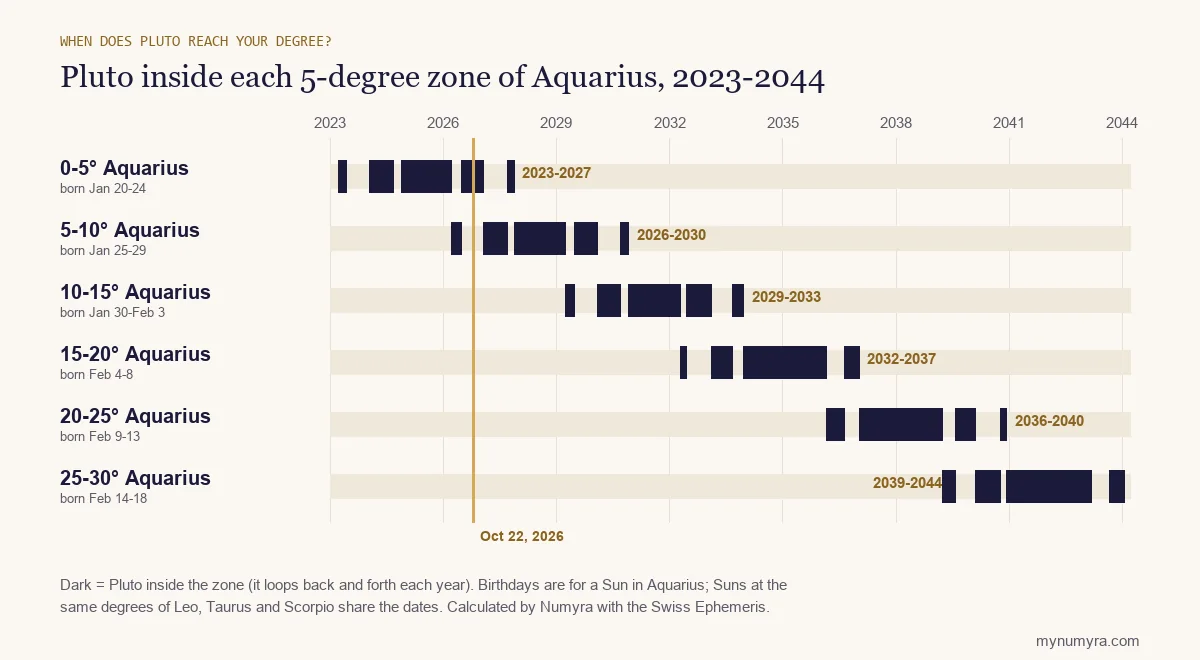
Astrological tradition reads a Pluto conjunction, square or opposition to the Sun as a long reckoning with identity and power, one that can feel like pressure or loss before it feels like renewal. We are not aware of any peer-reviewed study that tests Pluto transits against life events, so treat the dates as a prompt for reflection, not a forecast. If a hard period is affecting your mental health, a chart cannot help with that: in the US you can call or text the 988 Suicide & Crisis Lifeline at 988.
Is Pluto still a planet?
Not to astronomers. On August 24, 2006, the International Astronomical Union, meeting in Prague, adopted a definition of “planet” that Pluto fails on one count: it has not cleared the neighborhood around its orbit. The same resolution created a new class:

“A “dwarf planet” is a celestial body that (a) is in orbit around the Sun, (b) has sufficient mass for its self-gravity to overcome rigid body forces so that it assumes a hydrostatic equilibrium (nearly round) shape, (c) has not cleared the neighbourhood around its orbit, and (d) is not a satellite.”
International Astronomical Union, Resolution 5A, Prague, August 24, 2006
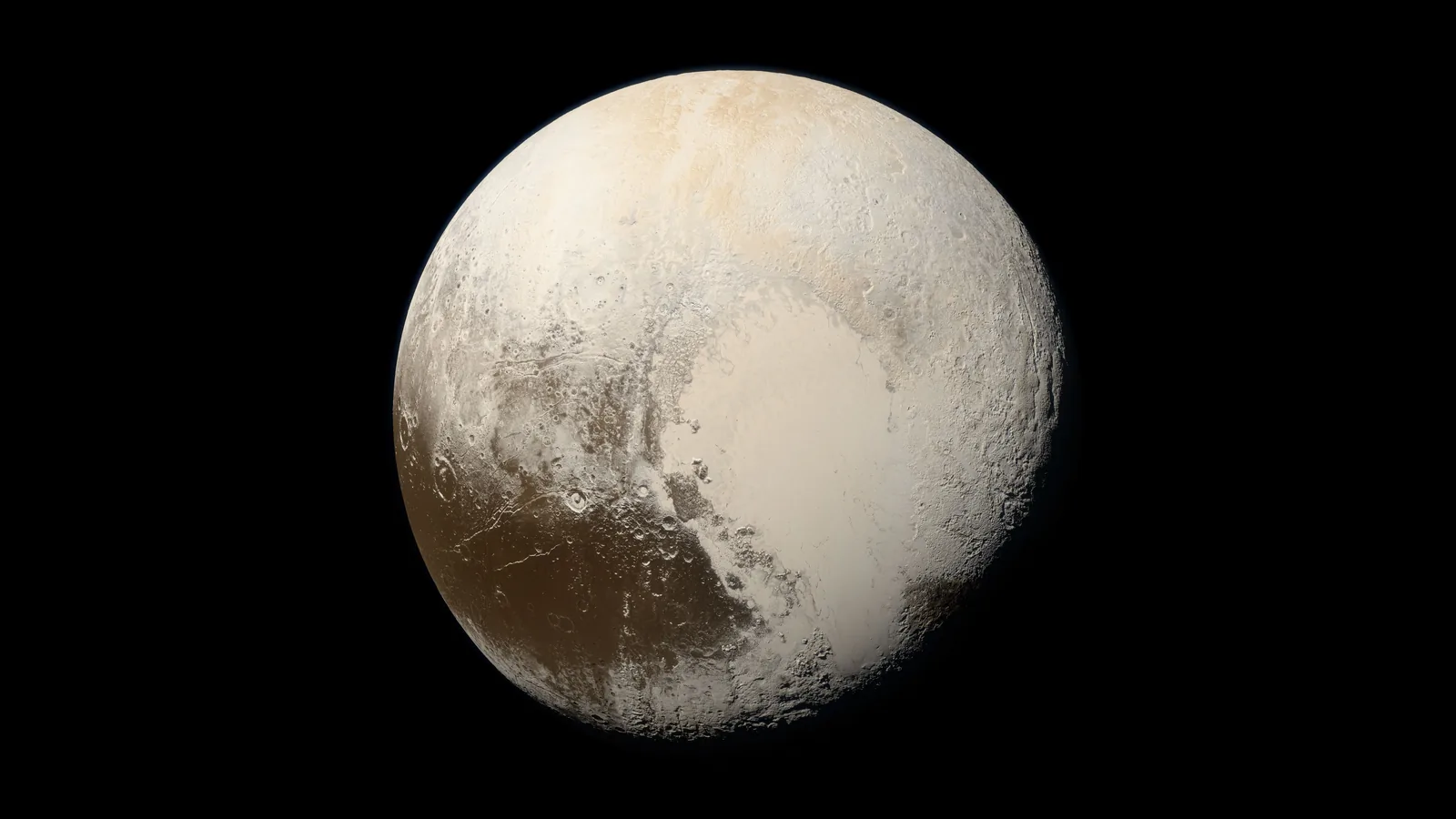
A second vote that day, Resolution 6A, passed 237 to 157 with 17 abstentions and declared that “Pluto is a “dwarf planet” by the above definition and is recognized as the prototype of a new category of trans-Neptunian objects.” Astrologers kept Pluto anyway, on the grounds that its meaning was built from observation of charts, not from its size. NASA’s own summary of the body is a reminder of how recent all of this is: discovered in 1930 at Lowell Observatory, and in NASA’s words, “Pluto was named by an 11-year-old girl,” Venetia Burney of Oxford. It has five known moons, a diameter of about 2,377 km, and ranges from 30 to 49.3 AU from the Sun. The New Horizons probe photographed it close up on July 14, 2015, the image at the top of this page.
Pluto is the slowest of the three generational planets. For Uranus (about 7 years a sign) and Neptune (about 14), see our guide to Uranus and Neptune signs by birth date.
Frequently asked questions
When did Pluto enter Aquarius, and when does it leave?
It entered first on March 23, 2023 for about three months, again on January 20, 2024 until September 1, and for good on November 19, 2024. It enters Pisces on March 8, 2043, dips back into Aquarius from August 31, 2043, and leaves Aquarius for the last time on January 19, 2044 (US Eastern time, Swiss Ephemeris).
What does Pluto in Aquarius mean?
Astrologers read it as a twenty-year transformation of the Aquarian parts of life: groups and networks, technology, equality and ideals, with old institutions broken down and power reorganized. It is an interpretive tradition, not a forecast of events.
When was Pluto last in Aquarius?
From April 4, 1777 to December 26, 1798, with the usual retrograde dips. Before that it visited in 1532 to 1553, 1286 to 1308 and 1041 to 1063. The American Constitution, the French and Haitian revolutions and the discovery of Uranus all fall inside the most recent window.
Which generation has Pluto in Aquarius?
Everyone born between March 23, 2023 and January 19, 2044, apart from the short dips back into Capricorn in 2023 and 2024 and into Pisces in 2043. The previous Aquarius generation was born from 1777 to 1798. Sociological names differ: Generation Alpha runs to 2024 and Generation Beta from 2025.
Which house is Pluto in Aquarius transiting for me?
With whole-sign houses it depends only on your rising sign: the 1st house for Aquarius rising, the 7th for Leo rising, the 10th for Taurus rising, and so on. The table above lists all twelve.
Which signs are most affected by Pluto in Aquarius?
The fixed signs: Suns and other planets in Aquarius (conjunction), Leo (opposition), Taurus and Scorpio (square) get Pluto’s hard aspects, and the 0 to 5 degree zone of each is in play from 2023 to 2027. Our Sun-sign table above gives the birthdays and the years for every zone through 2044.
Is Pluto retrograde right now?
Not as of October 22, 2026: Pluto turned direct on October 15, 2026 at 3°04′ Aquarius. It next turns retrograde on May 8, 2027 and direct again on October 17, 2027.
Why does Pluto stay so long in some signs?
Its orbit is very stretched. It moves fastest near perihelion in Scorpio and slowest on the far side in Taurus and Aries, so it spends about 12 years in Scorpio but 31 in Taurus.
Do astrologers still use Pluto now that it is a dwarf planet?
Yes. The IAU reclassified it in 2006 on astronomical grounds, but astrology uses Pluto for the meanings built up since 1930, and almost all Western astrologers still include it.
Is Pluto in Aquarius good or bad?
Neither, in the tradition: Pluto stands for death and rebirth, so astrologers describe both breakdown and renewal. How a transit feels depends on the houses and planets it touches, and astrology has not shown that it causes events. If you are struggling, 988 (the US Suicide & Crisis Lifeline) is free and open any time.
Sources
- International Astronomical Union. “IAU 2006 General Assembly: Result of the IAU Resolution votes.” Press release, Prague, August 24, 2006. Resolutions 5A and 6A, quoted above (Wayback Machine copy of the IAU page).
- NASA Goddard Space Flight Center. Pluto Fact Sheet. Orbit period, perihelion, aphelion, eccentricity and longitude of perihelion.
- NASA Science. Pluto: Facts. Discovery, naming, distance range, moons and the 1979-1999 period inside Neptune’s orbit.
- NASA StarChild. “What does it mean for Mercury to be in retrograde?” Why retrograde motion is apparent, not real.
- Cafe Astrology. “Pluto in Aquarius in 2023 to 2044: Pluto Transits.” Used for the description of the Capricorn years and to cross-check the entry dates, 2026 stations and aspect dates.
- Bonnie Sorsby. “Pluto in Aquarius 2026: Meaning, Dates, Retrograde, and Rising Sign Guide.” Source of the retrograde reading quoted above.
- National Archives. The Constitution of the United States: A Transcription. Dated September 17, 1787.
- Wikipedia. “Storming of the Bastille.” July 14, 1789.
- Wikipedia. “Haitian Revolution.” The 1791 uprising.
- Wikipedia. “Uranus.” Discovery by William Herschel, March 13, 1781; see also NASA Science, Uranus: Facts.
- Christian History Institute. “1054: The East-West Schism.” Quoted above.
- Wikipedia. “Knights Templar.” Arrests of October 13, 1307.
- Wikipedia. “Acts of Supremacy.” The 1534 Act.
- Wikipedia. “De revolutionibus orbium coelestium.” First printed in Nuremberg, 1543.
- Wikipedia. “Generation Beta.” Mark McCrindle’s date ranges for Generation Alpha (2010-2024) and Generation Beta (2025-2039).
- 988 Suicide & Crisis Lifeline.
- Astrodienst. Swiss Ephemeris. Every date, time, position and average on this page was calculated with it (Moshier mode) by the Numyra Methodology Desk.