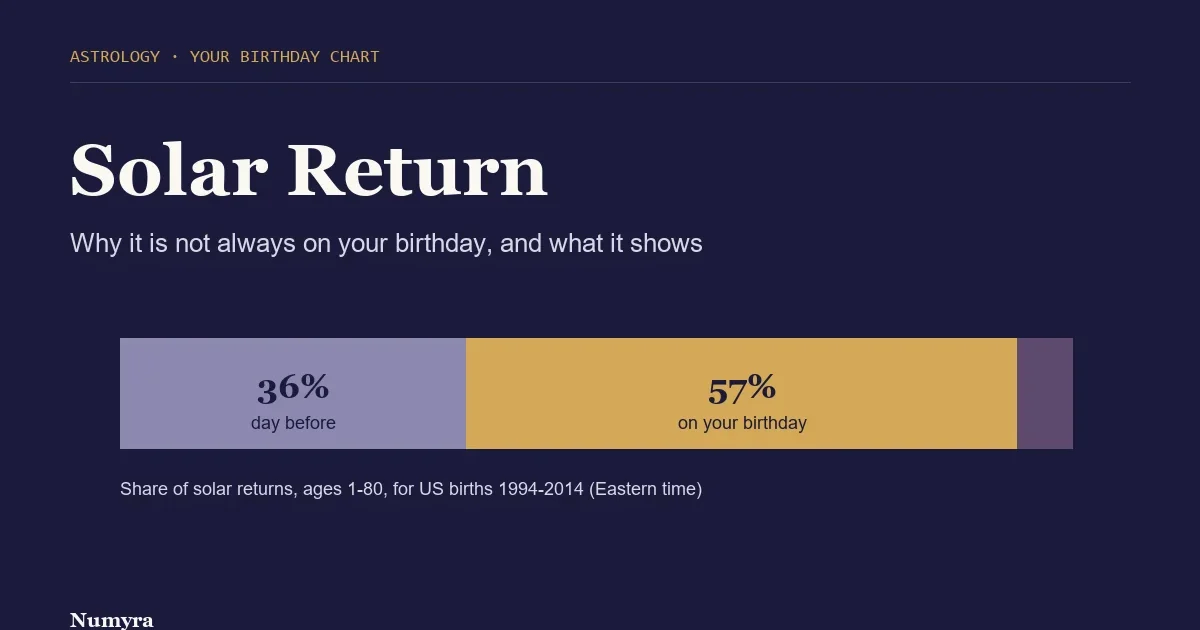
Your solar return is the moment each year when the Sun gets back to the exact degree and minute it held when you were born. Astrologers cast a chart for that moment, your “birthday chart”, and read it for the year until your next birthday. It is not always on your birthday: in our check of 320,000 returns for US births, it fell on the birthday 57% of the time and on the day before 36% of the time.
Key takeaways
- A solar return is the exact moment the Sun returns to its birth position. It needs your birth time: one arcminute of the Sun’s motion takes about 24 minutes.
- Among US births from 1994 to 2014, returns at ages 1 to 80 fell on the birthday 57.4%, the day before 36.1%, the day after 5.7% and two days early 0.8% of the time (Eastern time, Swiss Ephemeris).
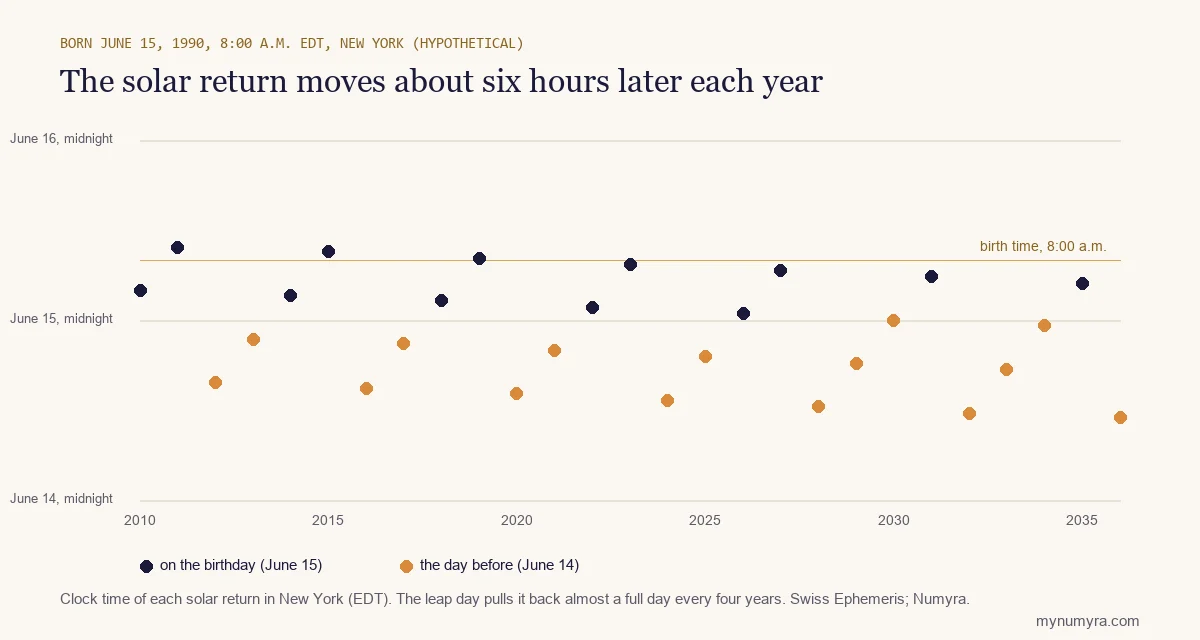
- The return comes about six hours later each year, jumps back almost a day after each leap day, and drifts about 45 minutes earlier every four years, which is why “the day before” becomes more common with age.
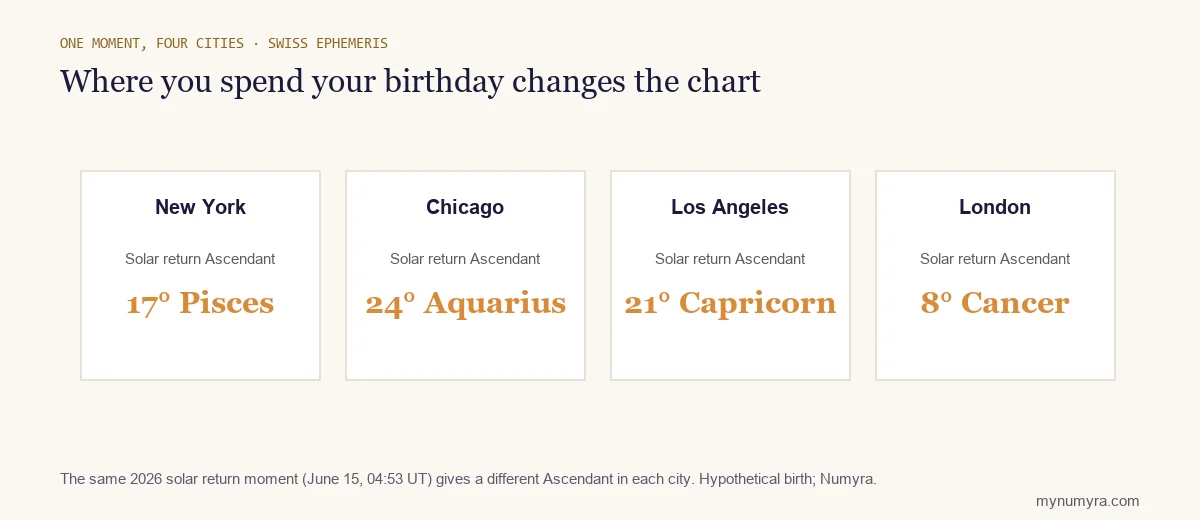
- Location changes the chart: the same moment gave Ascendants from Capricorn to Cancer across New York, Chicago, Los Angeles and London.
- Solar return readings are an astrological tradition, offered for reflection, not as prediction or advice.
In this guide
- What a solar return is
- When your solar return happens
- Why your birth time matters so much
- Does location change your solar return?
- How to read a solar return chart
- The solar return Sun by house
- The solar return Ascendant by sign
- How to find your solar return time yourself
- Solar returns and annual profections
- The 33-year rhythm
- Frequently asked questions
What a solar return is
Your natal chart is a snapshot of the sky at birth. Each year, the Sun completes one lap of the zodiac and comes back to the same spot, and a chart cast for that instant is your solar return. Astrologers read it as a forecast of the year’s themes, layered over the natal chart rather than replacing it. The technique is old: the 9th-century Persian astrologer Abu Ma’shar devoted a whole book to the “revolutions of the years of nativities”, and the English astrologer William Lilly defined it plainly in 1647:
“a Revolution or annuall Conversion is no other then the returne of the [Sun] to that very poynt wherein at the Radix of any Nativity or matter he was.”
William Lilly, Christian Astrology, London, 1647, chapter CLXXII, “Of Revolutions,” p. 734 (Lilly prints the Sun’s glyph, ☉)
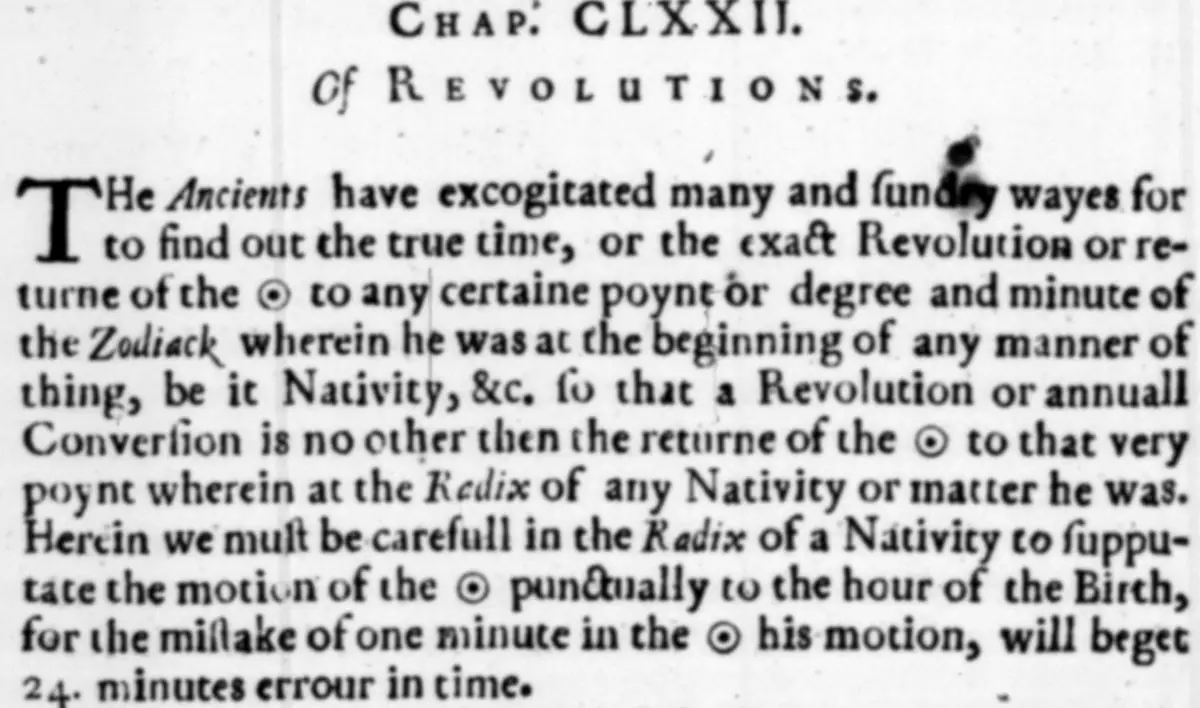
“Radix” is the root chart, your birth chart. Everything in a solar return except the Sun moves: the Moon, the planets, and above all the rising sign and houses, which depend on the exact time and place of the return.
When your solar return happens
The Sun takes about 365.2422 days to come back to the same point, a little longer than a 365-day year. So each year your return arrives roughly six hours later than the year before, until a leap day pulls the calendar back by a full day and the return jumps almost a day earlier. That is why it can land on your birthday, the day before or, more rarely, the day after.
To see how often each happens, we placed the Sun for 4,000 simulated people, weighted by the real daily count of US births from 1994 to 2014 with birth times spread evenly through the day, and found every solar return from age 1 to age 80 in US Eastern time:
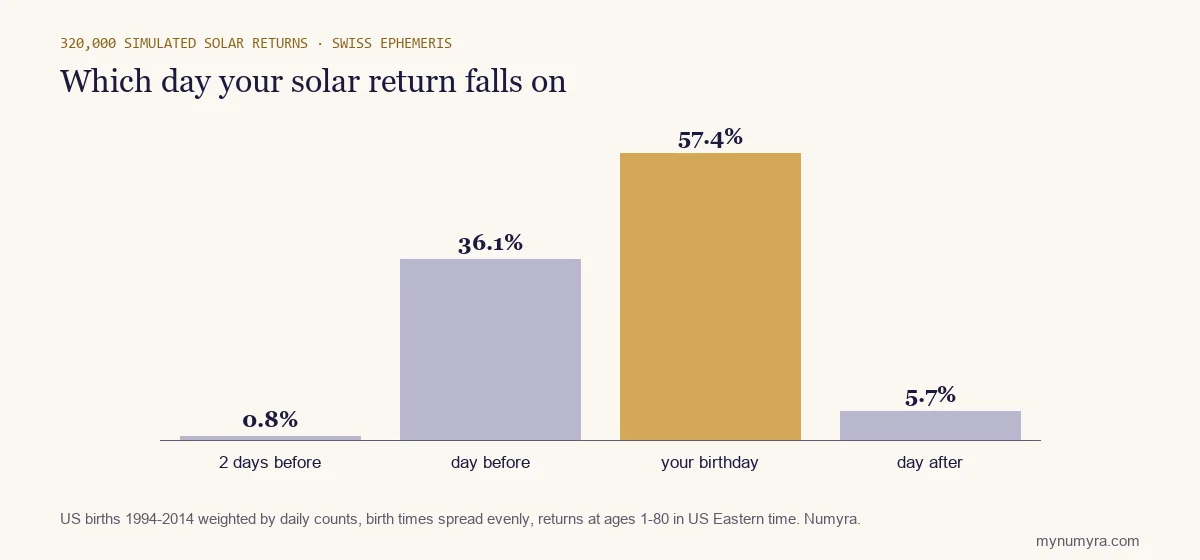
| Solar return falls on | Share of 319,840 returns |
|---|---|
| Two days before the birthday | 0.8% |
| The day before | 36.1% |
| The birthday itself | 57.4% |
| The day after | 5.7% |
Why so lopsided? Four calendar years with one leap day add up to 1,461 days, but four solar years are only about 1,460.97 days. The difference is about 45 minutes, so every four years your return arrives roughly 45 minutes earlier on the clock than four years before. Over 80 years that adds up to about 15 hours, steadily pushing returns from the birthday onto the day before. (The year 2100 skips its leap day, which will push them a day later again.) Here is how it played out for a hypothetical birth on June 15, 1990, at 8:00 a.m. in New York:
| Year | Age | Solar return (EDT) | Falls on |
|---|---|---|---|
| 2023 | 33 | June 15, 7:27 a.m. | birthday |
| 2024 | 34 | June 14, 1:14 p.m. | day before |
| 2025 | 35 | June 14, 7:08 p.m. | day before |
| 2026 | 36 | June 15, 12:53 a.m. | birthday |
| 2027 | 37 | June 15, 6:33 a.m. | birthday |
| 2028 | 38 | June 14, 12:29 p.m. | day before |
| 2029 | 39 | June 14, 6:14 p.m. | day before |
| 2030 | 40 | June 14, 11:54 p.m. | day before |
Why your birth time matters so much
The Sun moves about one degree a day, so the return moment is extremely sensitive to the Sun’s exact birth position. Lilly warned about this in the same chapter:
“for the mistake of one minute in the [Sun] his motion, will beget 24. minutes errour in time.”
William Lilly, Christian Astrology, 1647, p. 734
We checked his rule. Across a year, the Sun moves between 0.9532° and 1.0193° a day, so one arcminute takes 23.5 to 25.2 minutes, 24.3 on average. His 24 minutes holds up. A birth time that is off by half an hour shifts the return by roughly the same half hour, which is enough to move its rising sign. If you are unsure of your birth time, read the Sun’s sign and the planets’ signs and treat the houses with caution. Our birth chart calculator shows your natal Sun, Moon, rising sign and Midheaven; for the return chart itself you need chart software such as Astrodienst’s astro.com, which uses the Swiss Ephemeris.
Does location change your solar return?
The moment of the return is the same everywhere, but the rising sign and houses depend on where you are, just as your rising sign depends on where you were born. Most astrologers cast the return for the place you actually are on that day; some use your birthplace or your home. For the hypothetical 1990 birth above, the 2026 return came at 04:53 Universal Time on June 15, which gives a very different chart in each city:
| City | Solar return Ascendant, 2026 |
|---|---|
| New York | 17° Pisces |
| Chicago | 24° Aquarius |
| Los Angeles | 21° Capricorn |
| London | 8° Cancer |
This is the idea behind “relocated” solar returns: some people travel for their birthday to put a preferred sign on the Ascendant or a helpful planet on an angle. It is a popular modern practice, not a proven one, and astrologers disagree about whether it works.
How to read a solar return chart
Astrologers usually work in this order, giving the most weight to whatever sits on the angles:
- The Ascendant. The rising sign of the return is read as the year’s overall tone, and the natal house it falls in shows which part of life is emphasized.
- The angles. Planets close to the Ascendant, Midheaven, Descendant or IC are read as the year’s loudest themes.
- The Sun’s house. Where the Sun falls in the return’s houses shows where your energy goes this year.
- The Moon. Its sign and house are read as the year’s emotional focus and what you will need.
- Repeats. Anything that echoes your natal chart, such as the same rising sign or a planet returning to its birth house, is read as especially significant.
Many traditional astrologers read the solar return together with annual profections and with the year’s slow transits, such as a Jupiter return or Saturn return, rather than on its own. The houses guide explains how the twelve houses are set.
The solar return Sun by house
Your Sun is always in the same sign in the return, but its house changes every year with the return’s rising sign. These are the short traditional readings:
| Solar return Sun in the | The year is read as focused on |
|---|---|
| 1st house | A year about you: new starts, visibility, your body and how you come across. |
| 2nd house | Money, earnings, possessions and what you value. |
| 3rd house | Learning, writing, short trips, siblings and neighbors. |
| 4th house | Home, family, moving house or putting down roots. |
| 5th house | Creativity, romance, children and fun. |
| 6th house | Work routines, health habits and service. |
| 7th house | Partnerships, marriage, contracts and other people. |
| 8th house | Shared money, debt, intimacy and deep change. |
| 9th house | Travel, study, beliefs and publishing. |
| 10th house | Career, public role and reputation. |
| 11th house | Friends, groups, networks and long-term hopes. |
| 12th house | Rest, retreat, behind-the-scenes work and closing a chapter. |
The solar return Ascendant by sign
The return’s rising sign sets the tone of the year, much as a natal rising sign sets the tone of a life:
| Solar return Ascendant | Traditional reading |
|---|---|
| Aries | A year colored by initiative, speed and fresh starts |
| Taurus | A year colored by steady building, comfort and money |
| Gemini | A year colored by a busy, social, curious year |
| Cancer | A year colored by home, family and emotional security |
| Leo | A year colored by visibility, creativity and confidence |
| Virgo | A year colored by work, health and getting organized |
| Libra | A year colored by relationships, balance and agreements |
| Scorpio | A year colored by depth, change and shared resources |
| Sagittarius | A year colored by travel, study and optimism |
| Capricorn | A year colored by ambition, responsibility and career |
| Aquarius | A year colored by friends, groups and independence |
| Pisces | A year colored by rest, imagination and spirituality |
How to find your solar return time yourself
Lilly’s method still works with a modern ephemeris. First, find your natal Sun’s position to the arcsecond from a chart calculated for your exact birth time. Then look up the Sun’s position at midnight on the day before and the day of your birthday, and find the day on which it passes your natal degree. Divide how far it still has to go by how far it moves that day, and multiply by 24 hours. For the hypothetical 1990 birth, whose Sun sits at 24°08′ Gemini, that gives June 15, 2026 at 12:53 a.m. in New York. Convert to the time zone where you will be, and cast the chart for that moment and place. Chart software does all of this automatically.
Solar returns and annual profections
Many astrologers pair the solar return with an even older birthday technique, annual profections. It counts one sign forward from your rising sign for each year of life: at birth the year belongs to the 1st house, at age 1 to the 2nd, and so on, back to the 1st house at 12, 24, 36 and every twelve years after. The ruler of that sign is called the “lord of the year”, and its condition in the solar return is read closely. For the hypothetical 1990 birth with Cancer rising:
| Age | Profected house | Sign | Lord of the year |
|---|---|---|---|
| 35 | 12th | Gemini | Mercury |
| 36 | 1st | Cancer | The Moon |
| 37 | 2nd | Leo | The Sun |
| 38 | 3rd | Virgo | Mercury |
So at 36 this person’s year is ruled by the Moon, and an astrologer would look first at where the Moon falls in that year’s return. Your rising sign comes from the birth chart calculator.
The 33-year rhythm
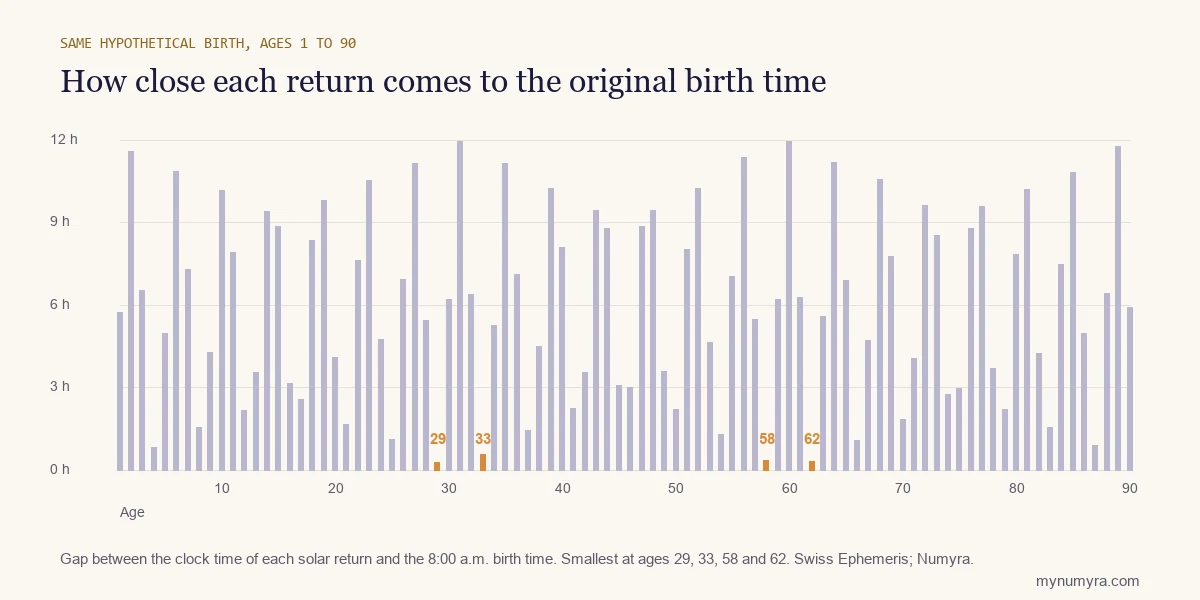
Because the return slides about six hours a year and resets every four, it rarely lands at your birth time. Every so often it comes close, and then the return chart has nearly the same Ascendant and houses as your natal chart. Some astrologers point to a 33-year cycle for this. For the hypothetical 1990 birth, the returns that came closest to 8:00 a.m. fell at ages 29 (16 minutes off), 33 (33 minutes), 58 (21 minutes) and 62 (19 minutes): pairs about 33 and 29 years apart, rather than one neat 33-year beat. The exact ages depend on your birth date and time.
Frequently asked questions
When is my solar return?
On your birthday, the day before or, less often, the day after, at the exact moment the Sun returns to its birth position. Among US births from 1994 to 2014, it fell on the birthday 57% of the time and the day before 36%.
Why is my solar return the day before my birthday?
Because the calendar and the Sun do not line up exactly. The return moves about six hours later each year and jumps back after each leap day, and it also drifts about 45 minutes earlier every four years, so later in life it falls on the day before more and more often.
Can a solar return fall two days before my birthday?
Rarely: 0.8% of returns in our check. It happens mostly late in life for people born shortly after midnight, when the six-hour yearly slide, the leap-day reset and the slow 45-minute drift all pull in the same direction.
Does my solar return change if I travel?
The moment stays the same, but the rising sign and houses depend on where you are. Most astrologers cast it for your location on the day, which is why some people travel for their birthday.
How long does a solar return last?
One year, from one return to the next. Many astrologers say its themes can be felt a little before the birthday, but it is read for the twelve months that follow.
Do I need my birth time for a solar return?
For the houses and rising sign, yes: one arcminute of the Sun’s motion is about 24 minutes of time. Without it you can still read the planets’ signs, but not where they fall in the chart.
What is the solar return Ascendant?
The rising sign of the chart cast for your solar return. It is read as the tone of the year ahead, and it changes almost every year.
Is a solar return the same as a birthday horoscope?
No. A birthday horoscope is usually written for everyone with your Sun sign. A solar return is calculated for your exact Sun position, time and place, so it is personal to you.
Sources
- Lilly, William. Christian Astrology. London, 1647. Chapter CLXXII, “Of Revolutions,” p. 734. Internet Archive scan of the first edition.
- Astrodienst. Swiss Ephemeris. Every return time, percentage and Ascendant on this page was calculated with it by the Numyra Methodology Desk.
- FiveThirtyEight. US births data, 1994–2014, from the CDC National Center for Health Statistics and the Social Security Administration, used to weight the simulation.