Leo Rising
Traditionally read as the warmest, most immediately noticeable first impression in the zodiac: confidence that arrives in the room before a word is spoken.
Key takeaways
- A natural stage presence: traditionally read as an ease in front of others that doesn't require trying.
- Warmth that puts people at ease quickly, often described as instantly likable or magnetic.
- A style that leans expressive: this Ascendant is traditionally read as dressing (and carrying itself) to be seen, even when the personality underneath is quieter.
- Generosity of attention: this placement is traditionally read as genuinely including people rather than just performing for them.
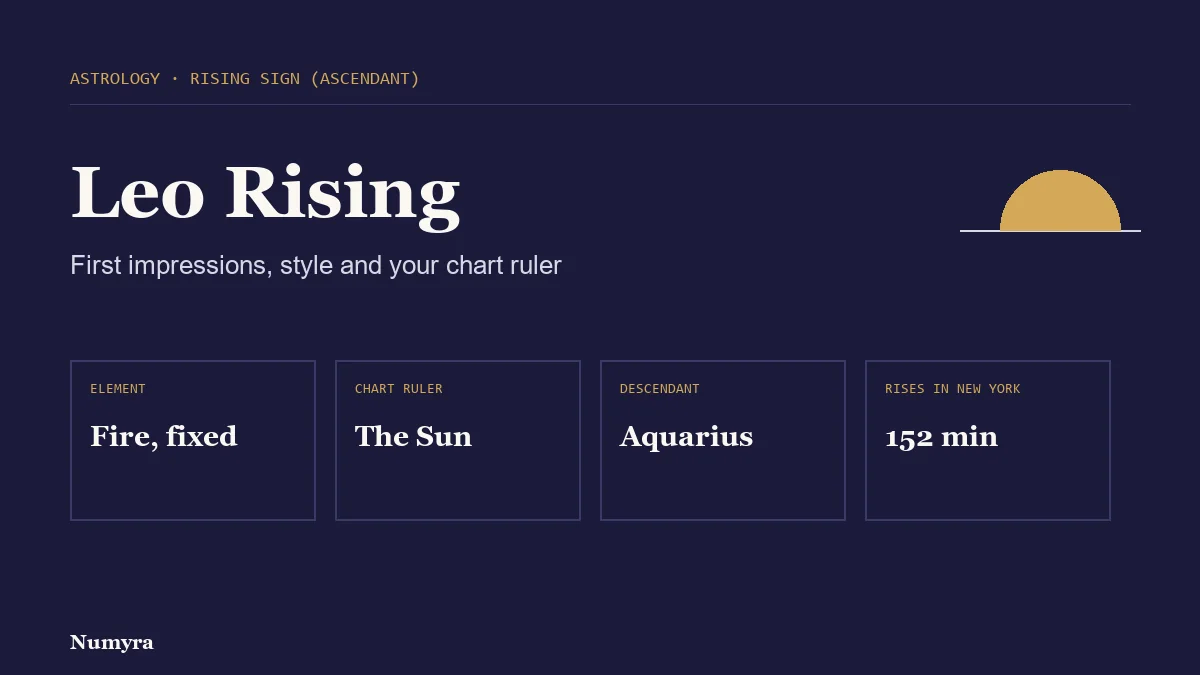
- Chart ruler: the Sun. Descendant: Aquarius. At New York's latitude Leo takes about 2 h 32 min to rise, 10.6% of the day.
- Nothing here is medical, financial, legal, or psychological advice. It is a cultural tradition, presented for reflection.
Leo rising at a glance
How this shows up in first impressions
Style tends toward bold and expressive: bright colors, statement pieces, or simply a way of carrying themselves that draws the eye without necessarily trying to.
Leo rising in relationships
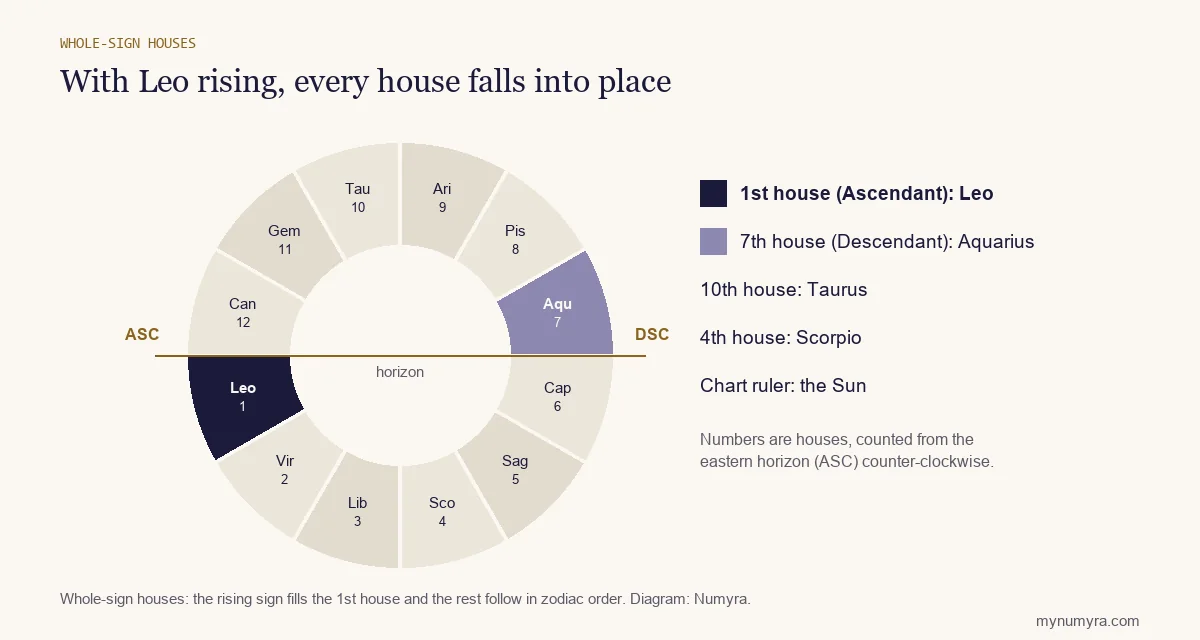
With Leo rising, Aquarius is on the Descendant. This warm, confident presence is traditionally read as drawn to partners who are independent, original and a little unconventional: people who are friends first. Relationships are read as where Leo rising learns to share the spotlight.
For how the Descendant and the houses work, see the guide to the astrological houses; to compare two charts see synastry and the composite chart.
Leo rising at work
At work and in interviews, Leo rising is read as confident and memorable, with natural presence in front of a group. It suits visible, leading roles. The traditional advice is to pair that presence with generosity toward the team, so confidence doesn't read as ego.
The traditional shadow side
The traditional shadow side is reading as more self-assured than is actually felt underneath, which can make it hard for others to notice when this Ascendant is actually struggling. The growth edge is letting the confident first impression include the honest, less polished moments too.
How common is Leo rising?
At New York's latitude Leo takes about 2 h 32 min, which puts it among the four slowest-rising signs. If births were spread evenly over the day, about 10.6% of people born there would have Leo rising.
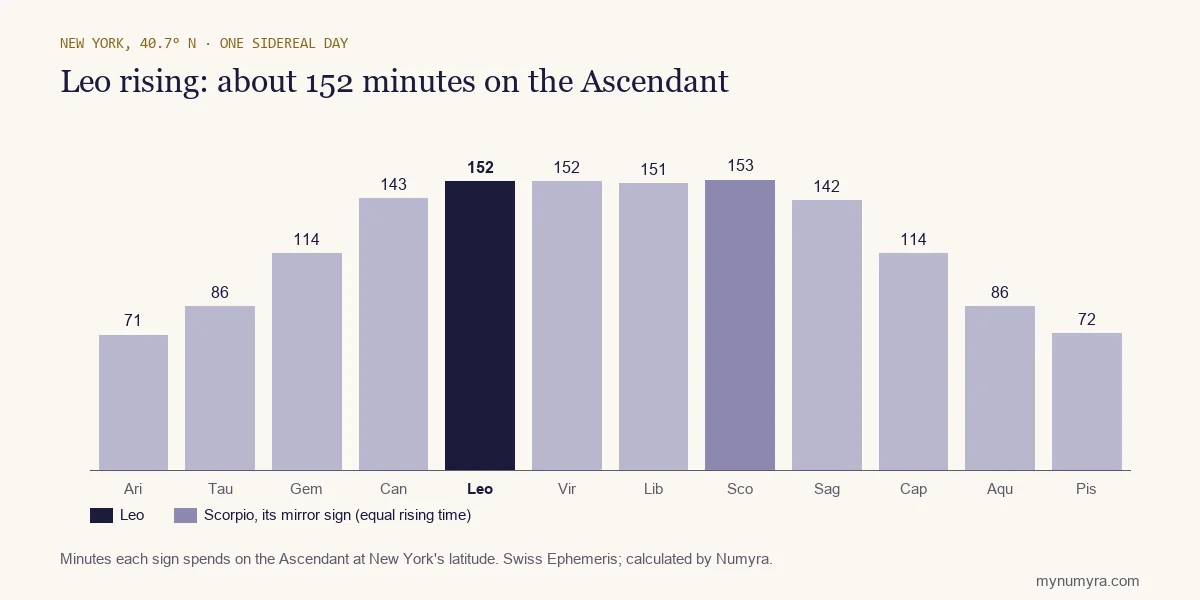
Leo and Scorpio mirror each other across the Aries–Libra axis and take almost the same time (152 and 153 minutes). Ptolemy's reason:
"because they ascend in equal periods of time and are on equal parallels"
Ptolemy, Tetrabiblos, Book I, chapter 14, trans. F. E. Robbins (1940)
When Leo rises in New York: the 15th of every month in 2027
Leo is one of the two longest-rising signs in New York, 2 h 32 min on the Ascendant, and it is ruled by the Sun. A window that long covers a good part of the morning or the evening, and because it comes about four minutes earlier each day it goes round the clock once a year. These are the Leo windows for the 15th of each month in 2027, in New York time with daylight saving applied.
| Date (2027) | Leo on the Ascendant | Against that day’s sunrise |
|---|---|---|
| Jan 15 | 5:11 pm to 7:43 pm | Opens 9 h 53 min after sunrise |
| Feb 15 | 3:09 pm to 5:41 pm | Opens 8 h 19 min after sunrise |
| Mar 15 | 2:19 pm to 4:51 pm | Opens 7 h 11 min after sunrise |
| Apr 15 | 12:17 pm to 2:49 pm | Opens 5 h 59 min after sunrise |
| May 15 | 10:19 am to 12:51 pm | Opens 4 h 40 min after sunrise |
| Jun 15 | 8:17 am to 10:50 am | Opens 2 h 53 min after sunrise |
| Jul 15 | 6:19 am to 8:52 am | Opens 41 min after sunrise |
| Aug 15 | 4:17 am to 6:50 am | Sunrise falls 1 h 49 min into the window |
| Sep 15 | 2:15 am to 4:48 am | Closes 1 h 49 min before sunrise |
| Oct 15 | 12:17 am to 2:50 am | Closes 4 h 17 min before sunrise |
| Nov 15 | 9:11 pm to 11:44 pm | Opens 14 h 28 min after sunrise |
| Dec 15 | 7:13 pm to 9:46 pm | Opens 12 h 00 min after sunrise |
Look at Aug 15, when Leo rises 4:17 am to 6:50 am and the sunrise is at 6:06 am: the Sun is in Leo, Leo is rising, and the Sun-ruled sign is on the horizon as the Sun itself appears. That is the double-Leo morning. In winter the window moves to the evening (Jan 15: 5:11 pm to 7:43 pm). On the equinox and solstice days Leo rises 1:59 pm to 4:32 pm (Mar 20), 7:53 am to 10:26 am (Jun 21), 1:44 am to 4:16 am (Sep 23) and 6:50 pm to 9:22 pm (Dec 21).
Leo rising in five US cities: minutes and birth-time margin
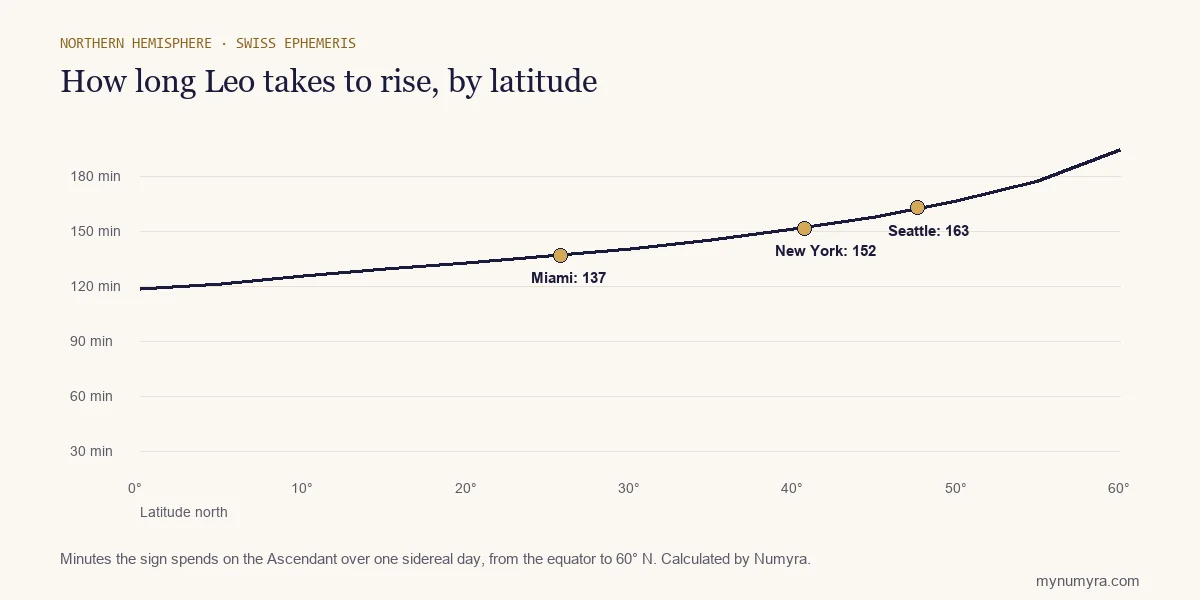
Leo lengthens the farther north you go: 138 minutes in Miami, 152 in New York, 163 in Seattle and 200 in Anchorage, which is more than three hours. Because it is a long window, errors in a birth time matter less than for the quick signs, and the table shows by how much.
| City (latitude) | Leo on the Ascendant | Share of the day | Sign changes at 15 min error | Sign changes at 30 min error |
|---|---|---|---|---|
| Miami (25.76° N) | 2 h 18 min | 9.6% | 22% | 44% |
| Houston (29.76° N) | 2 h 21 min | 9.8% | 21% | 43% |
| New York (40.71° N) | 2 h 32 min | 10.6% | 20% | 39% |
| Seattle (47.61° N) | 2 h 43 min | 11.3% | 18% | 37% |
| Anchorage (61.22° N) | 3 h 20 min | 13.9% | 15% | 30% |
| 26 largest US cities, population-weighted | 2 h 29 min | 10.4% |
A recorded time that is 15 minutes out gives a different sign for 20% of New York’s Leo risings and for 15% of Anchorage’s; at 30 minutes the figures are 39% and 30%. Weighting 26 large US cities by population and assuming even clock times, 10.4% of births would have Leo rising.
| Part of the sign | Minutes in New York |
|---|---|
| 0° to 5° of Leo | 25.2 min |
| 5° to 10° of Leo | 25.4 min |
| 10° to 15° of Leo | 25.5 min |
| 15° to 20° of Leo | 25.5 min |
| 20° to 25° of Leo | 25.5 min |
| 25° to 30° of Leo | 25.5 min |
In New York Leo climbs at a steady pace: the first 5° take 25.2 minutes and the last 5° take 25.5, about 5.1 minutes a degree. The Ascendant moves roughly 0.8° in 4 minutes, so a birth time that is 20 minutes out moves the rising degree by about 4°.
Your chart ruler: the Sun
With Leo rising the chart ruler is the Sun. Its sign and house are read as the key to the chart; see your Sun sign, and our stellium calculator lists every planet's sign.
What Lilly (1647) and Ptolemy wrote about Leo
In Lilly’s catalogue (1647) the Leo entry describes the Sun’s sign in vivid terms. Its first lines survive cleanly in the scan:
“Great round Head, big Eyes starting”
William Lilly, Christian Astrology (London, 1647), Book I, chapter XVI (scan; long s printed as s)
He goes on to speak of a full body, broad shoulders and a ruddy complexion. Modern astrologers do not read bodies this way, and Lilly himself blends the sign with the Moon’s and the ruler’s. Leo is the one sign that belongs to a single luminary, and Ptolemy’s reasoning is this:
“to the luminaries, as houses, Leo, which is masculine, to the sun and Cancer, feminine, to the moon”
Ptolemy, Tetrabiblos, Book I, chapter 17, trans. F. E. Robbins (1940)
Hence the chart ruler of a Leo rising is the Sun, whose own sign and house are read as the key. The Sun is also the planet whose position fixes the day’s sunrise, which is what the double-Leo window above is measured against.
Sun in Leo and Leo rising: the double window in New York
A double Leo is a Sun in Leo (Jul 22 to Aug 23 in 2027) with Leo rising, born close to sunrise. The rows below follow the New York window across the Sun’s month in Leo.
| Morning | Leo on the Ascendant | Sunrise | Window against sunrise |
|---|---|---|---|
| First day of the Sun in Leo (Jul 23) | 5:47 am to 8:20 am | 5:44 am | Opens 3 min after sunrise, closes 156 min after sunrise |
| Middle of the Sun in Leo (Aug 7) | 4:49 am to 7:21 am | 5:58 am | Opens 69 min before sunrise, closes 83 min after sunrise |
| Last day of the Sun in Leo (Aug 22) | 3:50 am to 6:22 am | 6:13 am | Opens 143 min before sunrise, closes 9 min after sunrise |
With a window of 2 h 32 min the double Leo has one of the widest bands of clock time of any sign. On Aug 22 it opens 143 minutes before sunrise, runs through the sunrise and closes 9 minutes after it; on Aug 7 the sunrise sits near the middle of the window.
Leo rising with each Sun sign
Find your Sun sign's row:
| Your Sun sign | How the pairing is traditionally read |
|---|---|
| Fire Sun Aries, Leo, Sagittarius | With a fire Sun (Aries, Leo, Sagittarius), Leo rising is read as warm, confident and hard to miss. The traditional caution is pride; the strength is natural leadership and generosity. |
| Earth Sun Taurus, Virgo, Capricorn | Earth Suns (Taurus, Virgo, Capricorn) with Leo rising are read as a confident, polished first impression over a practical, hardworking core. The presence is read as helping real competence get noticed. |
| Air Sun Gemini, Libra, Aquarius | Air Suns (Gemini, Libra, Aquarius) with Leo rising are read as sociable, expressive and charismatic. Aquarius Suns, opposite Leo, are read as a warm stage presence for unconventional ideas. |
| Water Sun Cancer, Scorpio, Pisces | A water Sun (Cancer, Scorpio, Pisces) with Leo rising is read as a bright, confident surface protecting a sensitive inner life. People may see strength first and only later the depth of feeling. |
Compare with Sun in Leo and Moon in Leo; the Sun, Moon and rising guide explains how the three fit together.
Frequently asked questions
How do I find my Rising sign?
You need your exact birth time and place. The Ascendant changes sign every 1 to 2¾ hours at US latitudes, so a rough time can leave it uncertain. Our Birth Chart calculator uses your date, time and place.
Is the Sun really the chart ruler of Leo rising?
In traditional astrology, yes: Leo is the Sun’s only house, so the Sun’s sign and house in your chart are the key to a Leo rising. Ptolemy gave Leo to the Sun because Leo and Cancer are the northernmost, hottest signs, which he assigned to the two luminaries.
What time on Aug 15, 2027 does Leo rise in New York?
4:17 am to 6:50 am, with sunrise at 6:06 am. The Sun is in Leo that month, so a baby born in that window is a double Leo. On Aug 7, the middle of the Sun’s stay, the window runs 4:49 am to 7:21 am.
How long does Leo take to rise in Anchorage?
200 minutes, over three hours, against 152 in New York and 138 in Miami. Long-ascension signs lengthen toward the pole, and Leo is among the longest.
Does Leo take longer to rise than Cancer in New York?
Yes: 152 minutes against 143. In the Southern Hemisphere the order flips and Leo is among the quick signs.
How big is the margin of error for a Leo birth time?
Large compared with the quick signs. In New York 20% of Leo risings would change sign with a 15-minute error and 39% with 30; in Aries the 15-minute figure is 42%.
What sets in the west as Leo rises?
Aquarius, the sign opposite. In New York Aquarius takes 86 minutes to rise and Leo 152.
Sources
- Lilly, William. Christian Astrology, Book I. London, 1647 (Internet Archive scan; long s printed as s). Cited for Leo rising: chapter XVI (the sign’s description).
- Ptolemy, Claudius. Tetrabiblos, Book I. Trans. F. E. Robbins (LacusCurtius, 1940). Cited for Leo rising: chapter 17 (why the Sun rules the sign).
- Astrodienst. Swiss Ephemeris. Used for the Leo windows on 12 dates, the 152-minute New York figure and the four other cities.
- US Naval Observatory, Rise/Set/Transit API. The 12 sunrise times in the Leo table were compared with the Observatory’s: identical to the minute.
- City populations used to weight the 26 cities in the last row of the cities table are rounded estimates of the largest US cities; they affect that row only.
- Numyra Methodology Desk. Astrology calculation standard.