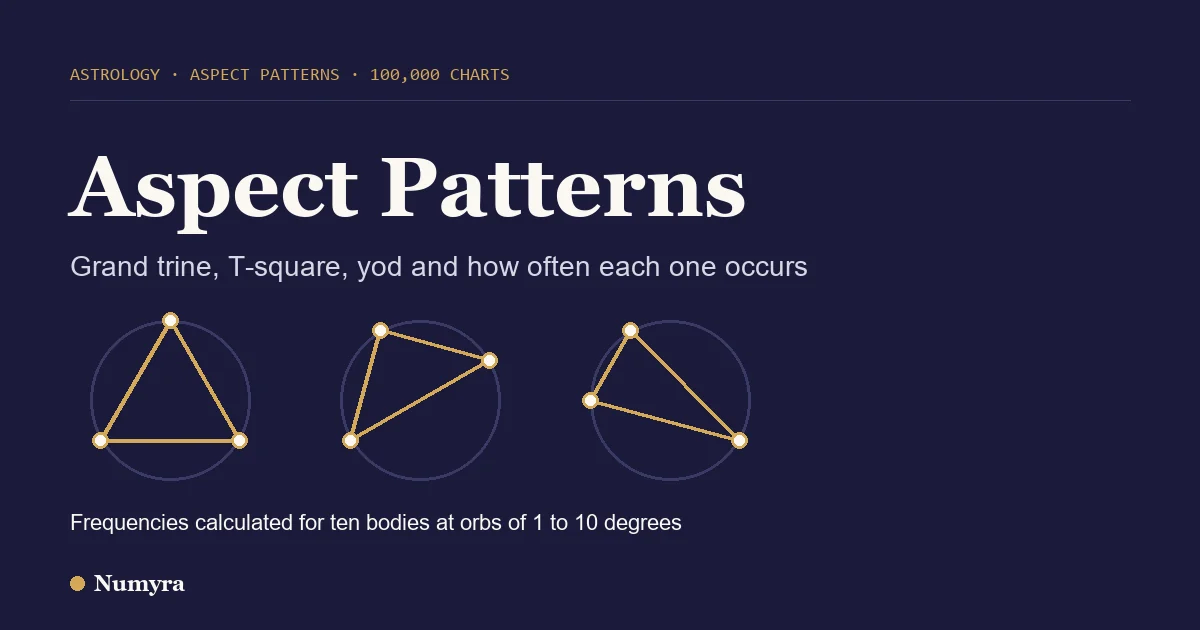
An aspect pattern is a shape made by three or more planets joined by aspects. A grand trine is three planets about 120 degrees apart, a T-square is two planets in opposition that both square a third, and a yod is two planets 60 degrees apart that both sit 150 degrees from a third. How often each one turns up depends mostly on the orb you allow, so we counted them. In 100,000 simulated charts built from US birth dates, with a 5-degree orb, 24% have a T-square, 23% a yod and 7% a grand trine, about 1 in 40 has a kite, about 1 in 100 has a grand cross or a mystic rectangle, and 46% have at least one of the six.
Key takeaways
- The six shapes people look for are the T-square, grand trine, yod, grand cross, kite and mystic rectangle. A stellium, a cluster of planets in one place, is a different kind of pattern and has its own guide.
- “Rare” depends on the orb. A yod is in 9.3% of charts at a 3-degree orb, 22.6% at 5 degrees and 45.4% at 8 degrees. One calculator page says 20 to 30% of charts have a yod and an encyclopedia-style page says under 10%; both fit our numbers at different orbs, and neither states its orb.
- Having a pattern is ordinary at generous orbs: at 5 degrees 54% of charts have none of the six, 36% have one kind and 10% have two or more; at 8 degrees three charts in four have at least one.
- Real skies make fewer patterns than random longitudes would (grand trines in 6.8% of charts, not 10.8%), because Mercury and Venus cannot stray far from the Sun and the slow planets move together. Births from 1994 to 2014 have more T-squares than the century average because Uranus and Pluto were in or near a square.
- The yod rests on a 150-degree angle that Ptolemy’s Tetrabiblos explicitly left out and that William Lilly, in 1647, still described as a recent addition by Kepler. Patterns are a tradition of interpretation, not a tested prediction.
In this guide
- What an aspect pattern is, and how we defined the six
- How astrologers read the six shapes
- How often each pattern occurs
- Why “rare” depends on the orb
- Real skies versus random ones
- T-squares: the apex and the modalities
- Grand trines and kites
- The yod and the angle Ptolemy left out
- Grand cross, mystic rectangle and grand sextile
- How to check your own chart
- What patterns cannot tell you
- Frequently asked questions
What an aspect pattern is, and how we defined the six
An aspect is the angle between two planets, measured around the zodiac: 60 degrees is a sextile, 90 a square, 120 a trine, 150 a quincunx and 180 an opposition. Our guide to synastry charts shows how orbs, the allowed distance from the exact angle, work for the main five. A pattern appears when several of these angles close into a shape. A widely used reference for the definitions describes the first of them like this:
“The T-square aspect pattern is formed when points in opposition also form a square with another point (or points).”
Cafe Astrology, Aspect Patterns
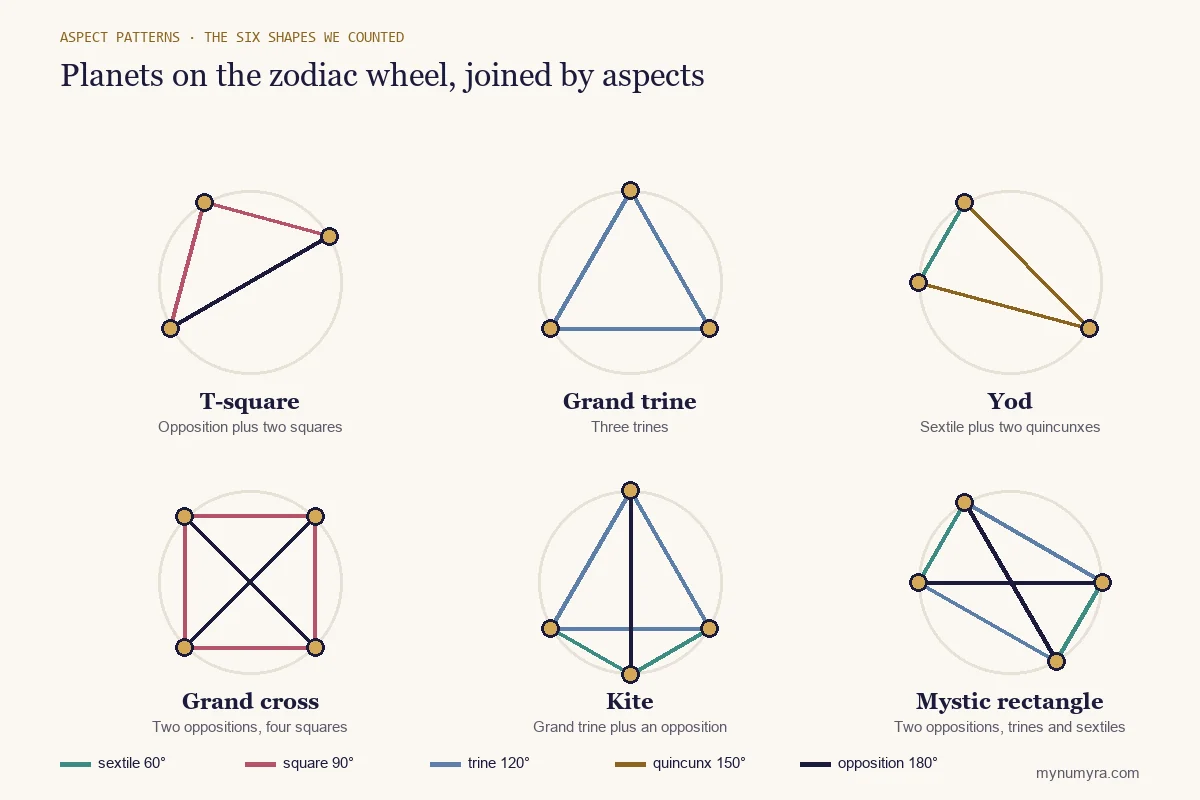
We used these definitions, which follow that reference and the usual textbook shapes. The planets are the Sun, Moon, Mercury, Venus, Mars, Jupiter, Saturn, Uranus, Neptune and Pluto; the lunar nodes, Chiron and the chart angles are left out.
| Pattern | Planets | Rule we counted |
|---|---|---|
| T-square | 3 | Two planets in opposition (180°); a third squares (90°) both. The third is the apex. |
| Grand trine | 3 | Three planets, every pair in trine (120°). We also count how many have all three in one element. |
| Yod | 3 | Two planets in sextile (60°); both in quincunx (150°) to a third, the apex. |
| Grand cross | 4 | Two oppositions with every neighbouring pair in square. |
| Kite | 4 | A grand trine plus a fourth planet opposite one of its planets and in sextile with the other two. |
| Mystic rectangle | 4 | Two oppositions joined by two trines and two sextiles. |
An angle counts when it is within the orb of exact, and one orb applies to every aspect in a run. At a 5-degree orb a trine is anything from 115 to 125 degrees. Orbs of 1 to 10 degrees were run; the tables use 2, 3, 5 and 8.
How astrologers read the six shapes
These are traditional and modern readings, not findings. Cafe Astrology’s pattern reference summarizes them as follows, here in our words.
- T-square. Tension that drives action. The apex planet is the focal point where the conflict is worked out, and the empty point opposite it, nicknamed a ghost leg, is treated as sensitive. By modality, cardinal T-squares are described as impatient and enterprising, fixed ones as persevering and stubborn, mutable ones as restless and adaptable.
- Grand trine. Ease, with talents that come so naturally that the person may not notice them. The same reference adds that too little challenge may leave them undeveloped.
- Kite. A grand trine with a fourth planet in opposition, read as adding the challenge or impetus the trine lacks.
- Yod. A need for perspective: a dilemma in which the two sextile planets find it hard to work with the apex.
- Grand cross. Four interlocking squares, read as a life of challenge with no single focal planet.
- Mystic rectangle. Two oppositions whose trines and sextiles are regarded as ways to release the tension.
None of these readings has been tested the way a calculation can be. What can be checked is how common each shape is, which the next sections do.
How often each pattern occurs
No guide we found gives a frequency with an orb and a method, so we calculated one. Method. We drew 100,000 birth moments. Each has a date drawn from real US daily birth counts for 1994 to 2014 (the CDC National Center for Health Statistics for 1994 to 2003 and the Social Security Administration for 2004 to 2014) and a clock time drawn uniformly across the day in a time zone weighted by population. We calculated the ten bodies with the Swiss Ephemeris (Moshier ephemeris, tropical zodiac) and tested every combination of planets against the definitions above. We checked the pattern detector against a separate brute-force program on 1,200 charts at orbs of 3, 5 and 8 degrees, and the counts matched exactly. The birth files have dates only, so clock times are random.
| Pattern | 2° orb | 3° orb | 5° orb | 8° orb | At 5°, about 1 chart in |
|---|---|---|---|---|---|
| T-square | 4.9% | 11.0% | 24.4% | 46.6% | 4 |
| Yod | 4.4% | 9.3% | 22.6% | 45.4% | 4 |
| Grand trine | 1.5% | 2.8% | 6.8% | 15.5% | 15 |
| Grand trine, all three in one element | 1.5% | 2.7% | 6.4% | 13.7% | 16 |
| Kite | 0.2% | 0.6% | 2.5% | 9.8% | 40 |
| Grand cross | 0.1% | 0.3% | 1.0% | 4.5% | 98 |
| Mystic rectangle | 0.05% | 0.2% | 1.1% | 6.3% | 95 |
| Grand sextile (six planets) | 0% | 0% | 0.01% | 0.03% | 10,000 |
| Any of the patterns above | 10.6% | 22.0% | 46.0% | 75.4% | 2 |
Share of 100,000 simulated charts with at least one of the pattern, US birth dates 1994 to 2014. Calculated by Numyra.
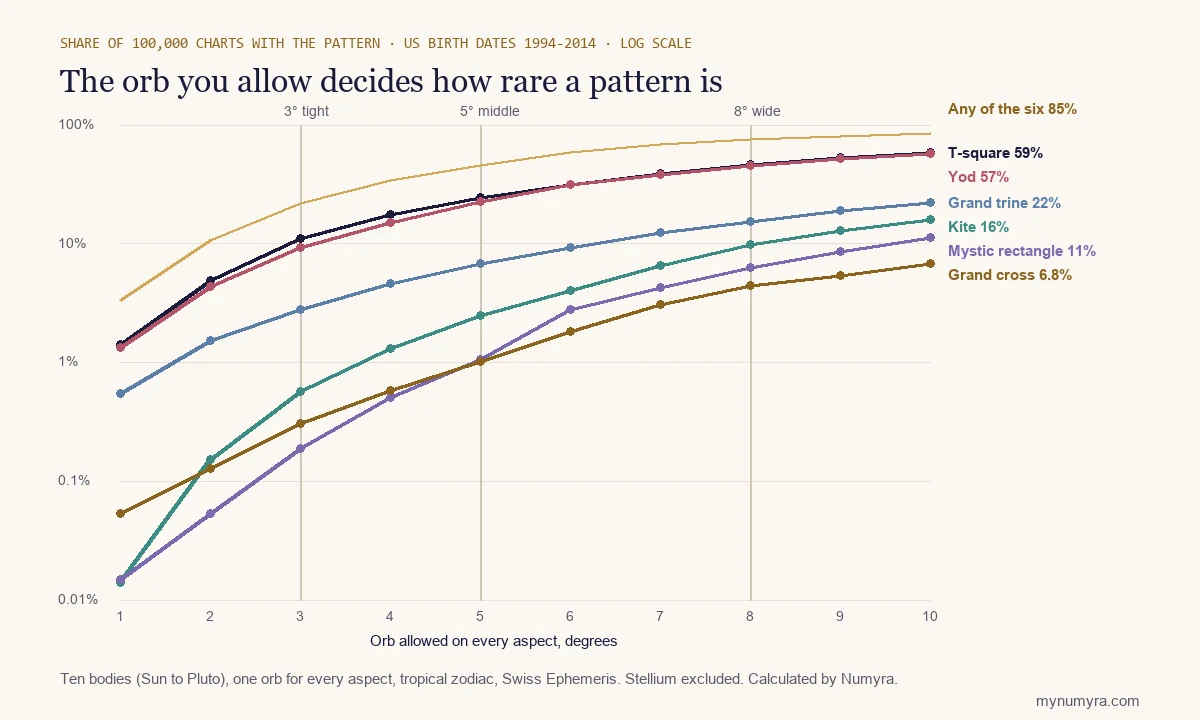
Three things stand out. The T-square and the yod are the common patterns and are almost equally common at every orb. The grand trine is about a quarter to a third as common. The four-planet shapes are the real rarities at tight orbs: at 3 degrees a kite is in 0.6% of charts, a grand cross in 0.3% and a mystic rectangle in 0.2%. The grand sextile, six planets in a hexagon, appeared in about 1 chart in 10,000 at 5 degrees and in 3 in 10,000 at 8 degrees.
Why “rare” depends on the orb
Published claims about how rare a yod is disagree. One yod calculator page says that approximately 20 to 30% of charts contain a yod; an encyclopedia-style page says under 10% of charts with tight orbs. Neither says which orb it used or how it counted. In our data both are right, at different orbs: 9.3% at 3 degrees, 22.6% at 5 and 45.4% at 8. The same applies to every pattern in the table, so a sentence such as “only 1 in 10 people have a grand trine” means nothing until it names the orb. The number of planets matters as much: with only the ten bodies we used, a chart tool that also counts the nodes, Chiron or the Ascendant will find more patterns.
It also changes how to read your own chart. At 5 degrees, 54% of charts have none of the six patterns, 36% have one kind, 8% two kinds and 2% three or more. At 3 degrees, 78% have none. At 8 degrees only 25% have none, and 12% have three or more kinds. A pattern at a generous orb is the middle of the distribution; one within 2 degrees is exceptional, because at a 2-degree orb only 11% of charts have any of the six.
Real skies versus random ones
If the ten planets sat at independent random points on the zodiac, a 5-degree orb would give grand trines in 10.8% of charts and at least one pattern in 54%. The real sky gives 6.8% and 46% for US births, and a century of dates gives 6.3% and 42%. We tested two causes. Mercury and Venus are tied to the Sun: in our charts Mercury was never more than 27.8 degrees from it and Venus never more than 47.2, so neither can form a sextile, square, trine or opposition with it, and no pattern can rely on such an angle between those bodies. Tying them to the Sun in an otherwise random chart takes “any pattern” from 54% to 47% and grand trines from 10.8% to 8.7%. The second cause is that the slow planets move together: shuffling the real positions of Jupiter to Pluto between charts, which breaks those links, raises the century figure from 42% to 45%.
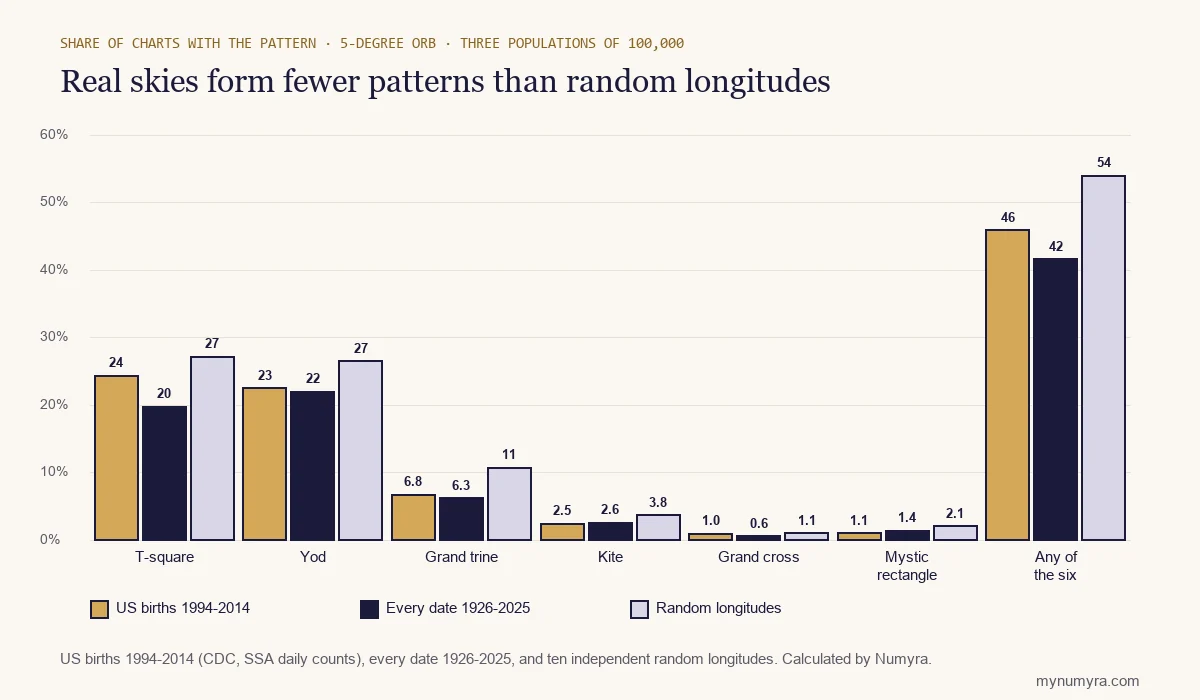
The second effect shows in the birth years. From 1994 to 2014 Uranus and Pluto were within 5 degrees of a square in 18.1% of births, against 9.1% across 1926 to 2025 and 5.7% for random longitudes; and any planet opposite either one completes a T-square. That is why US births have T-squares in 24.4% of charts and a century of dates in 19.8%. These are features of the 1994 to 2014 generation, not of astrology in general. Our guides to Uranus and Neptune signs and Pluto in Aquarius list the dates behind them.
T-squares: the apex and the modalities
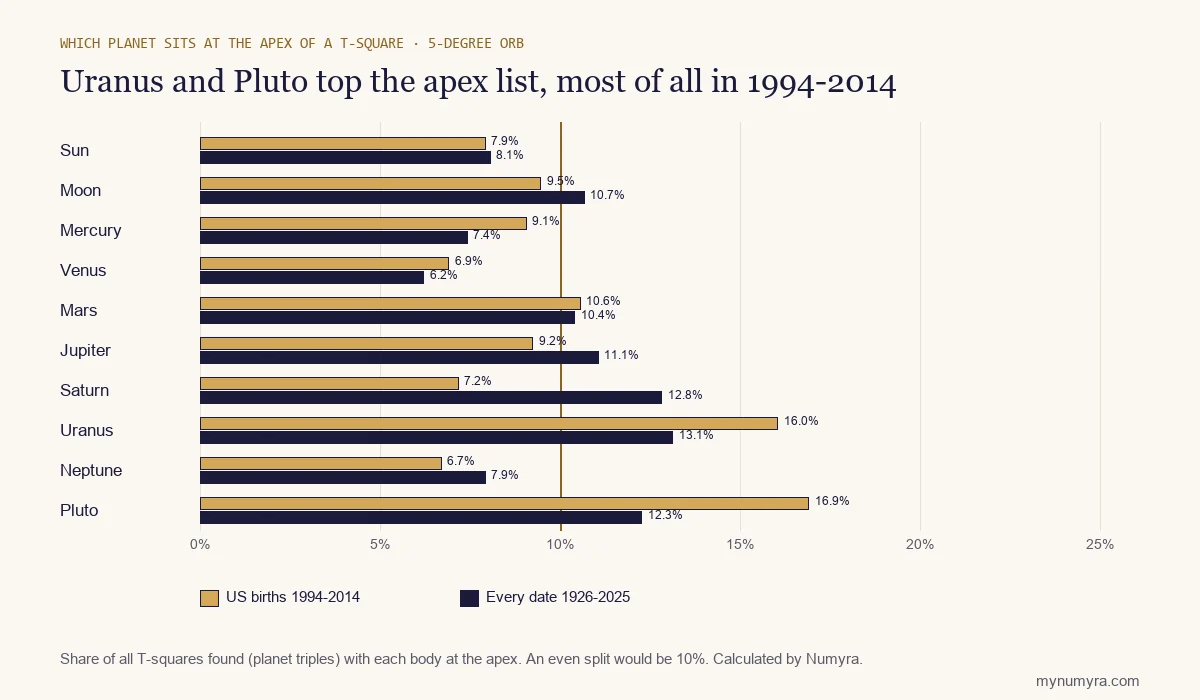
A T-square has a focal planet, the apex, that squares both ends of an opposition, and an empty point opposite the apex that astrologers also read. Which planet is the apex? An even split would give each body 10%. In US births at a 5-degree orb the apex is Pluto in 16.9% of T-squares and Uranus in 16.0%, against 6.7% for Neptune and 6.9% for Venus. Over a century the leaders are Uranus (13.1%), Saturn (12.8%) and Pluto (12.3%).
Tradition sorts T-squares by modality: cardinal, fixed or mutable, using the signs of the three planets (see our guide to the elements and modalities). In our run, 88% of T-squares at a 5-degree orb had all three planets in the same modality, so the three labels describe most of them; at 8 degrees it is 81%. A grand cross always contains four T-squares, and at 5 degrees 1.0% of charts have one.
Grand trines and kites
Because trines link signs four apart, a grand trine usually sits in one element, fire, earth, air or water. At a 5-degree orb 95% of grand trines are in a single element (6.4% of charts out of 6.8%); at 8 degrees 88%. The rest are “out of sign” grand trines, where a planet falls just across a sign boundary. Whether those count is a choice astrologers make, and it moves the figure by under a percentage point at 5 degrees.
A kite is a grand trine with a fourth planet opposite one corner. At a 5-degree orb 37% of grand trines have one, so the kite is a common upgrade of the trine rather than a separate rarity: 2.5% of charts against 6.8%. At tight orbs the share is lower, 21% at 3 degrees, and at 8 degrees it is 63%.
The yod and the angle Ptolemy left out
The yod uses the quincunx, 150 degrees, five signs apart. That angle has a short history that we could check. In the second century Ptolemy listed four aspects: opposition, trine, quartile and sextile. In the chapter on “disjunct” signs of his Tetrabiblos he put signs five apart outside them:
“those that are five signs apart divide the whole circle into unequal parts, while the other aspects make an equal division of the perimeter”
Ptolemy, Tetrabiblos, Book I, chapter 16, trans. F. E. Robbins (Loeb Classical Library, 1940), via LacusCurtius
Fifteen centuries later William Lilly’s Christian Astrology (1647) still treated five aspects as standard. In the introduction he says the astrologer rarely uses more, and then adds a short list of newer angles:
“to these of late one Kepler, a learned man, hath added some new ones”
William Lilly, Christian Astrology (London, 1647), “An Introduction to Astrologie”, p. 32, Internet Archive scan, transcribed from the page image
The list ends with the quincunx, 150 degrees, and Lilly adds only “I only acquaint you with these, that finding them any where you may apprehend their meaning.” Kepler’s book on the subject, Harmonice Mundi, appeared in 1619 (Wikipedia). So the angle that makes a yod was outside Ptolemy’s scheme and, to Lilly, a recent extra.
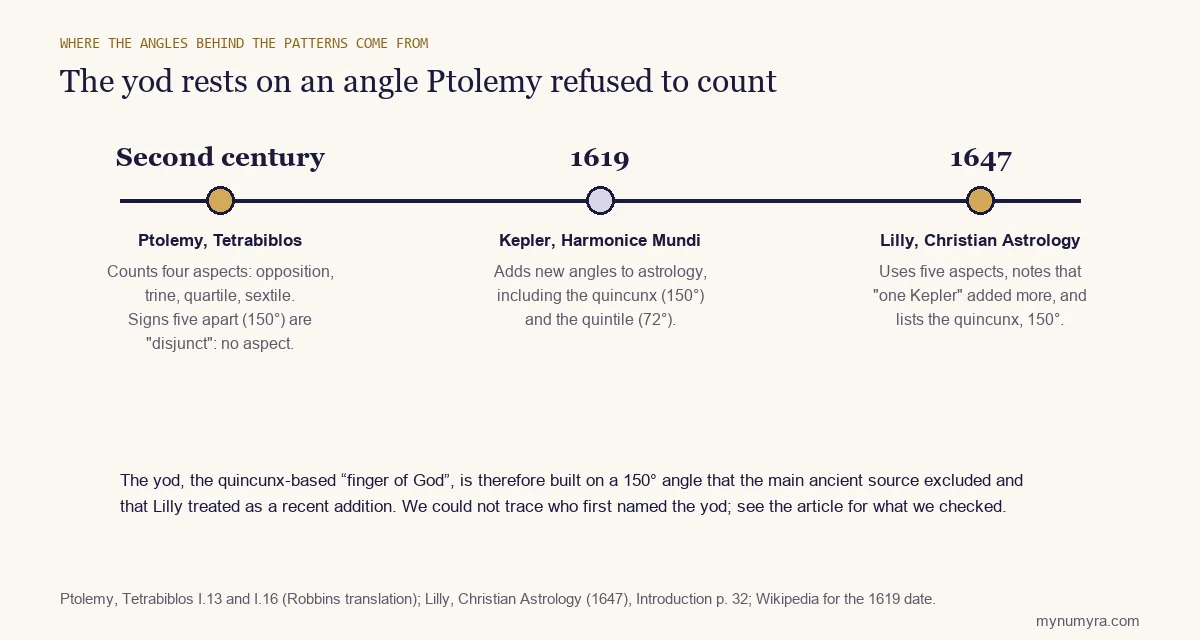
We could not verify who first called the arrangement a yod, who named the T-square or the kite, or when. The name is said to come from the tenth letter of the Hebrew alphabet, and the yod is also nicknamed the “finger of God”, but the sources we found give no first use, so we do not attribute the names to anyone. What can be said is that the angles are old and the names are modern. Our article on the Tetrabiblos and the guide to how sign compatibility works cover Ptolemy’s four aspects in more detail.
Grand cross, mystic rectangle and grand sextile
The grand cross is a square of four planets, two oppositions crossing; it is the T-square with its empty leg filled. At 3, 5 and 8 degrees it appears in 0.3%, 1.0% and 4.5% of charts. The mystic rectangle adds trines and sextiles to two oppositions and is in 0.2%, 1.1% and 6.3%. It needs four planets and three kinds of aspect at once, which is why it stays rare until the orb is wide. The grand sextile, the “star of David”, needs six planets and is the rarest of all. A stellium, three or more planets in one sign or house, is a clustering rather than a figure of angles; our stellium calculator checks it from a birth date.
How to check your own chart
- Get the degrees. You need each of the ten bodies’ longitude, not just its sign. Chart services such as Astrodienst, which publishes the Swiss Ephemeris, list the degree of every planet. Our birth chart calculator shows Sun, Moon and rising sign and tells you if a time is needed.
- Measure the angles. Subtract one planet’s longitude from another and take the shorter way round the circle, a number from 0 to 180.
- Pick one orb and keep it. If you allow 8 degrees for one pattern and 3 for another, the comparison with the tables above means nothing.
- Compare with the table. A yod at 3 degrees is in about 1 chart in 11; a yod at 8 degrees is in nearly half. Say which one you have.
What patterns cannot tell you
An aspect pattern is a geometric fact about ten bodies’ positions, and a fact about frequency. What it is said to mean is tradition. Astrology is a tradition of interpretation, not an established science, and a T-square or a grand trine does not predict events or fix anyone’s character. If at a generous orb about half the population has a “rare” pattern, the pattern cannot by itself make a person unusual. Use the shapes as a way to organize a reading, and give any one of them the weight its frequency suggests. This guide is educational information, not advice of any kind.
Frequently asked questions
What are the rarest aspect patterns?
Among the six shapes in this guide, the grand cross and the mystic rectangle at about 1% of charts at a 5-degree orb, and the kite at 2.5%. The grand sextile, with six planets, is rarer still at roughly 1 chart in 10,000. At tight orbs all of them are rarer.
How rare is a yod in a birth chart?
It depends on the orb. In 100,000 simulated charts with ten bodies, a yod appears in 9.3% at a 3-degree orb, 22.6% at 5 degrees and 45.4% at 8 degrees. At an exact-ish 1-degree orb it is 1.3%.
How rare is a grand trine?
2.8% of charts at a 3-degree orb, 6.8% at 5 degrees and 15.5% at 8 degrees. Requiring all three planets to be in the same element lowers these only slightly, to 2.7%, 6.4% and 13.7%.
Are T-squares rare?
No. They are the most common of the six: 11.0% of charts at 3 degrees, 24.4% at 5 degrees and 46.6% at 8 degrees. About one chart in four has one at a 5-degree orb.
What is the difference between a T-square and a grand cross?
A T-square has three planets: an opposition and a third planet squaring both ends. A grand cross has four planets, two oppositions with all four neighbouring pairs in square. Every grand cross contains four T-squares, and it is about 24 times less common at a 5-degree orb (1.0% against 24.4%).
What orb should I use for aspect patterns?
There is no standard, and sources differ. A practical rule is to use the same orb for every aspect, state it, and read tighter patterns as more definite. At 5 degrees about 46% of charts have a pattern; at 3 degrees 22%.
Does a kite count as a grand trine?
A kite contains a grand trine, so every kite chart also has a grand trine. At a 5-degree orb 37% of grand trines have a fourth planet opposite one corner that makes them a kite.
Is a stellium an aspect pattern?
It is usually listed with them, but it is defined by planets sharing a sign or house, not by angles between them. We cover it separately in our guide to the stellium.
Sources
- Ptolemy. Tetrabiblos, Book I, chapters 13 and 16, trans. F. E. Robbins (Loeb Classical Library, 1940), via LacusCurtius. The four aspects and the “disjunct” signs.
- William Lilly. Christian Astrology (London, 1647), Internet Archive scan; page 32 of “An Introduction to Astrologie”, transcribed by Numyra from the page image.
- Cafe Astrology. Aspect Patterns. Pattern definitions, used for the shapes we counted.
- Wikipedia. Astrological aspect. Kepler’s Harmonice Mundi, 1619.
- Astrodienst. Swiss Ephemeris. Planet positions for every simulated chart (calculations by the Numyra Methodology Desk).
- FiveThirtyEight. US births data, 1994 to 2014, from the CDC National Center for Health Statistics and the Social Security Administration. Dates only; clock times and time zones in our simulation are random.
- Yod Calculator Astrology (wizranktech.com) and Grokipedia, Yod (astrology). The two published frequency claims we tested; neither states an orb or a method.