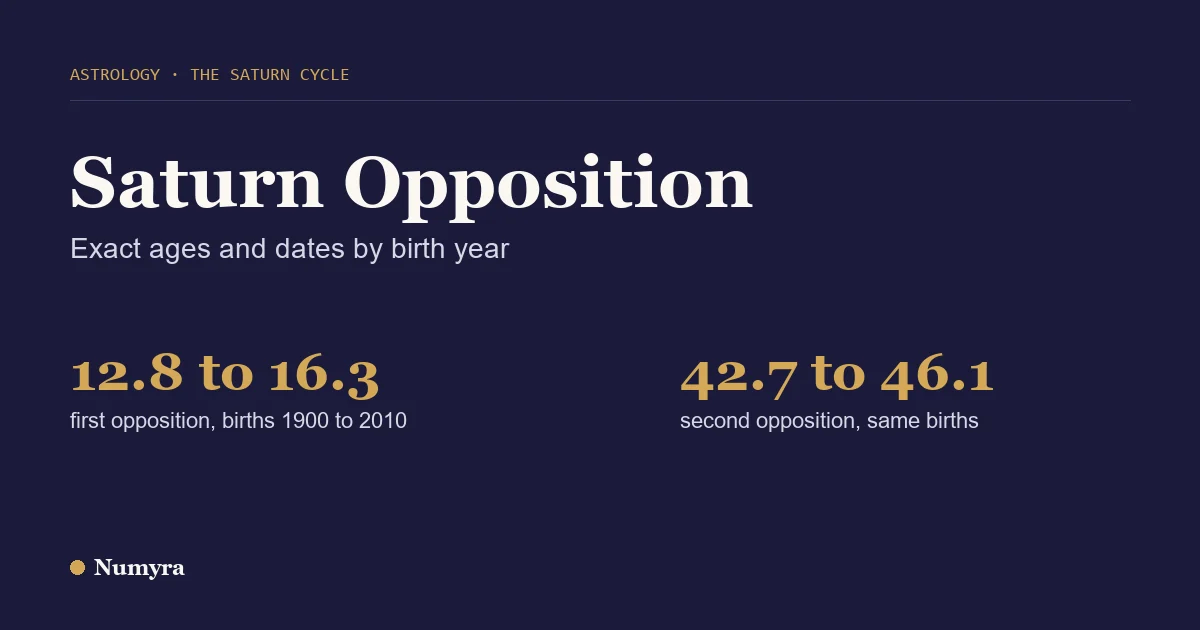
The Saturn opposition is the moment transiting Saturn reaches the point exactly opposite its position at your birth, and for every birth date from 1900 to 2010 the first one falls between ages 12.8 and 16.3 and the second between 42.7 and 46.1, not at a fixed 14 and 44. About half of all birth dates (54.1% for the first, 50.5% for the second) get three exact passes spread over a few months, because Saturn turns retrograde for about four and a half months each year. People born September 27, 2009 to October 12, 2013 have a first opposition between 2026 and 2028, and people born December 7, 1979 to August 27, 1984 have the second. Every age and date here is calculated for each birth date, and the other quarter points of the cycle (the squares at about 7 and 22, the return at about 29.5) are included so you can see where the opposition sits.
Key takeaways
- Saturn circles the zodiac in 29.447 years (NASA, sidereal), so the half-way point averages 14.7 years. Across 40,542 birth dates from 1900 to 2010 the first exact opposition falls between 12.8 and 16.3 (mean 14.5) and the second between 42.7 and 46.1 (mean 43.9).
- Whole-age shares: 41.5% of people meet their first opposition at 14 and 23.8% at 15 (25.3% at 13); the second comes at 43 for 37.0%, at 44 for 31.7%, at 42 for 18.2% and at 45 for 13.0%. Sources that say “14 and 44” are describing the middle of the range.
- The age follows where your natal Saturn sits: natal Saturn in Aries or Pisces gives the earliest opposition (mean 13.5 and 43.0) and Virgo or Libra the latest (mean 15.5 and 45.0).
- Three passes (direct, retrograde, direct) happen for 54.1% of first oppositions and 50.5% of second ones; the rest get one. In the 2026-2028 transit Saturn is in Aries: it is retrograde at about 10 degrees 31 minutes of Aries as of October 14, 2026 and turns direct at 7 degrees 56 minutes on December 10.
- Tradition reads the opposition as the half-way test of the Saturn cycle, about authority at 14 and about the results of a first adult structure at 44. That is interpretation, not a measured effect.
In this guide
- What age is the Saturn opposition?
- The eight quarter points of the Saturn cycle
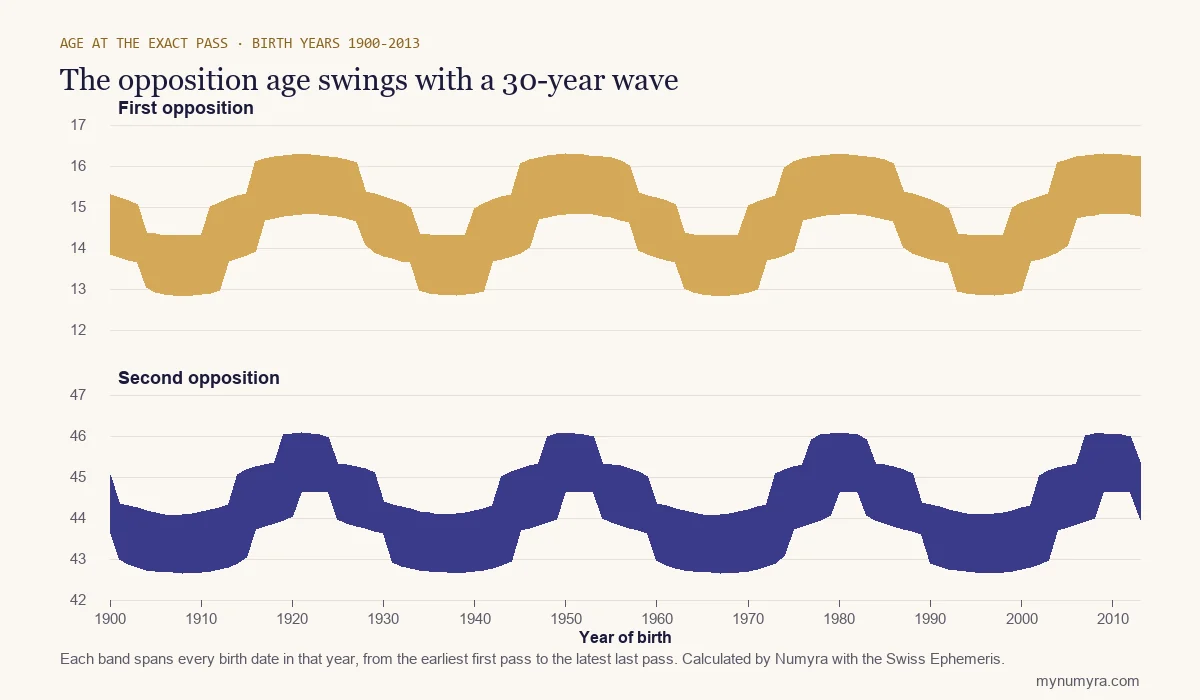
- Why the opposition age moves between 13 and 16
- Saturn opposition age by birth year, 1950 to 2012
- Three passes or one: how the retrograde works
- Who has a Saturn opposition from 2026 to 2028
- What astrologers say the Saturn opposition means
- How these numbers were calculated
- Frequently asked questions
What age is the Saturn opposition?
The Saturn opposition comes at about 14 to 15 and again at about 43 to 45. Saturn takes 10,755.699 days (29.447 years) to make one sidereal circuit in NASA’s Saturn Fact Sheet, so half a circuit is 14.7 years, and the opposition sits half-way between your birth and the first Saturn return. The usual round numbers disagree with each other: Chani gives 14 and 44, Nylon 14, 43 and 72, the Learn Astrology reference 14 to 15 and 43 to 44, and Augurine 13 to 16 and “early to middle forties”. None of these pages computes your age from your birth date, which is what this page does.

Calculating every birth date from January 1, 1900 to December 31, 2010, the first exact pass of the first opposition averages 14.5 and ranges from 12.8 to 16.3; the second opposition averages 43.9 and ranges from 42.7 to 45.4 at its first pass and up to 46.1 at its last. In completed years, 14 is the most common first-opposition age (41.5% of birth dates) and 43 the most common second (37.0%), but only about two people in five fit those exact numbers.
| Completed age at first exact pass | First opposition (share of birth dates) | Second opposition (share of birth dates) |
|---|---|---|
| 12 or 42 | 5.0% | 18.2% |
| 13 or 43 | 25.3% | 37.0% |
| 14 or 44 | 41.5% | 31.7% |
| 15 or 45 | 23.8% | 13.0% |
| 16 | 4.4% | none |
Each column is a share of 40,542 birth dates, and “completed age” means the age in whole years you had reached on the day of the exact pass: age 14 covers 14.0 to 14.99.
The eight quarter points of the Saturn cycle
Saturn moves 90 degrees about every 7.4 years, so its cycle against your natal Saturn has four quarter points in each 29.5 years: the opening (waxing) square at about 7, the opposition at about 14.5, the closing (waning) square at about 22, and the conjunction, the Saturn return, at about 29.5. Then the pattern repeats: the second opening square at about 36.5, the second opposition at about 44, the second closing square at about 51.5 and the second return at about 59. The table gives each one for the same 40,542 birth dates. “First pass” is the first time Saturn crosses the exact point and “last pass” the final crossing.
| Quarter point | Angle | First pass: ages (mean) | Last pass: ages (mean) | Births with three passes |
|---|---|---|---|---|
| 1. Opening square | 90° | 5.7 to 8.2 (7.2) | 6.4 to 8.9 (7.5) | 47.6% |
| 2. First opposition | 180° | 12.8 to 16.3 (14.5) | 13.6 to 16.3 (14.9) | 54.1% |
| 3. Closing square | 270° | 20.9 to 23.4 (21.8) | 20.9 to 23.5 (22.2) | 55.9% |
| 4. Saturn return | 360° | 28.4 to 29.9 (29.3) | 29.1 to 30.4 (29.5) | 37.9% |
| 5. Second opening square | 450° | 35.5 to 38.1 (36.5) | 35.5 to 38.1 (37.0) | 59.1% |
| 6. Second opposition | 540° | 42.7 to 45.4 (43.9) | 42.7 to 46.1 (44.3) | 50.5% |
| 7. Second closing square | 630° | 50.0 to 52.6 (51.2) | 50.1 to 52.6 (51.7) | 56.8% |
| 8. Second Saturn return | 720° | 58.2 to 59.0 (58.6) | 58.2 to 59.7 (59.0) | 58.9% |
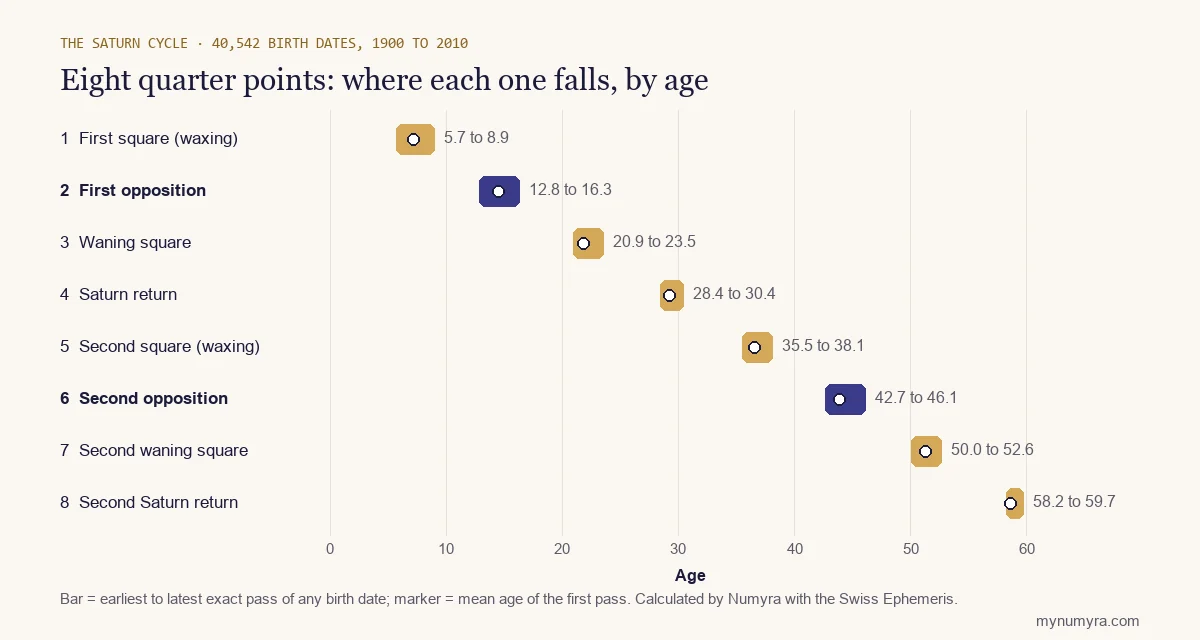
Two things stand out. The Saturn return has the narrowest age range of the eight (28.4 to 29.9 for the first pass), which is why “29” works as shorthand for it, while the opposition ranges over 3.5 years, so “14” and “44” are far looser. And the figure that people sometimes call the waning square at “36” is really the opening square of the second cycle: the closing square of the first cycle comes at about 22. Our Saturn return guide and Saturn return calculator cover the 29.5-year point itself; this page is about the opposition and the squares around it.
For scale, the oldest account on this page is William Lilly’s Christian Astrology (1647), which describes Saturn as
“slow in Motion, finishing his Course through the twelve Signes of the Zodiack in 29 yeers, 157 dayes, or thereabouts”
William Lilly, Christian Astrology (London, 1647), p. 57, Internet Archive scan, chapter VIII “Of the Planet Saturne”
That is 29.43 years, within six days of NASA’s modern 29 years and 163 days (29.447 years), so the cycle every astrologer has used for centuries is the real motion of the planet; what has been loose is the quoting of ages.
Why the opposition age moves between 13 and 16
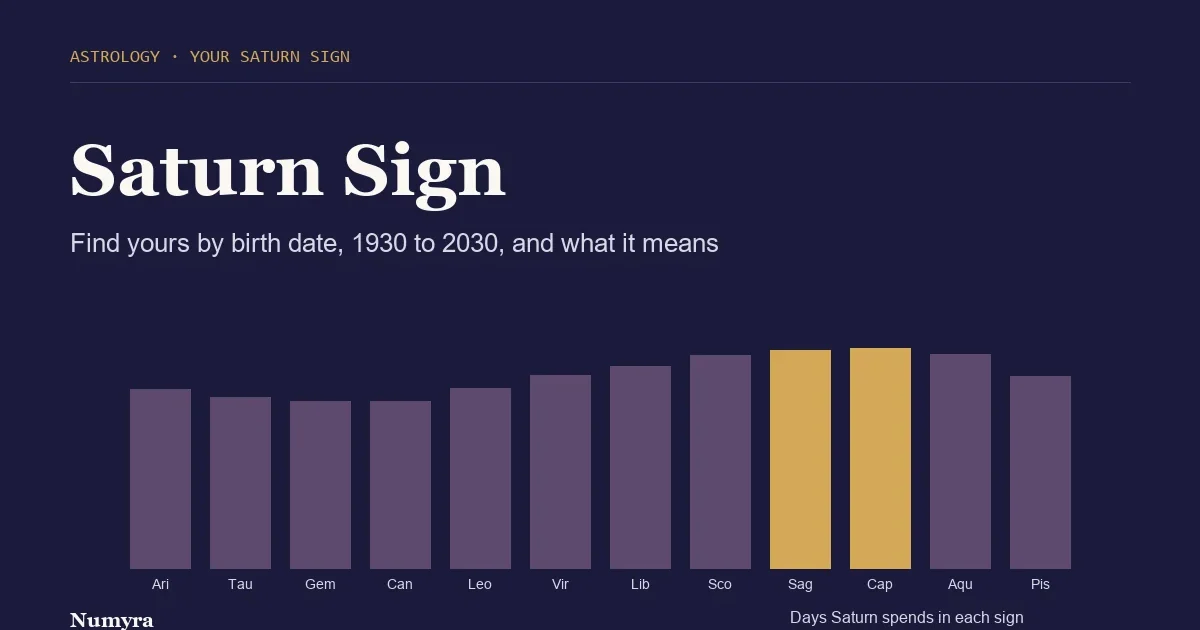
Saturn does not move at a constant speed. Its orbit is slightly elongated, with an eccentricity of 0.0520 (NASA): it is 1,357.554 million km from the Sun at its closest and 1,506.527 million km at its farthest, and its orbital speed varies from 9.14 to 10.14 km/s. A planet moves faster nearer the Sun, so Saturn crosses the stretch of zodiac around early Cancer (by our calculation its closest approaches were in 1974 and 2003, and the next is 2032) more quickly than the stretch around early Capricorn, where it was farthest in 1988 and 2018. A half-circuit that runs through the fast stretch arrives early, and one that runs through the slow stretch arrives late.
That is why the age depends on your natal Saturn sign. Natal Saturn in Aries has a half-orbit that crosses Cancer, so the opposition arrives at a mean of 13.5. Natal Saturn in Libra has a half-orbit through Capricorn, so it arrives at a mean of 15.5. The table shows the mean first-pass age, with the earliest and latest, for each natal sign among the 40,542 birth dates; you can look up your own sign in our Saturn sign guide.
| Natal Saturn in | Birth dates | First opposition: mean (range) | Second opposition: mean (range) |
|---|---|---|---|
| Aries | 3,425 | 13.5 (12.8 to 14.3) | 43.0 (42.7 to 43.4) |
| Taurus | 3,397 | 13.8 (12.9 to 14.4) | 43.1 (42.7 to 44.2) |
| Gemini | 3,266 | 14.2 (13.7 to 15.2) | 43.7 (42.8 to 44.4) |
| Cancer | 3,193 | 14.8 (13.8 to 15.4) | 44.1 (43.6 to 45.2) |
| Leo | 3,296 | 15.1 (14.7 to 16.2) | 44.6 (43.8 to 45.3) |
| Virgo | 3,411 | 15.4 (14.8 to 16.3) | 44.9 (44.0 to 45.4) |
| Libra | 3,103 | 15.5 (14.8 to 16.3) | 45.0 (44.1 to 45.4) |
| Scorpio | 2,855 | 15.2 (14.7 to 16.2) | 44.7 (43.8 to 45.4) |
| Sagittarius | 3,066 | 14.8 (13.9 to 15.4) | 44.2 (43.7 to 45.3) |
| Capricorn | 3,997 | 14.3 (13.7 to 15.3) | 43.8 (42.8 to 44.4) |
| Aquarius | 3,894 | 13.9 (12.9 to 14.4) | 43.2 (42.7 to 44.3) |
| Pisces | 3,639 | 13.6 (12.8 to 14.3) | 43.0 (42.7 to 43.4) |
Saturn opposition age by birth year, 1950 to 2012
Each row covers every birth date in that calendar year. The ages run from the earliest first pass to the latest last pass in that year, so an early-January birthday sits near the low end and a late-December one near the high end, and “years” are the calendar years in which the passes happen. For births from 1990 on the second opposition is still in the future and the figures are projections from the same calculation.
| Born | Natal Saturn in | First opposition: age | Years | Second opposition: age | Years |
|---|---|---|---|---|---|
| 1950 | Virgo, Libra | 14.8 to 16.3 | 1965 to 1967 | 44.6 to 46.1 | 1995 to 1997 |
| 1951 | Virgo, Libra | 14.8 to 16.3 | 1966 to 1968 | 44.6 to 46.1 | 1996 to 1998 |
| 1952 | Libra | 14.8 to 16.3 | 1967 to 1969 | 44.6 to 46.0 | 1997 to 1998 |
| 1953 | Libra, Scorpio | 14.8 to 16.2 | 1968 to 1970 | 44.6 to 46.0 | 1998 to 1999 |
| 1954 | Scorpio | 14.8 to 16.2 | 1969 to 1971 | 44.0 to 45.3 | 1998 to 2000 |
| 1955 | Scorpio | 14.7 to 16.2 | 1970 to 1971 | 43.9 to 45.3 | 1999 to 2001 |
| 1956 | Scorpio, Sagittarius | 14.7 to 16.1 | 1971 to 1972 | 43.8 to 45.3 | 2000 to 2002 |
| 1957 | Sagittarius | 14.6 to 16.0 | 1972 to 1973 | 43.8 to 45.2 | 2001 to 2002 |
| 1958 | Sagittarius | 13.9 to 15.4 | 1972 to 1974 | 43.7 to 45.1 | 2002 to 2003 |
| 1959 | Sagittarius, Capricorn | 13.8 to 15.3 | 1973 to 1974 | 43.6 to 45.0 | 2003 to 2004 |
| 1960 | Capricorn | 13.8 to 15.2 | 1974 to 1975 | 43.0 to 44.4 | 2003 to 2004 |
| 1961 | Capricorn | 13.7 to 15.1 | 1975 to 1976 | 42.8 to 44.3 | 2004 to 2005 |
| 1962 | Capricorn, Aquarius | 13.6 to 15.0 | 1975 to 1977 | 42.8 to 44.2 | 2005 to 2006 |
| 1963 | Aquarius | 13.0 to 14.4 | 1976 to 1977 | 42.7 to 44.2 | 2005 to 2007 |
| 1964 | Aquarius, Pisces | 12.9 to 14.3 | 1977 to 1978 | 42.7 to 44.1 | 2006 to 2008 |
| 1965 | Pisces | 12.9 to 14.3 | 1978 to 1979 | 42.7 to 44.1 | 2007 to 2009 |
| 1966 | Pisces | 12.9 to 14.3 | 1978 to 1980 | 42.7 to 44.1 | 2008 to 2010 |
| 1967 | Aries, Pisces | 12.8 to 14.3 | 1979 to 1981 | 42.7 to 44.1 | 2009 to 2011 |
| 1968 | Aries | 12.8 to 14.3 | 1980 to 1982 | 42.7 to 44.1 | 2010 to 2012 |
| 1969 | Aries, Taurus | 12.9 to 14.3 | 1981 to 1983 | 42.7 to 44.2 | 2011 to 2013 |
| 1970 | Taurus | 12.9 to 15.0 | 1982 to 1985 | 42.7 to 44.2 | 2012 to 2014 |
| 1971 | Taurus, Gemini | 13.0 to 15.1 | 1984 to 1986 | 42.7 to 44.3 | 2013 to 2015 |
| 1972 | Taurus, Gemini | 13.7 to 15.2 | 1985 to 1987 | 42.8 to 44.3 | 2014 to 2016 |
| 1973 | Gemini, Cancer | 13.8 to 15.3 | 1986 to 1988 | 42.9 to 45.1 | 2016 to 2018 |
| 1974 | Gemini, Cancer | 13.8 to 16.0 | 1988 to 1990 | 43.1 to 45.2 | 2017 to 2019 |
| 1975 | Cancer, Leo | 13.9 to 16.1 | 1989 to 1991 | 43.7 to 45.3 | 2019 to 2021 |
| 1976 | Cancer, Leo | 14.7 to 16.2 | 1991 to 1993 | 43.8 to 45.3 | 2020 to 2022 |
| 1977 | Leo, Virgo | 14.7 to 16.2 | 1992 to 1994 | 43.9 to 45.9 | 2021 to 2023 |
| 1978 | Leo, Virgo | 14.8 to 16.3 | 1993 to 1995 | 43.9 to 46.0 | 2022 to 2024 |
| 1979 | Virgo | 14.8 to 16.3 | 1994 to 1996 | 44.1 to 46.1 | 2023 to 2026 |
| 1980 | Virgo, Libra | 14.8 to 16.3 | 1995 to 1997 | 44.7 to 46.1 | 2025 to 2027 |
| 1981 | Libra | 14.8 to 16.3 | 1996 to 1998 | 44.7 to 46.1 | 2026 to 2028 |
| 1982 | Libra, Scorpio | 14.8 to 16.3 | 1997 to 1999 | 44.6 to 46.0 | 2027 to 2028 |
| 1983 | Libra, Scorpio | 14.8 to 16.2 | 1998 to 2000 | 44.1 to 45.9 | 2027 to 2029 |
| 1984 | Scorpio | 14.7 to 16.2 | 1999 to 2001 | 43.9 to 45.3 | 2028 to 2030 |
| 1985 | Scorpio, Sagittarius | 14.7 to 16.2 | 2000 to 2001 | 43.9 to 45.3 | 2029 to 2031 |
| 1986 | Sagittarius | 14.6 to 16.1 | 2001 to 2002 | 43.8 to 45.3 | 2030 to 2031 |
| 1987 | Sagittarius | 14.0 to 15.4 | 2001 to 2003 | 43.7 to 45.2 | 2031 to 2032 |
| 1988 | Sagittarius, Capricorn | 13.9 to 15.3 | 2002 to 2003 | 43.7 to 45.1 | 2032 to 2033 |
| 1989 | Capricorn | 13.8 to 15.3 | 2003 to 2004 | 43.6 to 44.4 | 2032 to 2034 |
| 1990 | Capricorn | 13.7 to 15.2 | 2004 to 2005 | 42.9 to 44.3 | 2033 to 2034 |
| 1991 | Capricorn, Aquarius | 13.7 to 15.1 | 2004 to 2006 | 42.8 to 44.3 | 2034 to 2035 |
| 1992 | Aquarius | 13.6 to 15.0 | 2005 to 2007 | 42.8 to 44.2 | 2035 to 2036 |
| 1993 | Aquarius, Pisces | 13.0 to 14.4 | 2006 to 2007 | 42.7 to 44.2 | 2035 to 2037 |
| 1994 | Aquarius, Pisces | 12.9 to 14.3 | 2007 to 2008 | 42.7 to 44.1 | 2036 to 2038 |
| 1995 | Pisces | 12.9 to 14.3 | 2007 to 2009 | 42.7 to 44.1 | 2037 to 2039 |
| 1996 | Aries, Pisces | 12.9 to 14.3 | 2008 to 2010 | 42.7 to 44.1 | 2038 to 2040 |
| 1997 | Aries | 12.8 to 14.3 | 2009 to 2011 | 42.7 to 44.1 | 2039 to 2041 |
| 1998 | Aries, Taurus | 12.9 to 14.3 | 2010 to 2012 | 42.7 to 44.1 | 2040 to 2042 |
| 1999 | Aries, Taurus | 12.9 to 15.0 | 2011 to 2014 | 42.7 to 44.2 | 2041 to 2043 |
| 2000 | Taurus, Gemini | 13.0 to 15.1 | 2013 to 2015 | 42.7 to 44.2 | 2042 to 2044 |
| 2001 | Taurus, Gemini | 13.7 to 15.2 | 2014 to 2016 | 42.8 to 44.3 | 2043 to 2045 |
| 2002 | Gemini | 13.7 to 15.3 | 2015 to 2017 | 42.9 to 45.0 | 2045 to 2047 |
| 2003 | Gemini, Cancer | 13.8 to 15.3 | 2017 to 2019 | 43.0 to 45.1 | 2046 to 2048 |
| 2004 | Cancer | 13.9 to 16.1 | 2018 to 2020 | 43.7 to 45.2 | 2047 to 2049 |
| 2005 | Cancer, Leo | 14.1 to 16.2 | 2019 to 2021 | 43.8 to 45.3 | 2049 to 2051 |
| 2006 | Leo | 14.7 to 16.2 | 2021 to 2023 | 43.8 to 45.3 | 2050 to 2052 |
| 2007 | Leo, Virgo | 14.8 to 16.3 | 2022 to 2024 | 43.9 to 46.0 | 2051 to 2053 |
| 2008 | Virgo | 14.8 to 16.3 | 2023 to 2025 | 44.0 to 46.1 | 2052 to 2055 |
| 2009 | Virgo, Libra | 14.8 to 16.3 | 2024 to 2026 | 44.6 to 46.1 | 2054 to 2056 |
| 2010 | Virgo, Libra | 14.8 to 16.3 | 2025 to 2027 | 44.6 to 46.0 | 2055 to 2057 |
| 2011 | Libra | 14.8 to 16.3 | 2026 to 2028 | 44.6 to 46.0 | 2056 to 2057 |
| 2012 | Libra, Scorpio | 14.8 to 16.2 | 2027 to 2029 | 44.6 to 46.0 | 2057 to 2058 |
The pattern repeats every 29 to 30 years: births in 1951 and 1980 have almost the same ages, because Saturn is in nearly the same part of its orbit. For the 85.4 million US births from 1994 to 2014 (CDC and Social Security Administration data, see below), the first opposition averages 14.6 when weighted by births.
Three passes or one: how the retrograde works
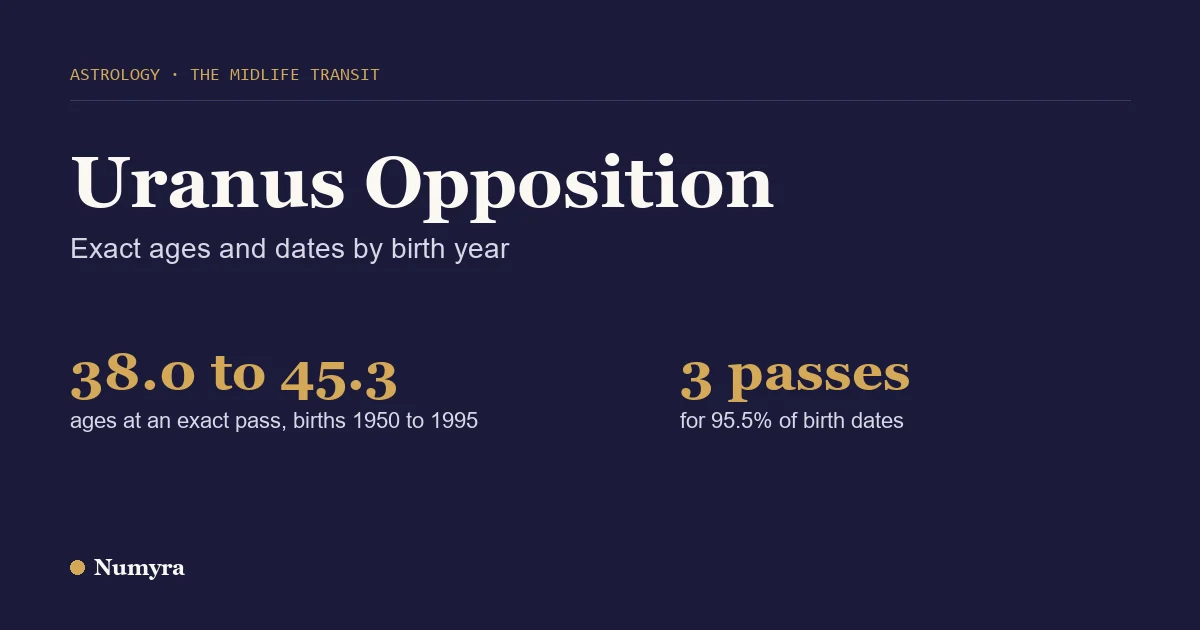
Seen from Earth, Saturn appears to move backward for about four and a half months every year, as Earth overtakes it (the same effect behind Mercury retrograde, only slower). The synodic period, the interval between one retrograde and the next, is 378.09 days. If your opposite point lies in the stretch of sky Saturn covers during that loop, the planet crosses it going forward, backward and forward again. Unlike the Uranus opposition, where 95.5% of dates get three passes (see the Uranus opposition guide), for Saturn it is close to a coin flip: 54.1% of first oppositions get three passes and 45.9% get one, and the second opposition splits 50.5% and 49.5%. No birth date gets two.
The three passes of one chart span on average 0.39 years (first oppositions) and 0.36 years (second) from first to last, and never more than 0.75 years. For someone born July 1, 2012 they fall on May 20, November 8, 2027 and February 6, 2028, and for someone born October 1, 1982 on May 22, November 4, 2027 and February 10, 2028 (the second opposition, at age 44 to 45).
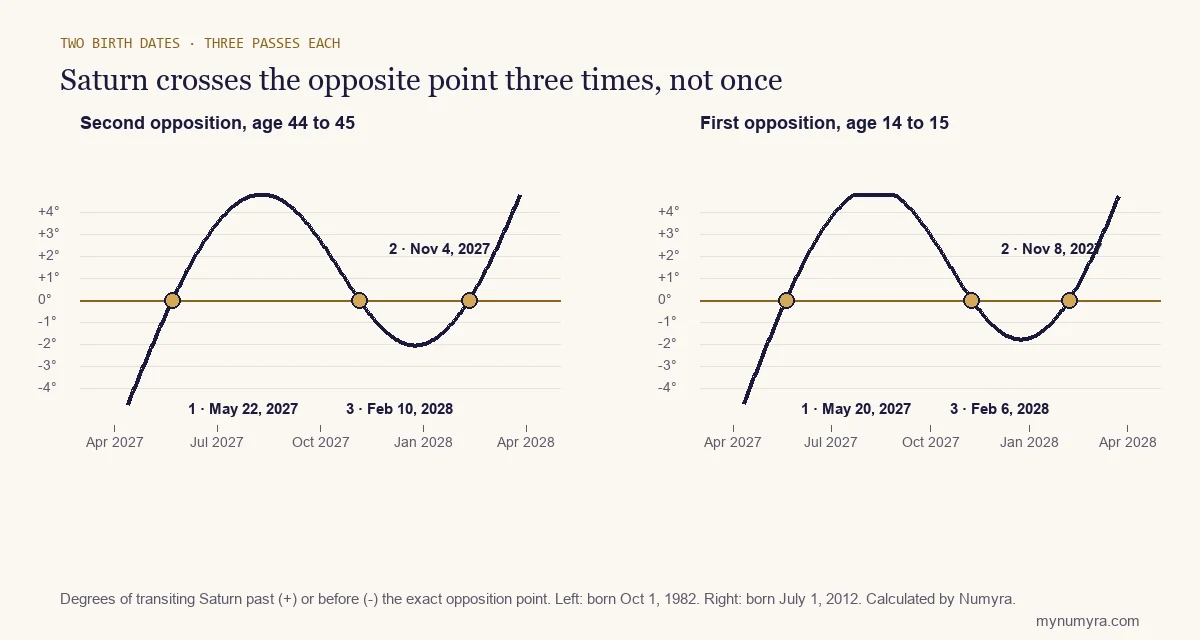
How long the transit lasts depends on how much margin you allow. Counting from the first entry to the last exit, Saturn stays within 1 degree of the exact opposite point for 0.54 years on average (about 6.5 months), within 3 degrees for 0.87 years and within 5 degrees for 1.20 years, and the second opposition gives nearly the same figures (0.52, 0.87 and 1.22 years). Astrologers who say the opposition lasts “a year or so” are describing roughly the 3-degree to 5-degree figures, and the nine-month stay at 1 degree explains why the felt period is so much longer than a single date.
Who has a Saturn opposition from 2026 to 2028
Saturn entered Aries for good at 7:11 p.m. EST on February 13, 2026 and leaves for Taurus at 11:40 p.m. EDT on April 12, 2028, so the planet doing the opposing is in Pisces and Aries and the natal planets being opposed are in Virgo, Libra and Scorpio. The first opposition and the second now fall on natal Saturn at almost the same degrees, because Saturn was in Libra for both the 1980-83 and the 2009-12 births, 29.5 years apart. The table lists, for each calendar year, the birth dates that have at least one exact pass in that year.
| Year | First opposition: born between | Second opposition: born between | Transiting Saturn covers | Natal Saturn opposed (about) |
|---|---|---|---|---|
| 2026 | Sep 27, 2009 and Aug 27, 2011 | Dec 7, 1979 and Oct 21, 1981 | 26°12′ Pisces to 14°45′ Aries | 26°12′ Virgo to 14°43′ Libra |
| 2027 | Oct 6, 2010 and Sep 16, 2012 | Dec 9, 1980 and Jul 14, 1983 | 8°21′ to 27°53′ Aries | 8°25′ to 27°51′ Libra |
| 2028 | Oct 21, 2011 and Oct 12, 2013 | Dec 26, 1981 and Aug 27, 1984 | 21°05′ Aries to 11°19′ Taurus | 21°07′ Libra to 11°19′ Scorpio |
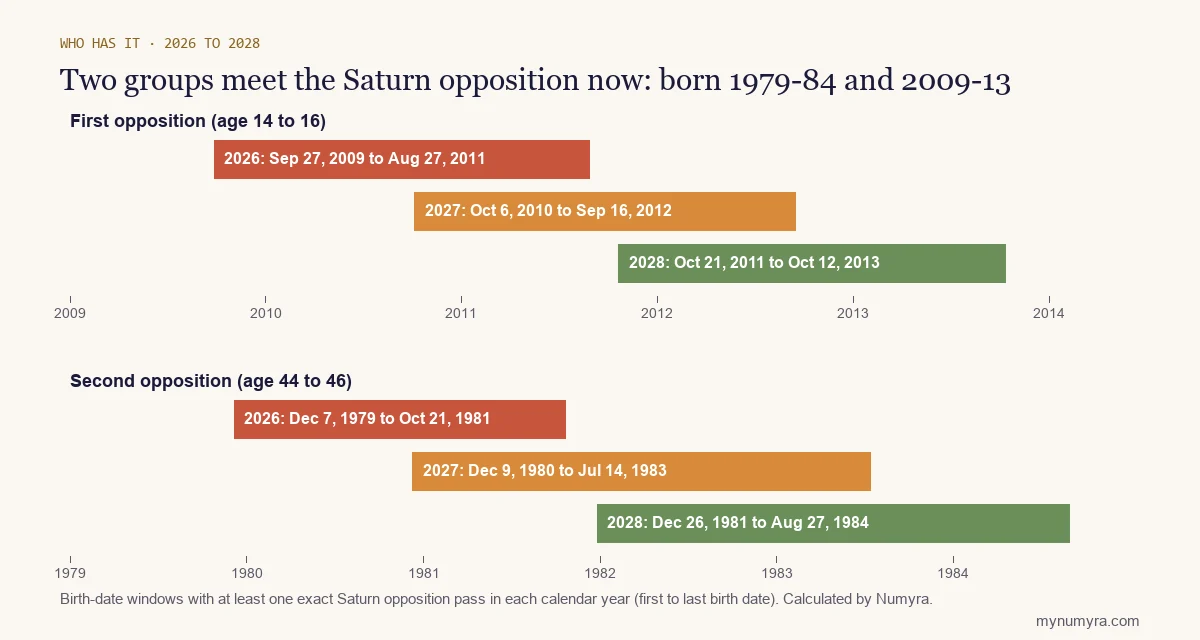
Each window covers about two years of birthdays, and the windows overlap because the passes of one person can fall in different years. As of October 14, 2026, Saturn is retrograde at about 10 degrees 31 minutes of Aries (it turned retrograde on July 26 at 14 degrees 45 minutes) and turns direct at 7 degrees 56 minutes of Aries at 6:31 p.m. EST on December 10. Passes still to come between October 16 and December 31, 2026 belong to people born October 3 to 22, 2010 (first opposition) and December 3, 1980 to March 6, 1981 or August 26 to September 15, 1981 (second opposition). Saturn’s next retrograde starts on August 9, 2027 at 27 degrees 53 minutes of Aries and ends December 23, 2027.
Saturn’s other quarter points in 2026 to 2028 fall on different groups: the opening square for births from February 20, 2017 to March 30, 2021, the closing square for births from August 14, 2002 to July 9, 2006, the Saturn return for March 7, 1996 to February 14, 2000, the second opening square for January 7, 1988 to February 15, 1992, the second closing square for July 1, 1973 to May 20, 1977 and the second return for May 5, 1966 to April 26, 1970. For the 85.4 million US births from 1994 to 2014, 15.9 million (18.6%) are in the first-opposition group, 14.7 million are having the closing square and 13.4 million the Saturn return, so 44.0 million of the 85.4 million (51.5%) have one of those three quarter points in these three years. The opening square, for births from 2017 on, is outside the data.
People born December 14, 1980 to August 27, 1984 also have a Uranus opposition in the same window: our Uranus opposition guide lists births from December 14, 1980 for 2026 and through September 17, 1985 for 2028. Augurine notes that the second Saturn opposition often belongs to a wider midlife cluster that includes the Uranus opposition. The Uranus and Neptune signs guide covers the Neptune square around age 40. The calculation uses noon UT on the birth date and ignores birth time, so a date at the edge of a window can be off by a day. For your own natal Saturn degree use the birth chart calculator and add 180. Or use the Saturn opposition calculator, which does it for you.
What astrologers say the Saturn opposition means
Astrologers read Saturn as the planet of structure, limits and responsibility, so an aspect from Saturn to its own natal position is taken as a checkpoint on whatever structures you have built. The opposition is the half-way point, when tradition says the lessons of the opening square are weighed against the results, and it is usually described in two forms. At about 14 it concerns authority and identity in the teenage years:
“Saturn can bring up insecurities, so this is a period when we may lack confidence, feel depressed or anxious, or stress about achievement at school.”
Chani, “The astrological timeline of your life”, section “Age 14”
At about 44 the same source frames the second opposition as a test of the first adult cycle:
“This is a time when we’re tested on all of the lessons we absorbed during our first Saturn return.”
Chani, “The astrological timeline of your life”, section “Age 44”
Other accounts agree on the shape. Augurine says the opposition brings the work of the preceding square to a result and that it often falls alongside the Uranus opposition, and the Learn Astrology reference calls the first one the first major Saturn checkpoint at which a young person meets inherited structure with a developing sense of self. These are interpretive traditions, not measured effects, and nothing in this section is a prediction: the exact date is a prompt for reflection, not a deadline. There is also no study that links planetary angles to life events at these ages, so we do not offer one.
How these numbers were calculated
Every figure comes from our own calculation with the Swiss Ephemeris (Moshier mode), using geocentric tropical longitudes of Saturn at noon UT for each day from December 1899 to 2090. For each birth date from January 1, 1900 to December 31, 2010 (40,542 dates) we located every day when transiting Saturn crossed the points 90, 180, 270, 360, 450, 540, 630 and 720 degrees past the natal longitude, interpolating between days, and recorded the ages (in 365.2425-day years). We checked the method against NASA’s JPL Horizons system: for six birth dates and 16 pass dates, Horizons’ natal longitudes agree to within 0.0001 degrees and every pass time falls within 0.1 hour of ours (both interpolate between daily noon positions). A second, brute-force check (a daily noon scan of 2026 to 2028 for each candidate birth date) reproduced the window edges for the first and second oppositions in all three years, with one edge a day apart. The US births figures use 85.4 million births from 1994 to 2014 (CDC/NCHS and Social Security Administration data via FiveThirtyEight); we did not use births before 1994. Our Saturn opposition calculator runs the same method for your own birth date and lists every pass of all eight quarter points.
Frequently asked questions
At what age is the Saturn opposition?
The first at about 14 to 15 and the second at about 43 to 45. In our calculation of 40,542 birth dates from 1900 to 2010, the first exact pass averages 14.5 (range 12.8 to 16.3) and the second 43.9 (range 42.7 to 45.4).
Is the Saturn opposition at 14 or 15?
It depends on your natal Saturn. For 41.5% of birth dates the first exact pass comes at 14, for 23.8% at 15, for 25.3% at 13, and for a few at 12 or 16. Natal Saturn in Aries or Pisces gives the earliest (mean 13.5), Virgo or Libra the latest (mean 15.5).
Does the Saturn opposition happen once or three times?
Either. In our calculation 54.1% of first oppositions and 50.5% of second oppositions get three passes (direct, retrograde, direct) spread over about four to five months, and the rest get one. Never two.
How long does the Saturn opposition last?
The exact passes span at most 0.75 years, with an average of about 0.4. Counting every time Saturn is within 1 degree of the opposite point, it averages 0.54 years; within 3 degrees, 0.87 years; within 5 degrees, 1.20 years.
Who has the Saturn opposition in 2026?
For the first opposition, people born between September 27, 2009 and August 27, 2011; for the second, people born between December 7, 1979 and October 21, 1981. In 2027 the windows are October 6, 2010 to September 16, 2012 and December 9, 1980 to July 14, 1983.
Is the Saturn opposition the same as the Saturn return?
No. The return is the conjunction, at about 29.5, when Saturn comes back to its natal position. The opposition is the half-way point, 180 degrees away, at about 14.5 and 44. See our Saturn return guide for the return.
What are the waxing and waning Saturn squares?
The opening (waxing) square comes at about 7 and again at about 36.5, and the closing (waning) square at about 22 and again at about 51.5. In our calculation the first opening square averages 7.2 and the first closing square 21.8.
Is the second Saturn opposition a midlife crisis?
That is the astrological tradition, not a finding. Chani frames it as a test of what was built at the first return; Augurine notes it often falls alongside the Uranus opposition. Nobody has shown that planetary angles cause crises at 44, so treat it as a prompt for reflection.
Sources
- Astrodienst. Swiss Ephemeris. Every position, pass, age and station on this page (calculations by the Numyra Methodology Desk).
- NASA. Saturn Fact Sheet. Sidereal orbit period 10,755.699 days (29.447 years), eccentricity, perihelion, aphelion, orbital speeds and synodic period.
- NASA JPL. Horizons System. Independent positions of Saturn used to cross-check our pass dates.
- William Lilly. Christian Astrology (London, 1647). Internet Archive scan; the Saturn orbit passage on p. 57.
- Chani. The astrological timeline of your life. Ages for the Saturn squares, oppositions and returns, and the readings quoted above.
- Augurine. Saturn Opposition Saturn: Results and Consequences. Age ranges and interpretation of the opposition.
- Learn Astrology (Kerykeion). Transit Saturn-Saturn Aspects. Ages for the squares, oppositions and returns in the cycle.
- FiveThirtyEight. US births data, 1994 to 2014, from the CDC National Center for Health Statistics and the Social Security Administration.