Your attitude number is your birth month plus your birth day, added together and reduced to a single digit from 1 to 9. Someone born on March 8 adds 3 + 8 = 11, then 1 + 1 = 2, so the attitude number is 2. The year of birth is not used. Numerologists read the number as the way you meet people, events and sudden change, though sources split on whether it describes your own instinctive reaction or the first impression others get of you. This guide shows the calculation with worked examples, gives a lookup table so you can find your number without any arithmetic, summarizes what each number from 1 to 9 means in the tradition, explains where sources disagree about the master sums 11, 22 and 33, and adds original figures on how often each attitude number occurs among 85.4 million US births.
Key takeaways
- The formula is birth month number plus birth day, reduced to one digit. It ignores the year, so everyone born on the same calendar date shares an attitude number for life.
- Sources define it two ways: Hans Decoz calls it your initial approach and instinctive reaction, while YourTango and Felicia Bender call it the first impression you make. Decoz says it is different from the Personality number.
- The master sums are a real disagreement. Decoz, Numerologist.com and YourTango reduce 11, 22 and 33 to 2, 4 and 6, while one site we read lists separate 11/2 and 22/4 readings. About 8.7% of US births, 32 of the 366 calendar dates, fall on a master sum.
- In 85.4 million US births from 1994 to 2014, all nine attitude numbers fall between 10.61% (number 1) and 11.52% (number 5), against an even split of 11.11%. No attitude number is rare.
- The attitude number and the reduced Life Path match only when the digits of the birth year add up to 9, such as 1998 or 2007 (9.75% of births in our data). These are traditional readings, not tested predictions.
In this guide
- What the attitude number is
- How to calculate your attitude number
- Find your attitude number without adding
- Master sums 11, 22 and 33: where sources disagree
- What attitude numbers 1 to 9 mean
- Attitude number vs Life Path, birthday and Personality numbers
- How common each attitude number is
- What the attitude number cannot tell you
- Frequently asked questions
- Sources
What the attitude number is
The attitude number is one of the smaller numbers in a numerology chart. It is built from the birth month and day only, and several sites also call it the Sun number or the Achievement number. It is not one of the five core numbers (Life Path, Expression, Soul Urge, Personality and Birthday), which is why most guides treat it as a supporting detail rather than a headline reading.
What it is supposed to describe depends on whom you read. Hans Decoz, whose World Numerology pages Numyra uses as its reference for date-based numbers, defines it as a reaction pattern:
it is your initial approach to meeting someone, encountering an event, and how you instinctively react to the unexpected changes life sends your way.
Hans Decoz, Your Attitude Number, World Numerology
Other writers read the same number from the outside in. YourTango, for example, puts it this way:
Your Attitude Number, also known as your Sun Number or Achievement Number, is all about the first impressions you make on other people.
NyRee Ausler, What Your Attitude Number Means, YourTango, October 20, 2022
These are not the same claim. Decoz explicitly separates the attitude number from the Personality number, which in his scheme is how people see you when they first meet you. Numerologist.com and Felicia Bender, by contrast, describe the attitude number as the outward impression itself. A practical way to hold both: treat the number as your default opening move, and expect other people to notice that move first. For the number that is built from your name rather than your birth date, see our guide to the Expression, Soul Urge and Personality numbers.
How to calculate your attitude number
The method is the same on every site we checked. Follow these steps:
- Write your birth month as a number from 1 (January) to 12 (December).
- Add the day of the month you were born.
- If the total has two digits, add those digits together. Repeat until one digit is left.
- Ignore the year. Only the month and day count.
Decoz’s own example is a November 28 birthday: 11 + 28 = 39, then 3 + 9 = 12, then 1 + 2 = 3. The figure below works four more dates, including two that add to a master number, and the December 31 example shows the largest possible total, 43.
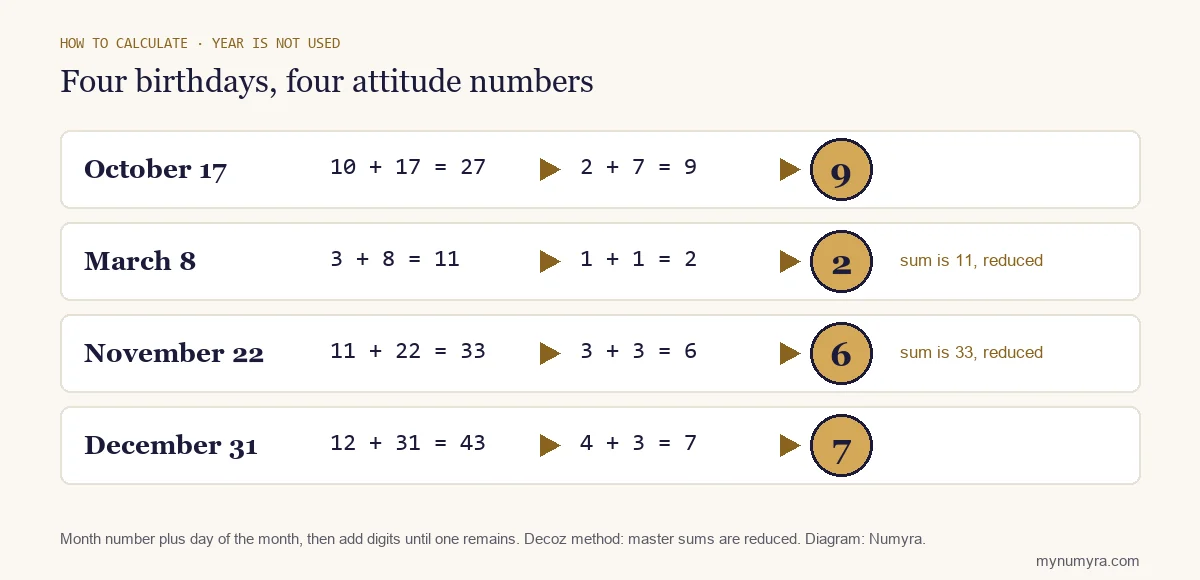
There is also a shortcut that needs no repeated adding. Because reducing digits always lands on the remainder after dividing by 9, your attitude number is the remainder of (month + day) divided by 9, with a remainder of 0 counted as 9. For October 17 that is 27, which divides by 9 exactly, so the number is 9. We checked the shortcut against all 7,670 month, day and year combinations in the US birth data used below and it never differed from the digit-by-digit method.
If you want the other date-based numbers as well, our guide to calculating a full numerology chart by hand walks through each one, and the Life Path calculator does the longest of them for you.
Find your attitude number without adding
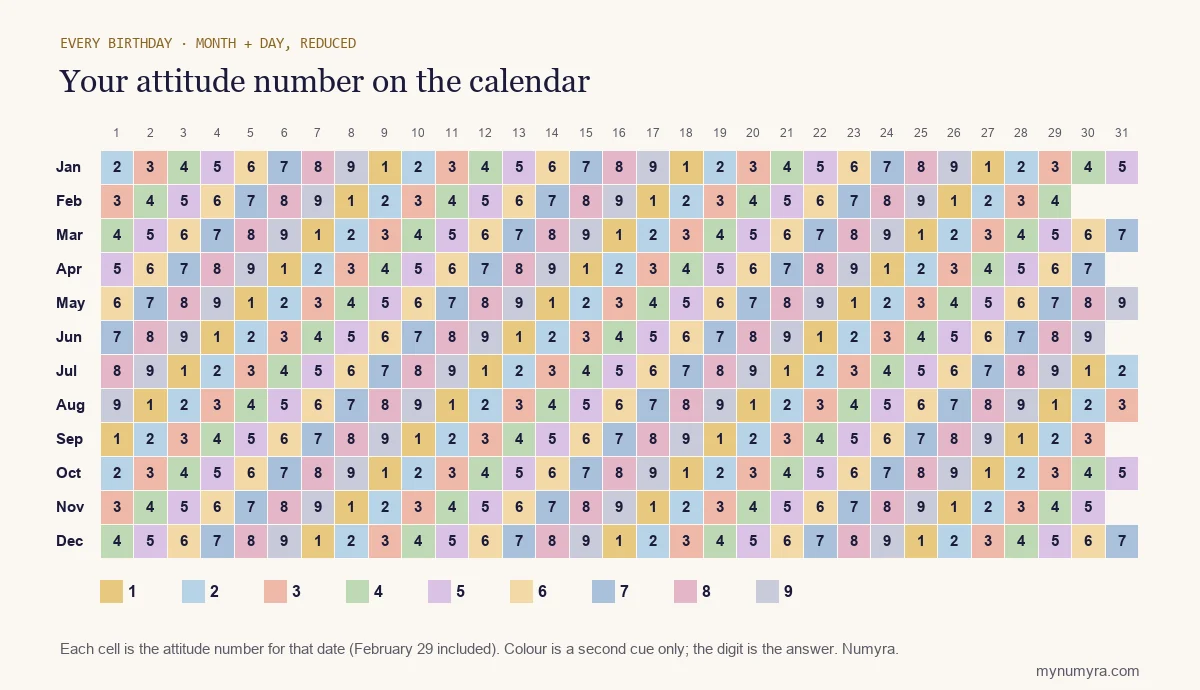
This table lists, for every birth month, the days of the month that give each attitude number. Find your month in the left column, then look for your birth day across the row. February 29 is included.
| Birth month | 1 | 2 | 3 | 4 | 5 | 6 | 7 | 8 | 9 |
|---|---|---|---|---|---|---|---|---|---|
| January | 9, 18, 27 | 1, 10, 19, 28 | 2, 11, 20, 29 | 3, 12, 21, 30 | 4, 13, 22, 31 | 5, 14, 23 | 6, 15, 24 | 7, 16, 25 | 8, 17, 26 |
| February | 8, 17, 26 | 9, 18, 27 | 1, 10, 19, 28 | 2, 11, 20, 29 | 3, 12, 21 | 4, 13, 22 | 5, 14, 23 | 6, 15, 24 | 7, 16, 25 |
| March | 7, 16, 25 | 8, 17, 26 | 9, 18, 27 | 1, 10, 19, 28 | 2, 11, 20, 29 | 3, 12, 21, 30 | 4, 13, 22, 31 | 5, 14, 23 | 6, 15, 24 |
| April | 6, 15, 24 | 7, 16, 25 | 8, 17, 26 | 9, 18, 27 | 1, 10, 19, 28 | 2, 11, 20, 29 | 3, 12, 21, 30 | 4, 13, 22 | 5, 14, 23 |
| May | 5, 14, 23 | 6, 15, 24 | 7, 16, 25 | 8, 17, 26 | 9, 18, 27 | 1, 10, 19, 28 | 2, 11, 20, 29 | 3, 12, 21, 30 | 4, 13, 22, 31 |
| June | 4, 13, 22 | 5, 14, 23 | 6, 15, 24 | 7, 16, 25 | 8, 17, 26 | 9, 18, 27 | 1, 10, 19, 28 | 2, 11, 20, 29 | 3, 12, 21, 30 |
| July | 3, 12, 21, 30 | 4, 13, 22, 31 | 5, 14, 23 | 6, 15, 24 | 7, 16, 25 | 8, 17, 26 | 9, 18, 27 | 1, 10, 19, 28 | 2, 11, 20, 29 |
| August | 2, 11, 20, 29 | 3, 12, 21, 30 | 4, 13, 22, 31 | 5, 14, 23 | 6, 15, 24 | 7, 16, 25 | 8, 17, 26 | 9, 18, 27 | 1, 10, 19, 28 |
| September | 1, 10, 19, 28 | 2, 11, 20, 29 | 3, 12, 21, 30 | 4, 13, 22 | 5, 14, 23 | 6, 15, 24 | 7, 16, 25 | 8, 17, 26 | 9, 18, 27 |
| October | 9, 18, 27 | 1, 10, 19, 28 | 2, 11, 20, 29 | 3, 12, 21, 30 | 4, 13, 22, 31 | 5, 14, 23 | 6, 15, 24 | 7, 16, 25 | 8, 17, 26 |
| November | 8, 17, 26 | 9, 18, 27 | 1, 10, 19, 28 | 2, 11, 20, 29 | 3, 12, 21, 30 | 4, 13, 22 | 5, 14, 23 | 6, 15, 24 | 7, 16, 25 |
| December | 7, 16, 25 | 8, 17, 26 | 9, 18, 27 | 1, 10, 19, 28 | 2, 11, 20, 29 | 3, 12, 21, 30 | 4, 13, 22, 31 | 5, 14, 23 | 6, 15, 24 |
The same information as a calendar, in which every date shows its attitude number, makes the pattern easy to see: the number rises by one each day, wraps from 9 back to 1, and the first date of each month is one step higher than the first date of the month before.
Master sums 11, 22 and 33: where sources disagree
A month and day can add up to 11, 22 or 33 before any reduction. March 8 gives 11, November 22 gives 33 and so on. Whether you keep that master number or reduce it is the one place where attitude number guides contradict each other.
Decoz reduces them and says so directly:
This is a grey area where not all numerologists agree – some will consider the Master numbers, but Decoz does not, for the simple reason that a Master number has nothing to do with the way an Attitude number affects you.
Hans Decoz, Your Attitude Number, World Numerology, answering the question “Are Master Numbers used for the Attitude Number?”
Numerologist.com (Blair Andrews, 2025) says standard practice reduces every sum to a single digit between 1 and 9, and YourTango states that master numbers cannot be attitude numbers. Felicia Bender’s page goes the other way: it lists a reading headed “Attitude 11/2” and another headed “Attitude 22/4”, each described as the base number plus the extra intensity of the master number. We did not find a similar entry for 33 on her page.
Numyra follows Decoz for date-based numbers, as our methodology page explains, so on this site an 11, 22 or 33 sum is reduced to 2, 4 or 6. If you prefer to keep master numbers, our guide to why 11, 22 and 33 are treated as master numbers sets out the tradition and where it comes from. The choice affects more people than you might expect. Only 32 of the 366 possible birth dates add up to a master sum (10 dates for 11, 12 for 22 and 10 for 33), but using the real birth counts, those dates cover almost one US birth in eleven.
| Month + day before reducing | Calendar dates that add up to it | Share of US births, 1994 to 2014 | Attitude number if reduced |
|---|---|---|---|
| 11 | 10 | 2.67% | 2 |
| 22 | 12 | 3.30% | 4 |
| 33 | 10 | 2.76% | 6 |
| All three | 32 | 8.74% | 2, 4 or 6 |
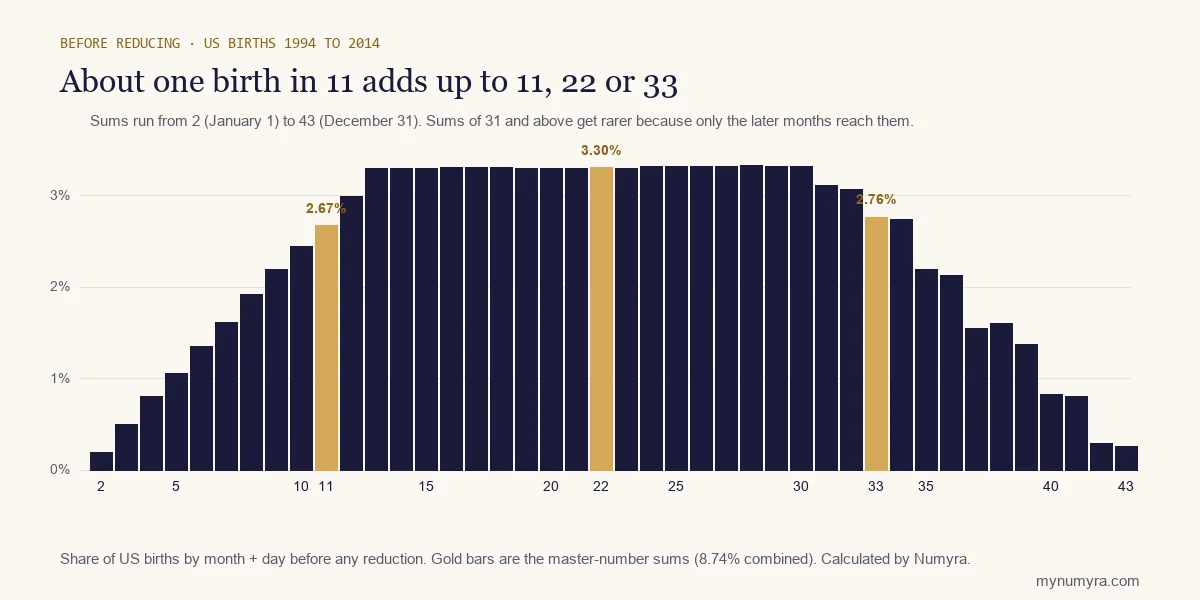
The table is original arithmetic on the national birth counts, not a claim about any one person. If your sum is 11, 22 or 33, read the reduced number first and treat any master-number reading from a source that keeps them as an optional extra layer.
What attitude numbers 1 to 9 mean
The descriptions below are summaries of how Decoz and other numerologists read each number. They are traditional interpretations for reflection, not measured traits. We have written them in our own words and kept the shadow side of each one in view, because every source we read pairs a strength with a typical blind spot.
Attitude number 1
A 1 is read as a direct, self-reliant first response. In Decoz’s account a 1 meets change head on, acts quickly and prefers not to ask for help. The usual blind spot is impulsiveness: reacting fast means early warning signs can be missed.
Attitude number 2
A 2 is read as cautious and diplomatic. Decoz describes someone who weighs the likely outcomes before moving, prefers cooperation to confrontation and has a good sense of timing. The traditional caution is that this person can give way too easily or, when the diplomacy turns calculating, steer situations from behind the scenes.
Attitude number 3
A 3 is the inventive, upbeat reaction: humor, quick thinking and an unconventional answer to a problem. The tradition adds that a 3 can keep things light to avoid heavy feelings or responsibilities, and can leave projects unfinished, yet rises to real pressure better than its easygoing surface suggests.
Attitude number 4
A 4 is the methodical, steady reaction. Readers describe careful planning, strong work habits and loyalty, along with a dislike of sudden change and a perfectionism that can make the person hard on themselves and others. Several sites picture a 4 as dependable first, spontaneous last.
Attitude number 5
A 5 is the adaptable, restless reaction. The tradition pictures someone who welcomes change, novelty and freedom and does not feel the need for much routine. The usual caution is trouble with discipline, and Decoz suggests that a successful 5 puts the energy into lasting goals rather than short-lived ones.
Attitude number 6
A 6 is the responsible, caring reaction, centered on family, community and a sense of duty. Decoz pairs this with a tendency toward fixed beliefs and, when the care becomes control, with self-righteousness. The recommended balance in the tradition is to look beyond the familiar and accept help as well as offering it.
Attitude number 7
A 7 is the reflective, analytical reaction. Readers describe curiosity, a wish to look beneath the surface and a calm, detached manner in the face of change, sometimes read by others as aloof or enigmatic. The tradition notes a preference for depth over small talk and a risk of withdrawing or turning passive-aggressive when feelings go unspoken.
Attitude number 8
An 8 is the authoritative, control-seeking reaction, strong on practical and financial matters and direct to the point of bluntness. The classic caution is frustration when events cannot be controlled, and a sometimes uneasy relationship with authority itself, which the tradition pairs with resilience after setbacks.
Attitude number 9
A 9 is the idealistic, big-picture reaction, with a calm and somewhat distant manner that Decoz reads as a shield against emotional entanglement. Humanitarian causes and teaching are the typical callings. The caution is that the pursuit of a larger purpose can come across as arrogance, or leave the person reluctant to accept recognition.
Attitude number vs Life Path, birthday and Personality numbers
People often ask how the attitude number fits with the numbers they already know. The table separates them by what they are built from.
| Number | Built from | Uses the birth year? | Traditionally read as |
|---|---|---|---|
| Attitude number | Birth month plus birth day, reduced | No | Your approach to people and change, or the impression you give |
| Birthday number | The day of the month alone | No | A single innate gift |
| Life Path | Month, day and year | Yes | The main lesson and direction of a life |
| First pinnacle | Month plus day, same sum as the attitude number | No | The theme of the first long life cycle |
| Personality number | Consonants in your name | No | How others see you, in Decoz’s scheme |
Decoz notes that the same calculation also gives the first pinnacle, with a different meaning because it describes a long-term cycle. One detail separates them in practice. His pinnacles keep 11, 22 and 33, as our guide to pinnacle numbers shows, while his attitude number reduces them, so a March 8 birthday has a first pinnacle of 11 but an attitude number of 2.
The Life Path link is more interesting, and it is a matter of arithmetic rather than tradition. Adding the birth year to the month and day gives the Life Path, so the reduced Life Path equals the attitude number plus the digit sum of the birth year, reduced again. We tested this on all 7,670 dates in our data and found no exceptions. It means the two numbers are identical only when the digits of the year add to 9, as in 1998 or 2007, and those two years account for 9.75% of the births in our 1994 to 2014 sample. Numerologist.com suggests that when the attitude number and Life Path are similar, people read you accurately from the start, and that a gap between them can explain a difference between first impressions and deeper character. Because the gap is set by the birth year, everyone born in the same year has the same offset between the two numbers, which is worth knowing before you read meaning into it. For another number that combines your birth date with your name, see our maturity number guide.
How common each attitude number is
To see whether any attitude number is unusual, we assigned an attitude number to every date in the US birth data and weighted each date by the number of babies born on it. The data are the CDC National Center for Health Statistics counts for 1994 to 2003 and the Social Security Administration counts for 2004 to 2014, 85,386,227 births on 7,670 dates in total, as compiled by FiveThirtyEight. The counts are dates only, so nothing about times or places is simulated here. They describe the US population in this window, not people born in other years or countries.
| Attitude number | Calendar dates (of 366) | US births, 1994 to 2014 | Share of births |
|---|---|---|---|
| 1 | 39 | 9,060,250 | 10.61% |
| 2 | 41 | 9,467,126 | 11.09% |
| 3 | 42 | 9,807,428 | 11.49% |
| 4 | 42 | 9,685,613 | 11.34% |
| 5 | 42 | 9,840,617 | 11.52% |
| 6 | 40 | 9,417,571 | 11.03% |
| 7 | 41 | 9,590,705 | 11.23% |
| 8 | 39 | 9,167,233 | 10.74% |
| 9 | 40 | 9,349,684 | 10.95% |
| All | 366 | 85,386,227 | 100.00% |
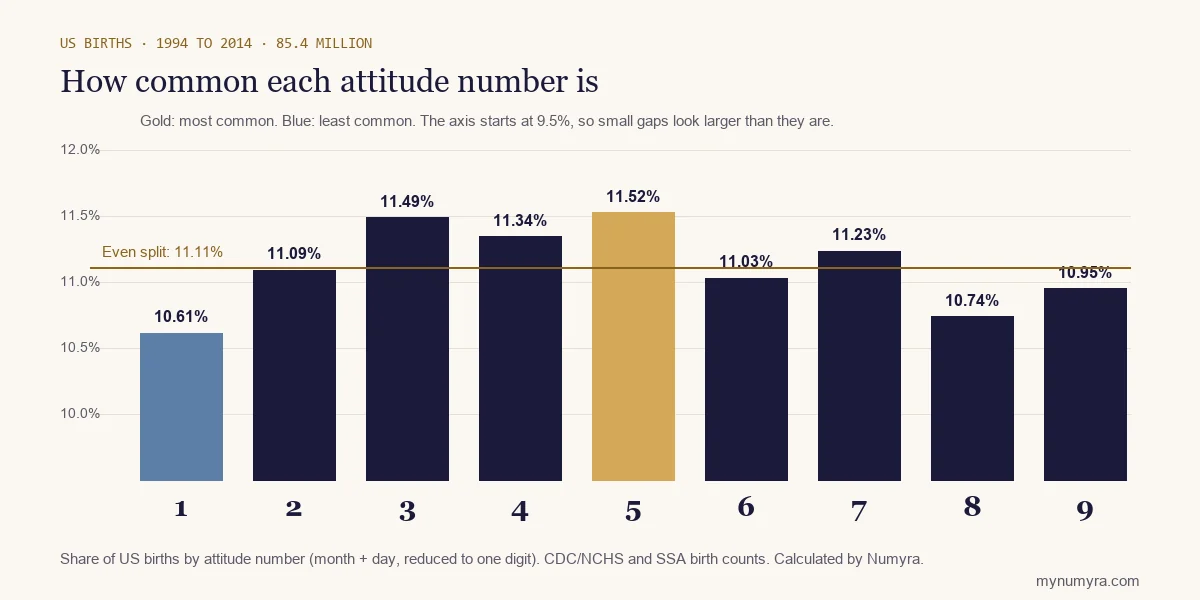
The spread is narrow. Number 5 is the most common at 11.52% and number 1 the least common at 10.61%, a gap of about 0.9 percentage points around an even split of 11.11%. Two things cause it. First, the calendar itself: attitude numbers 3, 4 and 5 each occur on 42 of the 366 dates, while 1 and 8 occur on only 39, because the possible totals, from 2 to 43, do not fall evenly into nine groups. Second, the weight of births: births are not spread evenly over the calendar, so the dates behind each number carry different numbers of babies, which reshuffles the order slightly (number 3 also covers 42 dates but trails number 5). The result is that no attitude number is a rare one, so a claim that your attitude number is rare cannot be true.
The data also give a quick answer to the question of how many attitude numbers exist. There are nine single digits. A reader who keeps master sums would add 11 and 22 and sometimes 33, which together would take about 8.7% of people out of the 2, 4 and 6 groups.
What the attitude number cannot tell you
The attitude number sorts every person on the planet into one of nine groups according to the calendar date of their birth. A reading of “how you react to change” or “what impression you give” is therefore an interpretation attached to a date, and it is the same for everyone born on that date regardless of upbringing, culture or circumstance. In preparing this guide we looked for published controlled studies of whether the attitude number predicts how people react or how others perceive them and did not find any, only descriptions from numerology sites. Treat the nine descriptions as a prompt for reflection, in the way you might use a personality quiz you enjoy, and not as a guide to hiring, relationships, health or money decisions.
If you want a next step, compare your attitude number with your Life Path and your personal month number to see how the date-based numbers differ. For pairings of two people, our numerology compatibility calculator works from Life Path numbers.
Frequently asked questions
How do I find my attitude number?
Add your birth month number and your birth day, then add the digits of the total until one digit is left. For March 8, 3 + 8 = 11 and 1 + 1 = 2. The lookup table above gives the answer for every date.
How many attitude numbers are there?
Nine, from 1 to 9, if every total is reduced to a single digit as Decoz, Numerologist.com and YourTango do. Writers who keep master sums add readings such as 11/2 and 22/4.
Is the attitude number the same as the Sun number?
Hans Decoz says they are two names for the same number: the attitude number describes how you react to people and events, while the Sun number refers to the same number’s role in your chart. YourTango lists Sun number and Achievement number as other names, and Felicia Bender calls it the Achievement number.
Does the year of birth matter for the attitude number?
No. Only the birth month and day are used, so everyone born on the same calendar date shares the same attitude number whatever the year.
Can the attitude number be 11, 22 or 33?
Not in the most common method. Decoz, Numerologist.com and YourTango reduce those sums to 2, 4 and 6. One site we read lists 11/2 and 22/4 readings, so the answer depends on the source. About 8.7% of US births fall on a date that adds up to 11, 22 or 33.
Is the attitude number the same as the Life Path number?
No. The Life Path also uses the birth year. The two reduced numbers match only when the digits of the birth year add up to 9, such as 1998 or 2007, so for most people they differ.
What does attitude number 7 mean?
Traditionally a reflective, analytical, private reaction to people and change, with a preference for depth over small talk. Some readers find it aloof or enigmatic. It is an interpretation, not a measured trait.
Is the attitude number scientifically proven?
No. We found no published controlled study showing that the attitude number predicts behavior or first impressions. It is a numerology tradition, best used for reflection.
Sources
- Decoz, Hans. Your Attitude Number. World Numerology. Source of the definition and the master number quotation, the Sun number and first pinnacle links, and the descriptions of numbers 1 to 9 that we summarized.
- Andrews, Blair. The Attitude Number: Your Energetic First Impression. Numerologist.com, published April 23, 2025, updated May 23, 2025. Source of the first-impression reading and the single-digit rule.
- Ausler, NyRee. What Your Attitude Number Means and How It Determines Your First Impression On Others. YourTango, October 20, 2022. Source of the quotation and of the statement that master numbers cannot be attitude numbers.
- Bender, Felicia. The Attitude Number. Source of the Achievement number name and the 11/2 and 22/4 readings.
- FiveThirtyEight. US births data, 1994 to 2014, from the CDC National Center for Health Statistics and the Social Security Administration. Dates only. All attitude number counts and shares are calculated by the Numyra Methodology Desk.