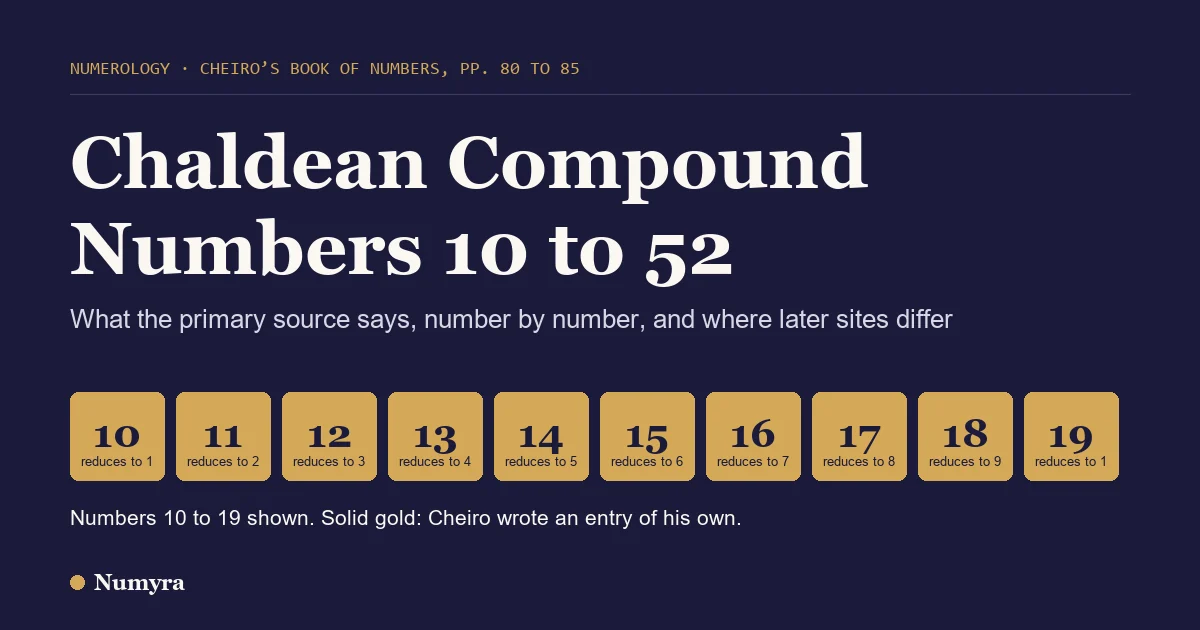
Chaldean compound numbers are the two-digit totals, 10 to 52, that a name makes before it is reduced to a single digit, and almost every list of what they mean traces back to one place: pages 80 to 85 of Cheiro’s Book of Numbers. Those six pages are thinner than the web suggests. Cheiro wrote an entry of his own for 26 of the 43 numbers; for the other 17 he wrote only “has the same meaning as” and named an earlier number. This page sets out every number from 10 to 52 with its page reference, shows where the book contradicts itself, compares 13 of the numbers with what four modern sites say, and counts how often real US names land on each total.
Key takeaways
- The standard 10 to 52 list is Cheiro’s, on pages 80 to 85 of the seventh impression of Cheiro’s Book of Numbers (Herbert Jenkins, London), which we read as a page scan. He wrote entries of his own for 10 to 32, 37, 43 and 51. The other 17 numbers copy an earlier one, and every copy lands on a number with the same digit root (17 of 17).
- After 32 the book adds only three new readings: 37, 43 and 51. Numbers 33 to 36, 38 to 42, 44 to 50 and 52 are cross-references, and nothing is said about 53 and up.
- Cheiro says he does not know how old the symbolism is, yet his pictures for 10, 13 and 16 to 21 carry the same names as the tarot trumps with those numbers, and four of his titles (the Muzzled Lion, the Sacrifice, the Awakening, the Crown of the Magi) are alternative titles that Wikipedia’s table attributes to Paul Christian. The “karmic” and “master number” labels common today do not appear in the book.
- His examples use different totals for a full name: for Lloyd George he adds the single digits (9 + 7 = 16), for Ramsay MacDonald he adds the compounds (12 + 32 = 44). Adding the letters of Lloyd George would give 43.
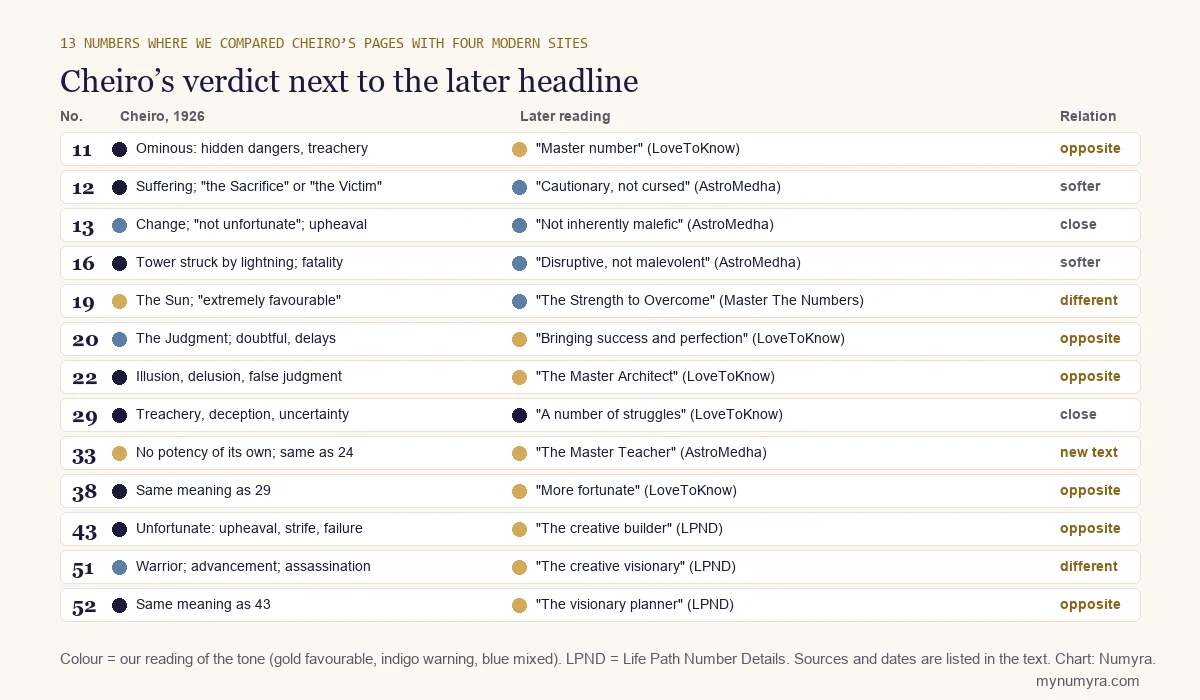
- In 10 of the 13 numbers we compared with modern pages, the modern tone is the opposite (6), softer (2) or simply different (2); two are close, and 33 has no text of Cheiro’s to compare. One site reproduces his entries without naming him, and another names him but cites the page numbers of a different edition.
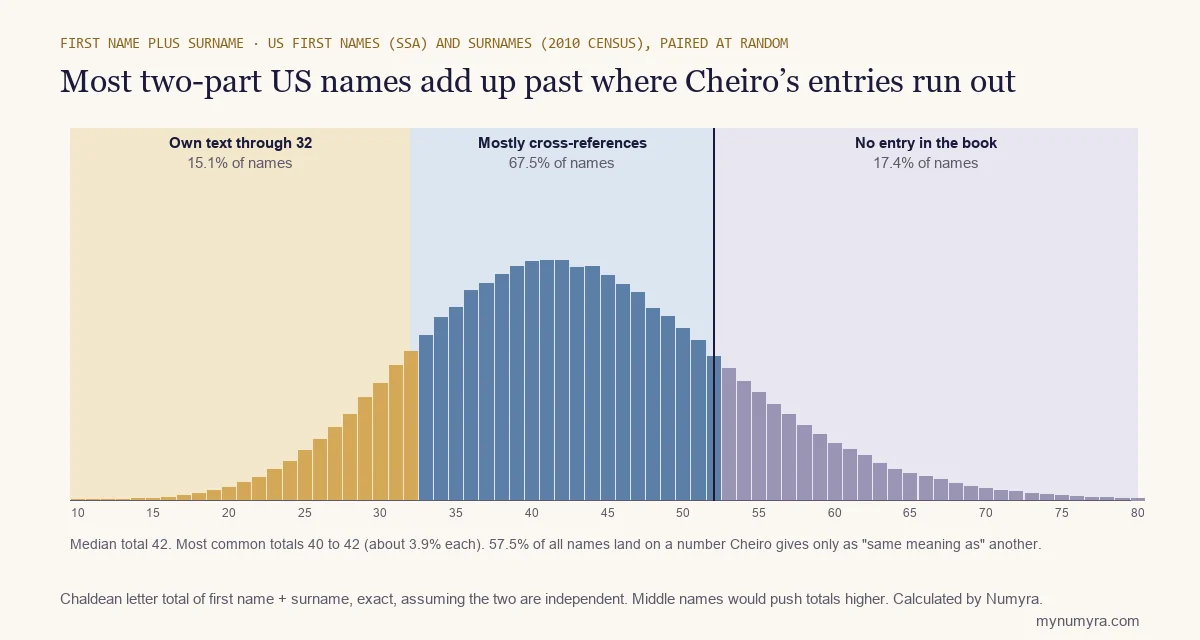
- Our calculation: 17.4% of US first-plus-last names (SSA first names, 2010 Census surnames) total above 52, where the book is silent, and 57.5% land on a number Cheiro only cross-references. This is tradition, not a tested method; see whether numerology is real.
In this guide
- What a compound number is and how Cheiro finds it
- The numbers 10 to 52, entry by entry
- How the “same meaning as” links work
- The tarot link in his own words
- Which total do you read for a full name?
- Where later sites say something different
- How often US names land on each number
- What the pages can and cannot support
- How we checked this
- Frequently asked questions
What a compound number is and how Cheiro finds it
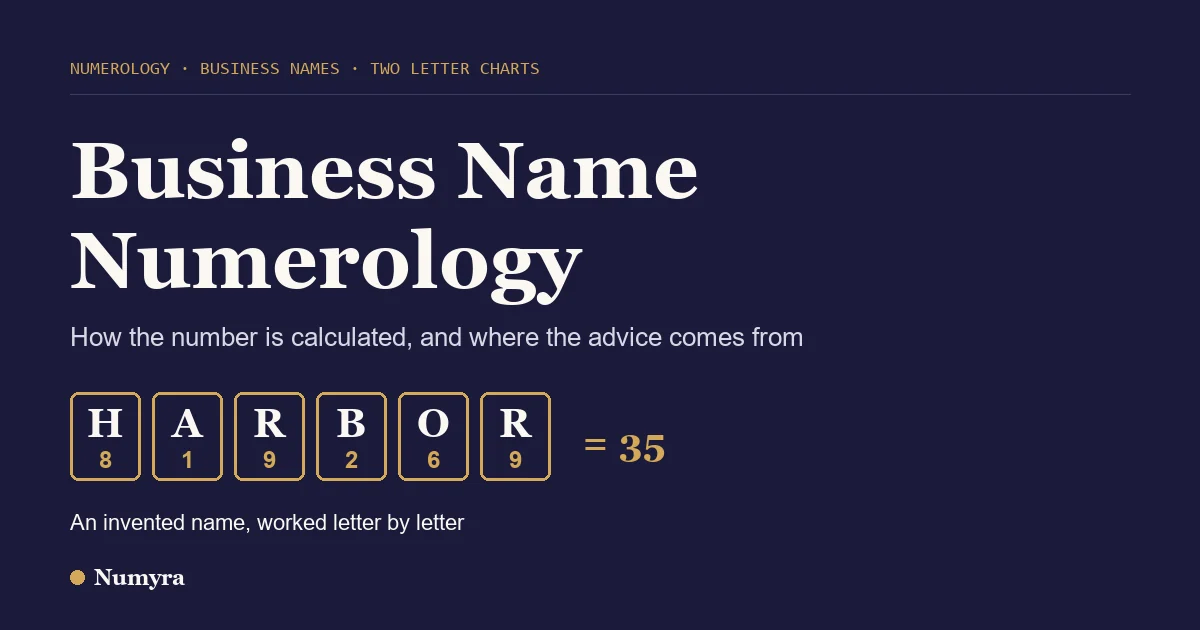
The method starts with the Chaldean letter chart that Cheiro prints on page 70, where A = 1, B = 2, C = 3, D = 4, E = 5, F = 8 and so on, with no letter worth 9 (our letter values chart sets it beside the Pythagorean chart, and Pythagorean vs. Chaldean numerology explains why the two exist). You add the letters of the name. His own example on page 86 is John Smith: John is 18 and Smith is 17. The total before any reduction is the compound number, and adding its digits gives the single number, so 18 becomes 9 and 17 becomes 8.
He separates the two on page 78: the single numbers “denote what the man or woman appears to be in the eyes of their fellow mortals, while the double or compound numbers show the hidden influences that play their role behind the scenes”. We recalculated every compound total the book prints for a name or word (Lloyd 18, George 25, Baldwin 22, Austen 24, Chamberlain 32, Ramsay 12, MacDonald 32, John 18, Smith 17, and the ships Maine 16, Waratah 20 and Leinster 28) using the page 70 chart. All twelve are right, and David comes to 16, which fits his single 7. His arithmetic is sound; the open questions are about what the numbers mean and which total to read.
The numbers 10 to 52, entry by entry
How to read the tables. “Picture or title” is the name or image the book attaches. “What the entry says” is our short paraphrase, not every clause. “Verdict” is our one-word coding of his wording: fortunate (he says fortunate, favourable or good), warning (he says warning, ominous, unfortunate or “not a fortunate number”), mixed (both appear, or he calls it doubtful), or neither. Page numbers are the printed ones, which match the Internet Archive scan. Where he wrote nothing of his own, the row says so. He stops at 52: “for all practical purposes there is no necessity to proceed further” (p. 85).
10 to 19
| No. | Reduces to | Picture or title in the book | What the entry says (our paraphrase) | Verdict (our coding) | Page |
|---|---|---|---|---|---|
| 10 | 1 | “Wheel of Fortune” | Honour, faith and self-confidence, rise and fall; one’s name known “for good or evil” according to one’s desires; plans likely to be carried out. | Fortunate | 80 |
| 11 | 2 | “a Clenched Hand” and “a Lion Muzzled” | Ominous “to occultists”: a warning of hidden dangers, trial and treachery from others, and of great difficulties to contend against. | Warning | 80 |
| 12 | 3 | “the Sacrifice” or “the Victim” | Suffering and anxiety of mind; foreshadows being sacrificed for the plans or intrigues of others. | Warning | 80 |
| 13 | 4 | “a Skeleton” or “Death” with a scythe | Change of plans and place, “not unfortunate, as is generally supposed”; an ancient saying that whoever understands 13 “will be given power and dominion”; also upheaval and destruction, and a warning of the unknown. | Mixed | 80 |
| 14 | 5 | No picture | Movement and combination of people and things; danger from tempests, water, air or fire; fortunate for money, speculation and business change but always with risk, usually from others’ foolhardiness. | Mixed | 80 |
| 15 | 6 | No picture; “occult significance, of magic and mystery” | Will use every art of magic to carry out a purpose: very lucky with a fortunate single number, but with a 4 or an 8 may use “black magic”. Linked to good talkers, music and art; fortunate for obtaining money, gifts and favours. | Fortunate (conditional) | 80 to 81 |
| 16 | 7 | “a Tower Struck by Lightning” with a man falling, crowned; “the Shattered Citadel” | A warning of “some strange fatality”, danger of accidents and defeat of plans; to be noted and planned for. | Warning | 81 |
| 17 | 8 | The 8-pointed “Star of Venus”; “the Star of the Magi” | Highly spiritual; the person has “risen superior in spirit”; a “number of immortality” whose name “lives after him”; fortunate unless joined to a single 4 or 8. | Fortunate | 81 |
| 18 | 9 | “a rayed moon” dropping blood, with a wolf, a dog and a crab | Materialism striving to destroy the spiritual side; quarrels, war, upheaval, money made through wars; treachery, deception, danger from storms, water, fire and explosions; take dates with great care. | Warning | 81 to 82 |
| 19 | 1 | “the Sun”; “the Prince of Heaven” | “Fortunate and extremely favourable”: happiness, success, esteem and honour, and success in future plans. | Fortunate | 82 |
20 to 29
| No. | Reduces to | Picture or title in the book | What the entry says (our paraphrase) | Verdict (our coding) | Page |
|---|---|---|---|---|---|
| 20 | 2 | “the Awakening”; “the Judgment” (angel with trumpet, a family rising from a tomb) | New purpose and a call to action for a great cause; “not a material number”, so “doubtful” for worldly success; delays and hindrances that only spiritual development overcomes. | Mixed (doubtful) | 82 |
| 21 | 3 | “the Universe”; “the Crown of the Magi” | Advancement, honours and general success; victory “after a long fight”; fortunate. | Fortunate | 82 |
| 22 | 4 | “a Good Man blinded by the folly of others”, a knapsack full of errors, a tiger attacking | A warning of illusion and delusion, a good person in “a fool’s paradise”, and false judgment through the influence of others. | Warning | 82 |
| 23 | 5 | “the Royal Star of the Lion” | Success, help from superiors and protection from those in high places; “a most fortunate number”. | Fortunate | 82 to 83 |
| 24 | 6 | No picture | Fortunate: the assistance and association of people of rank and position, and gain through love and the opposite sex. | Fortunate | 83 |
| 25 | 7 | No picture | Strength gained through experience and benefits through observation; he does not call it exactly lucky, since success comes through strife and trials earlier in life; favourable for the future. | Fortunate (qualified) | 83 |
| 26 | 8 | No picture | “The gravest warnings”: disaster through association with others, ruin by bad speculation, partnerships, unions and bad advice. | Warning | 83 |
| 27 | 9 | “the Sceptre” | Authority, power and command; reward from the productive intellect; fortunate. | Fortunate | 83 |
| 28 | 1 | No picture | “Full of contradictions”: great promise that may be lost without provision; loss through trust in others, trade competition and law, and having “to begin life’s road over and over again”; not fortunate. | Warning | 83 |
| 29 | 2 | No picture | Uncertainties, treachery and deception; trials, unexpected dangers, unreliable friends, and grief caused by members of the opposite sex; “grave warning”. | Warning | 83 |
30 to 52
| No. | Reduces to | Picture or title in the book | What the entry says (our paraphrase) | Verdict (our coding) | Page |
|---|---|---|---|---|---|
| 30 | 3 | No picture | Thoughtful deduction, retrospection and mental superiority; the person sets material things aside by choice; “neither fortunate nor unfortunate”. | Neither | 83 to 84 |
| 31 | 4 | No picture | Like 30, but more self-contained, lonely and isolated; “not a fortunate number from a worldly or material standpoint”. | Warning (mild) | 84 |
| 32 | 5 | No picture | A “magical power like the single 5” and the compounds 14 and 23; linked with combinations of people or nations; fortunate if the holder keeps his own judgment, otherwise plans are wrecked by others’ stubbornness. The phrase “the Paths of Wisdom” is used for 32 on pages 74 and 76 but is not in this entry. | Fortunate (conditional) | 84 |
| 33 | 6 | None | No entry of its own: it “has no potency of its own” and takes the meaning of 24 (“which is also a 6”). | As 24 (fortunate) | 84 |
| 34 | 7 | None | No entry of its own. Cheiro writes that it “has the same meaning as” 25. | As 25 (fortunate) | 84 |
| 35 | 8 | None | No entry of its own. Cheiro writes that it “has the same meaning as” 26. | As 26 (warning) | 84 |
| 36 | 9 | None | No entry of its own. Cheiro writes that it “has the same meaning as” 27. | As 27 (fortunate) | 84 |
| 37 | 1 | No picture | “A distinct potency of its own”: good and fortunate friendships in love, and in combinations connected with the opposite sex; good for partnerships of all kinds. | Fortunate | 84 |
| 38 | 2 | None | No entry of its own. Cheiro writes that it “has the same meaning as” 29. | As 29 (warning) | 84 |
| 39 | 3 | None | No entry of its own. Cheiro writes that it “has the same meaning as” 30. | As 30 (neither) | 84 |
| 40 | 4 | None | No entry of its own. Cheiro writes that it “has the same meaning as” 31. | As 31 (warning) | 84 |
| 41 | 5 | None | No entry of its own. Cheiro writes that it “has the same meaning as” 32. | As 32 (fortunate) | 84 |
| 42 | 6 | None | No entry of its own. Cheiro writes that it “has the same meaning as” 24. | As 24 (fortunate) | 84 |
| 43 | 7 | No picture; “signs” of revolution | “An unfortunate number”, symbolised by revolution, upheaval, strife, failure and prevention. | Warning | 84 |
| 44 | 8 | None | No entry of its own. Cheiro writes that it “has the same meaning as” 26. | As 26 (warning) | 85 |
| 45 | 9 | None | No entry of its own. Cheiro writes that it “has the same meaning as” 27. | As 27 (fortunate) | 85 |
| 46 | 1 | None | No entry of its own. Cheiro writes that it “has the same meaning as” 37. | As 37 (fortunate) | 85 |
| 47 | 2 | None | No entry of its own. Cheiro writes that it “has the same meaning as” 29. | As 29 (warning) | 85 |
| 48 | 3 | None | No entry of its own. Cheiro writes that it “has the same meaning as” 30. | As 30 (neither) | 85 |
| 49 | 4 | None | No entry of its own. Cheiro writes that it “has the same meaning as” 31. | As 31 (warning) | 85 |
| 50 | 5 | None | No entry of its own. Cheiro writes that it “has the same meaning as” 32. | As 32 (fortunate) | 85 |
| 51 | 6 | No picture; “the warrior” | A “very powerful potency of its own”: the nature of the warrior, sudden advancement, especially favourable in military or naval life and for leaders; but it “threatens enemies, danger, and the likelihood of assassination”. | Mixed | 85 |
| 52 | 7 | None | No entry of its own. Cheiro writes that it “has the same meaning as” 43. | As 43 (warning) | 85 |
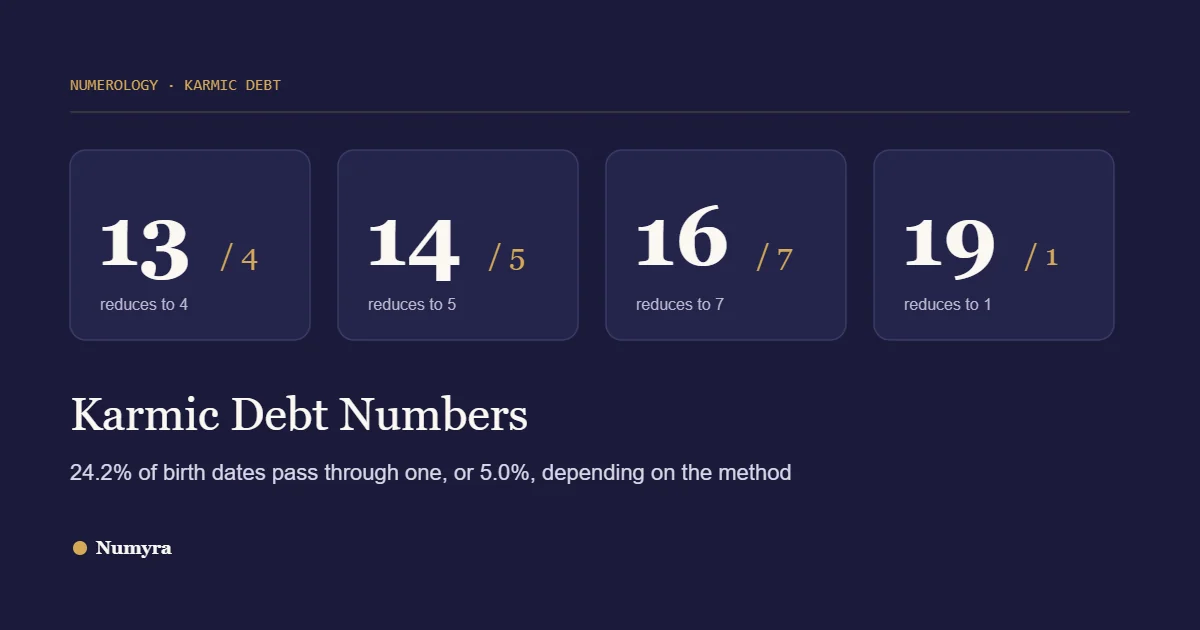
Two labels people expect are missing. The phrase “master number” does not occur in our text of the book, and 11, 22 and 33 are treated like any other compound: 11 and 22 have warning entries and 33 is a copy of 24 (see why 11, 22 and 33 are called master numbers for where that idea comes from). “Karmic” does not occur either, although many pages now describe 13, 14, 16 and 19 as karmic debts; our karmic debt numbers guide traces that label to the 1970s, and Cheiro’s entries for those four numbers are mixed for 13 and 14, a warning for 16, and among the most favourable in the book for 19.
How the “same meaning as” links work
Cheiro explains the copies in the same breath each time: 34 “has the same meaning as the number 25, which is the next to it in its own series of ‘compound’ numbers”. The series he means is the digit root. Our check found that all 17 cross-references point to a number with the same digit root as the number that copies it (33 and 24 both reduce to 6, 52 and 43 both to 7). Laid out by root, the pattern is plain: each series gets text for its first members, and the later members borrow it.
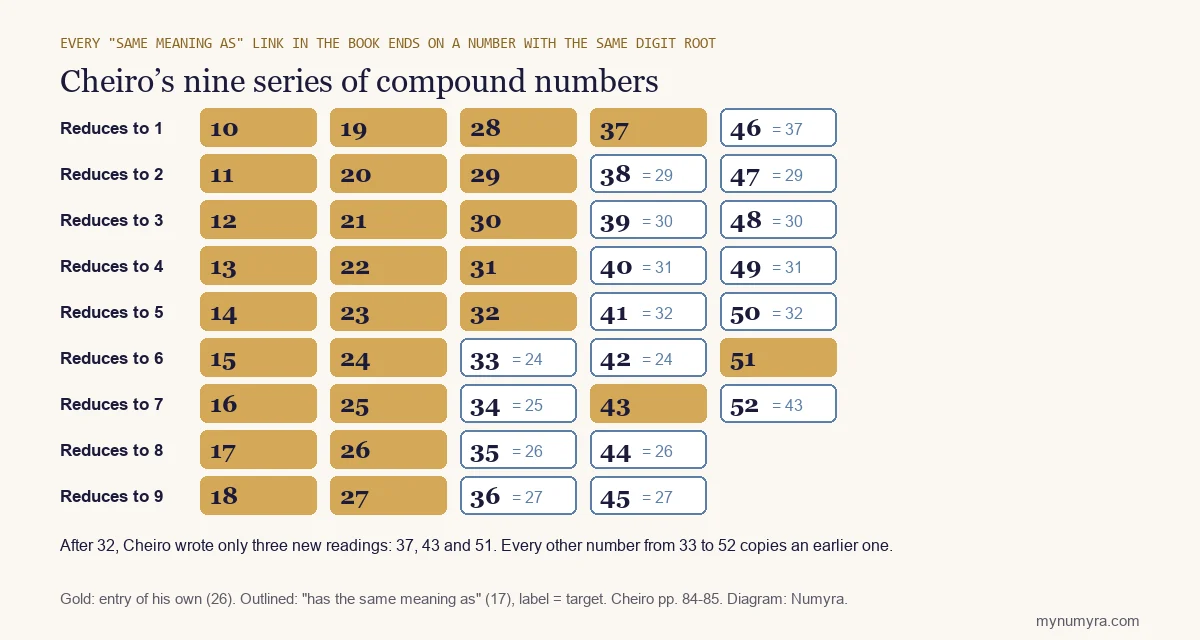
That means a name’s reading beyond 32 is really a reading of its digit root and its position. A name that totals 40 is read as 31 (self-contained, lonely, “not a fortunate number from a worldly or material standpoint”), and one that totals 44 is read as 26 (the “gravest warnings”). Only 37, 43 and 51 break the pattern, and 46 and 52 then copy 37 and 43.
The cut-off has an arithmetic story. Cheiro writes that the “greater symbolism” of numbers continues “until 5 times 9 is reached, or the number 45”, where “the mystical number of 7” is added to give 52, “which stands for the 52 weeks of a year” (p. 78). He then lists up to 52 anyway. The reasoning is numerological, not astronomical evidence for 52 as a boundary.
This number has no potency of its own, and consequently has the same meaning as the 24
Cheiro, Cheiro’s Book of Numbers, p. 84, entry for 33 (Internet Archive scan)
The tarot link in his own words
Cheiro does not claim to have invented the pictures. He writes that “the universally accepted symbolism of the compound numbers in ancient times was given in pictures and may still be found in the Tarot Cards” (p. 80), and on page 79 he says plainly that he does not know where they come from:
How and in what age these “compound” numbers became illustrated by symbolism, we do not know and never can know.
Cheiro, Cheiro’s Book of Numbers, p. 79 (Internet Archive scan)
He names no deck and no tarot author. Comparing his pictures with the major arcana numbered 10 to 22 shows how close the match is, and the table adds the alternative trump titles that Wikipedia’s comparison table attributes to Paul Christian: “The Muzzled Lion” for XI, “The Sacrifice” for XII, “The Awakening of the Dead” for XX and “The Crown of the Magi” for XXI. The table is our observation, from Wikipedia’s tables of Marseille, Rider-Waite and Christian titles; Cheiro does not give these pairings himself.
| Number | Cheiro’s picture or title | Tarot trump with that number | Our note |
|---|---|---|---|
| 10 | “Wheel of Fortune” | X, Wheel of Fortune (Christian: “The Sphinx”) | Same name. |
| 11 | “a Clenched Hand” and “a Lion Muzzled” | XI is Strength in the Marseille order (Rider-Waite swaps it with VIII); Christian: “The Muzzled Lion” | The lion matches. |
| 12 | “the Sacrifice” or “the Victim” (no picture) | XII, The Hanged Man; Christian: “The Sacrifice” | Title matches Christian title. |
| 13 | “a Skeleton” or “Death” with a scythe | XIII, unnamed in Marseille, Death in the Rider-Waite deck; Christian: “The Skeleton Reaper” | Same figure. |
| 14, 15 | No picture | XIV, Temperance; XV, The Devil | Nothing stated. |
| 16 | “a Tower Struck by Lightning”; “the Shattered Citadel” | XVI, The House of God in Marseille and The Tower in the Waite deck; Christian: “The Beheaded Tower” (“The Lightning-Struck Tower”) | Same image. |
| 17 | The “Star of Venus”; “the Star of the Magi” | XVII, The Star | Same name. |
| 18 | “a rayed moon” | XVIII, The Moon | Same name. |
| 19 | “the Sun” | XIX, The Sun | Same name. |
| 20 | “the Awakening”; “the Judgment” | XX, Judgement; Christian: “The Awakening of the Dead” | Both his titles appear. |
| 21 | “the Universe”; “the Crown of the Magi” | XXI, The World; Christian: “The Crown of the Magi” | Title matches Christian title. |
| 22 | “a Good Man blinded by the folly of others”, knapsack, tiger | The Fool, numbered XXII in some 18th-century Belgian decks and usually unnumbered; drawn with a bundle on a stick and an animal at his heels | Our reading. The animal is a dog or cat on Marseille cards, a tiger in Cheiro. |
For numbers 23 to 52 there is no trump with that number, and the pictures stop: 23 is “the Royal Star of the Lion” and 27 “the Sceptre”, and the rest are described only in words. One reading is that the list started from the trump order and ran out of cards; the book does not say so. Boštjan Lovrat, who writes about Chaldean numerology on his blog, likewise says the descriptions are not modern tarot readings “but rather a sort of Chaldean Tarot”, and he doubts that Cheiro wrote them. We did not test authorship, and Cheiro’s own claim, that he took the system from Indian teachers, is covered in our profile of Cheiro.
Which total do you read for a full name?
The book’s table needs a number to look up, and the worked examples do not use one rule. Each total below is stated in the text, except the 43 for Lloyd George, which is our addition from his page 84 entries.
| Name in the book | Parts and totals | How he combines them | Result he reads | Page |
|---|---|---|---|---|
| Lloyd George | Lloyd 18 (reduces to 9), George 25 (7) | Adds the two single numbers | 9 + 7 = 16, “the Shattered Citadel”. The two compounds added (18 + 25) would be 43, the “unfortunate” number. | 72 to 73 |
| David Lloyd George | David 16 (7), Lloyd 18 (9), George 25 (7) | Adds the three single numbers | 7 + 9 + 7 = 23, “considered a fortunate number”. | 72 |
| Austen Chamberlain | Austen 24 (6), Chamberlain 32 (5) | Adds the two single numbers | 6 + 5 = 11, which “gives warning of hidden dangers”. With the title “Sir” (6) the three singles give 17. | 74 to 75 |
| Ramsay MacDonald | Ramsay 12 (3), MacDonald 32 (5) | Adds the two compounds, and also the singles | 12 + 32 = 44, read as 26 (“the gravest warnings”); the singles give 3 + 5 = 8. | 75 to 76 |
Two things follow. First, the reading depends on a choice the book does not state: adding the single digits of each name part, as for Lloyd George, or adding the compounds, as for MacDonald. Second, the choice changes the entry. Lloyd George’s compounds give 43, the book’s “unfortunate” number, yet he is read as 16 and the “Shattered Citadel”. Cheiro also quotes his own entries loosely: on page 73 the figure for 22 is attacked by a tiger “who is biting him” and the blood for 18 is “dropping like rain”, where the entries on pages 81 and 82 say “attacking” and “falling”. The book is consistent about one thing, which is that each name part has its own compound number. The date method on pages 85 and 86 adds the date’s digit to “the total of the compound numbers of one’s name” and reads the result.
There is also a small internal slip. In the examples on pages 74 and 76 the compound 32 is called “the Paths of Wisdom”, but that phrase does not appear in the entry for 32 on page 84, which says 32 has “a magical power like the single 5” and is fortunate if its holder “holds to his own judgment”. If you want the full-name rule our calculators use, the name numerology calculator and calculating a chart by hand show it for either chart; the book does not settle the question.
Where later sites say something different
A Google search for “chaldean numerology compound numbers 10 to 52” on 26 October 2026 returned no AI Overview text for us. The results we could open were a mix of reproductions and rewrites. We read seven pages; six give meanings we could compare with the book: Boštjan Lovrat’s blog (21 August 2024), Professional Numerology (undated), LoveToKnow (updated 14 January 2022), Life Path Number Details (11 August 2026), AstroMedha (one page per number, undated) and Master The Numbers (undated). Three patterns stand out.
Some pages are Cheiro without Cheiro. Lovrat’s page names the book, cites “pages 126-133” of a 1935 edition (our scan’s pagination is 80 to 85, so editions differ) and reproduces the entries; Professional Numerology gives the same entries for 11, 13, 16, 22, 29, 38 and 43 in nearly the same words and never mentions Cheiro (the name appears nowhere on the page); its entry for 22 reads “full of Arrows” where the scan reads “full of Errors”, which may be a transcription slip. Some pages invent ancient sources. AstroMedha’s page for 16 says “Ancient Babylonian numerologists assigned 16 the symbol of a tower being struck by lightning” and cites no text, while Cheiro himself, the earliest source we found for that picture, says its age is unknown. We did not search for earlier sources exhaustively. Many pages drift upbeat. The comparison below keeps Cheiro’s tone as the baseline:
| No. | Cheiro, 1926 | Later reading and source | Relation |
|---|---|---|---|
| 11 | “An ominous number to occultists”: hidden dangers and treachery | LoveToKnow: “considered a master number” that gives the 2 “imagination, vision, and intuition”. Life Path Number Details: “The spiritual messenger”. | Opposite |
| 12 | “the Sacrifice” or “the Victim”; suffering and anxiety | AstroMedha keeps “The Sacrifice” but calls it “cautionary, not cursed”. | Softer |
| 13 | Change of plans, “not unfortunate”; also upheaval and destruction | AstroMedha: “Transition and Transformation”, “not inherently malefic”. Master The Numbers: “The Transformational Rebirth”. | Close |
| 16 | The Tower; “some strange fatality” | AstroMedha: “disruptive, not malevolent”, the fall “corrective, not cruel”. Master The Numbers: “The Awakening to Spiritual Truth”. | Softer |
| 19 | “the Sun”; “fortunate and extremely favourable” | Master The Numbers: “The Strength to Overcome”, “the number of the survivor”. | Different |
| 20 | “the Awakening”; doubtful for worldly success; delays | LoveToKnow: 20 brings “success and perfection” to the traits of 2. | Opposite |
| 22 | A warning of illusion, delusion and false judgment | LoveToKnow: “Master number 22, the Master Architect”. Life Path Number Details: “The master builder”. | Opposite |
| 29 | Uncertainties, treachery, deception | LoveToKnow: “a number of struggles”. Life Path Number Details: “The survivor”, who “always come back stronger”. | Close |
| 33 | No potency of its own; same as 24 | AstroMedha: “The Master Teacher”, “one of the rarest compound numbers”. | New text |
| 38 | Same meaning as 29 | LoveToKnow: “one of the more fortunate numbers” that reduce to 2. Life Path Number Details: “The rescuer”. | Opposite |
| 43 | “An unfortunate number” | Life Path Number Details: “The creative builder”. | Opposite |
| 51 | The warrior; advancement, but “likelihood of assassination” | Life Path Number Details: “The creative visionary”. | Different |
| 52 | Same meaning as 43 | Life Path Number Details: “The visionary planner”. | Opposite |
Where Cheiro warns, the modern pages usually soften or flip. They also write readings for the numbers he only cross-references: Life Path Number Details gives all 43 numbers a title of their own, so its 38 is “the rescuer” where the book says 38 means what 29 means. For numbers above 52 Lovrat reports that many practitioners reverse the digits (53 read as 35) or add them (65 read as 11), and he calls that approach misguided: “The number 12 does not have the same meaning as the number 21”. Our own reading is simpler: the book gives nothing for 53 and up, so any reading there is a later addition.
How often US names land on each number
To see how much of this table real names actually touch, we added up the Chaldean letter total for popular US first names and for first-plus-last pairs. First names come from the Social Security Administration’s top-1,000 lists for each sex and birth year, 1994 to 2014 (2,844 distinct names, covering 67% to 86% of births in a year, 77% on average), weighted by popularity. Surnames come from the 2010 Census list (162,253 names). We paired first names and surnames at random with an exact calculation, assuming the two are independent.
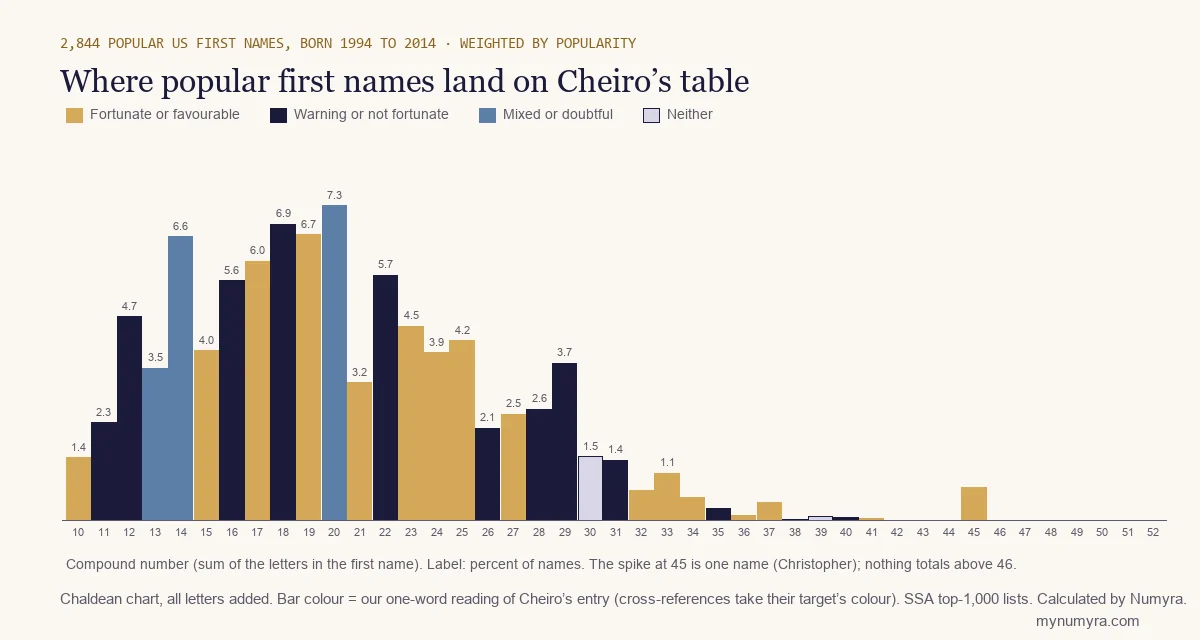
For first names alone, 94.4% fall in 10 to 52 and 5.6% are single digits; none total above 46. The most common totals are 20 (7.3%), 18 (6.9%), 19 (6.7%) and 14 (6.6%). Because first names are short, 91% fall in 10 to 32, where every number has an entry of Cheiro’s own. Our coding of his wording puts 40.0% of popular first names on numbers he calls fortunate, 35.4% on warning numbers, 17.5% on mixed or doubtful ones and 1.6% on 30 and its copies, “neither fortunate nor unfortunate”. That near-balance mostly reflects the table, which across all 43 numbers (copies included) has 19 fortunate, 17 warning, 4 mixed and 3 neutral, not anything about the names.
Full names are different. For the pair of first name plus surname the total has a median of 42 and peaks at 40 to 42 (about 3.9% each). Only 15.1% fall in 10 to 32, where Cheiro wrote entries of his own for every number. A further 67.5% fall in 33 to 52, of which 57.5% land on a number the book only copies, and 17.4% total above 52, where the book is silent. Adding a middle name would push these totals higher. The single number the book calls plainly unfortunate, 43, is the landing spot for 3.8% of such names and 52, which copies it, for another 2.4%.
The method question matters. Under Cheiro’s approach of adding the single digit of each name part, the totals can only run from 2 to 18, so 44.8% of pairs give a single digit and the rest fall in 10 to 18, with 10 (11.1%) and 11 (10.0%) the most common; numbers 19 to 52 could then never be reached from a two-part name. Here are the first-name figures for the numbers people ask about most, with popular names that land there (names only, not people):
| Compound | Popular first names | First name + surname | Cheiro’s verdict | Popular first names that total this |
|---|---|---|---|---|
| 13 | 3.5% | under 0.1% | Mixed | Juan, Luis, Bailey, Jared |
| 14 | 6.6% | under 0.1% | Mixed | Jacob, Emily, James, Emma |
| 16 | 5.6% | under 0.1% | Warning | David, Jose, Aaron, Amanda |
| 18 | 6.9% | 0.1% | Warning | John, Ashley, Alexis, Taylor |
| 22 | 5.7% | 0.4% | Warning | Michael, Hannah, Samuel, Robert |
| 23 | 4.5% | 0.5% | Fortunate | Joshua, Andrew, Destiny, Chloe |
| 29 | 3.7% | 1.7% | Warning | Matthew, Joseph, Jonathan, Connor |
| 43 | under 0.1% | 3.8% | Warning | none in the top-1,000 lists |
| 51 | under 0.1% | 2.6% | Mixed | none in the top-1,000 lists |
What the pages can and cannot support
The entries are a tradition, and the book offers no test of them. Every example it gives of a compound number “fitting” an event is told after the event. On page 95 the US battleship Maine comes to 16, the “Tower Struck by Lightning”; the ship Waratah comes to 20, “the Judgment”, and the Leinster comes to 28, “a number full of contradictions”. Each name fits its entry once the outcome is known, and the book gives no case of a number used to forecast something that was then checked. Our review of whether numerology is real covers the tests that exist for name-number claims, and we found none that supports the compound-number readings.
The coding in our tables is ours, built from Cheiro’s wording, and different readers could code a few entries differently (12, 14, 20, 25 and 51 are the closest calls). The popular-name counts depend on the pairing assumption and on the chart. If you apply a different Chaldean chart, such as the variants we list in the letter values guide, many totals move. If you use the numbers for a business name, our business name numerology guide shows where the popular advice that 33 and 51 are fortunate meets Cheiro’s 33 (no meaning of its own) and 51 (a warrior number that also “threatens enemies, danger, and the likelihood of assassination”), and our name change guide shows how a surname swap moves the total. Neither is advice on money, health or legal decisions.
How we checked this
The primary text. We read pages 70, 72 to 76, 78 to 86 and 95 of the Internet Archive scan of the seventh impression (Digital Library of India copy) as page images, and compared them with the saved OCR text. Every quotation on this page was matched to the page image. In this printing many sentence-ending full stops and commas are faint or missing; we supplied them where the sense needs them and changed no words. The table paraphrases follow the full entries, not summaries from other sites. Arithmetic. The Chaldean chart in our code equals the page 70 table letter for letter, and it reproduces all 12 compound totals the book prints for names and words. We tested that each of the 17 “same meaning as” links keeps the digit root. Modern sites. We fetched each page on 26 October 2026 and re-searched the saved text for every phrase we quote from it. Two other search results (Numerologist.com, Numerology Toolbox) are not described because we could not retrieve them. Names. SSA top-1,000 baby-name lists 1994 to 2014 as compiled in the open data-baby-names repository, and the 2010 Census surname file; the first-plus-last distribution is an exact convolution assuming independence, so it ignores middle names and any link between first-name and surname patterns. Limits. We did not read other editions of the book, earlier tarot sources or Sepharial, and the tarot comparison is ours.
Frequently asked questions
What are compound numbers in Chaldean numerology?
They are the two-digit totals from 10 to 52 that the letters of a name or word add up to before reduction to one digit. Cheiro, whose book is the source of the standard list, says the single digit shows how a person appears and the compound shows “the hidden influences” behind the scenes (p. 78).
Why do Chaldean compound numbers stop at 52?
Cheiro ties 52 to the 52 weeks of the year and to 45 (5 times 9) plus 7. He then writes that “for all practical purposes there is no necessity to proceed further” (p. 85). The book has no entry for 53 or above.
What does compound number 16 mean in Cheiro’s book?
Page 81 pictures it as “a Tower Struck by Lightning from which a man is falling with a Crown on his head” and calls it “the Shattered Citadel”. It “gives warning of some strange fatality”, danger of accidents and defeat of plans. Some modern pages soften this to a “corrective” upheaval.
Is 13 an unlucky compound number?
Cheiro says it “is not unfortunate, as is generally supposed” (p. 80), a number of change of plans and place. He also pictures it as “Death” with a scythe and calls it a number of upheaval and destruction, so the entry is mixed rather than simply lucky or unlucky.
Which compound numbers did Cheiro describe himself?
26 of the 43: every number from 10 to 32, plus 37, 43 and 51. The other 17 (33 to 36, 38 to 42, 44 to 50 and 52) say only that they have the same meaning as an earlier number with the same digit root.
Should I read the compound number of my first name or my full name?
The book does not give one rule. It reads Lloyd George as 16 by adding the single digits of the two names and Ramsay MacDonald as 44 by adding the two compounds. Say which method you used, and remember that adding all the letters often gives a total above 52, for which the book has no entry.
Is 52 a lucky compound number?
Not in Cheiro’s book. Entry 52 reads only “has the same meaning as 43” (p. 85), and 43 is “an unfortunate number” symbolised by “revolution, upheaval, strife, failure, and prevention” (p. 84). Some modern pages give 52 a positive title such as “the visionary planner”.
Which compound numbers are lucky in Chaldean numerology?
By his wording, the ones he calls fortunate or favourable are 10, 15, 17, 19, 21, 23, 24, 25, 27, 32 and 37, with 14 fortunate for money but risky, and the copies of those numbers (33, 34, 36, 41, 42, 45, 46, 50) inherit the reading. The table above has the full list, and our coding of tone is ours.
Do 11, 22 and 33 count as master numbers in this system?
Not in the book. We found no use of “master number” in our text of it, and 11 and 22 have warning entries while 33 copies 24. Modern pages such as LoveToKnow and AstroMedha do call them master numbers or give them elevated status.
What if my name adds up to more than 52?
The source has nothing for it. Some practitioners reverse the digits or add them to land back in the 10 to 52 range, and Lovrat objects that this is not supported by the entries themselves. In our calculation, 17.4% of first-plus-last US names total above 52.
Sources
- Cheiro. Cheiro’s Book of Numbers. London: Herbert Jenkins, seventh impression. Internet Archive scan (Digital Library of India), pp. 70, 72 to 76, 78 to 86 and 95.
- Lovrat, Boštjan. “Classical Cheiro’s Descriptions of Compound Numbers.” The Mystery of Numbers, 21 August 2024.
- Professional Numerology. “The Chaldean Numerology System.” Page read 26 October 2026.
- Lantz, Patricia. “What Is Chaldean Numerology? Simple Explanations.” LoveToKnow, updated 14 January 2022.
- Behera, Ashutosh. “Compound Numbers in Chaldean Numerology: 10 to 52 Meanings Explained.” Life Path Number Details, 11 August 2026.
- AstroMedha. “Compound Number 16 in Chaldean Numerology: The Shattered Citadel” and the companion pages for 10, 12, 13, 21 and 33. Read 26 October 2026.
- Bowers, Felicia. “Working With Karma: Compound Numbers and Their Meanings.” Master The Numbers. Read 26 October 2026.
- Wikipedia. “Major Arcana.” Marseille and Rider-Waite numbering and alternative titles.
- Wikipedia. “The Fool (tarot card).” Numbering of the Fool and the image on Marseille-type decks.
- US Social Security Administration. “Popular Baby Names.” Source of the national baby-name data (this site blocks automated checkers; it opens in a browser); top-1,000 lists compiled in hadley/data-baby-names.
- US Census Bureau. “Frequently Occurring Surnames from the 2010 Census.”