Pisces Zodiac Sign
Pisces dates: February 19 to March 20. Pisces is the twelfth sign of the zodiac, a mutable water sign traditionally ruled by Jupiter (and, for many modern astrologers, Neptune).
Traditionally read as the most imaginative and empathetic sign: absorbent to others' feelings and drawn to art, spirituality, or escape.
Key takeaways
- A genuine, sometimes overwhelming, capacity for empathy toward others.
- A strong traditional association with imagination, dreams, and artistic or spiritual sensitivity.
- A mutable water sign: adaptable through feeling rather than logic.
- Nothing here is medical, financial, legal, or psychological advice. It is a cultural tradition, presented for reflection.
Pisces dates, and where the Sun really is
Tropical Pisces, the version used here, spans Feb 19 to Mar 20, give or take a day. The IAU boundaries put the Sun in front of the constellation Pisces from about Mar 12 to Apr 18, a stay of roughly 38 days that is not the same period.
| Tropical sign Pisces | Feb 19 to Mar 20 |
|---|---|
| Sun in the constellation Pisces | About Mar 12 to Apr 18 (38 days) |
| Brightest star | Alpherg (magnitude about 3.6, essentially tied with Alrescha) |
Blame precession, which moves the equinoxes one degree in about 72 years: the first degree of Pisces has gone from Pisces to Aquarius since Ptolemy. The sidereal vs. tropical guide explains why the dates did not follow.
When does Pisces actually start?
Dates like those above are rounded; Pisces really starts when the Sun reaches 0° Pisces. Between 1990 and 2030 that was February 18 in 34 of 41 years and February 19 in 7 in US Eastern time (every year from 1950 to 2030 is tabulated below). In 2027, Thu, Feb 18, 2027, 4:33 pm ET splits the day: 3:03 pm on Feb 18 in New York gives an Aquarius, 6:03 pm gives a Pisces.
Exact Pisces start date and time for every year, 1950 to 2030
| Year | Sun enters Pisces (US Eastern time) |
|---|---|
| 1950 | Feb 19, 12:17 am |
| 1951 | Feb 19, 6:09 am |
| 1952 | Feb 19, 11:56 am |
| 1953 | Feb 18, 5:41 pm |
| 1954 | Feb 18, 11:32 pm |
| 1955 | Feb 19, 5:18 am |
| 1956 | Feb 19, 11:04 am |
| 1957 | Feb 18, 4:57 pm |
| 1958 | Feb 18, 10:48 pm |
| 1959 | Feb 19, 4:37 am |
| 1960 | Feb 19, 10:26 am |
| 1961 | Feb 18, 4:16 pm |
| 1962 | Feb 18, 10:14 pm |
| 1963 | Feb 19, 4:08 am |
| 1964 | Feb 19, 9:57 am |
| 1965 | Feb 18, 3:47 pm |
| 1966 | Feb 18, 9:37 pm |
| 1967 | Feb 19, 3:23 am |
| 1968 | Feb 19, 9:09 am |
| 1969 | Feb 18, 2:54 pm |
| 1970 | Feb 18, 8:41 pm |
| 1971 | Feb 19, 2:26 am |
| 1972 | Feb 19, 8:11 am |
| 1973 | Feb 18, 2:01 pm |
| 1974 | Feb 18, 8:58 pm |
| 1975 | Feb 19, 1:49 am |
| 1976 | Feb 19, 7:39 am |
| 1977 | Feb 18, 1:30 pm |
| 1978 | Feb 18, 7:20 pm |
| 1979 | Feb 19, 1:13 am |
| 1980 | Feb 19, 7:01 am |
| 1981 | Feb 18, 12:51 pm |
| 1982 | Feb 18, 6:46 pm |
| 1983 | Feb 19, 12:30 am |
| 1984 | Feb 19, 6:16 am |
| 1985 | Feb 18, 12:07 pm |
| 1986 | Feb 18, 5:57 pm |
| 1987 | Feb 18, 11:49 pm |
| 1988 | Feb 19, 5:35 am |
| 1989 | Feb 18, 11:20 am |
| 1990 | Feb 18, 5:14 pm |
| 1991 | Feb 18, 10:58 pm |
| 1992 | Feb 19, 4:43 am |
| 1993 | Feb 18, 10:35 am |
| 1994 | Feb 18, 4:21 pm |
| 1995 | Feb 18, 10:10 pm |
| 1996 | Feb 19, 4:00 am |
| 1997 | Feb 18, 9:51 am |
| 1998 | Feb 18, 3:54 pm |
| 1999 | Feb 18, 9:46 pm |
| 2000 | Feb 19, 3:33 am |
| 2001 | Feb 18, 9:27 am |
| 2002 | Feb 18, 3:13 pm |
| 2003 | Feb 18, 9:00 pm |
| 2004 | Feb 19, 2:49 am |
| 2005 | Feb 18, 8:31 am |
| 2006 | Feb 18, 2:25 pm |
| 2007 | Feb 18, 8:08 pm |
| 2008 | Feb 19, 1:49 am |
| 2009 | Feb 18, 7:46 am |
| 2010 | Feb 18, 1:35 pm |
| 2011 | Feb 18, 7:25 pm |
| 2012 | Feb 19, 1:17 am |
| 2013 | Feb 18, 7:01 am |
| 2014 | Feb 18, 12:59 pm |
| 2015 | Feb 18, 6:49 pm |
| 2016 | Feb 19, 12:33 am |
| 2017 | Feb 18, 6:31 am |
| 2018 | Feb 18, 12:18 pm |
| 2019 | Feb 18, 6:03 pm |
| 2020 | Feb 18, 11:56 pm |
| 2021 | Feb 18, 5:43 am |
| 2022 | Feb 18, 11:43 am |
| 2023 | Feb 18, 5:34 pm |
| 2024 | Feb 18, 11:13 pm |
| 2025 | Feb 18, 5:06 am |
| 2026 | Feb 18, 10:51 am |
| 2027 | Feb 18, 4:33 pm |
| 2028 | Feb 18, 10:26 pm |
| 2029 | Feb 18, 4:07 am |
| 2030 | Feb 18, 9:59 am |
Birth Chart calculator for a specific time and place.
At Fri, Mar 5, 2027, 2:39 pm ET the Sun stands at 15° Pisces; that is the solar return of every birth at that degree.
Pisces also splits into three decans of 10° each. In most years they begin on February 18, February 28 and March 10. Our guide to the Pisces decans explains what each one adds and who rules it in the three traditional systems.
The Sun in Pisces from 2026 to 2030: entries, exits and clock times
Mark Thu, Feb 18, 2027, 4:33 pm ET (1:33 pm PT) as the start of Pisces in 2027 and Sat, Mar 20, 2027, 4:24 pm ET (1:24 pm PT) as its end; between them lie 29.95 days (29 days 22 h 51 min). Among the 2027 seasons only 7 are longer than Pisces. Earth’s orbit carries it outward here, 147.86 to 148.98 million km from the Sun, so the Sun’s speed along the ecliptic falls, 1.008 to 0.993 degrees a day against a 0.986 yearly mean.
| Year | Sun enters Pisces (Eastern) | Sun enters Pisces (Pacific) | Sun leaves Pisces (Eastern) | Days |
|---|---|---|---|---|
| 2026 | Wed, Feb 18, 10:51 am | Wed, Feb 18, 7:51 am | Mar 20, 10:46 am | 29.95 |
| 2027 | Thu, Feb 18, 4:33 pm | Thu, Feb 18, 1:33 pm | Mar 20, 4:25 pm | 29.95 |
| 2028 | Fri, Feb 18, 10:26 pm | Fri, Feb 18, 7:26 pm | Mar 19, 10:17 pm | 29.95 |
| 2029 | Sun, Feb 18, 4:07 am | Sun, Feb 18, 1:07 am | Mar 20, 4:02 am | 29.95 |
| 2030 | Mon, Feb 18, 9:59 am | Mon, Feb 18, 6:59 am | Mar 20, 9:52 am | 29.95 |
Expect the Pisces start to land 5.7 hours later each ordinary year (2026 to 2027) and to snap back with the leap day: the 2028 entry is Fri, Feb 18, 10:26 pm ET, the same date as 2027. Season length is steady: 29.951 days in 2023, 29.963 in 1994, a 16-minute spread.
Pisces changes the New York day by 77 minutes: 10 h 48 min when it opens on Feb 18, 2027 (sun up 06:46 to 17:34), 12 h 05 min on its last full day, Mar 19, 2027 (sun up 07:01 to 19:06).
A sidereal calendar shifts Pisces to Mar 14, 2027, around 9:20 pm Eastern (Mar 15 in India): the Lahiri ayanamsa of 24.24 degrees in 2027 is worth 24.2 days of the Sun’s motion. The choice between the two is explained in sidereal vs. tropical.
The real sky behind Pisces in 2027
Just a share of tropical Pisces falls in front of its own constellation. Taking the days in order, the Sun stands 21.9 days in front of Aquarius and 8.0 days in front of Pisces in 2027, 29.95 days in total.
| Constellation behind the Sun | Sun enters it | Sun leaves it | Days of the Pisces season spent there |
|---|---|---|---|
| Aquarius | Tue, Feb 16, 1:49 pm | Fri, Mar 12, 3:18 pm | 21.95 |
| Pisces | Fri, Mar 12, 3:18 pm | Mon, Apr 19, 4:23 am | 8.00 |
The stay in Pisces itself runs Fri, Mar 12, 2027, 3:18 pm to Mon, Apr 19, 2027, 4:23 am ET, 37.5 days, mostly (29.5 days) in tropical Aries. The table further up says Mar 12 to Apr 18 (38 days); computed for 2027 the boundaries are crossed a day or two off that, since the Sun’s path shifts with precession while the lines stay put.
The first degree of Pisces stands against Aquarius in 2027. It entered Aquarius about 440 CE and will cross into Capricornus about 2180. Ptolemy would have found it in Pisces around 150 CE; precession has since shifted the equinoxes by 26.2 degrees.
The traditional shadow side
The traditional shadow side is difficulty with boundaries: absorbing other people's emotions as though they were their own, and a real pull toward escapism when reality feels like too much. The growth edge is staying grounded without losing the sensitivity itself.
Ruling planet and symbol
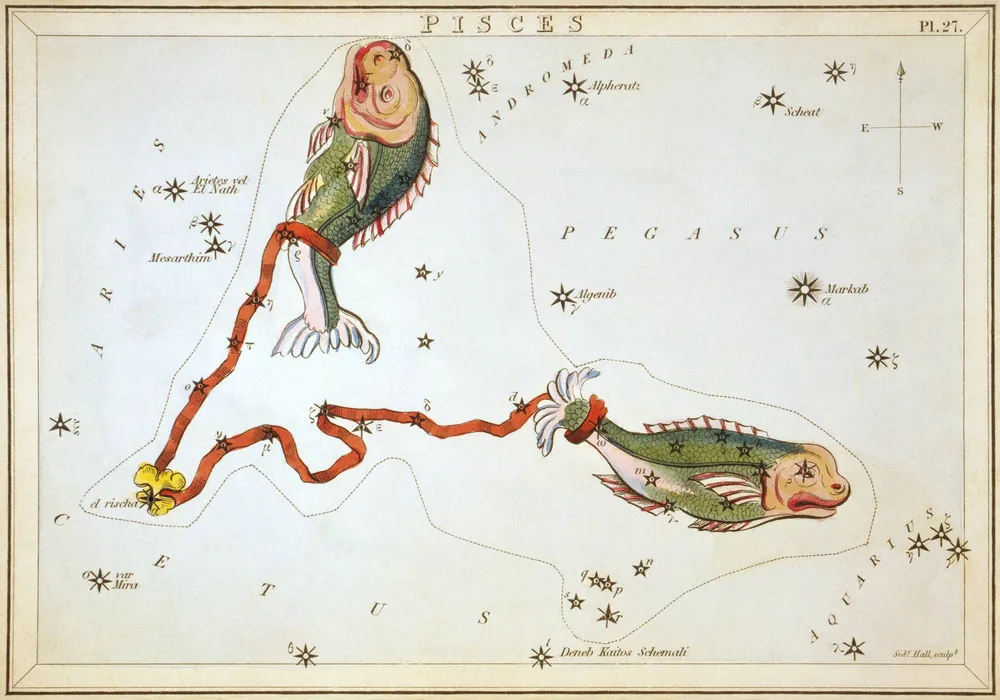
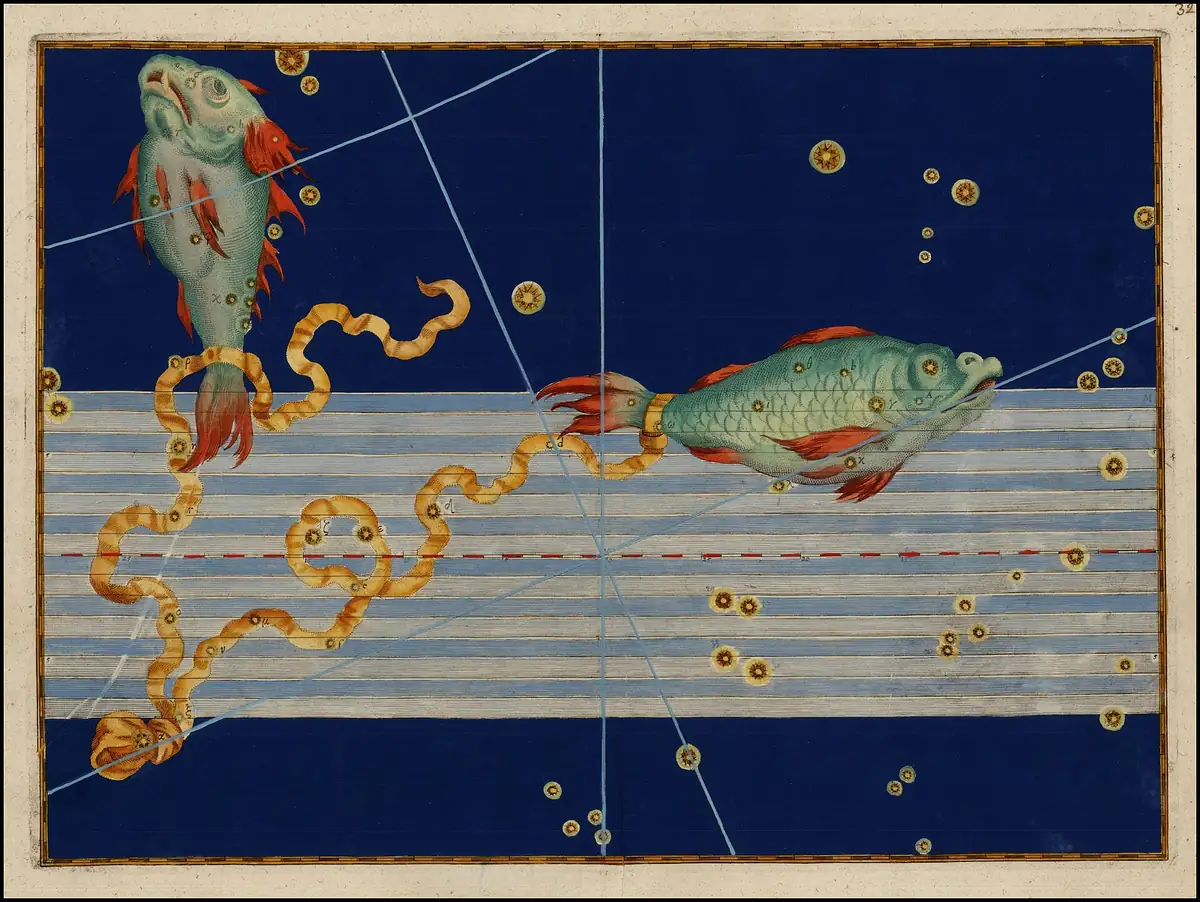
Pisces is traditionally ruled by Jupiter. Since its discovery, many modern astrologers instead assign Pisces to Neptune — we note both rather than pick a side, since Neptune wasn't known to the astrologers who first wrote this system down. Its symbol is the Fish — two fish tied together by a cord, from a myth of Aphrodite and Eros transforming into fish to escape the monster Typhon.
What Ptolemy wrote about Pisces
For Pisces, Ptolemy’s Tetrabiblos (2nd century CE, Alexandria) is the earliest full source of house, exaltation and triangle. What Book I assigns to Pisces:
"increases her own proper power all the more in Pisces, where the beginning of the moist spring is indicated"
Ptolemy, Tetrabiblos I.19, p. 91, on Venus, trans. F. E. Robbins (Loeb Classical Library, 1940)
- Type: bicorporeal. Pisces closes winter: the Sun leaves it on Sat, Mar 20, 2027, 4:24 pm ET and Aries opens spring.
- Gender: feminine; with Taurus, Cancer, Virgo, Scorpio and Capricorn it belongs to the feminine half of an alternating circle that starts at Aries.
- House: the house (domicile) of Jupiter.
- Exaltation: Venus is exalted here and Mercury is in its "depression" (later astrologers say "fall").
- Triangle: Pisces shares Ptolemy's fourth triangle with Cancer and Scorpio, governed by Mars, with Venus by day and the Moon by night as co-rulers. Ptolemy numbers these triangles and describes them by winds; naming them after the four elements came later.
Read further in our Tetrabiblos guide; Pisces’s later scoring sits in essential dignities.
The house, the bounds and the points of Pisces in Ptolemy and Lilly
Who is strong in Pisces? By Lilly’s points (five for a house, four for an exaltation, three for a triplicity) it is Venus, Mars and Jupiter; the Sun, the Moon and Saturn are left without a sign-level dignity. Ptolemy’s chapters 17 to 19 give the house to Jupiter and the exaltation of Venus, and the triplicity ruler is Mars, day and night, with Venus by day and the moon by night as co-rulers. More in essential dignities.
| Planet | Standing in Pisces | Points |
|---|---|---|
| Mercury | Detriment (opposite its own house); Fall (opposite its exaltation) | debility |
| Venus | Exaltation | +4 |
| Mars | Triplicity ruler, day and night (Ptolemy and Lilly) | +3 |
| Jupiter | Own house (domicile) | +5 |
Ptolemy’s two tables hand the same planet 20 of the 30 degrees of Pisces. Venus opens the sign in both tables; the longest bound is Venus’s in the first (12°) and Venus’s in the second (8°). Lilly, introducing his table of dignities, writes “I present thee with a Table according to” Ptolemy.
| Bound | Egyptian table (I.20) | Ptolemy’s own table (I.21) |
|---|---|---|
| Bound 1 | Venus 0° to 12° | Venus 0° to 8° |
| Bound 2 | Jupiter 12° to 16° | Jupiter 8° to 14° |
| Bound 3 | Mercury 16° to 19° | Mercury 14° to 20° |
| Bound 4 | Mars 19° to 28° | Mars 20° to 25° |
| Bound 5 | Saturn 28° to 30° | Saturn 25° to 30° |
Pisces through two old books: Lilly’s places, Ptolemy’s stars
Christian Astrology (1647), chapter XVI, assigns each sign qualities and a share of the map. Here are two phrases from the Pisces entry, offered as history of the tradition and not as a forecast for any place or person.
“…an idle, effeminate…”
William Lilly, Christian Astrology (1647), chapter XVI
“…Calabria in Sicilia, Portugall, Normandy, the North of Egipt…”
William Lilly, Christian Astrology (1647), chapter XVI
The stars themselves get a chapter of their own in Ptolemy (I.9). Under the constellation Pisces he sets out 6 groups and says which planets they act like:
“Of the stars in Pisces, those in the head of the southern Fish act in the same way as Mercury and somewhat as does Saturn; those in the body, as do Jupiter and Mercury; those in the tail and the southern cord, as do Saturn and, in some degree, Mercury; those in the body and backbone of the northern Fish, as do Jupiter and, in some degree, Venus; those in the northern part of the cord, as do Saturn and Jupiter; and the bright star on the bond, as do Mars and, in some degree, Mercury.”
Ptolemy, Tetrabiblos I.9, trans. Robbins (1940)
Reading the list as data: Mercury in 4, Saturn in 3, Jupiter in 3, Mars in 1 and Venus in 1, across 6 groups. 4 of them include Saturn or Mars, the planets chapter 5 calls maleficent, and 3 include Jupiter, Venus or the moon, the beneficent ones. Mercury is named most often (4 of 6 groups).
Element and modality
| Relation | Pisces |
|---|---|
| Element and modality | Water, mutable |
| Class (Ptolemy I.11) | bicorporeal |
| Opposite (180°) | Virgo |
| Trines (120°) | Cancer and Scorpio |
| Squares or quartiles (90°) | Gemini and Sagittarius |
| Sextiles (60°) | Taurus and Capricorn |
| Never in aspect (one or five signs away) | Aries, Leo, Libra and Aquarius |
| Rises in equal time with (I.14) | Aries (Pisces is the obeying sign of the pair) |
| Equal power, “beholds” (I.15) | Libra |
Pisces is the only mutable water sign; the other mutable signs are Gemini, Virgo and Sagittarius, and the other water signs are Cancer and Scorpio. Ptolemy sets Pisces beside Libra as signs of equal power, since the days are equal when the Sun comes into either. New York agrees: 10 h 48 min on Feb 18, 2027 (start of Pisces) and 10 h 51 min on Oct 22, 2027 (last full day of Libra), 3 minutes apart.
Traditionally easiest matches
For Pisces the easy pairings by element are Cancer and Scorpio, which share water, and Taurus, Virgo and Capricorn, the earth signs:
Pick a sign and the Zodiac Compatibility calculator sets it against Pisces.
Pisces strengths and challenges
Strengths and challenges, as the tradition pairs them for Pisces:
| Traditional strengths | Traditional challenges |
|---|---|
| Compassion | Escapism |
| Imagination | Blurred boundaries |
| Intuition | Avoiding hard decisions |
Pisces in love and relationships
Pisces is traditionally read as a romantic, devoted and deeply empathetic partner who feels a lover's moods as its own. The classic caution is losing itself in the relationship or seeing a partner as it wishes they were. Water and earth signs are the traditional natural matches, while fire and air signs may need to meet Pisces's sensitivity halfway.
Pisces at work
Pisces is traditionally linked with creative and caring work: the arts, music, healing professions, counselling, charity and spiritual work. Pisces is often described as bringing imagination and kindness to any team, with the traditional caution of struggling with rigid structures and deadlines.
For Pisces in the other two positions, Moon in Pisces and Pisces rising; the Sun, Moon and rising guide explains the combination.
6.88 million US births, 1994 to 2014: how many had the Sun in Pisces
Sorting 85.4 million US births (1994 to 2014, CDC and SSA daily counts) by the Sun’s real sign puts 6.88 million, 8.06%, in Pisces. A flat spread over the 29.95-day season would be 8.20%; Pisces lands 0.14 points below that and ranks as number 9 of the 12. Annual shares ran from 7.83% in 2011 to 8.28% in 2009.
| Year | Share of the year’s births in Pisces | Estimated Pisces births (thousands) |
|---|---|---|
| 1994 | 8.15% | 322 |
| 1995 | 8.06% | 314 |
| 1996 | 8.08% | 314 |
| 1997 | 8.15% | 316 |
| 1998 | 8.18% | 322 |
| 1999 | 8.04% | 318 |
| 2000 | 7.88% | 320 |
| 2001 | 8.05% | 324 |
| 2002 | 8.16% | 328 |
| 2003 | 8.17% | 334 |
| 2004 | 8.09% | 339 |
| 2005 | 7.93% | 334 |
| 2006 | 7.88% | 341 |
| 2007 | 8.11% | 355 |
| 2008 | 8.24% | 355 |
| 2009 | 8.28% | 347 |
| 2010 | 8.11% | 329 |
| 2011 | 7.83% | 314 |
| 2012 | 7.84% | 314 |
| 2013 | 8.04% | 319 |
| 2014 | 8.07% | 324 |
Splitting by month gives February (2.41 million) and March (4.48 million). Among Pisces dates the busiest was March 1 (11,129 births a day over the 21 years) and the quietest March 13 (10,654 a day), judged against each year’s own average so later, larger years do not skew it.
Method note for Pisces: births are spread evenly over each US Eastern day and given the Sun’s sign hour by hour. The 42 days of entry and exit hold 222 thousand Pisces-Sun births. A date rule of Feb 19 – Mar 20 puts 131 thousand births in the wrong sign and misses 69 thousand, a 2.9% error on the sign.
Outer planets in Pisces: the 2026 to 2030 picture, with the previous and next stays
In the 2026 to 2030 window Saturn and Neptune are in Pisces. A stay here means first entry to last exit, retrograde dips into the adjoining sign included.
| Planet | Stay overlapping 2026 to 2030 | Previous stay | Next stay |
|---|---|---|---|
| Jupiter | Not in the sign | May 13, 2021 to Dec 20, 2022 | Apr 14, 2033 to Apr 21, 2034 |
| Saturn | Mar 7, 2023 to Feb 13, 2026, with 1 return to a neighbouring sign | May 21, 1993 to Apr 7, 1996 | Apr 16, 2052 to Mar 22, 2055 |
| Uranus | Not in the sign | Mar 10, 2003 to Mar 11, 2011 | Feb 18, 2087 to Feb 18, 2095 |
| Neptune | Apr 4, 2011 to Jan 26, 2026, with 2 returns to a neighbouring sign | Apr 25, 1847 to Feb 13, 1862 | Mar 19, 2175 to Jan 1, 2190 |
| Pluto | Not in the sign | before 1801 (until Mar 3, 1823) | Mar 8, 2043 to Feb 23, 2068 |
Saturn last entered Pisces on Mar 7, 2023 and returns on Apr 16, 2052, 29.1 years later. More on the cycle at Saturn return; the quicker planets are covered in Jupiter by sign and Saturn by sign.
The oldest name for Pisces
The Babylonian figure combined Šinunutu, "the great swallow", with Anunitum, the "Lady of the Heaven". Hyginus tells how Aphrodite and Eros became fish, or were carried by fish, to escape the monster Typhon.
For Pisces among the twelve, see where the 12 zodiac signs came from.
Frequently asked questions
Is this the same as my "star sign"?
Yes. "Star sign," "sun sign," and "zodiac sign" all refer to the same thing here: the sign the Sun was traditionally in on your birth date.
Does my sign describe my whole personality?
A full traditional birth chart also considers your Moon sign, rising sign, and planetary positions. Your Sun sign is one layer of a fuller reading, not the whole picture.
How do I know my sign if I was born on a Pisces cusp date?
Check the hour, not just the day. Pisces began on February 18 in 34 of 41 years and February 19 in 7 across 1990 to 2030 (US Eastern); in 2027 it begins Thu, Feb 18, 2027, 4:33 pm ET and ends Sat, Mar 20, 2027, 4:24 pm ET, so 3:03 pm on the first day still belongs to Aquarius and 6:03 pm to Pisces. Using Feb 19 – Mar 20 as hard limits would have mislabelled about 200 thousand births of 1994 to 2014 (2.9% of the Pisces births).
Pisces season: start and end for 2027 and 2028?
For 2027 the answer is Thu, Feb 18, 2027, 4:33 pm ET (1:33 pm PT) to Sat, Mar 20, 2027, 4:24 pm ET, 29.95 days at 1.002 degrees a day. For 2028 it is Fri, Feb 18, 2028, 10:26 pm ET (7:26 pm PT) to Sun, Mar 19, 2028, 10:17 pm ET, 29.95 days. By length the season is 8th-longest of twelve.
Is Pisces season spent in the constellation Pisces?
Not for all of it: in 2027 the Sun spends tropical Pisces in front of Aquarius (21.9 days) and Pisces (8.0 days). For Pisces itself the dates are Mar 12 to Apr 19, a stay of 37.5 days. 0° Pisces lies in Aquarius in 2027; it lay in Pisces when Ptolemy wrote.
What share of births is Pisces, and when are the busiest and quietest Pisces birthdays?
Pisces accounts for 6.88 million of the 85.4 million US births in 1994 to 2014, 8.06%, the number 9 sign (an even spread would give 8.20%). Busiest birthday March 1 at 11,129 births a day; quietest March 13 at 10,654.
Which dignities and places did Ptolemy and Lilly give Pisces?
Ptolemy: house of Jupiter and the exaltation of Venus, bounds that agree across his two tables on 20 of 30 degrees, and 6 star groups of which 4 involve Saturn or Mars. Lilly: a point scale that credits Venus, Mars and Jupiter in Pisces, and the kingdoms “Calabria in Sicilia, Portugall, Normandy, the North of Egipt”.
Does any slow planet pass through Pisces in 2026 to 2030?
Pisces gets Saturn and Neptune during 2026 to 2030. Saturn is there Mar 7, 2023 to Feb 13, 2026. Neptune is there Apr 4, 2011 to Jan 26, 2026.
When does Vedic Pisces start compared with Western Pisces?
Vedic Pisces starts on Mar 14, 2027, around 9:20 pm Eastern (Lahiri ayanamsa 24.24 degrees, 2027), 24.2 days after Western Pisces on Feb 18.
Sources
- Ptolemy, Claudius. Tetrabiblos, Book I. 2nd century CE, trans. F. E. Robbins (LacusCurtius).
- Campion, Nicholas. A History of Western Astrology, vols. I–II. Continuum, 2008–2009.
- Numyra Methodology Desk. Astrology calculation standard.
- Astrodienst Swiss Ephemeris supplies the Pisces figures; NASA JPL Horizons and the US Naval Observatory serve as checks.
- CDS VI/42 (Roman 1987, after Delporte 1930): the IAU boundary file behind the Pisces constellation table.
- Birth counts for Pisces (6.88 million) come from the CDC/NCHS and SSA daily series in FiveThirtyEight’s births data.
- William Lilly (1647), Christian Astrology, chapters XVI and XVIII, scan with long s printed as s: the Pisces passages.
- Ptolemy’s Tetrabiblos (Robbins, 1940; LacusCurtius), chapters I.9 and I.17 to I.21, for Pisces: stars, house, triangle, bounds. Quotations omit the web edition’s footnote numbers.
- "Zodiac." Wikipedia: table of 1977 IAU constellation boundaries (after Shapiro, 1977).
- "Pisces (constellation)." Wikipedia: brightest star, Babylonian name and mythology.