Capricorn Zodiac Sign
Capricorn dates: December 22 to January 19. Capricorn is the tenth sign of the zodiac, a cardinal earth sign traditionally ruled by Saturn.
Traditionally read as the most disciplined sign: ambitious, patient, and comfortable with long-term responsibility.

Key takeaways
- A genuine willingness to put in years of unglamorous effort toward a goal.
- A traditional association with structure, tradition, and earned authority.
- A cardinal earth sign: initiates through discipline and long-range planning.
- Nothing here is medical, financial, legal, or psychological advice. It is a cultural tradition, presented for reflection.
Capricorn dates, and where the Sun really is
Capricorn is dated Dec 22 to Jan 19 in the tropical zodiac, the system this site uses, with a day either way depending on the year. The star pattern Capricornus is another matter: the Sun is in front of it from about Jan 19 to Feb 15, some 28 days by the IAU boundaries.
| Tropical sign Capricorn | Dec 22 to Jan 19 |
|---|---|
| Sun in the constellation Capricornus | About Jan 19 to Feb 15 (28 days) |
| Brightest star | Deneb Algedi (magnitude about 2.9) |
Precession, a degree every 72 years or so, did the drifting: 0° Capricorn lay in Sagittarius around 150 CE and lies in Sagittarius today. Why the tropical dates survived is in the sidereal vs. tropical guide.
When does Capricorn actually start?
Calendar dates for Capricorn are rounded; the true start is when the Sun reaches 0° Capricorn. Our 1950 to 2030 table shows that from 1990 to 2030 it happened on December 21 in 35 of 41 years and December 22 in 6 (US Eastern). In 2027 it is Tue, Dec 21, 2027, 9:42 pm ET: a New York birth at 8:12 pm on Dec 21 is a Sagittarius, one at 11:12 pm on Dec 21 is a Capricorn.
Exact Capricorn start date and time for every year, 1950 to 2030
| Year | Sun enters Capricorn (US Eastern time) |
|---|---|
| 1950 | Dec 22, 5:13 am |
| 1951 | Dec 22, 11:00 am |
| 1952 | Dec 21, 4:43 pm |
| 1953 | Dec 21, 10:31 pm |
| 1954 | Dec 22, 4:24 am |
| 1955 | Dec 22, 10:10 am |
| 1956 | Dec 21, 3:59 pm |
| 1957 | Dec 21, 9:48 pm |
| 1958 | Dec 22, 3:39 am |
| 1959 | Dec 22, 9:34 am |
| 1960 | Dec 21, 3:25 pm |
| 1961 | Dec 21, 9:19 pm |
| 1962 | Dec 22, 3:15 am |
| 1963 | Dec 22, 9:01 am |
| 1964 | Dec 21, 2:49 pm |
| 1965 | Dec 21, 8:40 pm |
| 1966 | Dec 22, 2:28 am |
| 1967 | Dec 22, 8:16 am |
| 1968 | Dec 21, 1:59 pm |
| 1969 | Dec 21, 7:43 pm |
| 1970 | Dec 22, 1:35 am |
| 1971 | Dec 22, 7:23 am |
| 1972 | Dec 21, 1:12 pm |
| 1973 | Dec 21, 7:07 pm |
| 1974 | Dec 22, 12:55 am |
| 1975 | Dec 22, 6:45 am |
| 1976 | Dec 21, 12:35 pm |
| 1977 | Dec 21, 6:23 pm |
| 1978 | Dec 22, 12:20 am |
| 1979 | Dec 22, 6:09 am |
| 1980 | Dec 21, 11:56 am |
| 1981 | Dec 21, 5:50 pm |
| 1982 | Dec 21, 11:38 pm |
| 1983 | Dec 22, 5:29 am |
| 1984 | Dec 21, 11:22 am |
| 1985 | Dec 21, 5:07 pm |
| 1986 | Dec 21, 11:02 pm |
| 1987 | Dec 22, 4:45 am |
| 1988 | Dec 21, 10:27 am |
| 1989 | Dec 21, 4:22 pm |
| 1990 | Dec 21, 10:06 pm |
| 1991 | Dec 22, 3:53 am |
| 1992 | Dec 21, 9:43 am |
| 1993 | Dec 21, 3:25 pm |
| 1994 | Dec 21, 9:22 pm |
| 1995 | Dec 22, 3:16 am |
| 1996 | Dec 21, 9:05 am |
| 1997 | Dec 21, 3:07 pm |
| 1998 | Dec 21, 8:56 pm |
| 1999 | Dec 22, 2:43 am |
| 2000 | Dec 21, 8:37 am |
| 2001 | Dec 21, 2:21 pm |
| 2002 | Dec 21, 8:14 pm |
| 2003 | Dec 22, 2:03 am |
| 2004 | Dec 21, 7:41 am |
| 2005 | Dec 21, 1:34 pm |
| 2006 | Dec 21, 7:22 pm |
| 2007 | Dec 22, 1:07 am |
| 2008 | Dec 21, 7:03 am |
| 2009 | Dec 21, 12:46 pm |
| 2010 | Dec 21, 6:38 pm |
| 2011 | Dec 22, 12:30 am |
| 2012 | Dec 21, 6:11 am |
| 2013 | Dec 21, 12:11 pm |
| 2014 | Dec 21, 6:03 pm |
| 2015 | Dec 21, 11:47 pm |
| 2016 | Dec 21, 5:44 am |
| 2017 | Dec 21, 11:27 am |
| 2018 | Dec 21, 5:22 pm |
| 2019 | Dec 21, 11:19 pm |
| 2020 | Dec 21, 5:02 am |
| 2021 | Dec 21, 10:59 am |
| 2022 | Dec 21, 4:48 pm |
| 2023 | Dec 21, 10:27 pm |
| 2024 | Dec 21, 4:20 am |
| 2025 | Dec 21, 10:03 am |
| 2026 | Dec 21, 3:50 pm |
| 2027 | Dec 21, 9:42 pm |
| 2028 | Dec 21, 3:19 am |
| 2029 | Dec 21, 9:14 am |
| 2030 | Dec 21, 3:09 pm |
Birth Chart calculator for a specific time and place.
The Sun reaches 15° Capricorn, the middle of the sign, on Wed, Jan 5, 2028, 2:54 pm ET; whoever was born at that degree has a solar return at that moment.
Capricorn also splits into three decans of 10° each. In most years they begin on December 21, December 31 and January 10. Our guide to the Capricorn decans explains what each one adds and who rules it in the three traditional systems.
When Capricorn starts and ends, 2026 to 2030: exact times in Eastern and Pacific
Capricorn season in 2027 opens Tue, Dec 21, 2027, 9:42 pm ET (6:42 pm PT) and closes Thu, Jan 20, 2028, 8:21 am ET (5:21 am PT): 29.44 days, or 29 days 10 h 40 min. Of the twelve seasons of 2027 this is the shortest. Earth reaches perihelion, its closest point to the Sun, on Jan 5, 2028 inside this sign, at 147.10 million km, so the Sun races through at about 1.018 degrees a day and Capricorn is the shortest season of the year.
| Year | Sun enters Capricorn (Eastern) | Sun enters Capricorn (Pacific) | Sun leaves Capricorn (Eastern) | Days |
|---|---|---|---|---|
| 2026 | Mon, Dec 21, 3:50 pm | Mon, Dec 21, 12:50 pm | Jan 20, 2:29 am | 29.44 |
| 2027 | Tue, Dec 21, 9:42 pm | Tue, Dec 21, 6:42 pm | Jan 20, 8:21 am | 29.44 |
| 2028 | Thu, Dec 21, 3:19 am | Thu, Dec 21, 12:19 am | Jan 19, 2:00 pm | 29.45 |
| 2029 | Fri, Dec 21, 9:14 am | Fri, Dec 21, 6:14 am | Jan 19, 7:54 pm | 29.44 |
| 2030 | Sat, Dec 21, 3:09 pm | Sat, Dec 21, 12:09 pm | Jan 20, 1:47 am | 29.44 |
The Capricorn entry moves 5.9 hours later between 2026 and 2027, and the 2028 leap day brings it back to Thu, Dec 21, 3:19 am ET, the same date as 2027. The sign’s length hardly changes: 29.441 days in 2019 against 29.446 in 2025, only 7 minutes apart.
Daylight in New York runs 9 h 15 min on Dec 21, 2027 (sunrise 07:16, sunset 16:31) and 9 h 41 min on Jan 19, 2028 (sunrise 07:16, sunset 16:57), the first and last days of Capricorn: 26 minutes more.
Under the Lahiri ayanamsa (24.25 degrees in 2027) the sidereal Capricorn begins 23.8 days later than the tropical one: on Jan 14, 2028, around 4:40 pm Eastern, or Jan 15 in India. Our sidereal vs. tropical guide explains the choice.
What stands behind the Sun in Capricorn season: the 2027 constellations
Through the whole 29.4-day Capricorn season of 2027 the Sun stays in front of Sagittarius; the sign and the star pattern behind it share no days at all.
| Constellation behind the Sun | Sun enters it | Sun leaves it | Days of the Capricorn season spent there |
|---|---|---|---|
| Sagittarius | Sat, Dec 18, 2:12 pm | Thu, Jan 20, 9:29 am | 29.44 |
For Capricornus itself the Sun is in front of it from Wed, Jan 20, 2027, 3:17 am until Tue, Feb 16, 2027, 1:49 pm ET, 27.4 days, and 27.4 of those days belong to tropical Aquarius. The earlier table gives Jan 19 to Feb 15 (28 days); the gap of a day or two is precession at work on a fixed boundary.
Where does 0° Capricorn sit among the stars? In front of Sagittarius in 2027. It entered Sagittarius about 130 BCE and will cross into Ophiuchus about 2270. Around 150 CE, when Ptolemy wrote, it was in Sagittarius; since then precession has moved the equinoxes 26.2 degrees backwards.
The traditional shadow side
The traditional shadow side is rigidity and a real risk of over-identifying with achievement or status: measuring worth by output. The growth edge is allowing rest and connection that isn't justified by productivity.
Ruling planet and symbol
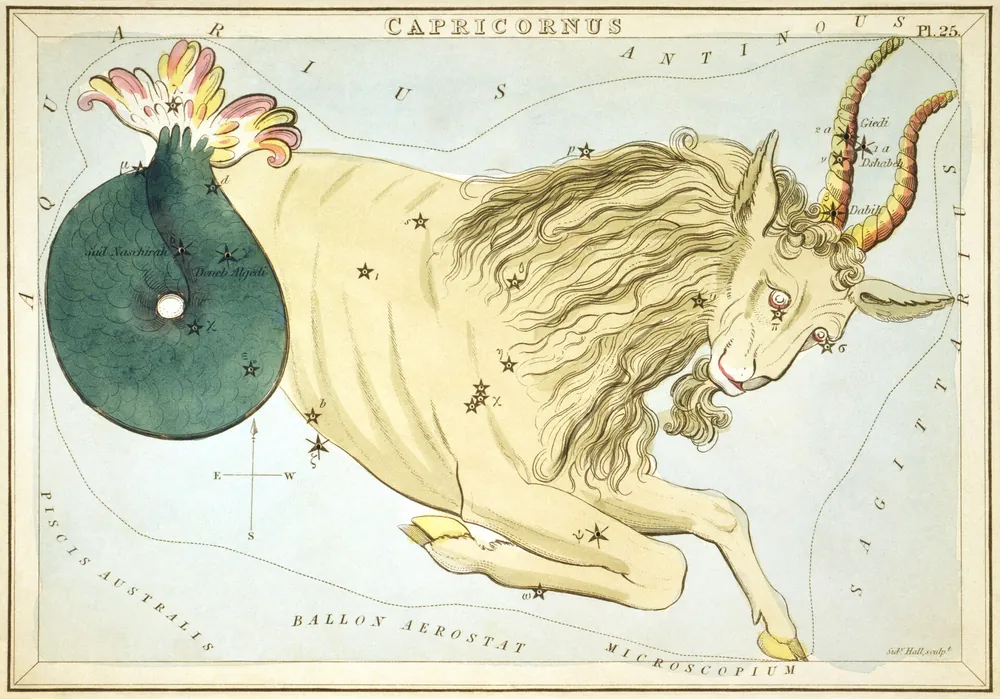
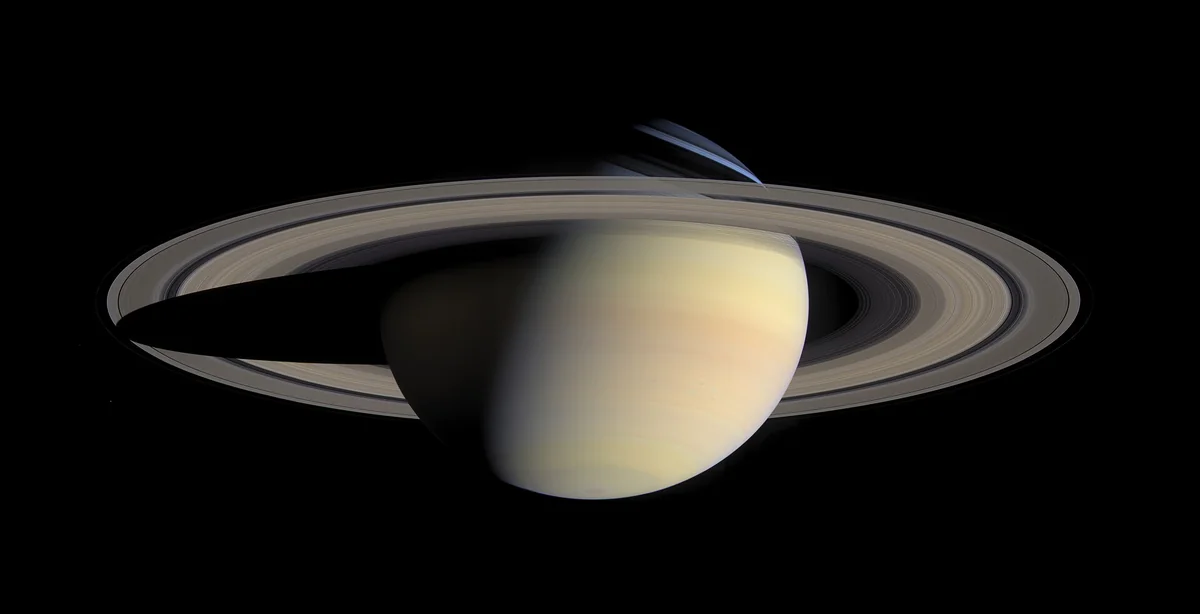
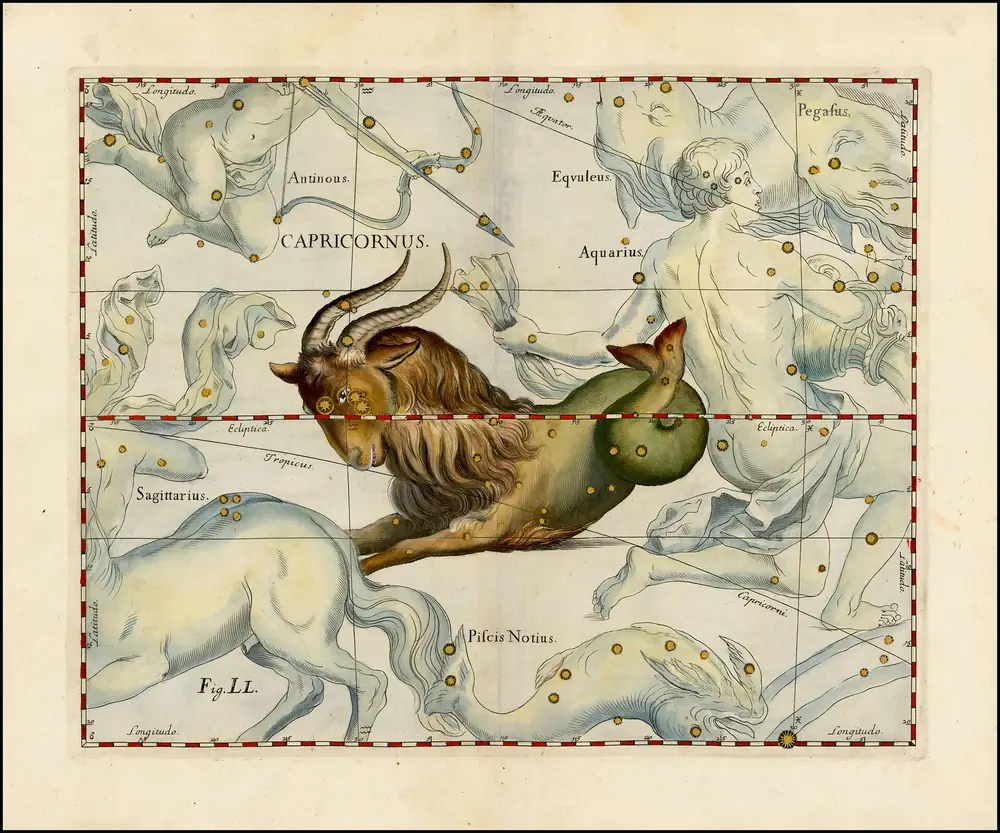
Capricorn is traditionally ruled by Saturn, one of the seven classical "planets" (Sun and Moon included) known to the astrologers who first wrote this system down. Its symbol is the Sea-Goat — a goat with a fish's tail, tied to a myth of the god Pan diving into a river and transforming partway into a fish to escape the monster Typhon.
What Ptolemy wrote about Capricorn
The Tetrabiblos, which Ptolemy wrote in 2nd-century Alexandria, is where Capricorn first gets a house, an exaltation and a triangle in a full text. Book I places Capricorn as follows.
"Mars, which by nature is fiery and becomes all the more so in Capricorn because in it he is farthest south"
Ptolemy, Tetrabiblos I.19, p. 91, trans. F. E. Robbins (Loeb Classical Library, 1940)
- Type: solstitial. Capricorn opens winter: in 2027 the December solstice and the Sun’s entry into Capricorn are the same moment, Tue, Dec 21, 2027, 9:42 pm ET.
- Gender: feminine. The genders alternate from Aries, so Capricorn shares it with Taurus, Cancer, Virgo, Scorpio and Pisces.
- House: the house (domicile) of Saturn.
- Exaltation: Mars is exalted here and Jupiter is in its "depression" (later astrologers say "fall").
- Triangle: Capricorn shares Ptolemy's second triangle with Taurus and Virgo, governed by Venus by day and the Moon by night. Ptolemy numbers these triangles and describes them by winds; naming them after the four elements came later.
On the book: Ptolemy’s Tetrabiblos. On the scoring of Capricorn: essential dignities.
Who holds Capricorn: dignities, bounds and Lilly’s points
At sign level, the Sun and Mercury hold nothing in Capricorn, while Venus, Mars and Saturn score for it in Lilly’s system (five points for a house, four for an exaltation, three for a triplicity). In Ptolemy, Book I chapters 17 to 19, the sign belongs to Saturn and the exaltation of Mars; the triplicity rulers are Venus by day and the Moon by night. See essential dignities for the rules.
| Planet | Standing in Capricorn | Points |
|---|---|---|
| The Moon | Triplicity ruler by night; Detriment (opposite its own house) | +3 by night; debility |
| Venus | Triplicity ruler by day | +3 by day |
| Mars | Exaltation | +4 |
| Jupiter | Fall (opposite its exaltation) | debility |
| Saturn | Own house (domicile) | +5 |
Compare the columns and 10 of Capricorn’s 30 degrees go to the same planet in both. Mercury opens the sign in the Egyptian table and Venus in Ptolemy’s own; the longest bound is Venus’s in the first (8°) and Jupiter’s in the second (7°). Ptolemy objects to Mercury leading Capricorn in the Egyptian order: “why have they given Mercury, and not Venus, first place in Capricorn”. Lilly, introducing his table of dignities, writes “I present thee with a Table according to” Ptolemy.
| Bound | Egyptian table (I.20) | Ptolemy’s own table (I.21) |
|---|---|---|
| Bound 1 | Mercury 0° to 7° | Venus 0° to 6° |
| Bound 2 | Jupiter 7° to 14° | Mercury 6° to 12° |
| Bound 3 | Venus 14° to 22° | Jupiter 12° to 19° |
| Bound 4 | Saturn 22° to 26° | Saturn 19° to 25° |
| Bound 5 | Mars 26° to 30° | Mars 25° to 30° |
Capricorn in Lilly’s map of 1647 and Ptolemy’s star list
Lilly’s chapter XVI (Christian Astrology, 1647) gives every sign a nature, a list of places and a set of “kingdoms” and cities. For Capricorn it reads as follows; it is the 17th-century geography of the tradition, not a prediction about any country or person.
“…Earthly, Feminine, Solsticiall, Cardinall, Moveable…”
William Lilly, Christian Astrology (1647), chapter XVI
“…Thrace, Macedon in Greece now Turkie, Albania, Bulgaria…”
William Lilly, Christian Astrology (1647), chapter XVI
In Book I, chapter 9, Ptolemy walks through the star figures of the zodiac. For the constellation Capricornus he gives 4 groups, each matched to the planets it resembles:
“Of the stars in Capricorn, those in the horns act in the same way as Venus and, in some degree, as Mars; those in the mouth, as Saturn and, in some degree, as Venus; those in the feet and the belly, as Mars and Mercury; and those in the tail, as Saturn and Jupiter.”
Ptolemy, Tetrabiblos I.9, trans. Robbins (1940)
A tally of the 4 groups gives Saturn in 2, Mars in 2, Venus in 2, Jupiter in 1 and Mercury in 1. Saturn and Mars, his maleficent pair (chapter 5), figure in 4 groups; Jupiter, Venus and the moon, his beneficent three, in 3. Saturn is named most often (2 of 4 groups).
Element and modality
| Relation | Capricorn |
|---|---|
| Element and modality | Earth, cardinal |
| Class (Ptolemy I.11) | solstitial |
| Opposite (180°) | Cancer |
| Trines (120°) | Taurus and Virgo |
| Squares or quartiles (90°) | Aries and Libra |
| Sextiles (60°) | Pisces and Scorpio |
| Never in aspect (one or five signs away) | Aquarius, Gemini, Leo and Sagittarius |
| Rises in equal time with (I.14) | Gemini (Capricorn is the obeying sign of the pair) |
| Equal power, “beholds” (I.15) | Sagittarius |
Capricorn is the only cardinal earth sign; the other cardinal signs are Aries, Cancer and Libra, and the other earth signs are Taurus and Virgo. Why does Ptolemy pair Capricorn with Sagittarius? Because the Sun’s entry into one gives the same day length as its exit from the other. In New York that is 9 h 15 min on Dec 21, 2027 (the day Capricorn opens) against 9 h 15 min on Dec 20, 2027 (the last full day of Sagittarius): 0 minutes apart.
Traditionally easiest matches
By element, Capricorn pairs most easily with Taurus and Virgo (earth) and Cancer, Scorpio and Pisces (water):
To compare Capricorn with one particular sign, use the Zodiac Compatibility calculator.
Capricorn strengths and challenges
What the tradition lists for Capricorn, strengths first and challenges alongside:
| Traditional strengths | Traditional challenges |
|---|---|
| Discipline | Rigidity |
| Patience with long goals | Workaholism |
| Responsibility | Pessimism |
Capricorn in love and relationships
Capricorn is traditionally read as a serious, loyal partner who shows love through commitment and building a future together. Warmth may take time to show, and the classic caution is putting work ahead of the relationship. Earth and water signs are the traditional natural fits, while fire and air partners can bring the lightness Capricorn sometimes needs.
Capricorn at work
Capricorn is traditionally the sign most linked with career itself: management, business, government, engineering and any field with a long ladder to climb. Capricorn is often described as the one who still shows up in year ten, with the traditional caution of measuring self-worth only by achievement.
Two more layers to read: Moon in Capricorn and Capricorn rising. How the three fit together is in the Sun, Moon and rising guide.
6.50 million US births, 1994 to 2014: how many had the Sun in Capricorn
6.50 million of the 85.4 million US births counted from 1994 to 2014 (7.62%) happened with the Sun in Capricorn. Season length alone (29.44 of 365.24 days) predicts 8.06%, so the real share is 0.44 points below it, which ranks Capricorn number 12 of the twelve signs. The lowest year was 2006 (7.42%) and the highest 2008 (7.93%).
| Year | Share of the year’s births in Capricorn | Estimated Capricorn births (thousands) |
|---|---|---|
| 1994 | 7.55% | 298 |
| 1995 | 7.48% | 292 |
| 1996 | 7.76% | 302 |
| 1997 | 7.59% | 295 |
| 1998 | 7.59% | 299 |
| 1999 | 7.57% | 300 |
| 2000 | 7.85% | 319 |
| 2001 | 7.59% | 305 |
| 2002 | 7.56% | 304 |
| 2003 | 7.48% | 306 |
| 2004 | 7.81% | 327 |
| 2005 | 7.54% | 318 |
| 2006 | 7.42% | 322 |
| 2007 | 7.50% | 329 |
| 2008 | 7.93% | 342 |
| 2009 | 7.54% | 316 |
| 2010 | 7.62% | 309 |
| 2011 | 7.57% | 303 |
| 2012 | 7.70% | 308 |
| 2013 | 7.69% | 305 |
| 2014 | 7.60% | 305 |
December (2.25 million) and January (4.26 million): that is how the Capricorn births divide by calendar month. The date with the most births, averaged over the 21 years, was December 29 at 11,956 a day, and the date with the fewest was December 25 at 6,574; dates are compared with each year’s own average.
How the edges are counted: hour by hour, Eastern time, the Sun’s true sign. On the 42 days when the Sun entered or left Capricorn, 232 thousand births had the Sun in Capricorn. The simple date rule (Dec 22 – Jan 19) would have misfiled 18 thousand into Capricorn and 121 thousand out of it, 2.1% of the total.
Which slow planets visit Capricorn in 2026 to 2030, and when they were last and next there
Capricorn has no slow-planet visitor from 2026 to 2030. Jupiter is next, entering on Nov 15, 2031; the far-off dates in the last column are ordinary for planets that need decades to cross a sign.
| Planet | Stay overlapping 2026 to 2030 | Previous stay | Next stay |
|---|---|---|---|
| Jupiter | Not in the sign | Dec 2, 2019 to Dec 19, 2020 | Nov 15, 2031 to Nov 29, 2032 |
| Saturn | Not in the sign | Dec 19, 2017 to Dec 17, 2020 | Jan 24, 2047 to Jan 21, 2050 |
| Uranus | Not in the sign | Feb 14, 1988 to Jan 12, 1996 | Jan 22, 2072 to Dec 23, 2079 |
| Neptune | Not in the sign | Jan 18, 1984 to Nov 27, 1998 | Jan 4, 2148 to Oct 31, 2162 |
| Pluto | Not in the sign | Jan 25, 2008 to Nov 19, 2024 | not before 2200 |
Saturn needs 29.1 years between one arrival in Capricorn and the next (Dec 19, 2017, then Jan 24, 2047). Faster planets: Jupiter by sign, Saturn by sign; the cycle itself: Saturn return.
The oldest name for Capricorn
The Babylonian MUL SUḪUR.MAŠ is "The Goat-Fish", a symbol of the god Ea, first attested on a cylinder seal from around the 21st century BCE. Greek accounts vary: sometimes Amalthea, the goat that nursed Zeus, sometimes Pan, who grew a fish's tail fleeing Typhon.
The story of how Capricorn and eleven other star groups became signs is in where the 12 zodiac signs came from.
Frequently asked questions
Is this the same as my "star sign"?
Yes. "Star sign," "sun sign," and "zodiac sign" all refer to the same thing here: the sign the Sun was traditionally in on your birth date.
Does my sign describe my whole personality?
A full traditional birth chart also considers your Moon sign, rising sign, and planetary positions. Your Sun sign is one layer of a fuller reading, not the whole picture.
What if my birthday is on the edge of Capricorn?
The date alone cannot tell you. The Sun entered Capricorn on December 21 in 35 of 41 years and December 22 in 6 between 1990 and 2030 (US Eastern), and the 2027 entry is Tue, Dec 21, 2027, 9:42 pm ET: at 8:12 pm that day a baby is a Sagittarius, at 11:12 pm a Capricorn. The exit comes Thu, Jan 20, 2028, 8:21 am ET. Treating Dec 22 – Jan 19 as exact would have put about 139 thousand births of 1994 to 2014 in the wrong sign (2.1% of Capricorn).
What are the exact Capricorn start and end times for 2027 and 2028?
In 2027 the Sun is in Capricorn from Tue, Dec 21, 2027, 9:42 pm ET (6:42 pm PT) until Thu, Jan 20, 2028, 8:21 am ET, 29.44 days; in 2028 from Thu, Dec 21, 2028, 3:19 am ET (12:19 am PT) until Fri, Jan 19, 2029, 2:00 pm ET, 29.45 days. The season ranks shortest of twelve and the Sun moves 1.019 degrees a day through it.
Does Capricorn season take place in front of the constellation Capricornus?
For all 29.4 days of tropical Capricorn in 2027 the Sun is in front of Sagittarius. Capricornus itself has the Sun from Jan 20 to Feb 16 (27.4 days). The start of Capricorn is in Sagittarius today and was in Sagittarius in Ptolemy’s time.
How many people have the Sun in Capricorn, and what is its busiest birthday?
Among 85.4 million US births from 1994 to 2014, 6.50 million (7.62%) fall in Capricorn, ranking it 12 of 12; season length alone would predict 8.06%. December 29 was the busiest Capricorn date (11,956 births a day) and December 25 the quietest (6,574).
How do Ptolemy and Lilly treat Capricorn?
Capricorn belongs to Saturn and the exaltation of Mars in Ptolemy. Lilly’s points favour Venus, Mars and Saturn there, and Ptolemy’s two bound tables match on 10 of 30 degrees. Lilly’s kingdoms for Capricorn include “Thrace, Macedon in Greece now Turkie, Albania, Bulgaria”; Ptolemy’s star list for the Capricornus has Saturn or Mars in 4 of 4 groups.
Is Jupiter, Saturn, Uranus, Neptune or Pluto in Capricorn from 2026 to 2030?
None; Capricorn stays empty of slow planets until Jupiter arrives on Nov 15, 2031.
What is the sidereal start date of Capricorn?
Sidereal Capricorn begins 23.8 days after the tropical one: on Jan 14, 2028, around 4:40 pm Eastern, using the Lahiri ayanamsa of 24.25 degrees (2027). The tropical entry is Dec 21.
Sources
- Ptolemy, Claudius. Tetrabiblos, Book I. 2nd century CE, trans. F. E. Robbins (LacusCurtius).
- Campion, Nicholas. A History of Western Astrology, vols. I–II. Continuum, 2008–2009.
- Numyra Methodology Desk. Astrology calculation standard.
- Swiss Ephemeris (Astrodienst, Moshier mode) for every Capricorn time and planet stay above, compared with NASA JPL Horizons and the US Naval Observatory.
- IAU constellation boundaries (Delporte, 1930) as tabulated in Roman (1987), CDS VI/42: the Capricorn constellation table.
- US daily births 1994 to 2014 from FiveThirtyEight (CDC/NCHS and SSA): source of the 6.50 million Capricorn births.
- Lilly’s Christian Astrology (London, 1647; scan with long s printed as s), chapters XVI and XVIII: Capricorn qualities, kingdoms, points.
- The Capricorn star list and both bound tables are Ptolemy’s, Tetrabiblos I.9, I.17 to I.21 (Robbins, 1940; LacusCurtius). Footnote numbers of the web edition are omitted from the quotation.
- "Zodiac." Wikipedia: table of 1977 IAU constellation boundaries (after Shapiro, 1977).
- "Capricornus (constellation)." Wikipedia: brightest star, Babylonian name and mythology.