Leo Zodiac Sign
Leo dates: July 23 to August 22. Leo is the fifth sign of the zodiac, a fixed fire sign traditionally ruled by the Sun.
Traditionally read as the most self-expressive sign: warm, confident, and drawn to being genuinely seen.

Key takeaways
- Natural warmth and generosity, especially toward people in their own circle.
- A traditional association with creative self-expression and performance, in whatever form that takes.
- A fixed fire sign: sustained confidence rather than Aries's quick spark.
- Nothing here is medical, financial, legal, or psychological advice. It is a cultural tradition, presented for reflection.
Leo dates, and where the Sun really is
In the tropical zodiac used by most Western astrology, and by this site, Leo runs Jul 23 to Aug 22, give or take a day. The constellation Leo is a separate patch of sky: by the IAU boundaries the Sun stands in front of it from about Aug 10 to Sep 15, roughly 37 days.
| Tropical sign Leo | Jul 23 to Aug 22 |
|---|---|
| Sun in the constellation Leo | About Aug 10 to Sep 15 (37 days) |
| Brightest star | Regulus (magnitude about 1.4) |
The signs and the stars drifted apart through precession, about one degree every 72 years: the point where Leo begins sat in Leo in Ptolemy’s day and sits in Cancer now. Our sidereal vs. tropical guide explains why astrologers kept the tropical dates.
When does Leo actually start?
The familiar dates are a rounded convention; the real start is the moment the Sun reaches 0° Leo. We calculated it for every year from 1950 to 2030, and between 1990 and 2030 the Sun entered Leo on July 22 in 35 of 41 years and July 23 in 6, in US Eastern time. The 2027 entry is Thu, Jul 22, 2027, 9:04 pm ET, so a baby born in New York at 7:34 pm on Jul 22 is a Cancer and one born at 10:34 pm on Jul 22 is a Leo.
Exact Leo start date and time for every year, 1950 to 2030
| Year | Sun enters Leo (US Eastern time) |
|---|---|
| 1950 | Jul 23, 6:29 am |
| 1951 | Jul 23, 12:20 pm |
| 1952 | Jul 22, 6:07 pm |
| 1953 | Jul 22, 11:52 pm |
| 1954 | Jul 23, 5:44 am |
| 1955 | Jul 23, 11:24 am |
| 1956 | Jul 22, 5:19 pm |
| 1957 | Jul 22, 11:14 pm |
| 1958 | Jul 23, 4:50 am |
| 1959 | Jul 23, 10:45 am |
| 1960 | Jul 22, 4:37 pm |
| 1961 | Jul 22, 10:23 pm |
| 1962 | Jul 23, 4:17 am |
| 1963 | Jul 23, 9:59 am |
| 1964 | Jul 22, 3:52 pm |
| 1965 | Jul 22, 9:48 pm |
| 1966 | Jul 23, 3:23 am |
| 1967 | Jul 23, 9:15 am |
| 1968 | Jul 22, 3:07 pm |
| 1969 | Jul 22, 8:48 pm |
| 1970 | Jul 23, 2:36 am |
| 1971 | Jul 23, 8:14 am |
| 1972 | Jul 22, 2:02 pm |
| 1973 | Jul 22, 7:55 pm |
| 1974 | Jul 23, 1:30 am |
| 1975 | Jul 23, 7:21 am |
| 1976 | Jul 22, 1:18 pm |
| 1977 | Jul 22, 7:03 pm |
| 1978 | Jul 23, 1:00 am |
| 1979 | Jul 23, 6:48 am |
| 1980 | Jul 22, 12:41 pm |
| 1981 | Jul 22, 6:39 pm |
| 1982 | Jul 23, 12:15 am |
| 1983 | Jul 23, 6:04 am |
| 1984 | Jul 22, 11:58 am |
| 1985 | Jul 22, 5:36 pm |
| 1986 | Jul 22, 11:24 pm |
| 1987 | Jul 23, 5:06 am |
| 1988 | Jul 22, 10:51 am |
| 1989 | Jul 22, 4:45 pm |
| 1990 | Jul 22, 10:21 pm |
| 1991 | Jul 23, 4:11 am |
| 1992 | Jul 22, 10:08 am |
| 1993 | Jul 22, 3:50 pm |
| 1994 | Jul 22, 9:40 pm |
| 1995 | Jul 23, 3:29 am |
| 1996 | Jul 22, 9:18 am |
| 1997 | Jul 22, 3:15 pm |
| 1998 | Jul 22, 8:55 pm |
| 1999 | Jul 23, 2:44 am |
| 2000 | Jul 22, 8:42 am |
| 2001 | Jul 22, 2:26 pm |
| 2002 | Jul 22, 8:14 pm |
| 2003 | Jul 23, 2:04 am |
| 2004 | Jul 22, 7:50 am |
| 2005 | Jul 22, 1:40 pm |
| 2006 | Jul 22, 7:17 pm |
| 2007 | Jul 23, 1:00 am |
| 2008 | Jul 22, 6:54 am |
| 2009 | Jul 22, 12:35 pm |
| 2010 | Jul 22, 6:21 pm |
| 2011 | Jul 23, 12:11 am |
| 2012 | Jul 22, 6:00 am |
| 2013 | Jul 22, 11:55 am |
| 2014 | Jul 22, 5:41 pm |
| 2015 | Jul 22, 11:30 pm |
| 2016 | Jul 22, 5:30 am |
| 2017 | Jul 22, 11:15 am |
| 2018 | Jul 22, 5:00 pm |
| 2019 | Jul 22, 10:50 pm |
| 2020 | Jul 22, 4:36 am |
| 2021 | Jul 22, 10:26 am |
| 2022 | Jul 22, 4:06 pm |
| 2023 | Jul 22, 9:50 pm |
| 2024 | Jul 22, 3:44 am |
| 2025 | Jul 22, 9:29 am |
| 2026 | Jul 22, 3:13 pm |
| 2027 | Jul 22, 9:04 pm |
| 2028 | Jul 22, 2:53 am |
| 2029 | Jul 22, 8:42 am |
| 2030 | Jul 22, 2:24 pm |
Birth Chart calculator for a specific time and place.
Halfway through the sign, at 15° Leo, the Sun is on Sat, Aug 7, 2027, 1:26 pm ET. Anyone born with the Sun at that degree has a solar return then.
Leo also splits into three decans of 10° each. In most years they begin on July 22, August 2 and August 12. Our guide to the Leo decans explains what each one adds and who rules it in the three traditional systems.
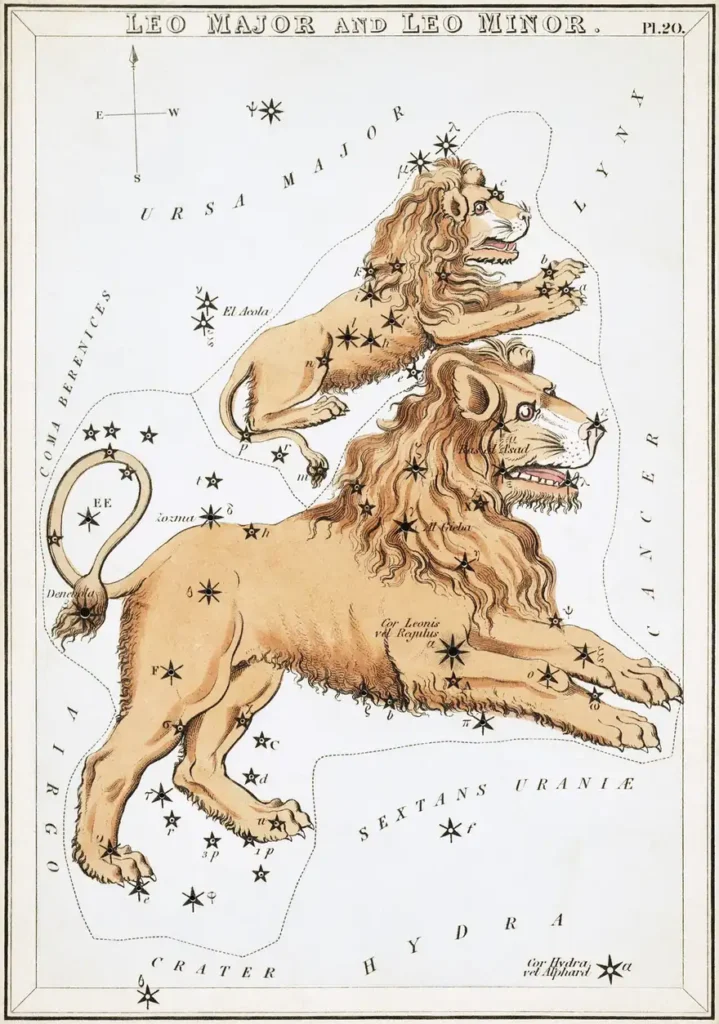
Leo season 2026 to 2030: exact Sun entry times, Eastern and Pacific
In 2027 the Sun enters Leo on Thu, Jul 22, 2027, 9:04 pm ET (6:04 pm PT) and leaves it on Mon, Aug 23, 2027, 4:14 am ET (1:14 am PT), after 31.30 days (31 days 7 h 10 min). That is the 3rd-longest of the twelve seasons in 2027. Earth is moving toward the Sun here, from 151.98 to 151.29 million km, and the Sun’s apparent speed rises from 0.955 to 0.963 degrees a day, against 0.986 on average over a year.
| Year | Sun enters Leo (Eastern) | Sun enters Leo (Pacific) | Sun leaves Leo (Eastern) | Days |
|---|---|---|---|---|
| 2026 | Wed, Jul 22, 3:13 pm | Wed, Jul 22, 12:13 pm | Aug 22, 10:18 pm | 31.30 |
| 2027 | Thu, Jul 22, 9:04 pm | Thu, Jul 22, 6:04 pm | Aug 23, 4:14 am | 31.30 |
| 2028 | Sat, Jul 22, 2:53 am | Fri, Jul 21, 11:53 pm | Aug 22, 10:00 am | 31.30 |
| 2029 | Sun, Jul 22, 8:42 am | Sun, Jul 22, 5:42 am | Aug 22, 3:51 pm | 31.30 |
| 2030 | Mon, Jul 22, 2:24 pm | Mon, Jul 22, 11:24 am | Aug 22, 9:36 pm | 31.30 |
From 2026 to 2027 the Leo entry slips 5.9 hours later on the clock; the leap day then resets the calendar, and the 2028 entry (Sat, Jul 22, 2:53 am ET) falls on the same date as 2027. Across 1990 to 2030 the sign’s length stayed between 31.291 days (1990) and 31.300 days (2019), a spread of 12 minutes.
In New York the day lasts 14 h 38 min on Jul 22, 2027, the day Leo opens (sunrise 05:43, sunset 20:21), and 13 h 31 min on Aug 22, 2027, its last full day (sunrise 06:13, sunset 19:44): 67 minutes less light across the sign.
The Indian sidereal zodiac (Lahiri ayanamsa, 24.24 degrees in 2027) puts the Sun in sidereal Leo 25.3 days after the tropical entry, on Aug 17, 2027, around 4:30 am Eastern, which is Aug 17 in India. See sidereal vs. tropical for why this site uses the tropical dates.
Behind Leo in 2027: the constellations the Sun really crosses
Only part of tropical Leo is spent in front of the constellation Leo. In 2027 the Sun spends 19.3 days in front of Cancer and 12.0 days in front of Leo, in that order; together that is the 31.30 days of the season.
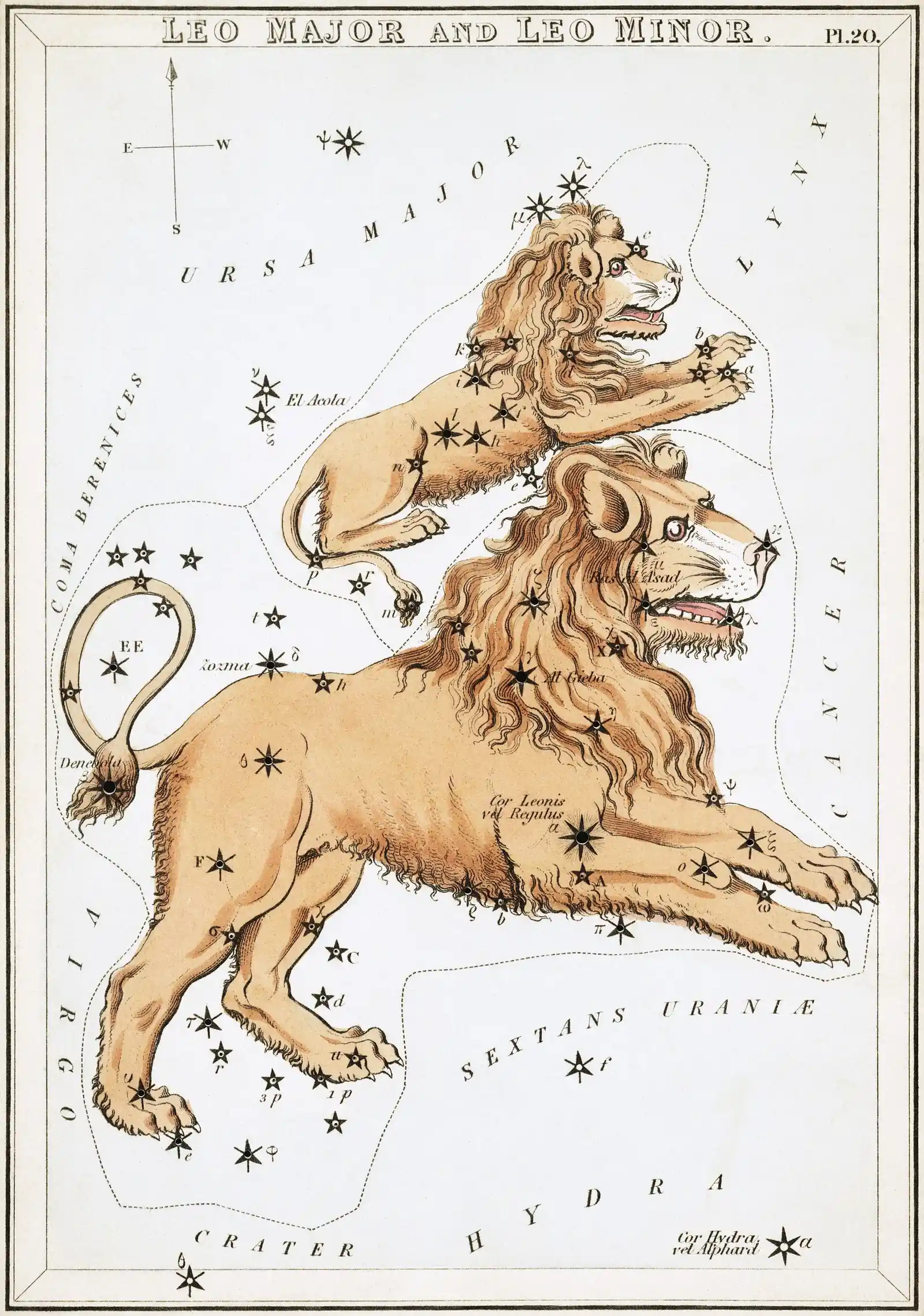
| Constellation behind the Sun | Sun enters it | Sun leaves it | Days of the Leo season spent there |
|---|---|---|---|
| Cancer | Wed, Jul 21, 4:08 am | Wed, Aug 11, 3:09 am | 19.25 |
| Leo | Wed, Aug 11, 3:09 am | Fri, Sep 17, 4:25 am | 12.05 |
The constellation Leo itself holds the Sun from Wed, Aug 11, 2027, 3:09 am to Fri, Sep 17, 2027, 4:25 am ET, a stay of 37.1 days, most of it (25.0 days) during tropical Virgo. The older table above gives Aug 10 to Sep 15 (37 days); the 2027 computation moves the edges by a day or two because the boundary lines are fixed and the Sun’s path across them shifts with precession.
The point where tropical Leo begins, 0° Leo, lies in front of Cancer in 2027. It entered Cancer about 710 CE and will cross into Gemini about 2145. In Ptolemy’s day, around 150 CE, it lay in Leo; precession has since carried the equinoxes about 26.2 degrees back along the ecliptic.
The traditional shadow side
The traditional shadow side is pride and a real need for recognition: difficulty when effort goes unacknowledged, or when someone else is the center of attention. The growth edge is finding steadiness that doesn't depend on an audience.
Ruling planet and symbol
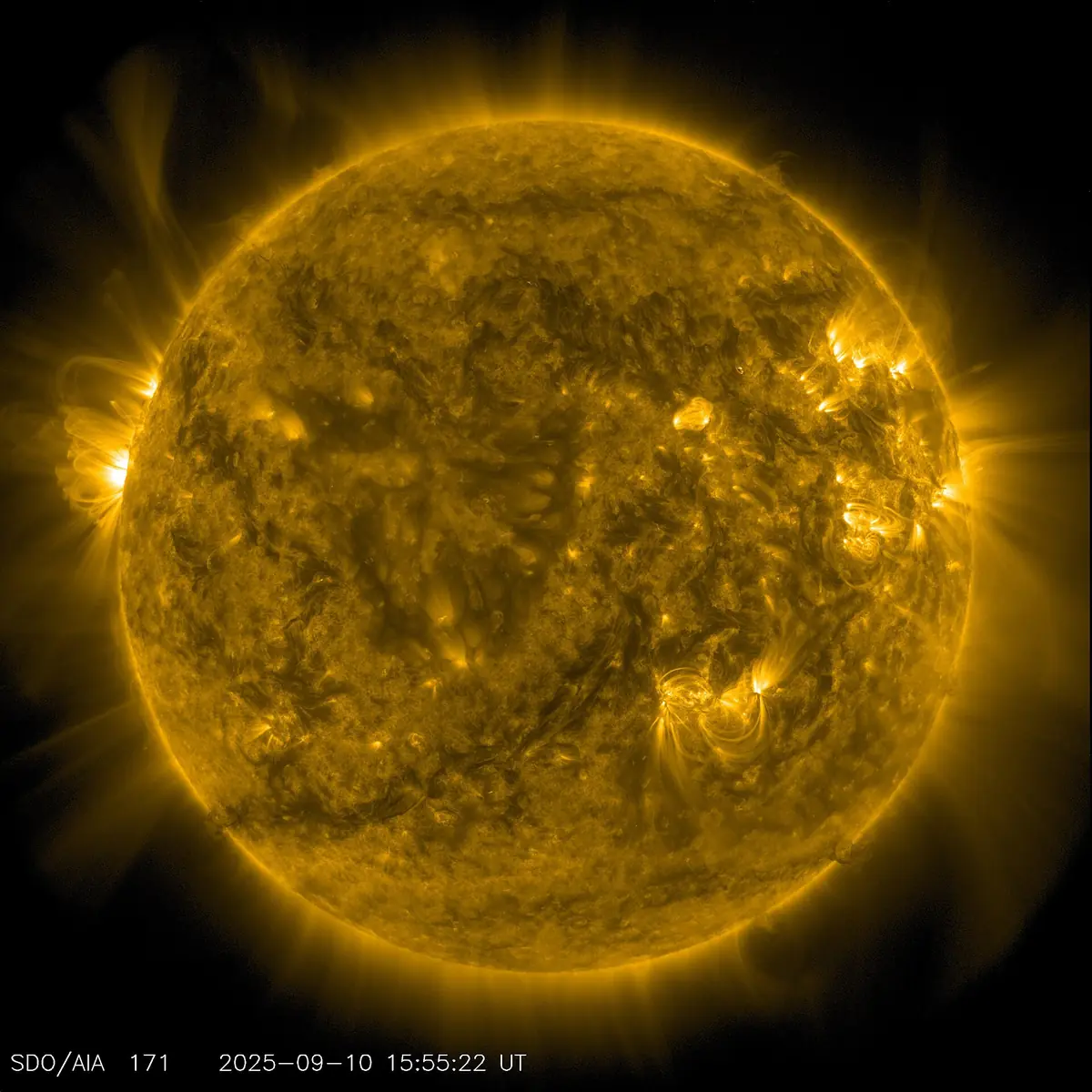
Leo is traditionally ruled by the Sun, one of the seven classical "planets" (Sun and Moon included) known to the astrologers who first wrote this system down. Its symbol is the Lion — traditionally identified with the Nemean Lion, killed by Heracles as the first of his Twelve Labors.
What Ptolemy wrote about Leo
Ptolemy’s Tetrabiblos, written in Alexandria in the 2nd century CE, is the earliest full text that gives Leo a house, an exaltation and a triangle. Book I sets Leo down like this.
"Leo, which is masculine, to the sun and Cancer, feminine, to the moon"
Ptolemy, Tetrabiblos I.17, p. 79, trans. F. E. Robbins (Loeb Classical Library, 1940)
- Type: solid. Leo sits in the middle of summer: in 2027 the Sun enters it 31.5 days after summer opens at the June solstice.
- Gender: masculine, like Aries, Gemini, Libra, Sagittarius and Aquarius; Ptolemy alternates the genders sign by sign from Aries.
- House: the house (domicile) of the Sun.
- Exaltation: none. Leo is one of the four signs where Ptolemy places no planet's exaltation or depression.
- Triangle: Leo shares Ptolemy's first triangle with Aries and Sagittarius, governed by the Sun by day and Jupiter by night. Ptolemy numbers these triangles and describes them by winds; naming them after the four elements came later.
Background: Ptolemy’s Tetrabiblos; how Leo is scored: essential dignities.
Leo in Ptolemy’s and Lilly’s dignity tables: house, bounds and points
Lilly gives a planet in its own house five points, in its exaltation four and in its triplicity three. By that count Leo favours the Sun and Jupiter and leaves the Moon, Mercury, Venus and Mars with nothing at sign level. Ptolemy’s own account (Book I, chapters 17 to 19) gives Leo the house of the Sun; the triplicity rulers are the Sun by day and Jupiter by night. Our guide to essential dignities explains the scoring.
| Planet | Standing in Leo | Points |
|---|---|---|
| The Sun | Own house (domicile); Triplicity ruler by day | +5 and +3 by day |
| Jupiter | Triplicity ruler by night | +3 by night |
| Saturn | Detriment (opposite its own house) | debility |
The two tables agree on 16 of Leo’s 30 degrees. Jupiter opens the sign in both tables; the longest bound is Saturn’s in the first (7°) and Mercury’s in the second (7°). Lilly, introducing his table of dignities, writes “I present thee with a Table according to” Ptolemy.
| Bound | Egyptian table (I.20) | Ptolemy’s own table (I.21) |
|---|---|---|
| Bound 1 | Jupiter 0° to 6° | Jupiter 0° to 6° |
| Bound 2 | Venus 6° to 11° | Mercury 6° to 13° |
| Bound 3 | Saturn 11° to 18° | Saturn 13° to 19° |
| Bound 4 | Mercury 18° to 24° | Venus 19° to 25° |
| Bound 5 | Mars 24° to 30° | Mars 25° to 30° |
What Lilly (1647) and Ptolemy wrote about Leo’s stars and places
In chapter XVI of Christian Astrology Lilly describes each sign’s nature, the places it rules and the kingdoms and cities “subject to” it. His Leo entry runs through the sign’s qualities and then lists countries. These are tradition’s map of 1647, not a forecast about any place or person.
“…by nature, Fiery, Hot, Dry…”
William Lilly, Christian Astrology (1647), chapter XVI
“…Italy, Bohemia, the Alpes, Turkie, Sicilia, Apulia, Rome…”
William Lilly, Christian Astrology (1647), chapter XVI
Ptolemy’s chapter on the fixed stars (I.9) takes the figures of the zodiac one by one. For the constellation Leo he lists 5 groups of stars, and says which planets each acts like:
“Of those in Leo, the two in the head act in the same way as Saturn and, to a less degree, as Mars; the three in the throat, the same as Saturn and, to a less degree, as Mercury; the bright star upon the heart, called Regulus, the same as Mars and Jupiter; those in the hip and the bright star in the tail, the same as Saturn and Venus; and those in the thighs, the same as Venus and, to a less degree, Mercury.”
Ptolemy, Tetrabiblos I.9, trans. Robbins (1940)
Counting the groups: Saturn in 3, Mars in 2, Venus in 2, Mercury in 2 and Jupiter in 1. The two planets he calls maleficent in chapter 5, Saturn and Mars, appear in 4 of the 5 groups; the beneficent ones, Jupiter, Venus and the moon, in 3. Regulus, the bright star upon the heart, is the only star he names in Leo; it is still called the heart of the Lion.
Element and modality
| Relation | Leo |
|---|---|
| Element and modality | Fire, fixed |
| Class (Ptolemy I.11) | solid |
| Opposite (180°) | Aquarius |
| Trines (120°) | Sagittarius and Aries |
| Squares or quartiles (90°) | Scorpio and Taurus |
| Sextiles (60°) | Libra and Gemini |
| Never in aspect (one or five signs away) | Virgo, Capricorn, Pisces and Cancer |
| Rises in equal time with (I.14) | Scorpio (Leo is the commanding sign of the pair) |
| Equal power, “beholds” (I.15) | Taurus |
Leo is the only fixed fire sign; the other fixed signs are Taurus, Scorpio and Aquarius, and the other fire signs are Aries and Sagittarius. Ptolemy’s reason for pairing Leo with Taurus is that when the Sun enters either of them the days are equal. New York bears it out: 14 h 38 min of daylight on Jul 22, 2027, the day Leo opens, and 14 h 36 min on May 20, 2027, the last full day of Taurus, a difference of 1 minute.
Traditionally easiest matches
The element rule gives Leo Aries and Sagittarius (fire) and Gemini, Libra and Aquarius (air):
The Zodiac Compatibility calculator compares Leo with any single sign.
Leo strengths and challenges
The strengths and challenges most often attached to Leo:
| Traditional strengths | Traditional challenges |
|---|---|
| Warmth and generosity | Pride |
| Confidence | Needing recognition |
| Creative flair | Taking criticism hard |
Leo in love and relationships
Leo is traditionally read as a generous, loyal and openly affectionate partner who loves grand gestures and wants to be appreciated in return. Feeling taken for granted is the classic sore point. Fire and air signs are the traditional easy matches, while earth and water partners can ground Leo if both respect each other's way of showing love.
Leo at work
At work, Leo is traditionally associated with leadership, performance and creative roles: managing a team, teaching, entertainment, design, or anything with a visible result. The traditional caution is sharing the stage, so Leo is often described as at its best when it lifts others alongside itself.
The other two layers are Moon in Leo and Leo rising; the Sun, Moon and rising guide shows how they combine.
7.65 million US births, 1994 to 2014: how many had the Sun in Leo
Of the 85.4 million births in the CDC and SSA daily counts for 1994 to 2014, 7.65 million (8.96%) fall in Leo when the Sun’s real position is used. An even spread by the length of the season (31.30 of 365.24 days) would give 8.57%, so Leo runs above it by 0.39 points; that makes Leo the most common by births. Yearly shares ranged from 8.69% (2004) to 9.16% (2014).
| Year | Share of the year’s births in Leo | Estimated Leo births (thousands) |
|---|---|---|
| 1994 | 8.87% | 351 |
| 1995 | 8.98% | 350 |
| 1996 | 9.04% | 352 |
| 1997 | 9.02% | 350 |
| 1998 | 8.93% | 352 |
| 1999 | 8.90% | 352 |
| 2000 | 8.77% | 356 |
| 2001 | 8.96% | 361 |
| 2002 | 9.12% | 367 |
| 2003 | 9.04% | 370 |
| 2004 | 8.69% | 364 |
| 2005 | 8.76% | 369 |
| 2006 | 8.96% | 389 |
| 2007 | 9.12% | 400 |
| 2008 | 9.09% | 392 |
| 2009 | 8.97% | 376 |
| 2010 | 8.69% | 352 |
| 2011 | 8.89% | 356 |
| 2012 | 9.08% | 363 |
| 2013 | 9.13% | 363 |
| 2014 | 9.16% | 367 |
By calendar month the Leo births split into July (2.26 million) and August (5.39 million). Averaged over 21 years, the busiest Leo birthday was August 8 (11,951 births a day) and the quietest August 3 (11,332 a day); each date is judged against its own year’s average so that the larger later years do not tilt the result.
Each day’s births are spread over its 24 US Eastern hours and every hour gets the Sun’s sign at that hour. Of the births on the 42 days the Sun entered or left Leo, 239 thousand had the Sun in Leo; the plain date rule (Jul 23 – Aug 22) would put 36 thousand into Leo that belong next door and drop 107 thousand that belong in it: 1.9% of the sign’s total.
Jupiter, Saturn, Uranus, Neptune and Pluto in Leo: 2026 to 2030 and the stays either side
Jupiter is in Leo at some point between 2026 and 2030. The table shows the whole stay, since the slow planets take from a year to decades to cross a sign, and a retrograde return to the neighbouring sign counts as part of the same stay.
| Planet | Stay overlapping 2026 to 2030 | Previous stay | Next stay |
|---|---|---|---|
| Jupiter | Jun 30, 2026 to Jul 26, 2027 | Jul 16, 2014 to Aug 11, 2015 | Jun 12, 2038 to Jul 7, 2039 |
| Saturn | Not in the sign | Jul 16, 2005 to Sep 2, 2007 | Aug 26, 2034 to Jul 6, 2037 |
| Uranus | Not in the sign | Aug 24, 1955 to Aug 9, 1962 | Aug 6, 2039 to Jul 22, 2046 |
| Neptune | Not in the sign | Sep 23, 1914 to Jul 24, 1929 | Sep 1, 2078 to Jul 5, 2093 |
| Pluto | Not in the sign | Oct 7, 1937 to Jun 10, 1958 | Aug 25, 2183 to 2204 |
Saturn’s visits to Leo come 29.1 years apart: the last began on Jul 16, 2005 and the next begins on Aug 26, 2034. For the faster planets see Jupiter by sign and Saturn by sign, and the Saturn return guide for the 29.5-year cycle.
The oldest name for Leo
The Babylonians called it UR.GU.LA, the "Great Lion". The Greeks identified it with the Nemean Lion, killed by Heracles in the first of his labours.
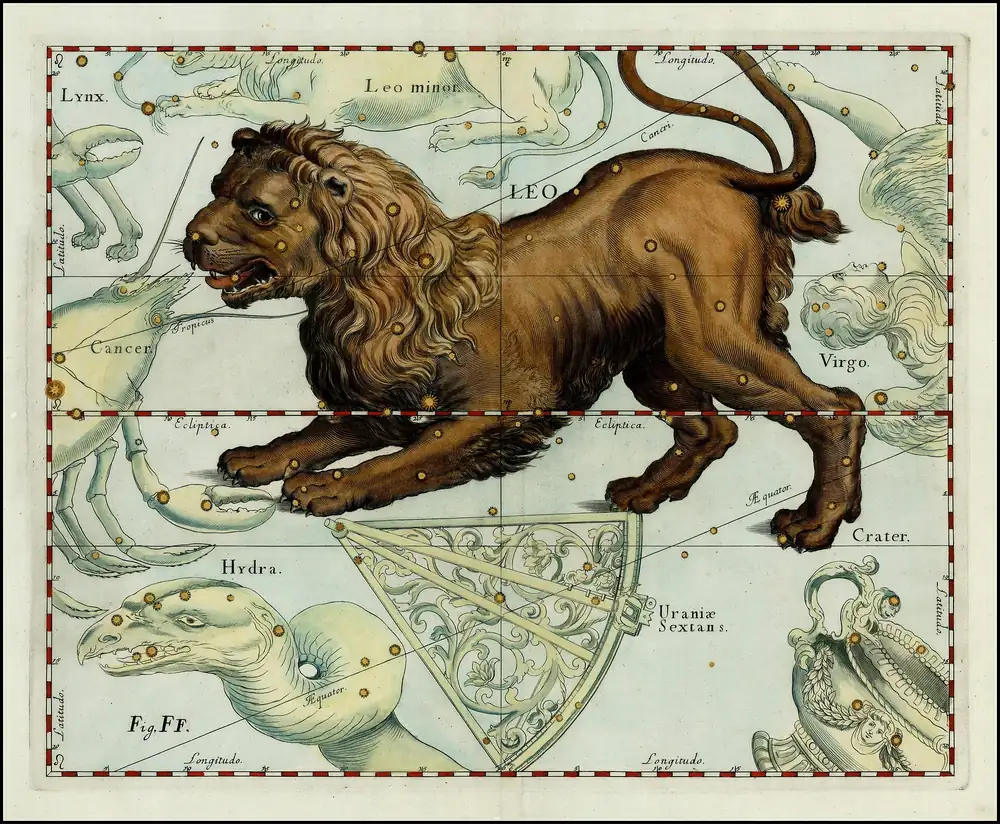
Leo is one of the twelve star groups traced in where the 12 zodiac signs came from.
Frequently asked questions
Is this the same as my "star sign"?
Yes. "Star sign," "sun sign," and "zodiac sign" all refer to the same thing here: the sign the Sun was traditionally in on your birth date.
Does my sign describe my whole personality?
A full traditional birth chart also considers your Moon sign, rising sign, and planetary positions. Your Sun sign is one layer of a fuller reading, not the whole picture.
What if I was born on the first or last day of Leo?
Your sign depends on the year and the hour. Between 1990 and 2030 the Sun entered Leo on July 22 in 35 of 41 years and July 23 in 6 (US Eastern). In 2027 the entry is Thu, Jul 22, 2027, 9:04 pm ET, so a baby born that day at 7:34 pm is a Cancer and one born at 10:34 pm is a Leo; on the way out the Sun leaves Leo on Mon, Aug 23, 2027, 4:14 am ET. Across 1994 to 2014 the plain date rule (Jul 23 – Aug 22) would have misfiled about 143 thousand births, 1.9% of the Leo total.
When does Leo season start and end in 2027 and 2028?
2027: Thu, Jul 22, 2027, 9:04 pm ET (6:04 pm PT) to Mon, Aug 23, 2027, 4:14 am ET, 31.30 days. 2028: Sat, Jul 22, 2028, 2:53 am ET (11:53 pm PT) to Tue, Aug 22, 2028, 10:00 am ET, 31.30 days. That is the 3rd-longest of the twelve seasons, at 0.959 degrees a day.
Is the Sun in the constellation Leo during Leo season?
Not for all of it: in 2027 the Sun spends tropical Leo in front of Cancer (19.3 days) and Leo (12.0 days). The Sun is in front of Leo itself from Aug 11 to Sep 17, 37.1 days. The point where Leo begins lies in Cancer in 2027 and sat in Leo around 150 CE.
How common is Leo, and which birthday is the busiest?
8.96% of the 85.4 million US births of 1994 to 2014 had the Sun in Leo, 7.65 million people, number 1 of 12 (an even spread by season length would be 8.57%). The busiest Leo birthday was August 8 with 11,951 births a day on average; the quietest was August 3 with 11,332.
What did Ptolemy and Lilly say about Leo?
Ptolemy gives Leo the house of the Sun; Lilly adds a point scale, Leo giving the Sun and Jupiter a sign-level dignity. The two bound tables Ptolemy prints for Leo agree on 16 of 30 degrees. Lilly lists these kingdoms under Leo: “Italy, Bohemia, the Alpes, Turkie, Sicilia, Apulia, Rome”. Ptolemy’s stars of the Leo name Saturn or Mars in 4 of 5 groups.
Which of the slow planets are in Leo between 2026 and 2030?
Between 2026 and 2030, Jupiter is in Leo. Jupiter stays from Jun 30, 2026 to Jul 26, 2027.
When does the Sun enter Leo in the Indian (sidereal) zodiac?
With the Lahiri ayanamsa (24.24 degrees in 2027) the Sun enters sidereal Leo on Aug 17, 2027, around 4:30 am Eastern, 25.3 days after the tropical entry on Jul 22. The tropical dates on this page follow the seasons, not the stars.
Sources
- Ptolemy, Claudius. Tetrabiblos, Book I. 2nd century CE, trans. F. E. Robbins (LacusCurtius).
- Campion, Nicholas. A History of Western Astrology, vols. I–II. Continuum, 2008–2009.
- Numyra Methodology Desk. Astrology calculation standard.
- Astrodienst. Swiss Ephemeris (Moshier mode): the Leo entry times for 2026 to 2030, the Sun’s constellations and the slow-planet stays, checked against NASA JPL Horizons and the US Naval Observatory.
- Roman, N. G. (1987), CDS catalogue VI/42, the IAU (Delporte, 1930) constellation boundaries used for the table of Leo in 2027.
- FiveThirtyEight. US births data, 1994–2014 (CDC/NCHS and Social Security Administration): the 7.65 million Leo births.
- Lilly, William. Christian Astrology. London, 1647 (Internet Archive scan, long s printed as s), chapters XVI and XVIII, for the Leo nature, kingdoms and dignity points.
- Ptolemy, Tetrabiblos I.9 and I.17 to I.21 (trans. F. E. Robbins, Loeb, 1940; LacusCurtius text): the Leo stars, house, triangle and the two tables of bounds. Footnote numbers of the web edition are left out of quotations.
- "Zodiac." Wikipedia: table of 1977 IAU constellation boundaries (after Shapiro, 1977).
- "Leo (constellation)." Wikipedia: brightest star, Babylonian name and mythology.