Aquarius Zodiac Sign
Aquarius dates: January 20 to February 18. Aquarius is the eleventh sign of the zodiac, a fixed air sign traditionally ruled by Saturn (and, for many modern astrologers, Uranus).
Traditionally read as the most independent-minded sign: original, idea-driven, and oriented toward the collective rather than the personal.

Key takeaways
- Genuine originality: traditionally read as comfort standing apart from convention.
- An orientation toward groups, causes, and future-facing ideas over one-to-one closeness.
- A fixed air sign: intellectual independence held with real staying power.
- Nothing here is medical, financial, legal, or psychological advice. It is a cultural tradition, presented for reflection.
Aquarius dates, and where the Sun really is
Western astrology, this site included, dates Aquarius Jan 20 to Feb 18 (the edges move by a day from year to year). Whether the Sun is in the constellation Aquarius is a different question: from about Feb 16 to Mar 11, roughly 24 days, according to the IAU boundaries.
| Tropical sign Aquarius | Jan 20 to Feb 18 |
|---|---|
| Sun in the constellation Aquarius | About Feb 16 to Mar 11 (24 days) |
| Brightest star | Sadalsuud (magnitude about 2.9) |
What separates the sign from the stars is precession (one degree per 72 years). The start of Aquarius was in Capricornus in the 2nd century and is in Sagittarius now; the sidereal vs. tropical guide covers the consequences.
When does Aquarius actually start?
The start of Aquarius is a moment, not a date: the Sun at 0° Aquarius. For 1990 to 2030 that moment fell on January 20 in 25 of 41 years and January 19 in 16, US Eastern, and our table covers every year from 1950 to 2030. Take 2027 (Wed, Jan 20, 2027, 2:29 am ET): born in New York at 12:59 am on Jan 20 you are a Capricorn; at 3:59 am on Jan 20, an Aquarius.
Exact Aquarius start date and time for every year, 1950 to 2030
| Year | Sun enters Aquarius (US Eastern time) |
|---|---|
| 1950 | Jan 20, 9:59 am |
| 1951 | Jan 20, 3:52 pm |
| 1952 | Jan 20, 9:38 pm |
| 1953 | Jan 20, 3:21 am |
| 1954 | Jan 20, 9:11 am |
| 1955 | Jan 20, 3:01 pm |
| 1956 | Jan 20, 8:48 pm |
| 1957 | Jan 20, 2:38 am |
| 1958 | Jan 20, 8:28 am |
| 1959 | Jan 20, 2:18 pm |
| 1960 | Jan 20, 8:10 pm |
| 1961 | Jan 20, 2:01 am |
| 1962 | Jan 20, 7:57 am |
| 1963 | Jan 20, 1:53 pm |
| 1964 | Jan 20, 7:41 pm |
| 1965 | Jan 20, 1:28 am |
| 1966 | Jan 20, 7:19 am |
| 1967 | Jan 20, 1:07 pm |
| 1968 | Jan 20, 6:54 pm |
| 1969 | Jan 20, 12:38 am |
| 1970 | Jan 20, 6:23 am |
| 1971 | Jan 20, 12:12 pm |
| 1972 | Jan 20, 5:58 pm |
| 1973 | Jan 19, 11:48 pm |
| 1974 | Jan 20, 6:45 am |
| 1975 | Jan 20, 11:36 am |
| 1976 | Jan 20, 5:25 pm |
| 1977 | Jan 19, 11:14 pm |
| 1978 | Jan 20, 5:03 am |
| 1979 | Jan 20, 10:59 am |
| 1980 | Jan 20, 4:48 pm |
| 1981 | Jan 19, 10:35 pm |
| 1982 | Jan 20, 4:30 am |
| 1983 | Jan 20, 10:16 am |
| 1984 | Jan 20, 4:05 pm |
| 1985 | Jan 19, 9:57 pm |
| 1986 | Jan 20, 3:46 am |
| 1987 | Jan 20, 9:40 am |
| 1988 | Jan 20, 3:24 pm |
| 1989 | Jan 19, 9:06 pm |
| 1990 | Jan 20, 3:01 am |
| 1991 | Jan 20, 8:47 am |
| 1992 | Jan 20, 2:32 pm |
| 1993 | Jan 19, 8:22 pm |
| 1994 | Jan 20, 2:07 am |
| 1995 | Jan 20, 8:00 am |
| 1996 | Jan 20, 1:52 pm |
| 1997 | Jan 19, 7:42 pm |
| 1998 | Jan 20, 1:46 am |
| 1999 | Jan 20, 7:37 am |
| 2000 | Jan 20, 1:23 pm |
| 2001 | Jan 19, 7:16 pm |
| 2002 | Jan 20, 1:02 am |
| 2003 | Jan 20, 6:52 am |
| 2004 | Jan 20, 12:42 pm |
| 2005 | Jan 19, 6:21 pm |
| 2006 | Jan 20, 12:15 am |
| 2007 | Jan 20, 6:00 am |
| 2008 | Jan 20, 11:43 am |
| 2009 | Jan 19, 5:40 pm |
| 2010 | Jan 19, 11:27 pm |
| 2011 | Jan 20, 5:18 am |
| 2012 | Jan 20, 11:09 am |
| 2013 | Jan 19, 4:51 pm |
| 2014 | Jan 19, 10:51 pm |
| 2015 | Jan 20, 4:43 am |
| 2016 | Jan 20, 10:27 am |
| 2017 | Jan 19, 4:23 pm |
| 2018 | Jan 19, 10:09 pm |
| 2019 | Jan 20, 3:59 am |
| 2020 | Jan 20, 9:54 am |
| 2021 | Jan 19, 3:39 pm |
| 2022 | Jan 19, 9:39 pm |
| 2023 | Jan 20, 3:29 am |
| 2024 | Jan 20, 9:07 am |
| 2025 | Jan 19, 3:00 pm |
| 2026 | Jan 19, 8:44 pm |
| 2027 | Jan 20, 2:29 am |
| 2028 | Jan 20, 8:21 am |
| 2029 | Jan 19, 2:00 pm |
| 2030 | Jan 19, 7:54 pm |
Birth Chart calculator for a specific time and place.
Mid-Aquarius (15°) arrives Wed, Feb 3, 2027, 8:46 pm ET, the solar return moment for anyone born with the Sun at 15° Aquarius.
Aquarius also splits into three decans of 10° each. In most years they begin on January 20, January 29 and February 8. Our guide to the Aquarius decans explains what each one adds and who rules it in the three traditional systems.
Aquarius season dates and times for 2026 to 2030, Eastern and Pacific
The Sun crosses into Aquarius at Wed, Jan 20, 2027, 2:29 am ET (11:29 pm on Jan 19 PT) in 2027 and out of it at Thu, Feb 18, 2027, 4:33 pm ET (1:33 pm PT), a stay of 29 days 14 h 04 min (29.59 days). By length Aquarius ranks 10th-longest among the 2027 seasons. The distance to the Sun grows from 147.20 to 147.86 million km across the sign, which is why the Sun’s pace falls from 1.018 to 1.008 degrees a day, where the yearly average is 0.986.
| Year | Sun enters Aquarius (Eastern) | Sun enters Aquarius (Pacific) | Sun leaves Aquarius (Eastern) | Days |
|---|---|---|---|---|
| 2026 | Mon, Jan 19, 8:44 pm | Mon, Jan 19, 5:44 pm | Feb 18, 10:51 am | 29.59 |
| 2027 | Wed, Jan 20, 2:29 am | Tue, Jan 19, 11:29 pm | Feb 18, 4:33 pm | 29.59 |
| 2028 | Thu, Jan 20, 8:21 am | Thu, Jan 20, 5:21 am | Feb 18, 10:26 pm | 29.59 |
| 2029 | Fri, Jan 19, 2:00 pm | Fri, Jan 19, 11:00 am | Feb 18, 4:07 am | 29.59 |
| 2030 | Sat, Jan 19, 7:54 pm | Sat, Jan 19, 4:54 pm | Feb 18, 9:59 am | 29.59 |
On the clock the Aquarius entry shifts 5.7 hours later from one year to the next, then 2028 adds a leap day and the entry lands on Thu, Jan 20, 8:21 am ET, the same date as 2027. Over 1990 to 2030 the season’s length varied by just 12 minutes, 29.585 to 29.593 days.
Watch the New York clock through Aquarius: 9 h 43 min of daylight on Jan 20, 2027, sunrise 07:15 and sunset 16:58; 10 h 46 min on Feb 17, 2027, sunrise 06:47 and sunset 17:33. The sign ends with 62 minutes more daylight than it began with.
Indian astrologers, who use the sidereal zodiac, would start Aquarius on Feb 12, 2027, around 11:30 pm Eastern (Feb 13 in India), 23.9 days after the tropical entry, because the Lahiri ayanamsa stands at 24.24 degrees in 2027. Background: sidereal vs. tropical.
Aquarius against the stars: which constellations the Sun crosses in 2027
Tropical Aquarius and the constellation Aquarius overlap only in part. Day by day in 2027: 48 minutes in front of Sagittarius, 27.4 days in front of Capricornus and 2.1 days in front of Aquarius, in that order (29.59 days in all).
| Constellation behind the Sun | Sun enters it | Sun leaves it | Days of the Aquarius season spent there |
|---|---|---|---|
| Sagittarius | Fri, Dec 18, 7:59 am | Wed, Jan 20, 3:17 am | 48 minutes |
| Capricornus | Wed, Jan 20, 3:17 am | Tue, Feb 16, 1:49 pm | 27.44 |
| Aquarius | Tue, Feb 16, 1:49 pm | Fri, Mar 12, 3:18 pm | 2.11 |
Aquarius proper takes the Sun from Tue, Feb 16, 2027, 1:49 pm to Fri, Mar 12, 2027, 3:18 pm ET: 24.1 days, 21.9 of them inside tropical Pisces. Our older figure, Feb 16 to Mar 11 (24 days), is a rounded table, so expect the edges to differ by a day or two.
Start of Aquarius, 0° of the sign: Sagittarius is behind it in 2027. It entered Sagittarius 2024 and will cross into Ophiuchus about 4410. In the 2nd century CE it lay in Capricornus, and the 26.2 degrees of precession since then explain the difference.
The traditional shadow side
The traditional shadow side is emotional distance: intellectualizing feelings rather than sitting with them, and a stubborn insistence on being different that can outlast its own usefulness. The growth edge is staying reachable up close, not just visionary at a distance.
Ruling planet and symbol
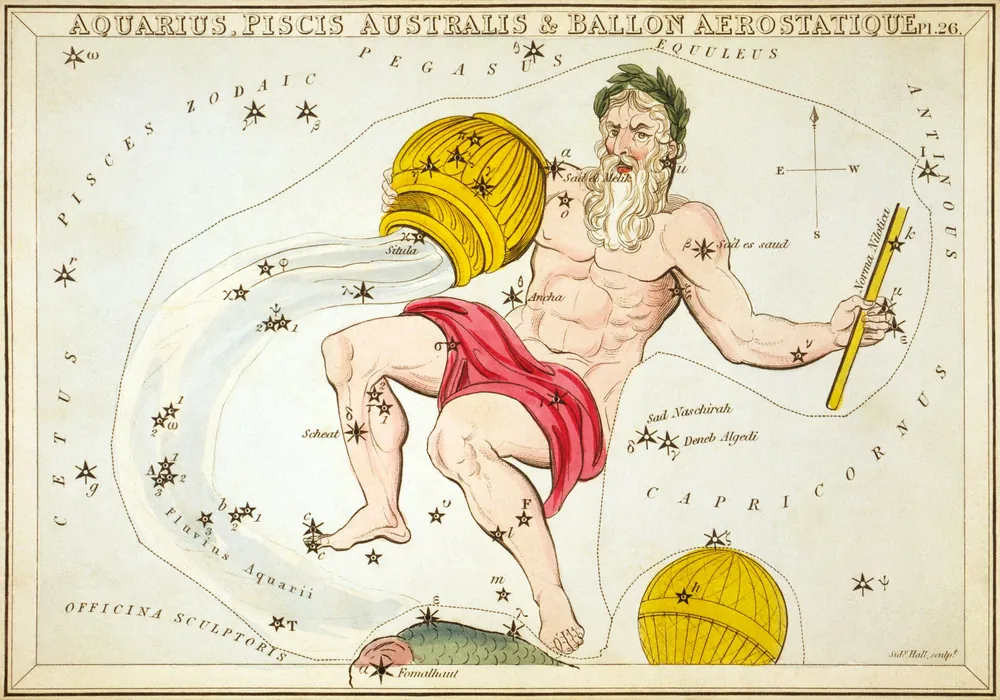
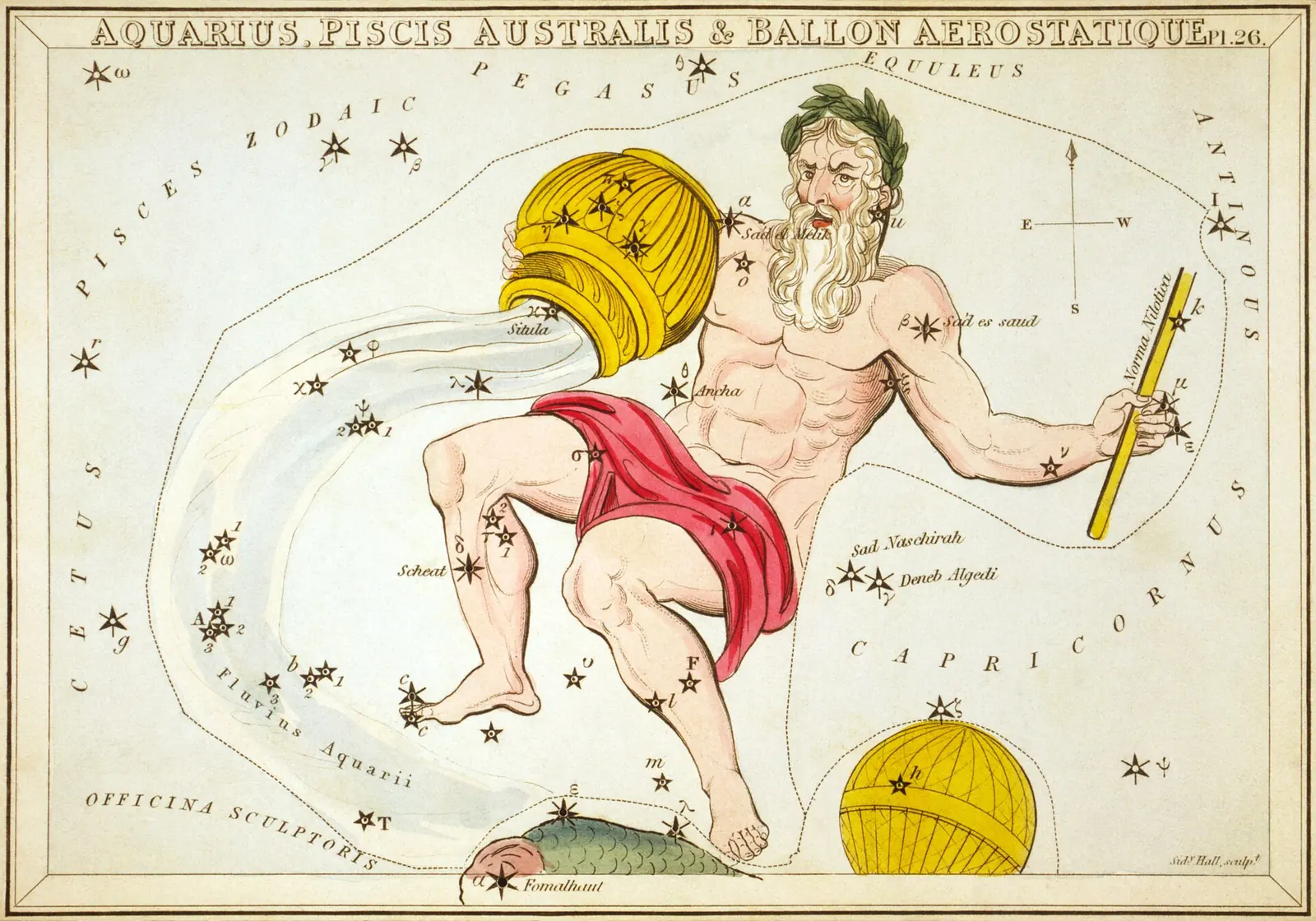
Aquarius is traditionally ruled by Saturn. Since its discovery, many modern astrologers instead assign Aquarius to Uranus — we note both rather than pick a side, since Uranus wasn't known to the astrologers who first wrote this system down. Its symbol is the Water-Bearer — a human figure pouring water from a vessel, traditionally identified with Ganymede, cup-bearer to the gods in Greek myth.
What Ptolemy wrote about Aquarius
Aquarius’s house, exaltation and triangle come from Ptolemy’s Tetrabiblos (Alexandria, 2nd century CE), the earliest complete text to set them out. In Book I Aquarius appears like this.
"were assigned the signs opposite Cancer and Leo, namely Capricorn and Aquarius"
Ptolemy, Tetrabiblos I.17, p. 81, giving both to Saturn, trans. F. E. Robbins (Loeb Classical Library, 1940)
- Type: solid. Aquarius sits in the middle of winter: in 2027 the Sun enters it 29.4 days after winter opens at the December solstice.
- Gender: masculine, as are Aries, Gemini, Leo, Libra and Sagittarius (Ptolemy alternates masculine and feminine from Aries on).
- House: the house (domicile) of Saturn.
- Exaltation: none. Aquarius is one of the four signs where Ptolemy places no planet's exaltation or depression.
- Triangle: Aquarius shares Ptolemy's third triangle with Gemini and Libra, governed by Saturn by day and Mercury by night. Ptolemy numbers these triangles and describes them by winds; naming them after the four elements came later.
More: the Tetrabiblos explained, and essential dignities for the later scoring of Aquarius.
Aquarius by the old rulebooks: Ptolemy’s bounds and Lilly’s scoring
Score Aquarius the way Lilly does and Mercury and Saturn come out ahead: house five, exaltation four, triplicity three. The Moon, Venus, Mars and Jupiter have no sign-level standing here. Ptolemy (Book I, chapters 17 to 19) assigns Aquarius to Saturn; the triplicity rulers are Saturn by day and Mercury by night. The scoring is explained in essential dignities.
| Planet | Standing in Aquarius | Points |
|---|---|---|
| The Sun | Detriment (opposite its own house) | debility |
| Mercury | Triplicity ruler by night | +3 by night |
| Saturn | Own house (domicile); Triplicity ruler by day | +5 and +3 by day |
Aquarius’s bounds match between the two tables on 2 degrees out of 30. Mercury opens the sign in the Egyptian table and Saturn in Ptolemy’s own; the longest bound is Mercury’s in the first (7°) and Venus’s in the second (8°). Ptolemy objects to Mercury leading Aquarius in the Egyptian order: “why have they given first place in Aquarius to Mercury, who has only his triplicity there, and not to Saturn”. Lilly, introducing his table of dignities, writes “I present thee with a Table according to” Ptolemy.
| Bound | Egyptian table (I.20) | Ptolemy’s own table (I.21) |
|---|---|---|
| Bound 1 | Mercury 0° to 7° | Saturn 0° to 6° |
| Bound 2 | Venus 7° to 13° | Mercury 6° to 12° |
| Bound 3 | Jupiter 13° to 20° | Venus 12° to 20° |
| Bound 4 | Mars 20° to 25° | Jupiter 20° to 25° |
| Bound 5 | Saturn 25° to 30° | Mars 25° to 30° |
The places and stars of Aquarius: Lilly and Ptolemy, word for word
What did a 1647 astrologer attach to Aquarius? Lilly’s chapter XVI lists qualities, places and kingdoms for each sign. Two passages from his Aquarius entry follow. They record what the tradition said then and predict nothing about any place or person.
“…diurnal, sanguine, fixed, rational, humane, masculine…”
William Lilly, Christian Astrology (1647), chapter XVI
“…Westphalia in Germany, Piemont in Savoy…”
William Lilly, Christian Astrology (1647), chapter XVI
Fixed stars come next in Ptolemy (I.9). The constellation Aquarius gets 3 groups, and each is compared with planets:
“Of the stars in Aquarius, those in the shoulders exert an influence like that of Saturn and Mercury, together with those in the left arm and the cloak; those in the thighs, like that of Mercury in a greater degree and like that of Saturn in a lesser degree; those in the stream of water, like that of Saturn and, in some degree, like that of Jupiter.”
Ptolemy, Tetrabiblos I.9, trans. Robbins (1940)
By count: Saturn in 3, Mercury in 2 and Jupiter in 1. Of the 3 groups, 3 carry a maleficent planet (Saturn or Mars, chapter 5) and 1 carry a beneficent one (Jupiter, Venus or the moon). Saturn is named most often (3 of 3 groups).
Element and modality
| Relation | Aquarius |
|---|---|
| Element and modality | Air, fixed |
| Class (Ptolemy I.11) | solid |
| Opposite (180°) | Leo |
| Trines (120°) | Gemini and Libra |
| Squares or quartiles (90°) | Taurus and Scorpio |
| Sextiles (60°) | Aries and Sagittarius |
| Never in aspect (one or five signs away) | Pisces, Cancer, Virgo and Capricorn |
| Rises in equal time with (I.14) | Taurus (Aquarius is the obeying sign of the pair) |
| Equal power, “beholds” (I.15) | Scorpio |
Aquarius is the only fixed air sign; the other fixed signs are Taurus, Leo and Scorpio, and the other air signs are Gemini and Libra. Aquarius and Scorpio are a pair in Ptolemy’s chapter 15 because the days match when the Sun enters either. Checked in New York: 9 h 43 min of daylight on Jan 20, 2027, when Aquarius opens, and 9 h 44 min on Nov 21, 2027, when Scorpio is about to end; the two differ by 1 minute.
Traditionally easiest matches
Same element (Gemini and Libra) plus the complementary fire signs (Aries, Leo and Sagittarius) make up the traditional easy list for Aquarius:
Any other sign can be set beside Aquarius in the Zodiac Compatibility calculator.
Aquarius strengths and challenges
Aquarius’s usual strengths, with the challenges that go with them:
| Traditional strengths | Traditional challenges |
|---|---|
| Originality | Emotional detachment |
| Independence | Stubborn ideals |
| Commitment to people and causes | Rebelling for its own sake |
Aquarius in love and relationships
Aquarius is traditionally read as a friend first and a partner second: loyal, unconventional and in need of space and intellectual connection. The classic caution is seeming distant when feelings run high. Air and fire signs are the traditional easy matches, while earth and water partners may need to accept Aquarius's independence.
Aquarius at work
At work, Aquarius is traditionally associated with technology, science, social causes, invention and community work, anywhere new ideas are welcome. The traditional caution is working within rules it disagrees with, so Aquarius is often described as at its best when it has room to innovate.
Beyond the Sun, see Moon in Aquarius and Aquarius rising, and the Sun, Moon and rising guide for how the three work together.
6.78 million US births, 1994 to 2014: how many had the Sun in Aquarius
Count the daily CDC and SSA births of 1994 to 2014 (85.4 million) by the Sun’s true sign and Aquarius gets 6.78 million, 7.93%. Its season covers 29.59 of 365.24 days, or 8.10%, so births ran 0.17 points below that, making Aquarius number 10 of the 12. Year by year the share swung from 7.74% (2013) to 8.09% (2009).
| Year | Share of the year’s births in Aquarius | Estimated Aquarius births (thousands) |
|---|---|---|
| 1994 | 8.08% | 319 |
| 1995 | 7.92% | 309 |
| 1996 | 7.76% | 302 |
| 1997 | 7.91% | 307 |
| 1998 | 7.99% | 315 |
| 1999 | 7.98% | 316 |
| 2000 | 7.98% | 324 |
| 2001 | 7.93% | 319 |
| 2002 | 7.85% | 316 |
| 2003 | 7.85% | 321 |
| 2004 | 7.96% | 333 |
| 2005 | 7.99% | 337 |
| 2006 | 7.88% | 342 |
| 2007 | 7.85% | 344 |
| 2008 | 8.06% | 348 |
| 2009 | 8.09% | 339 |
| 2010 | 8.04% | 326 |
| 2011 | 8.03% | 322 |
| 2012 | 7.78% | 311 |
| 2013 | 7.74% | 308 |
| 2014 | 7.93% | 318 |
Two calendar months share the sign: January (2.69 million) and February (4.08 million). The average Aquarius birthday brought 11,636 births on February 14 at its busiest and 10,567 on January 29 at its quietest (each date measured against its own year’s average).
Cusp days matter little here: spreading each day’s births evenly across its 24 hours, 220 thousand births on the 42 entry and exit days of Aquarius still carried the Aquarius Sun. Using only the dates Jan 20 – Feb 18 would wrongly add 115 thousand and wrongly drop 19 thousand, together 2.0% of Aquarius’s births.
The five slow planets and Aquarius: this decade’s visits and the stays on either side
Aquarius hosts Pluto during 2026 to 2030. Each stay is given in full; when a planet slips back into the neighbouring sign during a retrograde, that dip is folded into the same visit.
| Planet | Stay overlapping 2026 to 2030 | Previous stay | Next stay |
|---|---|---|---|
| Jupiter | Not in the sign | Dec 19, 2020 to Dec 28, 2021 | Apr 11, 2032 to Dec 1, 2033 |
| Saturn | Not in the sign | Mar 21, 2020 to Mar 7, 2023 | Jan 21, 2050 to Jan 10, 2053 |
| Uranus | Not in the sign | Apr 1, 1995 to Dec 30, 2003 | Mar 2, 2079 to Feb 18, 2087 |
| Neptune | Not in the sign | Jan 28, 1998 to Feb 3, 2012 | Mar 21, 2161 to Jan 20, 2176 |
| Pluto | Mar 23, 2023 to Jan 19, 2044, with 3 returns to a neighbouring sign | before 1801 (until 1798) | not before 2200 |
The gap between Saturn’s arrivals in Aquarius is 29.8 years, from Mar 21, 2020 to Jan 21, 2050. See Saturn return for what the 29.5-year cycle means, and Jupiter by sign and Saturn by sign for the quicker movers.
The oldest name for Aquarius
The Babylonians called it GU.LA, "The Great One", the god Ea pouring from an overflowing vase. Greek accounts vary: sometimes Ganymede, cup-bearer to the gods, sometimes Deucalion, who survived the great flood.
Where the 12 zodiac signs came from follows Aquarius and the other eleven star groups from Babylon onward.
Frequently asked questions
Is this the same as my "star sign"?
Yes. "Star sign," "sun sign," and "zodiac sign" all refer to the same thing here: the sign the Sun was traditionally in on your birth date.
Does my sign describe my whole personality?
A full traditional birth chart also considers your Moon sign, rising sign, and planetary positions. Your Sun sign is one layer of a fuller reading, not the whole picture.
Am I really an Aquarius if I was born on the first or last day?
It depends on the year and the clock. From 1990 to 2030 the Sun came into Aquarius on January 20 in 25 of 41 years and January 19 in 16, Eastern time. For 2027: Wed, Jan 20, 2027, 2:29 am ET in, Thu, Feb 18, 2027, 4:33 pm ET out; a New York birth at 12:59 am on the entry day is a Capricorn, one at 3:59 am is an Aquarius. A flat date rule (Jan 20 – Feb 18) misplaced roughly 134 thousand births from 1994 to 2014, 2.0% of the sign.
On what dates and times does the Sun enter and leave Aquarius in 2027 and 2028?
Start Wed, Jan 20, 2027, 2:29 am ET (11:29 pm PT), end Thu, Feb 18, 2027, 4:33 pm ET in 2027 (29.59 days); start Thu, Jan 20, 2028, 8:21 am ET (5:21 am PT), end Fri, Feb 18, 2028, 10:26 pm ET in 2028 (29.59 days). Average speed 1.014 degrees a day, the 10th-longest season.
Which constellation is behind the Sun during Aquarius season?
Not for all of it: in 2027 the Sun spends tropical Aquarius in front of Sagittarius (48 minutes), Capricornus (27.4 days) and Aquarius (2.1 days). The stay in Aquarius proper is Feb 16 to Mar 12, 24.1 days; 0° Aquarius sits against Sagittarius now, against Capricornus around 150 CE.
Is Aquarius a common sign, and which Aquarius birthday has the most births?
About 7.93% of US births in 1994 to 2014 (6.78 million of 85.4 million) were Aquarius, rank 10 of 12 against an expected 8.10%. Most births: February 14, 11,636 a day. Fewest: January 29, 10,567 a day.
What do the old textbooks say about Aquarius?
House: Saturn (Ptolemy). Lilly’s sign-level dignity goes to Mercury and Saturn. The bounds of Aquarius agree in 2 of 30 degrees between Ptolemy’s two tables. Lilly assigns “Westphalia in Germany, Piemont in Savoy” among the places of Aquarius, and 3 of the 3 star groups Ptolemy lists for the Aquarius involve Saturn or Mars.
Which outer planets visit Aquarius between 2026 and 2030?
In that window only Pluto is in Aquarius. Pluto: Mar 23, 2023 to Jan 19, 2044.
How much later does sidereal Aquarius begin than tropical Aquarius?
About 23.9 days later, on Feb 12, 2027, around 11:30 pm Eastern, because the Lahiri ayanamsa is 24.24 degrees in 2027. Tropical Aquarius starts Jan 20 and follows the seasons.
Sources
- Ptolemy, Claudius. Tetrabiblos, Book I. 2nd century CE, trans. F. E. Robbins (LacusCurtius).
- Campion, Nicholas. A History of Western Astrology, vols. I–II. Continuum, 2008–2009.
- Numyra Methodology Desk. Astrology calculation standard.
- Times, constellation stays and planet stays for Aquarius: Swiss Ephemeris, verified against JPL Horizons and the US Naval Observatory.
- The Aquarius constellation table uses the boundaries in Roman (1987), CDS catalogue VI/42 (IAU, Delporte 1930).
- FiveThirtyEight births data, 1994–2014 (CDC/NCHS, SSA), for the Aquarius birth counts (6.78 million).
- Christian Astrology by William Lilly (1647, Internet Archive scan; long s printed as s): chapters XVI and XVIII for Aquarius.
- Tetrabiblos I.9 and I.17 to I.21, Robbins translation (Loeb, 1940) as transcribed at LacusCurtius, supplies Aquarius’s star groups, house, triangle and bounds; footnote numbers are dropped from quotations.
- "Zodiac." Wikipedia: table of 1977 IAU constellation boundaries (after Shapiro, 1977).
- "Aquarius (constellation)." Wikipedia: brightest star, Babylonian name and mythology.