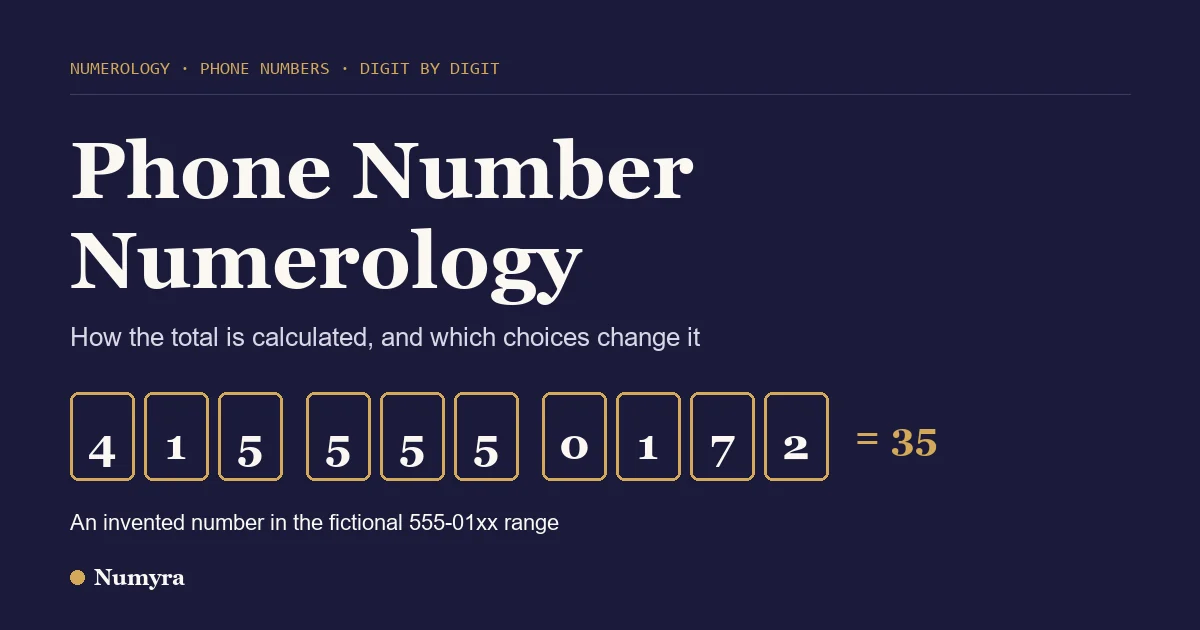
A phone number’s numerology number is the sum of its digits, reduced by adding digits until one remains (or until 11, 22 or 33 appears, if the calculator keeps master numbers). For the invented number 415-555-0172 the digits total 35, which reduces to 8. Two small choices change that answer: whether the country code is counted, since +1 raises the total of every US number by one, and whether master numbers are kept. We also checked the arithmetic on all 5.6 billion numbers that fit the US and Canadian format, and every total from 1 to 9 turns out to be exactly as common as any other, so no total is scarce.
Key takeaways
- The method is: add all ten digits, then add the digits of the total until one digit is left. The invented number 415-555-0172 gives 35, then 8. Counting the +1 country code gives 36, then 9.
- Of the 5,639,040,000 numbers that fit the US and Canada format, exactly 626,560,000 reduce to each of the digits 1 to 9 (the digits 4 and 6 are off by one number). The 372 in-service US area codes we checked are also spread evenly (p = 0.997).
- Any exchange has 10,000 line numbers, and 1,111 or 1,112 of them give each total. A “lucky” total is therefore never scarce; shown five random numbers, you will find your total among them 45% of the time.
- If a calculator keeps 11, 22 and 33, 12.5% of valid US numbers come out as one of them and a plain 2 almost disappears (0.03%). About 8.6% of numbers pass through 13, 14, 16 or 19, the “karmic debt” totals, on the way to one digit.
- The pages we read agree on the arithmetic and disagree on which totals are lucky; none of the four we checked cites a source for its meanings. We found no test linking a phone number’s total to anything. This is tradition and is not advice.
In this guide
- How to calculate a phone number’s numerology number
- Six choices that change the answer
- Country codes and how far each one shifts the total
- What a US phone number is made of
- Why every total is available
- Master numbers and karmic debt totals in phone numbers
- Vanity numbers: letters on the keypad
- Where the lucky phone number idea comes from
- What the sources say and what has been tested
- How to use a phone number total without overstating it
- How we ran the numbers
- Frequently asked questions
How to calculate a phone number’s numerology number
Phone number numerology borrows the digit-sum method from the birth-date numbers, as in our guide to calculating a numerology chart by hand. Unlike a name, a phone number needs no letter chart, because its symbols are already digits. Four steps are enough.
- Write the digits you have decided to count (the decisions are listed in the next section).
- Add them all together.
- If the total has two digits, add those digits, and repeat until one digit remains.
- Optionally stop early if the running total is 11, 22 or 33, which many practitioners keep as master numbers.
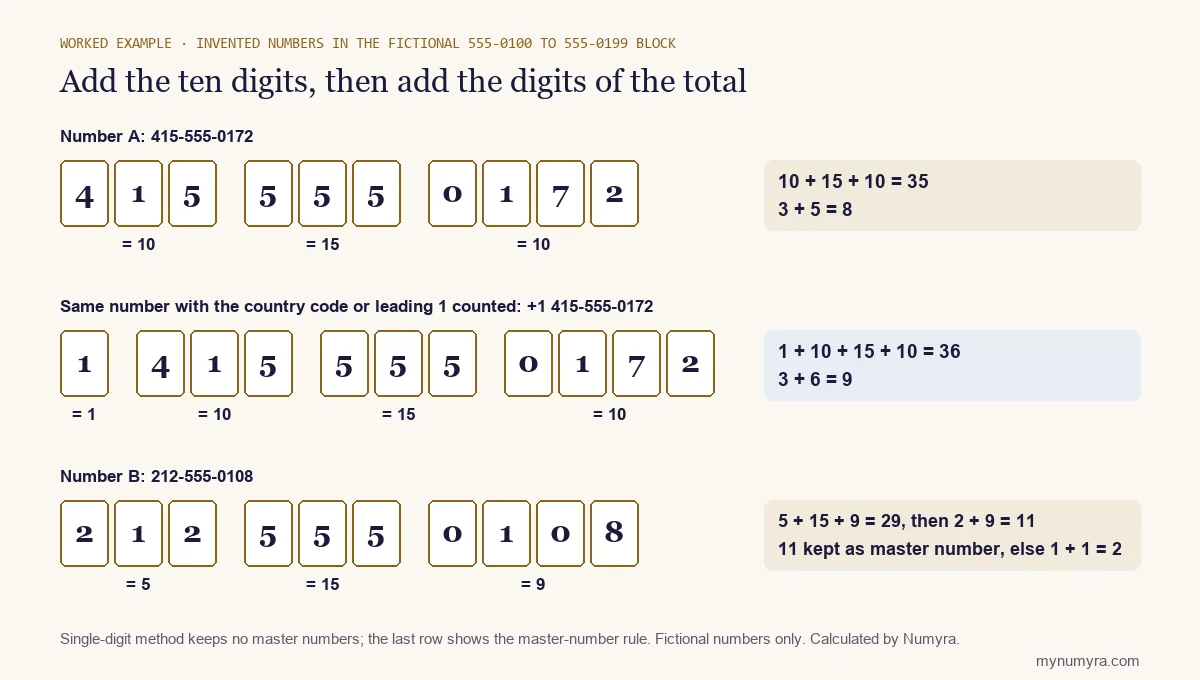
The two numbers in the figure are invented and sit in the block that the North American numbering administrator keeps for fiction (more on that below). The area code 415 adds 10, the exchange 555 adds 15 and the line number 0172 adds 10, so 415-555-0172 totals 35 and reduces to 8. Count the leading 1 and the total is 36, which reduces to 9. The second number, 212-555-0108, totals 29, and 2 + 9 is 11, so a calculator that keeps master numbers reports 11 where one that does not reports 2. When we searched Google on 23 October 2026, its AI Overview described the same steps, excluded country codes and used 987-654-3210 (total 45, so 9) as its example.
The one-digit result is then read against a list of meanings. The pages we read give broadly the same outline, shown below in a few words, and nothing in the arithmetic supports any of it.
| Total | Typical one-word reading in the pages we read | Where they differ |
|---|---|---|
| 1 | Leadership, new starts | Mostly agreed |
| 2 | Partnership | Mostly agreed |
| 3 | Creativity, communication | Mostly agreed |
| 4 | Stability, structure | One document in the results warns against repeated 4s |
| 5 | Change, freedom | Several guides add communication |
| 6 | Home, harmony | One page lists it as lucky for money |
| 7 | Reflection, spirituality | Mostly agreed |
| 8 | Power, money | Lucky in some pages, avoided in at least one |
| 9 | Completion, service | Mostly agreed |
For fuller meanings of each digit as a birth number, see our Life Path calculator and the Life Path pages it links to.
Six choices that change the answer
Two calculators can give different numbers for the same phone because the method leaves several choices open. The pages we read rarely say which choice they made.
| Choice | Effect on the total | Example with 415-555-0172 |
|---|---|---|
| Count the country code or the leading 1 | Adds the digit sum of the code | 35 becomes 36, so 8 becomes 9 |
| Count the zeros | None: a zero adds nothing | Same total either way |
| Drop the area code (local 7 digits only) | Subtracts the area code’s digit sum | 35 becomes 25, so 8 becomes 7 |
| Keep master numbers | Stops at 11, 22 or 33 when they appear | No change here; 212-555-0108 gives 11, not 2 |
| Use only the last four digits | A different number altogether | 0172 totals 10, which gives 1 |
| Write the number with letters (vanity) | Depends on the letter chart, see below | A word can give three different totals |
Parade’s September 2025 guide, republished by AOL, counts the area code and the zero and reduces everything to one digit. Healverse tells you to reduce every total to one digit while also mentioning master numbers, without saying how they are kept. A Google AI Overview treats the country code as out; Parade, Textr and the Occult Science page do not address it. The Healverse page and the Google answer both say the last four digits carry extra weight and call them a person’s “communication frequency”, a metaphor and not a measurement. Arithmetically, the last four digits settle the total only one time in nine: for a valid US number, the chance that the whole-number total equals the last-four total is 11.1%.
Country codes and how far each one shifts the total
Adding a country code adds its digits, so the effect is the same for every number: the one-digit total moves by the code’s own digit sum. A code whose digits add to a multiple of 9 does not move it at all.
| Country code | Digit sum of the code | Shift in the one-digit total |
|---|---|---|
| +1 United States and Canada | 1 | +1 |
| +44 United Kingdom | 8 | +8, the same as -1 |
| +91 India | 10 | +1 |
| +61 Australia | 7 | +7 |
| +49 Germany | 13 | +4 |
| +81 Japan | 9 | none |
| +33 France | 6 | +6 |
| +52 Mexico | 7 | +7 |
| +86 China | 14 | +5 |
| +353 Ireland | 11 | +2 |
| +971 United Arab Emirates | 17 | +8, the same as -1 |
| +27 South Africa | 9 | none |
The leading zero of a national format (as in a UK or Indian mobile number) adds nothing, so dropping it never matters, but swapping it for the country code does: a UK number written with +44 instead of the leading 0 moves down one place on the nine-step cycle. A reader outside the US who uses a US-made calculator should check whether it counted the code.
What a US phone number is made of
A US or Canadian number follows the North American Numbering Plan, written NPA-NXX-XXXX: a three-digit area code, a three-digit exchange (central office) code and a four-digit line number. In that notation N stands for any digit from 2 to 9 and X for any digit from 0 to 9. Neither the area code nor the exchange may begin with 0 or 1, codes of the form N11 (such as 911) are reserved for services, and 9 is reserved as the middle digit of an area code (Wikipedia, North American Numbering Plan). Those rules leave 712 possible area codes and 792 possible exchanges. Multiplied by the 10,000 possible line numbers, that is 5,639,040,000 numbers that fit the format, which is the population we calculated on below.
The same format explains why films use 555 so often. NANPA, the administrator, says of the block used for fiction:
The fictitious, non-working numbers, 555-0100 through 555-0199, will remain reserved for entertainment/advertising.
North American Numbering Plan Administrator, “555 Line Numbers” (nanpa.com)
That is why every example number on this page ends in 555-01xx. Other 555 numbers have been returned to the administrator’s inventory, so only that block of 100 is safe to print.
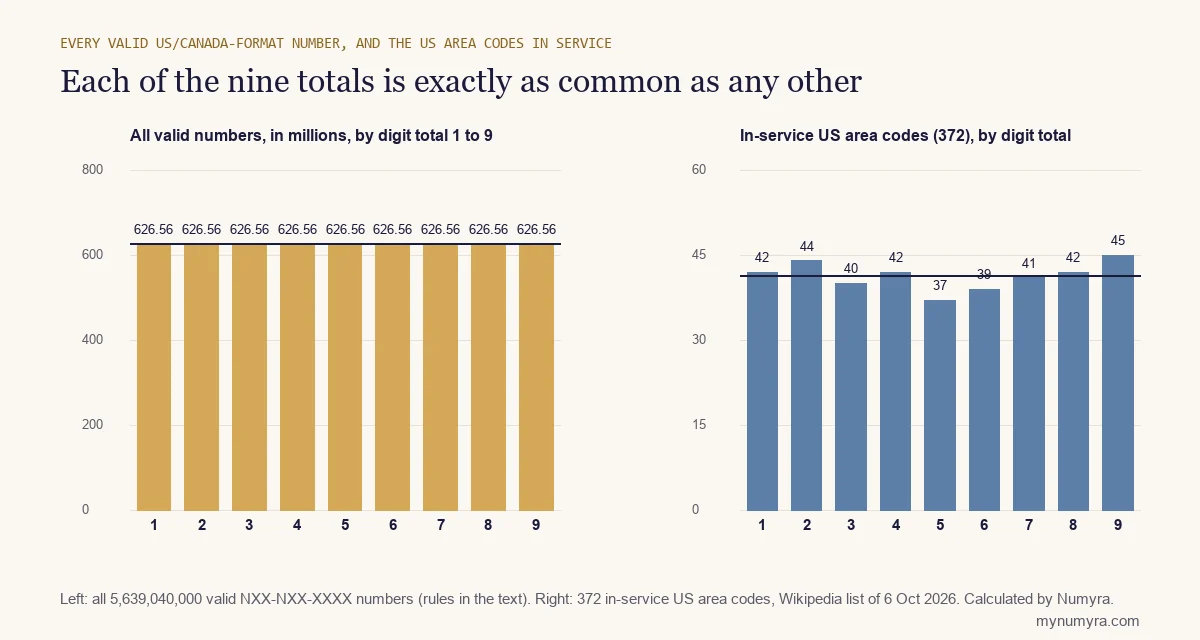
The figure shows what happens when you reduce every valid number to one digit. The totals themselves are not even: across all 5.6 billion numbers the sum of the ten digits runs from 4 to 89, averages 46.6 and clusters in a bell shape (92.3% of numbers fall between 30 and 60). But reducing a total to one digit keeps only its remainder after dividing by 9, and the remainder is flat, to within one number out of 626 million per digit. Real numbers behave the same way. The 372 area codes in service in the 50 states and Washington, D.C. (from Wikipedia’s list of 6 October 2026, which excludes Canada, the Caribbean and US territories) spread over the nine totals as 42, 44, 40, 42, 37, 39, 41, 42 and 45. A chi-square test against an even spread gives p = 0.997, so no total is tied to a place.
Why every total is available
Guides to “lucky” mobile numbers often tell readers to pick a number whose total matches their Life Path. The arithmetic shows how easy that is. Fix the first six digits, the area code and exchange. The remaining 10,000 line numbers split among the nine totals as 1,112 for the total 9 and 1,111 for each of the others. Whatever total you want, more than a thousand numbers in that one exchange have it.
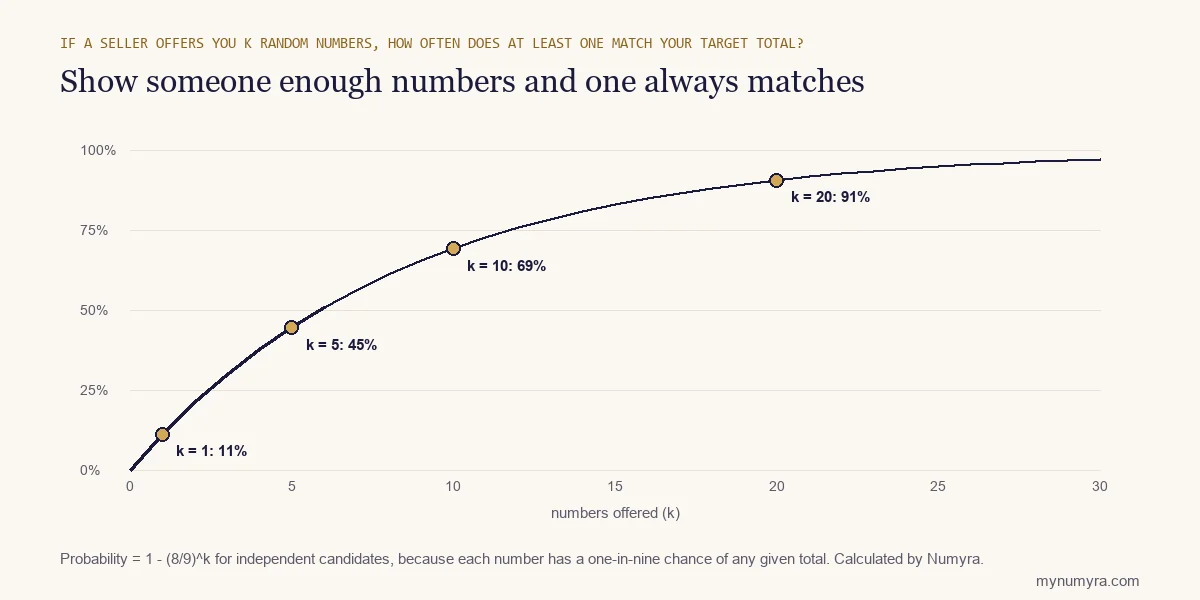
That changes what a “match” means. Each random number has a one-in-nine chance of giving any particular total, so if a store or carrier shows you five numbers there is a 45% chance one of them matches your target, ten numbers give 69%, and twenty give 91%. A match carries no information about the number, because the match is almost guaranteed by the shopping process itself. The total is the one feature of a number that cannot be scarce.
Master numbers and karmic debt totals in phone numbers
Whether a calculator keeps master numbers matters more for phone numbers than for birth dates, because ten digits give a large total and many routes to 11. We ran the rule that stops at 11, 22 or 33 whenever one appears, step by step.
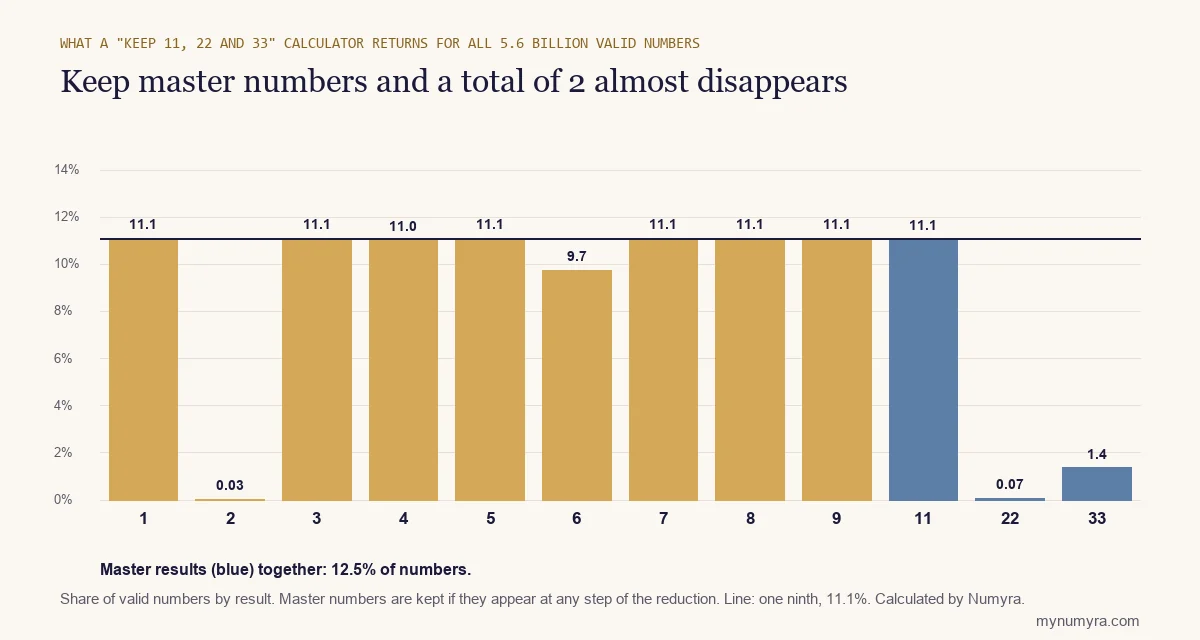
Under that rule 11.08% of valid numbers end as an 11, 33 shows up in 1.36% and 22 in 0.07%, so one number in eight (12.5%) gets a master result. The loss falls on the digits those masters would otherwise become. A plain 2 nearly vanishes (0.03%), because almost every total that reduces to 2 passes through 11 on the way (29, 38, 47, 56, 65, 74 and 83 all do). The share of 6 falls to 9.7% and the share of 4 to 11.0%. Our guide to master numbers explains where the rule comes from. For a phone number, the practical point is that “this number gives a 2” and “this number gives an 11” can describe the same digits, depending on the calculator.
The same reduction can pass through the four “karmic debt” totals, 13, 14, 16 and 19 (see our guide to karmic debt numbers). A link on Hans Decoz’s World Numerology page on karmic debt is labelled “You should avoid Karmic Debts in your address or phone number”; we could read only that label, not the page behind it. If you apply the rule at any step of the reduction, 8.6% of valid US numbers contain a karmic debt total (the totals 13, 14, 16, 19, 49, 58, 59, 67, 68, 76, 77, 79, 85, 86 and 88). Only 0.03% have one of the four as the full ten-digit total. A rule that touches about one number in twelve is a common filter, not a rare warning, and no source we read explains why a phone number should be treated this way.
Vanity numbers: letters on the keypad
Many US businesses advertise numbers as words. A telephone keypad puts letters on the digits, 2 for ABC up to 9 for WXYZ, in a layout that follows the international standard ITU E.161 (Wikipedia, Telephone keypad). The Textr guide to lucky numbers prints the same mapping and suggests building a vanity number from your Life Path and name numbers; it gives no source for the idea.
The keypad is a third letter chart, and it does not match either numerology chart. Only three letters share a value between the keypad and the Pythagorean chart (B, O and P), and only one with the Chaldean chart (B). The table shows three common English words as arithmetic examples:
| Word | Keypad total and digit | Pythagorean total and digit | Chaldean total and digit |
|---|---|---|---|
| HOME | 19, then 1 | 23, then 5 | 21, then 3 |
| SOLAR | 27, then 9 | 20, then 2 | 16, then 7 |
| PLUMBING | 42, then 6 | 40, then 4 | 32, then 5 |
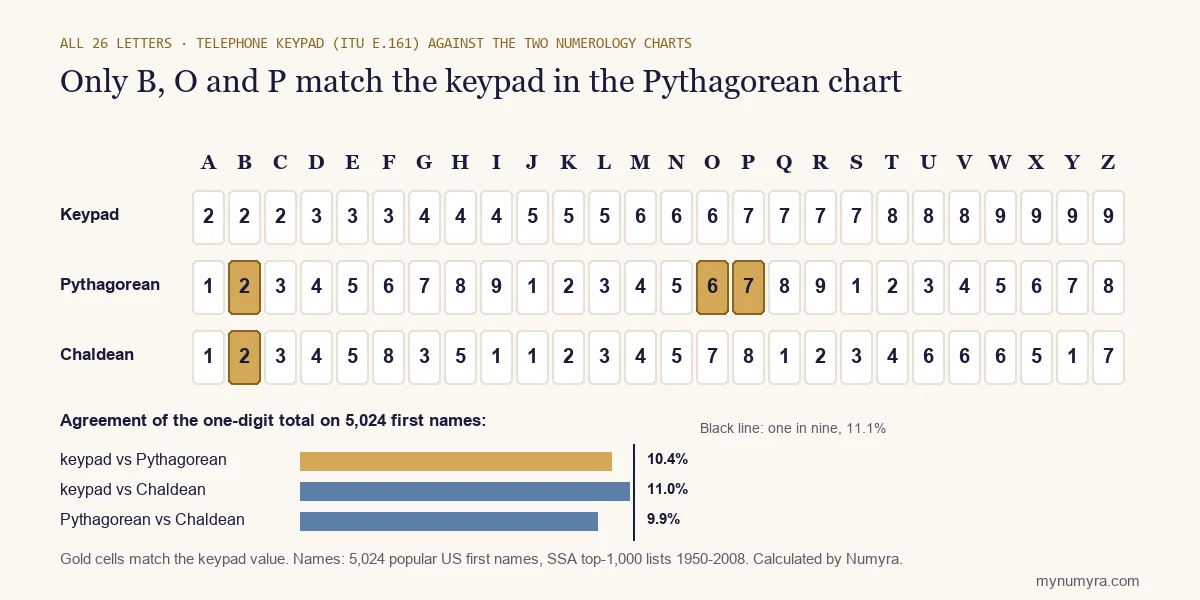
We measured the same effect on names. For 5,024 popular US first names, the keypad and Pythagorean one-digit totals agreed for 10.4%, the keypad and Chaldean for 11.0%, and the two numerology charts for 9.9%, about one in nine each, which is what unrelated charts would give. Dial 4663 and you reach HOME on the keypad; whether you should treat its keypad total (1) or its Pythagorean total (5) as the number’s meaning is a choice the tradition does not settle. More on the charts is in our numerology letter values chart and in the comparison of the Pythagorean, Chaldean and Kabbalah systems.
Where the lucky phone number idea comes from
The strongest example of lucky phone numbers is not digit-sum numerology at all. In Chinese tradition the digit 8 is prized because its sound resembles the word for prosperity, and 4 is avoided because it sounds like the word for death. Auction reports show what such patterns can fetch: VICE, citing AFP, described a Beijing court-ordered auction of a number ending in five 8s that sold for 2.25 million yuan (about $324,000) after more than 5,000 bids. An Associated Press report of November 2004, carried by NBC News, said:
Chinese tradition considers 3 a lucky number and groups of 3’s even luckier.
Associated Press, “Man pays $215,000 for lucky phone number,” NBC News, 6 November 2004 (nbcnews.com)
The difference matters. These buyers pay for digits that appear in a number, repeated, and for the sounds they stand for. They do not add the digits and read the total, which is the Pythagorean method used in US phone number guides. Scarcity is real in that case, because numbers made of many identical digits are rare; a total of 8, as shown above, is not.
What the sources say and what has been tested
We read four pages that appear for this search: Parade’s piece (about 550 words, no named expert, no sources), the Textr blog (unsourced), Healverse (about 1,400 words, a seller’s page) and the Occult Science calculator page (a course advertisement). We only checked the length and headings of the InstaAstro and Astrotalk guides (about 1,800 and 3,100 words), and two other pages would not open, one behind a robot check that we did not try to bypass. None of the four we read cites a source for its digit meanings, and as far as we could tell none explains how a US number is built or checks how common each total is. We also found no study that tests whether a phone number’s total relates to anything about its owner. Our review of the evidence for numerology generally, Is numerology real?, found no test that supports it, and the background to the practice is in what numerology is. The older tradition closest to phone numbers is the one for addresses, covered in house numerology and address numbers.
How to use a phone number total without overstating it
As a reflection exercise, fix the method before you look: say whether you count the country code, how you treat master numbers, and whether you use the full number. Calculate every candidate the same way and treat the result as a tiebreaker between numbers that already suit you. Do not pay extra for a total, and do not change a number you rely on because of it; it carries your contacts, accounts and history. Keep your own number out of calculators you do not know: the method needs only digits, so any number with the same digit sum, including a fictional 555-01xx one, gives the same result. This page is educational information about a cultural tradition. It is not financial, business or legal advice, and nothing here has been shown to predict anything.
If the number is for a business, the question of a business name’s total is a separate tradition, covered in our business name numerology guide. To see what a name adds up to, use our name numerology calculator.
How we ran the numbers
Format and population. We counted every number of the form NPA-NXX-XXXX with N from 2 to 9, X from 0 to 9, no area code or exchange of the form N11, and no 9 as the middle digit of an area code: 712 area codes, 792 exchanges and 10,000 line numbers. We computed the digit sums exactly by convolution, not by sampling. Digit totals. The one-digit result is the digital root; the master-number run keeps 11, 22 and 33 if they appear at any step. Area codes. From the table in Wikipedia’s list of North American Numbering Plan area codes (revision of 6 October 2026), we kept rows with a start date that name a US state or Washington, D.C., excluded Canadian, Caribbean, territory, toll-free and non-geographic entries, and got 372; the list can be wrong or out of date. Letters. The Pythagorean and Chaldean charts are the ones in our Pythagorean vs. Chaldean comparison; the keypad is ITU E.161. The 5,024 first names are the name-and-sex pairs in the US Social Security Administration’s yearly top-1,000 lists for 1950 to 2008, as compiled in the open data-baby-names repository, unweighted. Examples. All example numbers are invented and in the reserved fictional block. Sources. The AI Overview, the Google results and the guides were read on 23 October 2026 and will change; quotes were checked against the saved page text. Limits. We calculated format-valid numbers, not the numbers actually in use, which we cannot see, and we tested no outcome.
Frequently asked questions
How do I calculate the numerology of my phone number?
Add all the digits you decide to count, then add the digits of the total until one is left. The invented number 415-555-0172 totals 35, which reduces to 8. Decide first whether to count the country code and whether to keep 11, 22 and 33.
Should I include the area code?
Most guides count all ten digits, and Parade’s example includes the area code. Dropping it subtracts the area code’s digit sum: for 415-555-0172, 35 becomes 25 and the total changes from 8 to 7. Pick one rule and keep to it.
Do I count the +1 country code?
A Google AI Overview says to leave country codes out. Counting +1 adds one to every US number’s total, so 8 becomes 9 in our example. Codes such as +81 (Japan) and +27 (South Africa) add a multiple of 9 and change nothing.
What is the best numerology number for a phone number?
The pages we read disagree. Some call 6 and 8 lucky for money, some warn against 8 or repeated 4s, and some say the best total is the one that matches your Life Path. All nine totals are equally common among US numbers, so any total can be found.
Do the last four digits matter more?
Some guides say so, without a source. The last four digits give a total from 0 to 36 and agree with the whole-number total for exactly 11.1% of valid US numbers, no more than chance. Treat the rule as a tradition you may choose to follow.
Is Chinese lucky number tradition the same as phone number numerology?
No. Chinese practice prizes digits such as 8 for what they sound like and values repeated digits, with auction prices reported in the hundreds of thousands of dollars. Digit-sum numerology adds the digits and reads the total, a method with a different origin.
Can a phone number affect my life?
No test shows that it does. We found no study that links a phone number’s digit total to any outcome, and the review on our numerology evidence page found no pattern in birth-number tests either. Use the total for reflection, not for decisions.
Is it safe to type my phone number into a numerology calculator?
It is not needed. The calculation uses only the digits, so you can do it by hand or test any number with the same total. If you use a calculator, prefer one that states it does not store what you type, and never enter a number you would not give a stranger.
Sources
- North American Numbering Plan Administrator. “555 Line Numbers.” Read 23 October 2026.
- Wikipedia. “North American Numbering Plan.” Revision of 22 September 2026, CC BY-SA 4.0. Used for the number format and its history.
- Wikipedia. “List of North American Numbering Plan area codes.” Revision of 6 October 2026, CC BY-SA 4.0. Area code facts only.
- Wikipedia. “Telephone keypad.” Revision of 7 September 2026, CC BY-SA 4.0. Letter layout and ITU E.161.
- McRae, MaKayla. “The Hidden Power of Your Phone Number, Per Numerologists.” Parade, 16 September 2025, republished by AOL. Cited for its method.
- Textr Team. “Numerology | Find Your Lucky Phone Numbers.” 7 February 2025. Cited for its keypad letter mapping.
- Healverse. “Mobile Number Numerology: Choose Lucky Mobile Number.” Cited for the last-four-digit claim.
- All India Institute of Occult Science. “Mobile Number Numerology Calculator.” Cited for its stated lucky totals.
- Associated Press. “Man pays $215,000 for lucky phone number.” NBC News, 6 November 2004.
- VICE. “This ‘Lucky’ Phone Number Was Sold for Over $300,000 at a Chinese Online Auction.” Citing AFP and The New York Times.
- hadley/data-baby-names, top-1,000 US baby names by year from the Social Security Administration. Names only.
- Decoz, Hans. “Karmic Debt Numbers.” World Numerology. Cited for one link label only.