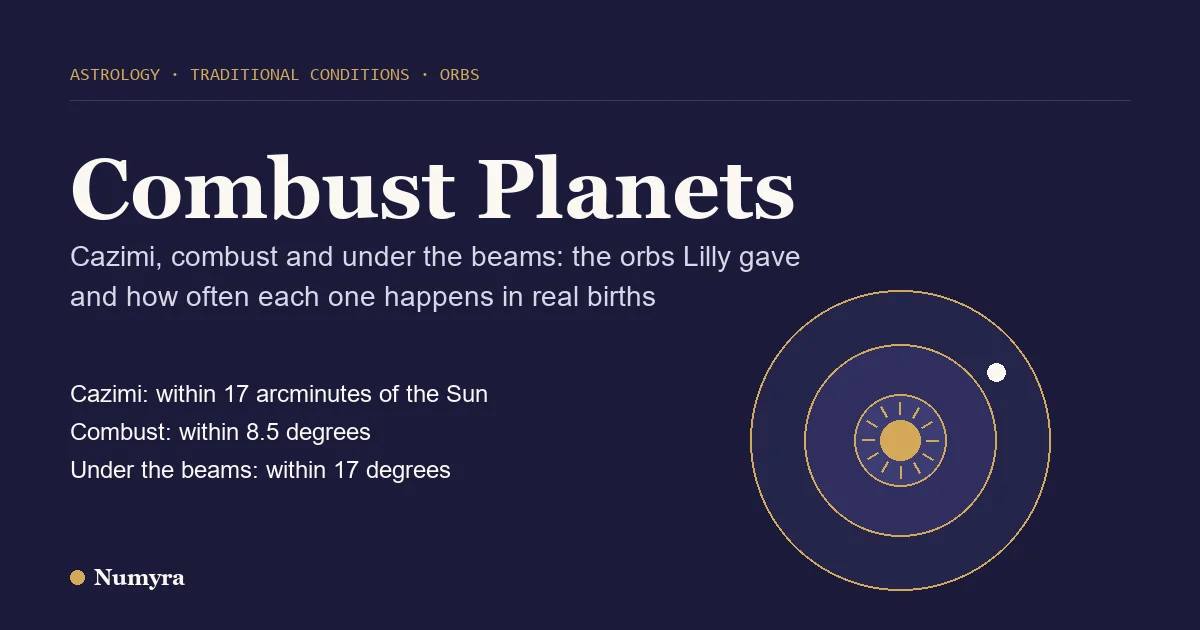
A planet is combust in astrology when it sits within about 8.5 degrees of the Sun, cazimi (“in the heart of the Sun”) when it is within 17 arcminutes, and under the beams out to about 17 degrees. Tradition reads combustion as a weakening and cazimi as a strengthening. Those numbers come from William Lilly’s Christian Astrology of 1647, and Lilly gives a second, different set on another page. This guide quotes both from the printed pages, then does what other guides on the subject skip: it measures how often each condition occurs in 85.7 million US births from 1994 to 2014, shows how a birth date without a time leaves the label uncertain, and lists the exact cazimi moments of Mercury and Venus from 2026 to 2028 in Eastern and Pacific time. Combustion is a traditional reading to weigh as symbolism, not a prediction.
Key takeaways
- Lilly (1647) gives cazimi as within 17 minutes of arc, combust as within 8 degrees 30 minutes in the same sign as the Sun, and under the beams as within 17 degrees (page 113). Some 190 pages later he writes 16 minutes and 12 degrees (page 300). Neither set is a scanning slip.
- Mercury is combust in 25.2% of US births, about one in four. Venus is combust in 13.6%, Mars in 7.8%, Jupiter in 5.5% and Saturn in 5.6%. 54.1% of births have none of those five planets combust.
- Cazimi is rare: 0.86% of births for Mercury, 0.44% for Venus, and under a quarter of one percent for Mars, Jupiter and Saturn.
- The orb you pick changes the count. Counting combust only in the Sun’s own sign, as Lilly’s wording says, takes Mercury from 25.2% to 21.5%. Counting the beams at 12 degrees instead of 17 takes it from 56.1% to 36.5%.
- A birth date with no time cannot settle cazimi: 0.86% of births are cazimi at noon, but 2.71% of birth dates contain a Mercury cazimi at some hour of the day.
In this guide
- What combust, cazimi and under the beams mean
- The orbs as Lilly printed them
- What came before: Valens and “under the rays”
- How often each planet is combust at birth
- Why Mercury is combust so often
- A birth date without a time: how sure is the label?
- Exact cazimi moments of Mercury and Venus, 2026 to 2028
- How to use combustion without over-reading it
- How we calculated this
- Frequently asked questions
What combust, cazimi and under the beams mean
All three terms measure one thing, how far a planet is from the Sun along the zodiac, and tradition cuts that distance into bands. A planet right on the Sun is cazimi, “in the heart of the Sun”, and is read as strengthened. A planet within a few degrees is combust, burnt by the Sun, and is read as hidden or weakened. A planet in a wider band is under the beams, still lost in the Sun’s glare, and is read as less fit than a planet in clear sight. The bands nest, so a cazimi planet is also inside the combust and beams distances, but the tradition gives it the strongest reading, not the weakest.
Only planets other than the Sun can be in these states, since the Sun is the point of reference. The distance is counted in zodiac longitude, the same degrees and minutes you read in a chart table, not by how close the two bodies look in the sky. A planet can share the Sun’s degree and still sit several degrees above or below it; astrologers ignore that height, and so do Lilly’s worked examples, which give only sign, degree and minute.
| Condition | Lilly, p. 113 (Introduction) | Lilly, p. 300 (judging a question) | Range on modern pages read | Traditional reading |
|---|---|---|---|---|
| Cazimi | within 17 minutes | within 16 minutes | 17 arcminutes; two pages also allow 1 degree | Strengthened; Lilly says all authors hold it fortifies the planet |
| Combust | not more than 8 degrees 30 minutes away, in the same sign as the Sun | not given | 7.5 to 8.5 degrees; one calculator page uses a different orb for each planet, 8 to 17 degrees | Weakened or hidden |
| Under the beams | until 17 degrees away | within 12 degrees | 15 to 17 degrees | Lilly: “no fortitude”, whatever sign the planet is in |
Modern ranges are from the guides by Kerykeion (Learn Astrology), Bonnie Sorsby, Nylon and Augurine, read in October 2026; they are listed to show how widely the figures vary, not as authorities.
The orbs as Lilly printed them
Lilly’s Christian Astrology (London, 1647) is the English book most modern orb tables trace back to, and the Internet Archive holds page scans. In the Introduction, on page 113, he gives all three bands in a row:
“A Planet is said to be Combust of the [Sun], when in the same Signe where the [Sun] is in, he is not distant from the [Sun] eight degrees and thirty minutes, either before or after the [Sun].” … “A Planet is said to be still under the Sun-beames, untill he is fully elongated or distant from his body 17, degr. either before or after him.” … “A Planet is in the heart of the Sunne, or in Cazimi, when he is not removed from him 17. min. or is within 17. min. forward or backward.”
William Lilly, Christian Astrology (London, 1647), p. 113, in the Internet Archive scan. Original spelling, long s modernized; Lilly’s Sun symbol is written out in brackets.
Four details in that passage are easy to miss. The first is the same-sign condition: Lilly counts combustion only when the planet and the Sun share a sign, so a planet 5 degrees from the Sun across a sign boundary is not combust by his wording. The second is that he thinks a planet suffers more while the Sun is approaching it than after the Sun has moved away. The third is his own preference, stated plainly, to measure combustion from half the planet’s own orb instead of from the Sun’s, which makes Jupiter combust only inside 4 degrees 30 minutes; he adds that he knows many are against that opinion and tells the reader to use whichever he finds truest. The fourth, on page 114, is that combustion comes only from a conjunction in the same sign and never from an aspect: a square or an opposition to the Sun afflicts a planet but does not burn it.
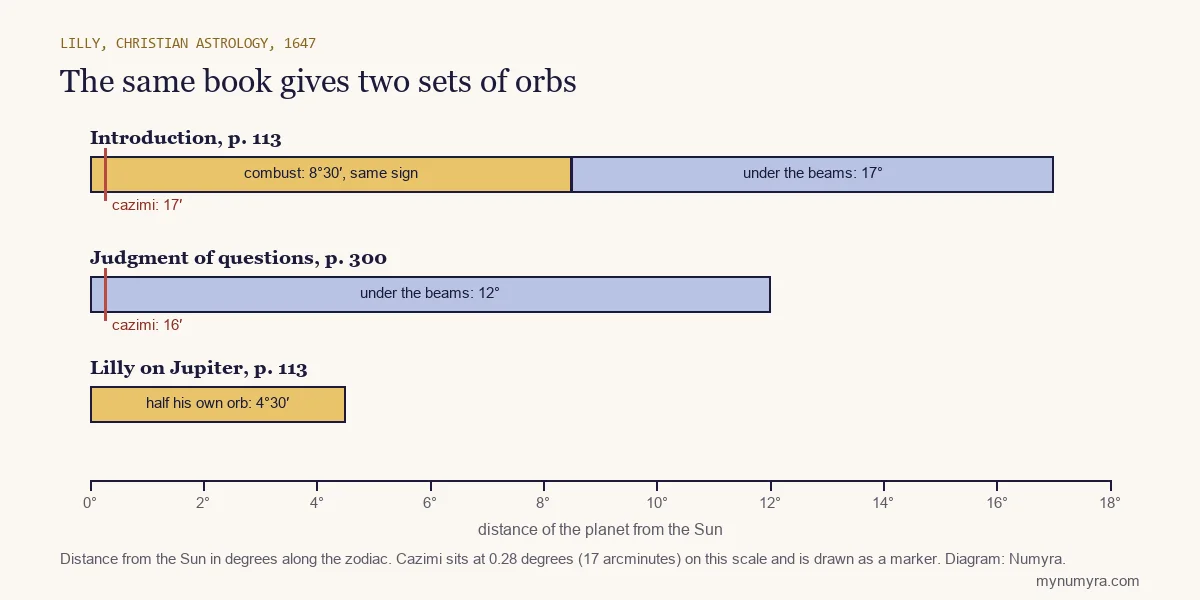
Page 113 is not the only place Lilly gives numbers. In a numbered list of aphorisms for judging a question, on page 300, he writes:
“A Planet within twelve degrees of the [Sun], is said to be under his Beames, and then hath no fortitude, let it be in what Signe it will; when a Planet is within sixteen minutes of the [Sun], he is said to be in Cazimi, … and then it’s an addition of fortune, and he is wondrous strong.”
William Lilly, Christian Astrology (London, 1647), p. 300, aphorism 26, in the chapters of “The Resolution of all manner of Questions”, Internet Archive scan. The ellipsis stands for four words and a Sun symbol that we could not read with confidence in the scan.
So one author, one book, two sets: 17 degrees and 12 degrees for the beams, 17 and 16 minutes for cazimi. We checked both against the page images, where the numbers are plainly legible, so this is not a transcription error. We found nothing in the book that reconciles them. Aphorism 23 on the same page 300 also warns against a question’s significator that is “either Combust, or in Opposition to the [Sun]”, treating an opposition as harmful in the same breath, while page 114 says an opposition cannot cause combustion. A reader choosing an orb is choosing between Lilly’s own pages, and the next sections show how much that choice matters.
What came before: Valens and “under the rays”
Lilly was writing fifteen centuries after the Greek astrologers. Vettius Valens, a second-century astrologer, uses the older wording, a planet “under the rays of the Sun”, in several passages of his Anthology. In the English translation by Mark Riley, one of them reads:
“The Moon setting under the rays of the Sun is not good for marriages.”
Vettius Valens, Anthology, Book II, chapter 37 (Kroll numbering), trans. Mark Riley, in the annotated edition by Jane Griscti. The Sun’s symbol is written out.
What is missing is as informative as what is there. In the passages we read, Valens states no distance in degrees, and a search of the whole translation finds neither “combust” nor “cazimi”. He treats the Sun’s light as a condition that hides a planet and weakens its results, and bluntly: in the chapter on the 2nd Place he says Mercury under the rays makes men stupid and illiterate. We did not read Hellenistic sources that give orbs, so we make no claim about the figures they use.
How often each planet is combust at birth
We took every US birth date from 1994 to 2014 (7,670 days, 85.7 million births), placed the planets with the Swiss Ephemeris at noon Eastern, and measured each planet’s longitude distance from the Sun, weighting each date by its births. Cazimi is 17 arcminutes, combust 8.5 degrees and the beams 17 degrees, with Lilly’s alternatives beside them.
| Planet | Cazimi, 17 arcminutes | Combust, 8.5 degrees | Combust, same sign as the Sun only | Under the beams, 12 degrees | Under the beams, 17 degrees |
|---|---|---|---|---|---|
| Mercury | 0.86% | 25.2% | 21.5% | 36.5% | 56.1% |
| Venus | 0.44% | 13.6% | 11.7% | 19.3% | 27.3% |
| Mars | 0.24% | 7.8% | 6.6% | 11.0% | 15.7% |
| Jupiter | 0.18% | 5.5% | 4.6% | 7.8% | 11.0% |
| Saturn | 0.23% | 5.6% | 4.6% | 7.8% | 11.0% |
| If spread evenly round the zodiac | 0.16% | 4.7% | not applicable | 6.7% | 9.4% |
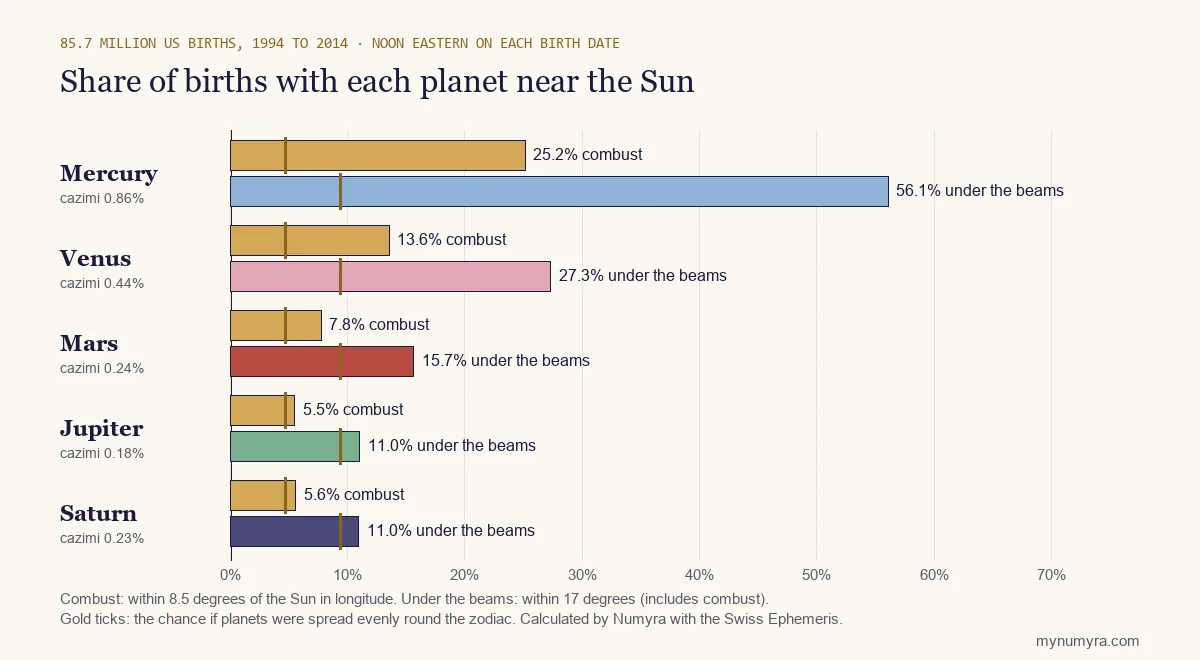
Mercury is the standout. It is combust in about one birth in four (25.2%) and under the beams in 56.1%, so more than half of the people in the sample have a Mercury that tradition calls at least dimmed. Venus is combust in 13.6%, close to one in seven. The slow planets sit near what pure chance would give: a planet spread evenly round the zodiac would be combust 4.7% of the time and under the beams 9.4%. Mars, Jupiter and Saturn run a little above that, at 7.8%, 5.5% and 5.6%. That excess is a sampling effect: in 21 years Mars passes the Sun only about ten times and Jupiter and Saturn about twenty times each, so another 21 years could move them by a point or more.
These match our chart ruler guide, where about one chart in four with a Mercury ruler has that ruler combust. Cazimi is far rarer: 0.86% for Mercury, about 1 birth in 117, and 0.44% for Venus, about 1 in 226. If you use Lilly’s page-300 figure of 16 minutes, Mercury’s cazimi share drops to 0.75%. If you follow his half-orb preference for Jupiter, Jupiter is combust in only 3.0% of births.
The other columns show how much the choice of orb moves the answer. Lilly’s same-sign rule removes births where Mercury is within 8.5 degrees but across a sign boundary, which accounts for 3.7 percentage points of all births for Mercury. Cutting the beams from 17 to 12 degrees lowers Venus from 27.3% to 19.3%.
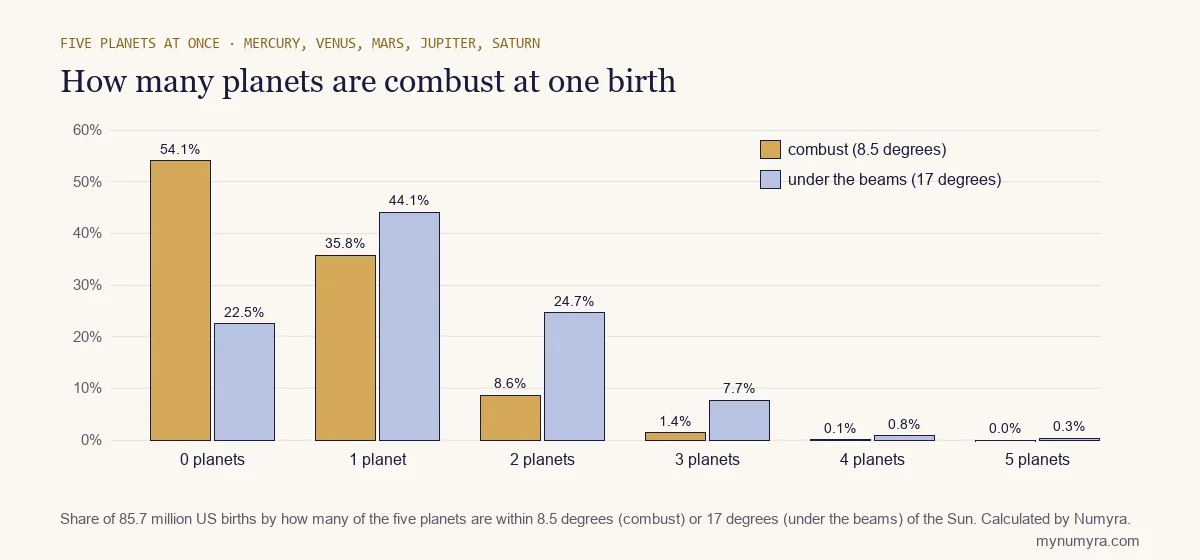
Across all five planets, 54.1% of births have none combust, 35.8% have exactly one, 8.6% have two and 1.5% have three or more. Only 22.5% have none under the beams, so 77.5% have at least one by the 17 degree rule. A combust or beam-dimmed planet is the normal case.
Why Mercury is combust so often
Mercury orbits inside Earth’s orbit, so from here it never wanders far from the Sun: in our sample its largest distance in longitude was 27.8 degrees, and Venus reached 47.1. A planet confined to 28 degrees on each side of the Sun spends a large share of its time inside 17 of them. The same limit keeps your Mercury sign within one sign of your Sun sign, and Venus within about 47 degrees.
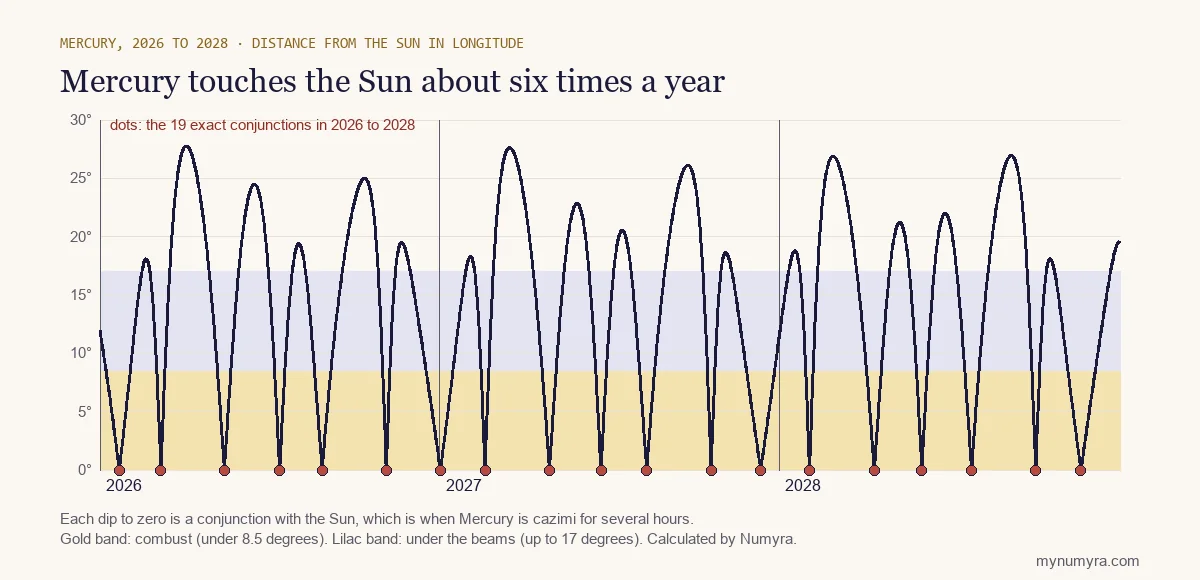
The chart traces Mercury’s distance from the Sun over 2026 to 2028: it swings out and returns 19 times in three years. In the ten superior conjunctions Mercury passes behind the Sun and is moving direct. In the nine inferior conjunctions it passes between Earth and the Sun, and every one of the nine falls while Mercury is retrograde, so each Mercury retrograde in this period has a cazimi near its middle. Venus retrograde has the same structure, once every 19 months or so.
A birth date without a time: how sure is the label?
Many people know their birth date but not their birth minute, and cazimi lasts only hours. For each of the 7,670 dates we checked every hour from midnight Eastern to midnight Pacific, the 27 hours in which a date exists in the lower 48 states, and asked whether the condition holds at some moment of that date and whether the answer changes during it.
| Planet | Cazimi at noon | Cazimi at some moment of the date | Combust at noon | Combust at some moment of the date | Combust label flips during the date |
|---|---|---|---|---|---|
| Mercury | 0.86% | 2.71% | 25.2% | 27.1% | 3.93% |
| Venus | 0.44% | 0.89% | 13.6% | 14.0% | 0.77% |
| Mars | 0.24% | 0.36% | 7.8% | 7.9% | 0.25% |
| Jupiter | 0.18% | 0.47% | 5.5% | 5.8% | 0.57% |
| Saturn | 0.23% | 0.49% | 5.6% | 5.8% | 0.59% |
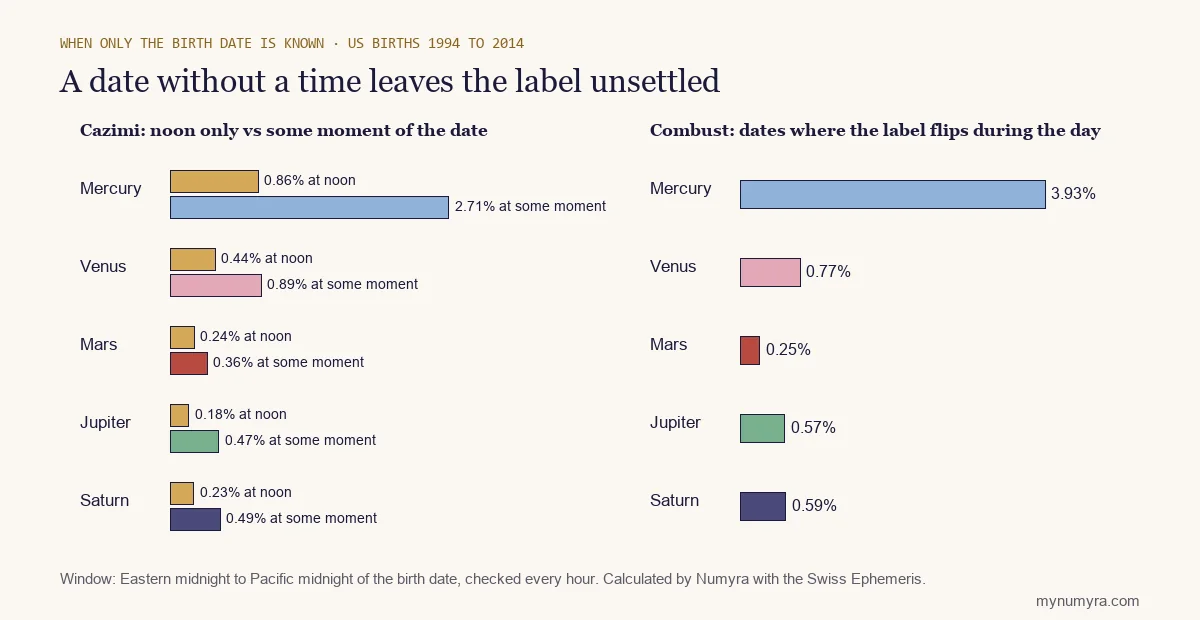
For cazimi the effect is large. Mercury is cazimi at noon in 0.86% of births, but 2.71% of birth dates include a Mercury cazimi at some hour, roughly one date in 37. Someone born on one of those dates may or may not have been cazimi, and only the birth time answers it. Combust is steadier: the label flips during the date for 3.9% of Mercury dates, about one in 25, and for under 1% of dates for every other planet. So a date-only chart gives a trustworthy combust verdict about 96 times in 100 for Mercury and more than 99 times in 100 for the others, and a cazimi verdict almost never. The same time-sensitivity is behind the rising sign changing every couple of hours.
The date also depends on whose clock you use: Mercury’s inferior conjunction on July 12, 2026 is at 9:25 pm Eastern, which is July 13 in Universal Time.
Exact cazimi moments of Mercury and Venus, 2026 to 2028
Each row is the moment the planet and the Sun share the same zodiac longitude, so it is the middle of the cazimi window. “Inside 17 arcminutes” is how long the longitude gap stays at or below 17 arcminutes, which is the stretch an astrologer would call cazimi. Times are Eastern and Pacific with daylight saving applied, and rows already in the past are included so you can check a recent birth. Mercury and Venus are cazimi on the same date twice, on August 11, 2027 and June 1, 2028.
| Planet and type | Exact moment, Eastern | Exact moment, Pacific | Inside 17 arcminutes | Sun at |
|---|---|---|---|---|
| Venus, superior (direct) | Tue Jan 6, 2026, 11:35 am | Tue Jan 6, 2026, 8:35 am | 56.9 hours | 16° Capricorn |
| Mercury, superior (direct) | Wed Jan 21, 2026, 10:48 am | Wed Jan 21, 2026, 7:48 am | 20.5 hours | 1° Aquarius |
| Mercury, inferior (retrograde) | Sat Mar 7, 2026, 6:01 am | Sat Mar 7, 2026, 3:01 am | 6.8 hours | 16° Pisces |
| Mercury, superior (direct) | Thu May 14, 2026, 10:24 am | Thu May 14, 2026, 7:24 am | 11.2 hours | 23° Taurus |
| Mercury, inferior (retrograde) | Sun Jul 12, 2026, 9:25 pm | Sun Jul 12, 2026, 6:25 pm | 8.5 hours | 20° Cancer |
| Mercury, superior (direct) | Thu Aug 27, 2026, 1:03 pm | Thu Aug 27, 2026, 10:03 am | 13.6 hours | 4° Virgo |
| Venus, inferior (retrograde) | Fri Oct 23, 2026, 11:44 pm | Fri Oct 23, 2026, 8:44 pm | 8.5 hours | 0° Scorpio |
| Mercury, inferior (retrograde) | Wed Nov 4, 2026, 9:24 am | Wed Nov 4, 2026, 6:24 am | 5.9 hours | 12° Scorpio |
| Mercury, superior (direct) | Fri Jan 1, 2027, 12:07 pm | Fri Jan 1, 2027, 9:07 am | 23.1 hours | 11° Capricorn |
| Mercury, inferior (retrograde) | Thu Feb 18, 2027, 11:39 am | Thu Feb 18, 2027, 8:39 am | 6.4 hours | 29° Aquarius |
| Mercury, superior (direct) | Wed Apr 28, 2027, 5:21 pm | Wed Apr 28, 2027, 2:21 pm | 11.6 hours | 8° Taurus |
| Mercury, inferior (retrograde) | Wed Jun 23, 2027, 3:59 am | Wed Jun 23, 2027, 12:59 am | 8.9 hours | 1° Cancer |
| Mercury, superior (direct) | Wed Aug 11, 2027, 7:02 am | Wed Aug 11, 2027, 4:02 am | 12.5 hours | 18° Leo |
| Venus, superior (direct) | Wed Aug 11, 2027, 8:20 pm | Wed Aug 11, 2027, 5:20 pm | 49.3 hours | 19° Leo |
| Mercury, inferior (retrograde) | Tue Oct 19, 2027, 11:30 am | Tue Oct 19, 2027, 8:30 am | 6.1 hours | 26° Libra |
| Mercury, superior (direct) | Sat Dec 11, 2027, 5:16 pm | Sat Dec 11, 2027, 2:16 pm | 24.5 hours | 19° Sagittarius |
| Mercury, inferior (retrograde) | Wed Feb 2, 2028, 3:47 am | Wed Feb 2, 2028, 12:47 am | 6.1 hours | 13° Aquarius |
| Mercury, superior (direct) | Tue Apr 11, 2028, 6:55 pm | Tue Apr 11, 2028, 3:55 pm | 12.3 hours | 22° Aries |
| Venus, inferior (retrograde) | Thu Jun 1, 2028, 6:00 am | Thu Jun 1, 2028, 3:00 am | 8.6 hours | 11° Gemini |
| Mercury, inferior (retrograde) | Thu Jun 1, 2028, 10:46 pm | Thu Jun 1, 2028, 7:46 pm | 9.0 hours | 12° Gemini |
| Mercury, superior (direct) | Tue Jul 25, 2028, 9:07 am | Tue Jul 25, 2028, 6:07 am | 11.8 hours | 3° Leo |
| Mercury, inferior (retrograde) | Mon Oct 2, 2028, 6:37 am | Mon Oct 2, 2028, 3:37 am | 6.4 hours | 9° Libra |
| Mercury, superior (direct) | Sun Nov 19, 2028, 8:40 pm | Sun Nov 19, 2028, 5:40 pm | 23.7 hours | 28° Scorpio |
We checked these against the Astronomical Yearbook of the Institute of Applied Astronomy of the Russian Academy of Sciences, which prints Mercury and Venus conjunction times for 2026 and 2027 to a tenth of an hour. All 16 events for those two years agree with our times to within 3 minutes. The 2028 rows follow the same method but have no independent published check yet.
“Cazimi” by longitude is not the same as lining up in the sky. At the moment the longitudes match, Mercury and Venus are usually a degree or more above or below the Sun. In this table only one event brings a planet within 17 arcminutes of the Sun’s center in the sky: Mercury’s superior conjunction on May 14, 2026, 9 arcminutes away, when it passed behind the Sun and could not be seen. The nearest inferior conjunction, Mercury on November 4, 2026, misses by about 22 arcminutes, which is about 6 arcminutes beyond the Sun’s edge (the Sun’s visible radius is about 16 arcminutes), so no row here is a transit. Across the birth sample, only 0.024% of births had Mercury within 17 arcminutes of the Sun’s center in the sky, against 0.86% by longitude. Astrologers use longitude, so that is the convention in this guide.
How to use combustion without over-reading it
To check your own chart, take the planet’s zodiac position, subtract the Sun’s, and look at the size of the gap. Under 8.5 degrees is combust by the common convention, under 8 degrees 30 minutes and in the same sign is combust by Lilly’s wording, and under 17 arcminutes is cazimi. Then decide which orb you are using and state it, because the same chart can be combust under one rule and not another.
Combustion is one factor among several. A combust planet can still be strong by sign, as the essential dignities table scores it, and retrograde motion is a separate mark that Lilly lists alongside it. Lilly’s harshest line, that a combust significator “will then signifie nothing of the matter”, belongs to horary questions, where an astrologer judged a single question from a single chart, and he himself says to use whichever orb you find truest. Modern writers mostly soften it into an image of a planet overwhelmed by the Sun’s glare. None of this has scientific support, and the old texts give examples chosen by their authors, not controlled tests.
The useful takeaway from the numbers is proportion. A combust Mercury is not a rare mark of distinction or doom, since one person in four has it, and cazimi is the unusual condition. Treat all of it as a traditional vocabulary for describing a chart. It is educational information, not advice on health, money or legal matters. Orbs for aspects, a different use of the same word, are in our aspect patterns guide.
How we calculated this
Birth dates and counts come from the CDC National Center for Health Statistics (1994 to 1999) and the Social Security Administration (2000 to 2014), as published in the FiveThirtyEight births dataset; the files hold dates and counts only, with no times or places. We placed Mercury, Venus, Mars, Jupiter, Saturn and the Sun at 12:00 noon US Eastern on each date, with daylight saving time applied, using pyswisseph, the Python binding of the Swiss Ephemeris, in its built-in Moshier mode, which is accurate to well under an arcminute for these planets. Positions are tropical, geocentric and apparent. Distance is the absolute difference in ecliptic longitude. The same-sign column also requires both bodies in the same 30 degree sign.
The date-only test samples each date every hour from Eastern midnight for 27 hours. The cazimi moments come from a root search for the instant the longitude difference is zero, with the window edges at plus and minus 17 arcminutes, and were compared to the Institute of Applied Astronomy Yearbook as described above. Limits: noon Eastern is a convention, not a real birth time; real births are spread across all hours and time zones and we did not model that. The slow planets have few conjunctions in 21 years, so their shares are specific to this sample. Our methodology page covers how Numyra calculates.
Frequently asked questions
What does combust mean in astrology?
A planet is combust when it is very close to the Sun, traditionally within about 8.5 degrees. Tradition reads it as weakened or hidden by the Sun’s light. William Lilly in 1647 adds that the planet should be in the same sign as the Sun.
What is cazimi?
Cazimi means “in the heart of the Sun”: a planet within about 17 arcminutes of the Sun, roughly a third of a degree. Lilly writes that all authors hold such a planet to be fortified, so it is read as strengthened, the opposite of combust.
What is the orb for a combust planet?
Most sources give 7.5 to 8.5 degrees. Lilly gives 8 degrees 30 minutes in the same sign, and says he prefers half the planet’s own orb, which is 4 degrees 30 minutes for Jupiter. Some calculator pages use a different orb for each planet.
What does under the beams mean?
A wider band around the Sun, in which a planet is still hidden by its light but less severely than when combust. Lilly gives 17 degrees on page 113 and 12 degrees on page 300 of Christian Astrology.
How common is a combust Mercury?
In US births from 1994 to 2014, Mercury was within 8.5 degrees of the Sun at noon in 25.2% of births, about one in four. Mercury never gets more than about 28 degrees from the Sun, so it is combust more often than any other planet.
Is a combust planet always bad?
Tradition says it is weakened, and Lilly calls a combust significator unable to bring anything to perfection in a question. The reading is symbolic and not tested, and since a quarter of people have a combust Mercury, it is a common feature of charts and not a sign of misfortune.
Can the Sun be combust?
No. Combustion measures a planet’s distance from the Sun, so the Sun itself has nothing to be close to. The condition applies to the other planets in the chart.
Do I need my birth time to know if a planet is combust?
Not for combust in most cases: with only a date, the combust label is stable for about 96% of Mercury dates and more than 99% for the others. For cazimi you do need the time, because it lasts only hours.
Sources
- William Lilly. Christian Astrology (London, 1647), Internet Archive scan; page 113 (combust, under the beams, cazimi), page 114 (combustion by conjunction only) and page 300 (aphorisms 23 and 26) checked against the page images.
- Vettius Valens. Anthology, Book II, chapter 37 (Kroll numbering), trans. Mark Riley, in the annotated edition by Jane Griscti.
- Institute of Applied Astronomy, Russian Academy of Sciences. Astronomical Yearbook 2026, configurations of the Sun, Moon and planets, and the 2027 edition, used to check Mercury and Venus conjunction times.
- FiveThirtyEight. US births data, 1994 to 2014, from the CDC National Center for Health Statistics and the Social Security Administration. Dates and counts only.
- Astrodienst. Swiss Ephemeris. Planet positions for all calculations (Numyra Methodology Desk, pyswisseph, Moshier mode).
- Kerykeion Learn Astrology. “Traditional Conditions: Planetary Conditions.” One of the modern guides whose orbs are compared above, with Bonnie Sorsby on cazimi and Augurine’s combust calculator page.