Your chart ruler is the planet that rules your rising sign: Mars for Aries rising, Venus for Taurus and Libra, Mercury for Gemini and Virgo, the Moon for Cancer, the Sun for Leo, Jupiter for Sagittarius and Saturn for Capricorn. Scorpio, Aquarius and Pisces rising each have two answers, a traditional ruler (Mars, Saturn, Jupiter) and a modern one (Pluto, Uranus, Neptune). Astrologers read the sign and house that planet occupies as a key to how the rest of the chart works. This guide gives the full table, explains the two systems, shows how the reading is done, and adds figures from 600,000 simulated births on how often a chart ruler is retrograde, at home or in each house.
Key takeaways
- Nine of the twelve rising signs have a single, uncontested chart ruler. Only Scorpio, Aquarius and Pisces rising have a traditional ruler (Mars, Saturn, Jupiter) and a modern one (Pluto, Uranus, Neptune), and our sign profiles name the traditional planet first.
- Ptolemy used the planets that rule the rising point to judge bodily form, and William Lilly treated the Lord of the Ascendant as the planet that stands for the person, in questions and in birth charts alike.
- In our simulation of 600,000 US births, a chart ruler is retrograde in 15.7% of charts and in its own sign in 12.1%, and it lands in an angular house (1st, 4th, 7th or 10th) in 33.4%, almost exactly the one-third that chance predicts.
- Modern rulers barely differ between people born close together. For Scorpio rising born from 1994 to 2014, Pluto sat in Sagittarius, the 2nd house, in 61.8% of charts; the traditional ruler, Mars, spread across all twelve houses.
- About one chart in five (20.1%) has a single final dispositor, a planet in its own sign that every other planet’s ruler chain ends at. Reading a chart ruler is a tradition of interpretation, not a tested prediction.
In this guide
- What a chart ruler is
- The chart ruler for every rising sign
- Traditional vs modern rulers: Scorpio, Aquarius, Pisces
- How astrologers read a chart ruler
- How often a chart ruler is retrograde, at home or in each house
- Dispositors: the ruler of the ruler
- What Ptolemy and Lilly wrote
- What the chart ruler cannot tell you
- Frequently asked questions
What a chart ruler is
Every zodiac sign has a ruling planet, the planet said to be at home in it. The sign rising on the eastern horizon at the moment of birth is your rising sign, or ascendant, and the planet that rules that sign is your chart ruler. Some astrologers call it the ruler of the ascendant, the lord of the ascendant or the chart’s ruling planet. If you do not know your rising sign yet, our birth chart calculator finds it from your birth date, time and place, and the guide to Sun, Moon and rising signs explains why it differs from your Sun sign.

The rising sign marks the first house, the starting point of the chart, and its ruler is the planet in charge of that starting point. Where the ruler is placed, in which sign and house, is read as showing where the person’s energy goes. Our guide to the houses lists what each house covers.
The chart ruler is not the ruler of your Sun sign. A Leo Sun with Taurus rising has the Sun as Sun-sign ruler and Venus as chart ruler. It is decided by the rising sign alone, which is why an accurate birth time matters.
The chart ruler for every rising sign
This table matches the rulers on our rising sign profiles. The traditional ruler is the planet assigned in the system used by astrologers before the discovery of Uranus (1781), Neptune (1846) and Pluto (1930). The share column is the percentage of our simulated US births with that rising sign, explained in the data section below. The shares differ because signs rise at different speeds at US latitudes: Aries and Pisces rising are about 5% of births each and Leo and Scorpio about 10%, in line with the rising times on our rising sign pages.
| Rising sign | Traditional chart ruler | Modern chart ruler | Share of simulated births |
|---|---|---|---|
| Aries | Mars | Same planet | 5.3% |
| Taurus | Venus | Same planet | 6.3% |
| Gemini | Mercury | Same planet | 8.1% |
| Cancer | The Moon | Same planet | 9.8% |
| Leo | The Sun | Same planet | 10.4% |
| Virgo | Mercury | Same planet | 10.2% |
| Libra | Venus | Same planet | 10.2% |
| Scorpio | Mars | Pluto | 10.3% |
| Sagittarius | Jupiter | Same planet | 9.8% |
| Capricorn | Saturn | Same planet | 8.1% |
| Aquarius | Saturn | Uranus | 6.3% |
| Pisces | Jupiter | Neptune | 5.3% |
Only seven planets appear in the traditional column because five of them rule two signs each: Venus, Mercury, Saturn, Jupiter and Mars. The Sun and Moon each rule one sign, Leo and Cancer, so those are the only risings where the chart ruler is a luminary and can never be retrograde.
Traditional vs modern rulers: Scorpio, Aquarius, Pisces
The three disputed signs are the ones that have a planet discovered after the traditional system was set. Our essential dignities guide sets out the traditional table from William Lilly’s Christian Astrology (1647), which has seven planets and no Uranus, Neptune or Pluto. Many modern astrologers give Uranus to Aquarius, Neptune to Pisces and Pluto to Scorpio, either replacing the traditional ruler or sitting beside it as a co-ruler.
There is no authority that settles it. A practical approach is to read the traditional ruler first, because it moves at a pace that makes it personal, and to treat the modern ruler as a second layer for that one sign. The simulation shows why. NASA’s fact sheets give orbital periods of about 84 years for Uranus, 165 for Neptune and 248 for Pluto, so everyone born within a few years shares the same sign, and often the same house, for the modern ruler:
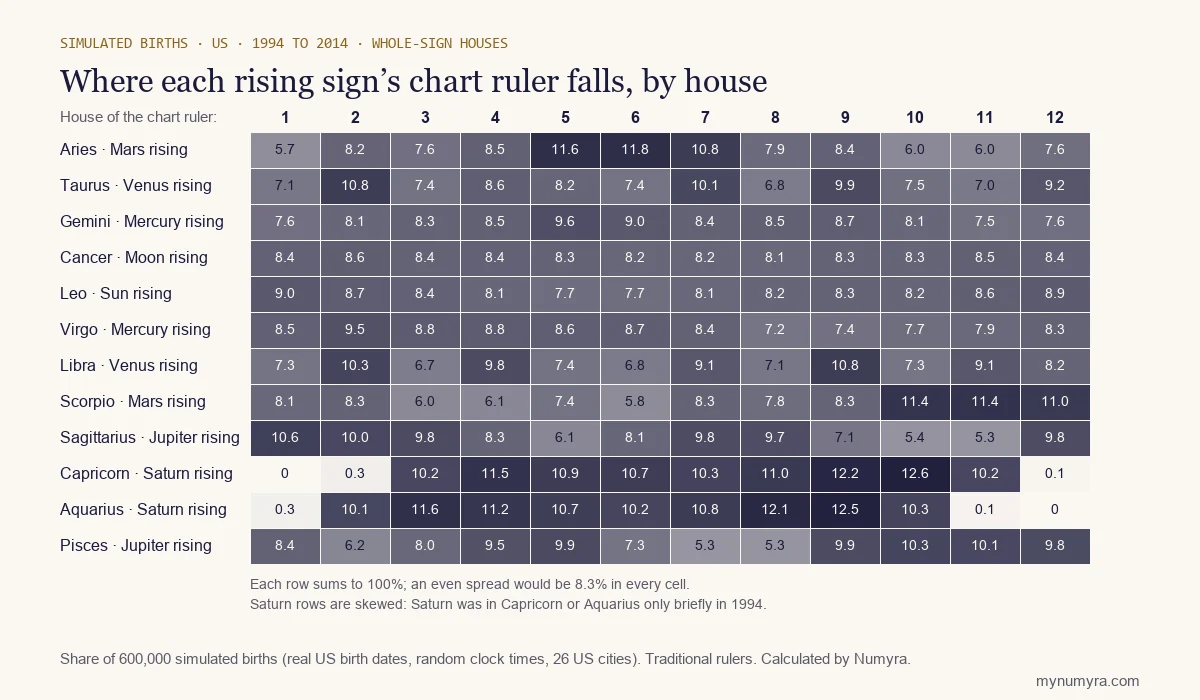
- Scorpio rising, born 1994 to 2014: Pluto was in Sagittarius (the 2nd house) in 61.8% of charts and Capricorn (3rd) in 30.9%. Mars, the traditional ruler, landed in the 10th and 11th houses in 11.4% of charts each, with every house between 5.8% and 11.4%.
- Aquarius rising: Uranus was in Pisces (2nd house) in 37.0% and Aquarius (1st) in 35.5%. Saturn was spread across houses 2 to 10, between 10.1% and 12.5% each.
- Pisces rising: Neptune was in Aquarius (12th house) in 64.6% of charts. Jupiter again spread out, between 5.3% and 10.3% in every house.
For people born in the same two decades the modern ruler describes a whole group, while the traditional ruler differs from chart to chart, which is the strongest practical argument for starting with the traditional planet. Outer planets are better read as generational layers, as our guides to Uranus and Neptune signs and Pluto in Aquarius cover.
How astrologers read a chart ruler
The reading follows a short sequence. Each step is interpretation handed down by tradition, not a measurement.
1. Find the ruler’s sign and its condition
Look up the sign your chart ruler sits in. Traditional astrologers then ask whether the planet is in a sign it rules (domicile), in its exaltation sign, or in the opposite signs, detriment and fall; our dignities table lists every pairing. Gemini rising has Mercury as ruler: Mercury in Virgo is both at home and exalted in Lilly’s table, so Virgo is the strongest place it can be, while Mercury in Sagittarius or Pisces is in detriment. To find the sign for the main rulers, use our guides to your Mercury sign, Venus sign, Mars sign, Jupiter sign and Saturn sign; the Moon sign pages cover the ruler of Cancer rising.
2. Find the ruler’s house
The house shows the area of life where the chart ruler is active. Houses here are counted from your rising sign, so the first house is the rising sign itself. This table gives the usual themes, in plain terms (our house guide goes deeper), with how often each house held the chart ruler in our simulation across all 600,000 charts.
| Chart ruler in the | Area of life it points to | Share of charts |
|---|---|---|
| 1st house | Self, body, how you present yourself | 7.1% |
| 2nd house | Money, possessions, values | 8.4% |
| 3rd house | Communication, siblings, short trips | 8.4% |
| 4th house | Home, family, roots | 8.8% |
| 5th house | Creativity, romance, children, play | 8.6% |
| 6th house | Work routines, health habits, service | 8.3% |
| 7th house | Partnerships and close one-to-one relationships | 8.9% |
| 8th house | Shared money, debts, deep change | 8.3% |
| 9th house | Travel, study, belief | 9.2% |
| 10th house | Career and public standing | 8.5% |
| 11th house | Friends, groups, hopes | 7.9% |
| 12th house | Rest, retreat, the hidden | 7.6% |
The shares sit close to the even 8.3% because the houses are twelve equal slices. The 1st-house share is lower, 7.1%, because Saturn was almost never in Capricorn or Aquarius between 1994 and 2014, which removes the 1st house for Capricorn and Aquarius risings.
3. Check aspects, the angles and the sign it rules
Astrologers then look at which planets aspect the chart ruler, whether it is on an angle, and whether it is applying to a benefic or a malefic. Lilly told students to note which planets aspect the Lord of the Ascendant and what houses those planets rule (page 124), so the connections between planets matter as much as the placement. A planet that rules two signs, such as Venus for Taurus rising, also rules a second house in the chart, and many astrologers bring that second house into the reading.
4. Note retrograde and combustion
Tradition counts a retrograde planet, one that appears to move backward as Earth passes it, as weakened, and a planet very close to the Sun, called combust, as hidden. Lilly’s rule for the nativity is quoted in the section on old sources below. The orb used here is 8.5 degrees from the Sun, a conventional choice and not a fixed rule. Mercury is retrograde or combust far more often than Mars, which matters for Gemini and Virgo risings.
How often a chart ruler is retrograde, at home or in each house
No competing guide we found gives these figures, so we calculated them. Method: we drew 600,000 birth moments. Each has a date drawn from real US daily birth counts for 1994 to 2014 (the CDC National Center for Health Statistics for 1994 to 2003 and the Social Security Administration for 2004 to 2014), a place drawn from 26 large US cities weighted by population, from New York and Los Angeles to Anchorage and Honolulu, and a clock time drawn uniformly across the 24 hours. We converted each local time to UT with the historical time-zone rules and daylight saving, and calculated the Ascendant and the seven classical planets with the Swiss Ephemeris using the tropical zodiac and whole-sign houses. The birth data we used has dates only, so the clock times are random, not real birth times. Real births cluster at certain hours, so the rising-sign shares below are approximate. We repeated the run with 300,000 moments across every calendar date from 1926 to 2025 to see which results depend on the era.
| Rising sign | Traditional ruler | Retrograde | In its own sign, 1994-2014 | In its own sign, 1926-2025 | Most common house | Angular house |
|---|---|---|---|---|---|---|
| Aries | Mars | 9.7% | 13.6% | 15.3% | 6th house (11.8%) | 30.9% |
| Taurus | Venus | 7.1% | 14.5% | 14.9% | 2nd house (10.8%) | 33.4% |
| Gemini | Mercury | 19.0% | 16.0% | 15.8% | 5th house (9.6%) | 32.6% |
| Cancer | The Moon | n/a | 8.4% | 8.3% | 2nd house (8.6%) | 33.3% |
| Leo | The Sun | n/a | 9.0% | 8.8% | 1st house (9.0%) | 33.4% |
| Virgo | Mercury | 19.4% | 16.3% | 15.8% | 2nd house (9.5%) | 33.4% |
| Libra | Venus | 7.0% | 14.5% | 14.7% | 9th house (10.8%) | 33.5% |
| Scorpio | Mars | 9.7% | 13.9% | 15.9% | 11th house (11.4%) | 33.9% |
| Sagittarius | Jupiter | 30.1% | 18.9% | 16.2% | 1st house (10.6%) | 34.0% |
| Capricorn | Saturn | 35.2% | 0.3% | 21.7% | 10th house (12.6%) | 34.4% |
| Aquarius | Saturn | 34.8% | 0.3% | 21.5% | 9th house (12.5%) | 32.6% |
| Pisces | Jupiter | 30.0% | 18.7% | 16.3% | 10th house (10.3%) | 33.4% |
Four results stand out.
- Retrograde depends on the planet, not the sign. Overall 15.7% of charts have a retrograde chart ruler. Saturn is retrograde in about 35% of its charts, Jupiter in 30%, Mercury in 19%, Mars in 9.7% and Venus in 7%, which matches how long each planet spends retrograde. The 1926 to 2025 run gives the same percentages within about two points.
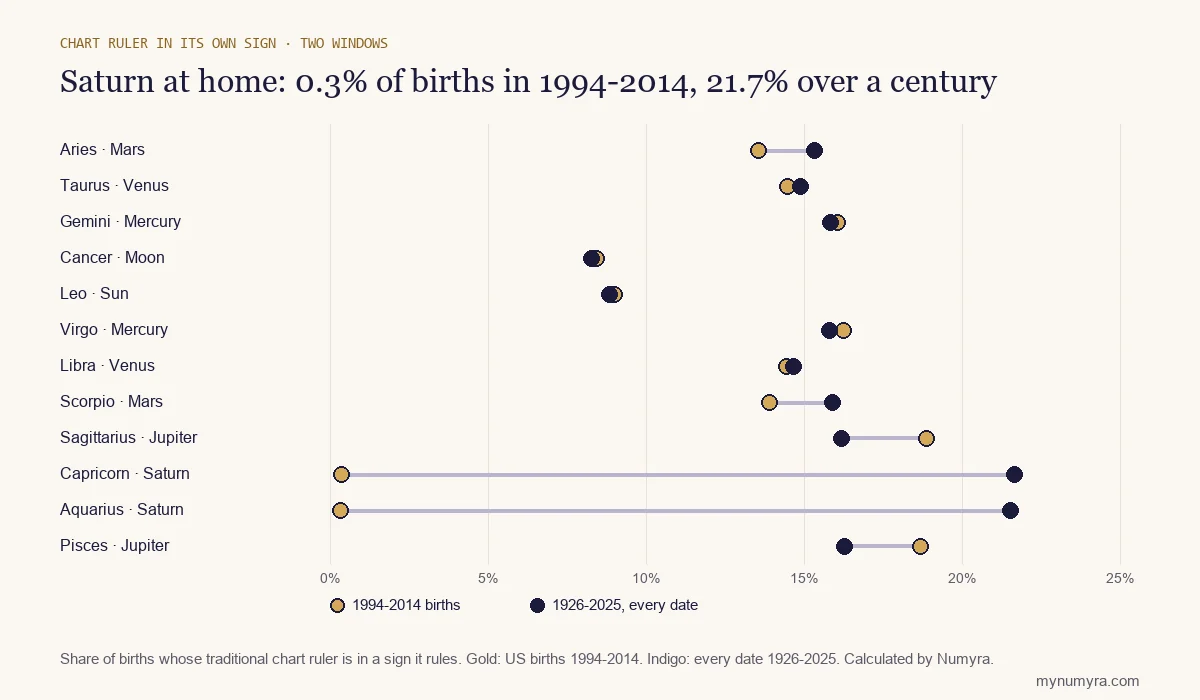
- Being at home depends on the era. Saturn was in Capricorn or Aquarius in only 0.3% of 1994 to 2014 births, so Capricorn and Aquarius risings almost never had a chart ruler at home. Over a century it is 21.7% and 21.5%. Overall, a chart ruler is in a sign it rules in 12.1% of 1994 to 2014 charts and 15.0% of 1926 to 2025 charts.
- Dignity is rare and debility is not. A traditional chart ruler is in domicile or exaltation in 19.2% of charts and in detriment or fall in 23.7%; 57.1% fall into none of the four sign-level conditions.
- No house is special. The chart ruler falls on an angle (1st, 4th, 7th or 10th) in 33.4% of charts, in the 6th, 8th or 12th in 24.3%, and in the 1st house itself in 7.1%. These are what chance predicts for twelve equal houses, so the placement of your chart ruler tells you about your chart, not about a statistically unusual one.
The combust figure shows why Mercury’s role is different. Mercury as chart ruler is within 8.5 degrees of the Sun in 25.1% of Gemini risings and 25.4% of Virgo risings, against 13.4% to 13.6% for Venus and 7.8% to 7.9% for Mars. Because Mercury never strays far from the Sun, about one chart in four with a Mercury ruler has a combust ruler, a state tradition reads as a weakened planet.
Dispositors: the ruler of the ruler
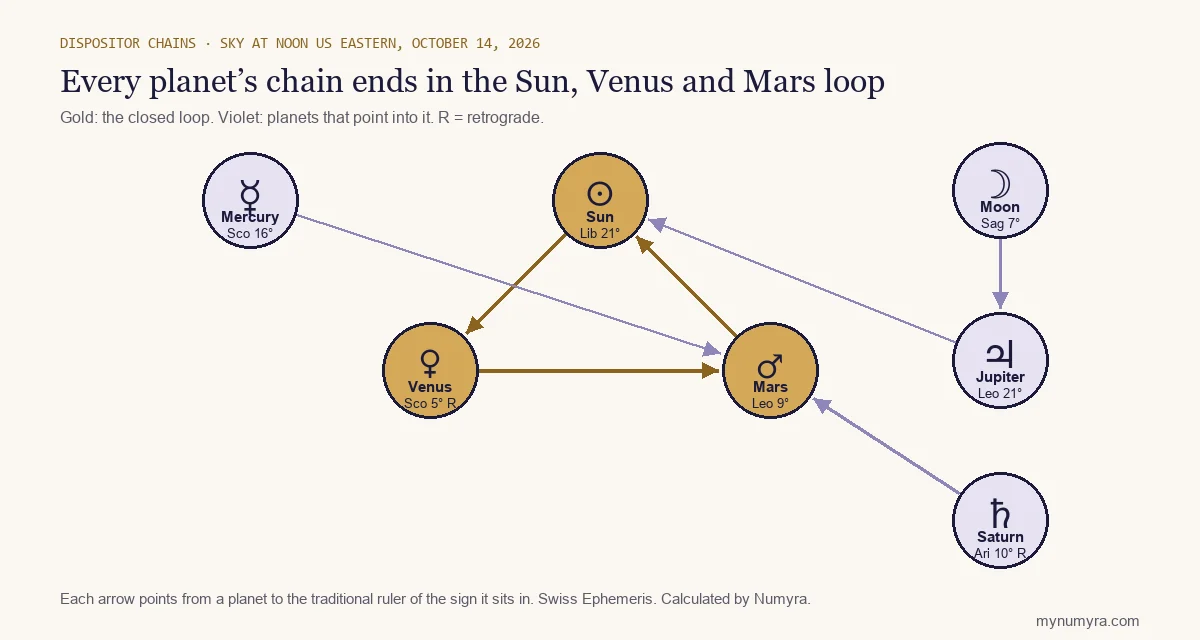
A dispositor is the planet that rules the sign another planet is in. Your chart ruler’s dispositor is the ruler of the sign where your chart ruler sits. Follow the chain: Mars in Leo is disposed by the Sun, so if the Sun is in Libra, its dispositor is Venus. Keep going until the chain stops. It stops in one of two ways. A planet in a sign it rules disposes itself and is a final dispositor; if every other planet’s chain ends there, it is the single “boss” of the chart. Or the chain runs in a circle, such as Sun to Venus to Mars to Sun, a loop with no single head.
Here is a real example, the sky at noon US Eastern on October 14, 2026, using the seven classical planets. The Sun is in Libra (ruled by Venus), Venus in Scorpio (Mars), Mars in Leo (the Sun), so the three form a loop. Mercury in Scorpio and Saturn in Aries both point to Mars, the Moon in Sagittarius points to Jupiter, and Jupiter in Leo points to the Sun, so every chain ends in the same loop.
How common is each outcome? Across the 600,000 simulated charts, 20.1% had a single final dispositor, 37.9% had one closed loop and 42.0% had two or more separate endpoints. Over 1926 to 2025 the single-final share is 20.3%, about the same, though loops and splits trade places with the era (29.9% and 49.8%). Dispositor patterns depend on where all seven planets sit, not on the rising sign. Lilly himself uses the word: in a 1646 question about a ship at sea on page 165 he names planets as the “Dispositor” of another and follows the chain on to a second planet.
What Ptolemy and Lilly wrote
Ptolemy’s Tetrabiblos (second century) does not use the phrase “chart ruler”, but it does tell the astrologer to look at the rising point and the planets in charge of it. In the chapter on bodily form and temperament he writes:
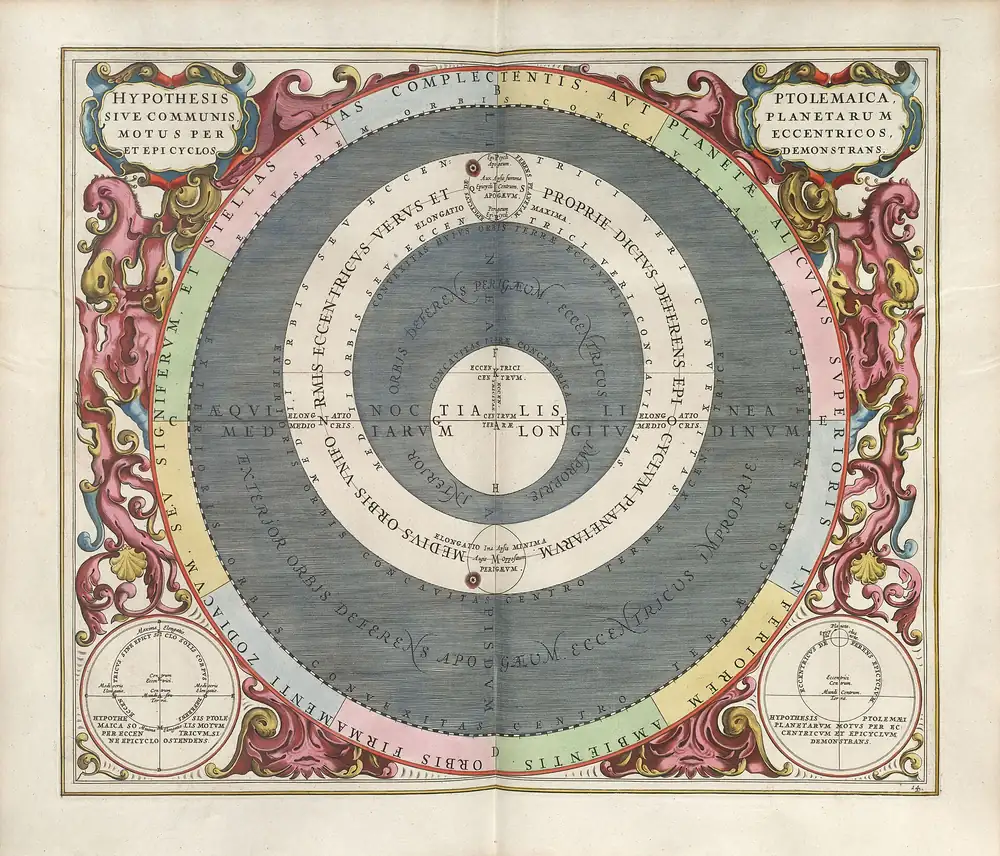
“We must, then, in general observe the eastern horizon and the planets that are upon it or assume its rulership in the way already explained”
Ptolemy, Tetrabiblos, Book III, chapter 11, trans. F. E. Robbins (Loeb Classical Library, 1940), via LacusCurtius
“The way already explained” refers to chapter 2 of the same book, where he says a place is ruled by a star related to it in several ways: trine, house, exaltation, term, and phase or aspect. For Ptolemy the ruler is therefore the planet with the most claims on the ascendant degree, not simply the planet that owns the sign, which is a refinement the modern one-planet shortcut leaves out. Our guide to the Tetrabiblos covers the book.
Lilly, writing in 1647, uses plain language. His Christian Astrology is mostly about horary astrology, in which a chart is cast for the moment a question is asked and the asker is represented by the rising sign. He defines the term as the planet that is Lord of the sign that ascends (page 49) and in chapter 20 says:
“When any Question is propounded, the Signe ascending and his Lord are alwayes given unto him or her that asks the question.”
William Lilly, Christian Astrology (London, 1647), Introduction, chapter 20, p. 123, original spelling
His nativity section applies the same test to a birth chart. When judging whether a child will live long, he lists the strength of the Lord of the Ascendant among the things to check:
“Secondly, the Lord of the ascendant is to be considered, for if he be Essentially strong, free from Combustion, Retrogradation and affliction”
William Lilly, Christian Astrology (London, 1647), Introduction to Nativities, chapter 103, p. 525, original spelling (long s modernized)
Those three conditions, dignity, direct motion and distance from the Sun, are the same ones tested in the simulation above. Both authors read the ruler of the rising sign as a significator, a planet that stands for the person. This is old practice, not a finding.
What the chart ruler cannot tell you
A chart ruler is one symbol in a chart, not a verdict. Astrology is a tradition of interpretation, not an established science, and nothing here is a prediction. The simulation shows why caution is sensible: a retrograde ruler is common, and a ruler in detriment occurs in about one chart in six. To place your chart ruler in context, look at the Midheaven, the Part of Fortune and the 12th house, other points astrologers weigh with it. Lilly’s test of whether a question could be judged compared the ruler of the planetary hour with the Lord of the Ascendant (page 121); our guide to planetary hours explains how the hour rulers work.
Frequently asked questions
What is a chart ruler in astrology?
The planet that rules your rising sign. For Aries rising it is Mars, for Taurus and Libra Venus, for Gemini and Virgo Mercury, for Cancer the Moon, for Leo the Sun, for Sagittarius Jupiter and for Capricorn Saturn. Astrologers read its sign and house as a key to the whole chart.
How do I find my chart ruler?
Work out your rising sign from your birth date, time and place, then look it up in the table above. Our birth chart calculator gives the rising sign, and each rising sign profile names the chart ruler.
Do I need my birth time to find my chart ruler?
Yes. The rising sign changes about every two hours, and on our rising sign pages a sign takes roughly one to two and a half hours to rise at New York’s latitude. Without a reasonably exact birth time the rising sign, and therefore the chart ruler, is a guess.
Is the chart ruler the same as my ruling planet by Sun sign?
No. The ruling planet of your Sun sign depends on your birth date. The chart ruler depends on your rising sign, which depends on your birth time and place. They match only when the Sun sign and rising sign share a ruler, for example Taurus and Libra, both ruled by Venus.
Which is correct for Scorpio, Aquarius and Pisces rising, traditional or modern?
Astrologers disagree, and there is no authority to settle it. The traditional rulers are Mars, Saturn and Jupiter; the modern ones are Pluto, Uranus and Neptune. A common approach is to read the traditional ruler first and treat the modern one as a second layer.
Which rising signs share the same chart ruler?
Taurus and Libra (Venus), Gemini and Virgo (Mercury), Capricorn and Aquarius (Saturn), Sagittarius and Pisces (Jupiter), and, in the traditional system, Aries and Scorpio (Mars).
What does it mean if my chart ruler is retrograde?
Traditionally it is read as a weakened planet whose themes turn inward or take longer. It is common: 15.7% of the charts in our simulation had a retrograde chart ruler, and it can only happen for Mercury, Venus, Mars, Jupiter or Saturn, never for the Sun or Moon.
What is the difference between a chart ruler and a dispositor?
The chart ruler is the ruler of the rising sign. A dispositor is the ruler of the sign any planet is in. Your chart ruler’s dispositor is the next link in the chain, which can end in a single final dispositor or in a loop.
Sources
- Ptolemy. Tetrabiblos, Book III, chapters 11 and 12, and chapters 1 to 9 (the five forms of rulership in chapter 2), trans. F. E. Robbins (Loeb Classical Library, 1940), via LacusCurtius.
- William Lilly. Christian Astrology (London, 1647), Internet Archive scan; pages 49, 121, 123, 124, 165 and 525 consulted.
- NASA. Planetary Fact Sheets for Uranus, Neptune and Pluto: sidereal orbital periods of 84.011, 164.79 and 247.94 years.
- Astrodienst. Swiss Ephemeris. Ascendants, planet positions and retrograde status for all simulated and example charts (calculations by the Numyra Methodology Desk).
- FiveThirtyEight. US births data, 1994 to 2014, from the CDC National Center for Health Statistics and the Social Security Administration. Dates only; clock times and places are simulated.