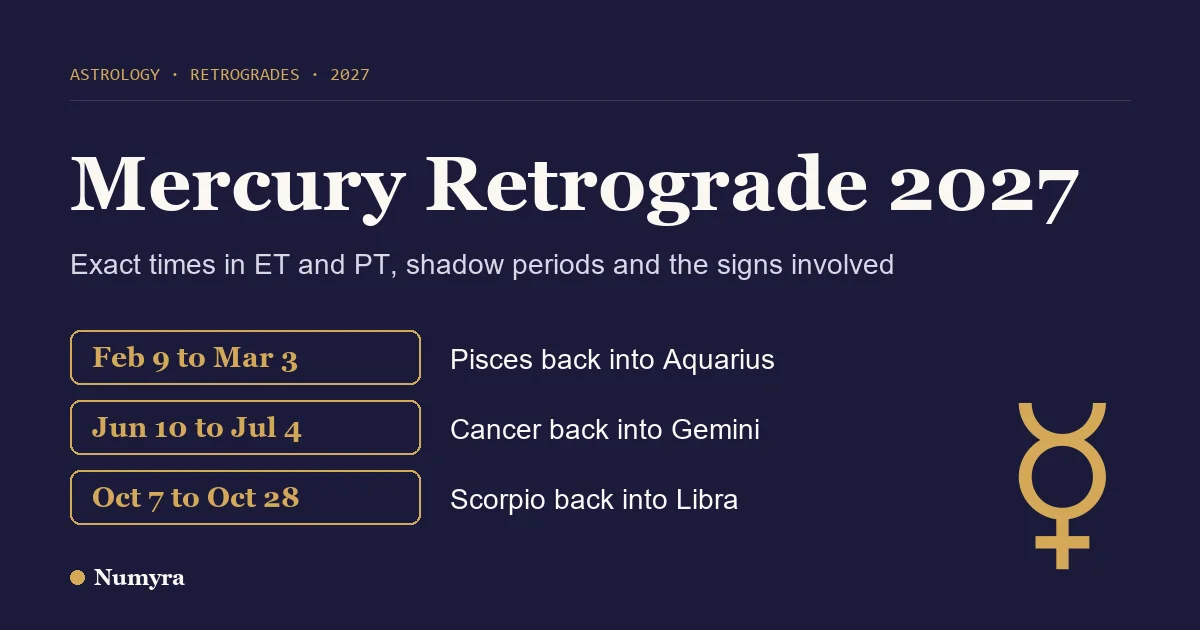
Mercury is retrograde three times in 2027: from February 9 to March 3, from June 10 to July 4 and from October 7 to October 28. It stations retrograde at 12:36 p.m. EST (9:36 a.m. PST) on February 9, at 2:15 p.m. EDT (11:15 a.m. PDT) on June 10 and at 10:37 a.m. EDT (7:37 a.m. PDT) on October 7, and each time it backs out of a water sign into the air sign behind it. This page gives every station time and every shadow-period start and end in US Eastern and Pacific time, the three sign changes inside each cycle, the planets that are retrograde at the same time, the house each retrograde touches for every rising sign, and how 2027 compares with 2026 and 2028. All times were computed with the Swiss Ephemeris and checked against NASA’s JPL Horizons system.
Key takeaways
- The three 2027 retrogrades run February 9 to March 3 (Pisces back into Aquarius), June 10 to July 4 (Cancer back into Gemini) and October 7 to October 28 (Scorpio back into Libra). They last 21.8, 24.1 and 21.0 days, 66.8 days in all, which is 18.3% of the year.
- The shadow periods run January 25 to March 23, May 26 to July 19 and September 17 to November 13. Counting them, Mercury is retrograde or in shadow for 168.0 days, 46.0% of 2027. The only West Coast date that differs is the June pre-shadow, which begins at 2:04 a.m. EDT on May 26, or 11:04 p.m. PDT on May 25.
- 2027 is the only year from 2026 to 2028 in which Mercury changes sign inside every cycle. In 2026 and 2028 each retrograde, shadows included, stays in one sign; in 2027 it makes nine sign changes, three per cycle.
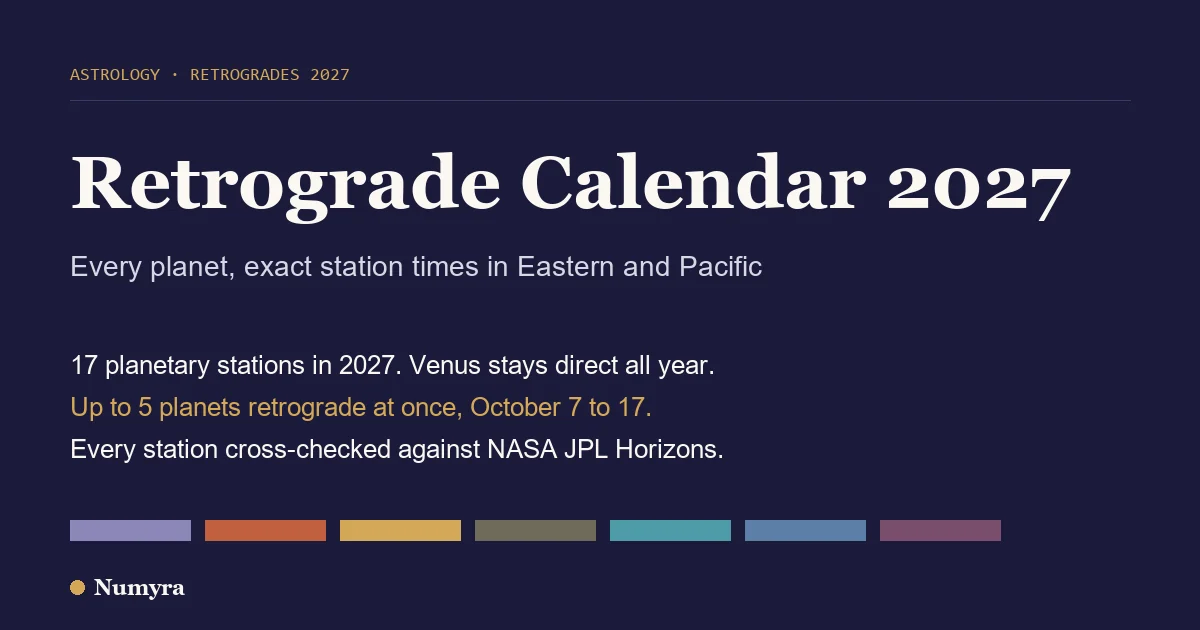
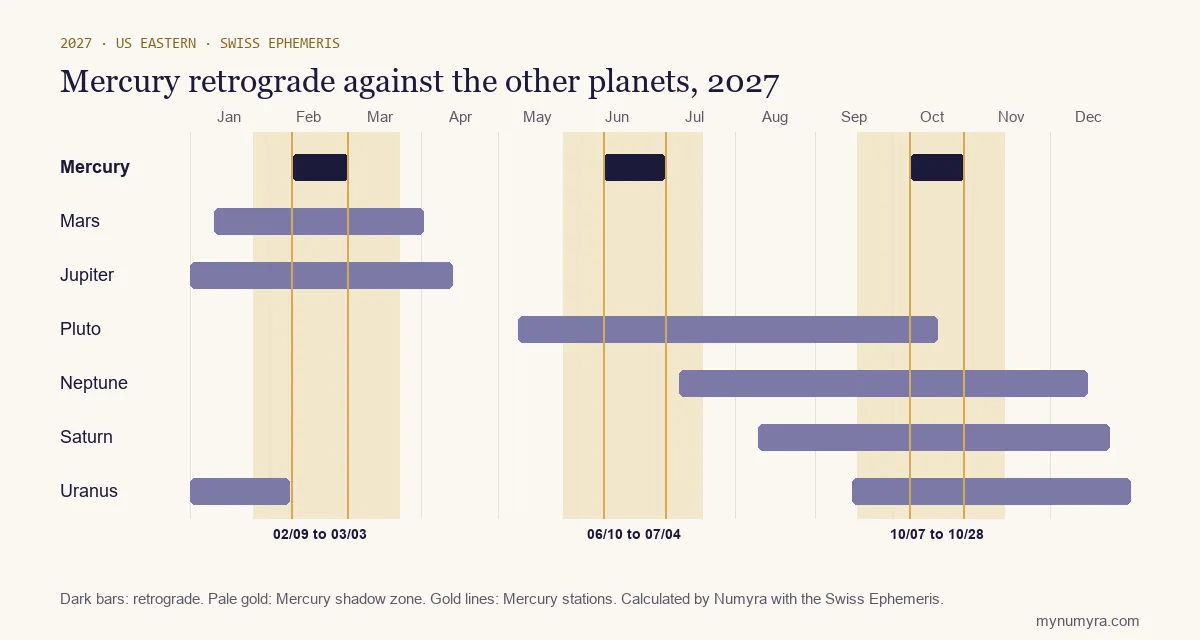
- Overlaps: Mars and Jupiter are retrograde for the whole February retrograde, only Pluto for the whole June one, and Saturn, Uranus and Neptune for the whole October one, with Pluto until October 17. Venus is not retrograde at any point in 2027.
- Every one of the 12 station and shadow times for 2027 matches NASA’s JPL Horizons to the same minute. Across all 36 for 2026 to 2028, stations agree within 48 seconds and shadow edges within 3 seconds. Retrograde is an optical effect, and what astrologers read into it is tradition, not a tested prediction.
In this guide
- The three Mercury retrogrades of 2027 at a glance
- Shadow periods and the degrees Mercury crosses three times
- February 9 to March 3: Pisces back into Aquarius
- June 10 to July 4: Cancer back into Gemini
- October 7 to October 28: Scorpio back into Libra
- Which other planets are retrograde at the same time
- Which house each retrograde touches, for every rising sign
- 2027 against 2026 and 2028, and the share of the year
- What the tradition says, and what it does not
- How the times were calculated and checked
- Frequently asked questions
The three Mercury retrogrades of 2027 at a glance
A station is the instant a planet appears to stop against the stars before reversing: Mercury stationing retrograde starts the backward drift, and stationing direct ends it. Times are in US Eastern and Pacific with daylight saving applied. In 2027 clocks go forward on March 14 and back on November 7 (daylight saving time starts on the second Sunday of March, as NIST states it, and ends on the first Sunday of November), so the February cycle begins in standard time and ends in daylight time, and the October cycle crosses back the other way. Signs are in the Western tropical zodiac. This page is about Mercury alone: our 2027 retrograde calendar lists every planet’s stations, and our guide to what Mercury retrograde means covers the astronomy, the tradition and a test of the travel myth against flight records.
| Retrograde | Stations retrograde | Stations direct | Signs | Days | Shadow, start to end (ET) |
|---|---|---|---|---|---|
| First | Tue, Feb 9, 12:36 p.m. EST (9:36 a.m. PST), 5°59′ Pisces | Wed, Mar 3, 7:32 a.m. EST (4:32 a.m. PST), 20°55′ Aquarius | Pisces back into Aquarius | 21.8 | Jan 25 to Mar 23 |
| Second | Thu, Jun 10, 2:15 p.m. EDT (11:15 a.m. PDT), 6°22′ Cancer | Sun, Jul 4, 3:39 p.m. EDT (12:39 p.m. PDT), 27°28′ Gemini | Cancer back into Gemini | 24.1 | May 26 to Jul 19 |
| Third | Thu, Oct 7, 10:37 a.m. EDT (7:37 a.m. PDT), 4°56′ Scorpio | Thu, Oct 28, 10:11 a.m. EDT (7:11 a.m. PDT), 19°19′ Libra | Scorpio back into Libra | 21.0 | Sep 17 to Nov 13 |
The February and October retrogrades are the short ones, near 21 days, and June is the long one at 24.1. Mercury moves slowest when it is far from the Sun in its lopsided orbit, which is why some retrogrades last about 24 days and others about 20 (the Mercury retrograde guide measured the two groups across 630 retrogrades from 1900 to 2099). The June retrograde is also the one that covers the narrowest band of zodiac, as the next section shows.
Shadow periods and the degrees Mercury crosses three times
Many astrologers track a retrograde together with its shadow. The pre-shadow starts when Mercury first reaches the degree where it will later turn direct, and the post-shadow ends when it gets back to the degree where it turned retrograde. Cafe Astrology puts the end of the shadow this way:
“The shadow period ends when Mercury again passes over the degree at which it first turned retrograde.”
Cafe Astrology, Mercury turns retrograde in Pisces (the February 2027 cycle)
That makes the shadow a band of the zodiac, not a number of weeks, and Mercury crosses the band three times: forward, backward, forward. Sites that say “two weeks before and after” are rounding. In 2027 the pre-shadow lasts 14.9, 15.5 and 20.3 days and the post-shadow 20.1, 14.5 and 15.8, and the whole cycle runs 56.8, 54.1 and 57.1 days. The diagram follows Mercury through each one.
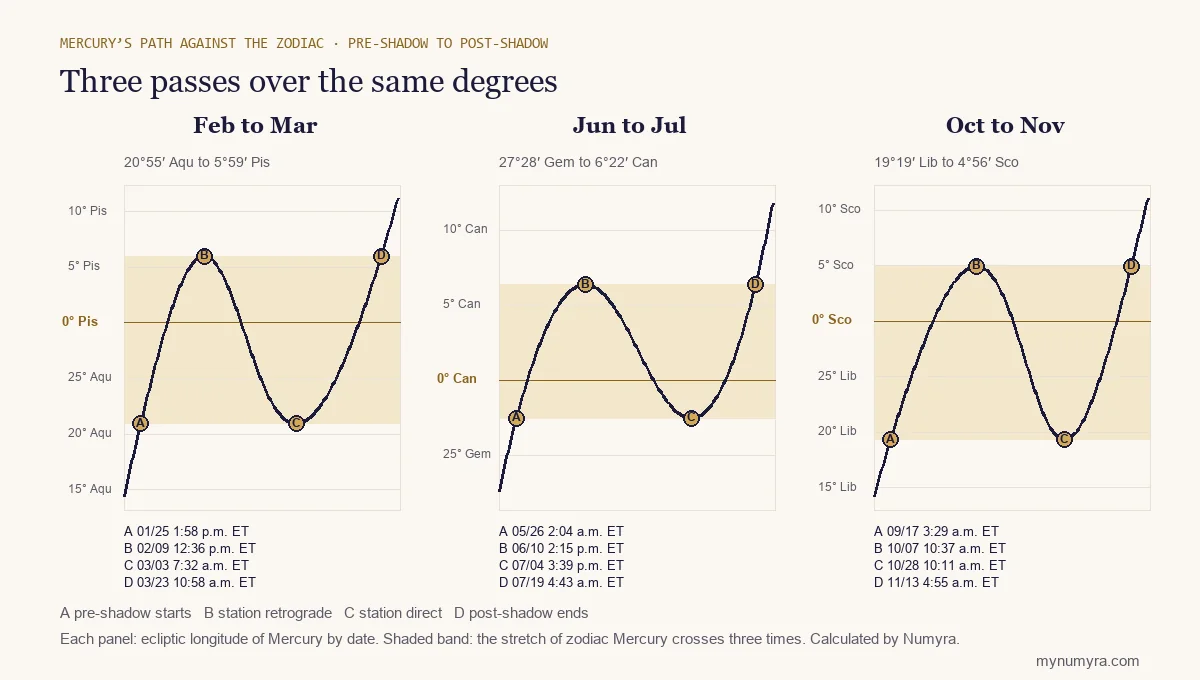
The degrees in the band are the personal part of the tradition. A planet or angle in your birth chart inside one of these ranges is crossed by Mercury three times in the cycle, once in each pass, so astrologers say that retrograde touches you more than someone with nothing there. Our birth chart calculator shows your planets by degree.
| Cycle | Degrees crossed three times | Width | Pre-shadow | Post-shadow |
|---|---|---|---|---|
| February to March | 20°55′ Aquarius to 5°59′ Pisces | 15.1° | 14.9 days | 20.1 days |
| June to July | 27°28′ Gemini to 6°22′ Cancer | 8.9° | 15.5 days | 14.5 days |
| October to November | 19°19′ Libra to 4°56′ Scorpio | 15.6° | 20.3 days | 15.8 days |
February 9 to March 3: Pisces back into Aquarius
Mercury stations retrograde on Tuesday, February 9 at 12:36 p.m. EST (9:36 a.m. PST) at 5°59′ Pisces, a sign where the traditional table of essential dignities puts Mercury in both its detriment and its fall. It spends the first 8.8 days in Pisces, backs across 0° Pisces into Aquarius on February 18, and passes between Earth and the Sun (inferior conjunction, the middle of every retrograde) about four and a half hours later at 29°48′ Aquarius. It turns direct on March 3 at 7:32 a.m. EST at 20°55′ Aquarius after 13.0 days in Aquarius, and moves forward into Pisces again on March 18.
| Event | US Eastern | US Pacific | Mercury |
|---|---|---|---|
| Pre-shadow begins: Mercury first reaches the degree where it will turn direct | Mon Jan 25, 1:58 p.m. EST | Mon Jan 25, 10:58 a.m. PST | 20°55′ Aquarius |
| Moves forward into Pisces | Sun Jan 31, 8:26 p.m. EST | Sun Jan 31, 5:26 p.m. PST | 0° Pisces |
| Stations retrograde | Tue Feb 9, 12:36 p.m. EST | Tue Feb 9, 9:36 a.m. PST | 5°59′ Pisces |
| Backs into Aquarius | Thu Feb 18, 7:16 a.m. EST | Thu Feb 18, 4:16 a.m. PST | From 0° Pisces back to 29°59′ Aquarius |
| Passes between Earth and the Sun (inferior conjunction) | Thu Feb 18, 11:39 a.m. EST | Thu Feb 18, 8:39 a.m. PST | 29°48′ Aquarius |
| Stations direct | Wed Mar 3, 7:32 a.m. EST | Wed Mar 3, 4:32 a.m. PST | 20°55′ Aquarius |
| Moves forward into Pisces | Thu Mar 18, 6:02 a.m. EDT | Thu Mar 18, 3:02 a.m. PDT | 0° Pisces |
| Post-shadow ends: Mercury is back at the degree where it turned retrograde | Tue Mar 23, 10:58 a.m. EDT | Tue Mar 23, 7:58 a.m. PDT | 5°59′ Pisces |
The cycle contains the change to daylight time on March 14, 2027, so the time zone label changes from EST to EDT between the direct station and the end of the post-shadow. It overlaps two other retrogrades from start to finish, Mars and Jupiter (see below), and two of the year’s eclipses: the annular solar eclipse of February 6 falls in the pre-shadow and the penumbral lunar eclipse of February 20 inside the retrograde itself (dates and signs in our 2027 eclipse guide).
June 10 to July 4: Cancer back into Gemini
Mercury stations retrograde on Thursday, June 10 at 2:15 p.m. EDT (11:15 a.m. PDT) at 6°22′ Cancer, the longest of the year’s three at 24.1 days. It spends 15.5 days in Cancer, then backs into Gemini on June 26 at 3:19 a.m. EDT (12:19 a.m. PDT), one of the two signs Mercury rules, and stays there for the last 8.5 days. It turns direct on Sunday, July 4 at 3:39 p.m. EDT (12:39 p.m. PDT) at 27°28′ Gemini, which makes the station fall on the US holiday itself, and returns to Cancer on July 12.
| Event | US Eastern | US Pacific | Mercury |
|---|---|---|---|
| Pre-shadow begins: Mercury first reaches the degree where it will turn direct | Wed May 26, 2:04 a.m. EDT | May 25, 11:04 p.m. PDT | 27°28′ Gemini |
| Moves forward into Cancer | Fri May 28, 1:07 p.m. EDT | Fri May 28, 10:07 a.m. PDT | 0° Cancer |
| Stations retrograde | Thu Jun 10, 2:15 p.m. EDT | Thu Jun 10, 11:15 a.m. PDT | 6°22′ Cancer |
| Passes between Earth and the Sun (inferior conjunction) | Wed Jun 23, 4:00 a.m. EDT | Wed Jun 23, 1:00 a.m. PDT | 1°40′ Cancer |
| Backs into Gemini | Sat Jun 26, 3:19 a.m. EDT | Sat Jun 26, 12:19 a.m. PDT | From 0° Cancer back to 29°59′ Gemini |
| Stations direct | Sun Jul 4, 3:39 p.m. EDT | Sun Jul 4, 12:39 p.m. PDT | 27°28′ Gemini |
| Moves forward into Cancer | Mon Jul 12, 9:48 a.m. EDT | Mon Jul 12, 6:48 a.m. PDT | 0° Cancer |
| Post-shadow ends: Mercury is back at the degree where it turned retrograde | Mon Jul 19, 4:43 a.m. EDT | Mon Jul 19, 1:43 a.m. PDT | 6°22′ Cancer |
This is the one cycle in which the date differs by coast: the pre-shadow begins at 2:04 a.m. EDT on May 26, which is 11:04 p.m. PDT on May 25. Among the other planets only Pluto is retrograde for the full retrograde; Neptune turns retrograde on July 9, five days after Mercury turns direct, inside the post-shadow. The penumbral lunar eclipse of July 18 falls less than a day before the post-shadow ends, though at magnitude 0.001 it is, as our eclipse guide notes, essentially invisible.
October 7 to October 28: Scorpio back into Libra
Mercury stations retrograde on Thursday, October 7 at 10:37 a.m. EDT (7:37 a.m. PDT) at 4°56′ Scorpio. It spends 8.7 days in Scorpio, backs into Libra on October 16 at 3:36 a.m. EDT (12:36 a.m. PDT), passes between Earth and the Sun on October 19 at 26°01′ Libra and turns direct on October 28 at 10:11 a.m. EDT (7:11 a.m. PDT) at 19°19′ Libra, after 12.3 days in Libra. It is back in Scorpio on November 9 and the post-shadow ends on November 13, after clocks have gone back on November 7.
| Event | US Eastern | US Pacific | Mercury |
|---|---|---|---|
| Pre-shadow begins: Mercury first reaches the degree where it will turn direct | Fri Sep 17, 3:29 a.m. EDT | Fri Sep 17, 12:29 a.m. PDT | 19°19′ Libra |
| Moves forward into Scorpio | Mon Sep 27, 5:10 a.m. EDT | Mon Sep 27, 2:10 a.m. PDT | 0° Scorpio |
| Stations retrograde | Thu Oct 7, 10:37 a.m. EDT | Thu Oct 7, 7:37 a.m. PDT | 4°56′ Scorpio |
| Backs into Libra | Sat Oct 16, 3:36 a.m. EDT | Sat Oct 16, 12:36 a.m. PDT | From 0° Scorpio back to 29°59′ Libra |
| Passes between Earth and the Sun (inferior conjunction) | Tue Oct 19, 11:31 a.m. EDT | Tue Oct 19, 8:31 a.m. PDT | 26°01′ Libra |
| Stations direct | Thu Oct 28, 10:11 a.m. EDT | Thu Oct 28, 7:11 a.m. PDT | 19°19′ Libra |
| Moves forward into Scorpio | Tue Nov 9, 7:26 p.m. EST | Tue Nov 9, 4:26 p.m. PST | 0° Scorpio |
| Post-shadow ends: Mercury is back at the degree where it turned retrograde | Sat Nov 13, 4:55 a.m. EST | Sat Nov 13, 1:55 a.m. PST | 4°56′ Scorpio |
This is the crowded cycle. Saturn, Uranus and Neptune are retrograde for every day of it, and Pluto until October 17, so for 10.6 days five planets are retrograde together, the year’s maximum (see the retrograde calendar for the count day by day).
Which other planets are retrograde at the same time
The chart shows 2027 with Mercury’s three retrogrades in the top row, the shadow zones shaded and every other planet’s retrograde beneath. The table counts the days of overlap with each Mercury retrograde, measured from station to station.
| Mercury retrograde | Retrograde for the whole cycle | Part of the cycle | Not retrograde |
|---|---|---|---|
| February 9 to March 3 | Mars, Jupiter | None | Venus, Saturn, Uranus, Neptune, Pluto |
| June 10 to July 4 | Pluto | None | Venus, Mars, Jupiter, Saturn, Uranus, Neptune |
| October 7 to 28 | Saturn, Uranus, Neptune | Pluto (10.6 of 21.0 days) | Venus, Mars, Jupiter |
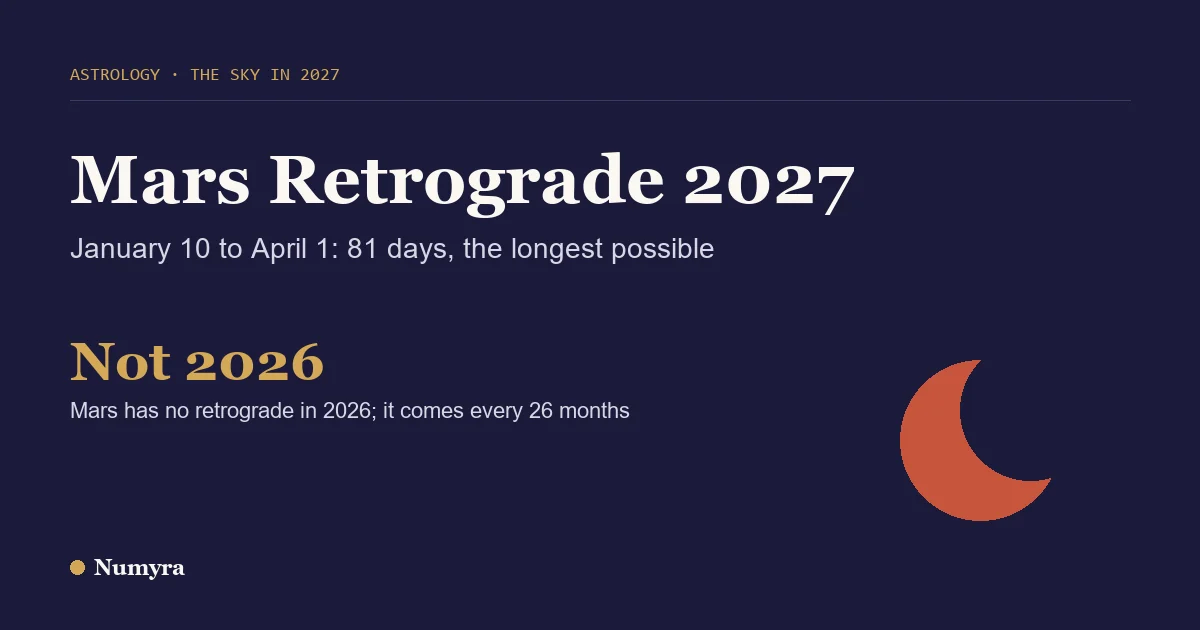
Venus is direct all year: its last retrograde ended on November 13, 2026 and the next begins in 2028 (our Venus retrograde guide has the eight-year pattern). Mars is retrograde from January 10 to April 1 (Mars retrograde 2027), which is why the February cycle runs alongside it. Pluto’s long retrograde from May 8 to October 17 stays in Aquarius, covered in our Pluto in Aquarius guide.
Which house each retrograde touches, for every rising sign
Astrologers read a retrograde through the house of your chart it moves through, and because each 2027 retrograde crosses a sign line, it touches two houses, not one. The table uses whole-sign houses, the oldest system, in which each sign is one house. Find your rising sign (the birth chart calculator needs your birth time and place), or use your Sun sign if you do not have a birth time. The columns give the date range Mercury spends in each sign, in Eastern time.
| Rising sign | Feb 9 to 18, Pisces | Feb 18 to Mar 3, Aquarius | Jun 10 to 26, Cancer | Jun 26 to Jul 4, Gemini | Oct 7 to 16, Scorpio | Oct 16 to 28, Libra |
|---|---|---|---|---|---|---|
| Aries | 12th | 11th | 4th | 3rd | 8th | 7th |
| Taurus | 11th | 10th | 3rd | 2nd | 7th | 6th |
| Gemini | 10th | 9th | 2nd | 1st | 6th | 5th |
| Cancer | 9th | 8th | 1st | 12th | 5th | 4th |
| Leo | 8th | 7th | 12th | 11th | 4th | 3rd |
| Virgo | 7th | 6th | 11th | 10th | 3rd | 2nd |
| Libra | 6th | 5th | 10th | 9th | 2nd | 1st |
| Scorpio | 5th | 4th | 9th | 8th | 1st | 12th |
| Sagittarius | 4th | 3rd | 8th | 7th | 12th | 11th |
| Capricorn | 3rd | 2nd | 7th | 6th | 11th | 10th |
| Aquarius | 2nd | 1st | 6th | 5th | 10th | 9th |
| Pisces | 1st | 12th | 5th | 4th | 9th | 8th |
Traditionally the houses stand for: 1st, you and first impressions; 2nd, money and possessions; 3rd, messages, siblings and short trips; 4th, home and family; 5th, dating and creative work; 6th, daily work and routines; 7th, partners and agreements; 8th, shared money and debts; 9th, travel, study and law; 10th, career and reputation; 11th, friends and groups; 12th, rest and the hidden. Our guide to the houses explains each one. For Gemini and Virgo rising, Mercury is the chart ruler, so astrologers treat every Mercury retrograde as touching the whole chart. To see where your own Mercury sits, use the Mercury sign calculator and read what Mercury in each sign means.
2027 against 2026 and 2028, and the share of the year
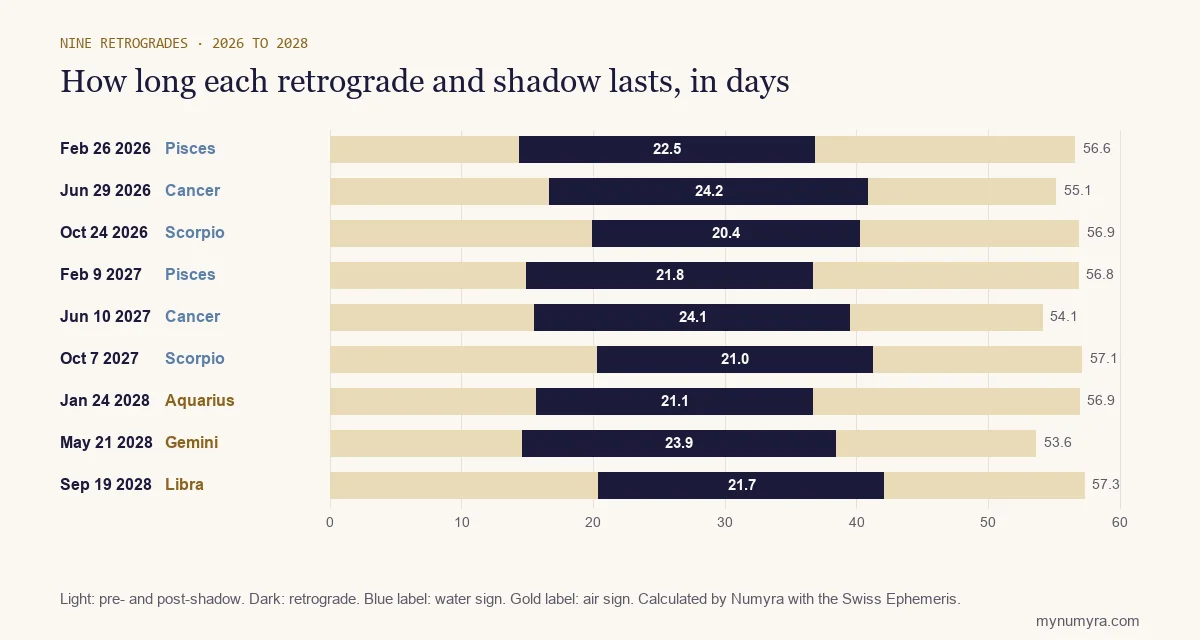
All nine Mercury retrogrades from 2026 to 2028 were computed the same way. The pattern is that the element changes with the year: 2026’s three are in water signs (Pisces, Cancer, Scorpio), 2027’s start in those water signs and end in air signs, and 2028’s three are in air signs (Aquarius, Gemini, Libra).
| Retrograde (ET) | Signs | Days | Shadow zone, days |
|---|---|---|---|
| Feb 26 to Mar 20, 2026 | Pisces only | 22.5 | 56.6 |
| Jun 29 to Jul 23, 2026 | Cancer only | 24.2 | 55.1 |
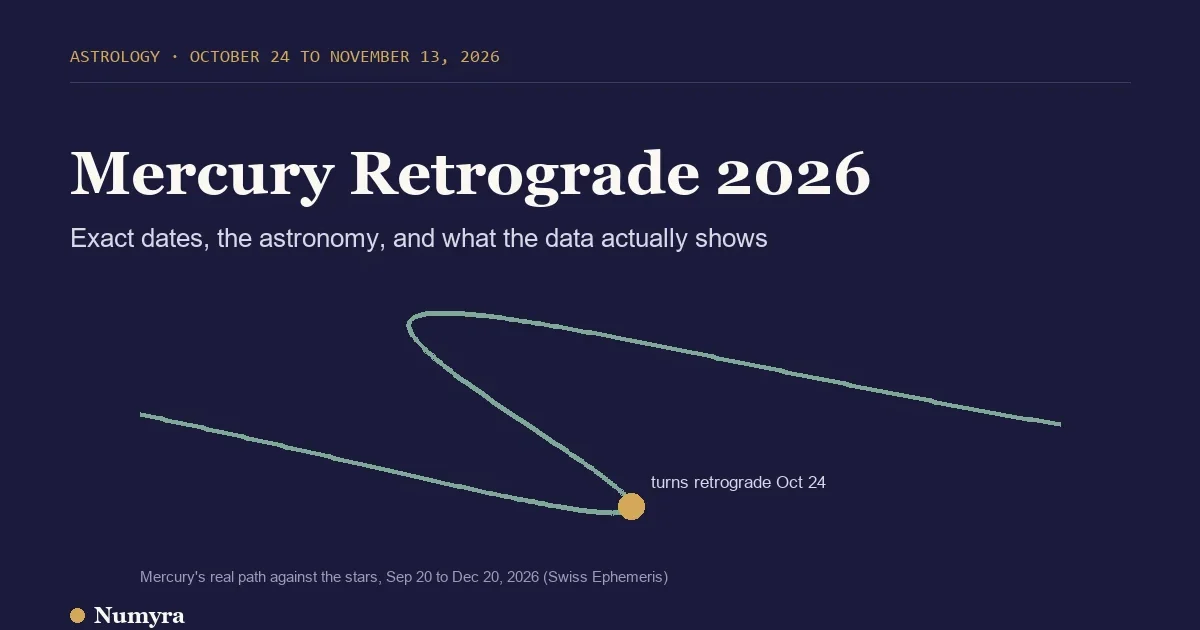
| Oct 24 to Nov 13, 2026 | Scorpio only | 20.4 | 56.9 |
| Feb 9 to Mar 3, 2027 | Pisces back into Aquarius | 21.8 | 56.8 |
| Jun 10 to Jul 4, 2027 | Cancer back into Gemini | 24.1 | 54.1 |
| Oct 7 to Oct 28, 2027 | Scorpio back into Libra | 21.0 | 57.1 |
| Jan 24 to Feb 14, 2028 | Aquarius only | 21.1 | 56.9 |
| May 21 to Jun 14, 2028 | Gemini only | 23.9 | 53.6 |
| Sep 19 to Oct 11, 2028 | Libra only | 21.7 | 57.3 |
| Year | Days retrograde | Share of year | Days retrograde or in shadow | Share of year | Sign changes in cycles |
|---|---|---|---|---|---|
| 2026 | 67.1 | 18.4% | 168.6 | 46.2% | 0 |
| 2027 | 66.8 | 18.3% | 168.0 | 46.0% | 9 |
| 2028 | 66.7 | 18.2% | 167.8 | 45.8% | 0 |
The totals barely move, because three retrogrades of 20 to 24 days always add to about 67 days. What differs is the sign: 2026 and 2028 each stay in one sign from the start of the pre-shadow to the end of the post-shadow, and 2027 does not. Counting whole days at noon Eastern gives 66 retrograde days and 167 retrograde-or-shadow days; either way, about 197 days of 2027 have Mercury direct and outside any shadow. The 18.3% is a little below the 19.2% long-run average in the Mercury retrograde guide, because that average includes years with four retrogrades and 2027 has three. For the other planets across the same three years, see the retrograde calendar. Dates in the table are Eastern; the May 2028 retrograde ends at 2:06 a.m. EDT on June 14, which is 11:06 p.m. PDT on June 13 on the West Coast.
What the tradition says, and what it does not
Astronomically a retrograde is a matter of perspective. NASA’s StarChild explainer states the mechanism in one sentence:
“retrograde occurs roughly when a faster moving planet catches up to and passes a slower moving planet.”
NASA Goddard Space Flight Center, StarChild Question of the Month, June 2002: What does it mean for Mercury to be in retrograde?
For Mercury the faster planet is Mercury, which laps Earth roughly every 116 days, and that is why there are three or four retrogrades a year. The planet never reverses.
The astrological reading is a separate, interpretive layer. Mercury stands for communication, thinking, paperwork, short trips and trade, so a retrograde is traditionally taken as a time for the “re-” words: review, revise, reconnect, repair. The advice usually offered is to re-read before signing, back up devices and confirm bookings. That is sensible in any week, and nothing in this page predicts that anything will go wrong. The one popular claim we could test, that travel falls apart, did not hold up: across 52.4 million US domestic flights, 18.5% arrived 15 or more minutes late on retrograde days and 19.7% on other days (method in the Mercury retrograde guide). This is educational information about a tradition, not financial, legal or medical advice.
How the times were calculated and checked
We computed Mercury’s apparent geocentric longitude with the Swiss Ephemeris in its built-in Moshier mode, found each station where the planet’s speed in longitude crosses zero, and found each shadow edge as the moment Mercury’s longitude equals the longitude of the opposite station. Times are rounded to the nearest minute and converted to Eastern and Pacific using the historical daylight saving rules; the days in each sign and the inferior conjunctions come from the same calculation.
We then checked all nine retrogrades from 2026 to 2028 against NASA’s JPL Horizons system, an independent ephemeris: stations from a fourth-degree polynomial fitted to Horizons longitudes at 2-hour steps, shadow edges by fitting Horizons longitudes at 1-hour steps and solving for the crossing. For all 36 events the stations agree within 48 seconds and the shadow edges within 3 seconds; 32 of the 36 round to the same minute and the other 4 differ by one minute. All 12 events of 2027 round to the same minute.
| 2027 event | Ours (UT) | JPL Horizons minus ours |
|---|---|---|
| Pre-shadow begins, Jan 25 | Jan 25 18:58 UT | +0 s |
| Stations retrograde, Feb 9 | Feb 9 17:36 UT | -29 s |
| Stations direct, Mar 3 | Mar 3 12:32 UT | +16 s |
| Post-shadow ends, Mar 23 | Mar 23 14:58 UT | -2 s |
| Pre-shadow begins, May 26 | May 26 06:04 UT | +0 s |
| Stations retrograde, Jun 10 | Jun 10 18:15 UT | -13 s |
| Stations direct, Jul 4 | Jul 4 19:39 UT | +2 s |
| Post-shadow ends, Jul 19 | Jul 19 08:43 UT | -1 s |
| Pre-shadow begins, Sep 17 | Sep 17 07:29 UT | -1 s |
| Stations retrograde, Oct 7 | Oct 7 14:37 UT | -31 s |
| Stations direct, Oct 28 | Oct 28 14:11 UT | +36 s |
| Post-shadow ends, Nov 13 | Nov 13 09:55 UT | -1 s |
Two published lists agree. Cafe Astrology’s February and June pages give the same station degrees, the same shadow dates (January 25 and March 23, May 26 and July 19), the February 9 station at 12:36 p.m. and the June 26 ingress at 3:19 a.m. AstroMitra, which uses the sidereal zodiac but lists the same instants in India Standard Time, matches five of the six station times to the minute once converted and the sixth, October 28, by one minute. Other calendars differ by a day for a simple reason: MiniWebtool’s calendar lists February 10, June 11 and October 8 as the starts, a day after each station in every US time zone, since the stations fall on February 9, June 10 and October 7 even in UT.
Frequently asked questions
When is Mercury retrograde in 2027?
Three times: February 9 to March 3 (Pisces back into Aquarius), June 10 to July 4 (Cancer back into Gemini) and October 7 to October 28 (Scorpio back into Libra), in US Eastern time.
What time does Mercury go retrograde and direct in 2027, in Eastern and Pacific time?
Retrograde on February 9 at 12:36 p.m. EST (9:36 a.m. PST), June 10 at 2:15 p.m. EDT (11:15 a.m. PDT) and October 7 at 10:37 a.m. EDT (7:37 a.m. PDT). Direct on March 3 at 7:32 a.m. EST (4:32 a.m. PST), July 4 at 3:39 p.m. EDT (12:39 p.m. PDT) and October 28 at 10:11 a.m. EDT (7:11 a.m. PDT).
When do the Mercury retrograde shadow periods start and end in 2027?
January 25 to March 23, May 26 to July 19 and September 17 to November 13, Eastern dates. The pre-shadow begins when Mercury first reaches the degree where it will turn direct, and the post-shadow ends when it returns to the degree where it turned retrograde.
Which zodiac signs is Mercury retrograde in during 2027?
Pisces and Aquarius in February and March, Cancer and Gemini in June and July, and Scorpio and Libra in October. Each retrograde starts in the water sign and backs into the air sign behind it.
How many days is Mercury retrograde in 2027?
66.8 days in all, in retrogrades of 21.8, 24.1 and 21.0 days, which is 18.3% of the year. With the shadow periods, Mercury is retrograde or in shadow for 168.0 days, 46.0% of 2027.
Is Venus retrograde at the same time as Mercury in 2027?
No. Venus is not retrograde at any point in 2027. Mercury’s retrogrades overlap Mars and Jupiter in February, Pluto in June, and Saturn, Uranus, Neptune and, for the first ten days, Pluto in October.
Why do some sites list February 10 or October 8 instead of February 9 and October 7?
Those are one day after the station in every US time zone. Mercury stations retrograde on February 9 at 17:36 UT, June 10 at 18:15 UT and October 7 at 14:37 UT, so a calendar that prints the next day is not using the station’s own date.
Is Mercury retrograde in 2027 worse than in 2026?
Astronomically they are almost identical: 66.8 days of retrograde in 2027 against 67.1 in 2026. The difference is that 2026’s retrogrades stay in water signs and 2027’s each cross into an air sign. Astrology reads that symbolically, and no study has shown that a retrograde changes events.
Does Mercury really move backward?
No. Mercury keeps orbiting the Sun in the same direction. It only appears to move backward against the stars for a few weeks while it passes between Earth and the Sun, as NASA explains.
Sources
- Astrodienst. Swiss Ephemeris. All stations, shadow edges, ingresses, positions, lengths and shares on this page were calculated with it by the Numyra Methodology Desk.
- NASA JPL. Horizons System. Independent check of every Mercury station and shadow edge from 2026 to 2028 (API documentation).
- NASA Goddard Space Flight Center. StarChild Question of the Month, June 2002: What does it mean for Mercury to be in retrograde?
- Cafe Astrology. Mercury turns retrograde in Pisces (2027) and Retrograde Mercury enters Gemini (2027): shadow definition, station and ingress times used as a cross-check.
- AstroMitra. Mercury Retrograde 2027: Dates and Time (India Standard Time, sidereal signs), used to cross-check the station instants.
- MiniWebtool. Mercury Retrograde Calendar, 2027, read for the one-day difference in start dates.
- NIST. Daylight Saving Time: the US rule for when clocks change.