Your rising sign changes about every two hours, but that is an average, not a rule: in New York a sign takes anywhere from 71 to 153 minutes to rise, and in Anchorage from 25 to 200. What this means for you is simple to state. If your birth time is wrong by 15 minutes, your rising sign is wrong for about one chart in eight; at 30 minutes it is one in four, and at an hour it is one in two. We calculated those odds for five US cities with the Swiss Ephemeris and checked them against 100,000 simulated US births, so you can see how many minutes your own birth time has to spare.
Key takeaways
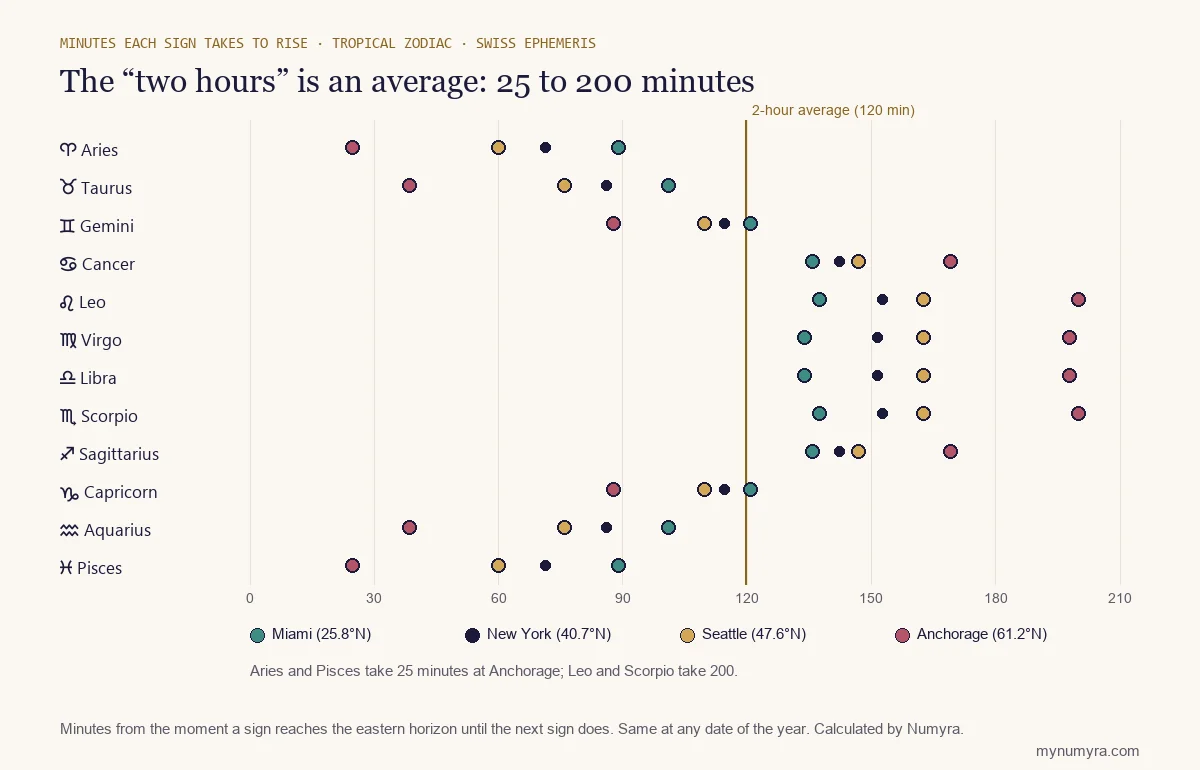
- “Every two hours” is the average: Earth turns once in 23.9345 hours, which is 1,436 minutes, and 1,436 divided by 12 signs is 119.7 minutes. The real stay of one sign on the horizon runs from 71 to 153 minutes in New York, 60 to 163 in Seattle and 25 to 200 in Anchorage.
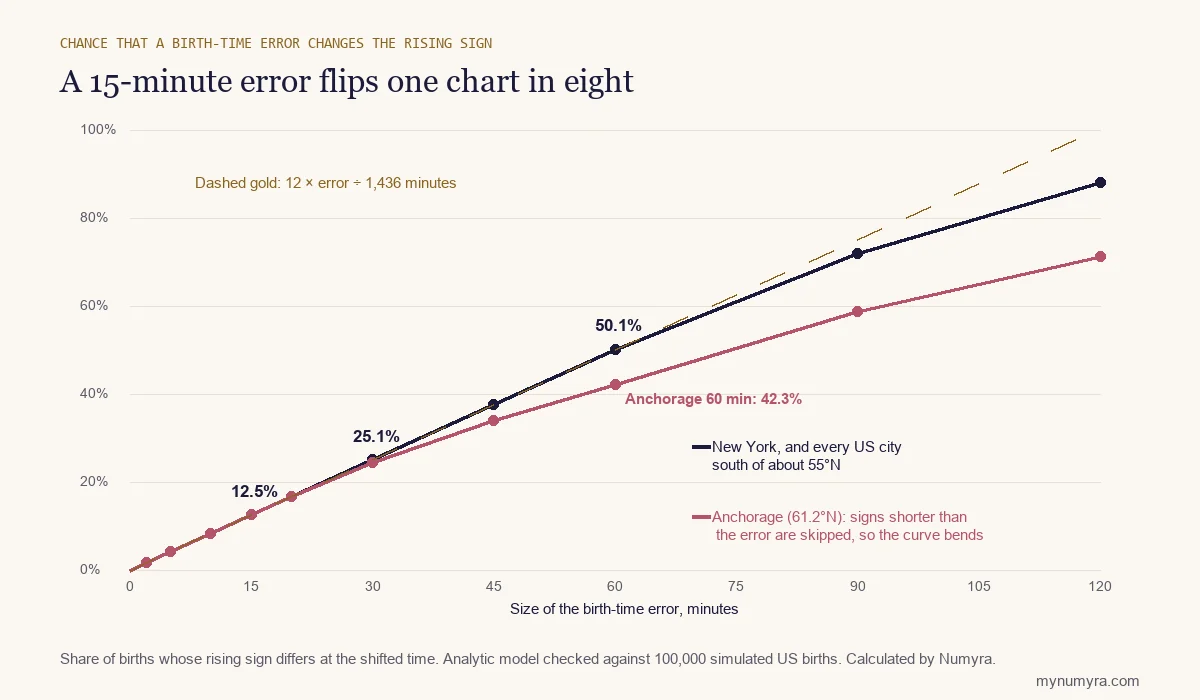
- A birth-time error of 5 minutes gives the wrong rising sign in 4.2% of charts, 15 minutes in 12.5%, 30 minutes in 25.1% and 60 minutes in 50.1%, in any US city up to Seattle’s latitude. A time rounded to the nearest quarter hour gives the wrong sign in about 3% of charts.
- Aries and Pisces are the fragile risings. In New York 42% of people with Aries or Pisces rising were born within 15 minutes of a sign change, against about 20% for Leo, Virgo, Libra and Scorpio.
- “One degree every four minutes” is also an average. In New York the ascendant moves between 0.8 and 1.7 degrees in four minutes depending on the sign, and degrees left in your sign times minutes per degree estimates your margin to within about 4 minutes.
- The biggest everyday risk is an hour, not a minute: a missed or doubled daylight saving hour is a 60-minute error, and 57% of our simulated births fell on a date when the local clock was on daylight time. Astrology is a tradition of interpretation, not a science, and none of this predicts anything.
In this guide
- Why “every two hours” is only an average
- The “one degree every four minutes” rule
- How often a birth-time error changes the rising sign
- How close is your birth time to a sign change?
- Rounded times and “around 3 pm”
- The one-hour trap: daylight saving time
- What changes when the rising sign flips
- What to do if your birth time may be off
- Frequently asked questions
Why “every two hours” is only an average
The rising sign, or ascendant, is the sign on the eastern horizon at the moment and place of birth. As Earth turns, the whole zodiac passes over that horizon once in a sidereal day, which NASA’s Earth fact sheet gives as 23.9345 hours, or about 1,436 minutes. Twelve signs share that time, so the average sign takes 119.7 minutes. That is where “every two hours” comes from, and it is correct as a mean.
It fails as a rule because the signs are not laid across the horizon evenly. The ecliptic, the Sun’s path, is tilted about 23.44 degrees to the equator (NASA gives the same figure), so at any place above the equator some signs climb steeply and others skim along the horizon. One long-standing astrology reference puts it this way:
“The Ascendant sign changes, on average, every two hours, but this is quite variable depending on how close the birth place is to the equator.”
Cafe Astrology, What’s My Ascendant? (Rising Sign)
We measured how variable. The figure below follows one real day in New York, October 22, 2026, on Eastern Daylight Time. Leo and Scorpio stay up for about two and a half hours, Aries and Pisces for just over an hour. The sequence is the same every day, but the clock times slide about four minutes earlier each day, because a sidereal day is about four minutes shorter than a solar day.
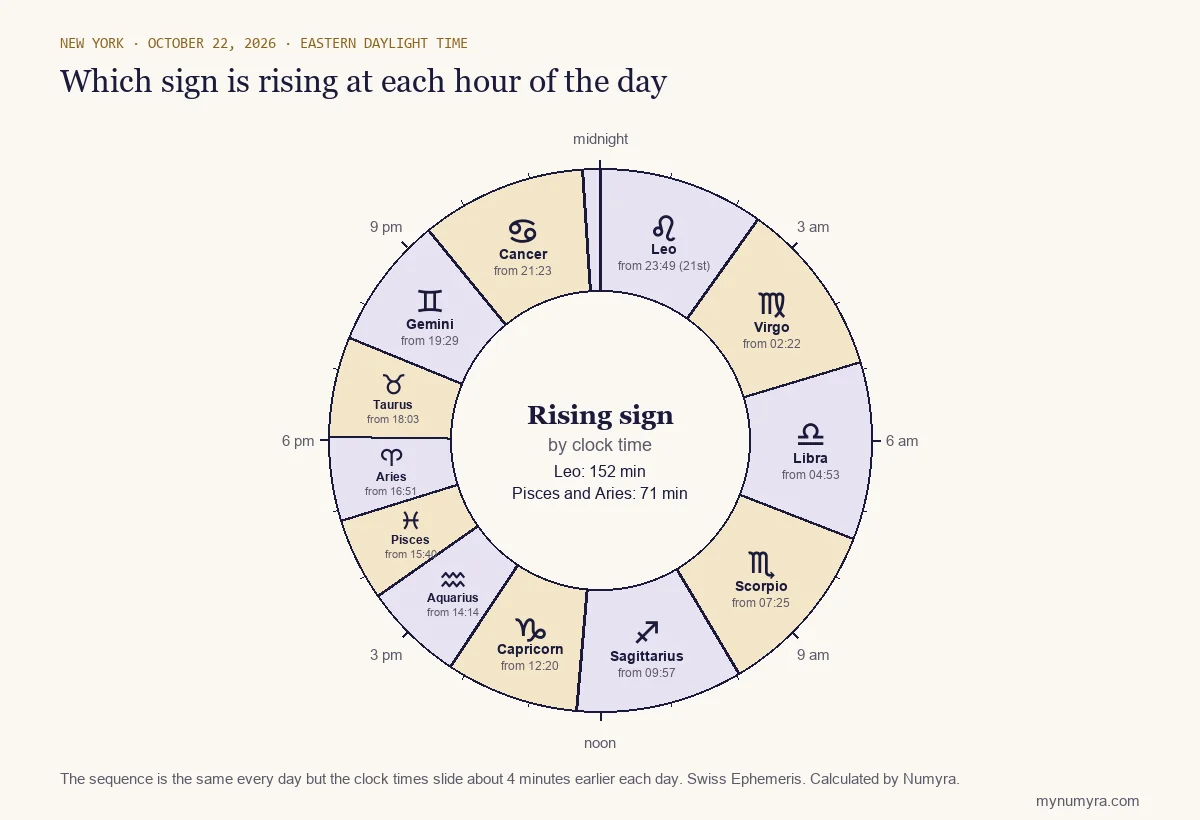
The length of each stay depends on the sign and the latitude, not on the date. The table gives the minutes for five US cities; it was calculated with the ascendant formula in the Swiss Ephemeris and holds for any date of the year.
| Rising sign | Miami 25.8°N | Houston 29.8°N | New York 40.7°N | Seattle 47.6°N | Anchorage 61.2°N |
|---|---|---|---|---|---|
| Aries | 89 min | 85 min | 71 min | 60 min | 25 min |
| Taurus | 101 min | 98 min | 86 min | 76 min | 39 min |
| Gemini | 121 min | 119 min | 114 min | 110 min | 88 min |
| Cancer | 136 min | 137 min | 142 min | 147 min | 169 min |
| Leo | 138 min | 141 min | 153 min | 163 min | 200 min |
| Virgo | 134 min | 138 min | 151 min | 163 min | 198 min |
| Libra | 134 min | 138 min | 151 min | 163 min | 198 min |
| Scorpio | 138 min | 141 min | 153 min | 163 min | 200 min |
| Sagittarius | 136 min | 137 min | 142 min | 147 min | 169 min |
| Capricorn | 121 min | 119 min | 114 min | 110 min | 88 min |
| Aquarius | 101 min | 98 min | 86 min | 76 min | 39 min |
| Pisces | 89 min | 85 min | 71 min | 60 min | 25 min |
Minutes each sign takes to rise, from the moment it reaches the eastern horizon until the next sign does. Each column adds up to 1,436 minutes.
Three patterns stand out. First, the signs from Cancer to Sagittarius are long everywhere: 134 to 163 minutes in the lower 48 states. Second, Aries, Taurus, Aquarius and Pisces are short, and they get shorter as you go north, from about 89 minutes in Miami to 60 in Seattle. Third, the effect is steep far north: in Anchorage Aries and Pisces take 25 minutes and Leo and Scorpio take 200, which is the range of roughly half an hour to nearly three hours that some astrology guides describe. In the lower 48 states the spread is real but milder. Our most common zodiac sign article uses the same durations to show why Aries and Pisces are the rarest rising signs if births are spread evenly across the day.
The “one degree every four minutes” rule
A second rule of thumb says the ascendant moves one degree every four minutes. That is the average: 360 degrees in 1,436 minutes is 1.003 degrees per four minutes. But a fast-rising sign has to cover its 30 degrees in fewer minutes, so the ascendant moves faster there. At New York’s latitude it moves between 0.79 and 1.75 degrees in four minutes depending on the hour; in Miami between 0.87 and 1.39; in Seattle between 0.74 and 2.09; and in Anchorage between 0.60 and 5.19.
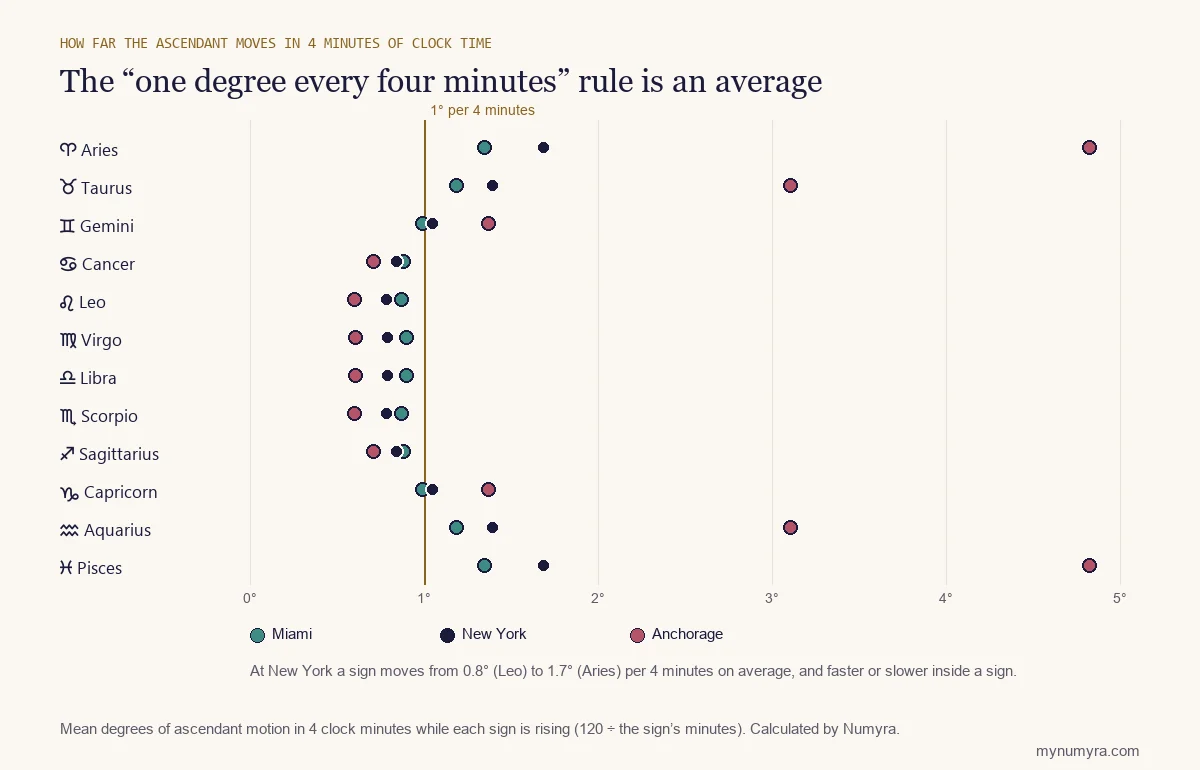
The figure shows the mean for each sign. At New York Aries and Pisces average 1.7 degrees in four minutes, so a four-minute slip moves the ascendant almost two degrees; Leo moves 0.8. The practical consequence is that “how many degrees off” is the wrong way to think about birth-time error. The ascendant degree is not the goal; the sign boundary is, and the next section shows how to measure the distance to it in minutes.
How often a birth-time error changes the rising sign
If a birth time is off by a given number of minutes, how often is the rising sign different? There is a clean answer. Over a full day the ascendant crosses exactly twelve sign boundaries, so the chance that a shift of e minutes crosses one is 12 × e ÷ 1,436, as long as the shift is shorter than the shortest sign. For 15 minutes that is 12.5%.
| Birth-time error | Miami | Houston | New York | Seattle | Anchorage |
|---|---|---|---|---|---|
| 2 minutes | 1.7% | 1.7% | 1.7% | 1.7% | 1.7% |
| 5 minutes | 4.2% | 4.2% | 4.2% | 4.2% | 4.2% |
| 10 minutes | 8.3% | 8.3% | 8.3% | 8.3% | 8.3% |
| 15 minutes | 12.5% | 12.5% | 12.5% | 12.5% | 12.5% |
| 30 minutes | 25.1% | 25.1% | 25.1% | 25.1% | 24.4% |
| 45 minutes | 37.6% | 37.6% | 37.6% | 37.6% | 33.9% |
| 60 minutes | 50.1% | 50.1% | 50.1% | 50.1% | 42.3% |
| 90 minutes | 75.1% | 74.5% | 72.0% | 69.1% | 58.7% |
| 120 minutes | 93.3% | 92.2% | 88.0% | 84.4% | 71.2% |
Share of births whose rising sign differs when the clock time is off by this many minutes, either direction. Calculated by Numyra.
Four results matter. A 2-minute error changes the sign for about 1 chart in 60, and 5 minutes for 1 in 24. Fifteen minutes, an ordinary slip when a time is remembered or copied, changes it for one in eight. At an hour it is one in two. And latitude changes which signs are at risk but not how many people are, up to the point where the error is longer than a whole sign: in Anchorage a 60-minute error skips right over Aries, Taurus, Aquarius and Pisces, which are all shorter than an hour, so the total is 42.3% instead of 50.1%. An independent check agrees: an Indian astrology site, AstroMedha, swept a whole year at Delhi with the sidereal zodiac and reported 12.53%, 25.07% and 50.14% for 15, 30 and 60 minutes, the same figures our model gives for US cities with the tropical zodiac.
Method. We computed the ascendant with the Swiss Ephemeris house routine (pyswisseph) using the tropical zodiac and a 23.4365 degree obliquity. The minutes-per-sign and error tables come from a date-independent model: the ascendant depends only on latitude and local sidereal time, which advances 360 degrees in 1,436.07 minutes, and we sampled it every 1.2 seconds of time. To check the model against real conditions we simulated 100,000 births: each has a date drawn from real US daily birth counts for 1994 to 2014 (the CDC National Center for Health Statistics for 1994 to 2003 and the Social Security Administration for 2004 to 2014), a city drawn from 26 large US cities weighted by population, and a clock time drawn uniformly across the 24 hours, converted to UT with historical time-zone and daylight saving rules. For each birth we recomputed the rising sign at shifted and rounded times. The simulation matched the model within 0.3 percentage points for every error size: 12.7%, 25.2% and 49.9% at 15, 30 and 60 minutes. The public birth files have dates only, so clock times are random, not real birth hours, and real births cluster at some hours; the percentages describe the astronomy of the ascendant, not a count of real birth records.
How close is your birth time to a sign change?
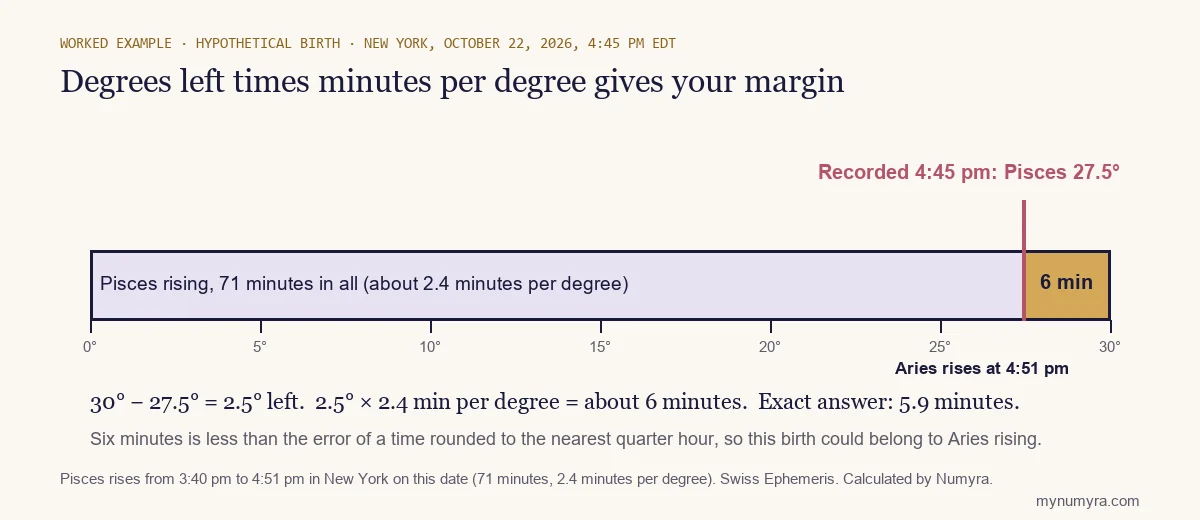
The averages describe a crowd. Your own risk depends on where your ascendant sits inside its sign. If it is at 5 degrees, a time error of ten minutes will not matter; at 28 degrees it may. You can estimate your margin in minutes with one multiplication: the degrees left in your rising sign times the minutes per degree for that sign and latitude. Take a hypothetical birth in New York at 4:45 pm EDT on October 22, 2026. The ascendant is 27.5 degrees of Pisces, 2.5 degrees from the end. Pisces takes 71 minutes at that latitude, 2.4 minutes per degree, so the margin is about six minutes. The exact answer from the ephemeris is 5.9.
The table lists minutes per degree for New York, and the share of people with each rising sign who were born within 15 minutes of a sign change, before or after. That share is the sign’s fragility. Aries and Pisces are the most exposed at 42%; Leo, Virgo, Libra and Scorpio the least at about 20%.
| Rising sign | Minutes to rise | Minutes per degree | Born within 15 minutes of a sign change |
|---|---|---|---|
| Aries | 71 min | 2.4 | 42% |
| Taurus | 86 min | 2.9 | 35% |
| Gemini | 114 min | 3.8 | 26% |
| Cancer | 142 min | 4.7 | 21% |
| Leo | 153 min | 5.1 | 20% |
| Virgo | 151 min | 5.0 | 20% |
| Libra | 151 min | 5.0 | 20% |
| Scorpio | 153 min | 5.1 | 20% |
| Sagittarius | 142 min | 4.7 | 21% |
| Capricorn | 114 min | 3.8 | 26% |
| Aquarius | 86 min | 2.9 | 35% |
| Pisces | 71 min | 2.4 | 42% |
New York, 40.7°N. The share is 30 divided by the minutes the sign takes. Calculated by Numyra.
The shortcut is an average, because the ascendant speeds up and slows down inside a sign. Compared with the exact answer at every point of the day, it is off by 1.1 minutes on average and 4.1 at worst at New York, and by 2.4 on average and 9.7 at worst at Anchorage. To find your own margin without arithmetic, run your details through our birth chart calculator three times: with your time, 15 minutes earlier and 15 minutes later. If the rising sign is the same in all three, a 15-minute error cannot hurt you. If it changes, you are on the edge, and each rising sign profile, such as Aries rising and Leo rising, reads differently.
Rounded times and “around 3 pm”
Many birth times are not exact. The national worksheet that US hospitals use for the birth certificate asks for the time of birth “based on a 24-hour clock (military time)” (CDC National Center for Health Statistics) and names the labor-and-delivery record as the first source, so a time copied from that record is the best you can get. A time that comes from memory, or one that ends in :00, :15, :30 or :45, may have been rounded.
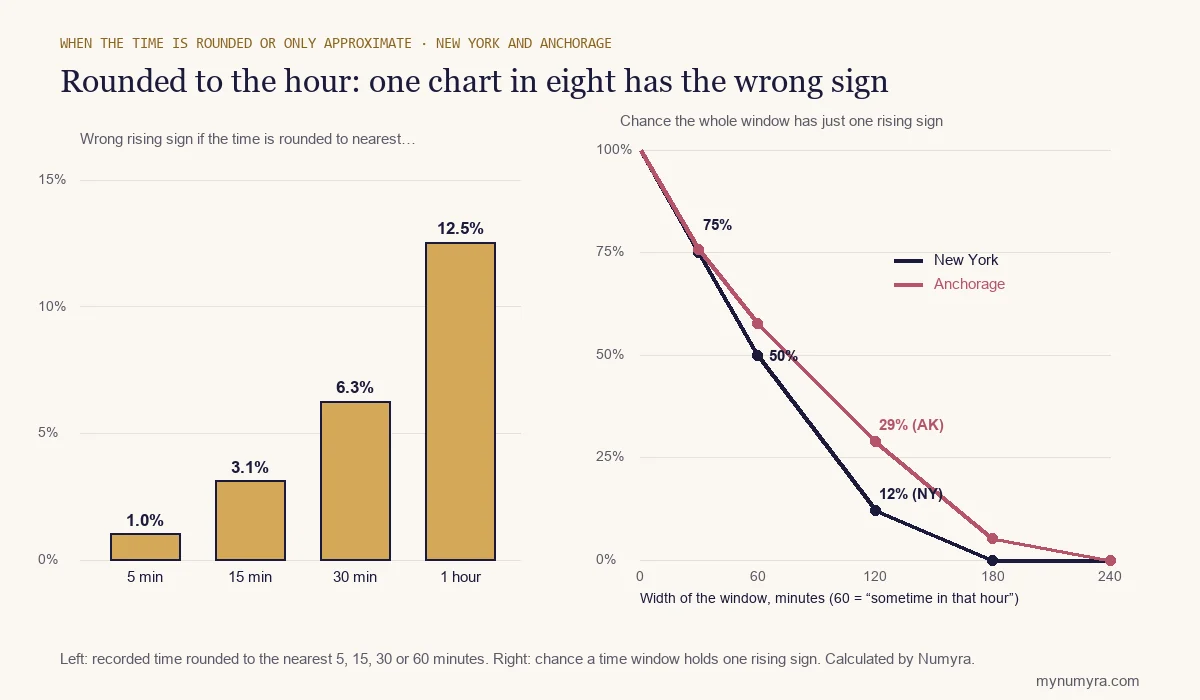
Rounding is smaller than the errors above because the true time lies within half the rounding step. In our simulation, a time rounded to the nearest 5 minutes gives the wrong rising sign in 1.0% of births, to the nearest 15 minutes in 3.2%, to the nearest 30 minutes in 6.3% and to the nearest hour in 12.7%.
| Recorded time rounded to the nearest | Wrong rising sign, model | Wrong rising sign, 100,000 simulated births |
|---|---|---|
| 5 minutes | 1.0% | 1.0% |
| 15 minutes | 3.1% | 3.2% |
| 30 minutes | 6.3% | 6.3% |
| hour | 12.5% | 12.7% |
When all you know is a window, such as “sometime in the afternoon”, the question changes: how many rising signs fit inside it? The window below is how many minutes wide the stated period is. A 30-minute window holds a single sign in 75% of cases at New York, an hour in 50%, and a two-hour window in only 12%. Two hours holds two signs on average and three hours two and a half.
| Window | One sign only, New York | One sign only, Anchorage | Average number of signs |
|---|---|---|---|
| 30 minutes | 75% | 76% | 1.3 |
| 1 hour | 50% | 58% | 1.5 |
| 2 hours | 12% | 29% | 2.0 |
| 3 hours | 0% | 5% | 2.5 |
| 4 hours | 0% | 0% | 3.0 |
| 6 hours | 0% | 0% | 4.0 |
Chance that a window placed at random holds a single rising sign. Calculated by Numyra.
The one-hour trap: daylight saving time
An error of exactly 60 minutes is not a rounding slip. It is what happens when a daylight saving hour is applied twice or not at all, and it flips the rising sign about half the time. The risk is larger than it looks because daylight time covers most of the year. Since 2007 it runs from the second Sunday of March to the first Sunday of November, a rule enacted by the Energy Policy Act of 2005 that lengthened daylight time by about a month (NIST). Hawaii and most of Arizona do not observe it, which is why a Phoenix or Honolulu birth needs different handling from a New York one. In our simulated births, 57% fell on a date when the local clock was on daylight time.
If you were born between spring and autumn, check that the time on your certificate is local clock time and that your chart software knows the date was in daylight time. Our methodology page states that the birth chart calculator converts every birth time with the city’s real IANA time zone, including historical daylight-saving rules. For births before 2007, or for unusual places and years, a one-hour mismatch between two tools is the first thing to rule out when two charts disagree.
What changes when the rising sign flips
Everything built on the ascendant moves with it. In whole-sign houses the rising sign is the whole first house, so all twelve houses rotate by one sign and every planet changes house at once, which our guide to whole sign and Placidus houses shows with numbers. The chart ruler changes, so Gemini rising has Mercury as its ruler and Cancer rising the Moon (see chart ruler). The Midheaven moves at a similar pace, each sign staying on it for 1 h 51 min to 2 h 08 min. The signs of the planets almost never change with a small time error; only the Moon, which changes sign every two to three days, sometimes does. Our explainer on Sun, Moon and rising signs covers what each one is read to mean.
The difficulty is not modern. In the second century Ptolemy opened his chapter on the horoscopic point with it:
“Difficulty often arises with regard to the first and most important fact, that is, the fraction of the hour of the birth”
Ptolemy, Tetrabiblos, Book III, chapter 2, trans. F. E. Robbins (Loeb Classical Library, 1940), via LacusCurtius
He goes on to say that only observation with a horoscopic astrolabe could give the minute, and that the solar instruments and water clocks most practitioners relied on were often wrong. Our article on Ptolemy’s Tetrabiblos puts the book in context.
What to do if your birth time may be off
- Look for the record first. A hospital record or birth certificate beats memory. Ask which source the time came from.
- Test the edges. Run your chart at your time and 15 and 30 minutes either side. If the rising sign never changes, you are safe at that level of error; if it does, treat the two signs as candidates.
- Do not pick the description that fits. Recognizing yourself in a sign’s description is not evidence that it is your rising sign, because broad descriptions fit many people.
- Use what does not depend on the minute. The signs of the Sun and of every planet from Mercury outward hold for almost any plausible error, and so does a reading that leaves out houses.
This guide is educational information about how an astrological point is calculated. Astrology is a tradition of interpretation, not an established science, and a rising sign does not predict events or decide anything about your life. If you are not sure of the time, the honest answer is a range of rising signs, not a single one.
Frequently asked questions
Does your birth time affect your rising sign?
Yes. The rising sign is the sign on the eastern horizon at the moment and place of birth, so it depends on the clock time more than any other part of the chart. Your birth date fixes the Sun sign and, with the place, the day’s pattern; the time picks the sign inside it.
Does your rising sign change every two hours?
On average, yes: a sign passes the horizon every 119.7 minutes. In practice a sign stays from 71 to 153 minutes in New York and from 25 to 200 in Anchorage, so two hours is only the middle of a wide range.
How accurate does my birth time need to be for my rising sign?
It depends on your margin. A 5-minute error changes the rising sign for 4.2% of people, 15 minutes for 12.5% and 30 minutes for 25.1%. To be sure, test your time and 15 minutes either side in a calculator; if the sign does not change, you are safe at that level.
Does 2 minutes make a difference in a birth chart?
Rarely for the rising sign: a 2-minute shift changes the sign for 1.7% of births, about 1 in 60. It does move the ascendant by about 0.4 to 0.9 degrees at New York’s latitude, and it can move planets across house lines in quadrant house systems.
Which rising signs are most likely to be wrong?
Aries and Pisces, which pass the horizon fastest: 71 minutes each in New York, so 42% of people with these risings were born within 15 minutes of a sign change. Taurus and Aquarius come next at 35%. Leo, Virgo, Libra and Scorpio are the most stable at about 20%.
Why does the time a sign takes depend on latitude?
The ecliptic is tilted about 23.4 degrees to the equator, so its angle to the horizon changes through the day, and the tilt matters more the farther you are from the equator. Near the equator the signs take similar times; far north some rise very slowly and others very fast.
Can my rising sign change as I get older?
No. The rising sign is fixed by the sky at the moment and place of birth. If a chart app shows a different one than before, the usual causes are different inputs, such as the birth time, the time zone or the daylight saving setting, or a different zodiac setting.
What if I only know the part of the day I was born?
Then you have a set of candidates, not an answer. A two-hour window at New York holds two rising signs on average, and only 12% of two-hour windows hold a single one. Keep each candidate and read only what does not depend on the rising sign.
Sources
- Ptolemy. Tetrabiblos, Book III, chapters 1 to 9, trans. F. E. Robbins (Loeb Classical Library, 1940), via LacusCurtius. The quotation is from chapter 2, “Of the Degree of the Horoscopic Point”.
- Cafe Astrology. What’s My Ascendant? (Rising Sign). Source of the quotation on how the rising sign interval varies with latitude.
- NASA. Earth Fact Sheet. Sidereal rotation period 23.9345 hours; obliquity to orbit 23.44 degrees.
- CDC National Center for Health Statistics. Guide to Completing the Facility Worksheets for the Certificate of Live Birth and Report of Fetal Death (2003 revision, updated March 2026). Item 18, time of birth.
- NIST. Daylight Saving Time. Current US rules, the 2007 change and the places that do not observe DST.
- Astrodienst. Swiss Ephemeris. House and ascendant routines used for every calculation on this page (by the Numyra Methodology Desk).
- FiveThirtyEight. US births data, 1994 to 2014, from the CDC National Center for Health Statistics and the Social Security Administration. Dates only; clock times and places in our simulation are random.
- AstroMedha. How Wrong Can Your Birth Time Be? An independent sidereal-zodiac calculation for Delhi, used only as a cross-check of the 15-, 30- and 60-minute percentages.