The 12th house has a reputation as astrology’s most unsettling house — hidden enemies, self-undoing, confinement. That reputation isn’t a modern invention. It traces directly to what Ptolemy called it, 2,000 years ago.
Key takeaways
- The 12th house is traditionally read as the house of the hidden: the subconscious, secrets, isolation, and what a person can’t fully see about themselves.
- Its difficult reputation has a real, findable historical root — Ptolemy’s 2nd-century Tetrabiblos names it directly as the house “of the Evil Dæmon.”
- It’s traditionally associated with Pisces and its ruling planet Neptune, continuing the theme of dissolution and the unseen.
- Modern astrology has softened the reading considerably — from “hidden enemies” toward “the parts of yourself you haven’t examined yet.”
- For the full house system (how houses are calculated, why astrologers disagree on the method), see our Astrological Houses guide — this article goes deep on this one house specifically.
- Nothing here is medical, financial, legal, or psychological advice — a cultural tradition, presented for reflection.
In this guide
- What the 12th house traditionally represents
- Where the “difficult house” reputation actually comes from
- How the reading has softened over time
- What it means to have a planet in your 12th house
- Its connection to Pisces and Neptune
- Frequently asked questions
What the 12th house traditionally represents
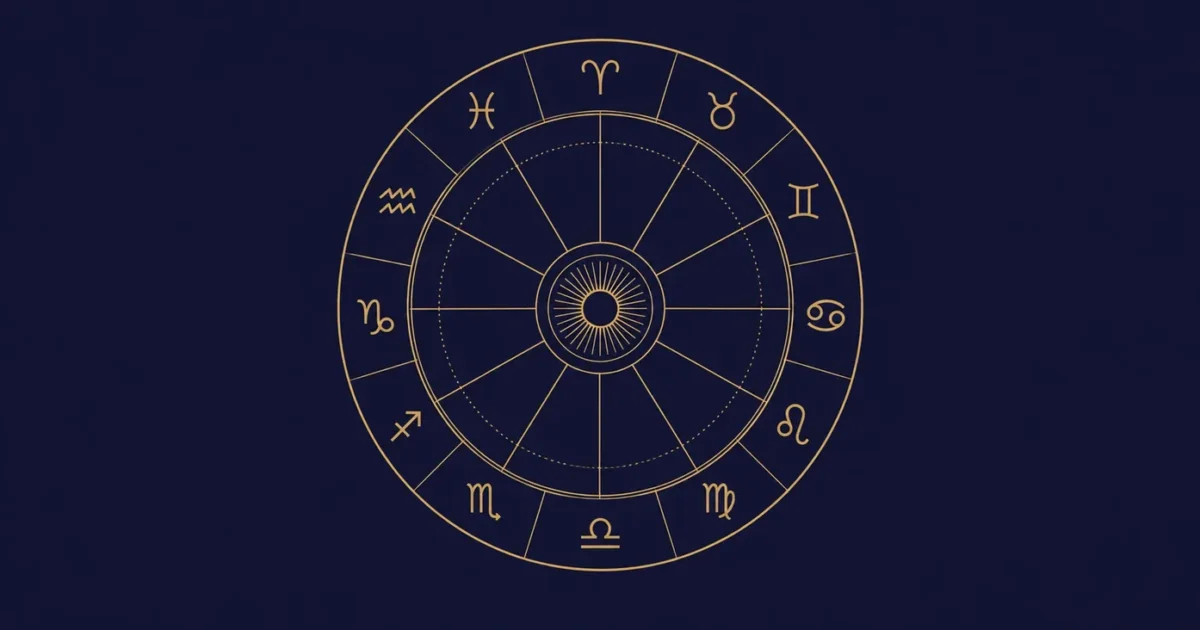
In a traditional birth chart, the 12th house is the final house of the twelve — the one immediately before the 1st house (identity, the self) comes back around. That position in the cycle matters to the reading: it’s traditionally treated as a house of endings, of things not yet resolved before a new cycle begins. Its core themes, consistently repeated across the astrological tradition, are the subconscious mind, secrets, isolation, sleep and dreams, institutions of confinement (hospitals, retreats — in the older tradition, prisons), and self-undoing: patterns a person repeats without fully seeing why.

It’s also traditionally classified as a cadent house — one of four houses (3rd, 6th, 9th, 12th) considered structurally weaker in classical astrology, tied to transition and adjustment rather than the more forceful angular houses (1st, 4th, 7th, 10th). That classification matters for why the 12th house was historically read as difficult in the first place, not just thematically but structurally.
Where the “difficult house” reputation actually comes from
This is the part most modern explainers skip entirely. The 12th house’s unsettling reputation isn’t a vague old feeling that accumulated over centuries — it traces to a specific, findable source. Ptolemy’s Tetrabiblos, the 2nd-century text that standardized Western astrology (see our Tetrabiblos article), names the house directly while explaining why it’s excluded from a favorable predictive technique:
“The sign which precedes the ascendant, and constitutes the twelfth house (called that of the Evil Dæmon), is incompetent [for this purpose]… because it is cadent, and because the beams cast by the stars posited therein, towards the earth, are impaired.”
— Ptolemy, Tetrabiblos, Book III, Chapter XII (trans. J.M. Ashmand, 1822)
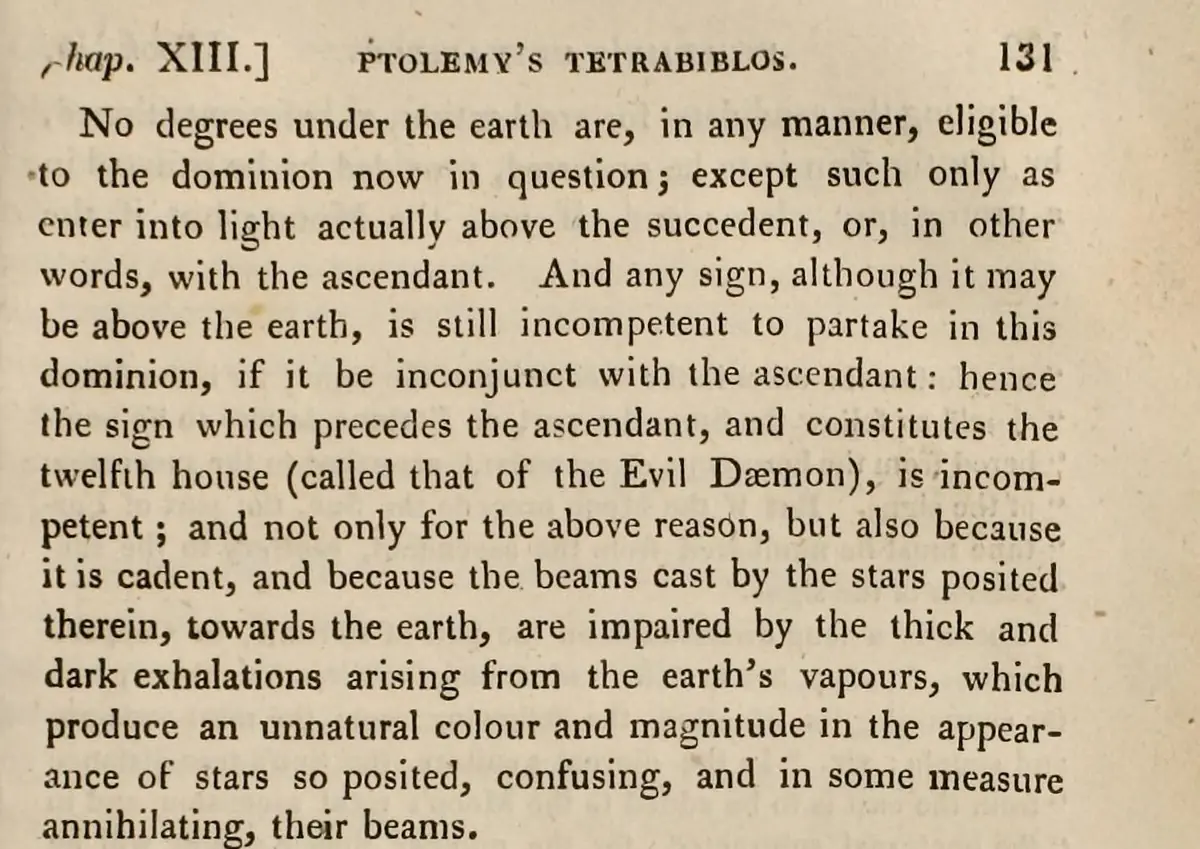
“That of the Evil Dæmon” (“Kakos Daimon” in the original Greek tradition) is a direct, historical name for this house, not a modern dramatization — and Ptolemy’s own stated reasoning is worth sitting with: he excludes the 12th house from favorable calculations specifically because of its cadent position (structurally weak, mid-transition) and because planets there are described as having their light “impaired.” The reputation for hiddenness and difficulty was built into the house’s classical name and function from the start, not layered on by centuries of horoscope-column embellishment.
How the reading has softened over time
Contemporary astrology has moved meaningfully away from “Evil Dæmon” toward a more psychological framing. Where the classical tradition read the 12th house as a source of hidden threat, modern astrologers more often read it as a house of the unconscious — the parts of a person’s own patterns, fears, or inherited behavior that stay invisible specifically because they’ve never been examined. The traditional “hidden enemies” reading persists in some modern content, but it now sits alongside — and is often reframed by — a therapeutic lens: not enemies acting on you from outside, but unresolved material acting on you from within. Both readings share the same core theme (something operating outside conscious awareness); they differ mainly in whether that “something” is cast as external or internal.
What it means to have a planet in your 12th house
Rather than list a meaning for each of the ten traditionally-tracked planets individually (a permutation exercise that risks reading as padding more than real insight), the traditional principle is worth stating clearly on its own: whatever a planet represents gets filtered through the 12th house’s core theme of hiddenness. A planet there is traditionally read as operating more privately, more instinctively, or less consciously than it would elsewhere in the chart — its energy is real and active, but less visible, even to the person whose chart it is. The practical takeaway is less “planet X means Y specifically” and more a lens: whatever that planet’s usual domain is, expect it to show up here in a quieter, more internal, less immediately obvious way than it would in an angular house like the 1st or 10th.
Its connection to Pisces and Neptune
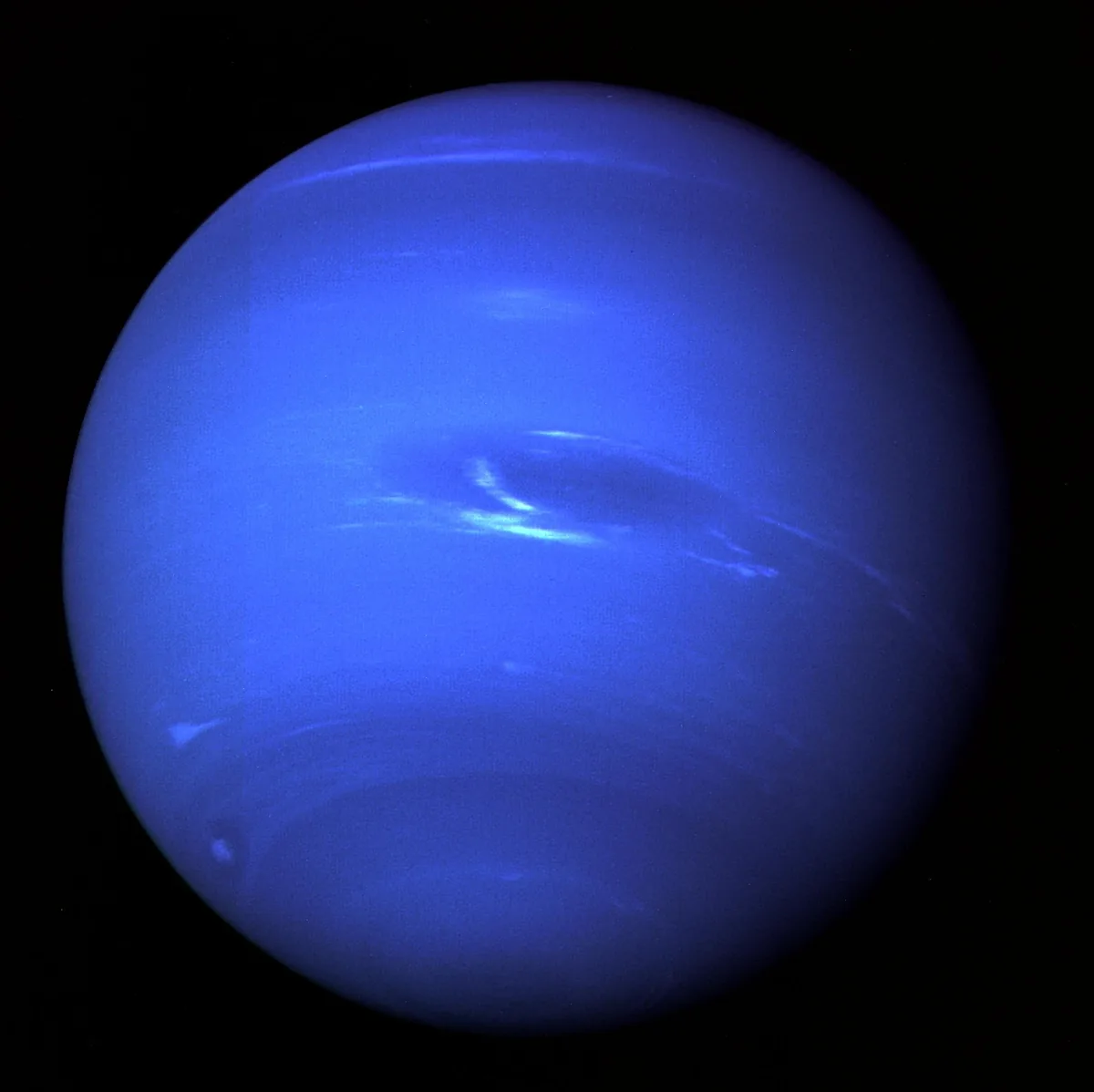
In the standard association between houses and signs (each of the 12 houses is traditionally linked to one of the 12 signs in order, starting from Aries at the 1st), the 12th house corresponds to Pisces, and by extension to Pisces’s modern ruling planet, Neptune. This isn’t a coincidence of temperament: Pisces is traditionally read as the most boundary-dissolving of the water signs (see our Four Elements and Three Modalities guide for the water-sign theme generally), and Neptune governs illusion, dreams, and the blurring of clear edges. The 12th house’s core theme — what isn’t clearly seen — and Pisces/Neptune’s core theme — what dissolves clear boundaries — reinforce each other, which is part of why this specific house-sign pairing is considered one of the more thematically coherent ones in the traditional system.
Frequently asked questions
Is the 12th house always a “bad” house to have planets in?
No — traditional difficulty doesn’t mean modern misfortune. A planet in the 12th house is read as operating more privately or subconsciously, which can be uncomfortable to access but isn’t framed as inherently harmful in contemporary practice.
What does “Evil Dæmon” actually mean in this context?
It’s a classical astrological name, not a literal claim about demons. In Hellenistic astrology, the 12th house’s Greek name (“Kakos Daimon”) reflected its structurally weak, hidden position in the chart — its reputation for hardship comes from that classical function, not folklore added later.
How is the 12th house different from the 8th house, which is also read as “difficult”?
They’re both traditionally uncomfortable houses but represent different things: the 8th house is read as transformation, shared resources, and confronting mortality directly; the 12th house is read as what stays hidden or unconscious rather than confronted. One is about facing something intense; the other is about what isn’t being faced at all.
Do I need my exact birth time to know my 12th house?
Yes — house placements depend on your exact birth time and location, the same requirement as your rising sign. See our Birth Chart calculator for the inputs currently supported (Sun, Moon, and rising sign); full house placements for every planet aren’t computed there yet.
What sign rules the 12th house?
Pisces, in the standard sign-to-house correspondence, with Neptune as its modern ruling planet (Jupiter in the older, pre-Neptune classical system).
Sources
- Ptolemy, Claudius. Tetrabiblos, Book III, Chapter XII, trans. J. M. Ashmand, 1822, p. 131. Internet Archive scan. Source of the direct “Evil Dæmon” quote above.
- Ptolemy, Claudius. Tetrabiblos, trans. F. E. Robbins, 1940. LacusCurtius. A later, more literal translation of the same text.
- Lilly, William. Christian Astrology, 1647, p. 56, “The Twelfth House.” Internet Archive scan of the page shown above.
- Numyra: What Are Astrological Houses? A Plain-English Guide. The full house-system overview this article builds on.
- Numyra Methodology Desk. Astrology calculation standard.