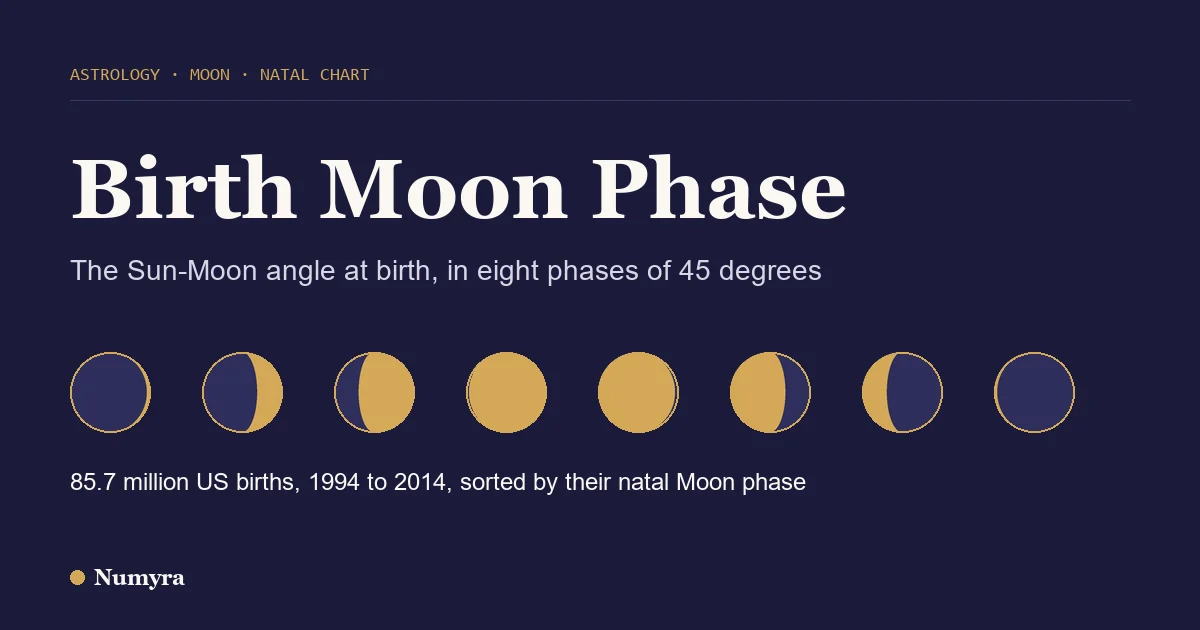
Your birth Moon phase is the angle between the Moon and the Sun at the moment you were born, sorted into eight phases of 45 degrees each: New, Crescent, First Quarter, Gibbous, Full, Disseminating, Last Quarter and Balsamic. It is a different fact from your Moon sign, which only says which zodiac sign the Moon was in. This guide shows how to find yours from a date and time, what the astrologer Dane Rudhyar wrote about each phase (with quotations from his book), and how 85.7 million US births from 1994 to 2014 spread across the eight phases. They fall almost exactly one in eight, and the old claim that more babies arrive at the full moon does not appear in the data. Astrology here is a tradition of interpretation, not a prediction.
Key takeaways
- Your birth Moon phase is the Moon’s ecliptic longitude minus the Sun’s, a number from 0 to 360 degrees, divided into eight 45-degree phases. Rudhyar’s “First Quarter” band (90 to 135 degrees) starts at the exact quarter, so it describes a Moon that is already 50% to 85% lit.
- The date alone settles your phase only 72.9% of the time. In 27.1% of US birth dates (2,078 of 7,670 between 1994 and 2014) a phase boundary fell inside the day, so the birth time decides.
- The phases are not equal in length: each lasted between 3.18 and 4.16 days across 261 lunar cycles, averaging 3.64 to 3.74 days. The shortest, Full and Gibbous, are the two least common among US births (12.28% and 12.32%).
- Out of 85,712,738 US births, every phase holds between 12.28% and 12.68%. After adjusting for the weekday, the largest gap from a normal day is 0.21%, about 23 births on a day with 11,175, and chance alone produces a gap that size 77% of the time.
- Rudhyar described eight “lunation types” in 1967 and wrote that his classification does not “fill all the requirements of a thorough analysis of personality”. We found no published study that tests the eight types, so treat them as tradition.
In this guide
- What a birth Moon phase is, and what it is not
- The eight phases, from New to Balsamic
- How to find your birth Moon phase
- What Rudhyar wrote about the eight types
- How common is each phase? 85.7 million US births
- Are more babies born at the full moon?
- What your birth Moon phase cannot tell you
- Frequently asked questions
- Sources
What a birth Moon phase is, and what it is not
The Moon shines by reflected sunlight, so how much of it we see lit depends on where it stands relative to the Sun: new when it is in the Sun’s direction, full when it is opposite. Astrologers measure this as an angle along the zodiac: the Moon’s longitude minus the Sun’s longitude, counted forward from 0 to 360 degrees. At birth that angle is your natal or birth Moon phase. A waxing Moon, between 0 and 180 degrees, is growing toward full; a waning Moon, between 180 and 360, is shrinking toward new.
It is not the same as your Moon sign. The Moon sign names the zodiac sign the Moon occupied, and the Moon crosses all twelve in about 27 days. The phase depends on the Sun as well, so two people with the Moon in Taurus can be born under a New, a Full or any other phase. Our guide to Sun, Moon and rising signs lays out how the three differ.
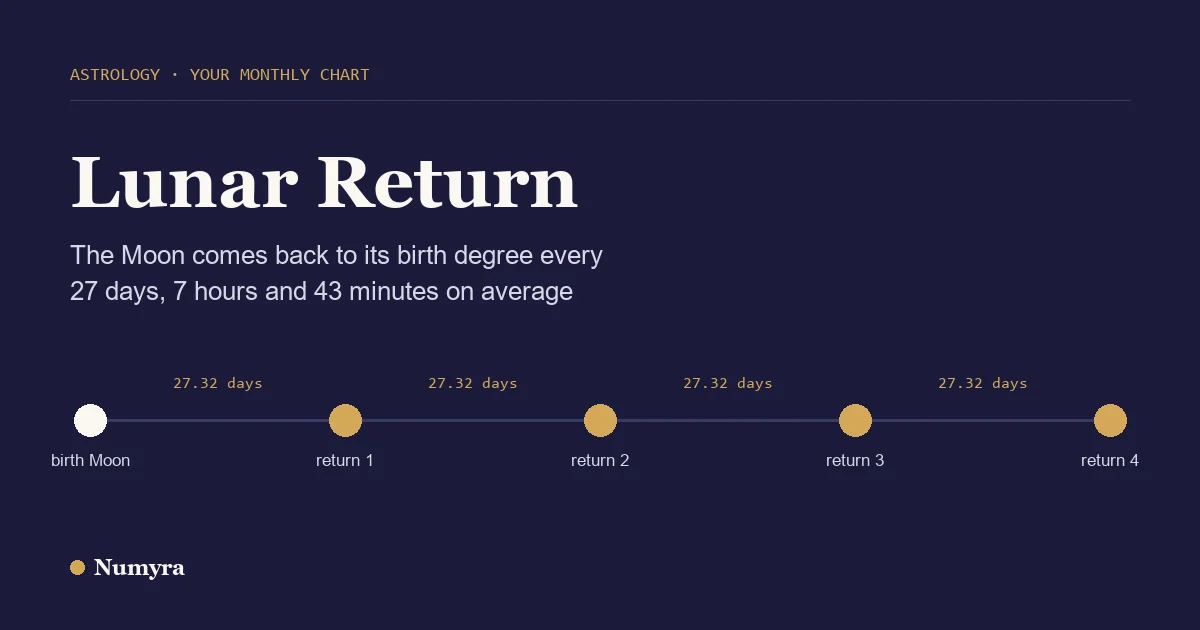
The phase is also not the lunar return. The Moon returns to the same zodiac degree every 27.32 days but to the same phase every 29.53, because the Sun has moved on and the Moon needs about two extra days to catch up. For what research says about the real Moon’s effect on mood and sleep, see our guide to moon phases and mood.
The eight phases, from New to Balsamic
Western astrology’s eight-phase scheme comes from Dane Rudhyar’s 1967 book The Lunation Cycle. He split the angle into 45-degree steps and named each step. The table lists the angle, how much of the Moon’s disc is lit at each end of the step (the lit share at angle A is (1 minus cos A) divided by 2), the average length of the phase in our 1994 to 2014 calculations, and a short paraphrase of how Rudhyar described that type of person.
| Phase | Sun-Moon angle | Moon lit | Average length | Rudhyar’s type, in brief |
|---|---|---|---|---|
| New | 0° to 45° | 0 to 15% | 3.66 days | subjective, impulsive, emotional in relationships; people met as symbols |
| Crescent | 45° to 90° | 15 to 50% | 3.74 days | new impulse pushing against the old; self-assertive, eager to overcome obstacles |
| First Quarter | 90° to 135° | 50 to 85% | 3.73 days | crisis in action; managerial, forceful, building frameworks for new ideals |
| Gibbous | 135° to 180° | 85 to 100% | 3.64 days | seeks meaning and personal growth; keeps asking why |
| Full | 180° to 225° | 100 to 85% | 3.64 days | objectivity and clear consciousness; fulfillment or, negatively, separation |
| Disseminating | 225° to 270° | 85 to 50% | 3.73 days | wants to show others what was learned; popularizer, crusader |
| Last Quarter | 270° to 315° | 50 to 15% | 3.74 days | crisis in consciousness; embodies beliefs in systems and institutions |
| Balsamic | 315° to 360° | 15 to 0% | 3.66 days | prophetic, turned to the future; sense of finality, readiness for sacrifice |
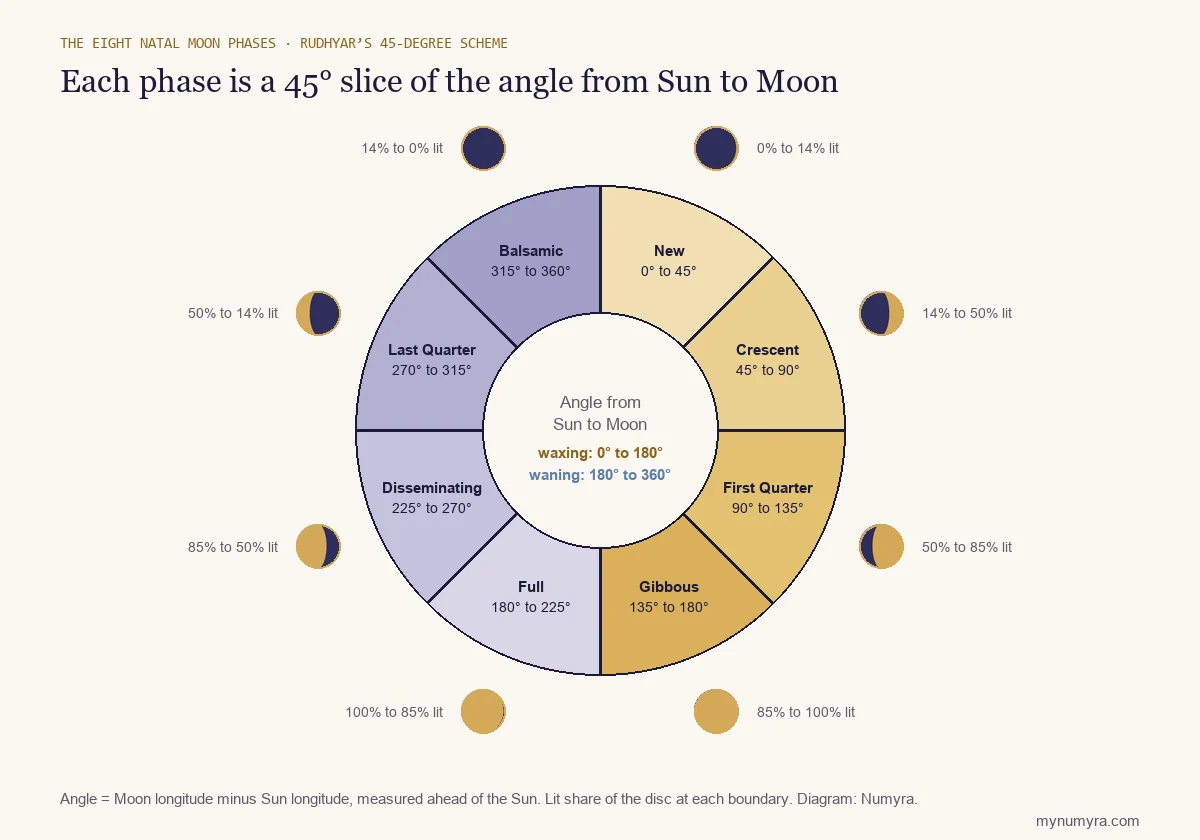
Rudhyar’s names follow a rule he states himself, and it explains why other sites label the same slices differently:
“The phase’s name characterizes all the people born within the period which follows that phase.”
Dane Rudhyar, The Lunation Cycle (1967; Aurora Press edition, 1986), chapter III, “The Eight Lunation Types of Personality”
So the “First Quarter” type begins at the exact first-quarter moment, when the Moon is half lit, and runs until it is 85% lit. To the eye that Moon looks gibbous, so Rudhyar’s names label the period after each phase point and do not describe how the Moon looks. Modern lists often keep his 45-degree slices and rename some of them: Waxing Crescent for Crescent, Waxing Gibbous for Gibbous, Waning Gibbous for Disseminating, Third Quarter for Last Quarter and Waning Crescent for Balsamic. A calculator that centers each phase on its exact point instead would move every boundary by 22.5 degrees, so check the degree ranges before comparing results.
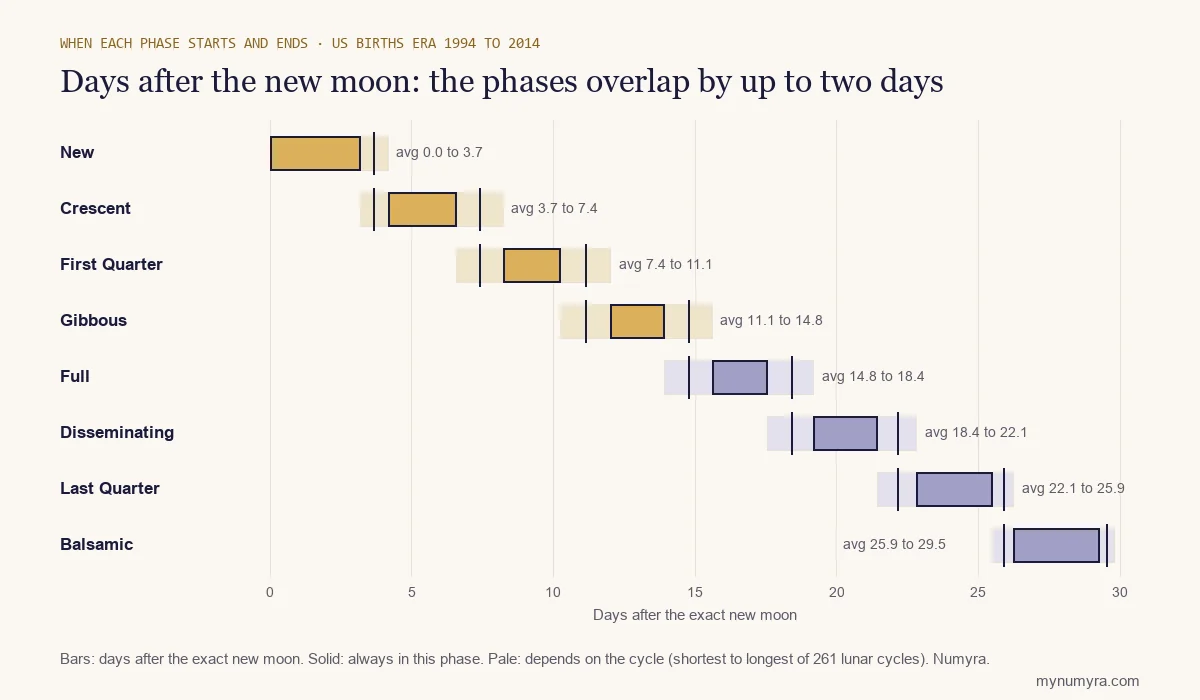
The eight phases are not equal in time. Over the roughly 261 lunar cycles from 1994 to 2014, a 45-degree slice lasted anywhere from 3.18 to 4.16 days. New, Gibbous, Full and Balsamic average 3.64 to 3.66 days; Crescent, First Quarter, Disseminating and Last Quarter average 3.73 to 3.74. The pattern fits the Moon’s known speed-up around new and full, which the lunar theory calls the variation. A whole cycle from one new moon to the next averaged 29.53 days, ranging from 29.29 to 29.82.
How to find your birth Moon phase
You need three things: your birth date, your birth time and your birth place, so the clock time can be converted to Universal Time. Then follow three steps.
- Get the Sun’s and Moon’s positions at birth from a chart or ephemeris, in zodiac degrees. Our birth chart calculator gives your Sun and Moon signs, and any chart program or ephemeris gives the degrees.
- Turn each position into a number from 0 to 360: add 30 for each full sign since Aries (Taurus starts at 30, Gemini at 60, and so on up to Pisces at 330), then add the degrees.
- Subtract the Sun’s number from the Moon’s, adding 360 if the answer is negative, and divide by 45. The whole-number part tells you the phase: 0 is New, 1 Crescent, 2 First Quarter, 3 Gibbous, 4 Full, 5 Disseminating, 6 Last Quarter, 7 Balsamic.
A worked example. Take a hypothetical birth on June 15, 1992 at 2:30 pm Eastern Daylight Time in New York, which is 18:30 Universal Time. The Swiss Ephemeris puts the Sun at 24 degrees 53 minutes of Gemini, which is 84.88 degrees, and the Moon at 1 degree 22 minutes of Capricorn, which is 271.37. Moon minus Sun is 186.49 degrees. Divided by 45 that is 4.14, so the person was born in the Full phase, 6.5 degrees past the exact full moon, with the Moon 99.7% lit. The US Naval Observatory lists that full moon at 04:50 Universal Time the same day, about 13.7 hours earlier. The Moon sign here is Capricorn and the Sun sign Gemini, but neither says anything about the phase.
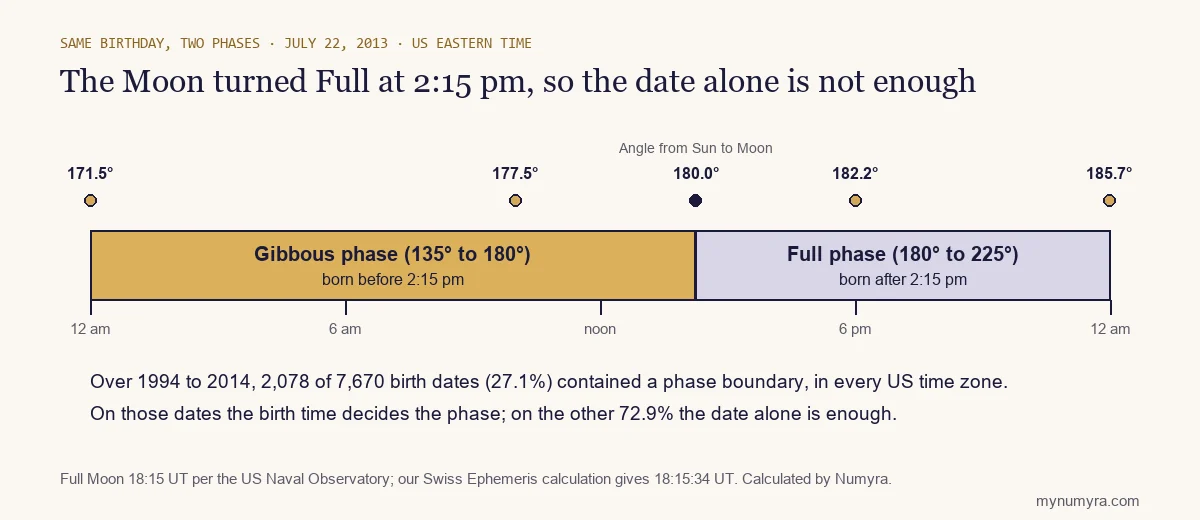
Can you find it from the date alone? Often, but not always. The Moon gains about 12 degrees a day on the Sun, so a 45-degree phase boundary falls inside a calendar day on about one date in four. We counted every phase boundary for 1994 to 2014: 2,078 of the 7,670 dates in that period (27.1%) had one, and the figure is the same in the Eastern, Central and Pacific time zones. On those dates, two people born hours apart share a birthday and not a phase. If your birth time is unknown and your date is one of these, treat your phase as one of two neighbors; our guide on how birth time changes your rising sign explains why times matter in general.
If you only have a moon calendar, the table below converts days since the last new moon into a phase. The new moon, counted from its exact moment, is day 0. “Always” means the phase held at that point in every one of the 261 cycles we calculated; between the windows the phase depends on whether that particular lunar cycle ran short or long. For exact times in a given year, the US Naval Observatory moon phase data lists every new, quarter and full moon, and our Full Moon and New Moon Calendar 2027 covers the year ahead.
| Phase | Always this phase between day | Starts between day (shortest to longest) |
|---|---|---|
| New | 0.0 to 3.2 | the new moon (day 0) |
| Crescent | 4.2 to 6.6 | 3.2 to 4.2 |
| First Quarter | 8.2 to 10.2 | 6.6 to 8.2 |
| Gibbous | 12.0 to 13.9 | 10.2 to 12.0 |
| Full | 15.6 to 17.6 | 13.9 to 15.6 |
| Disseminating | 19.2 to 21.4 | 17.6 to 19.2 |
| Last Quarter | 22.8 to 25.5 | 21.4 to 22.8 |
| Balsamic | 26.3 to 29.3 | 25.5 to 26.3 |
How we checked the calculation. Our phase times come from the Swiss Ephemeris (Moshier mode). We compared them with the US Naval Observatory’s published times for every new moon, first quarter, full moon and last quarter from 1994 to 2014, 1,039 events. All matched within 0.6 minutes, with an average gap of 0.26 minutes.
What Rudhyar wrote about the eight types
Dane Rudhyar (1895 to 1985) built the scheme on what he called the lunation birthday: the monthly moment when the Moon returns to the phase it had when you were born. The copyright page of the 1986 Aurora Press edition says the book was first published as The Moon, The Cycles and Fortunes of Life by David McKay Co., which a San Diego State University library record dates to 1946. Chapter III is the one that describes the eight types. He ties the scheme to a seasonal analogy:
“Such a classification of types according to the lunation birthday is fully as significant and valid, within its proper limits, as a classification based on the season of the year in which a man is born.”
Dane Rudhyar, The Lunation Cycle, chapter III
His descriptions are about how a person meets relationships, and each type has a positive and a negative side; the table above gives them in brief. A Moon from 90 to 135 degrees ahead of the Sun makes a forceful, structure-building First Quarter type, for instance, while one from 270 to 315 degrees makes a Last Quarter type who tends to defend institutions and principles. Rudhyar calls the Full type the first of the waning types.
For each type he lists historical figures as examples. Those lists are illustrations from his reading of biographies, not a test, and we did not check them. Rudhyar also states the limits of his own scheme:
“This eight-fold classification of lunation types does not, however, fill all the requirements of a thorough analysis of personality”
Dane Rudhyar, The Lunation Cycle, chapter III
The next chapter turns to the Part of Fortune, which our Part of Fortune guide explains, and later chapters follow the same angle through life as the progressed lunation cycle, covered in our progressed Moon guide, where your natal phase decides when your first progressed New Moon arrives. We read Rudhyar’s text in the Internet Archive’s scan, which is a third-party upload of the 1986 edition; page numbers there come from OCR, so we cite the chapter and not a page.
How common is each phase? 85.7 million US births
No page we found for this topic counts real births by phase. One calculator page states that new moon and full moon each take 12.2% of 31,673 dates from 1940 to 2026, which counts days and not babies. We counted babies.
Method. We used daily US birth counts for 7,670 days from 1994 to 2014: the CDC National Center for Health Statistics file for 1994 to 1999 and the Social Security Administration file for 2000 to 2014, both published in FiveThirtyEight’s births repository. The two files overlap from 2000 to 2003, and the SSA counts run about 2% higher (a ratio of 1.007 to 1.034 per day), so we used one source for each year and only ever compared a day with days from the same source. The files give dates but no birth times, so we split each day into 24 equal hours of US Central time, worked out the Sun-Moon angle for each hour, and gave each phase its share of that day’s births. Real births cluster in daytime hours, so on the 27.1% of days that contain a phase boundary our even split is an approximation; on the other days it makes no difference. The same births data drives our most common zodiac sign analysis.
| Birth Moon phase | US births, 1994 to 2014 | Share of births | Share of calendar time | Gap from a normal day (±1 standard error) |
|---|---|---|---|---|
| New | 10,615,127 | 12.38% | 12.39% | +0.03% (±0.13) |
| Crescent | 10,851,527 | 12.66% | 12.66% | +0.11% (±0.13) |
| First Quarter | 10,835,853 | 12.64% | 12.64% | +0.13% (±0.13) |
| Gibbous | 10,560,147 | 12.32% | 12.29% | +0.16% (±0.13) |
| Full | 10,525,706 | 12.28% | 12.30% | -0.15% (±0.13) |
| Disseminating | 10,826,474 | 12.63% | 12.65% | -0.21% (±0.13) |
| Last Quarter | 10,867,215 | 12.68% | 12.67% | +0.04% (±0.13) |
| Balsamic | 10,630,689 | 12.40% | 12.39% | -0.04% (±0.13) |
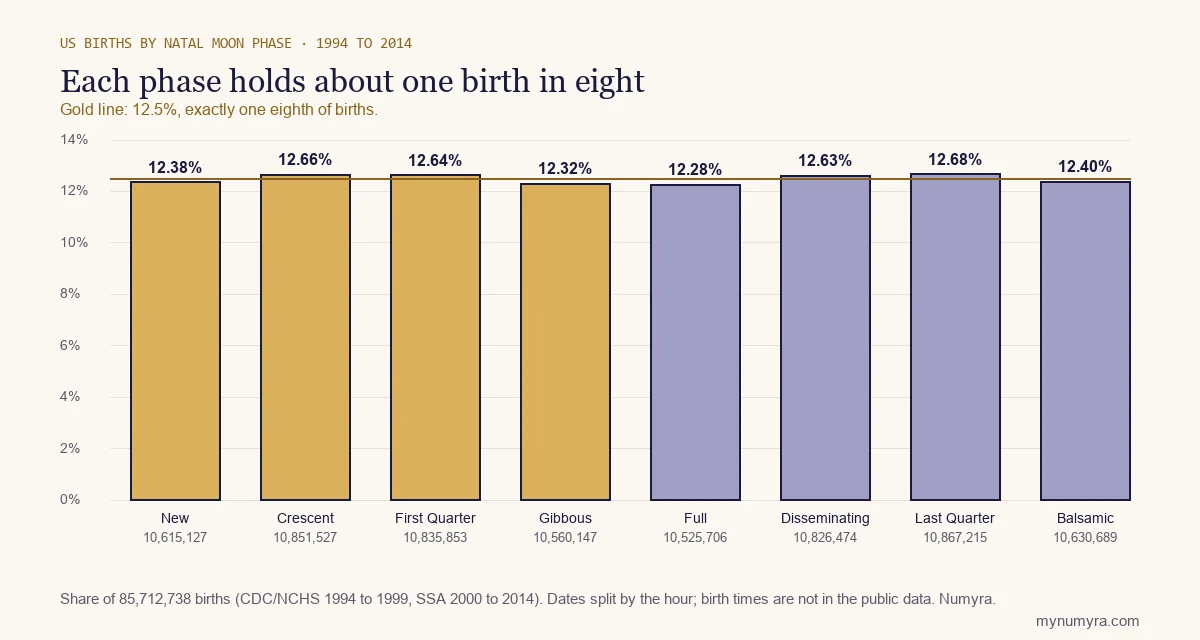
Every phase holds between 12.28% and 12.68% of births, against 12.5% if they were perfectly even. The share of births tracks the share of time almost exactly (within 0.05 percentage points), which means that no phase is rare because fewer babies arrive in it. Full and Gibbous are the two smallest simply because they are the two shortest, at 3.64 days on average. Any site that calls a phase “rare” is describing how long it lasts.
Are more babies born at the full moon?
Births are not even from day to day: they fall on weekends and holidays and shift with the season. To see whether the Moon adds anything, we compared each day with the same weekday in the four weeks before and after it, after setting aside 231 holiday-type days (December 24 to 26 and 31, January 1 and 2, July 3 to 5, Thanksgiving and the day after). That left 7,436 comparable days, whose births vary by about 4% around their normal level. We then averaged the gap for each phase, with a standard error from 5,000 random shifts of the phase calendar against the births.
The Full phase came out 0.15% below normal, plus or minus 0.13, which is about 17 fewer births on an average day of 11,175. The largest gap anywhere is the Disseminating phase at 0.21% below normal, 1.55 standard errors from zero. With eight phases tested, a gap that large turns up in 77% of the random shifts, so it means nothing. Taken together the eight results give a chi-squared statistic of 7.1, and 63% of the random shifts do at least as badly. The exact day of the full moon alone, as in our moon phases and mood guide, gives +0.33% (standard error 0.20, 252 days), consistent with the +0.41% reported there under a slightly different split of the two data files.
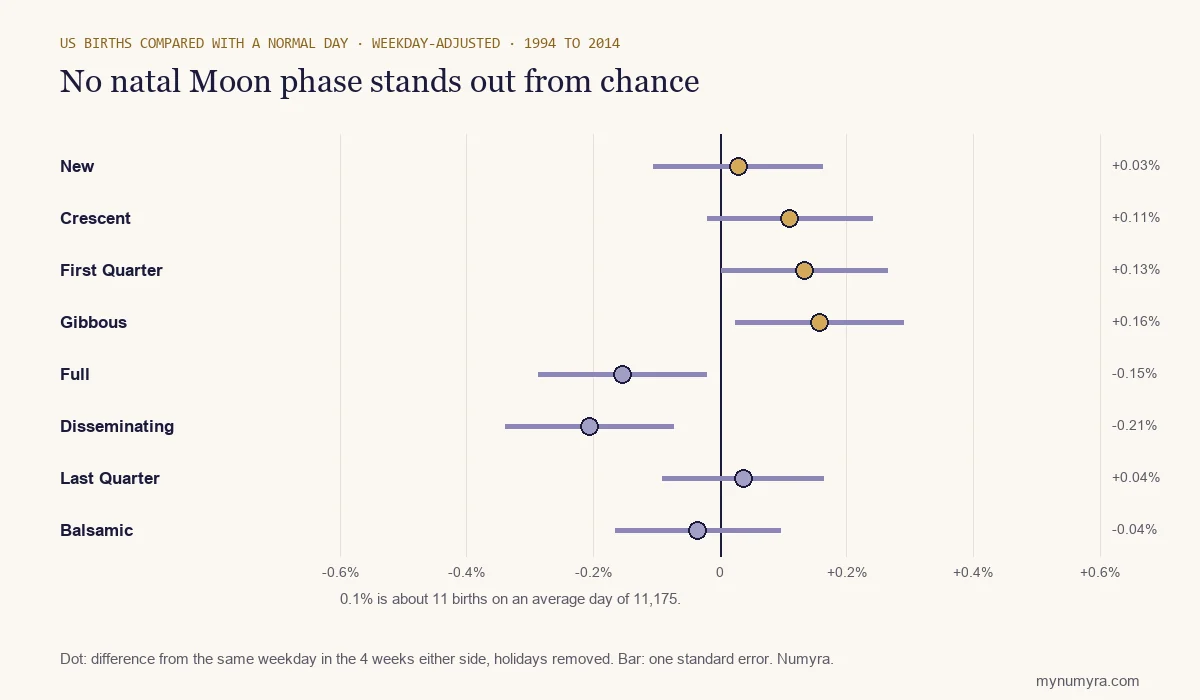
One result shows why a single cut of data can mislead. In the 1994 to 2003 CDC years alone, the Gibbous phase reads +0.39% (standard error 0.15), more than two and a half standard errors from zero. The 2000 to 2014 SSA years alone give +0.06% (0.18) for the same phase. A pattern that appears in one half and vanishes in the other is what chance looks like, and across the three splits we had made 24 phase comparisons, so one reading above two standard errors is expected.
Published studies agree. Arliss and colleagues analyzed 564,039 births in North Carolina from 1997 to 2001 and “found no significant differences” in the frequency of births across the eight phases of the moon, concluding that the data showed “no predictable influence of the lunar cycle on deliveries or complications” (American Journal of Obstetrics and Gynecology, 2005). A 2024 study of 13,349 spontaneous vaginal deliveries at one hospital in Udine, Italy, found no correlation between birth and the Moon phase, though more births happened when the Moon was above the horizon (BMC Pregnancy and Childbirth). An earlier review update of six more studies from five countries reported that none produced evidence consistent with folklore (Kelly and Martens, Psychological Reports, 1994). The limit of our own test is that public birth files carry no clock times, so we cannot test the Udine study’s question about the Moon’s position at the hour of birth.
What your birth Moon phase cannot tell you
The eight types are a framework for reflection, not a measurement of character. On 26 October 2026 we searched PubMed for studies of birth or natal lunar phase together with personality or temperament and found five papers; four were about births and obstetrics and one was about trauma admissions, and none tested Rudhyar’s types. That is a gap in the evidence, not proof either way, but it means every reading above rests on tradition and one author’s interpretation, best used as a symbolic lens for relationships. This is educational information, not medical or psychological advice, and the birth-timing statistics describe populations, not any single pregnancy; questions about labor belong with a care provider.
What the data does show is simple: your phase is a precise astronomical fact once you know your birth time, it is shared by about one person in eight, and it has no measurable link to when babies are born. To go further, follow your phase forward with the progressed Moon or the monthly lunar return.
Frequently asked questions
What is a birth Moon phase?
It is the angle from the Sun to the Moon, measured along the zodiac, at the moment you were born. Astrologers divide the 360-degree cycle into eight phases of 45 degrees: New, Crescent, First Quarter, Gibbous, Full, Disseminating, Last Quarter and Balsamic.
How do I find the Moon phase I was born under?
Find the Sun’s and Moon’s positions at your birth time, convert each to degrees from 0 Aries, subtract the Sun from the Moon (add 360 if negative) and divide by 45. The whole number is the phase, from 0 for New to 7 for Balsamic. The worked example above shows the arithmetic.
Is my birth Moon phase the same as my Moon sign?
No. The Moon sign is the zodiac sign the Moon was in, and it changes every two to three days. The phase depends on the Moon’s angle to the Sun and takes 29.53 days to cycle, so people with the same Moon sign can be born under any phase.
Do I need my birth time to know my birth Moon phase?
Not always. In our calculation for 1994 to 2014, 72.9% of dates fell wholly inside one phase, so the date is enough. On the other 27.1% a phase boundary fell during the day, and the birth time decides which of two neighboring phases applies.
What is the rarest birth Moon phase?
None is rare. Among 85.7 million US births from 1994 to 2014 each phase holds 12.28% to 12.68%. Full (12.28%) and Gibbous (12.32%) are smallest only because they are the shortest phases, at about 3.64 days each on average.
Are more babies born at the full moon?
Not in our data. After adjusting for the weekday and holidays, births in the Full phase were 0.15% below normal (plus or minus 0.13), about 17 births on an average day. A 2005 study of 564,039 North Carolina births also found no significant difference across the eight phases.
Why do other sites name the eight phases differently?
Rudhyar named each 45-degree slice after the phase point that starts it, so his First Quarter type runs from 90 to 135 degrees, when the Moon is 50% to 85% lit. Modern lists often keep the same slices but rename several, such as Waning Gibbous for Disseminating. Always check the degree ranges.
What does a Full Moon birth mean in astrology?
Rudhyar described the Full type (180 to 225 degrees) as marked by objectivity and clear consciousness through relationships, with fulfillment as the positive outcome and separation as the negative one. It is a tradition of interpretation, and we found no study testing it.
What is a lunation birthday?
It is Rudhyar’s name for the monthly moment when the Moon returns to the phase it had at your birth. That happens every 29.53 days on average, which is different from the 27.32-day lunar return to your Moon’s zodiac degree.
Sources
- Dane Rudhyar. The Lunation Cycle: A Key to the Understanding of Personality (Aurora Press, 1986; copyright 1967; first published as The Moon, The Cycles and Fortunes of Life), Internet Archive scan, chapter III. Quotations checked against the scanned text. San Diego State University Humanities Hub record of the 1946 edition.
- US Naval Observatory. Moon Phases data and its API: exact times of new, first quarter, full and last quarter moons used to check our calculations.
- Arliss JM, Kaplan EN, Galvin SL. The effect of the lunar cycle on frequency of births and birth complications. Am J Obstet Gynecol 2005;192:1462-4 (DOI 10.1016/j.ajog.2004.12.034).
- Londero AP et al. Exploring the mystical relationship between the Moon, Sun, and birth rate. BMC Pregnancy Childbirth 2024;24:454.
- Kelly IW, Martens R. Geophysical variables and behavior: LXXVIII. Lunar phase and birthrate: an update. Psychol Rep 1994;75:507-11.
- FiveThirtyEight. US births data, 1994 to 2014, from the CDC National Center for Health Statistics (1994 to 1999 used here) and the Social Security Administration (2000 to 2014). Dates only.
- Astrodienst. Swiss Ephemeris: Sun and Moon positions for every phase calculation (Moshier mode, calculated by the Numyra Methodology Desk).