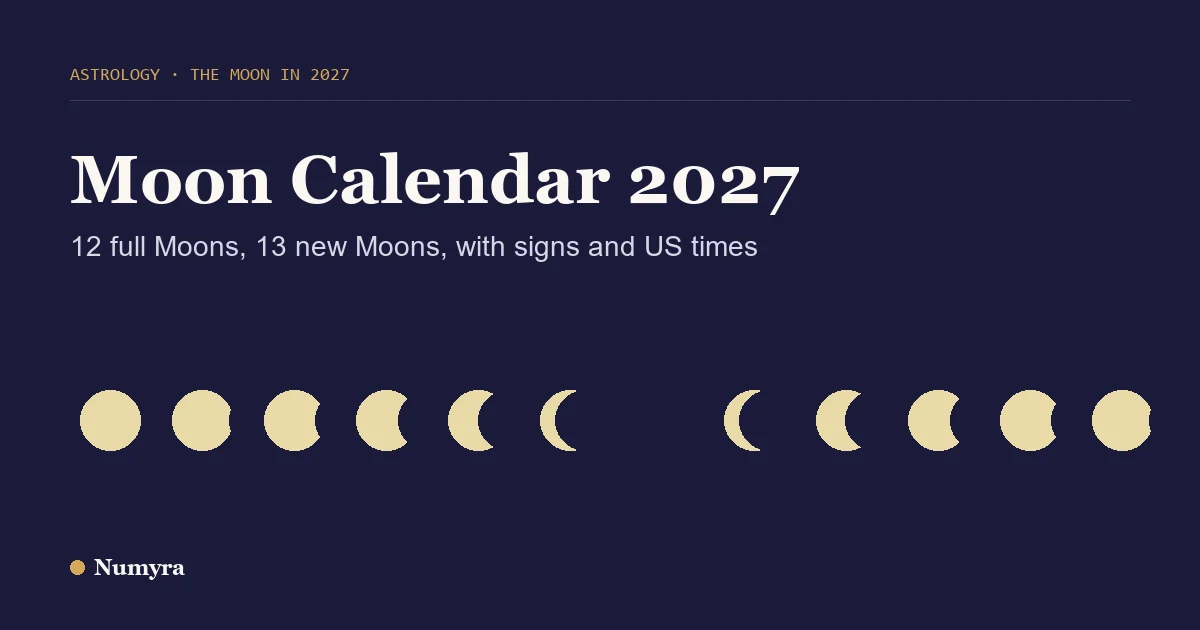
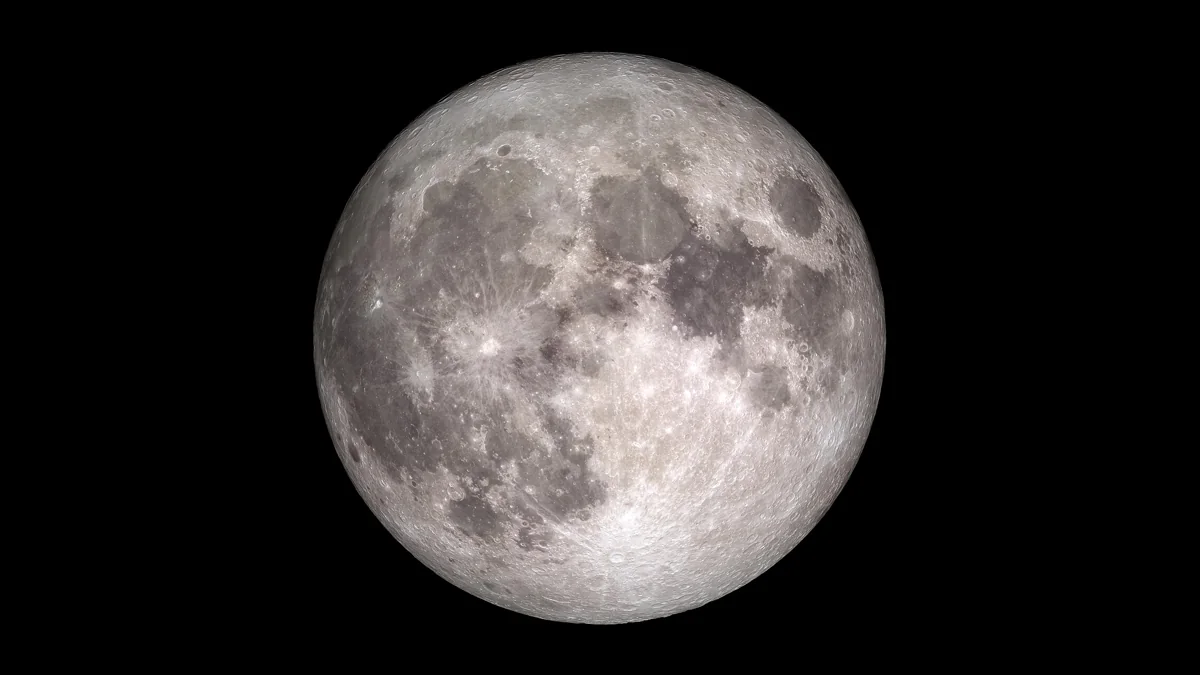
There are 12 full Moons and 13 new Moons in 2027. The first full Moon is the Wolf Moon on January 22 at 7:17 a.m. EST, in Leo, and the last is the Cold Moon on December 13, in Gemini; the year has no Blue Moon, and only one full Moon, January 22, is close enough to Earth to count as a supermoon.
Key takeaways
- Full Moons in 2027 (US Eastern dates): Jan 22, Feb 20, Mar 22, Apr 20, May 20, Jun 18, Jul 18, Aug 17, Sep 15, Oct 15, Nov 13 and Dec 13. New Moons: Jan 7, Feb 6, Mar 8, Apr 6, May 6, Jun 4, Jul 3, Aug 2, Aug 31, Sep 29, Oct 29, Nov 27 and Dec 27.
- The full Moon is always in the sign opposite the Sun. In 2027 it falls in every sign except Cancer, and in Scorpio twice (April 20 and May 20).
- Five of the 25 Moons are eclipses: the new Moons of February 6 (annular) and August 2 (total), and the penumbral full Moons of February 20, July 18 and August 17.
- Only the January 22 full Moon is a supermoon, at 357,644 km. The August 2 new Moon is even closer, at 357,384 km, one reason that eclipse has such long totality.
- Sites disagree on dates because some use Universal Time. Our times are US Eastern and Pacific. Moon readings are an astrological tradition, offered for reflection, not as prediction or advice.
In this guide
- Full Moon dates and times, 2027
- New Moon dates and times, 2027
- The traditional full Moon names
- Supermoons and micromoons
- Is there a Blue Moon in 2027?
- Which Moons are eclipses
- Which sign each Moon falls in
- How astrology reads the full and new Moon in each sign
- Why websites give different dates
- Frequently asked questions
Full Moon dates and times, 2027
Every time below was calculated with the Swiss Ephemeris, the reference behind professional astrology software, for the moment the Moon is exactly opposite the Sun. The distance is the Moon’s centre-to-centre distance from Earth at that moment, and the degree is the Moon’s position within its sign.
| Full Moon | US Eastern | US Pacific | Sign | Distance | Note |
|---|---|---|---|---|---|
| Jan 22 · Wolf Moon | Jan 22, 7:17 a.m. EST | Jan 22, 4:17 a.m. PST | 2.2° Leo | 357,644 km | Supermoon |
| Feb 20 · Snow Moon | Feb 20, 6:23 p.m. EST | Feb 20, 3:23 p.m. PST | 2.1° Virgo | 363,306 km | Penumbral lunar eclipse |
| Mar 22 · Worm Moon | Mar 22, 6:43 a.m. EDT | Mar 22, 3:43 a.m. PDT | 1.6° Libra | 372,527 km | — |
| Apr 20 · Pink Moon | Apr 20, 6:27 p.m. EDT | Apr 20, 3:27 p.m. PDT | 0.6° Scorpio | 383,429 km | — |
| May 20 · Flower Moon | May 20, 6:59 a.m. EDT | May 20, 3:59 a.m. PDT | 29.2° Scorpio | 393,902 km | — |
| Jun 18 · Strawberry Moon | Jun 18, 8:44 p.m. EDT | Jun 18, 5:44 p.m. PDT | 27.6° Sagittarius | 401,952 km | — |
| Jul 18 · Buck Moon | Jul 18, 11:44 a.m. EDT | Jul 18, 8:44 a.m. PDT | 25.8° Capricorn | 405,979 km | Penumbral lunar eclipse; Micromoon |
| Aug 17 · Sturgeon Moon | Aug 17, 3:28 a.m. EDT | Aug 17, 12:28 a.m. PDT | 24.2° Aquarius | 405,082 km | Penumbral lunar eclipse; Micromoon |
| Sep 15 · Harvest Moon | Sep 15, 7:03 p.m. EDT | Sep 15, 4:03 p.m. PDT | 22.9° Pisces | 399,355 km | Harvest Moon |
| Oct 15 · Hunter’s Moon | Oct 15, 9:46 a.m. EDT | Oct 15, 6:46 a.m. PDT | 22.0° Aries | 389,939 km | — |
| Nov 13 · Beaver Moon | Nov 13, 10:25 p.m. EST | Nov 13, 7:25 p.m. PST | 21.5° Taurus | 378,767 km | — |
| Dec 13 · Cold Moon | Dec 13, 11:08 a.m. EST | Dec 13, 8:08 a.m. PST | 21.4° Gemini | 368,142 km | — |
New Moon dates and times, 2027
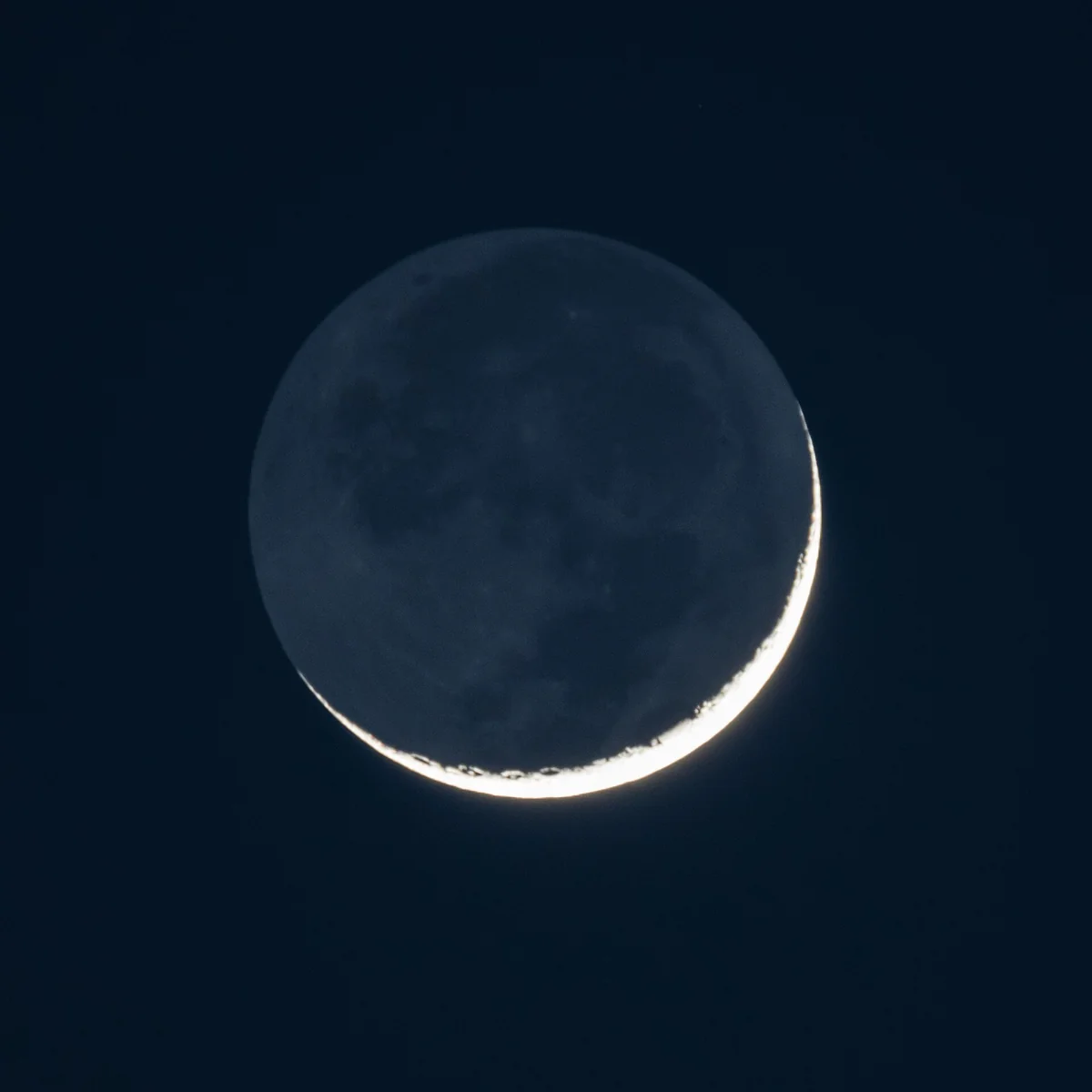
A new Moon is the moment the Moon is in the same direction as the Sun; astrologers read it as a time to begin things. There are 13 in 2027 because the synodic month, from new Moon to new Moon, is 29.53 days (NASA), so a 365-day year holds 12 and a bit.
| New Moon | US Eastern | US Pacific | Sign | Note |
|---|---|---|---|---|
| Jan 7 | Jan 7, 3:24 p.m. EST | Jan 7, 12:24 p.m. PST | 17.3° Capricorn | — |
| Feb 6 | Feb 6, 10:56 a.m. EST | Feb 6, 7:56 a.m. PST | 17.6° Aquarius | Annular solar eclipse |
| Mar 8 | Mar 8, 4:29 a.m. EST | Mar 8, 1:29 a.m. PST | 17.6° Pisces | — |
| Apr 6 | Apr 6, 7:51 p.m. EDT | Apr 6, 4:51 p.m. PDT | 17.0° Aries | — |
| May 6 | May 6, 6:58 a.m. EDT | May 6, 3:58 a.m. PDT | 15.7° Taurus | — |
| Jun 4 | Jun 4, 3:40 p.m. EDT | Jun 4, 12:40 p.m. PDT | 14.0° Gemini | — |
| Jul 3 | Jul 3, 11:02 p.m. EDT | Jul 3, 8:02 p.m. PDT | 12.0° Cancer | — |
| Aug 2 | Aug 2, 6:05 a.m. EDT | Aug 2, 3:05 a.m. PDT | 9.9° Leo | Total solar eclipse, closest new Moon of the year |
| Aug 31 | Aug 31, 1:41 p.m. EDT | Aug 31, 10:41 a.m. PDT | 8.1° Virgo | — |
| Sep 29 | Sep 29, 10:36 p.m. EDT | Sep 29, 7:36 p.m. PDT | 6.7° Libra | — |
| Oct 29 | Oct 29, 9:36 a.m. EDT | Oct 29, 6:36 a.m. PDT | 5.9° Scorpio | — |
| Nov 27 | Nov 27, 10:24 p.m. EST | Nov 27, 7:24 p.m. PST | 5.7° Sagittarius | — |
| Dec 27 | Dec 27, 3:12 p.m. EST | Dec 27, 12:12 p.m. PST | 5.8° Capricorn | — |
The traditional full Moon names
The full Moon names most calendars use come from folk tradition, many from Native American, colonial and European sources. According to the Old Farmer’s Almanac, the names are Wolf (January), Snow (February), Worm (March), Pink (April, for the wildflower moss pink), Flower (May), Strawberry (June), Buck (July), Sturgeon (August), Harvest or Corn (September), Hunter’s (October), Beaver (November) and Cold (December). Most are tied to the month, not to the Moon’s exact date, so the June full Moon of June 18 in the evening is the Strawberry Moon even though it is already June 19 in Universal Time. Only the Harvest Moon has a precise rule:
“the Full Moon that occurs closest to the September equinox.”
Old Farmer’s Almanac, Full Moon Names
In 2027 the September equinox is on September 23 at 06:02 UT. The nearest full Moon is September 15, 8 days before it, against October 15, 22 days after, so the Harvest Moon is September 15 and October 15 is the Hunter’s Moon. The names describe the season, not the Moon’s look or position.
Supermoons and micromoons
A supermoon is a full Moon that happens close to perigee, the Moon’s nearest point to Earth. There is no single official definition: a common one is a full Moon within about 90% of the way to perigee, which for 2027 means closer than about 361,500 km. We measured the distance at each full Moon; the Moon’s closest approach in 2027 is about 357,300 km and its farthest about 406,600 km.
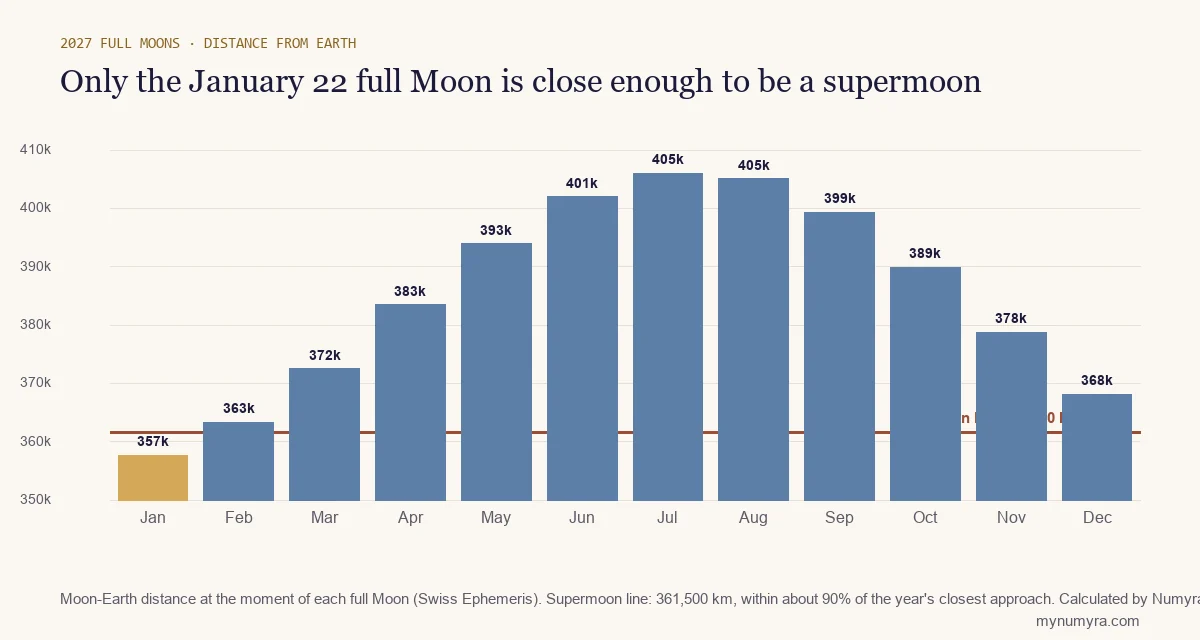
On that definition, 2027 has one supermoon: the January 22 Wolf Moon at 357,644 km. The February 20 Snow Moon, at 363,306 km, is just outside our line, and sources using a looser threshold may count it as a second. The farthest full Moons are the micromoons of July 18 (405,979 km) and August 17 (405,082 km), about 13% farther than the January supermoon, which makes the Moon look roughly 12% smaller across.
New Moons have their own perigee: the August 2 new Moon is at 357,384 km, within 0.1% of the year’s closest approach. A nearby Moon looks bigger in the sky, which is one reason the total solar eclipse that day lasts up to 6 minutes 23 seconds. Our 2027 eclipses guide has the full details.
Is there a Blue Moon in 2027?
No. The Old Farmer’s Almanac gives the usual definition: when a calendar month has two full Moons, “the second Full Moon is commonly called a Blue Moon.” Each month of 2027 has exactly one full Moon in US Eastern time, so there is none.
Which Moons are eclipses
An eclipse happens when a new or full Moon is also near one of the Moon’s nodes. Five of the 25 Moons of 2027 qualify: the February 6 new Moon (annular solar eclipse), the February 20 full Moon (penumbral lunar), the July 18 full Moon (penumbral lunar, magnitude 0.001, practically invisible), the August 2 new Moon (total solar) and the August 17 full Moon (penumbral lunar). Our guides to the North Node and the 2027 eclipses explain how the nodes work and what each eclipse looks like.
Which sign each Moon falls in
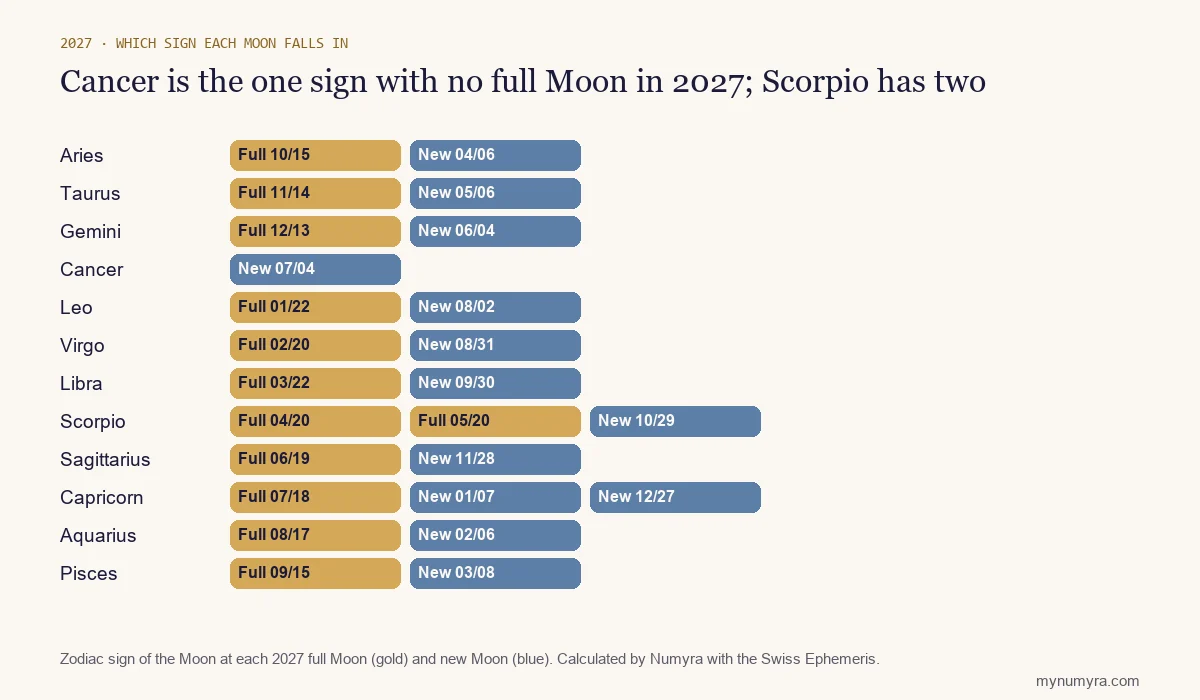
Because the full Moon is opposite the Sun, it falls in the sign opposite the Sun’s. In 2027 that gives Leo, Virgo, Libra, Scorpio (twice), Sagittarius, Capricorn, Aquarius, Pisces, Aries, Taurus and Gemini. Cancer gets no full Moon: a full Moon in Cancer needs the Sun in Capricorn, roughly December 22 to January 19, and no 2027 full Moon falls in those windows. The next one in Cancer is January 12, 2028. Scorpio gets two, April 20 at 0.6° and May 20 at 29.2°, almost the full width of the sign apart. New Moons fall in Capricorn twice (January 7 and December 27) and in every other sign once.
How astrology reads the full and new Moon in each sign
Astrologers read a new Moon as a seed moment and a full Moon as a culmination or release, coloured by the sign. These are traditional associations. They also depend on the house the Moon lands in for you; our Birth Chart calculator gives your rising sign, and our guide to the twelve houses explains what each house covers.
| Sign | New Moon there: beginning | Full Moon there: culmination |
|---|---|---|
| Aries | Starting something under your own steam | Impulses, anger or courage come to a head |
| Taurus | Planting money, comfort and habit goals | Security, possessions and the senses in focus |
| Gemini | New ideas, courses and conversations | Messages and plans reach a conclusion |
| Cancer | Home, family and emotional fresh starts | Feelings and family matters peak |
| Leo | Creative projects and self-expression | Recognition, pride and performance |
| Virgo | New routines, health habits and work systems | The results of effort and detail show |
| Libra | New partnerships and agreements | Relationships reach a balance point |
| Scorpio | Deeper commitments and honest conversations | Secrets, trust and shared resources surface |
| Sagittarius | Travel, study and new beliefs | Big-picture ideas peak or break down |
| Capricorn | Career goals and long-term plans | Ambitions meet their test |
| Aquarius | Friends, groups and reform ideas | Community and independence collide or align |
| Pisces | Rest, imagination and compassion | Dreams, endings and release |
For a longer look at what the Moon means in a birth chart, see our Moon sign profiles and our guide to Moon phases, which also covers what research found about the Moon and mood. The Moon changes sign every two to three days; the void-of-course Moon guide covers the stretch before each change, and the lunar return guide covers the monthly chart for your own Moon.
Why websites give different dates
A full Moon is a single instant, but it falls on different calendar dates in different places. Many calendars list Universal Time (UT), which is four to eight hours ahead of the US, so a full Moon late on one evening in America is already the next day in UT. In 2027 that moves the June and November full Moons and several new Moons: the June full Moon is at 00:44 UT on June 19 but 8:44 p.m. on June 18 in New York, and the November full Moon is at 03:25 UT on November 14 but 10:25 p.m. on November 13 in Eastern time. The tables use Eastern and Pacific time, with daylight saving time applied between March 14 and November 7, 2027. Because the times are calculated, they may differ from other sources by a minute or so.
Frequently asked questions
When is the next full Moon in 2027?
The full Moons of 2027 are January 22, February 20, March 22, April 20, May 20, June 18, July 18, August 17, September 15, October 15, November 13 and December 13 (US Eastern dates). Use the table above for the exact time and sign.
What date is the full Moon in March 2027?
March 22, 2027, at 6:43 a.m. EDT (3:43 a.m. PDT, 10:43 UT): the Worm Moon, at 1.6° Libra.
How many supermoons are there in 2027?
One by the common definition (a full Moon within about 90% of perigee, closer than about 361,500 km): the January 22 Wolf Moon at 357,644 km. The February 20 Snow Moon, at 363,306 km, is just outside it and counts only on looser definitions.
Is there a Blue Moon in 2027?
No. Every month of 2027 has exactly one full Moon in US time, so no month has a second one.
What is the Harvest Moon in 2027?
September 15, 2027. It is the full Moon closest to the September equinox, which falls on September 23; the October 15 full Moon is the Hunter’s Moon.
Are there lunar eclipses in 2027?
Yes, three, all penumbral: February 20, July 18 and August 17. They coincide with full Moons. There are also two solar eclipses, on the new Moons of February 6 and August 2.
Why is there no full Moon in Cancer in 2027?
A full Moon is opposite the Sun, so a full Moon in Cancer happens when the Sun is in Capricorn, about December 22 to January 19. No full Moon of 2027 falls in those windows; the next full Moon in Cancer is January 12, 2028.
What is going to happen to the Moon in 2027?
It goes through 12 full and 13 new phases, with one supermoon on January 22, two solar eclipses (an annular one on February 6 and a total one on August 2 with up to 6 minutes 23 seconds of totality) and three faint penumbral lunar eclipses.
Sources
- Astrodienst. Swiss Ephemeris. Every time, sign, degree and distance on this page (calculations by the Numyra Methodology Desk).
- Old Farmer’s Almanac. Full Moon Names, for the traditional names and the Harvest Moon and Blue Moon definitions.
- NASA. Moon Fact Sheet. Synodic period 29.53 days.
- NASA. Solar Eclipses 2021 to 2030, for the two 2027 solar eclipses.