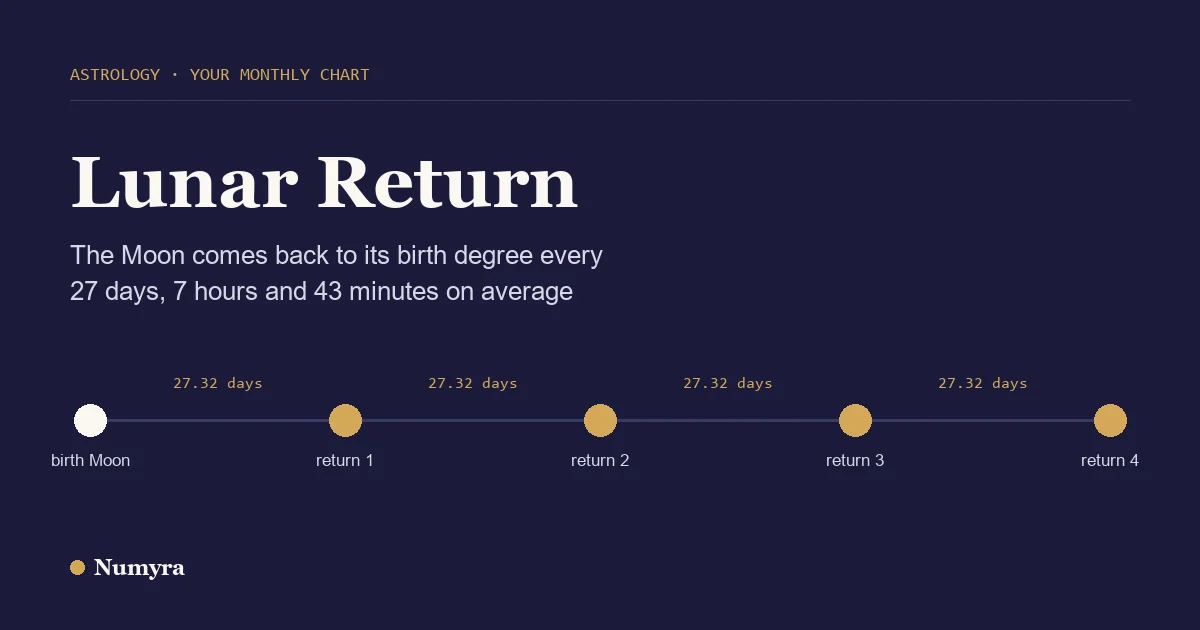
A lunar return is the moment the Moon comes back to the exact zodiac degree it held when you were born. It happens every 27 days, 7 hours and 43 minutes on average, never as little as 27 days 5 hours or as much as 27 days 12 hours, and astrologers cast a chart for that moment to read the emotional tone of the month ahead.
Key takeaways
- Your lunar return comes every 27.32 days, the time the Moon takes to go once around the zodiac. It is not the 29.5-day cycle from one new Moon to the next, which is why it does not land on the same Moon phase each month.
- Across 80,153 lunar returns from 1950 to 2050 that we calculated with the Swiss Ephemeris, the gap between two returns was never shorter than 27 days 5 hours or longer than 27 days 12 hours.
- In 65% of calendar years you get 13 lunar returns; in the other 35% you get 14.
- The rising sign of the return chart jumps about five signs from one month to the next, so most people see eight or more different rising signs in a year.
- Lunar return readings are an astrological tradition, offered for reflection, not as prediction or advice.
In this guide
- What a lunar return is
- How often a lunar return happens
- Why it is not the same as a full or new Moon
- How to find your lunar return
- Birthplace or where you live now?
- A year of lunar returns: a worked example
- How to read a lunar return chart
- The lunar return Ascendant by sign
- The return Moon by house
- Where monthly timing comes from
- Frequently asked questions
What a lunar return is
Your birth chart records where the Sun, Moon and planets were at the moment you were born. Each planet eventually comes back to its birth position, and astrologers call that moment a return. The Sun’s comes once a year, near your birthday, and is the basis of the solar return. Saturn’s comes about every 29 years, which is the famous Saturn return. The Moon is the fastest body in the sky, so its return comes round every month.
A chart cast for the exact minute of that return is your lunar return chart. In astrology the Moon stands for feelings, habits, home and the body’s daily rhythms, so the lunar return is read as a short-range snapshot: the mood, needs and domestic themes of the next four weeks, layered over your birth chart rather than replacing it. Where the solar return is read for the year, the lunar return is read for the month, and many astrologers use the two together. To get one you need your natal Moon’s exact degree, which our Birth Chart calculator gives you, and your Moon sign profile describes what the Moon in that sign is traditionally read as.
How often a lunar return happens
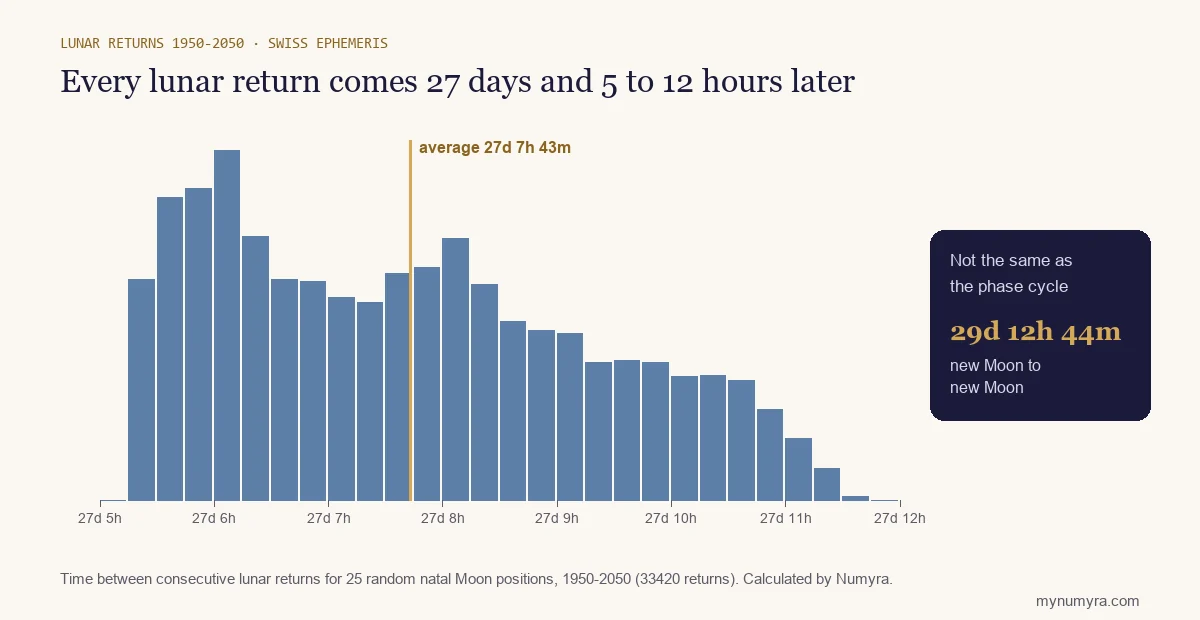
Most guides say “about every 28 days” or “roughly 27.5 days.” The real figure is more exact, and more regular, than either. NASA’s Moon fact sheet gives the Moon’s revolution period as 27.3217 days, and that is the average gap between lunar returns. We checked how much it varies by calculating every lunar return from 1950 to 2050 for 60 random natal Moon positions, 80,153 returns in all, with the Swiss Ephemeris, the reference behind professional astrology software:
| Measure | Time between two lunar returns |
|---|---|
| Average | 27 days 7 hours 43 minutes (27.3215 days) |
| Shortest | 27 days 5 hours 19 minutes |
| Longest | 27 days 11 hours 39 minutes |
| 90% of returns fall between | 27 days 5.5 hours and 27 days 10.6 hours |
| For comparison: new Moon to new Moon | 29 days 12 hours 44 minutes on average |
The Moon’s speed changes a lot within each orbit, from about 12° to 15° a day, but because a return covers one full lap, the fast and slow stretches mostly cancel out. That is why the gap stays inside a window of about six hours. In practice, if you know one lunar return, the next is 27 days and between 5 and 12 hours later, so on average it comes about seven and a half hours later on the clock each month.
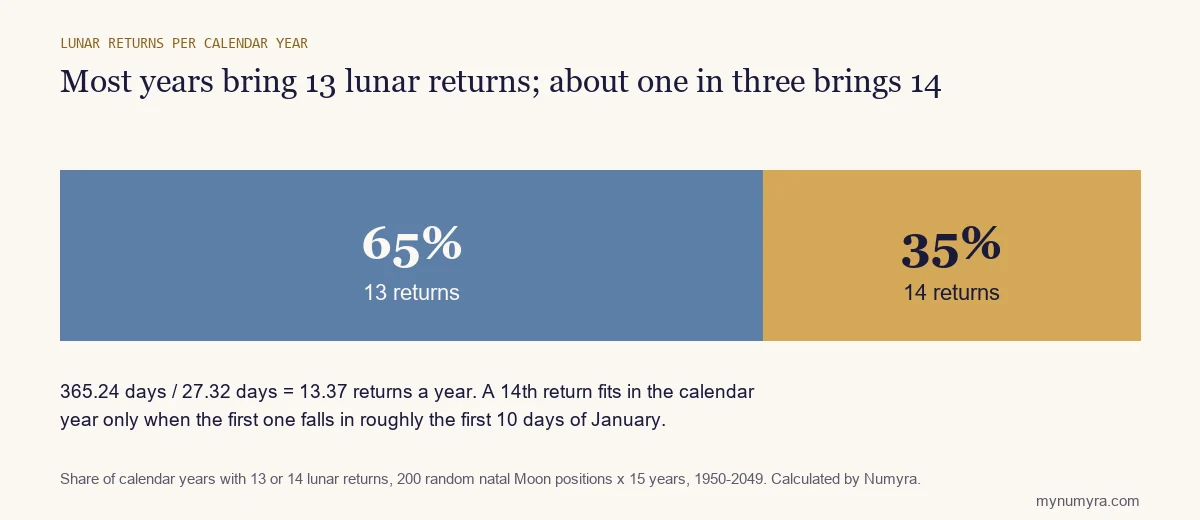
A year is 13.37 lunar months long, so you get either 13 or 14 lunar returns in any calendar year. A 14th fits only when the year’s first return falls in roughly the first ten days of January. Across 3,000 combinations of random natal Moons and years, 65% of years had 13 returns and 35% had 14.
Why it is not the same as a full or new Moon
The most common mix-up is to treat the lunar return as part of the lunar phase cycle. They are two different clocks. Your lunar return tracks the Moon against the zodiac: 27.32 days. The phases track the Moon against the Sun: 29.53 days, because the Sun has moved on by about 27° in the meantime and the Moon needs two more days to catch up.
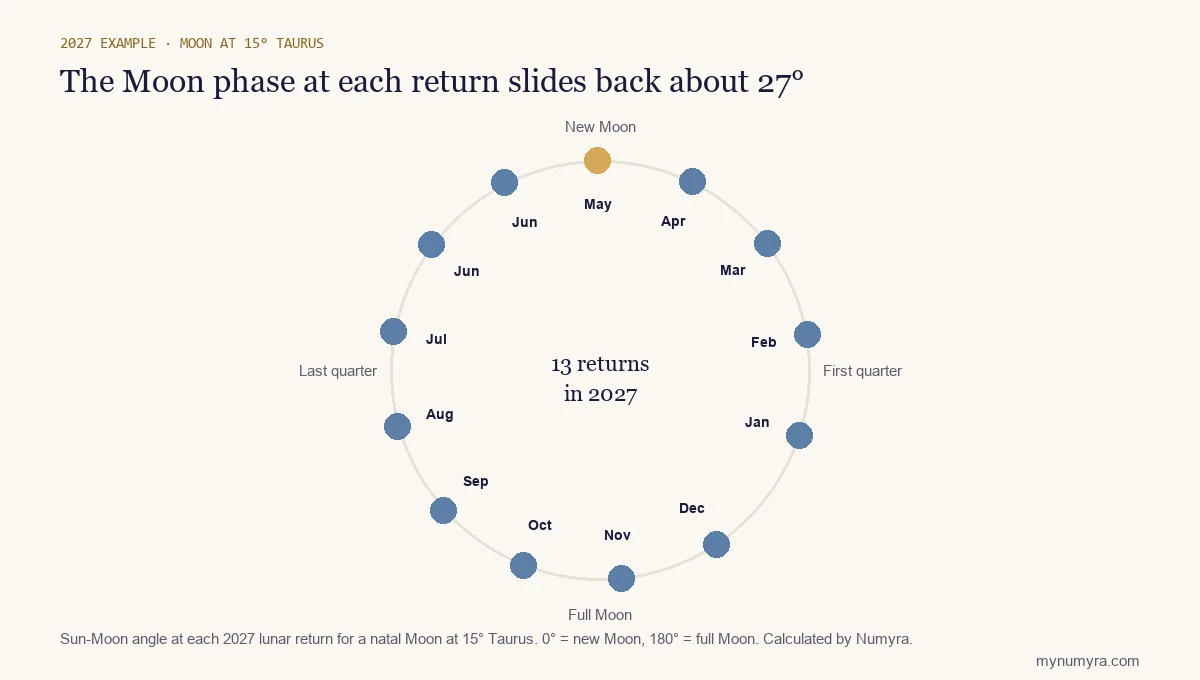
The result is that the Moon phase at your lunar return slides back by about 27° every month, a little over two days’ worth of phase. Over a year it visits every phase once. In our worked example below, the January return fell just past the first quarter, the May return almost exactly on the new Moon, and the November return almost exactly on the full Moon. A neat consequence: the lunar return closest to your birthday repeats the phase you were born under, because both the Sun and the Moon are back near their birth positions at the same time. If you were born under a full Moon, the lunar return nearest your birthday comes close to a full Moon too. Our guide to Moon phases covers how astrology reads each phase.
How to find your lunar return
- Get your natal Moon to the degree and minute. Enter your birth date, time and place in our Birth Chart calculator or the Stellium Calculator, which lists the degree of all ten bodies. The birth time matters a great deal here: the Moon moves about half a degree every hour, so a birth time that is an hour off moves every lunar return by about an hour.
- Find when the Moon next reaches that degree. A software ephemeris or a return calculator does this to the minute. By hand, look up the day the Moon enters your Moon sign in an ephemeris, then estimate the hour from its daily motion.
- Cast a chart for that exact moment for the place you choose (see the next section). The Moon will sit at your natal degree; everything else, including the Ascendant and the houses, will be new.
- Read it for the month until the next return.
One technical choice divides astrologers: whether to correct the return for precession, the slow drift of the equinoxes against the stars that our sidereal vs. tropical guide explains. A “precessed” lunar return uses a natal Moon moved forward by the precession since your birth, about 50 arcseconds a year. The difference is small but grows with age: for a 40-year-old the precessed return comes about an hour after the ordinary tropical one, enough to change the Ascendant. The worked example on this page uses the ordinary tropical return, as the guides we checked do.
Birthplace or where you live now?
The moment of a lunar return is the same everywhere on Earth; only the chart’s angles and houses change with location. The guides we checked, Llewellyn’s, Worts & Cunning’s and the AskNova calculator’s, all cast the chart for where you are living rather than for your birthplace, on the reasoning that the return describes the month you are actually living. AskNova goes further and tells users to set the chart for wherever they will spend most of the lunar month, which settles what to do when you travel.
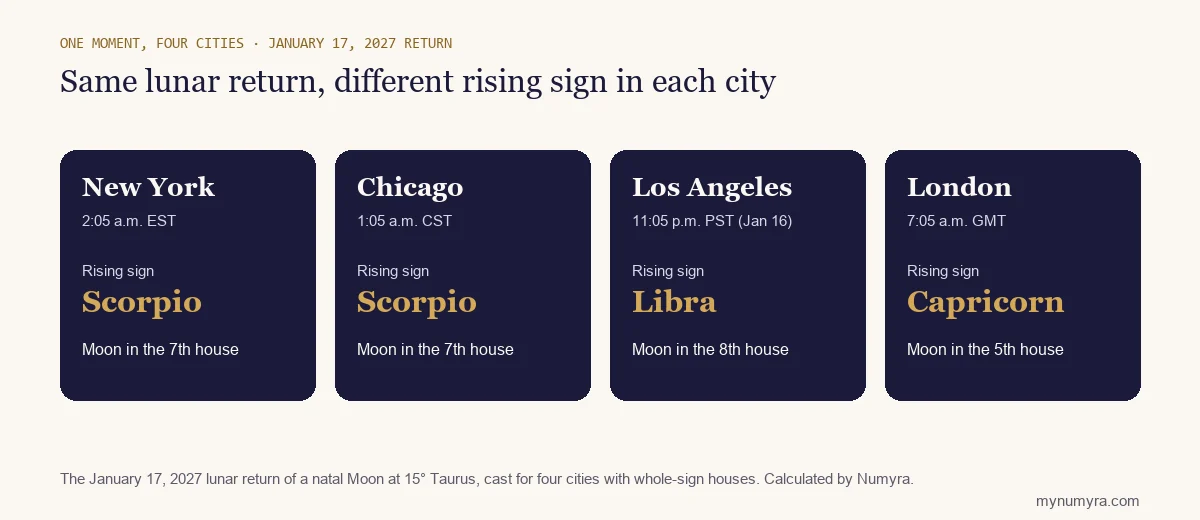
Because the Ascendant crosses a whole sign in roughly two hours, location makes a real difference. For the January 17, 2027 return in the worked example below, New York and Chicago both get Scorpio rising, but Los Angeles gets Libra and London gets Capricorn, which also moves the return Moon from the 7th house to the 8th or the 5th.
A year of lunar returns: a worked example
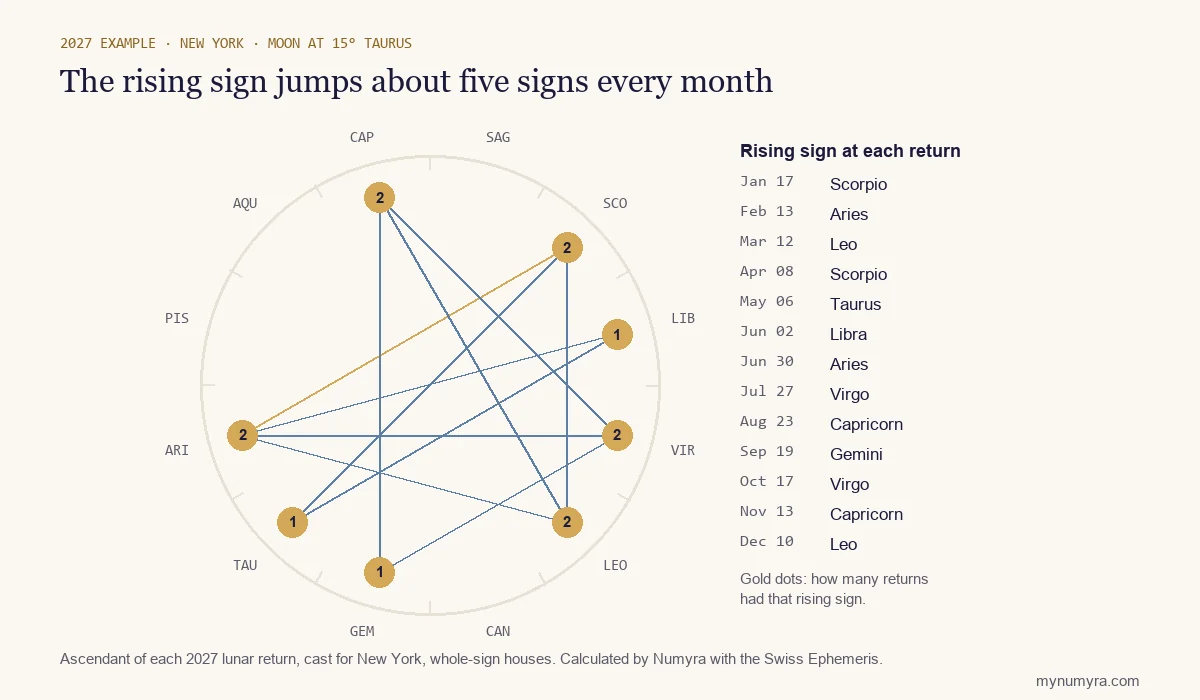
To show how this plays out, here are all 13 lunar returns in 2027 for a natal Moon at 15° Taurus, cast for New York, with whole-sign houses. The times are US Eastern; the Moon phase is the angle between the Sun and the Moon at the return.
| Lunar return (US Eastern) | Rising sign | Moon’s house | Moon phase at return |
|---|---|---|---|
| Jan 17, 2:05 a.m. EST | Scorpio | 7th | First quarter (108°) |
| Feb 13, 8:42 a.m. EST | Aries | 2nd | First quarter (80°) |
| Mar 12, 2:06 p.m. EST | Leo | 10th | Waxing crescent (53°) |
| Apr 8, 9:27 p.m. EDT | Scorpio | 7th | Waxing crescent (26°) |
| May 6, 5:46 a.m. EDT | Taurus | 1st | New Moon (359°) |
| Jun 2, 3:31 p.m. EDT | Libra | 8th | Waning crescent (333°) |
| Jun 30, 1:19 a.m. EDT | Aries | 2nd | Waning crescent (307°) |
| Jul 27, 9:47 a.m. EDT | Virgo | 9th | Last quarter (281°) |
| Aug 23, 4:22 p.m. EDT | Capricorn | 5th | Last quarter (254°) |
| Sep 19, 9:51 p.m. EDT | Gemini | 12th | Waning gibbous (228°) |
| Oct 17, 3:55 a.m. EDT | Virgo | 9th | Full Moon (201°) |
| Nov 13, 10:55 a.m. EST | Capricorn | 5th | Full Moon (174°) |
| Dec 10, 8:41 p.m. EST | Leo | 10th | Waxing gibbous (146°) |
Three things stand out. The rising sign jumps around rather than moving forward one sign a month: Scorpio, Aries, Leo, Scorpio again, then Taurus. That is because the sky turns about 142.7° on top of a whole number of days between returns, close to five signs, so the Ascendant leaps about five signs each time, more or less depending on latitude. Eight different rising signs appear in the 13 returns. The Moon’s house follows from the rising sign, so it jumps too, here between the 1st, 2nd, 5th, 7th, 8th, 9th, 10th and 12th houses. And the phase slides steadily backward, from just past the half Moon in January to the new Moon in May and the full Moon in November.
How to read a lunar return chart
The guides we checked agree on the order, and it mirrors how a solar return is read:

- The rising sign. The Ascendant of the return chart sets the tone of the month and how you are said to meet it. Llewellyn’s guide calls it the first thing to examine. Our profiles of the rising signs cover each one in depth.
- The house the Moon falls in. The Moon is always at your natal degree, so the variable is its house: the area of life said to carry the month’s emotional focus. Our guide to the twelve houses explains each one.
- Planets near the angles and aspects to the Moon. A planet close to the Ascendant, the Descendant, the Midheaven or the IC, or in a tight aspect to the return Moon, is read as a strong theme for the month.
- Repeating themes. A sign, house or planet that keeps turning up, in the return and in your current transits or solar return, is given more weight than any single factor.
A lunar return is read as weather, not climate: it is said to colour the month rather than decide it, and anything it shows is weighed against the longer cycles of the solar return and the slow planets.
The lunar return Ascendant by sign
| Return rising sign | Traditionally read as a month of |
|---|---|
| Aries | Energy and impatience: starting things, acting first, a shorter fuse |
| Taurus | Comfort and steadiness: money, food, the body, slowing down |
| Gemini | Busyness and talk: messages, errands, short trips, a restless mind |
| Cancer | Home and feeling: family, nesting, moods closer to the surface |
| Leo | Visibility: wanting to be seen, creativity, fun and pride |
| Virgo | Order and health: routines, work, fixing and improving |
| Libra | Other people: partners, balance, negotiation and social life |
| Scorpio | Intensity: privacy, trust, deeper feelings and shared resources |
| Sagittarius | Expansion: travel, learning, optimism and wider horizons |
| Capricorn | Responsibility: work goals, structure, a more serious mood |
| Aquarius | Independence: friends, groups, new ideas and some detachment |
| Pisces | Sensitivity: rest, imagination, softer boundaries and intuition |
The return Moon by house
| House of the return Moon | Where the month’s feelings are said to focus |
|---|---|
| 1st | Yourself: your body, mood and how you come across |
| 2nd | Money, possessions and what makes you feel secure |
| 3rd | Conversations, siblings, neighbours and everyday errands |
| 4th | Home, family and private life |
| 5th | Romance, children, play and creative work |
| 6th | Daily routine, work tasks and health habits |
| 7th | Partners and close one-to-one relationships |
| 8th | Intimacy, trust, shared money and debts |
| 9th | Travel, study, beliefs and the bigger picture |
| 10th | Career, reputation and public life |
| 11th | Friends, groups and hopes for the future |
| 12th | Rest, solitude and what happens behind the scenes; our 12th house guide covers this one in depth |
Where monthly timing comes from
Dividing life into months for prediction is old, but Ptolemy’s method was not a lunar return. In the 2nd century CE, he described monthly “time-lords” counted forward from the yearly ones, a sign at a time:
“We shall do the same thing for the months, setting out, again, the number of months from the month of birth, starting from the places that govern the year, twenty-eight days to a sign.”
Ptolemy, Tetrabiblos, Book IV, chapter 10, “Of the Division of Times,” trans. F. E. Robbins, Loeb Classical Library (1940), via LacusCurtius
That is a counting technique, now called monthly profections, not a chart of the Moon’s actual position. The lunar return chart works the other way round: it waits for the real Moon to reach its birth degree and casts a new chart for that minute, which in practice needs an accurate ephemeris. Calculating thirteen or fourteen of those a year by hand is laborious; today’s ephemeris software finds each one to the minute. Our guide to Ptolemy’s Tetrabiblos explains the rest of his timing system.
Frequently asked questions
What is a lunar return?
The moment the Moon returns to the exact zodiac degree it occupied at your birth (a different technique from the progressed Moon’s slower return at about age 27). Astrologers cast a chart for that moment and read it for the emotional themes of the following month, until the next return.
How often does a lunar return happen?
Every 27 days, 7 hours and 43 minutes on average. In our Swiss Ephemeris calculation of 80,153 returns from 1950 to 2050, the gap was never shorter than 27 days 5 hours or longer than 27 days 12 hours. That gives 13 lunar returns in most years and 14 in about a third of years.
How do I calculate my lunar return?
Find your natal Moon’s exact degree from a birth chart, then find the next moment the Moon reaches that degree using an ephemeris or a return calculator, and cast a chart for that moment and your current location. You need your birth time, because the Moon moves about half a degree an hour.
Should I use my birthplace or my current location?
The guides we checked use the place where you are living, or where you will spend most of the month. The time of the return is the same everywhere; the location only changes the rising sign and the houses.
Is my lunar return the same as a full Moon or new Moon?
No. The lunar return follows the Moon around the zodiac (27.32 days), while the phases follow the Moon against the Sun (29.53 days). The phase at your return slides back about 27° each month and passes through every phase over a year; the return nearest your birthday comes closest to your birth phase.
How long does a lunar return last?
It is read for the period until the next lunar return, about 27 days and 7 hours. The return itself is a single moment; the chart cast for it is used for the whole month that follows.
What should I look at first in a lunar return chart?
The rising sign, then the house the Moon falls in, then planets near the angles or in close aspect to the return Moon. Themes that repeat across these, or that echo your solar return, are given the most weight.
What is a precessed lunar return?
A version that corrects the natal Moon for precession, about 50 arcseconds a year. It comes slightly later than the ordinary tropical return, about an hour later for a 40-year-old, which can change the rising sign.
Sources
- NASA. Moon Fact Sheet. Revolution period 27.3217 days; synodic period 29.53 days.
- Astrodienst. Swiss Ephemeris. Used for every lunar return time, interval and example on this page (calculations by the Numyra Methodology Desk).
- Ptolemy, Tetrabiblos, trans. F. E. Robbins, Loeb Classical Library 435 (1940), Book IV, chapter 10, via LacusCurtius.
- Ghaneh, Isabelle. “How to Read a Lunar Return—Yours or Anyone’s.” Llewellyn Journal (2005). On reading the Ascendant first and casting for the current residence.