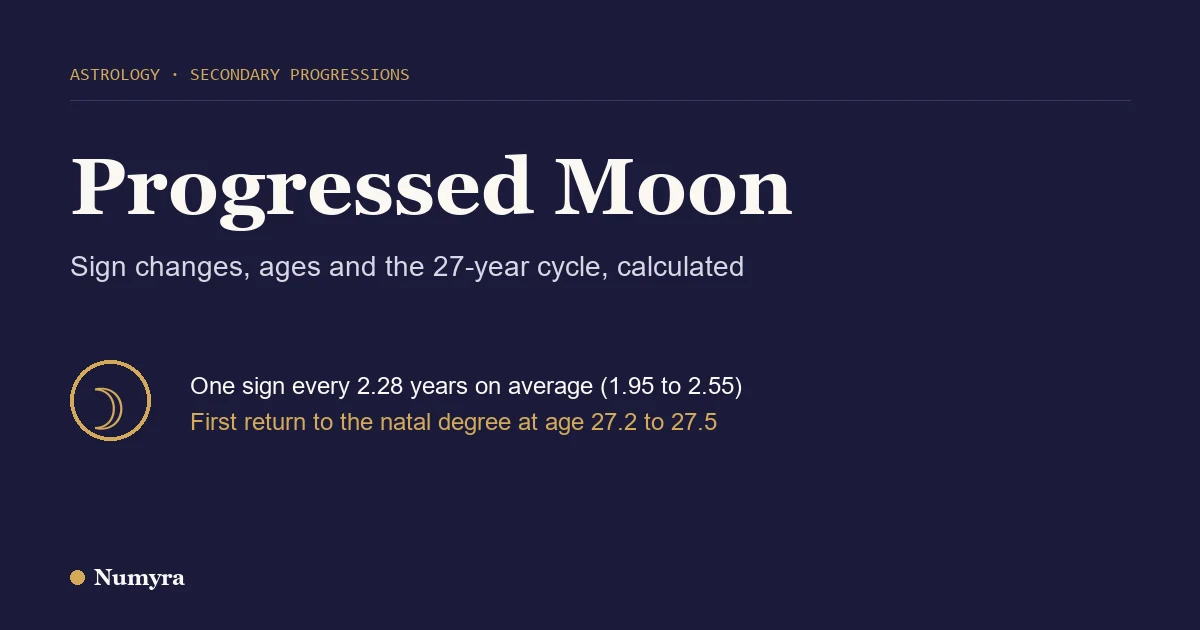
The progressed Moon is where the Moon stands in a chart advanced by secondary progression, the astrological method that counts one day after birth as one year of life. It moves about 13 degrees a year, so it changes sign every 2.28 years on average (we measured a range of 1.95 to 2.55), returns to its birth degree between ages 27.2 and 27.5, and completes a Sun-Moon phase cycle in 29.5 years. This guide gives the exact conventions, the ranges from our own calculations, a fully worked example, and what astrologers who use the technique say it means. Like all progression work, it is interpretation, not measurement, and nothing here predicts what will happen to you.
Key takeaways
- Progressing a chart means moving it forward one day per year of life. The progressed Moon at age 36.4 is the Moon as it stood 36.4 days after you were born, which is why it travels about 13.2 degrees per year.
- Across 13,808 passages of the Moon through a sign, the progressed Moon stayed 2.28 years on average, from 1.95 to 2.55. Only 15.7% of stays run longer than 2.5 years, so the commonly quoted “2.5 years” is the top of the range, not the middle.
- The first progressed lunar return, when the progressed Moon is back at its natal degree, falls between age 27.22 and 27.49 (mean 27.32). The second falls between 54.47 and 54.94. That is about two years before the Saturn return, not at it.
- The progressed New Moon cycle averages 29.53 years (29.28 to 29.83). Which age you meet your first progressed New Moon depends on the phase of the Moon you were born under: anywhere from age 0 to 29.7.
- Birth time matters more here than for most techniques: a 12-hour error moves the progressed Moon about 6.6 degrees, equal to six months of age, and puts it in a different sign for 21.9% of birth dates.
In this guide
- What the progressed Moon is and how it is calculated
- How fast it moves and how long it stays in each sign
- A worked example, with every sign change
- How to find your progressed Moon
- The progressed lunar return at age 27 and 54
- The progressed lunation cycle and the age-59 New Moon
- Why birth time matters so much
- What the tradition says, and where it comes from
- The US cohort born 1994 to 2014
- Frequently asked questions
What the progressed Moon is and how it is calculated
Secondary progression is a symbolic timing method: take the sky on the day after you were born, call it your chart for age one, take the sky two days after birth for age two, and so on. One day stands for one year. The progressed Moon is simply where the Moon is in that advanced chart. It is not a planetary movement you can see; it is a calendar substitution, which is why the Moon, the fastest body, becomes the fastest-moving indicator in the method. A detailed reference page on astrological progression gives the same definition, with the example of a person born April 2, 1982, whose chart for 2007 is read from the sky of April 27, 1982.
The conventions we used for every number on this page are these. Age is the time elapsed since birth divided by 365.2422 days, the length of the tropical year. The progressed date is the birth moment plus that many days, so a person aged 36.417 years is read from the sky 36.417 days (36 days and about 10 hours) after birth. Positions are geocentric, tropical zodiac, from the Swiss Ephemeris. Some programs divide by 365.25 instead; at age 36 that changes the progressed Moon by about 0.01 degree, which does not matter. What does matter is the birth moment, covered in the section on birth time.
The progressed Moon is not the same thing as a lunar return, which is the transiting Moon coming back to your natal degree every 27.3 days, and it is a different technique from a solar return. Progression uses the day-after-birth sky; returns use the sky at the moment a planet comes back to a natal position.
How fast it moves and how long it stays in each sign
The Moon moves between 11.76 and 15.39 degrees a day in the sky, with a mean of 13.18, which we measured from hourly positions for every hour from December 1929 to January 2016. Under day-for-a-year that becomes 13.18 degrees per year of life, a little over a degree a month. Popular reference pages round this: one widely read page gives a rate of about 12 degrees per year and a stay of about two and a half years per sign. The first figure is low, and the second is the longest end of the real range.
Because the Moon speeds up and slows down through its orbit, the progressed Moon does too, so its stay in a sign varies. We counted 13,808 passages of the Moon through a sign between 1930 and 2011 and read each one as years of progressed time.
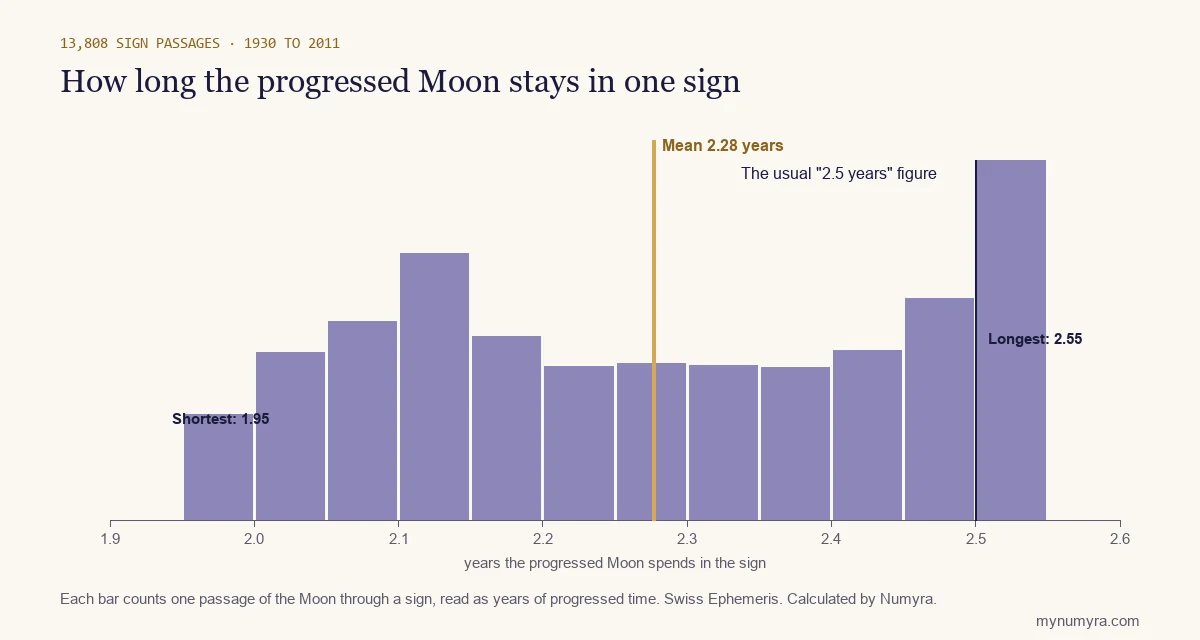
| Measure | Years in one sign |
|---|---|
| Shortest stay (Virgo) | 1.95 |
| Mean of all 13,808 stays | 2.28 |
| Longest stay (Sagittarius) | 2.55 |
| Stays between 2.0 and 2.5 years | 79.7% |
| Stays longer than 2.5 years | 15.7% |
| Mean by sign, lowest (Sagittarius and Scorpio) | 2.27 |
| Mean by sign, highest (Taurus) | 2.28 |
The sign you are in makes almost no difference: the mean stay ranges only from 2.27 to 2.28 years across the twelve signs. What changes the length of a stay is where the Moon is in its own cycle of speed, so the length of your progressed Moon’s stay in Taurus, say, depends on the exact dates in your progressed chart. Twelve signs at 2.28 years make a circuit of 27.3 years, which is also the Moon’s real sidereal month in days. That is the link to the lunar return, covered below.
The first sign change after birth is the exception: it depends on how far through its sign your natal Moon was. Across the 29,585 dates we sampled (every day from 1930 to 2010, assuming a noon UT birth), the first change came at anywhere from age 0 to 2.54, with a mean of 1.15, half the typical stay. A natal Moon at 29 degrees of a sign leaves it within months; one at 1 degree takes the best part of two and a half years.
A worked example, with every sign change
To make this concrete, take a person born May 15, 1990 at 8:30 a.m. EDT in New York (12:30 UT). Their natal Moon is at 27°25′ Capricorn, with 2°35′ left before the sign ends. On October 14, 2026 at noon Eastern they are 36.417 years old. The progressed date is 36.417 days after birth, June 20, 1990 at about 22:31 UT, and the Moon on that date was at 3°18′ Gemini. So today their progressed Moon is in Gemini, three degrees into the sign, having entered it on July 26, 2026 and due to leave for Cancer on July 24, 2028.
We checked this against an independent ephemeris, NASA’s JPL Horizons system. For the natal moment it gives the Moon at 297.4194° and ours is 297.4193°; for the progressed moment it gives 63.3056° and ours is 63.3054°. They agree to under 0.0005 degree, far finer than any astrological reading needs.
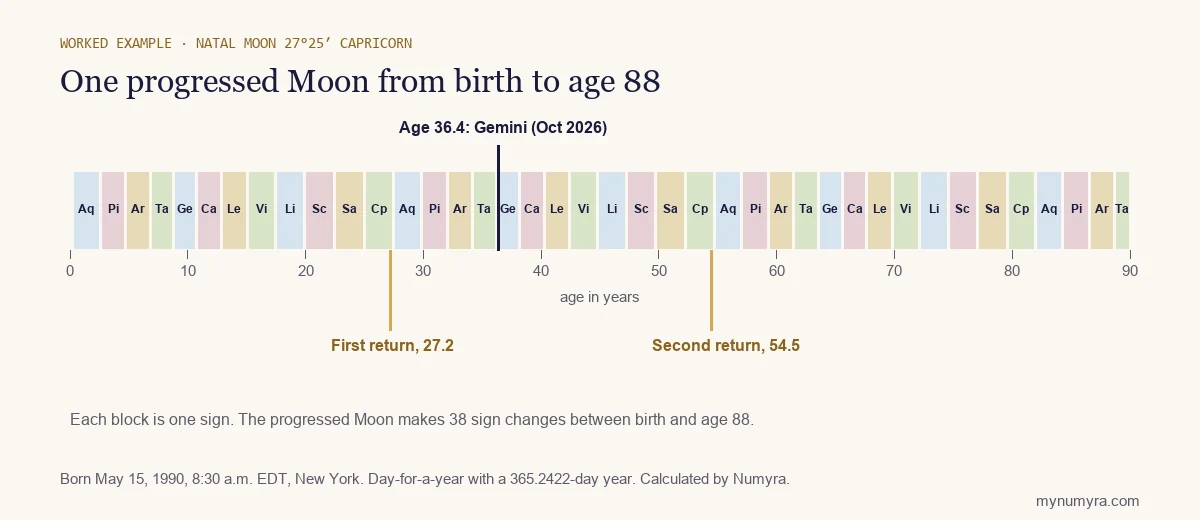
Here is the full run of sign changes for this birth, with the calendar date each one falls on (the date is the real-world date when the progressed Moon crosses the line, in US Eastern time).
| Progressed Moon enters | At age | On about |
|---|---|---|
| Aquarius | 0.21 | Jul 30, 1990 |
| Pisces | 2.56 | Dec 04, 1992 |
| Aries | 4.75 | Feb 13, 1995 |
| Taurus | 6.80 | Mar 02, 1997 |
| Gemini | 8.77 | Feb 20, 1999 |
| Cancer | 10.75 | Feb 13, 2001 |
| Leo | 12.83 | Mar 15, 2003 |
| Virgo | 15.07 | Jun 08, 2005 |
| Libra | 17.46 | Oct 30, 2007 |
| Scorpio | 19.95 | Apr 27, 2010 |
| Sagittarius | 22.48 | Nov 05, 2012 |
| Capricorn | 24.99 | May 10, 2015 |
| Aquarius | 27.44 | Oct 23, 2017 |
| Pisces | 29.81 | Mar 07, 2020 |
| Aries | 32.06 | Jun 05, 2022 |
| Taurus | 34.18 | Jul 17, 2024 |
| Gemini | 36.20 | Jul 26, 2026 |
| Cancer | 38.19 | Jul 24, 2028 |
| Leo | 40.25 | Aug 13, 2030 |
| Virgo | 42.42 | Oct 16, 2032 |
| Libra | 44.76 | Feb 17, 2035 |
| Scorpio | 47.23 | Aug 06, 2037 |
| Sagittarius | 49.75 | Feb 14, 2040 |
| Capricorn | 52.26 | Aug 16, 2042 |
| Aquarius | 54.69 | Jan 22, 2045 |
| Pisces | 57.04 | May 30, 2047 |
| Aries | 59.30 | Aug 30, 2049 |
Two things stand out in the table. The stays are not equal: in the first circuit the progressed Moon spent 1.97 years in Taurus and 2.53 in Scorpio, because its speed changes with where the real Moon is in its orbit, and the same shape repeats on every lap. And the sequence wraps: the progressed Moon reaches Capricorn again at age 24.99 and passes the natal degree, 27°25′, at age 27.24 on August 8, 2017. That moment is the first progressed lunar return.
How to find your progressed Moon
You can do it by hand with any daily ephemeris that lists the Moon’s position, or you can use software. The hand method is four steps.
- Work out your age in years to a decimal (days since birth divided by 365.2422).
- Add that number of days to your birth date and time. This is your progressed date, and it will be the date at some time of day, not a whole day.
- Look up the Moon’s longitude at that exact moment, which an ephemeris gives to the minute. Convert it to a sign: 0 to 30 degrees is Aries, 30 to 60 Taurus, and so on.
- Compare the progressed position with your natal Moon in a birth chart. The birth chart calculator gives you the natal Moon, and the guide to Sun, Moon and rising signs explains why the Moon is the sign most people underuse.
For the progressed New Moon, which is the age at which your progressed Moon has caught up with your progressed Sun, there is a shortcut: look up the real New Moon dates after your birth. The first real New Moon after you were born, counted in days, is your first progressed New Moon, counted in years: if it came 11 days after your birth, you meet it at age 11. Our own Moon calendar lists current dates, and a published table of past dates works for older births. The section on the progressed lunation cycle shows what to expect.
We have not built a progressed-Moon calculator on this site, since the tool has to handle birth time, time zone and daylight saving as carefully as the natal chart does. If you do want to find yours quickly, a calculator that takes a birth time and place and returns the progressed Moon’s sign, degree and next sign change is the sensible tool.
The progressed lunar return at age 27 and 54
The progressed Moon goes once around the zodiac in about 27.3 years, so it returns to the degree it held at birth. From our 29,585 dates:
| Return | Earliest age | Mean age | Latest age |
|---|---|---|---|
| First progressed lunar return | 27.22 | 27.32 | 27.49 |
| Second | 54.47 | 54.64 | 54.94 |
| Third | 81.74 | 81.96 | 82.35 |
The mean, 27.32 years, matches the Moon’s sidereal month of 27.32 days, which it must under day-for-a-year. Individual returns run from about one month early to two months late, because the Moon’s pace is not uniform. For the person in the example it came at 27.24, in August 2017. The natal sign makes no practical difference: the mean for each of the twelve signs rounds to 27.32.
Many astrologers describe the first progressed lunar return as the start of a new emotional chapter, and you will see it compared with the Saturn return. They are not at the same age. Saturn takes about 29.5 years to circle the zodiac, so the Saturn return (see our guide to the Saturn return and the Saturn return calculator) comes about two years after the progressed lunar return. The two are separate events.
The progressed lunation cycle and the age-59 New Moon
Besides the sign, astrologers read the progressed Moon’s angle to the progressed Sun, the way a real Moon phase is the angle between the Moon and the Sun. In progressed time the Moon moves about 12.2 degrees per year faster than the Sun, so the angle goes through a full 360 degrees in the length of a real synodic month, 29.53 days, which becomes 29.53 years. Across the same 29,585 dates the cycle between two progressed New Moons measured 29.53 years on average, 29.28 at the shortest and 29.83 at the longest. Each quarter lasts 7.38 years on average (6.58 to 8.23), and each of the eight named phases about 3.7 years.
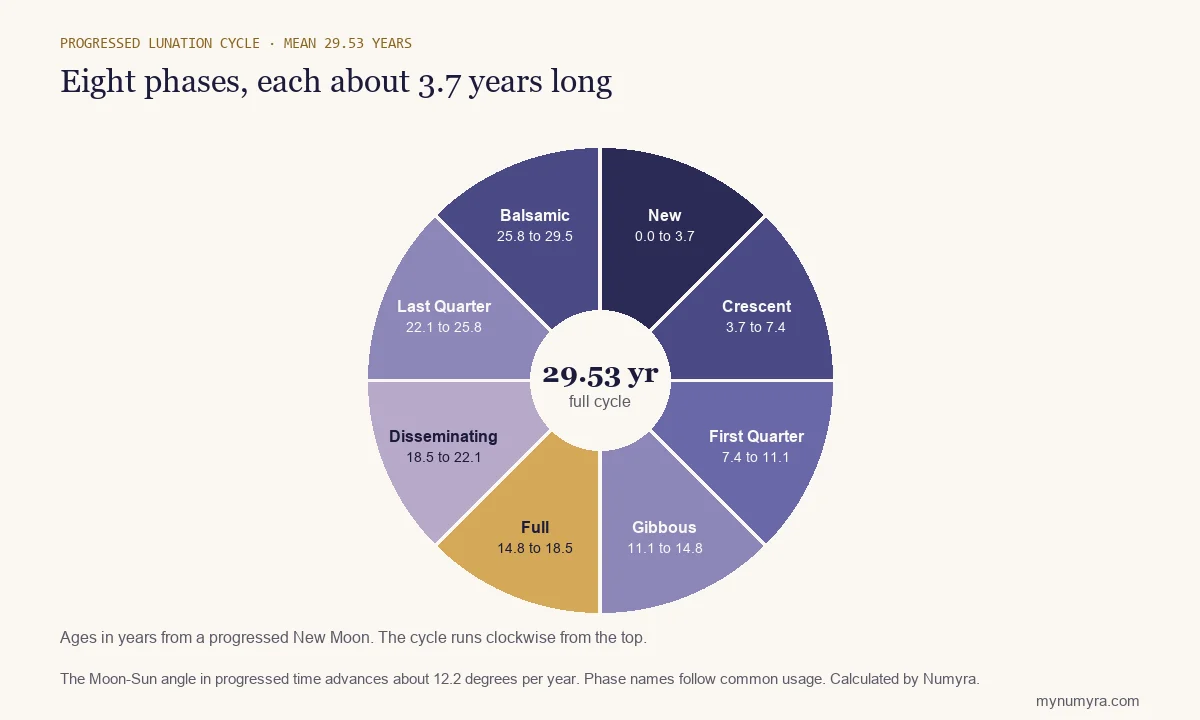
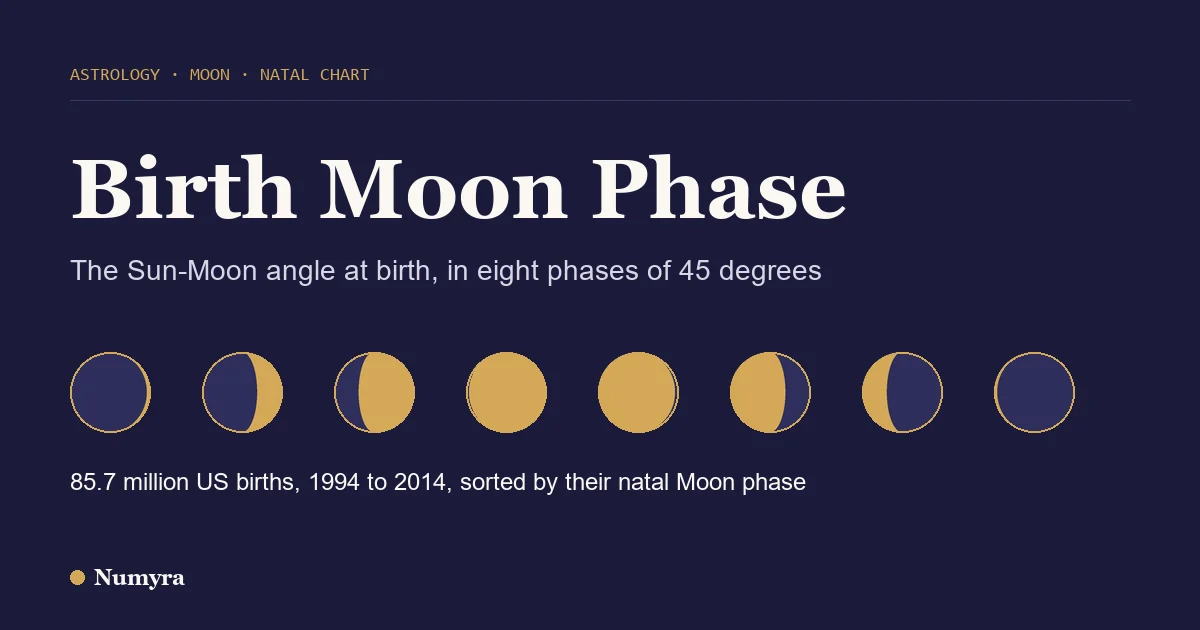
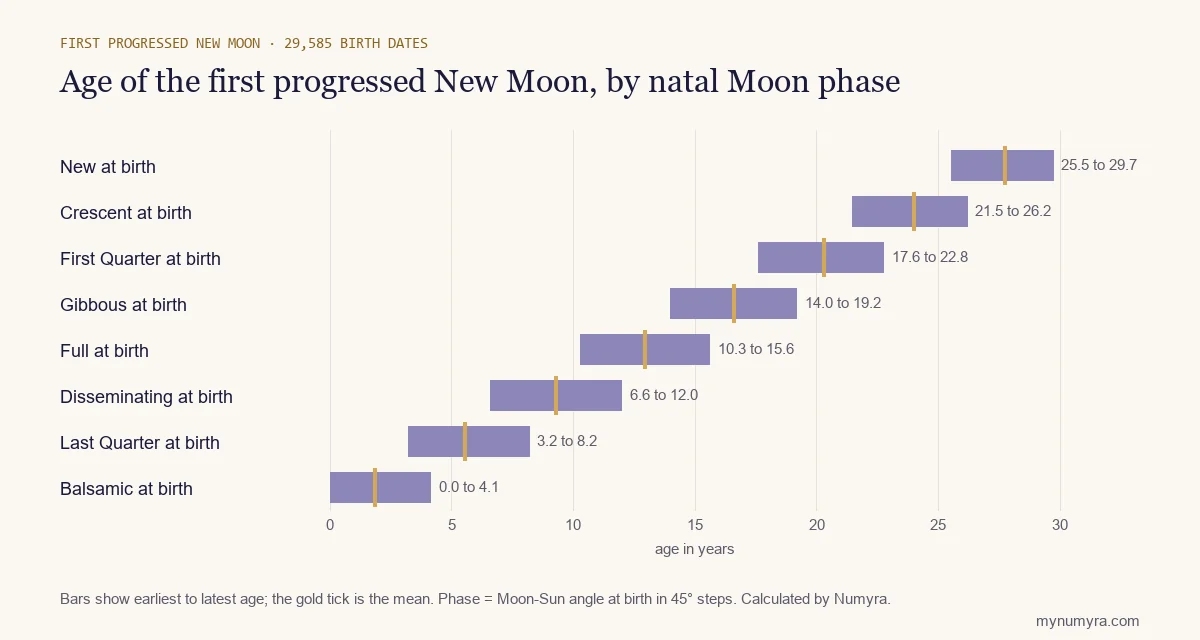
Where you start in the cycle depends on the Moon phase you were born under, the angle between the Sun and Moon at birth. If you were born on a New Moon, your first progressed New Moon is almost a full cycle away; if you were born just before a New Moon, you meet it in your first year of life. We grouped our dates by natal phase in 45-degree steps:
| Natal Moon phase | Earliest age of first progressed New Moon | Mean | Latest |
|---|---|---|---|
| New (0 to 45°) | 25.5 | 27.7 | 29.7 |
| Crescent (45 to 90°) | 21.5 | 24.0 | 26.2 |
| First Quarter (90 to 135°) | 17.6 | 20.3 | 22.8 |
| Gibbous (135 to 180°) | 14.0 | 16.6 | 19.2 |
| Full (180 to 225°) | 10.3 | 12.9 | 15.6 |
| Disseminating (225 to 270°) | 6.6 | 9.3 | 12.0 |
| Last Quarter (270 to 315°) | 3.2 | 5.5 | 8.2 |
| Balsamic (315 to 360°) | 0.0 | 1.8 | 4.1 |
This gives the answer to the “age 59” claim. The second progressed New Moon falls about one cycle after the first. For the 965 sampled birth dates where the natal Moon was within 12 degrees past the New Moon, the first progressed New Moon came at 28.5 to 29.7 (mean 29.06) and the second at 57.9 to 59.5 (mean 58.6). For births just before a New Moon, the first comes in the first year and the second at 29.3 to 30.9. So the second progressed New Moon lands at about age 59 for people born within a day or two after a New Moon, and not for everyone.
The example person was born with the Moon in the “Disseminating” phase, 243 degrees ahead of the Sun. Their first progressed New Moon came at age 9.0 (May 1999), the first quarter at 15.8, the full at 23.9, the last quarter at 31.7, and the second New Moon falls at age 38.3, in August 2028. As of October 2026 their progressed Moon is 334 degrees ahead of the progressed Sun, which puts it in the Balsamic phase, with about 1.9 years left before that New Moon. Astrologers describe this stage as inward and preparatory. Our guide to moon phases and mood explains how little the evidence supports effects of the real lunar phase on behavior, a caution that applies at least as strongly to the symbolic one here.
Why birth time matters so much
Birth time governs the progressed Moon more than almost any other chart factor, because the whole progressed chart is offset by the same amount. A 12-hour error moves the progressed epoch by half a day, and half a day of Moon motion is about 6.6 degrees (5.9 to 7.7 in our sample). Since one progressed day equals one year, the same error equals six months of life: the progressed Moon you think you have at 40.0 is the one you will really have at 40.5. The Moon moves 0.549 degree per hour on average, which is the figure to scale any smaller error by.
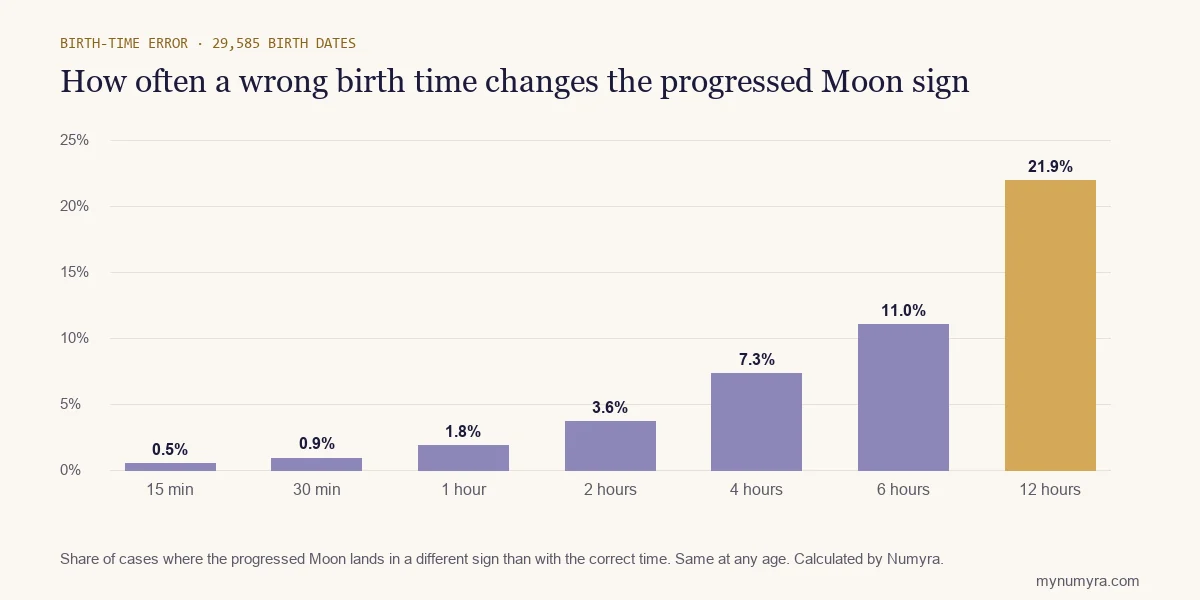
We tested how often an error changes the progressed Moon’s sign. The share did not depend on age; it depends only on the size of the error:
| Birth-time error | Progressed Moon in a different sign |
|---|---|
| 15 minutes | 0.5% |
| 1 hour | 1.8% |
| 2 hours | 3.6% |
| 6 hours | 11.0% |
| 12 hours | 21.9% |
In practice this means a birth time rounded to the nearest hour is fine for the sign and a time off by half a day is not, and that anyone reading a progressed Moon degree should know how reliable the birth time is. The Midheaven guide covers another chart point that depends on the birth time.
What the tradition says, and where it comes from
The idea that a short span of time can stand for a long one is old. Ptolemy’s Tetrabiblos, from the second century, describes a scheme of “chronocrators” in which time lords are counted forward from a starting place:
“We shall discover the general chronocrators, then, in the manner described, and the annual chronocrators by setting out from each of the prorogatory places, in the order of the signs, the number of years from birth, one year to each sign, and taking the ruler of the last sign. We shall do the same thing for the months, setting out, again, the number of months from the month of birth, starting from the places that govern the year, twenty-eight days to a sign”
Ptolemy, Tetrabiblos, Book IV, chapter 10, trans. F. E. Robbins (Loeb Classical Library, 1940), via LacusCurtius
That counts signs in years, months and days, not days of the real sky, so it is not secondary progression, and the page’s editor, Bill Thayer, notes that ancient astrology knew nothing of that method. The footnotes also record that some translators read “one year to each sign” as one year to each degree, which shows how disputed the passage is. On the history, the astrologer Chris Brennan summarises the standard account on his podcast:
“James Holden, in his book, thought that Johannes Kepler in the 16th or 17th century was the first astrologer to mention it or to really start talking about it.”
Chris Brennan, The Astrology Podcast, Ep. 144 transcript, 2018
In the same conversation Brennan adds that a brief passage in Vettius Valens may point to something similar much earlier, so the origin is not settled. What is clear is that the method became one of the most common timing techniques in modern astrology, and that the Moon is its main character.
What do astrologers who use it read from the progressed Moon? Working from the practice described on pages like the one by Bonnie Sorsby, the usual reading is that the sign sets the emotional tone of a two-year chapter and the house, which is the area of life the Moon is moving through, sets where it shows. Cafe Astrology adds that the signs alternate between outward and inward energy as the Moon passes through them. For the signs themselves, see our Moon sign meanings and our guide to the astrological houses. A house reading is more precise than it looks: with whole-sign houses the progressed Moon spends the same stretch in a house as in a sign, but with quadrant systems the stay in a house can be much shorter or longer than 2.3 years.
Nothing here has been tested and shown to predict events. Progression is a way to organize reflection on a life, the way a calendar of seasons is; treat the sign as a prompt and not a verdict.
The US cohort born 1994 to 2014
To see whether any progressed sign is rare, we applied the same method to every US birth date from 1994 to 2014 (85.4 million births, using the CDC series for 1994 to 2003 and the Social Security Administration series for 2004 to 2014, assuming a noon UT birth for each date) as of noon Eastern on October 14, 2026. Those people are now between 11.8 and 32.8 years old.
- Their progressed Moon signs are almost evenly spread: from 8.13% (Scorpio) to 8.56% (Taurus), against an even 8.33%. No sign is rare or dominant.
- The same is true of the progressed phase: each of the eight phases holds 12.3% to 12.7%.
- 25.1% have already had their first progressed lunar return (born before roughly mid-1999); 4.7%, about 4.0 million people, are within six months of it.
This is a distribution of a calendar rule, not of people’s lives, and the noon assumption means the counts for any one sign are approximate.
Frequently asked questions
What is the progressed Moon?
It is the Moon’s position in a chart advanced by secondary progression, where each day after birth stands for a year of life. At age 30, for example, it is the Moon as it stood 30 days after you were born. Astrologers read its sign, house and aspects as the emotional backdrop of a period.
How long does the progressed Moon stay in a sign?
2.28 years on average. In our count of 13,808 passages it ranged from 1.95 to 2.55 years, and 79.7% of stays were between 2.0 and 2.5 years. The often-quoted 2.5 years is near the top of that range.
How long does the progressed Moon take to go around the chart?
About 27.3 years. The first return to the natal degree comes between age 27.22 and 27.49, the second between 54.47 and 54.94, and the third between 81.74 and 82.35.
Is the progressed Moon the same as the Moon sign on my birth chart?
No. The natal Moon sign is fixed at birth. The progressed Moon starts at the natal position and moves on, changing sign about every 2.3 years; the two agree only at birth and at each progressed lunar return.
How do I find my progressed Moon?
Convert your age to days after birth (age times one day), add that to your birth date and time, then look up the Moon’s sign and degree at that moment in an ephemeris. A birth time is needed for an accurate answer, and a 12-hour error changes the sign for about one birth in five.
What is a progressed New Moon?
It is the point at which the progressed Moon conjoins the progressed Sun, starting a new progressed lunation cycle. The cycle averages 29.53 years. How soon you reach your first one depends on the Moon phase at your birth, from the first year of life to age 29.7.
Does the progressed lunar return happen at the same time as the Saturn return?
No. The first progressed lunar return is at about age 27.3 and the Saturn return at about 29.5, so they are around two years apart.
How much does an inaccurate birth time change the progressed Moon?
The Moon shifts about 0.55 degree per hour of error. Twelve hours moves it about 6.6 degrees, equal to six months of age, and puts it in a different sign for 21.9% of birth dates; a one-hour error does so for 1.8%.
Sources and method
- Original calculations by Numyra with the Swiss Ephemeris (pyswisseph, Moshier mode): hourly Moon and Sun longitudes, December 1929 to January 2016; 29,585 birth dates (every day from January 1, 1930 to December 31, 2010, at 12:00 UT); day-for-a-year with a 365.2422-day year; cross-checked at three epochs against NASA JPL Horizons.
- FiveThirtyEight. US births data, 1994 to 2014, from the CDC National Center for Health Statistics (1994 to 2003) and the Social Security Administration (2004 to 2014): 85.4 million births, dates only.
- Ptolemy, Tetrabiblos, Book IV, trans. F. E. Robbins (Loeb Classical Library, 1940), via LacusCurtius.
- The Astrology Podcast, Ep. 144, Secondary Progressions: Every Day Symbolizes A Year, Chris Brennan with Kelly Surtees.
- Wikipedia, Astrological progression.
- Cafe Astrology, The Secondary Progressed Moon Through the Signs.
Astrology is presented here as tradition and interpretation, not as a predictor of events. This is educational information, not professional advice.