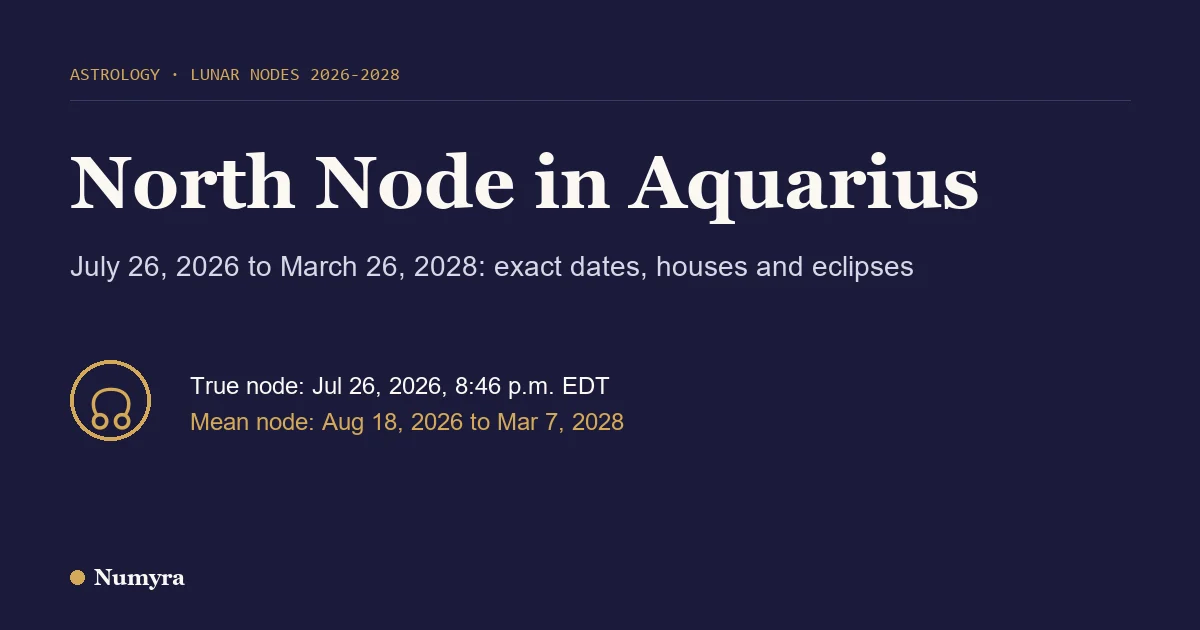
The North Node entered Aquarius on July 26, 2026 at 8:46 p.m. EDT (5:46 p.m. PDT) by the true node, the version most astrologers and calendars use, and stays there until March 26, 2028. The mean node, a smoothed average, runs from August 18, 2026 to March 7, 2028. The South Node moved into Leo at the same instant. As of October 14, 2026 the true North Node is at about 28°18′ Aquarius and moving backward through the sign, as the nodes always do on average.
Key takeaways
- True North Node in Aquarius: July 26, 2026 (8:46 p.m. EDT) to March 26, 2028, a stay of 609 days. Mean North Node: August 18, 2026 to March 7, 2028, 567 days. Sources that say July 27 are quoting the same instant in UT.
- The mean node takes 567 days (566.5, rounded) in every sign, but the true node’s stays between 1900 and 2100 range from 17.6 to 20.8 months, so the exact dates depend on which node you use.
- The North Node was last in Aquarius from December 2007 to August 2009 (true node) and returns in April 2045, an 18.6-year cycle that NASA puts at 6,793.48 days.
- The nodes move from the mutable Pisces-Virgo axis to the fixed Aquarius-Leo axis, and nine eclipses fall in the window before they leave in March 2028.
- Your house for the transit depends on your rising sign: Leo rising has the North Node in the 7th house and the South Node in the 1st, Aquarius rising the reverse (full table below).
In this guide
- The exact dates the North Node is in Aquarius
- True node or mean node: why dates differ
- How long the nodes stay and the 18.6-year cycle
- Past and future stays in Aquarius
- What the Aquarius-Leo axis traditionally means
- Which house the North Node falls in for you
- The planets the nodes meet in 2026 to 2028
- Eclipses on the Aquarius-Leo axis
- Born in 2007 to 2009: your nodal return
- Frequently asked questions
The exact dates the North Node is in Aquarius
The lunar nodes are the two points where the Moon’s orbit crosses the Sun’s path in the sky, which is why they are tied to eclipses; our guide to the North Node, its meaning and the difference between the North and South Node explains what they are. Because the nodes are calculated points, not objects, the entry is a moment in time, and it lands on different calendar days in different time zones. We calculated each one with the Swiss Ephemeris, the library behind most professional astrology software.
| Event | US Eastern | US Pacific | UT |
|---|---|---|---|
| True North Node enters Aquarius (South Node enters Leo) | Jul 26, 2026, 8:46 p.m. EDT | Jul 26, 2026, 5:46 p.m. PDT | Jul 27, 00:46 |
| Mean North Node enters Aquarius | Aug 18, 2026, 4:34 p.m. EDT | Aug 18, 2026, 1:34 p.m. PDT | Aug 18, 20:34 |
| Mean North Node enters Capricorn (South Node enters Cancer) | Mar 7, 2028, 5:08 a.m. EST | Mar 7, 2028, 2:08 a.m. PST | Mar 7, 10:08 |
| True North Node enters Capricorn (South Node enters Cancer) | Mar 26, 2028, 11:45 a.m. EDT | Mar 26, 2028, 8:45 a.m. PDT | Mar 26, 15:45 |
The true-node times agree with the published listing at Cafe Astrology, which gives 8:46 p.m. Eastern on July 26, 2026 and the same March 26, 2028 exit date. The current position agrees too: the live table at Astrodienst showed the true node at 28°23′ Aquarius on October 13, 2026, and our calculation gives 28°23′ for 23:00 UT that day.
True node or mean node: why dates differ
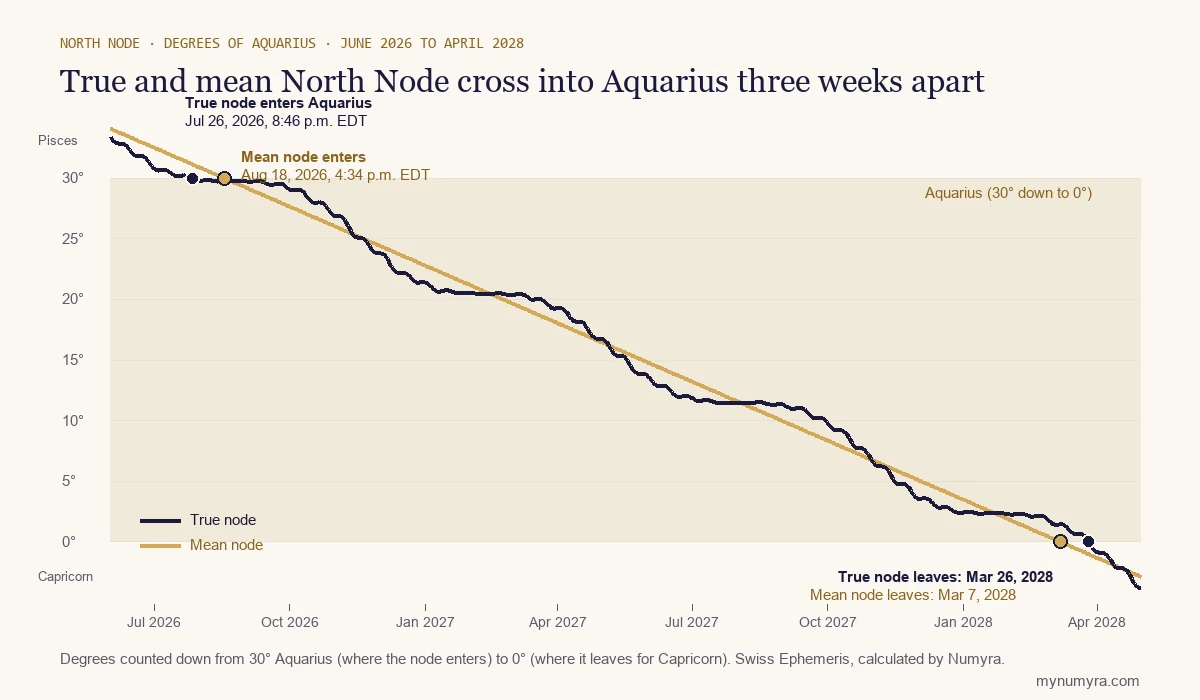
Search results disagree on the start by a day (July 26 or 27) and on the end by a day (March 26 or 27). Those are the same instant: 00:46 UT on July 27 is still the evening of July 26 in the United States, and 15:45 UT on March 26, 2028 is the same calendar day in most of the world. Time zones explain the one-day gaps. The three-week gap between July 26 and August 18 is different: it comes from using the true node instead of the mean node.
The mean node moves backward at a perfectly steady pace, about 0.053° a day. The true node follows the Moon’s actual, wobbling orbit, so it speeds up, slows down and sometimes moves forward for a while. Between June 1, 2026 and April 30, 2028 the true node moved forward on 181 of the 699 days, 26% of the time, which is why it entered Aquarius three weeks before the mean node and will leave about three weeks after it. Astrologers are split on which to use, and many software defaults and most published calendars use the true node, which is why this guide leads with those dates. Neither is more correct astronomically; they are two definitions of a point. The two can sit up to about 2° apart (1.98° at most between 1900 and 2100, by our calculation).
The wobble can even produce a double crossing. Around ten times between 1900 and 2100 the true node steps over a sign line, back, and over again; this happened when it first touched Aquarius on December 15, 2007 and settled in on December 18. In 2026 it crossed once and stayed.
As a check on the mean-node times we also computed them from the standard mean-longitude formula in Jean Meeus’s Astronomical Algorithms, which agrees with the Swiss Ephemeris to within about 70 minutes at the entry and about 2 hours at the exit. For 3.4% of US births from 1994 to 2014 (2.87 million people, calculated from CDC and Social Security Administration data), the mean and true North Node fall in different signs.
How long the nodes stay and the 18.6-year cycle
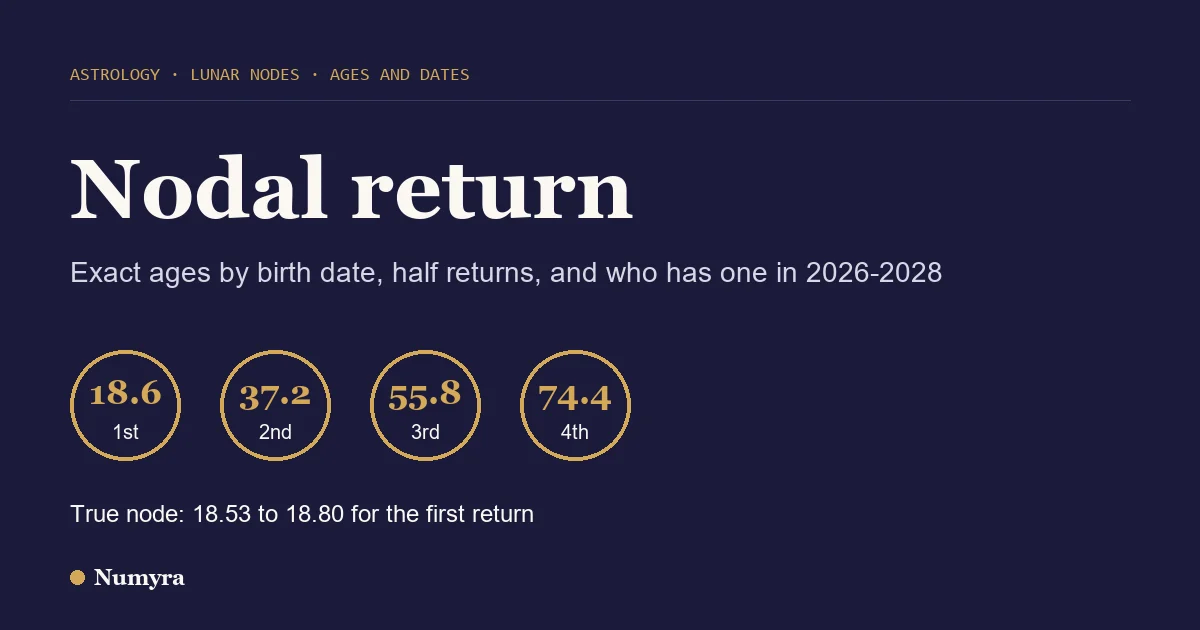
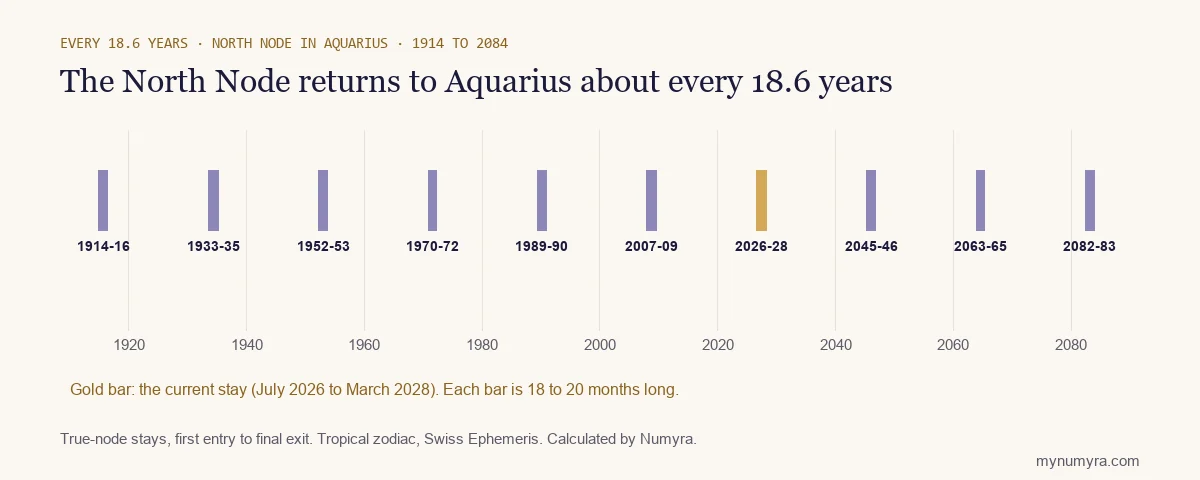
The nodes slide backward around the zodiac, the opposite direction to the planets’ usual motion, and complete one full circle in 18.6 years. NASA states the rate and the period in two separate places:
“the lunar nodes slowly regress westward by 19.3° per year.”
NASA Eclipse Web Site, Periodicity of Solar Eclipses
The same NASA Moon orbit page puts one complete rotation of the ascending node (the North Node) at 18.6 years, or 6,793.48 days. NASA’s figure is measured against the fixed stars. The tropical zodiac used in Western astrology drifts slightly against them, so one lap of the mean node around the tropical signs takes about 6,798 days (18.61 years), by our calculation. Divided by twelve signs, that is 566.5 days, about 18.6 months, per sign, and the mean node takes exactly that in all 128 complete stays we calculated between 1900 and 2100. The true node varies: its complete stays in a sign range from 535 days (17.6 months, Aquarius in 2063) to 633 days (20.8 months, Virgo in 1997), averaging 566 days. This stay, 609 days or 20 months by the true node, is one of the longer ones.
Past and future stays in Aquarius
Every stay of the North Node in Aquarius from 1914 to 2084, from first entry to final exit, is in the table. The 2007 to 2009 row is the last time; the next is 2045.
| Stay | True node: enters | True node: leaves | Mean node: enters | Mean node: leaves |
|---|---|---|---|---|
| 1914 to 1916 | Dec 3, 1914 | May 31, 1916 | Dec 14, 1914 | Jul 3, 1916 |
| 1933 to 1935 | Jun 24, 1933 | Mar 8, 1935 | Jul 25, 1933 | Feb 12, 1935 |
| 1952 to 1953 | Mar 28, 1952 | Oct 9, 1953 | Mar 6, 1952 | Sep 23, 1953 |
| 1970 to 1972 | Nov 2, 1970 | Apr 27, 1972 | Oct 16, 1970 | May 5, 1972 |
| 1989 to 1990 | May 22, 1989 | Nov 18, 1990 | May 28, 1989 | Dec 15, 1990 |
| 2007 to 2009 | Dec 18, 2007 | Aug 21, 2009 | Jan 7, 2008 | Jul 27, 2009 |
| 2026 to 2028 | Jul 27, 2026 | Mar 26, 2028 | Aug 18, 2026 | Mar 7, 2028 |
| 2045 to 2046 | Apr 18, 2045 | Oct 18, 2046 | Mar 30, 2045 | Oct 17, 2046 |
| 2063 to 2065 | Nov 18, 2063 | May 6, 2065 | Nov 9, 2063 | May 29, 2065 |
| 2082 to 2084 | Jun 7, 2082 | Dec 8, 2083 | Jun 21, 2082 | Jan 8, 2084 |
All dates are in UT, so a time near midnight can fall a day earlier in the United States. The South Node is always in the opposite sign, so each of these stays is also a stay of the South Node in Leo. Astrologers often link each Aquarius-Leo swing to the cultural mood of its era. That is an interpretation we can not test, so we list the dates and leave the history to you. If you want to find your own placement, the table in the North Node guide lists every sign by birth date.
What the Aquarius-Leo axis traditionally means
Aquarius is the eleventh sign, an air sign in the fixed mode, traditionally ruled by Saturn and, in modern astrology, by Uranus; Leo is the fifth, a fire sign, also fixed, ruled by the Sun. The two are exact opposites, 180° apart. Read together, astrologers describe the axis as individual expression and recognition (Leo) against shared causes, friendship and ideals (Aquarius). The usual modern line is that the South Node in Leo shows what comes naturally, such as the pull toward performing, leading and being admired, and the North Node in Aquarius shows the growth direction: contributing to a group on equal terms, thinking independently, building communities and trying new ideas. You will see the same shorthand in the Aquarius and Leo sign profiles.
Two things are worth knowing about that reading. First, it is a modern layer: for most of astrology’s history the nodes were simply the Dragon’s Head and Tail, and neither was a life lesson. William Lilly, in the 1647 textbook Christian Astrology, calls the Head a fortune but admits that the traditional view of the Tail was not something he could fully explain, and reports from his own practice that when the Tail was joined with a malefic planet the harm was:
“doubled and trebled, or extreamly augmented”
William Lilly, Christian Astrology (London, 1647), Book 1, p. 83, spelling as printed
The “karmic” framing popular today came much later; our North Node guide traces where the karmic reading came from. Second, none of it is a forecast. Nothing in the sky has been shown to cause events or character traits, and astrologers disagree about how much weight the nodes deserve. Treat the Aquarius-Leo reading as a prompt for reflection about community, ego and recognition, not a prediction. The sign rulers also matter to the tradition: for how Saturn, the Sun and the other planets are scored in each sign, see essential dignities.
Which house the North Node falls in for you
The house shows the area of life astrologers associate with the transit. It depends on your rising sign (ascendant), not your Sun sign, and this table uses whole-sign houses, where each sign is one house counted from your rising sign. If you do not know your rising sign, the birth chart calculator works it out from your birth time and place, and our guide to the Sun, Moon and rising sign explains the difference. The South Node is always in the house opposite.
| Rising sign | North Node (Aquarius) in the | South Node (Leo) in the |
|---|---|---|
| Aries | 11th house: friends, groups, hopes | 5th house: creativity, romance, children, play |
| Taurus | 10th house: career and public standing | 4th house: home, family, roots |
| Gemini | 9th house: travel, study, belief | 3rd house: communication, siblings, short trips |
| Cancer | 8th house: shared money, debts, deep change | 2nd house: money, possessions, values |
| Leo | 7th house: partnerships and close one-to-one relationships | 1st house: self, body, how you present yourself |
| Virgo | 6th house: work routines, health habits, service | 12th house: rest, retreat, the hidden |
| Libra | 5th house: creativity, romance, children, play | 11th house: friends, groups, hopes |
| Scorpio | 4th house: home, family, roots | 10th house: career and public standing |
| Sagittarius | 3rd house: communication, siblings, short trips | 9th house: travel, study, belief |
| Capricorn | 2nd house: money, possessions, values | 8th house: shared money, debts, deep change |
| Aquarius | 1st house: self, body, how you present yourself | 7th house: partnerships and close one-to-one relationships |
| Pisces | 12th house: rest, retreat, the hidden | 6th house: work routines, health habits, service |
The two rising signs that get the strongest personal emphasis are the ones where the axis sits on the 1st and 7th houses: Leo rising has the South Node on the self and the North Node on partnerships, and Aquarius rising the reverse. Astrologers read houses as themes, not as forecasts, and what a transit means for one person is a matter of interpretation.
The planets the nodes meet in 2026 to 2028
While the true North Node is in Aquarius it makes seven exact aspects to the slow planets. Because the South Node is opposite the North Node, a planet opposite the North Node is conjunct the South Node, so Jupiter’s three oppositions are also its three conjunctions with the South Node in Leo. All times are US Eastern.
| US Eastern | Aspect to the True North Node | Position |
|---|---|---|
| Nov 12, 2026, 12:26 a.m. EST | Jupiter opposite (conjunct South Node), Jupiter direct | 25°32′ |
| Feb 22, 2027, 10:35 a.m. EST | Jupiter opposite (conjunct South Node), Jupiter retrograde | 20°31′ |
| Apr 12, 2027, 2:44 a.m. EDT | Saturn sextile (Saturn in Aries) | 18°14′ |
| Apr 23, 2027, 11:15 a.m. EDT | Jupiter opposite (conjunct South Node), Jupiter direct | 17°10′ |
| Sep 30, 2027, 9:56 p.m. EDT | Uranus trine (Uranus in Gemini) | 9°51′ |
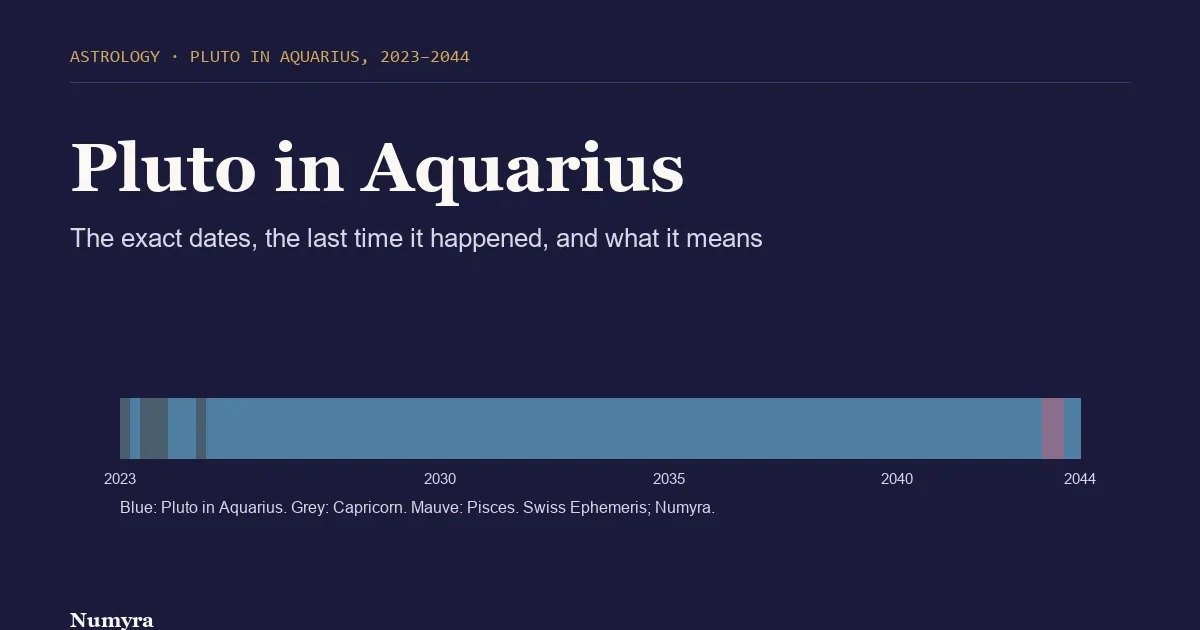
| Nov 16, 2027, 1:09 a.m. EST | Pluto conjunct (Pluto in Aquarius) | 4°57′ |
| Nov 28, 2027, 2:29 a.m. EST | Neptune sextile (Neptune in Aries) | 3°56′ |
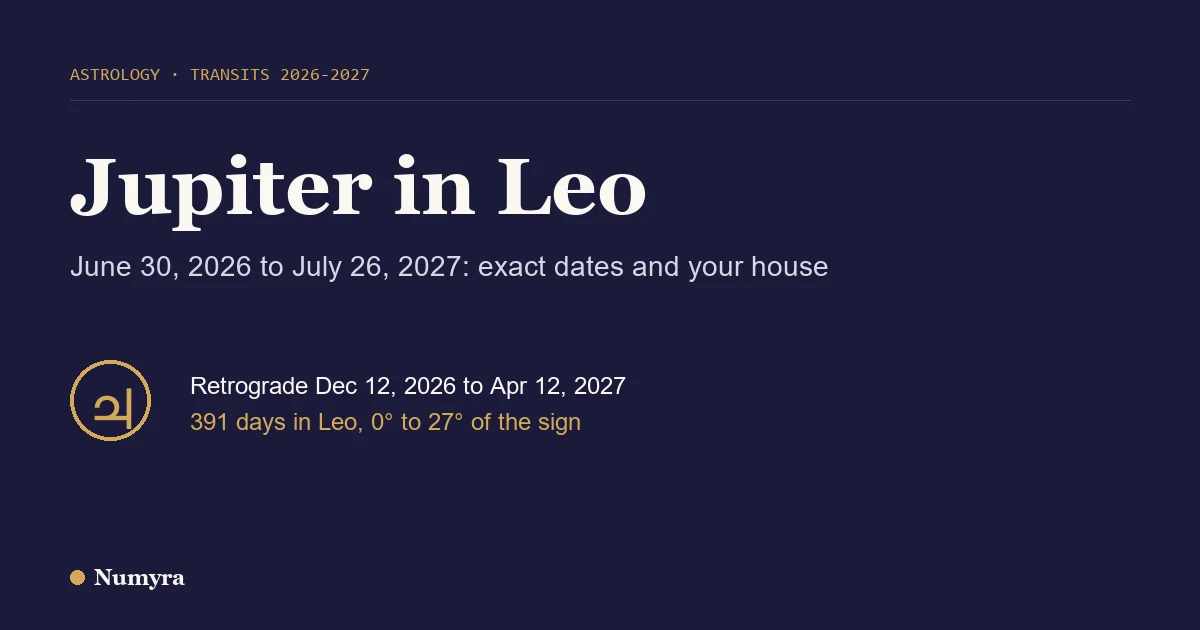
The positions are degrees of Aquarius for the node (and the same degree of the other sign for the planet). The Jupiter contacts are the best known: Jupiter in Leo runs from June 30, 2026 to July 26, 2027, so the planet spends the whole transit’s first year on the South Node side. The Pluto conjunction on November 16, 2027 is the other landmark, covered in our Pluto in Aquarius guide, and the Uranus and Neptune placements are explained in Uranus and Neptune signs. Independent listings by astrologers Jessica Davidson and Astro Butterfly between them give the same Jupiter dates (November 12, 2026 and April 23, 2027) and the same Pluto date (November 16, 2027).
Eclipses on the Aquarius-Leo axis
Eclipses happen only when a New or Full Moon falls near a node. NASA’s eclipse periodicity page gives the rule for solar eclipses: “If New Moon takes place within about 17° of a node, then a solar eclipse will be visible from some location on Earth.” That is why the eclipse series moves to the Aquarius-Leo axis when the nodes change sign. We found nine eclipses between the node’s entry and exit, and every date and type matches NASA’s solar eclipse catalog and lunar eclipse catalog.
| US Eastern | Eclipse | Position |
|---|---|---|
| Aug 12, 2026, 1:45 p.m. EDT | Total solar | 20°02′ Leo |
| Aug 28, 2026, 12:12 a.m. EDT | Partial lunar | 4°51′ Pisces |
| Feb 6, 2027, 10:59 a.m. EST | Annular solar | 17°38′ Aquarius |
| Feb 20, 2027, 6:12 p.m. EST | Penumbral lunar | 1°59′ Virgo |
| Jul 18, 2027, 12:03 p.m. EDT | Penumbral lunar | 25°58′ Capricorn |
| Aug 2, 2027, 6:06 a.m. EDT | Total solar | 9°55′ Leo |
| Aug 17, 2027, 3:13 a.m. EDT | Penumbral lunar | 24°04′ Aquarius |
| Jan 11, 2028, 11:13 p.m. EST | Partial lunar | 21°34′ Cancer |
| Jan 26, 2028, 10:07 a.m. EST | Annular solar | 6°11′ Aquarius |
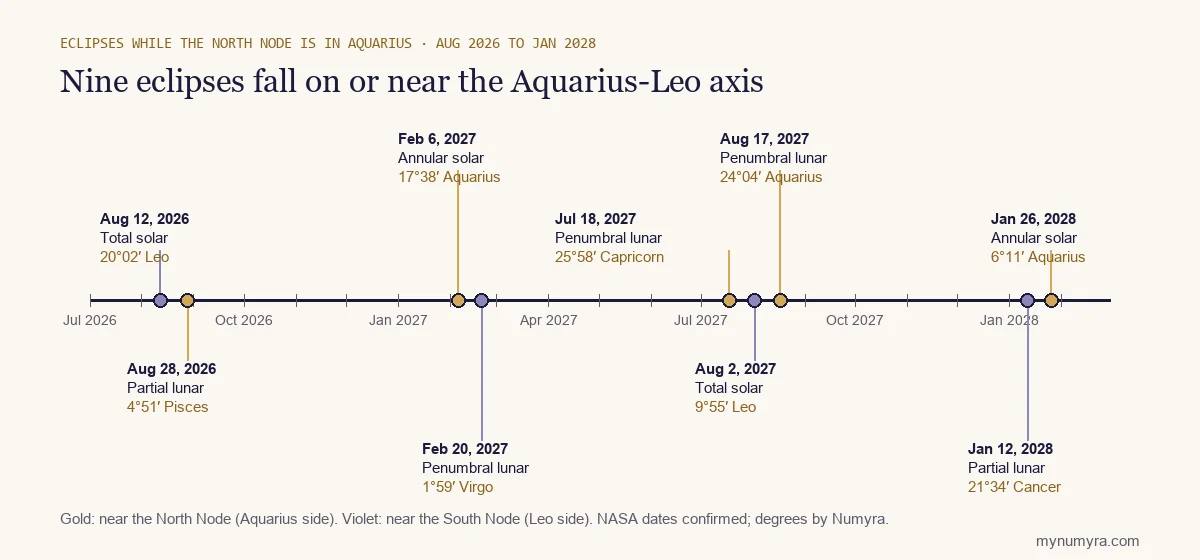
The lunar eclipses sit up to 17° from the axis, which is why some land in Capricorn, Virgo or Cancer rather than in Aquarius or Leo itself. The 2027 ones, including the total solar eclipse of August 2, 2027, are explained in our eclipses in 2027 guide, and every New and Full Moon in between is in the 2027 Moon calendar. Astrologers read eclipses as stronger versions of an ordinary lunation, with the node sign supplying the theme.
Born in 2007 to 2009: your nodal return
If you were born between December 18, 2007 and August 21, 2009 (true node) or between January 7, 2008 and July 27, 2009 (mean node), the North Node was in Aquarius at your birth, and this transit puts it back where it was. That is your first nodal return, at about 18 years and 7 months. Of the 85.4 million US births from 1994 to 2014, 6.6 million fall in the mean-node window and 7.2 million in the true-node window; those people are 17 or 18 years old in October 2026. Astrologers describe the first return as a checkpoint for the themes of the North Node, often around leaving school and choosing a direction, though the age is simple arithmetic from the 18.6-year cycle and the reading is interpretation. The nodal returns section of our North Node guide lists the ages for later returns.
Vedic (Jyotish) astrologers use the sidereal zodiac, in which the same node sits in a different sign and the dates differ completely; their names for the nodes are Rahu and Ketu. See our guide to sidereal vs. tropical zodiac for why, and use one system at a time.
Frequently asked questions
When does the North Node enter Aquarius in 2026?
July 26, 2026 at 8:46 p.m. EDT (5:46 p.m. PDT, 00:46 UT on July 27) by the true node. By the mean node it is August 18, 2026 at 4:34 p.m. EDT.
How long will the North Node be in Aquarius?
609 days by the true node (July 26, 2026 to March 26, 2028, about 20 months) and 567 days by the mean node (August 18, 2026 to March 7, 2028, about 18.6 months).
Where is the North Node today?
On October 14, 2026 the true North Node is at about 28°18′ Aquarius and the mean node at 27°00′ Aquarius. The South Node is in the same degree of Leo.
What does the South Node in Leo mean?
In modern astrology it is read as familiar habits tied to Leo themes, such as seeking recognition, leading and performing, which the North Node in Aquarius asks you to balance with group work and equality. This is a modern interpretation, not an established fact, and older astrology read the South Node quite differently.
Should I use the true node or the mean node?
Astrologers disagree and there is no standard. Most published calendars and software defaults use the true node, so July 26, 2026 is the more widely quoted entry. The two differ in sign only for people born within a few weeks of a sign change.
When was the last time the North Node was in Aquarius?
From December 18, 2007 to August 21, 2009 by the true node (January 7, 2008 to July 27, 2009 by the mean node). Before that, May 22, 1989 to November 18, 1990. It returns in April 2045.
Is the transit the same as having the North Node in Aquarius in my birth chart?
No. The transit affects everyone at once and is a shared backdrop; a natal placement is fixed by your birth date. People born in the 2007 to 2009 window have both, and the transit is their first nodal return. Our North Node guide covers the natal reading.
Which house is the North Node in for me?
It depends on your rising sign. Aries rising has Aquarius in the 11th house, Gemini rising in the 9th, Cancer rising in the 8th and Libra rising in the 5th. See the table above.
What sign does the North Node move into after Aquarius?
Capricorn, on March 26, 2028 by the true node (March 7, 2028 by the mean node), with the South Node moving into Cancer.
Sources
- Astrodienst. Swiss Ephemeris. Every node crossing, stay, aspect and eclipse position (calculations by the Numyra Methodology Desk, converted with US time-zone rules); the live position check on October 13, 2026.
- NASA. Periodicity of Solar Eclipses. Nodal regression of 19.3° per year and the 17° eclipse limit quoted above.
- NASA. Moon’s orbit. The 18.6-year (6,793.48-day) period of the nodes.
- NASA. Solar Eclipses 2021 to 2030 and Lunar Eclipses 2021 to 2030. Dates and types of all nine eclipses.
- Cafe Astrology. True North Node enters Aquarius. Independent check of the true-node entry time and exit date.
- CHANI. Your guide to the lunar nodes in Aquarius and Leo (July 19, 2026), used to cross-check entry and exit dates and the eclipse dates.
- Jean Meeus. Astronomical Algorithms, 2nd ed. (Willmann-Bell, 1998), the mean longitude of the Moon’s ascending node, used to check the mean-node dates.
- William Lilly. Christian Astrology (London, 1647), Book 1, p. 83, via the Internet Archive.
- FiveThirtyEight. US births data, 1994 to 2014, from the CDC National Center for Health Statistics and the Social Security Administration.