Whole sign houses make each zodiac sign one house, so your rising sign is the whole 1st house. Placidus houses divide the sky by time and come out unequal, so a house can hold part of a sign or more than one. The two systems put the same planet in a different house 53% of the time: in our simulation of 600,000 US births, 97 charts in 100 had at least one planet change house between them. This guide explains six house systems (whole sign, equal, Porphyry, Regiomontanus, Placidus and Koch), measures how often they disagree, shows why Placidus stops working near the Arctic Circle, and says which one our calculators use.
Key takeaways
- Whole sign and Placidus disagree about the house of a planet in 53.2% of 6,000,000 simulated US placements, and in 96.6% of charts at least one of the ten planets changes house. On average 5.3 of the ten planets move.
- The later your rising degree, the bigger the gap. With a rising degree of 0 to 5 within its sign, 27.6% of placements differ; with 25 to 30, it is 82.2%. When the two disagree, Placidus gives a house number exactly one lower in 89% of cases.
- Placidus, Koch, Porphyry and Regiomontanus mostly agree with each other (90% to 95% of placements match Placidus). Whole sign is the outlier, matching Placidus only 46.8% of the time.
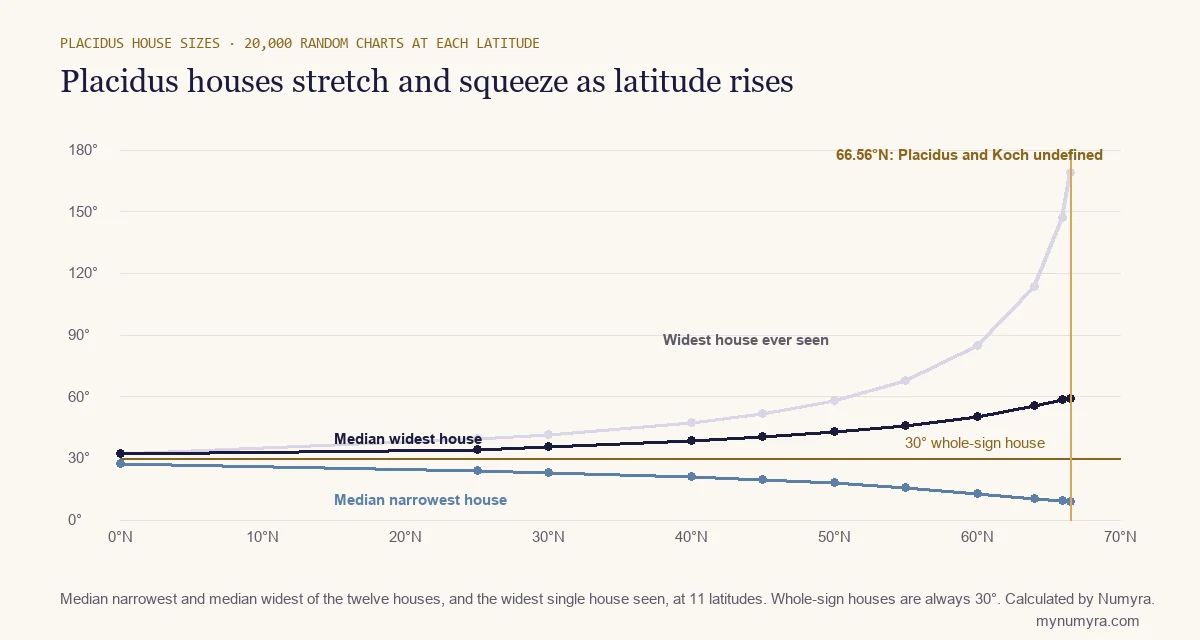
- Placidus and Koch have no cusps beyond about 66.56 degrees north, and Placidus houses are already badly uneven before that: at 64 degrees north the widest house is a median 56 degrees and the narrowest 10. Whole sign, equal and Porphyry work everywhere.
- Numyra’s calculators that place a point in a house use whole sign houses. Neither system is more accurate; they are different conventions, and each house reading is a tradition, not a measurement.
In this guide
- What a house system decides
- Six house systems side by side
- How often whole sign and Placidus disagree
- Which systems agree with each other
- The Ascendant and Midheaven
- A worked example: two Apollo launches
- Latitude: uneven houses and the polar limit
- What the old texts used
- Which system to use, and which one we use
- How we ran the numbers
- Frequently asked questions
What a house system decides
A birth chart has two layers. The zodiac signs are fixed arcs of 30 degrees. The houses are twelve slices tied to the horizon and the meridian at the moment and place of birth, each read as an area of life. Every house system uses the same two anchor points, the Ascendant on the eastern horizon and the Midheaven at the top of the sky. The systems differ in where they draw the ten lines between those anchors, and whether a house boundary has to match a sign boundary. Our guide to the astrological houses covers what each of the twelve houses means; this page is about where one house ends and the next begins.
The choice matters because a planet’s house is read as the area of life where its themes play out. Move a planet one house and the reading changes with it. An exact birth time is needed for any of this, since the horizon turns through a whole sign in roughly two hours (see Sun, Moon and rising signs).
Six house systems side by side
Astrodienst, the maker of the Swiss Ephemeris, documents more than a dozen systems. These six are the ones astrologers argue about most. The descriptions follow its documentation, and the last column is what we measured when we asked the Swiss Ephemeris for cusps at every latitude from 60 to 90 degrees north.
| System | How the houses are set | House sizes | Near the poles |
|---|---|---|---|
| Whole sign | The first house starts at 0 degrees of the rising sign; every house is one full sign | Always 30° | Works at every latitude |
| Equal (from the Ascendant) | Twelve 30° houses counted from the exact Ascendant degree | Always 30° | Works at every latitude |
| Porphyry | Each quarter of the ecliptic between the four angles is split into three equal parts | Unequal; varies with the angles | Works at every latitude |
| Regiomontanus | The celestial equator is split into 12 equal parts; circles through those points and the north and south points of the horizon cut the ecliptic | Unequal | Returned cusps at every latitude we tried |
| Placidus | Cusps 11, 12, 2 and 3 are the points that have travelled one third or two thirds of their daily arc above or below the horizon | Unequal; large swings at high latitude | No cusps above about 66.56°N |
| Koch | The time the Midheaven degree took to rise to the meridian is divided into thirds | Unequal | No cusps above about 66.56°N |
Two families emerge. Whole sign and equal houses are sign-based or angle-plus-30 systems: simple, always 30 degrees, and independent of latitude. Porphyry, Regiomontanus, Placidus and Koch are quadrant systems that put the Midheaven on the 10th cusp and divide the space between the angles, each by a different rule. Placidus is widely described as the most common in modern Western astrology. Koch, the Swiss Ephemeris documentation notes, was invented by Friedrich Zanzinger and Heinz Specht and made known by the German astrologer Walter Koch.
One consequence of the quadrant rule is that a sign can be “intercepted”: it sits inside a house without starting any house. In our simulated US charts, Placidus intercepted two signs in 51.5% of charts, four in 0.3%, and none in 48.2%. Whole sign houses can never intercept a sign.
How often whole sign and Placidus disagree
Every explainer says that the two systems can place a planet in different houses. None we found says how often, so we measured it. We drew 600,000 simulated US birth moments (the method is explained at the end) and, for each, placed the Sun, Moon, Mercury, Venus, Mars, Jupiter, Saturn, Uranus, Neptune and Pluto in a house under whole sign and under Placidus. That is 6,000,000 placements.
The answer is close to a coin flip: 53.2% of placements land in a different house. Only 3.4% of charts had every planet in the same house under both systems; 96.6% had at least one planet move, and the median chart had five.
| Point | Different house, whole sign vs Placidus |
|---|---|
| Ascendant | 0% (the Ascendant starts the 1st house in both) |
| Midheaven | 38.7% (in Placidus it is always the 10th cusp) |
| Sun | 52.8% |
| Moon | 53.0% |
| Mercury | 53.2% |
| Venus | 52.9% |
| Mars | 53.1% |
| Jupiter | 54.9% |
| Saturn | 52.7% |
| Uranus | 53.8% |
| Neptune | 50.1% |
| Pluto | 56.0% |
The planets all land within a few points of each other because the outcome depends on the house lines, not on the planet. The slow planets deviate a little (Pluto 56.0%, Neptune 50.1%) because births from 1994 to 2014 clustered them in a few signs. When the two systems disagree, the gap is usually one house: Placidus gives a number one lower in 88.6% of disagreements, two lower in 5.4%, one higher in 6.0%, and a gap of three or more in 0.1%.
The rising degree is the best predictor
Whole sign starts your 1st house at the first degree of your rising sign, however far the Ascendant is into that sign. Placidus starts it at the Ascendant itself. So a rising degree of 3 degrees leaves little room for disagreement, and a rising degree of 27 leaves 27 degrees of the rising sign that whole sign puts in the 1st house and Placidus puts in the 12th. The chart shows the effect.
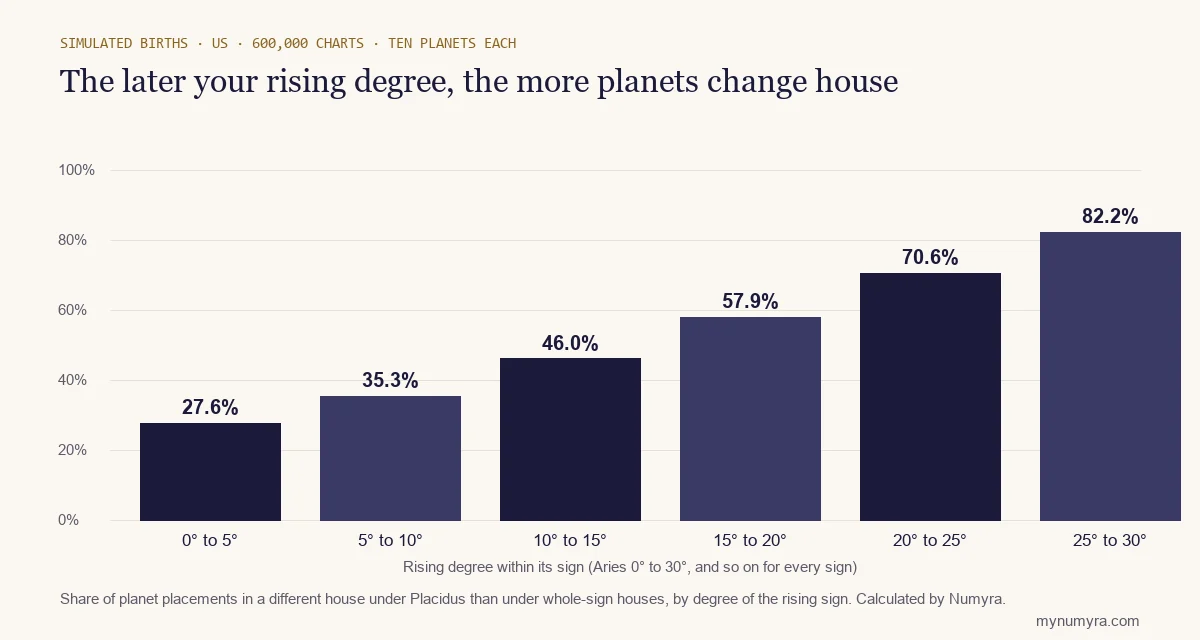
| Rising degree within its sign | Placements in a different house |
|---|---|
| 0° to 5° | 27.6% |
| 5° to 10° | 35.3% |
| 10° to 15° | 46.0% |
| 15° to 20° | 57.9% |
| 20° to 25° | 70.6% |
| 25° to 30° | 82.2% |
If your Ascendant is in the first few degrees of a sign, whole sign and Placidus will agree about most of your planets. If it is in the last few degrees, expect most of them to move. An Ascendant near a sign boundary is also the case where a small birth-time error changes the rising sign itself, so it is the hardest case to rely on either way.
Latitude widens the gap
| Birth latitude (simulated US cities) | Charts | Placements in a different house | Charts with at least one planet moved |
|---|---|---|---|
| 20° to 30°N (Honolulu, Miami, Houston) | 74,568 | 51.7% | 95.1% |
| 30° to 35°N (Los Angeles, Atlanta, Dallas) | 172,524 | 52.2% | 95.9% |
| 35° to 40°N (New York area, Denver, Washington) | 120,419 | 53.4% | 96.9% |
| 40° to 45°N (Chicago, Boston, Detroit) | 215,868 | 54.1% | 97.3% |
| 45° to 65°N (Seattle, Minneapolis, Anchorage) | 16,621 | 58.9% | 98.8% |
The trend is gentle across the lower 48 states and steeper in the far north. Anchorage, at 61.2 degrees north, had 65.8% of placements in a different house. The reason is the next section: the higher the latitude, the more the Placidus houses depart from 30 degrees.
Which systems agree with each other
We also compared every other system with Placidus, planet by planet. Regiomontanus matched Placidus on 95.2% of the 6,000,000 placements, Porphyry on 90.7% and Koch on 90.1%. Equal houses from the Ascendant matched on 74.9%. Whole sign matched on only 46.8%.
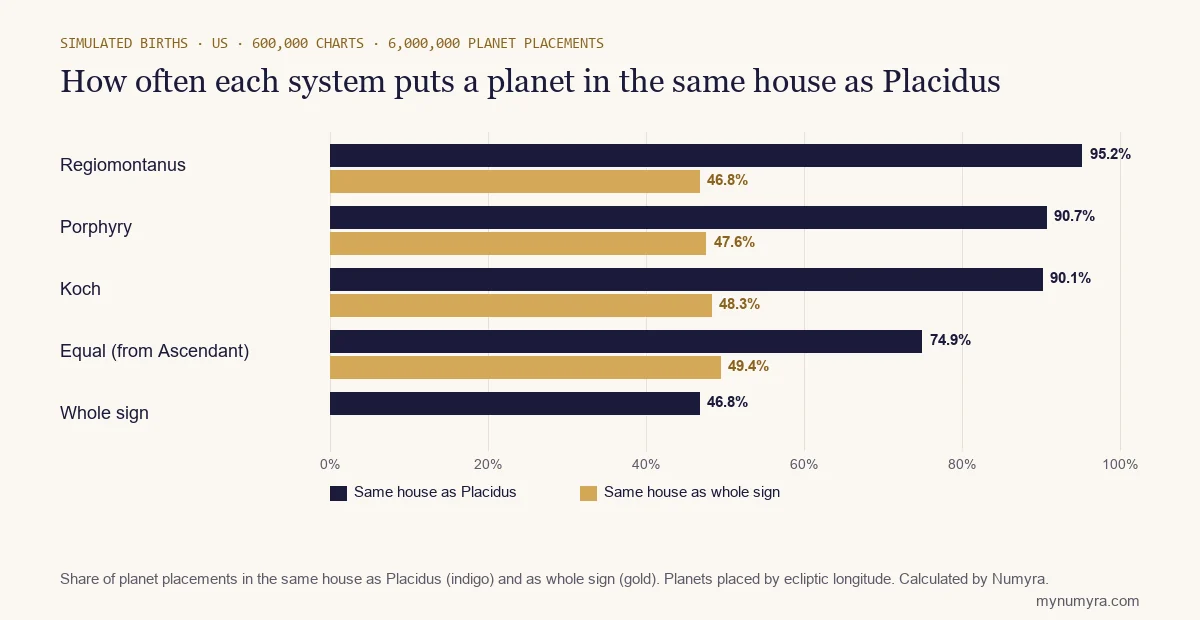
So the quadrant systems form a tight group whose differences are mostly a matter of a planet sitting within a few degrees of a cusp, while the real fork is between sign-based houses and everything else. Equal houses sit in between: they share Placidus’s start at the Ascendant degree but give every house 30 degrees. Against whole sign, no other system did better than 49.4% agreement (equal houses), because none of them starts houses at the beginning of a sign.
The Placidus cusps themselves are not special degrees. Across 2,400,000 simulated cusps (the 2nd, 3rd, 11th and 12th in each chart), each five-degree slice of a sign held 16.6% to 16.7%, which is an even split, and 13.4% fell within two degrees of a sign boundary. Planets near those boundaries are the ones that are most sensitive to the choice of system.
The Ascendant and Midheaven
Every system uses the same Ascendant and Midheaven. The Ascendant is where the ecliptic crosses the eastern horizon and the Midheaven is where it crosses the meridian, and both are plain geometry. What changes is whether the Midheaven is also the 10th house cusp. In Placidus, Koch, Porphyry and Regiomontanus it is by definition. In whole sign it is not: the 10th house is simply the tenth sign counted from the rising sign, and the Midheaven can fall in the 9th, 10th or 11th. In our simulation it was in the 10th 61.3% of the time overall, and in the 9th or 11th 19.2% each.
| Birth latitude | MC in 9th whole-sign house | In 10th | In 11th |
|---|---|---|---|
| 20° to 30°N | 13.8% | 72.4% | 13.8% |
| 30° to 35°N | 16.4% | 67.3% | 16.4% |
| 35° to 40°N | 20.3% | 59.4% | 20.3% |
| 40° to 45°N | 22.3% | 55.4% | 22.3% |
| 45° to 65°N | 26.8% | 39.4% | 25.9% |
In the last row, 4.0% of charts put the Midheaven in the 8th and 3.9% in the 12th. Our Midheaven guide shows the same effect city by city and explains how astrologers who use whole sign read a Midheaven in the 9th or 11th. Chart-ruler readings use the same house, so the choice also changes which house a chart ruler is said to sit in.
A worked example: two Apollo launches
To see the systems on a real chart, we used two documented moments from our Part of Fortune guide: the Apollo 11 launch at 9:32 a.m. EDT on July 16, 1969 (NASA) and the Apollo 17 launch at 12:33 a.m. EST on December 7, 1972 (NASA), both from Kennedy Space Center at 28.608°N, 80.604°W. These are event charts, not anyone’s birth chart. Apollo 11 had 0°45′ Virgo rising, just past a sign boundary; Apollo 17 had 20°05′ Virgo rising.
Apollo 11: the systems barely disagree
With the Ascendant under 1 degree into Virgo, whole sign and Placidus put all ten planets in the same house. The only differences are Jupiter and Uranus, which sit within a degree of the start of Libra and so land in the 1st house under equal houses (and Jupiter under Koch), and the Midheaven, which is in the 9th under whole sign and equal houses and is the 10th cusp in the quadrant systems.
| Apollo 11 point | Position | Whole sign | Equal | Placidus | Koch | Porphyry | Regiomontanus |
|---|---|---|---|---|---|---|---|
| Sun | 23°49′ Cancer | 11th | 11th | 11th | 11th | 11th | 11th |
| Moon | 15°25′ Leo | 12th | 12th | 12th | 12th | 12th | 12th |
| Mercury | 16°43′ Cancer | 11th | 11th | 11th | 11th | 11th | 11th |
| Venus | 10°21′ Gemini | 10th | 10th | 10th | 10th | 10th | 10th |
| Mars | 2°10′ Sagittarius | 4th | 4th | 4th | 4th | 4th | 4th |
| Jupiter | 0°08′ Libra | 2nd | 1st | 2nd | 1st | 2nd | 2nd |
| Saturn | 7°51′ Taurus | 9th | 9th | 9th | 9th | 9th | 9th |
| Uranus | 0°32′ Libra | 2nd | 1st | 2nd | 2nd | 2nd | 2nd |
| Neptune | 26°04′ Scorpio | 3rd | 3rd | 3rd | 3rd | 3rd | 3rd |
| Pluto | 22°55′ Virgo | 1st | 1st | 1st | 1st | 1st | 1st |
| Midheaven | 28°50′ Taurus | 9th | 9th | 10th | 10th | 10th | 10th |
The Placidus 2nd cusp is at 26°48′ Virgo and the Koch 2nd cusp at 0°21′ Libra, a gap of under four degrees, which is why Jupiter at 0°08′ Libra is in the 2nd house under Placidus and the 1st under Koch.
Apollo 17: eight of ten planets move
The Apollo 17 chart has the Ascendant late in its sign, the case where the earlier chart predicts a big gap. Eight of the ten planets are in a different house under whole sign than under Placidus: the Sun (4th in whole sign, 3rd in Placidus), Moon (5th, 4th), Venus (3rd, 2nd), Mars (3rd, 2nd), Jupiter (5th, 4th), Saturn (10th, 9th), Neptune (4th, 3rd) and Pluto (2nd, 1st). Only Mercury (3rd) and Uranus (2nd) stay put. Equal, Porphyry, Koch, Regiomontanus and Placidus agree with one another on all ten planets, and only whole sign differs.
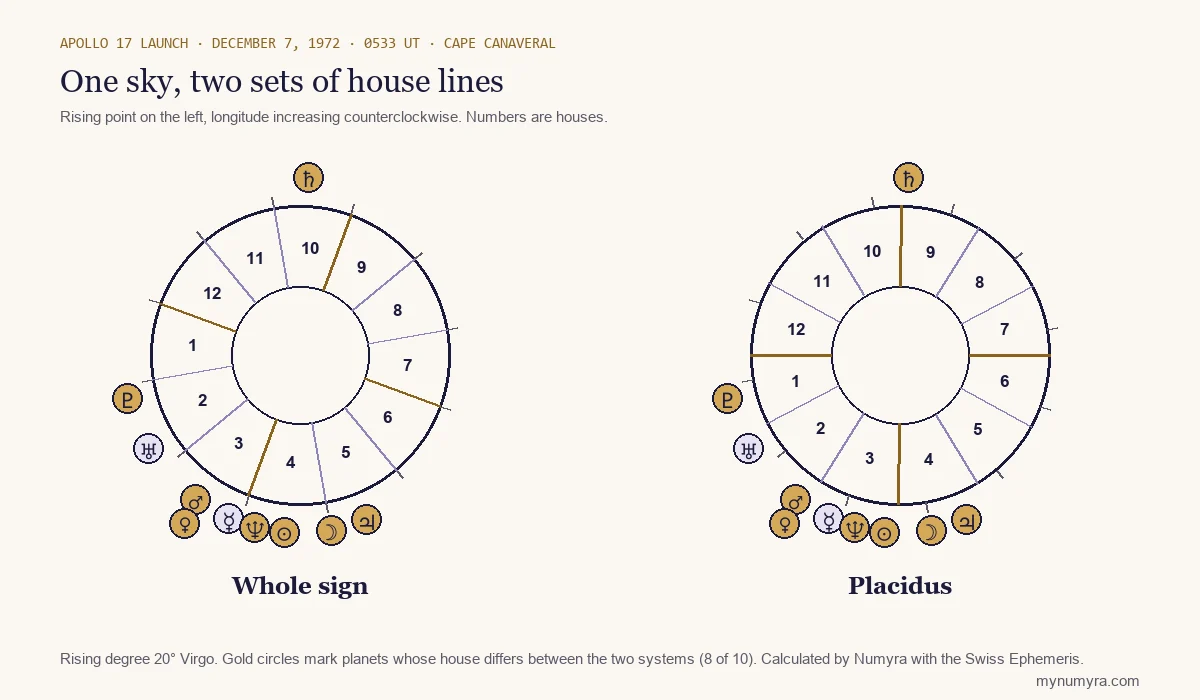
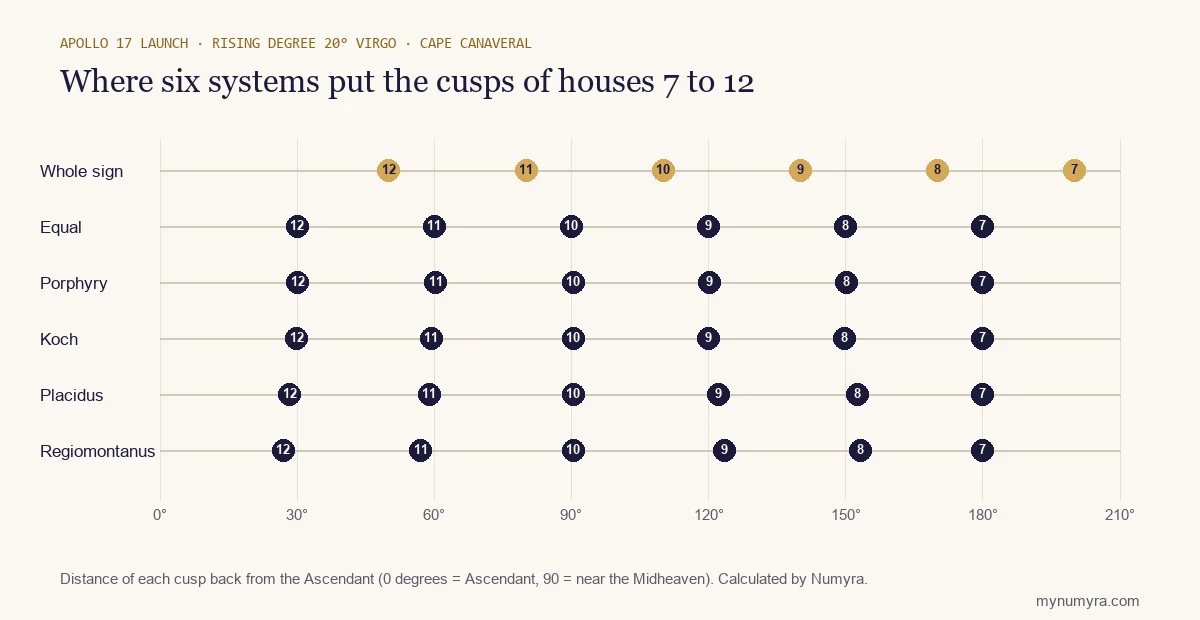
The strip shows why. The whole-sign cusps sit 50, 80 and 110 degrees back from the Ascendant for houses 12, 11 and 10, because they start at the beginning of Leo, Cancer and Gemini. All five other systems put those cusps near 30, 60 and 90 degrees. The lesson from both charts is the same: the rising degree decides how large the disagreement is.
Latitude: uneven houses and the polar limit
Whole sign houses are 30 degrees at every latitude. Placidus houses are not. Because Placidus divides the time a degree takes to cross the sky, and that time varies more the farther you are from the equator, houses grow lopsided with latitude. We measured it with 20,000 random charts at each of eleven latitudes.
| Latitude | Median narrowest house | Median widest house | Widest house seen | Charts with a house of 60° or more | Charts with an intercepted sign |
|---|---|---|---|---|---|
| 0° | 27.7° | 32.5° | 32.6° | 0% | 14% |
| 30°N | 23.3° | 35.8° | 41.6° | 0% | 39% |
| 40°N | 21.1° | 38.8° | 47.5° | 0% | 57% |
| 50°N | 18.1° | 42.9° | 58.1° | 0% | 77% |
| 55°N | 16.0° | 45.8° | 67.7° | 18% | 84% |
| 60°N | 12.9° | 50.3° | 84.9° | 26% | 89% |
| 64°N | 10.4° | 55.7° | 113.8° | 46% | 95% |
| 66.5°N | 9.1° | 59.2° | 169.3° | 50% | 97% |
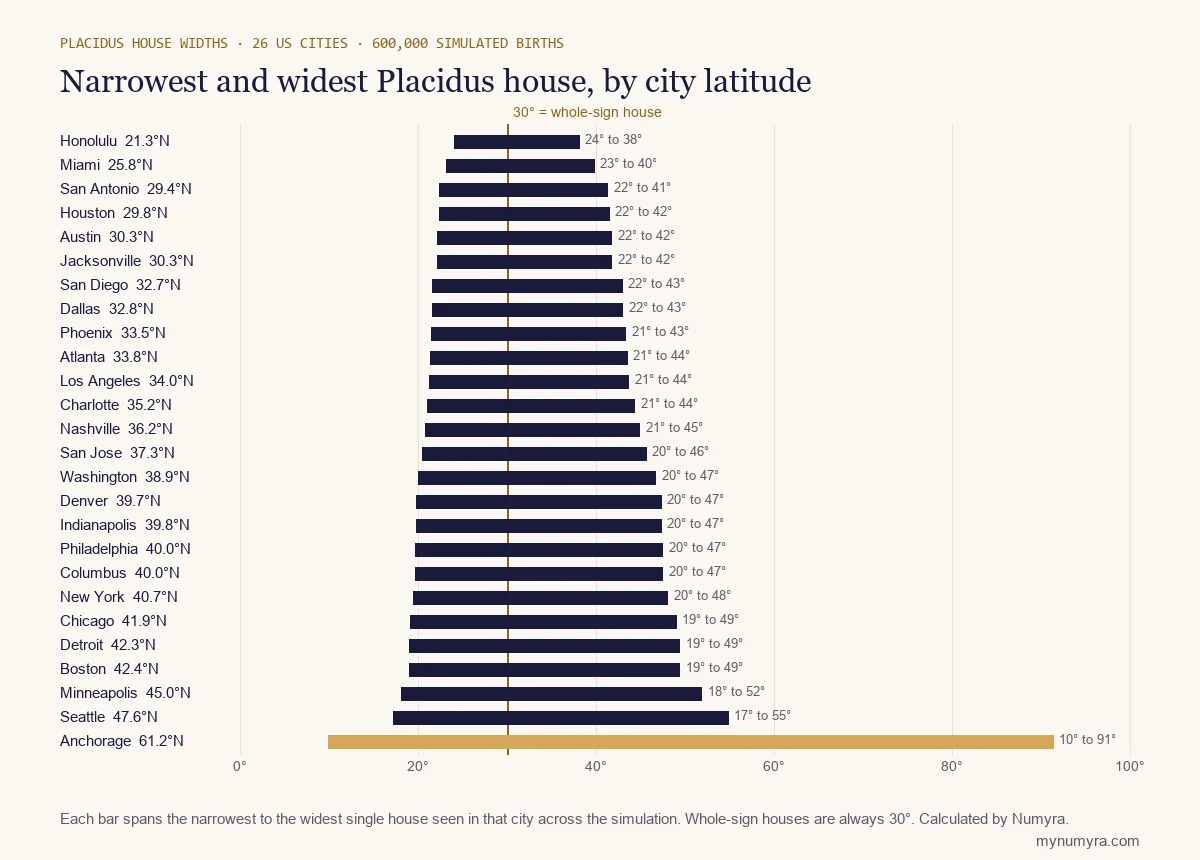
Other guides give rules of thumb for where Placidus starts to misbehave, from 55 to 60 degrees. The numbers fit: at 55 degrees north about one chart in six has a house of 60 degrees or more, and at 64 degrees (Reykjavík is at 64.1) about half the charts have a house narrower than 10 degrees. Across the 26 US cities in our sample, the Placidus houses ranged from 24 to 38 degrees in Honolulu, 20 to 48 in New York and 10 to 91 in Anchorage.
Where Placidus stops: the polar circle
Placidus needs every degree of the ecliptic to rise and set. Above about 66.56 degrees north, which is 90 degrees minus the tilt of Earth’s axis, some degrees stay above or below the horizon all day and have no rising or setting to divide. The Swiss Ephemeris documentation, in the section on house cusps beyond the polar circle, puts it this way:
“Placidus and Koch house cusps sometimes can, sometimes cannot be computed beyond the polar circles. Even the MC doesn’t exist always, if one defines it in the Placidus manner. Our function therefore automatically switches to Porphyry houses (each quadrant is divided into three equal parts) and returns a warning.”
Astrodienst, Swiss Ephemeris documentation, section 6.4, “House cusps beyond the polar circle”
We tested the library directly. At 66.55 degrees north it returned Placidus and Koch cusps for every one of the 3,456 moments we tried; at 66.6 degrees and at every latitude we tried above that, up to the pole, it returned none, while Porphyry, Regiomontanus and whole sign returned cusps at every latitude. Software that reports Placidus charts for a Tromsø or Kirkenes birth is therefore using a fallback, and it is worth knowing which.
| Hand-picked list | Cities | Above 66.56°N |
|---|---|---|
| 26 large US cities in our sample | 26 | None (Anchorage, 61.2°N, is the northernmost) |
| Other North American places | 10 | 1: Utqiagvik, Alaska (71.3°N); Fairbanks, 64.8°N, is below the line |
| European capitals and large cities | 28 | 1 of 28 (3.6%): Murmansk, 69.0°N |
| Scandinavia and Iceland | 18 | 5 of 18 (27.8%): Bodø, Kiruna, Tromsø, Hammerfest, Kirkenes |
These are lists we chose, not population-weighted shares, and coordinates come from Wikipedia. Even so the pattern is clear: Placidus cannot be computed for any large US city and for almost no large European one, but for a meaningful slice of northern Norway, Sweden and Finland. Rovaniemi, Finland (about 66.50°N) sits just inside the limit, and Luleå (65.6°N) and Akureyri (65.7°N) are just under it, where Placidus is defined but strongly lopsided.
What the old texts used
The Swiss Ephemeris documentation says of whole sign houses:
“The first house starts at the beginning of the zodiac sign in which the ascendant is. Each house covers a complete sign. This method was used in Hellenistic astrology and is still used in Hindu astrology.”
Astrodienst, Swiss Ephemeris documentation, section 6.2.5, “Equal Systems”
That is a claim about a whole tradition, and the primary texts are more mixed than a single line suggests. In Book III of Ptolemy’s Tetrabiblos (chapters 1 to 14) we found no chapter that sets out a full twelve-house system. In the chapter on length of life, he picks out the place around the Ascendant as the strongest for a planet that governs the span of life, and describes it like this:
“the twelfth part of the zodiac surrounding the horoscope, from 5° above the actual horizon up to the 25° that remains, which is rising in succession to the horizon”
Ptolemy, Tetrabiblos, Book III, chapter 10, trans. F. E. Robbins (Loeb Classical Library, 1940), via LacusCurtius
This is a 30-degree stretch, but it begins five degrees before the horizon crossing rather than at the beginning of the sign. He then names the other places by their aspect from that stretch: the one in sextile is the House of the Good Daemon, the one in quartile the mid-heaven and the one in trine the House of the God. That is neither whole sign nor equal houses from the Ascendant, and it echoes the five-degree rule for planets near a cusp that William Lilly gives in Christian Astrology (quoted in our houses guide). Ptolemy’s places are for judging strength in one specific question, not a full set of twelve houses, so it is fair to say he does not settle the whole sign versus Placidus argument. Our Tetrabiblos article covers his wider influence.
In 1647, Lilly taught the reader a quadrant system. His Christian Astrology includes tables and a worked example for erecting a chart by the tables of Regiomontanus, finding the 10th cusp from the right ascension of the Sun and of the time, then using tables of oblique ascensions for the other cusps. Koch is a 20th-century system, and Placidus is named for a 17th-century Italian monk. Today whole sign houses are used by practitioners of Hellenistic-style astrology and, as the quotation above notes, in Hindu astrology.
Which system to use, and which one we use
No test in this article, or anywhere we know of, shows that one system predicts events better. Each is a convention. Three practical points follow from what we measured:
- You are not choosing between two nearly identical charts. Half your placements may change house. If a reading says your Mars is in your 6th house, ask which system it used.
- Birth time matters more in quadrant systems. Placidus cusps moved 1.0 degree on average in four minutes in our test (0.7 to 2.1), so a planet near a cusp can switch houses on a small time error. Whole sign houses only change when the rising sign changes, roughly every two hours.
- Far north, whole sign, equal or Porphyry are the safe choices, because they are defined at every latitude.
Numyra’s calculators that assign a point to a house, including the Part of Fortune calculator, the stellium calculator and the synastry calculator, use whole sign houses, and each states this on its result. Our birth chart calculator gives the Sun, Moon, rising sign and Midheaven, which are the same in every system. If you use another system elsewhere, the sign-level facts on this site still apply; only the house numbers change. Our essential dignities guide and 12th house article are unaffected by this choice at the sign level.
How we ran the numbers
We simulated 600,000 US births. For each one we drew a date at random, weighted by the real number of US births on that calendar day, from the CDC National Center for Health Statistics series for 1994 to 2003 and the Social Security Administration series for 2004 to 2014 as compiled by FiveThirtyEight. We drew one of 26 large US cities, weighted by an approximate population we entered by hand, and a clock time uniformly at random across the 24 hours. The clock times are random, not real birth times: the data has dates only, and real births cluster at certain hours, so shares tied to the time of day are approximate. We converted each local time to UT with the historical time-zone and daylight-saving rules, and computed the tropical zodiac positions and the house cusps of each system with the Swiss Ephemeris in Moshier mode. Planets are placed by their ecliptic longitude, ignoring their small latitude above or below the ecliptic; the library notes this is how a house position is traditionally found.
As a check on the Placidus numbers, we wrote our own solver for the definition (the point whose hour angle is one third or two thirds of its semi-arc) and compared its 11th, 12th, 2nd and 3rd cusps with the Swiss Ephemeris for 300 random charts between 20 and 62 degrees north. All 1,200 cusps agreed to within 0.0000002 degrees. The check uses the library’s sidereal time and obliquity as inputs, so it verifies the house construction, not the planet positions. Positions for Apollo 11 and 17 match those in our Part of Fortune guide. The simulation seed, 600,000 charts and 6,000,000 placements give a statistical error of well under 0.1 percentage point on the shares above.
Limits: the 26 cities are large ones, so high-latitude results rest on Anchorage and the latitude-curve test, not on a sample of Scandinavian births; the outer-planet figures reflect where those planets were in 1994 to 2014; and we compared houses, not their meaning. How a planet in a given house is read is interpretation, offered for reflection rather than prediction, and not advice of any kind.
Frequently asked questions
What is the difference between whole sign and Placidus houses?
In whole sign houses each house is exactly one zodiac sign, starting with your rising sign as the 1st house. In Placidus the houses start at the Ascendant, Midheaven and points found by dividing the time a degree takes to cross the sky, so they are unequal and can cut across signs. In our 600,000 simulated US births, 53.2% of planet placements fell in different houses under the two systems.
Which house system is the most accurate?
None can be shown to be more accurate, because a house is a convention rather than a measurement. Placidus is widely used in modern Western astrology and whole sign is used in Hellenistic and Hindu practice. What can be said is that Placidus and Koch have no cusps above about 66.56 degrees north, while whole sign, equal and Porphyry work everywhere.
How often does a planet change house between whole sign and Placidus?
About 53% of the time in our simulation, and in 96.6% of charts at least one of the ten planets changed house. The share rises from 27.6% when the rising degree is 0 to 5 in its sign to 82.2% when it is 25 to 30.
Do my rising sign and Midheaven change with the house system?
No. The Ascendant and Midheaven are the same degrees in every system. What changes is the house lines between them, and whether the Midheaven is the start of the 10th house. In whole sign it lands in the 9th, 10th or 11th: in the 10th 72.4% of the time at 20 to 30 degrees north and 55.4% at 40 to 45 degrees north.
Which house system did ancient astrologers use?
The Swiss Ephemeris documentation says whole sign houses were used in Hellenistic astrology. Ptolemy’s Tetrabiblos does not lay out a full house system; in the chapter on length of life he describes a 30-degree place that begins five degrees above the horizon. Lilly’s 1647 Christian Astrology works with the tables of Regiomontanus, a quadrant system.
Why does Placidus not work in northern Norway or Alaska?
Placidus divides the time each degree of the ecliptic spends rising and setting. Above about 66.56 degrees north some degrees never rise or set, so there is nothing to divide. The Swiss Ephemeris then falls back to Porphyry houses and returns a warning. Tromsø, Kirkenes and Utqiagvik are affected; Fairbanks, Anchorage, Reykjavík and Helsinki are not.
What is an intercepted sign?
It is a sign that sits inside a house without starting one. It happens in quadrant systems when a house is wider than 30 degrees. In our simulated US charts, Placidus intercepted two signs in 51.5% of charts and four signs in 0.3%. Whole sign houses never intercept signs.
Which house system does Numyra use?
Our calculators that place a point in a house, the Part of Fortune, stellium and synastry calculators, use whole sign houses and say so on the result. The birth chart calculator reports the Sun, Moon, rising sign and Midheaven, which do not depend on the system.
Sources
- Astrodienst. Swiss Ephemeris documentation, chapter 6: house system descriptions (6.2.1 to 6.2.6) and house cusps beyond the polar circle (6.4). Also the ephemeris used for every calculation here, by the Numyra Methodology Desk.
- Ptolemy. Tetrabiblos, Book III, chapter 10, trans. F. E. Robbins (Loeb Classical Library, 1940), via LacusCurtius.
- William Lilly. Christian Astrology (London, 1647), Internet Archive scan; the Introduction’s tables and worked example by Regiomontanus.
- NASA. Apollo 11 lifts off and Apollo 17 launch: launch times.
- FiveThirtyEight. US births data, 1994 to 2014, from the CDC National Center for Health Statistics and the Social Security Administration. Dates only; clock times and places are simulated.
- Wikipedia. House (astrology): the statement that Placidus is the most commonly used house system in modern Western astrology, and city coordinates from Wikipedia articles. The page carries a maintenance notice, so we used it only for that general statement.