A Jupiter return is the moment Jupiter comes back to the exact degree of the zodiac it occupied when you were born, which takes about 11.86 years, so your returns fall near ages 12, 24, 36, 47, 59, 71 and 83. We measured every birth date from 1900 to 2010, and the popular “age 12” is slightly off: your first exact pass arrives between ages 11.3 and 12.0, and only a retrograde loop can carry a later pass beyond your twelfth birthday. This guide gives the measured age range of all seven returns, who has one in 2026 to 2028, and why Jupiter sometimes crosses your degree three times.
Key takeaways
- Jupiter’s tropical orbit takes 11.857 years (NASA), but your first exact return does not come at 12: across 40,542 birth dates it fell between age 11.3 and 12.0 every time, and averaged 11.7.
- Jupiter’s backward loop means 44% of first returns and 70% of seventh returns are three exact passes, spread over 6.6 to 8.0 months. A return is never two passes.
- A Jupiter return falls in 2026 to 2028 for people born roughly 2013 to 2017, 2001 to 2005, 1990 to 1993, 1978 to 1981, 1966 to 1969, 1954 to 1958 and 1942 to 1946. About 14.4 million US births from October 2001 to October 2005 are having their second return.
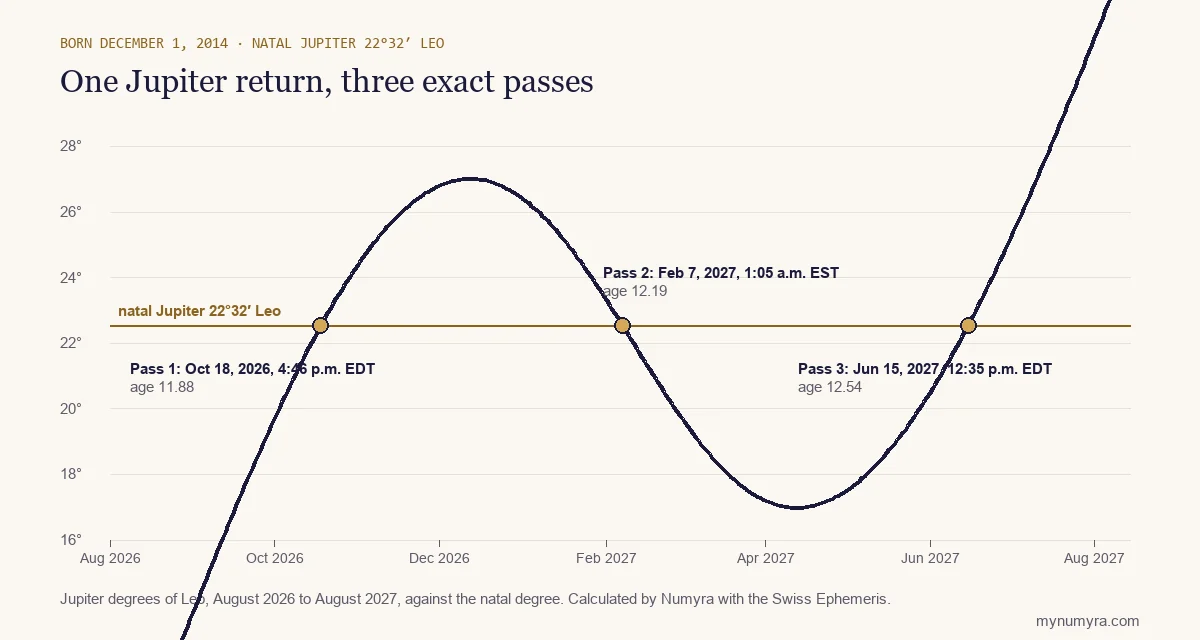
- Someone born December 1, 2014 has natal Jupiter at 22°32′ Leo and three passes: October 18, 2026, February 7 and June 15, 2027.
- The meaning of a return is astrological tradition, offered for reflection, not prediction.
In this guide
- What a Jupiter return is
- At what age is your Jupiter return?
- One pass or three
- Why the exact age varies
- Who is having a Jupiter return in 2026 to 2028
- How to find your own Jupiter return
- What a Jupiter return traditionally means
- Jupiter return, Saturn return and Jupiter in Leo
- Frequently asked questions
What a Jupiter return is
Jupiter takes about a year to cross each sign, and NASA gives its tropical orbit period, the time to come back to the same point of the zodiac, as 4,330.6 days, or 11.857 years. When transiting Jupiter reaches the sign and degree it held at your birth, astrologers call that your Jupiter return. It is a return to a degree, not merely to a sign. Jupiter is in your Jupiter sign for about a year, but the exact return is the day it reaches your own degree, the same method behind the Saturn return and the solar and lunar returns in our guides to the solar return and lunar return.

The result is a table of ages, but it is an average with scatter, not a schedule. Everything below is measured: for every birth date from January 1, 1900 to December 31, 2010 (40,542 days) we computed Jupiter’s position at noon Universal Time with the Swiss Ephemeris, then found every day Jupiter crossed that degree from age 3 onward, grouping the crossings into returns.
At what age is your Jupiter return?
Close to 12, 24, 36, 47, 59, 71 and 83, but with real spread. This table shows the measured range of the first exact pass for each return, how far the last pass can run, and the share of birth dates with a single pass.
| Return | n x 11.857 | First exact pass (age) | Average first pass | Last pass up to | Single pass |
|---|---|---|---|---|---|
| 1st | 11.9 | 11.3 to 12.0 | 11.7 | 12.6 | 56% |
| 2nd | 23.7 | 23.2 to 23.9 | 23.6 | 24.5 | 81% |
| 3rd | 35.6 | 35.2 to 35.9 | 35.5 | 35.9 | 89% |
| 4th | 47.4 | 47.1 to 47.8 | 47.4 | 47.8 | 89% |
| 5th | 59.3 | 58.5 to 59.8 | 59.3 | 59.8 | 81% |
| 6th | 71.1 | 70.4 to 71.7 | 71.1 | 71.7 | 57% |
| 7th | 83.0 | 82.3 to 83.6 | 82.8 | 83.7 | 31% |
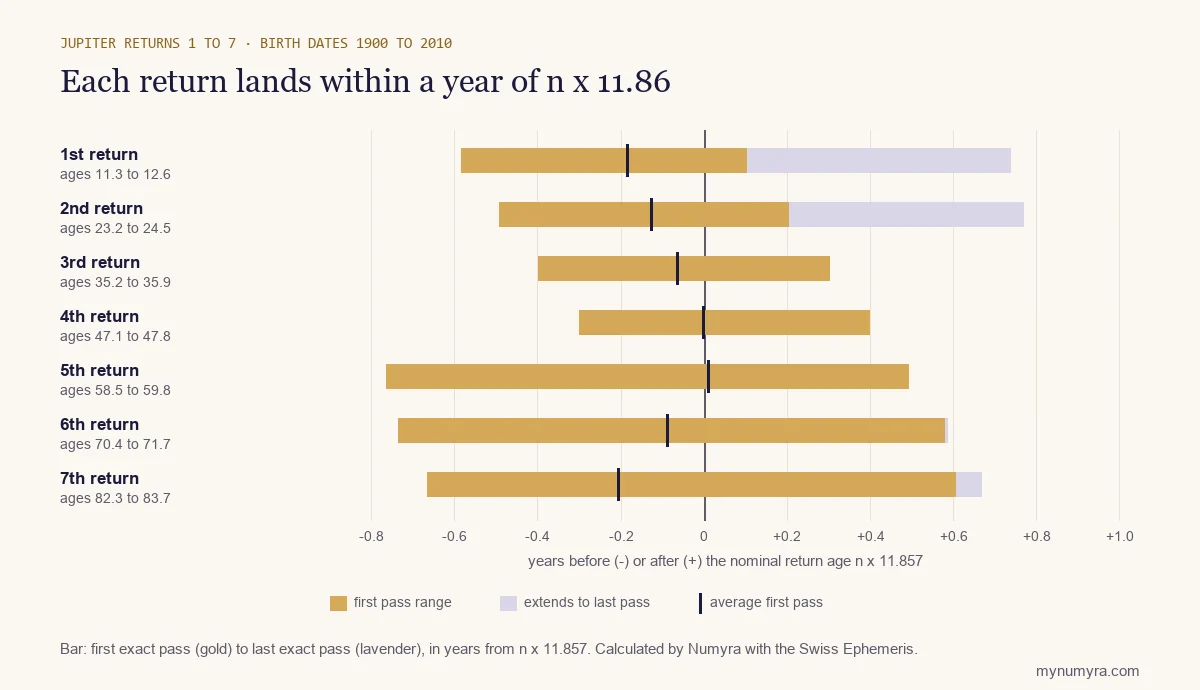
The first return never arrives at age 12. Its first exact pass fell between 11.27 and 11.96 years, or 4,118 to 4,368 days, for every one of the 40,542 birth dates, so in completed years it is always age 11. The popular “age 12” comes from the fact that 31% of first returns have a final pass after the twelfth birthday, as late as 12.6. For the first four returns the first-pass window is about 0.7 years wide; from the fifth return it widens to about 1.3 years. The third and fourth (35.2 to 35.9 and 47.1 to 47.8) are also the two where a retrograde loop never pushes the last pass past that window, which makes 36 and 47 the most dependable markers.
Two worked examples show the range. Someone born April 10, 2015, with Jupiter at 12°36′ Leo, gets a single first return on August 26, 2026, at age 11.38. Someone born September 1, 2015 gets theirs on August 16, 2027, 16 days before turning 12. At the other end of life, a person born September 10, 1990 has a single third return on July 21, 2026, at age 35.86.
One pass or three
Seen from Earth, Jupiter turns retrograde for about four months of every thirteen, the same optical effect explained in our Mercury retrograde guide. In 1647 William Lilly put the length of Jupiter’s backward motion at about four months, in his chapter on the planet:
“He is Retrograde about 120 dayes, is five dayes in his first station before retrogradation, and four dayes stationary before Direction.”
William Lilly, Christian Astrology, London, 1647, chapter IX, p. 62

Jupiter’s retrograde in Leo lasts 121 days (see Jupiter in Leo 2026-27), within a day of Lilly’s figure. If that loop passes over your natal degree, Jupiter crosses it forward, back and forward again. That is what we found: 56% of first returns are one pass and 44% are three, and no return was ever two. Across all seven returns, 31% of the 283,794 returns measured were triple. The three passes of a triple return span 6.6 to 8.0 months, 7.6 on average.
The share of triple returns changes with the return number, and the pattern is mirror-shaped: 44% at the first return, 19% at the second, 11% at the third and fourth, 19% at the fifth, 43% at the sixth and 70% at the seventh. The pattern probably tracks how far Earth is from its starting point at each return, but we did not test that explanation.
The clearest recent example is a person born December 1, 2014, with natal Jupiter at 22°32′ Leo. Jupiter is in Leo for 391 days from June 30, 2026, and its backward loop runs from 27°01′ down to 17°00′, so a natal degree between 17° and 27° of Leo is crossed three times. For this birth date the passes are October 18, 2026 at 4:46 p.m. EDT (age 11.88), February 7, 2027 at 1:05 a.m. EST (12.19) and June 15, 2027 at 12:35 p.m. EDT (12.54). We checked each of those instants against NASA’s JPL Horizons system, converting its apparent right ascension and declination to ecliptic longitude: it agrees with our Jupiter longitude to 0.0001°.
Why the exact age varies
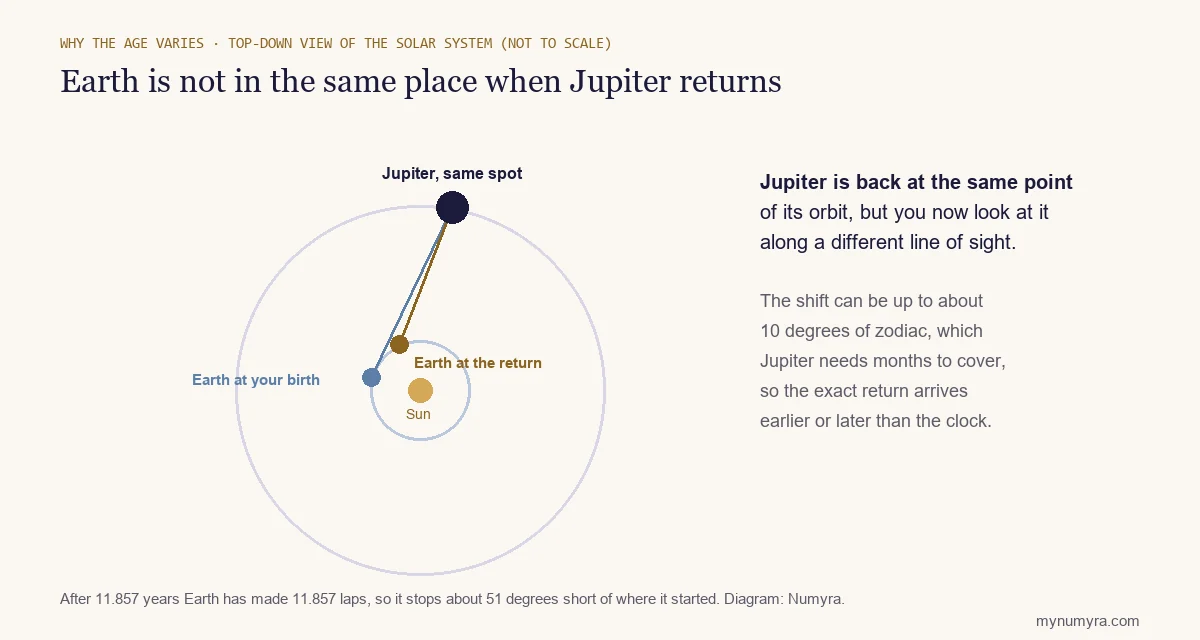
If Jupiter returns on a fixed 11.857-year schedule, why does the first exact return land anywhere from 11.3 to 12.0? Because astrology measures the zodiac from a moving Earth. After one Jupiter orbit Earth has completed 11.857 laps of the Sun, so it ends up about 51° short of where it began. From there it looks at the same point in space along a different line of sight, shifting Jupiter’s apparent position by up to roughly 10° of the zodiac, and Jupiter, creeping near its stations, can take months to cover that. This is the same reason the Saturn return does not land on a fixed age.
Jupiter’s orbit is also an oval, with its closest point to the Sun, 740.6 million km, near 15° Aries and its farthest, 816.4 million km, on the opposite side. It moves faster near the Sun, which is why Jupiter stays in some signs longer than others.
Who is having a Jupiter return in 2026 to 2028
Jupiter is in Cancer until June 29, 2026, in Leo from June 30, 2026 to July 26, 2027 and in Virgo until August 24, 2028, so anyone with natal Jupiter between about 15° Cancer and 25° Libra has a return in this window. This table lists the birth dates, by natal Jupiter sign, whose exact pass falls in 2026 to 2028. Some birth dates have passes in two calendar years (2026 and 2027 for Leo, 2027 and 2028 for Virgo).
| Return | Natal Jupiter in Cancer (2026, before June 30) | Natal Jupiter in Leo (2026 to 2027) | Natal Jupiter in Virgo (2027 to 2028) | Natal Jupiter in Libra (2028) |
|---|---|---|---|---|
| 1st (about 12) | Sep 7, 2013 to Jan 8, 2014 May 2, 2014 to Jul 15, 2014 |
Jul 16, 2014 to Aug 10, 2015 | Aug 11, 2015 to Sep 8, 2016 | Sep 9, 2016 to Sep 15, 2017 |
| 2nd (about 24) | Oct 14, 2001 to Nov 21, 2001 May 24, 2002 to Aug 1, 2002 |
Aug 2, 2002 to Aug 26, 2003 | Aug 27, 2003 to Sep 24, 2004 | Sep 25, 2004 to Oct 2, 2005 |
| 3rd (about 36) | Jun 12, 1990 to Aug 17, 1990 | Aug 18, 1990 to Sep 11, 1991 | Sep 12, 1991 to Oct 10, 1992 | Oct 11, 1992 to Oct 17, 1993 |
| 4th (about 47) | Jun 28, 1978 to Sep 4, 1978 Mar 1, 1979 to Apr 19, 1979 |
Sep 5, 1978 to Feb 28, 1979 Apr 20, 1979 to Sep 28, 1979 |
Sep 29, 1979 to Oct 26, 1980 | Oct 27, 1980 to Nov 2, 1981 |
| 5th (about 59) | Jul 14, 1966 to Sep 27, 1966 Jan 16, 1967 to May 22, 1967 |
Sep 28, 1966 to Jan 15, 1967 May 23, 1967 to Oct 18, 1967 Feb 27, 1968 to Jun 15, 1968 |
Oct 19, 1967 to Feb 26, 1968 Jun 16, 1968 to Nov 15, 1968 Mar 31, 1969 to Jul 15, 1969 |
Nov 16, 1968 to Mar 30, 1969 Jul 16, 1969 to Nov 18, 1969 |
| 6th (about 71) | Jul 31, 1954 to Jun 12, 1955 | Jun 13, 1955 to Nov 16, 1955 Jan 18, 1956 to Jul 7, 1956 |
Nov 17, 1955 to Jan 17, 1956 Jul 8, 1956 to Dec 12, 1956 Feb 20, 1957 to Aug 6, 1957 |
Dec 13, 1956 to Feb 19, 1957 Aug 7, 1957 to Dec 7, 1957 May 2, 1958 to Aug 5, 1958 |
| 7th (about 83) | Aug 18, 1942 to Jun 30, 1943 | Jul 1, 1943 to Jul 25, 1944 | Jul 26, 1944 to Aug 24, 1945 | Aug 25, 1945 to Jan 1, 1946 Mar 24, 1946 to Aug 29, 1946 |
Dates use Jupiter’s position at noon UT, so a birth within a day of a sign change can fall in the next column depending on birth time and place. The Libra column stops at about 25° Libra, the last degree Jupiter reaches by the end of 2028. A return can list two ranges in one row because Jupiter’s retrograde loops carried it back across a sign line: people born March 1 to April 19, 1979, for instance, have natal Jupiter back in Cancer. For the Leo stay itself, a natal degree under 17° is crossed once in 2026, 17° to 27°01′ three times from 2026 into 2027, and above 27°01′ once in July 2027; the dates are in our Jupiter in Leo guide.
As of October 14, 2026, Jupiter is at about 21°52′ Leo (noon UT) and moving forward by about 0.16° a day, so exact passes are under way for natal degrees just ahead of it, and the 22°32′ degree is crossed on October 18. Using CDC and Social Security birth counts for 1994 to 2014, 14.4 million US births from October 14, 2001 to October 2, 2005 are having their second return, with 5.4 million passes in 2026, 5.6 million in 2027 and 5.7 million in 2028 (people with passes in two years count in both). First and third returns are only partly covered by those files, which start in 1994 and end in 2014.
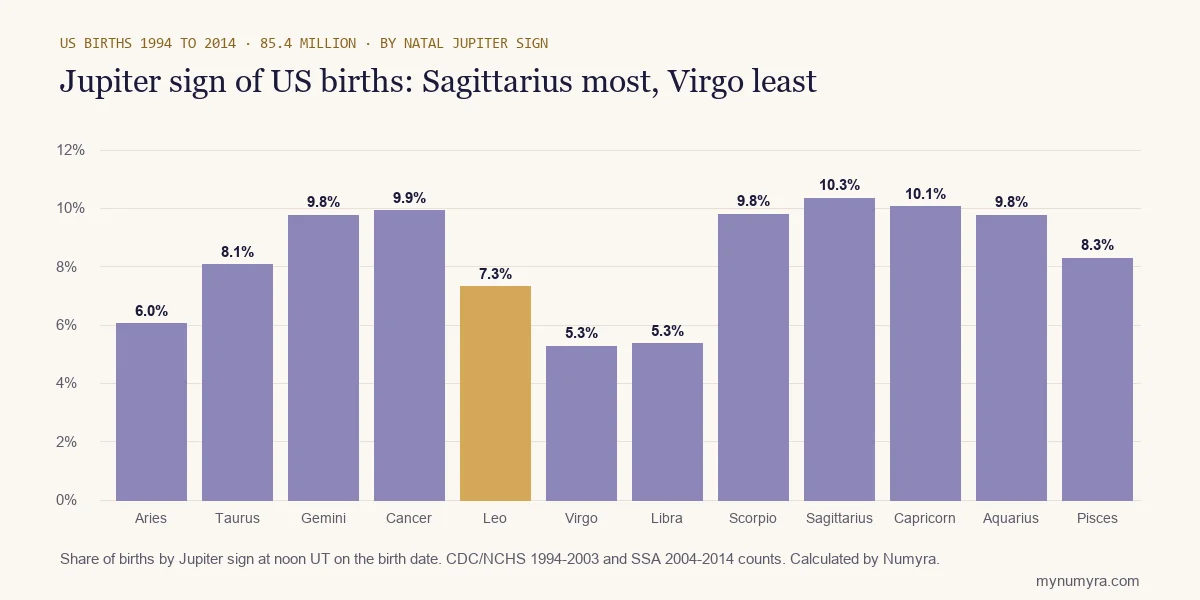
The same files show how unevenly US births fall by Jupiter sign: Sagittarius has the most (10.3%) and Virgo the fewest (5.3%), with Leo at 7.3%. This is a feature of 21 years of data, not a rule, since those years cover only a little under two Jupiter laps.
How to find your own Jupiter return
First, find your natal Jupiter sign and degree. Our Jupiter sign guide lists signs by birth date, and the stellium calculator shows the sign and degree of all ten planets. Second, locate the birth date in the table above, or compare your degree with Jupiter’s position when it crosses that sign. Third, for the exact day, use any ephemeris that lists Jupiter’s longitude by date and find the days it equals your natal degree; because of the retrograde loop, expect one or three. Fourth, remember that a birth time matters most when Jupiter is moving slowly near a station, where a few hours can move a pass by days. Our Jupiter return calculator does steps two and three for you and lists every pass for all seven returns. The astrological houses guide explains which area of life a return is said to touch.
What a Jupiter return traditionally means
In astrology Jupiter stands for growth, generosity, belief and meaning. William Lilly (1647) called it “the greater Fortune,” the more generous of the two traditional benefics. A return is read as the start of a fresh twelve-year chapter: a time to expand, study, travel and take a chance. Popular astrology writing links the first return to the shift from childhood to adolescence, the second to early adulthood, the third and fourth to a more grounded, mid-life stretch, and the later ones to elderhood. Those are modern, loosely sourced readings, and they vary by author.

The older link between Jupiter and twelve years is a division of life, not a return. Ptolemy assigns Jupiter a stage of life of its own, and gives it twelve years:
“Jupiter, taking as his lot the elderly age, again for the space of his own period, twelve years, brings about the renunciation of manual labour, toil, turmoil, and dangerous activity, and in their place brings decorum, foresight, retirement”
Ptolemy, Tetrabiblos, Book IV, chapter 10, p. 447, trans. F. E. Robbins (Loeb Classical Library, 1940)
A note in the Loeb edition says twelve years is close to Jupiter’s real 11.86-year period and was the usual round figure of ancient astronomers. We did not find the modern “return to the natal degree” idea in either Ptolemy or Lilly, so it is better treated as a later habit than an ancient rule. Our guide to the Tetrabiblos covers his system. Whatever you make of the tradition, nothing about Jupiter’s position has been shown to cause events in anyone’s life.
Jupiter return, Saturn return and Jupiter in Leo
The Saturn return is the Jupiter return’s stricter counterpart: it comes at 28.4 to 29.9 with a first exact pass, is read as a test, and has its own guide and Saturn return calculator. The two cycles line up roughly every 60 years, when a fifth Jupiter return and a second Saturn return fall close together. Jupiter in Leo is a transit, not a return, but everyone with natal Jupiter in Leo has a Jupiter return during it. Many astrologers read the return together with that year’s solar return.
Frequently asked questions
At what age is your Jupiter return?
Near 12, 24, 36, 47, 59, 71 and 83. The first exact pass is measured between 11.3 and 12.0, the second between 23.2 and 23.9, the third between 35.2 and 35.9, and the fourth between 47.1 and 47.8.
Is your Jupiter return at 12, 24 and 36?
Roughly, but the first exact pass is in the year you are 11, and the average is 11.7. The common 48 is closer to 47, and 60 to 59.
Can Jupiter return happen three times?
Yes, if its retrograde loop covers your natal degree. 44% of first returns are three passes spread over 6.6 to 8.0 months. It is never two.
How long does a Jupiter return last?
The exact crossing is a single day, or three days within 8 months. Astrologers often count the surrounding year, which is a convention, not a measured length.
Is 2026 a Jupiter return year?
Yes for people with natal Jupiter between about 15° Cancer and Leo, such as those born July 16, 2014 to August 10, 2015 (first return), August 2, 2002 to August 26, 2003 (second) and August 18, 1990 to September 11, 1991 (third).
Is a Jupiter return lucky?
Tradition calls Jupiter “the greater Fortune,” so it is read as favorable, but a return is read as opportunity rather than guaranteed luck. Nothing in this page predicts events.
How many Jupiter returns will I have?
Seven by age 83 or so, and an eighth near age 94.9 (8 x 11.857).
Is a Jupiter return the same as Jupiter in my sign?
No. Jupiter spends about a year in your sign, but the return is the day it reaches your exact degree, as in our Jupiter in Leo guide.
Sources
- Astrodienst. Swiss Ephemeris. All ages, passes and shares on this page were calculated with it by the Numyra Methodology Desk (birth dates 1900 to 2010, noon UT).
- NASA. Jupiter Fact Sheet. Tropical orbit period 4,330.595 days (11.857 years), perihelion and aphelion distances.
- NASA JPL Horizons System. Used to cross-check Jupiter’s longitude at the three passes of the worked example.
- Lilly, William. Christian Astrology. London, 1647. Chapter IX, p. 62. Internet Archive scan of the first edition.
- Ptolemy. Tetrabiblos, Book IV, chapters 8 to 10, trans. F. E. Robbins (Loeb Classical Library), via LacusCurtius.
- FiveThirtyEight. US births data, 1994 to 2014, from the CDC National Center for Health Statistics and the Social Security Administration.