A planetary return is the moment a planet comes back to the zodiac degree it held when you were born, and the time it takes runs from about a year for Mercury and Venus to 29 years for Saturn, while Neptune and Pluto never complete one in a human life. This page puts all of them in one table. For every birth date from 1900 to 2010 we measured the age of each planet’s return and half return: Jupiter comes back at 11.3 to 12.0, Saturn at 28.4 to 29.9 and Uranus at 82.4 to 84.0, while Mercury returns 11.7 to 13.4 months apart, Venus 9.6 or 13.3 months apart and Mars 17 to 23 months apart. We also counted how many exact passes each return makes and how many Americans live long enough to reach each one.
Key takeaways
- Across 40,542 birth dates from 1900 to 2010, the first exact return fell at ages 11.27 to 11.96 for Jupiter, 28.40 to 29.86 for Saturn and 82.37 to 83.95 for Uranus. Neptune and Pluto have no return in a lifetime: theirs come at 162 to 164 and 242 to 247.
- The fast planets do not return “every 88 days” or “every 225 days”. Seen from Earth, Mercury returns 11.7 to 13.4 months apart, Venus either 9.6 or 13.3 months apart (almost never 12) and Mars 17.1 to 23.4 months apart, so you have about 80 Mercury and Venus returns and 42 Mars returns by age 80.
- A “return” is often three or more exact passes: 43.7% of Jupiter’s first returns, 37.9% of Saturn’s and 94.4% of Uranus’s, spread over up to 8, 9 and 10 months. Neptune and Pluto never make fewer than three.
- The Pluto square comes at 35.5 to 65.3 depending on birth year, and the Pluto opposition at 83 to 152, so it comes before age 90 for every birth date from 1924 to 1963 and after 100 for every birth date from 1978 on.
- By the Social Security Administration’s 2023 life table, 41,922 of 100,000 American men and 56,068 of 100,000 women are alive at 83, the age of the Uranus return. Planetary returns are an astrological tradition read for reflection, not a prediction.
In this guide
- What a return, a half return and an exact pass are
- The planetary returns table, Mercury to Pluto
- Mercury, Venus and Mars: a return every year or two
- Jupiter and Saturn: the returns you can plan around
- Chiron, the lunar nodes and Uranus
- Neptune and Pluto: squares and oppositions, not returns
- One pass, three or five: how many times a planet crosses your degree
- Why guides quote different numbers
- How many Americans live to each return
- What astrologers say a return means
- How we measured every age on this page
- Frequently asked questions
What a return, a half return and an exact pass are
Your birth chart records where each planet stood among the 360 degrees of the zodiac when you were born. The planets keep moving, and the moment a transiting planet reaches the same degree again is its return. A half return is the moment it stands exactly opposite that degree, 180 degrees away, which for the slow planets is also called the opposition. The squares, at 90 and 270 degrees, mark the quarter points. This guide uses the tropical zodiac and the planet’s position as seen from Earth, which is how astrology charts it.
An exact pass is one crossing of your degree. A planet moving steadily would cross it once. But from Earth every planet except the Sun and Moon appears to stop, back up and move forward again, so it can cross the same degree three times in a row, and some cross it five. When this page says a return happens “at age 29.1” it means the first exact pass, and the table shows how many passes follow.
Seen from Earth, a planet’s return is not the same as its orbit. NASA gives the tropical orbital period of Mercury as 87.968 days and of Venus as 224.695, but you are watching from a planet that is itself circling the Sun in the same direction, so Mercury and Venus take about a year to return to a natal degree, not 88 or 225 days. For the planets beyond Earth the orbit and the return are close, and the difference is the scatter in the age ranges below.
The planetary returns table, Mercury to Pluto
Every figure for Mercury through Pluto is our own calculation from 40,542 birth dates between January 1, 1900 and December 31, 2010 (Mercury, Venus and Mars: every seventh date, 5,792 births). The “first return” column gives the earliest and latest age at which the first exact pass fell, and “half return” gives the same for the opposition. The Sun, Moon, Chiron and lunar node rows summarise our dedicated guides, which use their own methods. Orbits are NASA’s tropical periods, except the Moon (our lunar return guide), Chiron (JPL) and Pluto (NASA gives only a sidereal figure).
| Planet | Orbit | First return (age) | Half return (age) | Returns by age 80 | Passes at first return | Full guide |
|---|---|---|---|---|---|---|
| Moon | 27.32 days | Every 27 d 5 h to 27 d 12 h | About 13.7 days | About 1,070 | 1 | Lunar return |
| Sun | 365.24 days | Every birthday, within a day or two | About 6 months | 80 | 1 | Solar return |
| Mercury | 87.97 days | 0.89 to 1.12 | 0.40 to 0.58 | 79 or 80 | 1 (91.7%) or 3 (8.3%) | Mercury retrograde |
| Venus | 224.70 days | 0.80 to 1.12 | 0.39 to 0.72 | 79 or 80 | 1 (97.8%) or 3 (2.2%) | Venus retrograde |
| Mars | 686.97 days | 1.43 to 1.95 | 0.65 to 1.30 | 42 | 1 (96.5%) or 3 (3.5%) | Mars retrograde |
| Jupiter | 11.86 years | 11.27 to 11.96 | 4.88 to 6.44 | 6 | 1 (56.3%) or 3 (43.7%) | Jupiter return |
| Saturn | 29.42 years | 28.40 to 29.86 | 12.84 to 16.29 | 2 | 1 (62.1%) or 3 (37.9%) | Saturn return |
| Chiron | 50.7 years (JPL) | 48.4 to 50.9 (births 1900-1980) | Not measured | 1 | 1, 3 or 5, by natal sign | Chiron return |
| Uranus | 83.75 years | 82.37 to 83.95 | 37.98 to 44.48 | 0 (1 if you reach 82 to 84) | 1 (5.6%) or 3 (94.4%) | Uranus opposition |
| Neptune | 163.73 years | 162.30 to 163.96 (beyond a life) | 79.75 to 83.36 | 0 | 3 (76.7%) or 5 (23.3%) | Uranus and Neptune signs |
| Pluto | 247.94 years (sidereal) | 242.33 to 246.94 (beyond a life) | 82.78 to 152.43 | 0 | 3 (53.2%), 5 (46.7%) or 7 (0.1%) | Pluto in Aquarius |
| Lunar nodes | 18.61 years (mean node) | 18.53 to 18.80 (true node) | 9.15 to 9.42 (true node) | 4 | Mostly 1; 4.9% of returns and half returns have 3 or more | Nodal return |
The Sun and Moon are in the table because they are the planets of the shortest cycles: the Sun returns once a year, on or within a day or two of your birthday, and the Moon about every 27.3 days, never less than 27 days 5 hours or more than 27 days 12 hours apart in our lunar return count. Neither ever turns retrograde, so each return is a single pass.
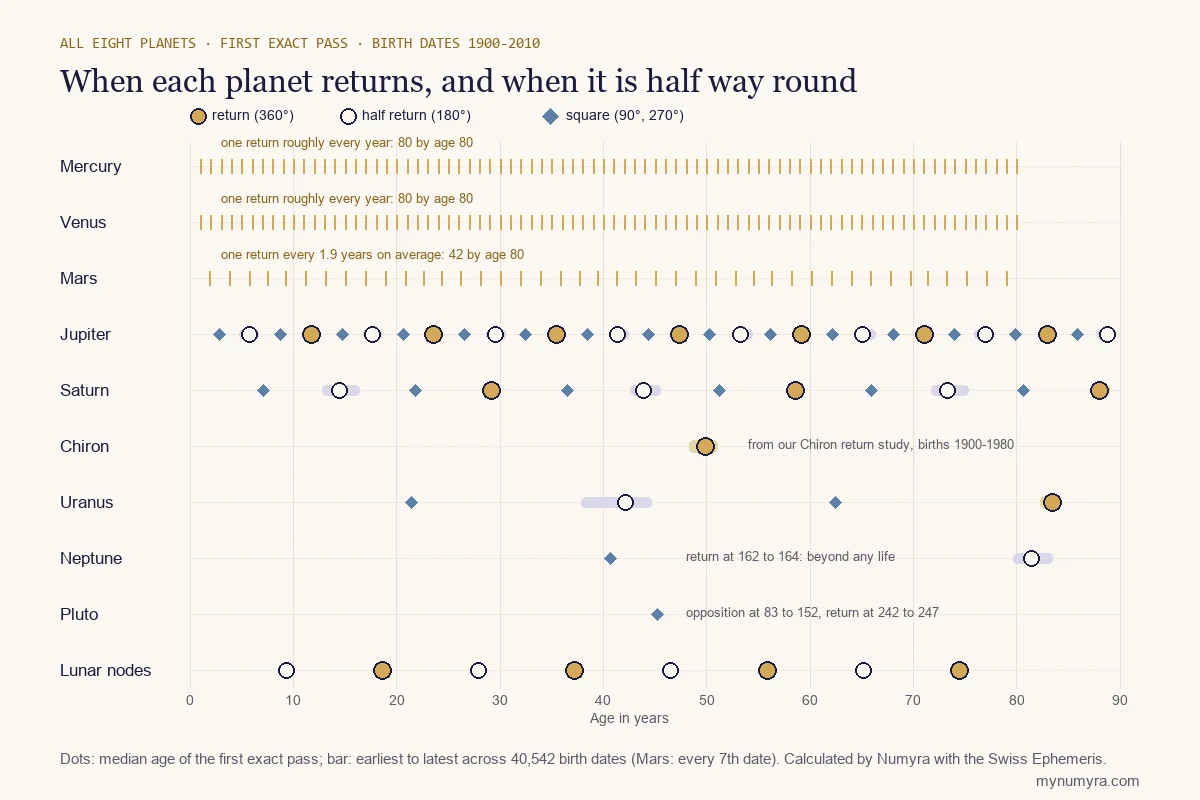
The chart above shows the table as a life: the dots are the median age of the first exact pass, and the bars are the full range across birth dates. Mercury and Venus fill the whole line with yearly returns, Mars marks every second year or so, Jupiter’s seven returns fall near 12, 24, 36, 47, 59, 71 and 83, and Saturn’s three near 29, 59 and 88.
Mercury, Venus and Mars: a return every year or two
The fast planets are the ones most guides describe loosely, so here are the measured numbers. We took each birth date, followed the planet’s apparent position forward, and noted the first exact pass of each of its first 100 returns (55 for Mars).
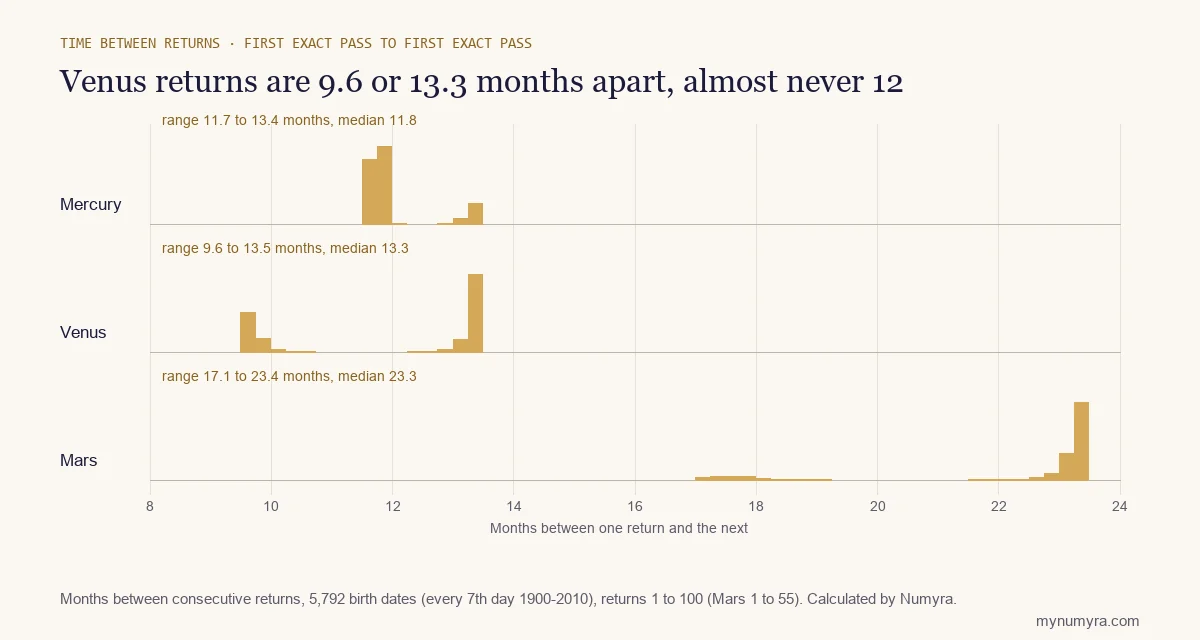
Mercury returns between 11.7 and 13.4 months apart, with a median of 11.8, so the first one falls between ages 0.89 and 1.12, close to your first birthday. Over 80 years you have 79 or 80 of them. About one return in eight is a triple pass (12.0% of those by age 80), spread over a median of 44 days, which is when Mercury’s retrograde loop happens to sit on your natal degree; our Mercury retrograde guide and the 2027 retrograde calendar show where those loops fall.
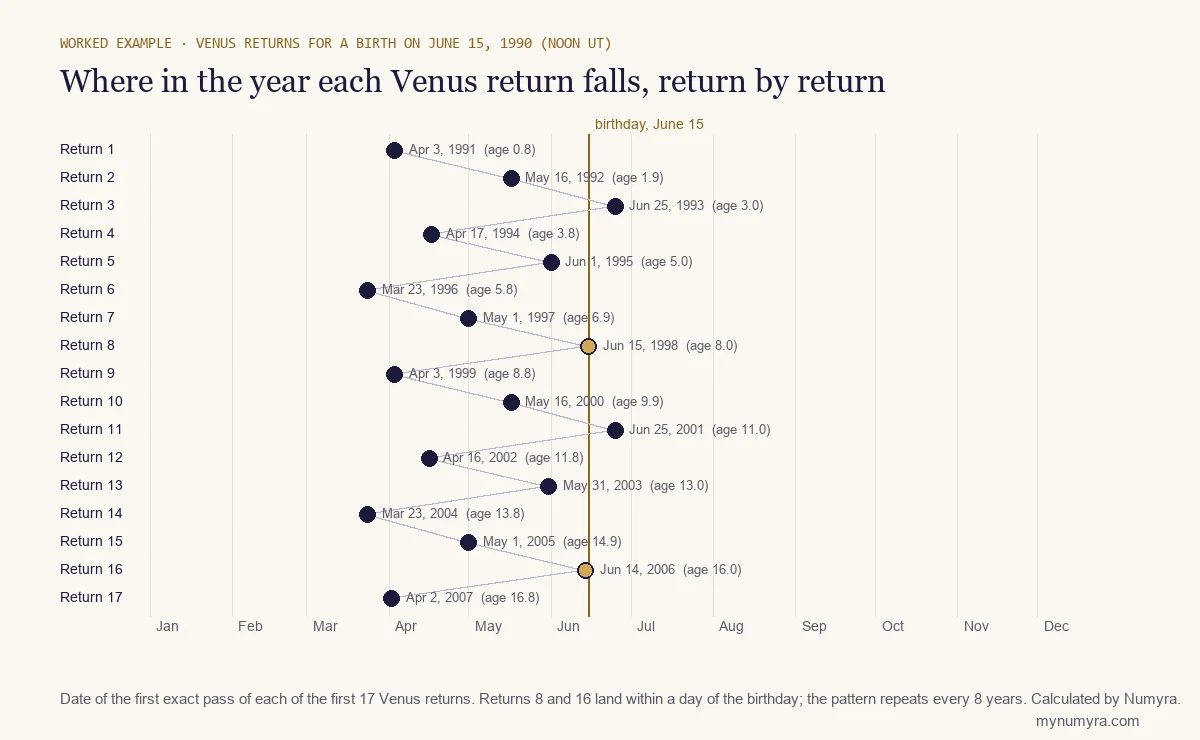
Venus is the surprise. Its returns are not a year apart: 37.4% of the gaps between one return and the next are under 11 months, nearly all close to 9.6, and 60.3% are over 13, nearly all close to 13.3. Only 2.3% fall between 11 and 13 months. The reason is Venus’s eight-year rhythm, where the same pattern of returns repeats. For 95% of the 532,864 pairs of returns we compared, return number n plus 8 fell within half a day of exactly eight years after return n. The worked example below follows someone born on June 15, 1990: the first Venus return is on April 3, 1991, the eighth on June 15, 1998, the birthday itself, and the ninth on April 3, 1999, the same date as the first. Only 2.9% of Venus returns by age 80 are triple passes (2.2% of the first), so the Venus retrograde cycle lands on your own degree only about once in 35 returns.
Mars returns 17.1 to 23.4 months apart, with a median of 23.3 and exactly 42 returns by age 80 for every birth date we sampled. The first return falls between ages 1.43 and 1.95, so it always comes before the second birthday. About one gap in nine is short, 17 to 19 months instead of 23 (11.7% of the total). Every Mars return that is a triple pass follows a short gap, because the first of its three crossings comes about five months early; those make up about a third of the short gaps. Our Mars retrograde guide covers the 2027 loop.
If you want the sign each planet was in rather than the return, the Mercury sign, Venus sign and Mars sign guides tell you how to find it from your birth date. The solar return and lunar return guides cover the two luminaries.
Jupiter and Saturn: the returns you can plan around
Jupiter and Saturn are slow enough that a return is a stretch of months, and the ages are predictable to within a year. Jupiter’s first return falls at 11.27 to 11.96, with a median of 11.75; its second is at 23.2 to 23.9, its third at 35.2 to 35.9 and its fourth at 47.1 to 47.8, with medians of 11.8, 23.6, 35.5, 47.3, 59.2, 71.0 and 83.0 for all seven. Its half return comes at 4.88 to 6.44, near age 6, and 28.3% of those are triple passes. The measured ranges match our Jupiter return guide, which lists every return and who has one in 2026 to 2028, and the Jupiter return calculator gives your own dates.
Saturn’s first return falls at 28.40 to 29.86 with a median of 29.14, so the common “27 to 30” is a wide window around a narrow fact. Its half return, the Saturn opposition, is the wide one: 12.84 to 16.29, a spread of 3.4 years, with 54.1% of birth dates getting three passes. The second return is far tighter, at 58.20 to 58.96, and the third lands at 87.32 to 88.81. Our Saturn return guide and Saturn opposition guide have the year-by-year tables, and the Saturn return calculator and Saturn opposition calculator give exact dates for your birth.
Chiron, the lunar nodes and Uranus
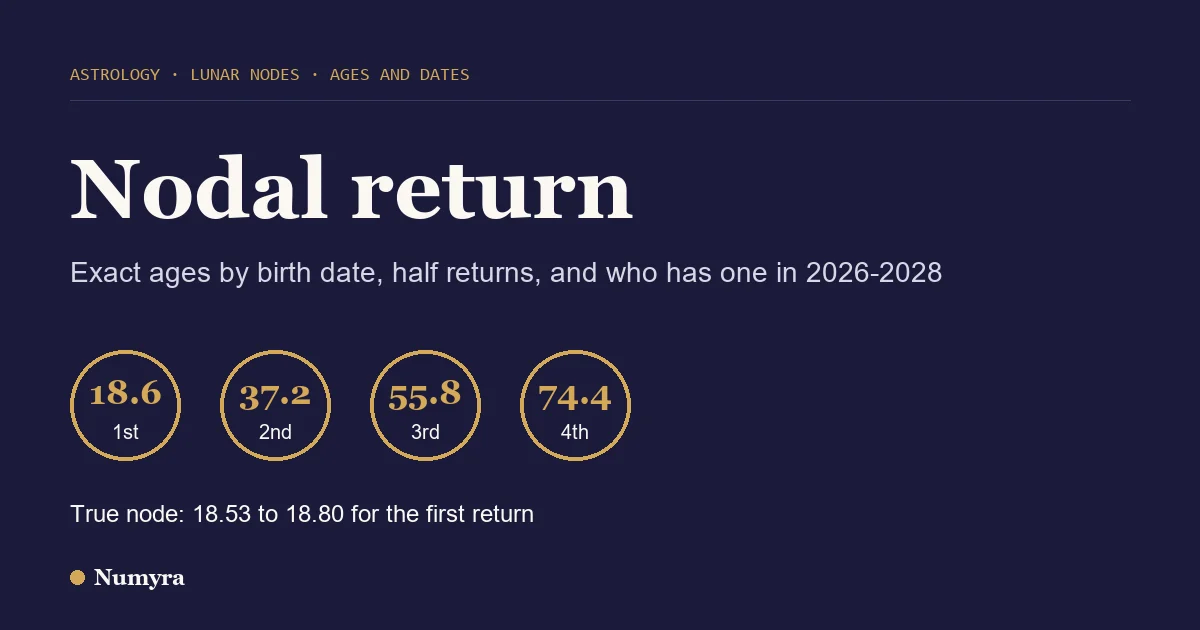
Three more cycles sit between Saturn and Neptune. Chiron, a small icy body that orbits between Saturn and Uranus, returned for the people we measured (births from 1900 to 1980) at 48.4 to 50.9, so “around 50” is a window of two and a half years; the Chiron return guide has the age for every birth year, and Chiron in astrology explains what astrologers read into it. The lunar nodes are not planets but they return too: the mean node at 18.61, 37.23, 55.84 and 74.45 years for everyone, and the true node within about two months of those. The nodal return guide and nodal return calculator cover the half returns near 9, 28, 47 and 65.
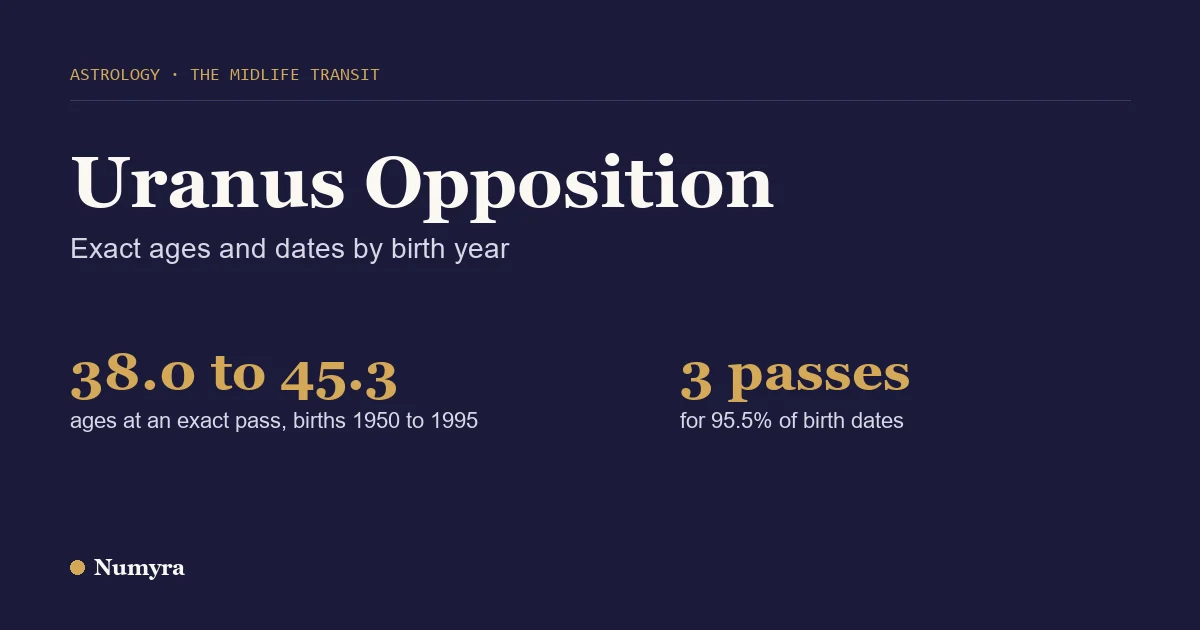
Uranus is the planet astrologers tie to “midlife”. Its square falls at 18.45 to 23.16, near age 21; its opposition at 37.98 to 44.48, with a median of 42.19; its second square at 59.99 to 64.71; and its return at 82.37 to 83.95. For 91% of birth dates the opposition is a triple pass, spread over about 9 or 10 months. The Uranus opposition guide lists the ages by birth year, and the Uranus opposition calculator gives the three dates.
Neptune and Pluto: squares and oppositions, not returns
Neptune orbits the Sun once every 163.7 years by NASA’s tropical figure, and Pluto once every 247.9 (NASA’s sidereal figure), so no one alive has seen either return. What a person can reach is a quarter point. Neptune’s square falls at 38.70 to 42.12 for every birth date and its opposition at 79.75 to 83.36, so the Neptune opposition and the Uranus return both arrive in the early 80s. Pluto is different because its orbit is lopsided (NASA gives an eccentricity of 0.2488): in our ephemeris it covers about 25 degrees in the decade from 1989 and only about 10 in the decades from 1900 or 2100.
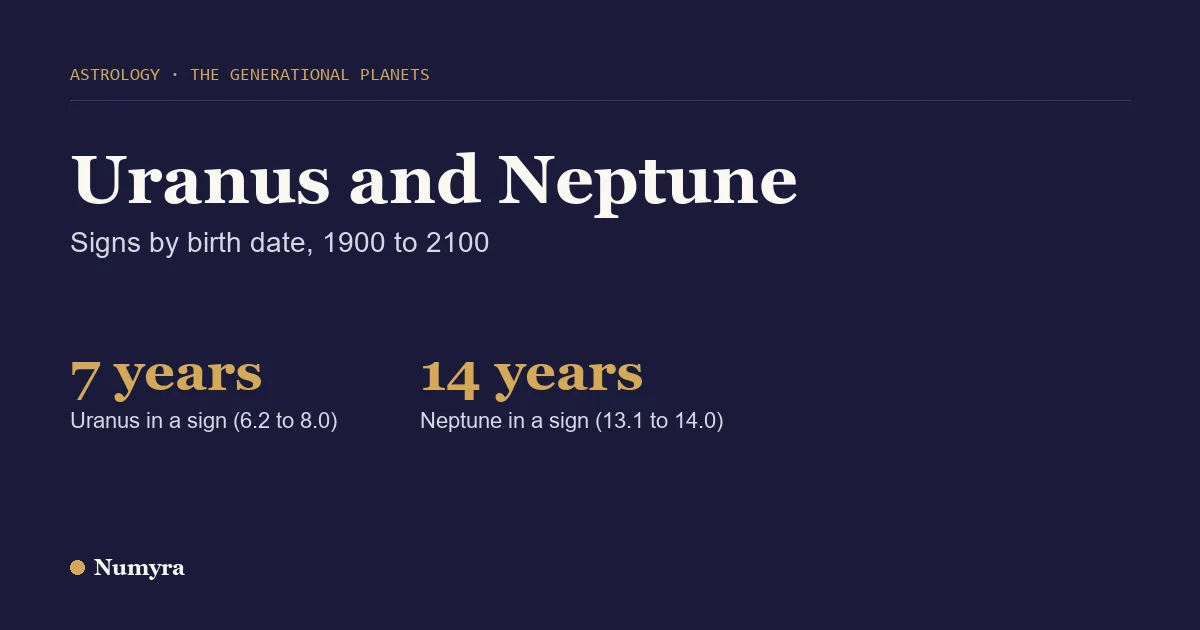
That makes the age of a Pluto aspect depend on the year you were born. The Pluto square falls at 35.46 to 65.26: about 36 for people born around 1969, whose first 36 years take in Pluto’s fastest stretch, and 65 for people born in 1900. The Pluto opposition falls at 82.78 to 152.43. It comes before age 90 for every birth date from 1924 to 1963, but for everyone born from 1978 on it is past 100, and for people born in 2010 it comes at about 151. Our Pluto in Aquarius guide and Uranus and Neptune signs table tell you where those planets sit now.
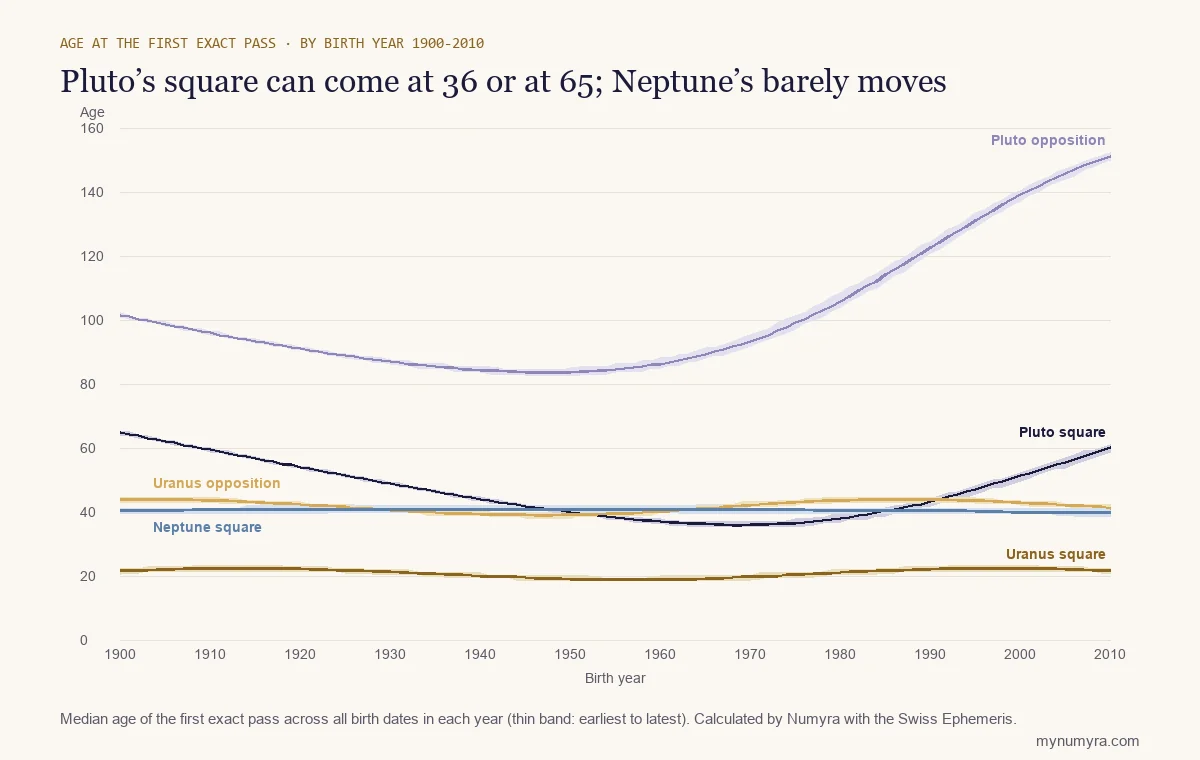
The second table gives the quarter points of every slow planet. Each cell is the earliest and latest first exact pass, with the median in brackets. The Pluto return and Neptune return are computed for completeness only.
| Planet | Square, 90° | Half return, 180° | Square, 270° | Return, 360° |
|---|---|---|---|---|
| Jupiter | 2.40 to 3.25 (2.86) | 4.88 to 6.44 (5.81) | 8.04 to 9.55 (8.79) | 11.27 to 11.96 (11.75) |
| Saturn | 5.72 to 8.21 (7.14) | 12.84 to 16.29 (14.45) | 20.89 to 23.40 (21.83) | 28.40 to 29.86 (29.14) |
| Uranus | 18.45 to 23.16 (21.40) | 37.98 to 44.48 (42.19) | 59.99 to 64.71 (62.43) | 82.37 to 83.95 (83.47) |
| Neptune | 38.70 to 42.12 (40.71) | 79.75 to 83.36 (81.44) | 120.99 to 123.70 (122.23) | 162.30 to 163.96 (163.14) |
| Pluto | 35.46 to 65.26 (45.24) | 82.78 to 152.43 (93.55) | 152.00 to 210.59 (167.49) | 242.33 to 246.94 (245.32) |
One pass, three or five: how many times a planet crosses your degree
Whether you get one crossing or several depends on where the planet’s backward loop falls relative to your degree. We counted every crossing of each return, and the share of first returns with one, three, five or seven passes is below. The slower the planet, the more of its returns are multiple, because its own forward motion is small next to the apparent loop that Earth’s movement draws in the sky.
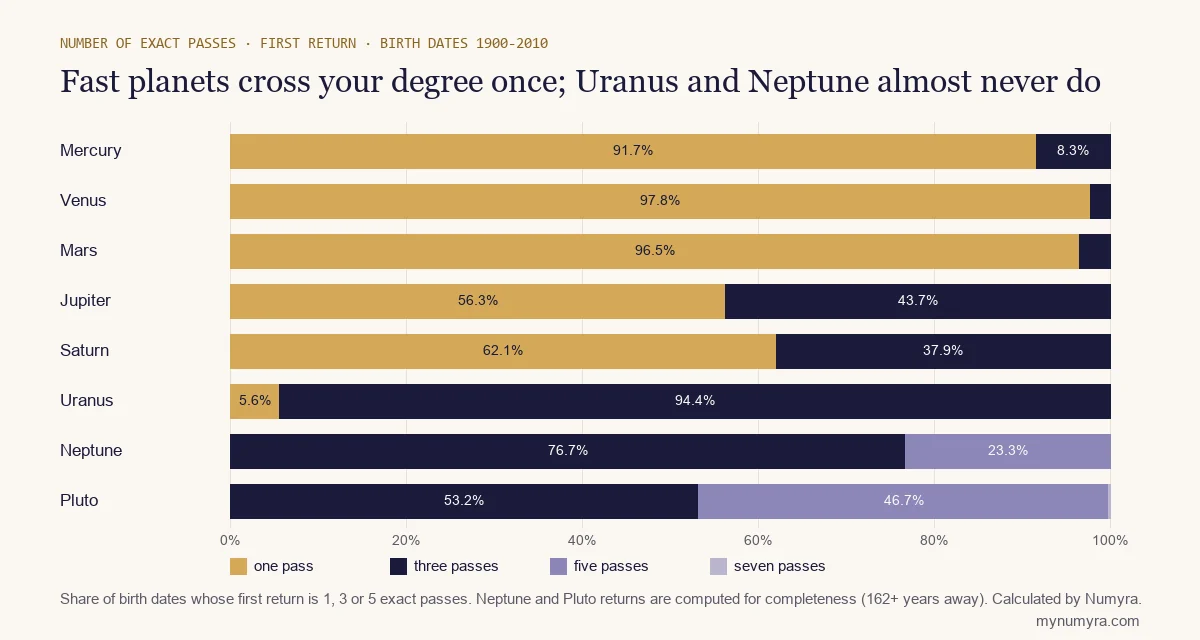
The consequence is that a return is a season, not a day. The median spread between the first and last pass of a triple return is 44 days for Mercury, 84 for Venus, 157 for Mars, 234 for Jupiter, 261 for Saturn, 290 for Uranus and 306 for Neptune, and the longest we found were 243, 273 and 297 days for Jupiter, Saturn and Uranus. Neptune can take 594 days (19.5 months) and the Pluto opposition up to 930 days, over two and a half years.
Why guides quote different numbers
The figures online disagree because they answer different questions. Some give the planet’s orbit, some round to a convenient number, and some count from the moment the planet enters the sign rather than the exact degree. The table sets the common numbers beside what a chart return measures.
| Figure you will see | What it is | Measured for a chart return |
|---|---|---|
| Mercury: 88 days | Orbital period around the Sun (NASA: 87.97 days) | 11.7 to 13.4 months between returns |
| Venus: 225 days | Orbital period (NASA: 224.70 days) | 9.6 or 13.3 months between returns |
| Mars: “every two years” | Rounded from 687 days (1.88 years) | 17.1 to 23.4 months, never as long as two years |
| Jupiter: 12 years | Rounded from 11.86 years | Age 11.27 to 11.96 |
| Saturn: 28 or 29.5 years | Rounded; NASA’s tropical period is 29.42 years | Age 28.40 to 29.86 |
| Uranus: 80 or 84 years | Rounded; NASA’s tropical period is 83.75 years | Age 82.37 to 83.95 |
| Chiron: “around 50” | Orbital period of 50.7 years (JPL: 18,500 days) | Age 48.4 to 50.9 |
Even a published astrology column rounds freely. Monte Farber wrote in Dan’s Papers in 2015:
“Saturn takes 28 years and Uranus takes 80 years”
Monte Farber, “Psychic Thoughts: Planetary Returns”, Dan’s Papers, February 27, 2015
He adds that all the periods are approximate, “give or take a couple of years”, so this is a rounding, not an error. The measured ages are Saturn 28.4 to 29.9 and Uranus 82.4 to 84.0, which is the same information to the month.
How many Americans live to each return
A table of ages invites the question of who gets to them. The Social Security Administration’s 2023 period life table, used in its 2026 Trustees Report, shows how many of 100,000 people born alive in the Social Security area population are still living at each exact age. Applying it to the median age of each return gives the figures below. It is a snapshot of 2023 death rates, not a forecast for anyone born today, but it shows how the cycles fit a life.
| Return or aspect | Median age | Alive at that age, men | Alive at that age, women |
|---|---|---|---|
| Jupiter first return | 11.8 (age 12 used) | 99,183 (99.2%) | 99,316 (99.3%) |
| Saturn return | 29.1 (age 29 used) | 97,354 (97.4%) | 98,593 (98.6%) |
| Uranus opposition | 42.2 (age 42 used) | 94,125 (94.1%) | 97,020 (97.0%) |
| Chiron return | 49.9 (age 50 used) | 91,126 (91.1%) | 95,269 (95.3%) |
| Saturn second return | 58.6 (age 59 used) | 85,440 (85.4%) | 91,661 (91.7%) |
| Jupiter sixth return | 71.0 (age 71 used) | 70,269 (70.3%) | 81,158 (81.2%) |
| Neptune opposition | 81.4 (age 81 used) | 47,960 (48.0%) | 61,946 (61.9%) |
| Uranus return | 83.5 (age 83 used) | 41,922 (41.9%) | 56,068 (56.1%) |
| Saturn third return | 88.1 (age 88 used) | 25,563 (25.6%) | 38,399 (38.4%) |
The Saturn return is reached by 97.4% of men and 98.6% of women, the Chiron return by 91.1% and 95.3%, and the Uranus return by 41.9% and 56.1%. A Neptune opposition at about 81 is reached by 48.0% of men and 61.9% of women, and a third Saturn return by 25.6% of men and 38.4% of women. These are shares of a population, not predictions, and every US life is more than a table.
What astrologers say a return means
Astrologers treat a return as a moment when a cycle is renewed, and they read it through the planet’s nature and the sign and house it occupies. The Astrotheme guide to returns traces the idea to the solar and lunar returns of medieval astrologers such as Abu Ma’shar and notes that the faster returns can refine a short period while the slower ones structure a whole life. It is careful about how far to take any of this:
“A planetary return does not automatically promise a specific event.”
Astrotheme, “Planetary Returns in Astrology”
The Kerykeion astrology guide puts the same idea more gently:
“a return is an open door, not a verdict.”
Kerykeion, “Understanding Planetary Returns”
That is the sensible way to use this page. The dates above are astronomy and can be checked against any ephemeris. What a return is said to mean is a tradition offered for reflection: no test has shown that the ages of planetary returns predict events in people’s lives, and this is educational information, not medical, financial or legal advice. If you want the readings, each planet’s guide linked in the table covers them. For the whole picture of your chart, start with the birth chart calculator, and see how the progressed Moon’s 27-year cycle runs alongside these.
How we measured every age on this page
For each birth date we took the planet’s apparent geocentric longitude in the tropical zodiac at 12:00 UT from the Swiss Ephemeris (Moshier planetary theory, through the pyswisseph library), computed on a grid of 6 hours for Mercury, 12 hours for Venus and Mars and one day for the rest, and unwrapped it into a continuous path of total degrees travelled. A return, half return or square is each moment the path crosses the birth value plus 360, 180, 90 or 270 degrees; we interpolated each crossing and counted all of them. The age is in years of 365.2425 days from the birth date. The birth time of day would move any of these ages by at most half a day, so we used noon for every date.
We checked the ephemeris against NASA’s JPL Horizons system, which uses the DE441 ephemeris, on nine dates between 1900 and 2150 for all eight planets, 72 positions in all. The largest difference was 2.5 arcseconds, about 0.0007 degrees, for Pluto and Mercury in 2150. Our Jupiter, Saturn and Uranus ranges also match the ranges on our Jupiter, Saturn and Uranus calculators, which were measured separately. The Pluto square, opposition and return values for the latest birth dates run to the year 2257, beyond our JPL check at 2150, so they are projections. The Chiron figures come from our Chiron guide and use the full Swiss Ephemeris files rather than Moshier, with first passes counted from age 25 for births 1900 to 1980, and the node figures use the true node as in our nodal return guide.
Two further limits. Mercury, Venus and Mars use every seventh birth date because they need 100 returns each, so their ranges are for 5,792 dates rather than 40,542; the shares of triple passes are measured on those. And “first return” means the first exact pass: if you want the last, add the spread from the passes section.
Frequently asked questions
What is a planetary return?
The moment a planet, seen from Earth, comes back to the exact zodiac degree it occupied at your birth. Astrologers cast or read a chart for that moment. The Sun’s return happens every year, Saturn’s about every 29 years.
At what age does each planetary return happen?
The first exact return falls at 0.89 to 1.12 for Mercury, 0.80 to 1.12 for Venus, 1.43 to 1.95 for Mars, 11.27 to 11.96 for Jupiter, 28.40 to 29.86 for Saturn, about 48.4 to 50.9 for Chiron and 82.37 to 83.95 for Uranus. Neptune and Pluto return at about 163 and 245, beyond a human life.
How often is a Venus return?
Every 9.6 or 13.3 months, depending on where you are in Venus’s eight-year pattern, and in 95% of cases the pattern repeats to within half a day after eight years. The average gap is 12 months, but almost no single gap is 12.
How often is a Mars return?
About every 23 months. Across our sample the gap between one Mars return and the next ranged from 17.1 to 23.4 months, with a median of 23.3, and you have 42 Mars returns by age 80. The first comes before your second birthday.
What is a half return?
The moment a transiting planet is exactly opposite its natal position. For Saturn it comes at 12.8 to 16.3, for Uranus at 38.0 to 44.5 and for Neptune at 79.8 to 83.4. Astrologers call it an opposition, and for the lunar nodes a reversal.
Why does a planet cross the same degree three times?
Because every planet except the Sun and Moon appears to move backward for a few months as Earth overtakes or is overtaken by it. If that backward loop covers your degree, the planet crosses it going forward, backward and forward again. This happens for 43.7% of Jupiter’s first returns and 94.4% of Uranus’s.
Does everyone have a Uranus, Neptune or Pluto return?
Only the Uranus return is within reach, at 82.4 to 84.0, which the 2023 Social Security life table has 41.9% of American men and 56.1% of women living to see. Neptune returns at 162 to 164 and Pluto at 242 to 247, so no one has a personal return of either.
Which planetary return matters most?
No test ranks them. Astrologers traditionally weight the slow ones, Saturn, Jupiter and Uranus, because they mark long stretches of life, and read the fast ones as short rhythms. Astrotheme says not all returns carry the same weight.
Do planetary returns predict events?
No test has shown that they do. The ages and dates are astronomical facts; what they mean is an interpretive tradition, offered for reflection and not as a prediction.
How do I find my own planetary returns?
Use our calculators for the Jupiter return, Saturn return, Saturn opposition, Uranus opposition and nodal return, which give exact dates from your birth date. The birth chart calculator gives the natal degrees.
Sources
- NASA. Planetary Fact Sheets (Mercury to Pluto): tropical and sidereal orbital periods, including Mercury 87.968 days, Venus 224.695, Mars 686.972, Jupiter 4,330.595, Saturn 10,746.940, Uranus 30,588.740 and Neptune 59,799.900 tropical days, and Pluto 90,560 sidereal days.
- NASA JPL. Small-Body Database, 2060 Chiron: orbital period 18,500 days.
- NASA JPL. Horizons On-Line Ephemeris System (DE441), used to check 72 planet positions from 1900 to 2150.
- Astrodienst. Swiss Ephemeris, Moshier mode, for all planet positions (calculations by the Numyra Methodology Desk).
- Social Security Administration. Actuarial Life Table, 2023 period life table used in the 2026 Trustees Report.
- Monte Farber. “Psychic Thoughts: Planetary Returns.” Dan’s Papers, February 27, 2015.
- Astrotheme. “Planetary Returns in Astrology.”
- Kerykeion. “Understanding Planetary Returns.” Learn Astrology.