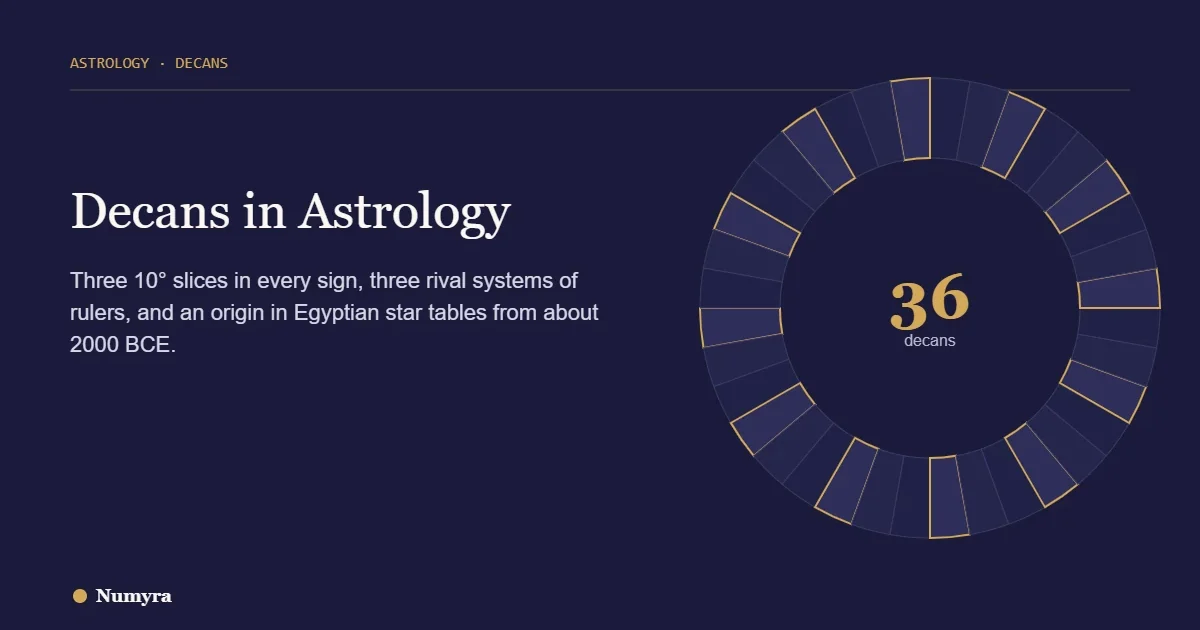
A decan is one third of a zodiac sign: a 10° slice, covering roughly ten days of the year. Every sign has three, so the zodiac holds 36 in all, and each one is given its own ruling planet or sign to shade the sign’s meaning. The idea is far older than the zodiac itself. It began as 36 star groups painted inside Egyptian coffins around 2000 BCE, and the three ways astrologers assign decan rulers today come from three different points in that long history.
Key takeaways
- Each sign splits into three decans: 0° to 9°59′, 10° to 19°59′ and 20° to 29°59′. Your decan depends on how far through your Sun sign the Sun was when you were born.
- There are three systems for decan rulers: the Chaldean “faces” of traditional astrology, the triplicity system most modern sites use, and the sign-based scheme of the Roman poet Manilius.
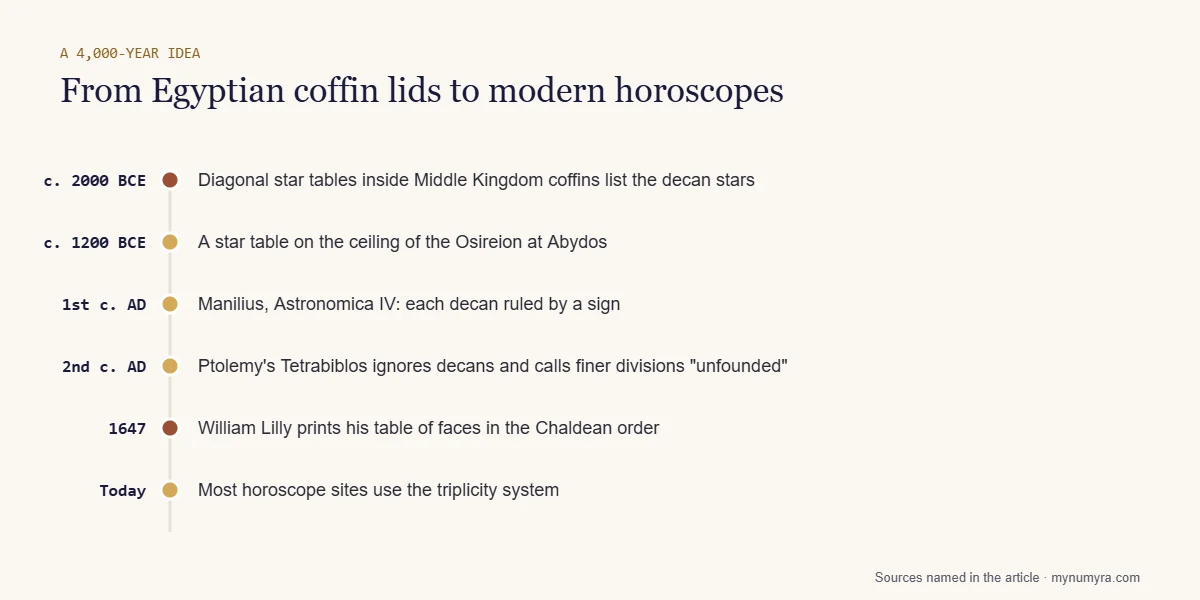
- The decans started as Egyptian stars. Diagonal star tables painted inside coffins date to around 2000 BCE, according to McMaster University’s Ancient Egyptian Astronomy database.
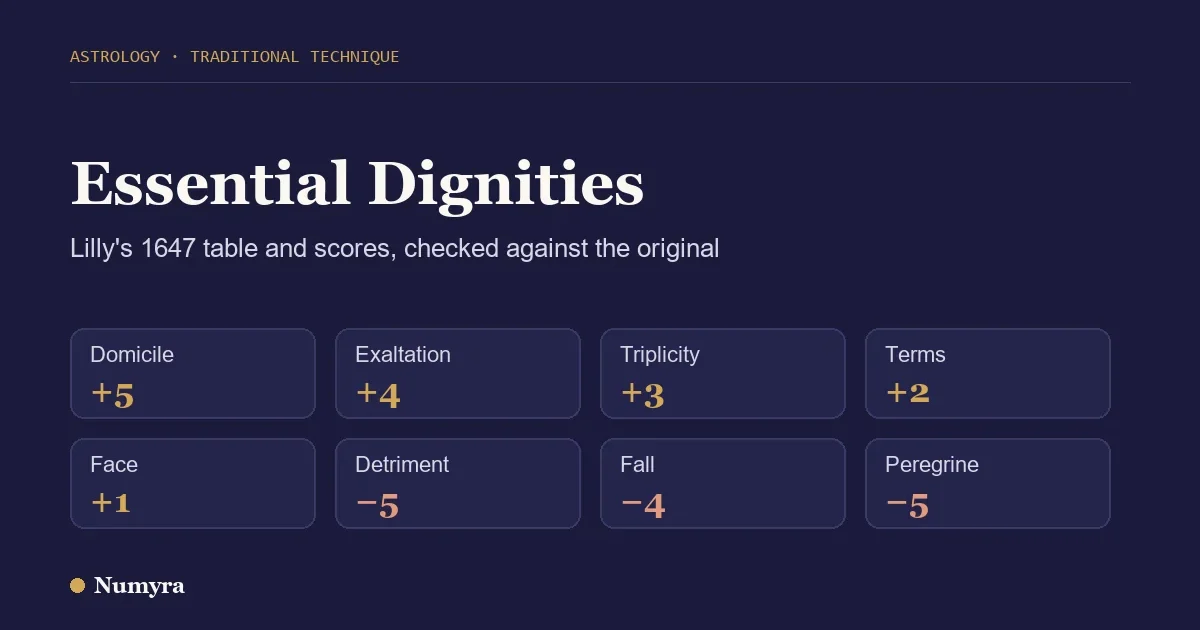
- Ptolemy never mentions decans. The “according to Ptolomy” label on William Lilly’s famous 1647 table of faces is a later attribution.
- Decan dates shift by a day between years. We calculated every decan start from 1990 to 2030 so you can see which date is typical and which ones vary.
- This is a cultural tradition presented for reflection, not a prediction or advice of any kind.
In this guide
- What a decan is
- How to find your decan
- Decan dates for all 12 signs
- What decan are we in today?
- Three ways to assign decan rulers
- The Chaldean faces
- The triplicity system
- Manilius and the decans ruled by signs
- Where decans come from: Egyptian star tables
- What Ptolemy actually said
- All 36 decans: rulers in every system
- The decans of each sign, traditionally read
- How astrologers use decans today
- Frequently asked questions
What a decan is
The zodiac is a 360° circle divided into twelve 30° signs. Divide each sign into three equal parts and you get 36 decans of 10° each. Since the Sun moves about one degree a day, it spends roughly ten days in each decan, which is where the name comes from: deka is Greek for ten.
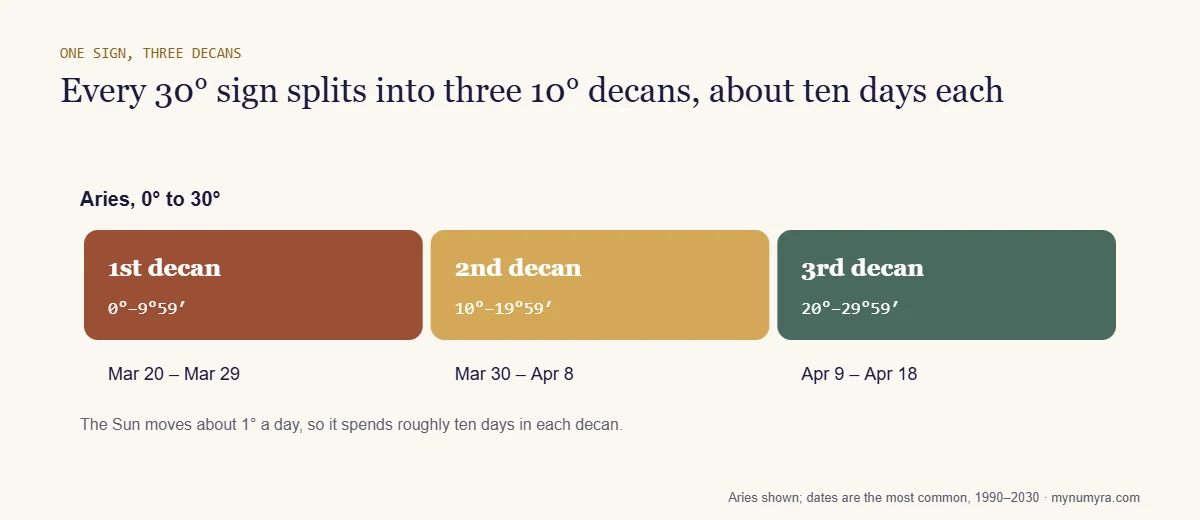
Older English texts use other words for the same thing. William Lilly’s Christian Astrology (1647) calls a decan a “Decanate, Decurie or Face”, and “face” is still the usual term in traditional astrology. The 1697 English translator of the Roman poet Manilius coined “the Tenths”. Whatever the name, the idea is the same: a decan gives a sign three different moods, so that someone born early in Aries is not read exactly like someone born at its end.
A decan does not replace your Sun sign. In the usual reading it refines it, adding the flavor of a second planet or sign on top of the sign’s own character, the way your Moon and Rising signs add layers to the Sun.
How to find your decan
Your decan is set by your Sun’s exact position in its sign:
- First decan: the Sun at 0° to 9°59′ of the sign
- Second decan: 10° to 19°59′
- Third decan: 20° to 29°59′
The quickest way to get that degree is our Birth Chart calculator, which shows how many degrees into its sign your Sun was. If you only know your birthday, the date table below will usually be enough. If you were born within a day of a decan change, though, the year and your birth time decide it, just as they do for birthdays on a sign’s first day.
The same method works for any planet. Astrologers sometimes speak of the decan of your Moon, Venus or Rising sign; you just need that point’s degree instead of the Sun’s.
Decan dates for all 12 signs
Most decan tables give one fixed set of dates, but the Sun reaches each 10° mark at a slightly different time every year, because the calendar year is not exactly 365 days. So we calculated the moment the Sun entered every decan in every year from 1990 to 2030, using the Swiss Ephemeris and US Eastern time, and list the most common start date for each:
| Sign | 1st decan (0°–9°) | 2nd decan (10°–19°) | 3rd decan (20°–29°) |
|---|---|---|---|
| Aries | March 20 – March 29 | March 30 – April 8 | April 9 – April 18 |
| Taurus | April 19 – April 29 | April 30 – May 9 | May 10 – May 19 |
| Gemini | May 20 – May 30 | May 31 – June 9 | June 10 – June 20 |
| Cancer | June 21 – June 30 | July 1 – July 11 | July 12 – July 21 |
| Leo | July 22 – August 1 | August 2 – August 11 | August 12 – August 21 |
| Virgo | August 22 – September 1 | September 2 – September 11 | September 12 – September 21 |
| Libra | September 22 – October 2 | October 3 – October 12 | October 13 – October 22 |
| Scorpio | October 23 – November 1 | November 2 – November 11 | November 12 – November 21 |
| Sagittarius | November 22 – November 30 | December 1 – December 10 | December 11 – December 20 |
| Capricorn | December 21 – December 30 | December 31 – January 9 | January 10 – January 19 |
| Aquarius | January 20 – January 28 | January 29 – February 7 | February 8 – February 17 |
| Pisces | February 18 – February 27 | February 28 – March 9 | March 10 – March 19 |
Some start dates are almost fixed: the Sun entered the first decan of Aries on March 20 in 38 of the 41 years we checked, and the second decan of Capricorn on December 31 in 39 of them. Others are close to a coin toss. The second decan of Libra began on October 3 in 22 years and October 2 in 19, and the first decan of Taurus began on April 19 in 25 years and April 20 in 16. If your birthday is one of these swing days, use your exact Sun degree.

What decan are we in today?
As this guide was last checked on October 2, 2026, the Sun was at about 9.6° Libra, at the very end of Libra’s first decan. It entered Libra’s second decan at about 04:45 UT on October 3, 2026 (12:45 a.m. Eastern time). Each decan lasts about ten days, so the table above tells you which one is current on any date: find today’s date in the row for the current Sun sign.
Three ways to assign decan rulers
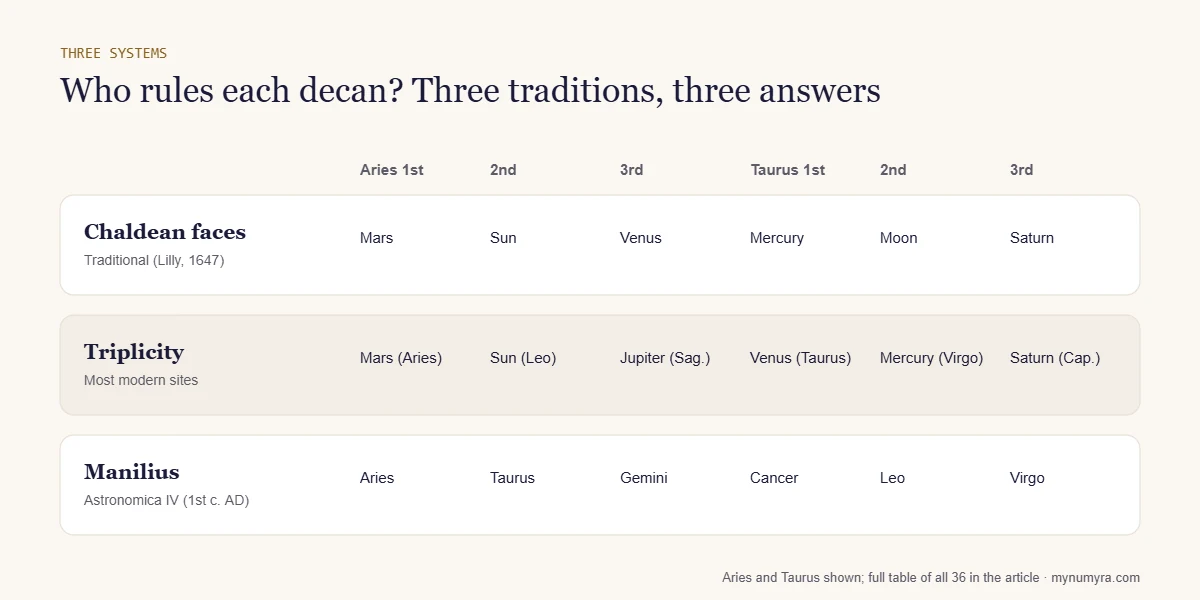
Every source agrees on what a decan is. They disagree on who rules it. There are three systems in real use, and most pages online show only one or two:
| System | Rulers | Aries example | Where it comes from |
|---|---|---|---|
| Chaldean faces | The seven classical planets in a repeating order | Mars, Sun, Venus | Hellenistic astrology; the standard in Lilly (1647) and traditional astrology |
| Triplicity | The three signs of the same element, in zodiac order | Aries (Mars), Leo (Sun), Sagittarius (Jupiter) | Used by most modern horoscope sites |
| Manilius | Signs, not planets, running through the zodiac | Aries, Taurus, Gemini | The Roman poet Manilius, Astronomica book IV (1st century AD) |
The systems agree on very little. The triplicity system always gives a sign’s first decan to the sign itself; Manilius does that only for Aries and Libra; and the Chaldean faces follow a logic of their own. That is why two decan readings for the same birthday can sound so different: they may simply be using different rulers. When you read about your decan, check which system the writer uses.
The Chaldean faces
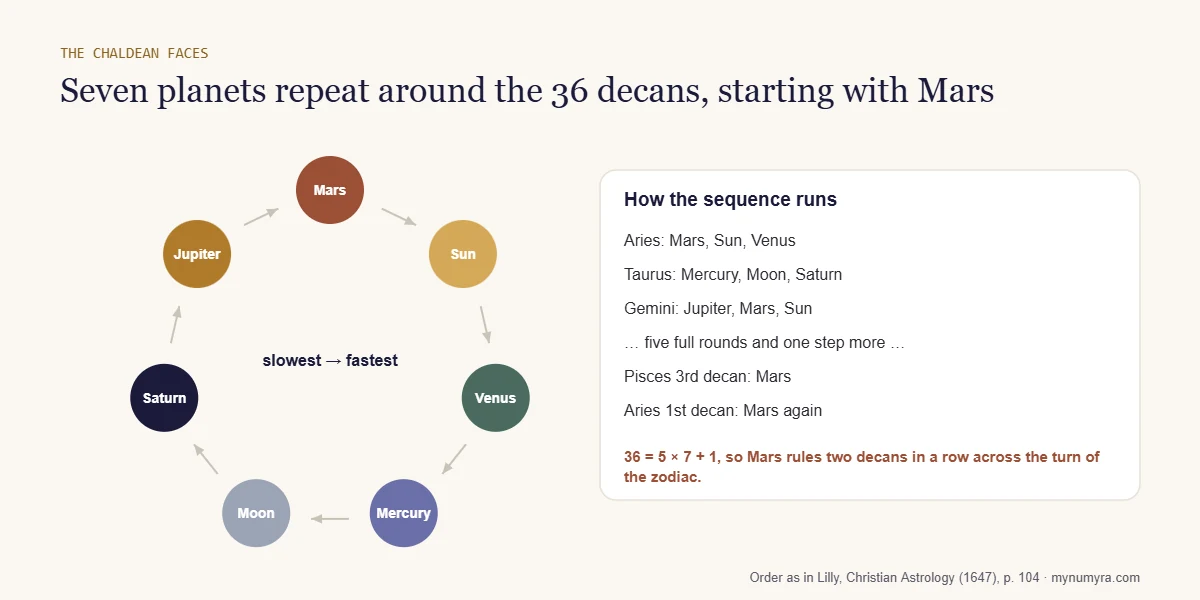
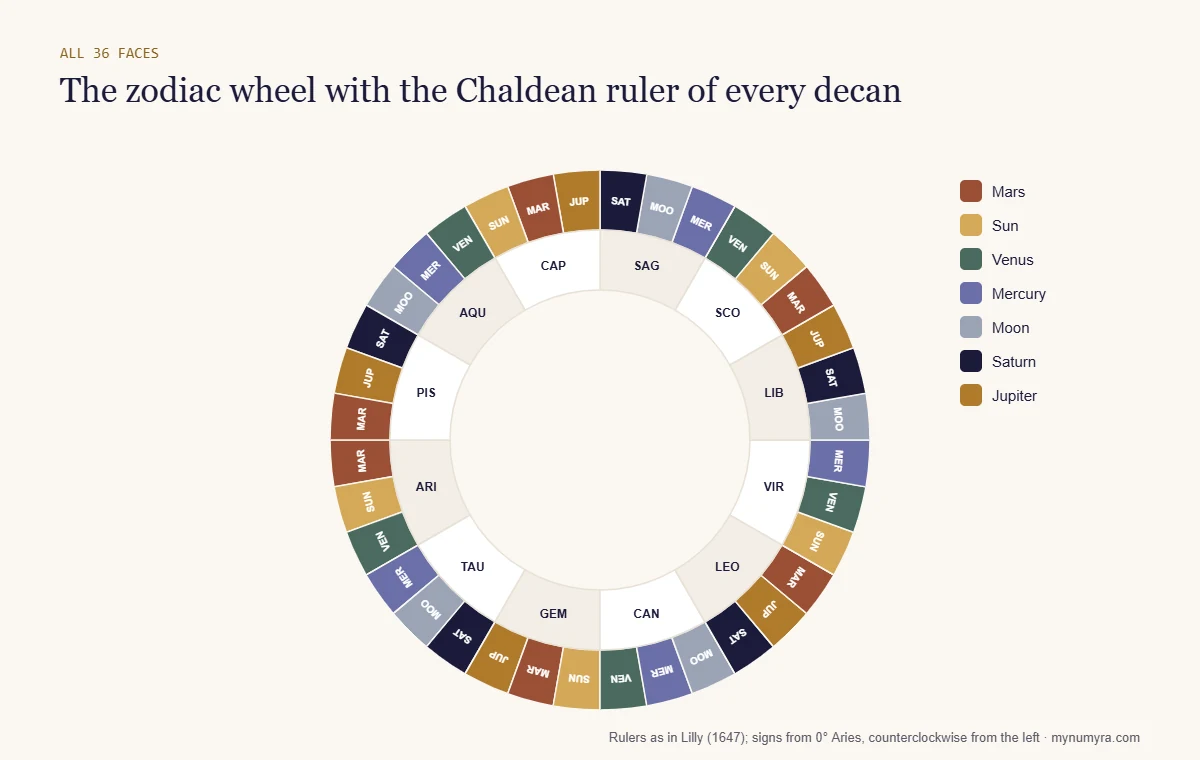
The oldest planetary system lists the seven visible planets in the so-called Chaldean order, from slowest to fastest as seen from Earth: Saturn, Jupiter, Mars, the Sun, Venus, Mercury and the Moon. The faces start with Mars at 0° Aries and then simply follow that order, decan by decan, around the zodiac: Mars, the Sun, Venus for Aries; Mercury, the Moon, Saturn for Taurus; Jupiter, Mars, the Sun for Gemini, and so on.
Seven planets do not divide evenly into 36 decans. The sequence runs five full times and one step further, so it ends where it began: the last decan of Pisces is ruled by Mars, and so is the first decan of Aries. Mars gets two consecutive faces across the turn of the zodiac year, the only planet that does.
In traditional astrology, a planet in its own face gains a small amount of strength. Lilly describes it in Christian Astrology:
“If any Planet be in his Decanate, Decurie or Face, as ♂ in the first ten degrees of ♈, or ☿ in the first ten degrees of ♉, he is then allowed one essentiall dignity.”
— William Lilly, Christian Astrology (London, 1647), p. 103
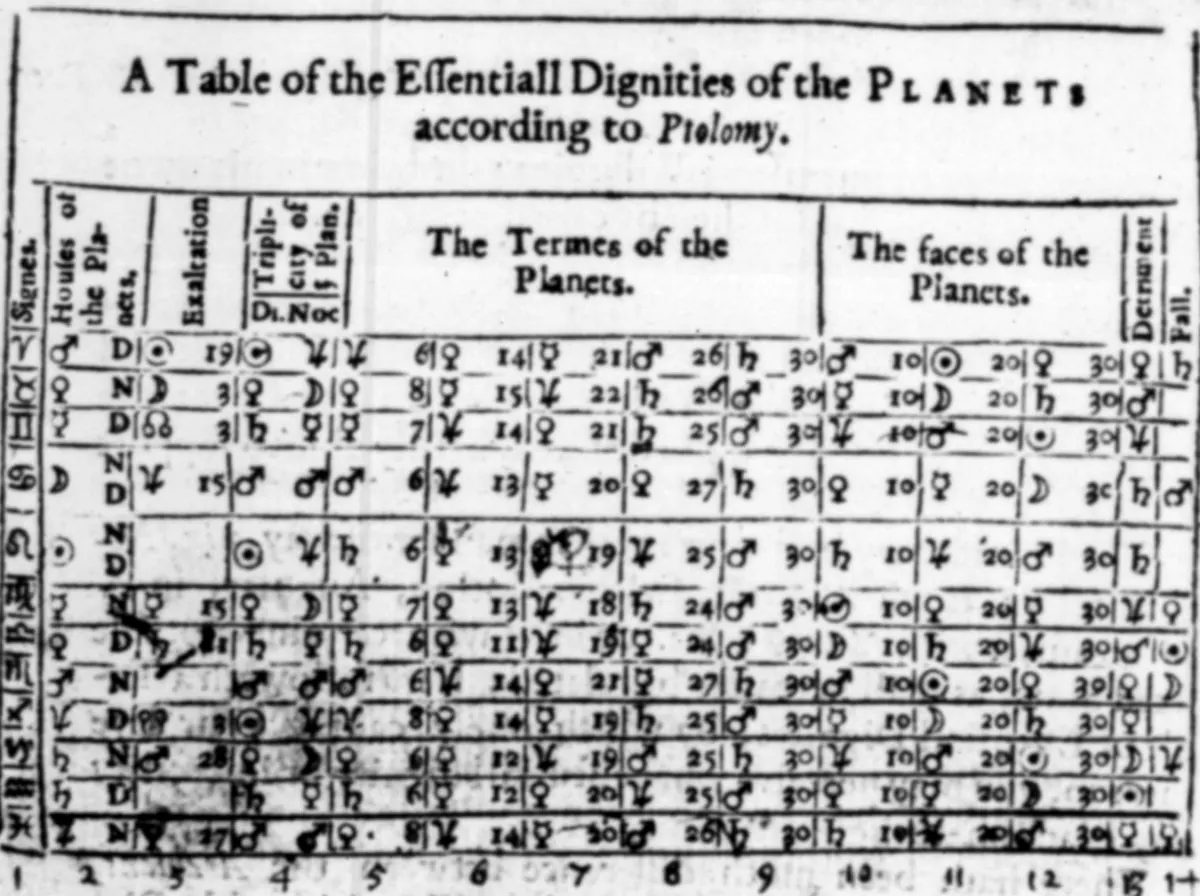
One point is the smallest dignity on Lilly’s scale, and he was blunt about how little it is worth on its own: a planet with no other dignity, “but by being in his Decanate or Face, is almost like a man ready to be turned out of doores, having much adoe to maintaine himselfe in credit and reputation.” His table on the next page lists the faces for every sign, and every one of them follows the Chaldean order.
The triplicity system
The system you will meet on most modern horoscope sites gives each decan to one of the three signs of the sign’s own element, in zodiac order. For a fire sign like Aries, the three decans go to the three fire signs: Aries, Leo and Sagittarius, ruled by Mars, the Sun and Jupiter. For Taurus, an earth sign, they go to Taurus, Virgo and Capricorn, ruled by Venus, Mercury and Saturn.
Its appeal is that it is easy to remember and stays inside the sign’s element, so every decan of a water sign still reads as watery; our guide to the four elements and three modalities explains why element matters so much. Modern writers often substitute the outer planets for the traditional rulers: Pluto for Scorpio, Uranus for Aquarius and Neptune for Pisces. So the third decan of Cancer, for example, is “ruled by Neptune” in some modern tables and by Jupiter in older ones. The table of all 36 decans below shows both.
Manilius and the decans ruled by signs
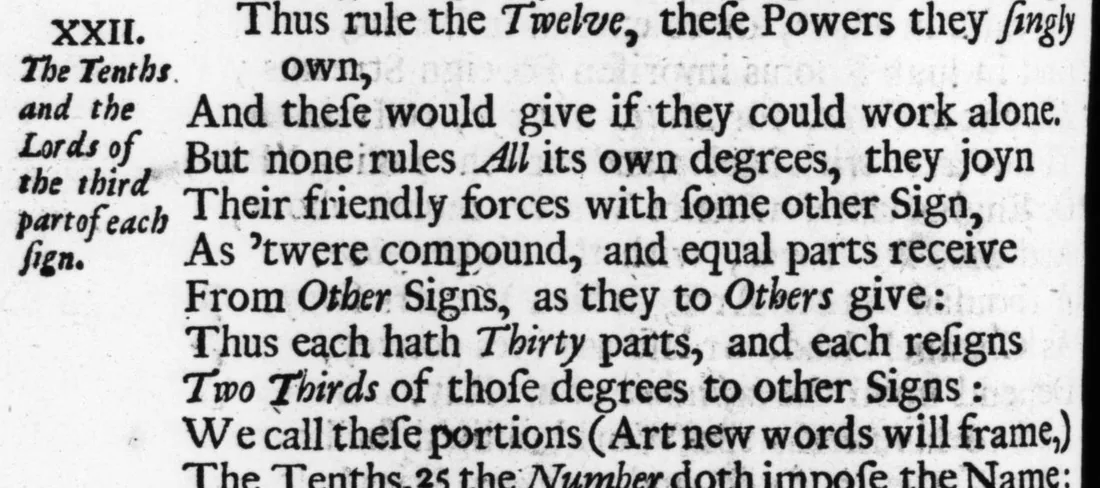
The third system is the oldest one written down in a Western astrological text, and almost nobody uses it now. In the fourth book of his Astronomica, written in the early 1st century AD, the Roman poet Marcus Manilius gave each decan to a sign rather than a planet. The first English translation, by Thomas Creech in 1697, coined a name for the portions:
“Thus each hath Thirty parts, and each resigns
Two Thirds of those degrees to other Signs:
We call these portions (Art new words will frame,)
The Tenths, the Number doth impose the Name.”
— Manilius, Astronomica IV, trans. Thomas Creech, The Five Books of M. Manilius (London, 1697), p. 16
Creech’s note explains that the word answers to Manilius’s Latin decanica, which “signifies Ten Degrees, and the Decanus is Lord of Ten Degrees.” The scheme itself is simple. Aries “governs the First Ten of his Degrees: But next the Bull, and next the Twins do claim the second, and third Portions of the Ram.” Taurus then hands its three decans to Cancer, Leo and Virgo, Gemini to Libra, Scorpio and Sagittarius, and so on: the 36 decans simply run through the twelve signs three times in order. So each sign ends up ruling exactly three decans, spaced four signs apart: Aries, for example, rules the first decans of Aries, Leo and Sagittarius.
Where decans come from: Egyptian star tables
Decans are much older than the twelve signs of the zodiac. In ancient Egypt they were stars. McMaster University’s Ancient Egyptian Astronomy database defines a decan as “a significant star or asterism observed and recorded by ancient Egyptian astronomers,” and the oldest records of them are the diagonal star tables painted inside coffins. As the database’s page on diagonal star tables puts it, “All but one of these tables occur inside rectangular coffins from the beginning of the Middle Kingdom (around 2000 BCE).”
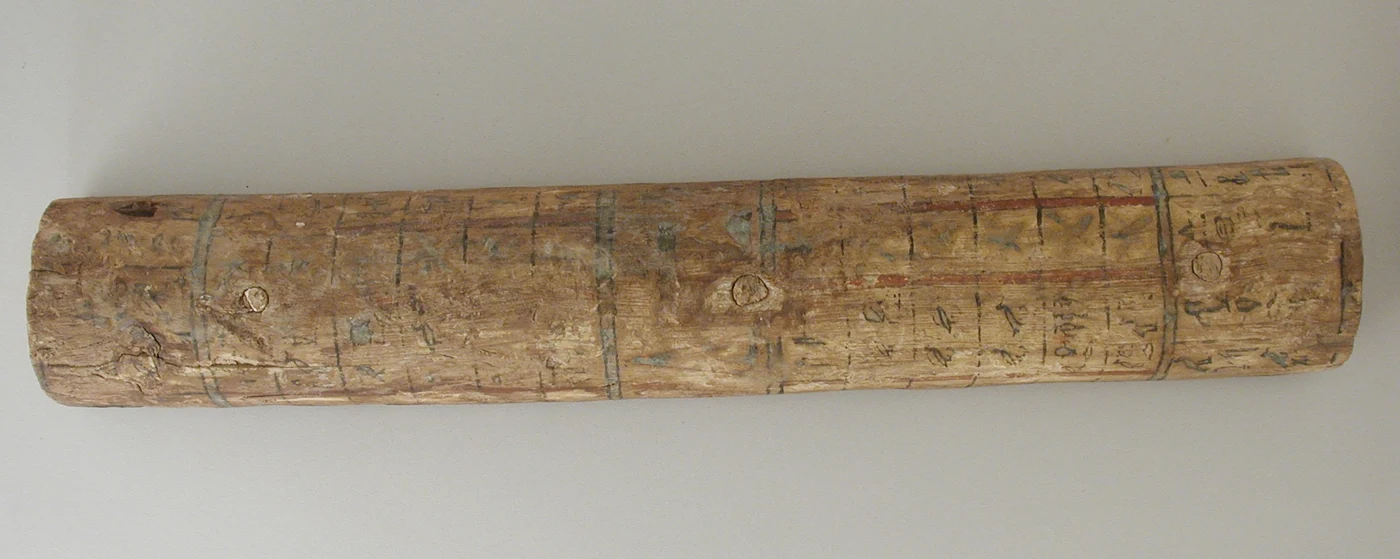
The tables are grids: each column corresponds to a ten-day “decade” of the Egyptian civil calendar, and each cell names a decan star, so that the names step diagonally across the grid as the year goes on. The one exception is a table on the ceiling of the Osireion, a New Kingdom temple at Abydos, from around 1200 BCE. The database prefers the neutral term “diagonal star table” over the older “star clock”, because nobody can be sure exactly how the Egyptians used them.
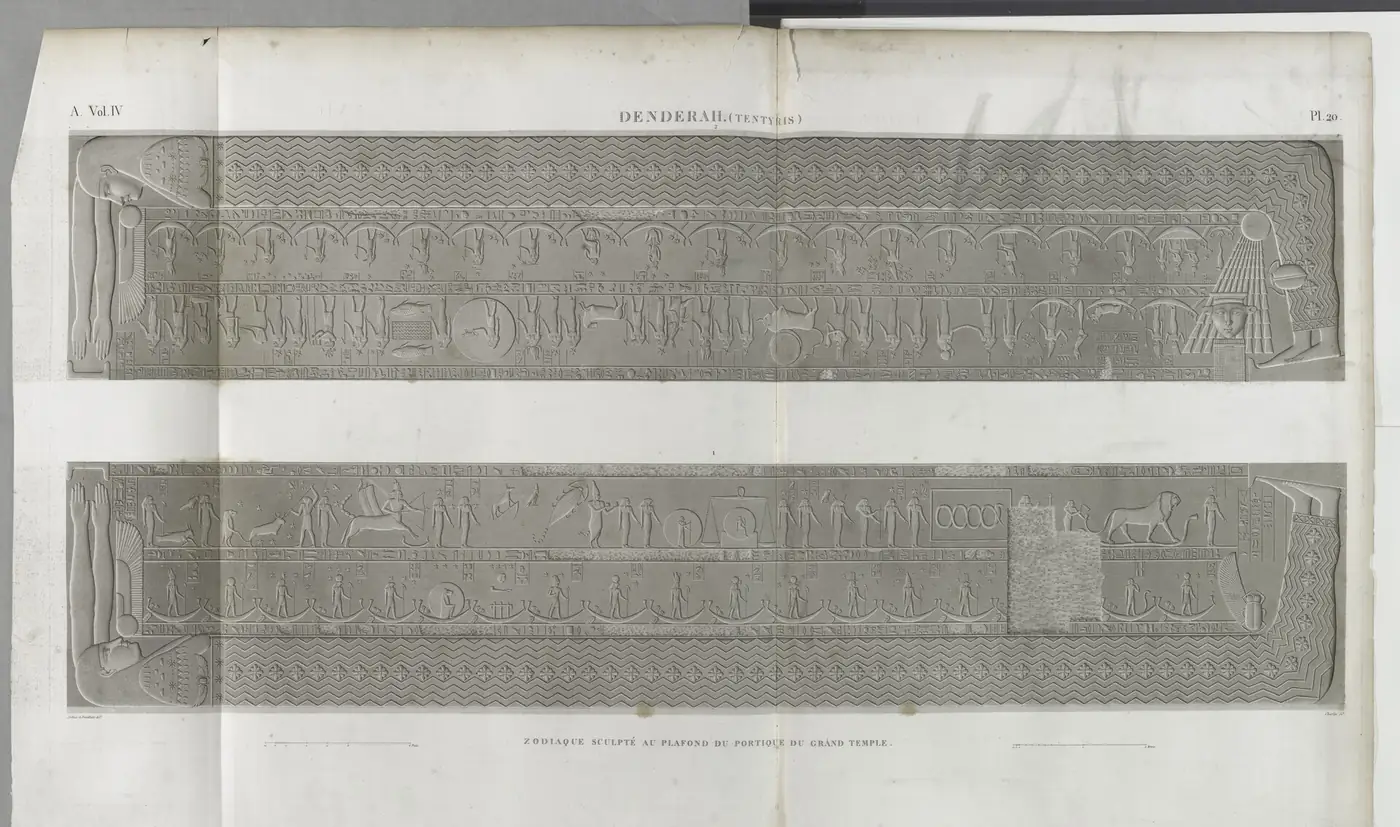
Some popular astrology pages date the Egyptian decans to the 5th century BCE. The coffins show they are at least 1,500 years older than that. What came later was the merger: after Greek astrology reached Egypt in the last centuries BCE, the 36 Egyptian decans were mapped onto the new 12-sign zodiac, three to each sign, and given rulers. Our history of the zodiac signs covers how the twelve signs themselves took shape.
What Ptolemy actually said
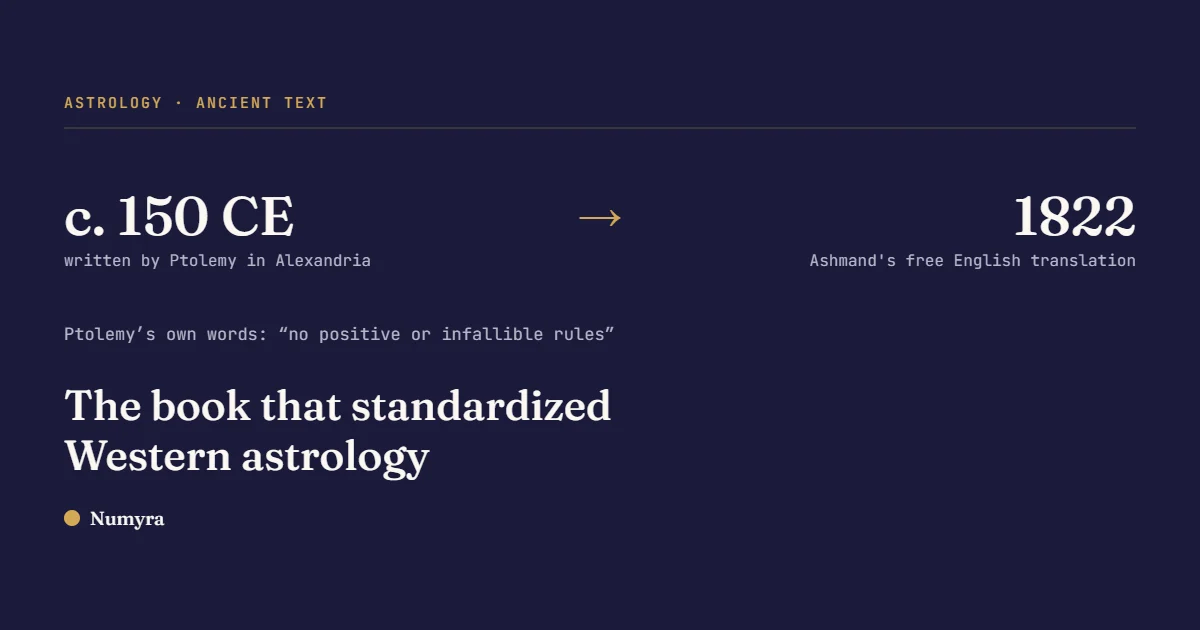
Lilly titled his table “A Table of the Essentiall Dignities of the Planets according to Ptolomy”, and many pages still credit the Chaldean faces to Ptolemy. They should not. Claudius Ptolemy’s Tetrabiblos (2nd century AD), the most influential astrology book of antiquity and the subject of our guide to Ptolemy’s Tetrabiblos, never uses the word decan at all.
What Ptolemy calls a planet’s “proper face” (Tetrabiblos I.23) is something else entirely: an aspect relationship between a planet and the Sun or Moon, not a 10° slice of a sign. And he explicitly dismissed the habit of dividing signs into smaller units ruled by planets in the Chaldean order:
“These matters, as they have only plausible and not natural, but, rather, unfounded, arguments in their favour, we shall omit.”
— Ptolemy, Tetrabiblos I.22, trans. F. E. Robbins (Loeb Classical Library, 1940)
So the faces in Lilly’s table come from the wider Hellenistic tradition, not from Ptolemy himself. Lilly’s own words suggest he knew the sources varied: “There hath been much difference between the Arabians, Greeks and Indians concerning the Essentiall Dignities of the Planets,” he wrote, before presenting the table he preferred.
All 36 decans: rulers in every system
Here is every decan with its ruler in all three systems. The Chaldean column matches Lilly’s 1647 table; the triplicity column gives the traditional ruler with the modern outer-planet ruler in brackets where they differ; the Manilius column is the sign that rules the decan in his scheme.
| Decan | Degrees | Chaldean face | Triplicity ruler | Manilius |
|---|---|---|---|---|
| Aries 1st | 0°–9°59′ | Mars | Mars | Aries |
| Aries 2nd | 10°–19°59′ | Sun | Sun | Taurus |
| Aries 3rd | 20°–29°59′ | Venus | Jupiter | Gemini |
| Taurus 1st | 0°–9°59′ | Mercury | Venus | Cancer |
| Taurus 2nd | 10°–19°59′ | Moon | Mercury | Leo |
| Taurus 3rd | 20°–29°59′ | Saturn | Saturn | Virgo |
| Gemini 1st | 0°–9°59′ | Jupiter | Mercury | Libra |
| Gemini 2nd | 10°–19°59′ | Mars | Venus | Scorpio |
| Gemini 3rd | 20°–29°59′ | Sun | Saturn (modern: Uranus) | Sagittarius |
| Cancer 1st | 0°–9°59′ | Venus | Moon | Capricorn |
| Cancer 2nd | 10°–19°59′ | Mercury | Mars (modern: Pluto) | Aquarius |
| Cancer 3rd | 20°–29°59′ | Moon | Jupiter (modern: Neptune) | Pisces |
| Leo 1st | 0°–9°59′ | Saturn | Sun | Aries |
| Leo 2nd | 10°–19°59′ | Jupiter | Jupiter | Taurus |
| Leo 3rd | 20°–29°59′ | Mars | Mars | Gemini |
| Virgo 1st | 0°–9°59′ | Sun | Mercury | Cancer |
| Virgo 2nd | 10°–19°59′ | Venus | Saturn | Leo |
| Virgo 3rd | 20°–29°59′ | Mercury | Venus | Virgo |
| Libra 1st | 0°–9°59′ | Moon | Venus | Libra |
| Libra 2nd | 10°–19°59′ | Saturn | Saturn (modern: Uranus) | Scorpio |
| Libra 3rd | 20°–29°59′ | Jupiter | Mercury | Sagittarius |
| Scorpio 1st | 0°–9°59′ | Mars | Mars (modern: Pluto) | Capricorn |
| Scorpio 2nd | 10°–19°59′ | Sun | Jupiter (modern: Neptune) | Aquarius |
| Scorpio 3rd | 20°–29°59′ | Venus | Moon | Pisces |
| Sagittarius 1st | 0°–9°59′ | Mercury | Jupiter | Aries |
| Sagittarius 2nd | 10°–19°59′ | Moon | Mars | Taurus |
| Sagittarius 3rd | 20°–29°59′ | Saturn | Sun | Gemini |
| Capricorn 1st | 0°–9°59′ | Jupiter | Saturn | Cancer |
| Capricorn 2nd | 10°–19°59′ | Mars | Venus | Leo |
| Capricorn 3rd | 20°–29°59′ | Sun | Mercury | Virgo |
| Aquarius 1st | 0°–9°59′ | Venus | Saturn (modern: Uranus) | Libra |
| Aquarius 2nd | 10°–19°59′ | Mercury | Mercury | Scorpio |
| Aquarius 3rd | 20°–29°59′ | Moon | Venus | Sagittarius |
| Pisces 1st | 0°–9°59′ | Saturn | Jupiter (modern: Neptune) | Capricorn |
| Pisces 2nd | 10°–19°59′ | Jupiter | Moon | Aquarius |
| Pisces 3rd | 20°–29°59′ | Mars | Mars (modern: Pluto) | Pisces |
The decans of each sign, traditionally read
Decan readings combine the sign with its sub-ruler. The short notes below follow the most common modern pattern, the triplicity system, and add the Chaldean ruler where it gives a distinctly different flavor. They describe themes, not fixed traits.
Aries decans
1st (Mars in both systems): the purest Aries, direct and competitive. 2nd (Leo/Sun): Aries with more warmth, pride and flair. 3rd (Sagittarius/Jupiter; Chaldean Venus): Aries with a wider view, restless for adventure, softened by Venus in the traditional reading.
Taurus decans
1st (Venus; Chaldean Mercury): the most Taurean, sensual and steady. 2nd (Virgo/Mercury; Chaldean Moon): practical, careful and more analytical. 3rd (Capricorn/Saturn in both): ambitious and disciplined, Taurus with a long-term plan.
Gemini decans
1st (Mercury; Chaldean Jupiter): quick, curious and talkative. 2nd (Libra/Venus; Chaldean Mars): more social and diplomatic. 3rd (Aquarius/Saturn, modern Uranus; Chaldean Sun): inventive and independent-minded.
Cancer decans
1st (Moon; Chaldean Venus): the most nurturing and home-loving. 2nd (Scorpio/Mars, modern Pluto; Chaldean Mercury): more intense and private. 3rd (Pisces/Jupiter, modern Neptune; Chaldean Moon): imaginative and empathetic.
Leo decans
1st (Sun; Chaldean Saturn): confident and proud, with a serious streak in the traditional reading. 2nd (Sagittarius/Jupiter in both): generous, expansive and optimistic. 3rd (Aries/Mars in both): bold, energetic and quick to act.
Virgo decans
1st (Mercury; Chaldean Sun): precise and analytical. 2nd (Capricorn/Saturn; Chaldean Venus): hard-working and reliable. 3rd (Taurus/Venus; Chaldean Mercury): practical with an eye for quality and comfort.
Libra decans
1st (Venus; Chaldean Moon): the most romantic and harmony-seeking. 2nd (Aquarius/Saturn, modern Uranus; Chaldean Saturn): fair-minded and idealistic. 3rd (Gemini/Mercury; Chaldean Jupiter): sociable, witty and persuasive.
Scorpio decans
1st (Mars, modern Pluto, in both): the most intense and determined. 2nd (Pisces/Jupiter, modern Neptune; Chaldean Sun): intuitive and emotionally deep. 3rd (Cancer/Moon; Chaldean Venus): protective and loyal.
Sagittarius decans
1st (Jupiter; Chaldean Mercury): the most adventurous and philosophical. 2nd (Aries/Mars; Chaldean Moon): bold and spontaneous. 3rd (Leo/Sun; Chaldean Saturn): warm and expressive, with a serious edge in the traditional reading.
Capricorn decans
1st (Saturn; Chaldean Jupiter): the most driven and responsible. 2nd (Taurus/Venus; Chaldean Mars): steady and pragmatic. 3rd (Virgo/Mercury; Chaldean Sun): methodical and detail-minded.
Aquarius decans
1st (Saturn, modern Uranus; Chaldean Venus): the most original and independent. 2nd (Gemini/Mercury in both): curious, quick and communicative. 3rd (Libra/Venus; Chaldean Moon): sociable and fair-minded.
Pisces decans
1st (Jupiter, modern Neptune; Chaldean Saturn): the most dreamy and spiritual. 2nd (Cancer/Moon; Chaldean Jupiter): caring and emotionally attuned. 3rd (Scorpio/Mars, modern Pluto; Chaldean Mars): deep, intense and perceptive.
How astrologers use decans today
Modern astrologers mostly use decans in two ways. The first is to refine a Sun sign reading: some horoscope writers split each sign into its three decans and write slightly different forecasts for each. The second is as a small part of a planet’s strength in traditional chart reading, where a planet in its own face scores one point of essential dignity, as Lilly set out. Hellenistic and medieval astrologers also gave the decans their own images and associations, a tradition that continued into Renaissance magical texts; that later layer is outside the scope of this guide.
Whichever system you choose, the decan is a fine-tuning tool, not a new sign. It makes most sense alongside the rest of the chart, including the houses your planets fall in and the aspects between them, covered in our guide to how zodiac compatibility really works.
Frequently asked questions
How do I find my decan?
Find how many degrees into your Sun sign the Sun was when you were born: 0° to 9°59′ is the first decan, 10° to 19°59′ the second and 20° to 29°59′ the third. Our Birth Chart calculator shows that degree, and the date table on this page works for most birthdays.
What decan are we in today?
On October 2, 2026, the Sun was in the first decan of Libra; it entered Libra’s second decan on October 3, 2026 at about 04:45 UT. For any other date, find it in the decan date table for the current Sun sign.
What are the 36 decans?
They are the 36 ten-degree slices of the zodiac, three per sign. They began as 36 star groups recorded by Egyptian astronomers and were later fitted onto the Greek zodiac.
Is a decan the same as a face?
Yes. “Face” is the traditional English term, used by William Lilly in 1647 alongside “decanate” and “decurie”. In the Chaldean system each face is ruled by one of the seven classical planets.
Which decan system is correct?
None is provably correct; they are different traditions. The Chaldean faces are the traditional standard, the triplicity system is the most common modern one, and Manilius’s sign-based system is the oldest written down in Western astrology.
Are decans from ancient Egypt?
Yes. Egyptian diagonal star tables listing the decan stars appear inside coffins from around 2000 BCE. The link to the twelve zodiac signs came much later, after Greek astrology reached Egypt.
Did Ptolemy use decans?
No. His Tetrabiblos never mentions decans, and he dismissed finer divisions of the signs as “unfounded”. His “proper face” means an aspect to the Sun or Moon, not a decan.
Can the decan of my Moon or Rising sign be read too?
Yes. The same 10° rule works for any planet or point; you just need its degree in the sign. Most decan descriptions are written for the Sun, though.
Sources
- Ancient Egyptian Astronomy database. “Diagonal star tables” and glossary entry “decan.” McMaster University.
- Manilius. The Five Books of M. Manilius, trans. Thomas Creech. London, 1697. Book IV, pp. 16–17, and Creech’s note 25. Internet Archive.
- Lilly, William. Christian Astrology. London, 1647. Pp. 103–104. Internet Archive.
- Ptolemy. Tetrabiblos, Book I, trans. F. E. Robbins. Loeb Classical Library, 1940. Chapters I.22 and I.23. LacusCurtius.
- Numyra Methodology Desk. Decan start dates for 1990–2030 calculated with the Swiss Ephemeris in US Eastern time; ruler tables checked against Lilly’s 1647 table and Creech’s 1697 text.