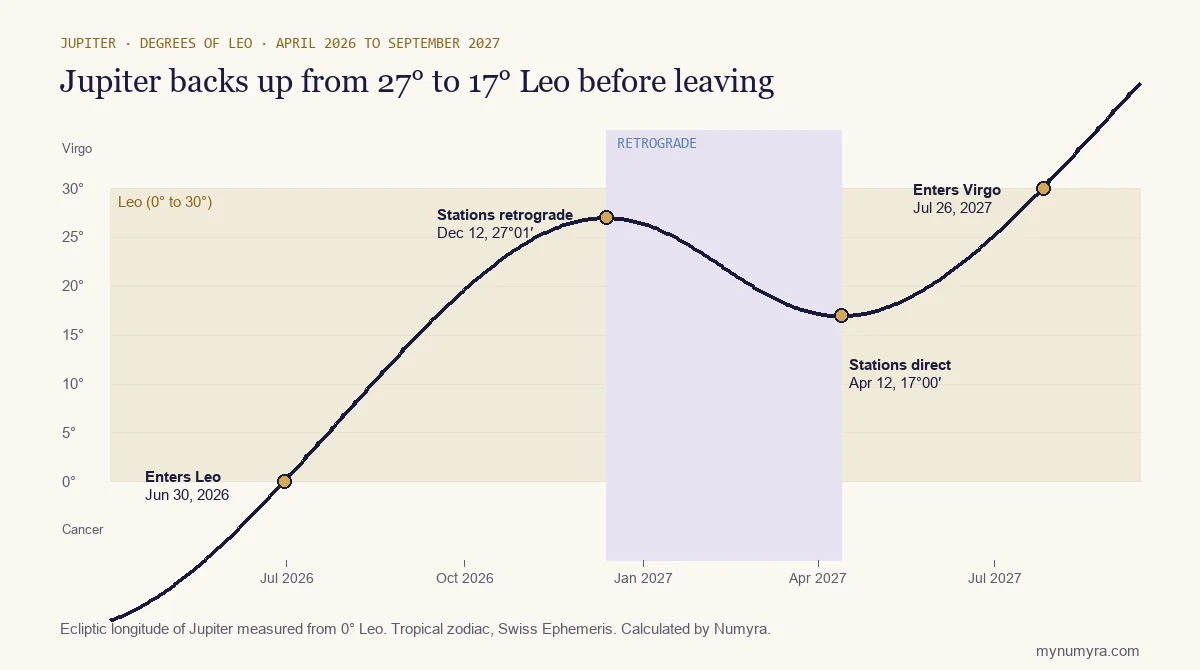
Jupiter is in Leo from June 30, 2026 to July 26, 2027, a stay of 391 days. It entered the sign at 1:52 a.m. EDT on June 30 (10:52 p.m. PDT on June 29), turns retrograde on December 12, 2026 at 27°01′ Leo, turns direct on April 12, 2027 at 17°00′ Leo and leaves for Virgo at 12:49 a.m. EDT on July 26, 2027. As of October 14, 2026 it is at about 21°54′ Leo and still moving forward, so it has about two months before it reverses. The dates below are for the Western tropical zodiac, in US Eastern and Pacific time.
Key takeaways
- Jupiter enters Leo June 30, 2026 at 0°00′ and does not go back to Cancer: its retrograde only takes it from 27°01′ back to 17°00′ Leo, so there is a single entry and a single exit.
- Three outer-planet contacts fall within a day of each other in July 2026 (Neptune trine, Pluto opposition, Uranus sextile, all at about 4°30′), and Jupiter trines Saturn three times: August 31, 2026, April 3, 2027 and July 11, 2027.
- Your house for the transit depends on your rising sign: Leo rising has it in the 1st house, Aries rising in the 5th, Scorpio rising in the 10th (full table below).
- Jupiter’s last stay in Leo was July 16, 2014 to August 11, 2015 and the next is June 12, 2038 to July 8, 2039. Of US births from 1994 to 2014, 7.3% fell while Jupiter was in Leo.
- Sources disagree by a day on the start and end because the move happens at a single instant that lands on different dates in different time zones. Vedic (sidereal) calendars give entirely different dates.
In this guide
- Jupiter in Leo: every date
- Why sources give different dates
- Which house Jupiter in Leo falls in for you
- The planets Jupiter meets in Leo
- What Jupiter in Leo traditionally means
- The 12-year cycle: past and future stays in Leo
- Jupiter in Leo in Vedic astrology
- Frequently asked questions
Jupiter in Leo: every date
These times come from the Swiss Ephemeris, the reference behind professional astrology software, with daylight saving time applied where it is in force. The ingress is when Jupiter’s longitude reaches 120°, the start of Leo. A published ephemeris-based listing gives the same station degrees (27°01′ and 17°00′) and the same retrograde window; its entry time differs from ours by a few minutes, which is normal between calculation methods.
| Event | US Eastern | US Pacific | Position |
|---|---|---|---|
| Jupiter enters Leo | Jun 30, 2026, 1:52 a.m. EDT | Jun 29, 2026, 10:52 p.m. PDT | 0°00′ Leo |
| Jupiter stations retrograde | Dec 12, 2026, 7:56 p.m. EST | Dec 12, 2026, 4:56 p.m. PST | 27°01′ Leo |
| Jupiter stations direct | Apr 12, 2027, 10:11 p.m. EDT | Apr 12, 2027, 7:11 p.m. PDT | 17°00′ Leo |
| Jupiter enters Virgo | Jul 26, 2027, 12:49 a.m. EDT | Jul 25, 2027, 9:49 p.m. PDT | 0°00′ Virgo |
The retrograde lasts 121 days. Jupiter is retrograde about four months in every thirteen (compare every planet in the 2027 retrograde calendar), when Earth overtakes it on the inside track and it appears to move backward against the stars; nothing happens to Jupiter itself. Because the reversal only reaches back to 17° Leo, Jupiter covers the first 17 degrees of Leo once and the stretch from 17° to 27° three times: forward until December, backward until April, then forward again.

Why sources give different dates
Articles list the start as June 29 or June 30 and the end as July 25 or July 26. All of them are right about the same instant. Jupiter crosses into Leo at 05:52 UT on June 30, which is still the evening of June 29 on the US West Coast, and it leaves at 04:49 UT on July 26, which is the evening of July 25 in California. A site based in Sydney, London or New York rounds the same instant to a different calendar day. If you are working with a birth chart or an event time, use the time and your own time zone from the table above, not the bare date.
Which house Jupiter in Leo falls in for you
The house is the area of life the transit touches. It depends on your rising sign (ascendant), not your Sun sign. This table uses whole-sign houses, in which each sign is one house counted from your rising sign. If you do not know your rising sign, our birth chart calculator works it out from your birth time and place, and the guide to Sun, Moon and rising signs explains the difference.
| Rising sign | Leo is your | Traditional area of life |
|---|---|---|
| Aries | 5th house | Creativity, romance, children, play |
| Taurus | 4th house | Home, family, roots |
| Gemini | 3rd house | Communication, siblings, short trips |
| Cancer | 2nd house | Money, possessions, values |
| Leo | 1st house | Self, body, how you present yourself |
| Virgo | 12th house | Rest, retreat, the hidden |
| Libra | 11th house | Friends, groups, hopes |
| Scorpio | 10th house | Career and public standing |
| Sagittarius | 9th house | Travel, study, belief |
| Capricorn | 8th house | Shared money, debts, deep change |
| Aquarius | 7th house | Partnerships and close one-to-one relationships |
| Pisces | 6th house | Work routines, health habits, service |
Leo rising is the special case, with Jupiter crossing the 1st house, which astrologers describe as a time of visibility and self-presentation. Astrologers read houses as themes, not as forecasts, and what a transit means for any one person is a matter of interpretation.
The planets Jupiter meets in Leo
An aspect is a specific angle between two planets: 0° (conjunction), 60° (sextile), 90° (square), 120° (trine) or 180° (opposition). We calculated every aspect Jupiter makes to Saturn, Uranus, Neptune and Pluto while it is in Leo. There are six, listed here in US Eastern time.
| US Eastern | Aspect | Jupiter at |
|---|---|---|
| Jul 20, 2026, 3:22 a.m. EDT | Jupiter trine Neptune (Aries) | 4°22′ Leo |
| Jul 20, 2026, 10:43 a.m. EDT | Jupiter opposite Pluto (Aquarius) | 4°27′ Leo |
| Jul 21, 2026, 7:10 a.m. EDT | Jupiter sextile Uranus (Gemini) | 4°38′ Leo |
| Aug 31, 2026, 6:17 p.m. EDT | Jupiter trine Saturn (Aries) | 13°41′ Leo |
| Apr 3, 2027, 8:59 a.m. EDT | Jupiter trine Saturn (Aries), Jupiter retrograde | 17°08′ Leo |
| Jul 11, 2027, 7:15 p.m. EDT | Jupiter trine Saturn (Aries) | 27°10′ Leo |
The Saturn trine is the one that repeats, because Jupiter’s backward loop crosses the same 120° angle twice more. The Moon’s nodes, which are not planets but the points where the Moon’s orbit crosses the Sun’s path, also change sign during this transit: the true North Node enters Aquarius, and the South Node enters Leo, on July 26, 2026 at 8:46 p.m. EDT, so Jupiter spends almost all of its time in Leo alongside the South Node. Astrologers who use the mean node, a smoothed average, place the same change on August 18, 2026.
What Jupiter in Leo traditionally means
Jupiter is the largest planet and the one astrology has long associated with expansion, generosity, learning and good fortune. Leo is the sign assigned to the Sun. Ptolemy, in the second century, explains in the Tetrabiblos that Leo and Cancer are the two signs closest to the zenith and so “most productive of heat and of warmth,” which is why they were given to the Sun and Moon as their houses. He describes Jupiter’s own nature in these terms:
“Jupiter has a temperate active force because his movement takes place between the cooling influence of Saturn and the burning power of Mars.”
Ptolemy, Tetrabiblos, Book I, chapter 4, trans. F. E. Robbins (Loeb Classical Library, 1940), via LacusCurtius
Modern astrology builds on that picture and describes Jupiter in Leo as a time of amplified self-expression: creativity, performance, leadership, romance, generosity and the wish to be seen. The familiar caution is that Jupiter exaggerates whatever it touches, so the risks named are overconfidence, spending beyond your means and the need for applause. These are interpretive traditions, not measured effects, and nothing about the sky has been shown to cause events in a person’s life; read them as prompts for reflection, not predictions. For how rulerships and strengths are worked out in the traditional system, see our guide to essential dignities, and for the other slow planets see Saturn signs, Uranus and Neptune signs and Pluto in Aquarius.
The 12-year cycle: past and future stays in Leo
Jupiter takes 11.86 years to orbit the Sun (NASA’s Jupiter fact sheet gives 4,332.6 days), so it visits each sign roughly once every twelve years (the same cycle sets your Jupiter return) and stays for about a year. Counting from first entry to final exit, we calculated every stay in Leo from 1900 to 2100 using the Swiss Ephemeris. The recent and upcoming stays are:
| Stay in Leo | First entry | Final exit | Length |
|---|---|---|---|
| 1990 to 1991 | Aug 18, 1990 | Sep 12, 1991 | 390 days |
| 2002 to 2003 | Aug 1, 2002 | Aug 27, 2003 | 391 days |
| 2014 to 2015 | Jul 16, 2014 | Aug 11, 2015 | 391 days |
| 2026 to 2027 | Jun 30, 2026 | Jul 26, 2027 | 391 days |
| 2038 to 2039 | Jun 12, 2038 | Jul 8, 2039 | 390 days |
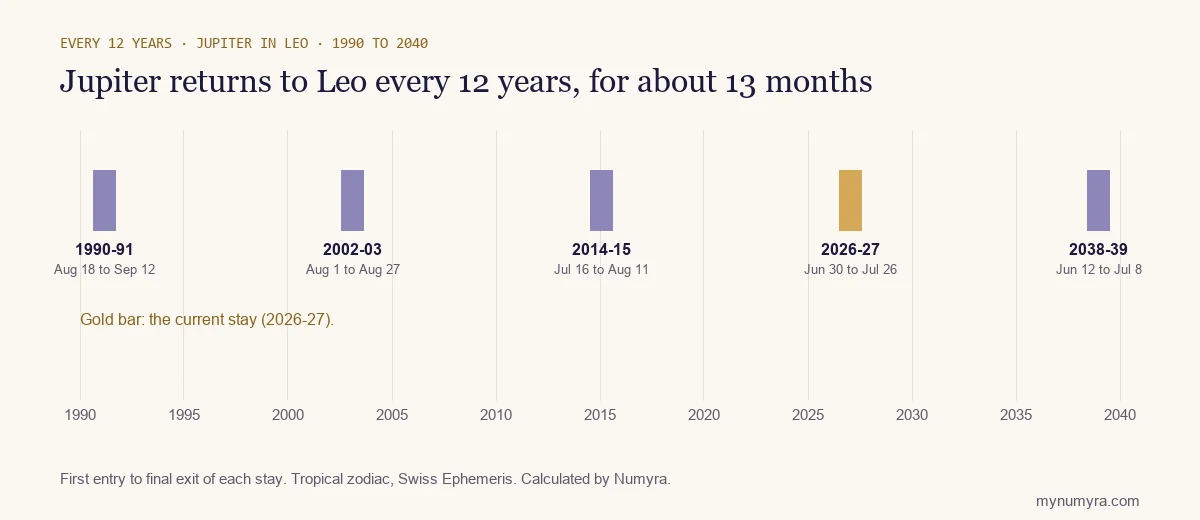
Dates are in UT. In 2038 the path is more tangled than now: Jupiter leaves Leo in November, drops back into it while retrograde and leaves for good in July 2039, so the span runs from first entry to final exit. People born during a stay have Jupiter in Leo in their natal chart. Of the 85.4 million US births from 1994 to 2014 (CDC and Social Security Administration data), 7.3% occurred while Jupiter was in Leo, covering the whole 2002 to 2003 stay and the first part of the 2014 to 2015 one that fell inside the data. Our Jupiter sign guide shows how to find the sign Jupiter was in at your birth and what each placement means.
Jupiter in Leo in Vedic astrology
Everything above is tropical, the system used by most Western astrology, in which the signs are fixed to the equinoxes. Vedic (Jyotish) astrology uses the sidereal zodiac, which sits roughly 24 degrees behind the tropical one today, so the same Jupiter is in a different sign and the dates differ completely. One Vedic calendar publisher lists the sidereal Jupiter transit into Leo as beginning on November 1, 2026 and ending in April 2027. If a page gives those dates, it is using a different zodiac, not making an error, and you should not mix the two systems. The reason for the gap is explained in our guide to sidereal vs. tropical zodiac.
Frequently asked questions
When does Jupiter enter Leo in 2026?
June 30, 2026 at 1:52 a.m. EDT (10:52 p.m. PDT on June 29, 05:52 UT). It reaches 0° Leo and stays until July 26, 2027.
How long is Jupiter in Leo?
391 days, about 12 months and 26 days. Jupiter stays in each sign for roughly a year.
When is Jupiter retrograde in Leo?
From December 12, 2026 (27°01′ Leo) to April 12, 2027 (17°00′ Leo), 121 days. It does not retreat back into Cancer.
When was the last time Jupiter was in Leo?
From July 16, 2014 to August 11, 2015. Before that, August 1, 2002 to August 27, 2003.
When is the next Jupiter in Leo after 2027?
June 12, 2038, with the last exit on July 8, 2039.
Which signs benefit most from Jupiter in Leo?
Astrologers usually name the fire signs, Aries, Leo and Sagittarius, because Jupiter in Leo is in the same element, and also the signs that sextile Leo, Gemini and Libra. This is a tradition: the effect on any person depends on their whole chart, and it has not been tested as a prediction.
What house is Jupiter in Leo for my rising sign?
See the table above. For example, Aries rising has Leo in the 5th house, Cancer rising in the 2nd, Libra rising in the 11th and Capricorn rising in the 8th.
Is it true Jupiter enters Leo on June 29?
For the western United States, yes: the ingress is 10:52 p.m. PDT on June 29. In Eastern time and UT it is June 30. It is the same instant.
Sources
- Astrodienst. Swiss Ephemeris. Every ingress, station, aspect, node crossing and stay (calculations by the Numyra Methodology Desk, converted with historical US time-zone rules).
- NASA. Jupiter Fact Sheet. Orbital period and sidereal period of Jupiter.
- Ptolemy. Tetrabiblos, Book I, chapters 4 and 17, trans. F. E. Robbins (Loeb Classical Library), via LacusCurtius.
- Natal Echo. Jupiter Enters Leo 2026, used to cross-check the station dates and degrees.
- Dekho Panchang. Jupiter in Leo 2026-27, for the sidereal (Vedic) timing quoted above.
- FiveThirtyEight. US births data, 1994 to 2014, from the CDC National Center for Health Statistics and the Social Security Administration.