Rising Sign Calculator: What Is My Rising Sign?
Your rising sign, or Ascendant, is the zodiac sign that was coming up over the eastern horizon at the minute and place you were born. Enter your birth date, time and city to get it with its degree, element, ruler and how many minutes you were from the next sign. No birth time? The calculator lists every sign that rose on your birth date at your birthplace, with the clock times, instead of guessing.
Your rising sign
Key takeaways
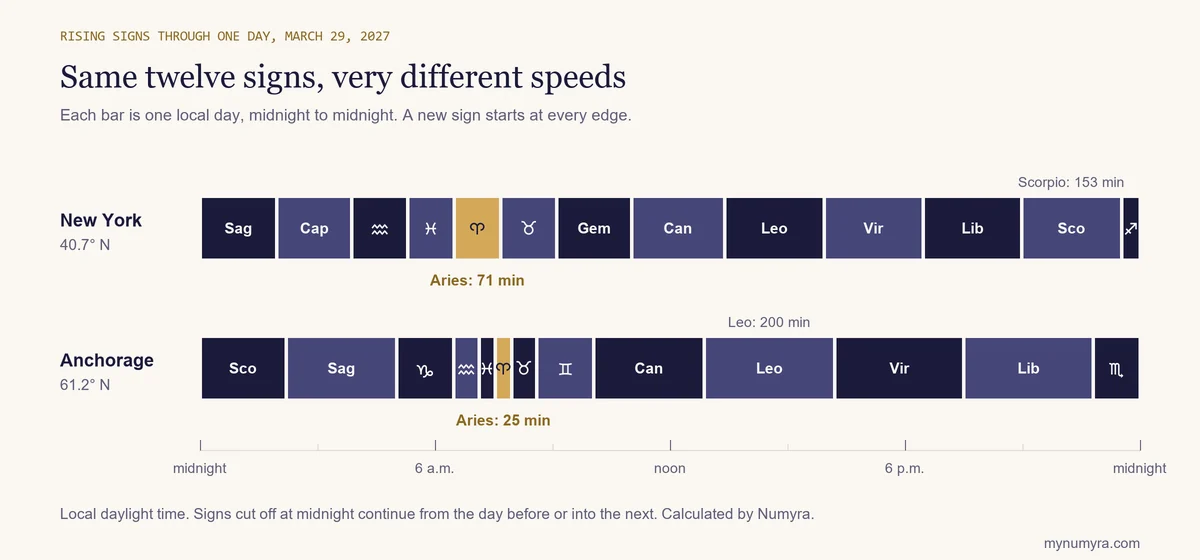
- A new sign rises about every two hours on average, but the real length depends on latitude: every sign takes 89 to 138 minutes to rise in Miami, 60 to 163 in Seattle and 25 to 200 in Anchorage. Aries and Pisces are always the quickest in the US.
- Place matters as much as time. At the same moment, Boston and Detroit, both on Eastern time, have different rising signs 40% of the time, because Detroit is 12 degrees farther west.
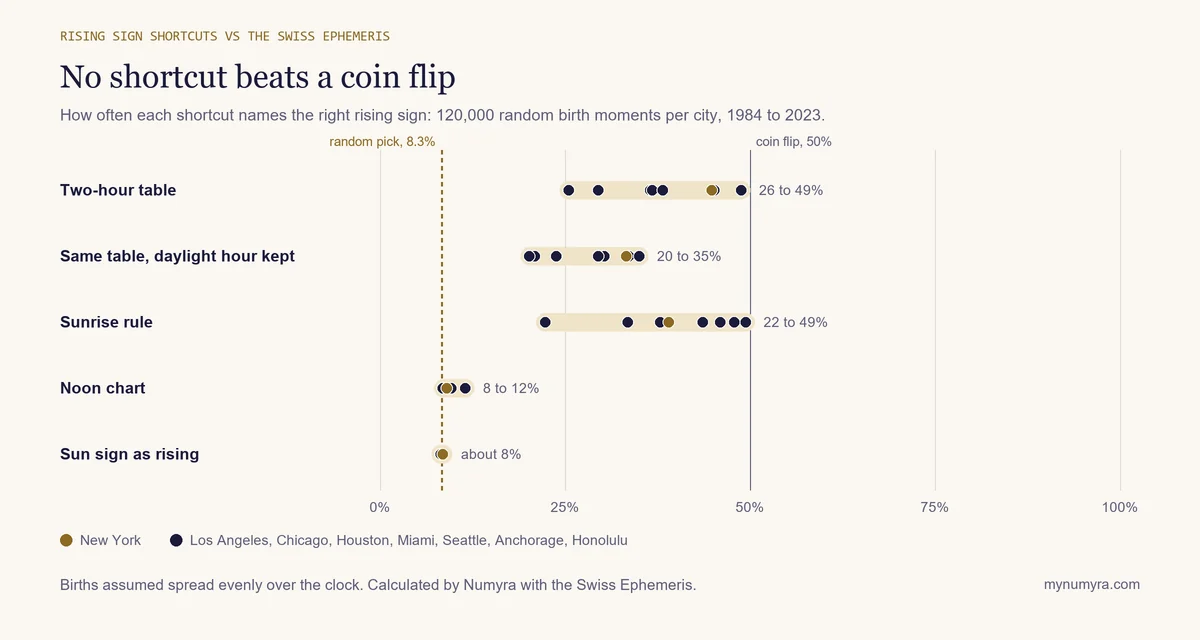
- Shortcuts for people without a birth time do not work. Scored against the Swiss Ephemeris on 960,000 random birth moments in eight US cities, a common two-hour rising sign table named the right sign 26% to 49% of the time, the sunrise rule 22% to 49%, and a noon chart about 9%, close to the 8.3% of a random pick.
- Without a birth time the honest answer is a list: the calculator shows every rising sign of your birth date at your birthplace, with clock times. In many states the long-form birth certificate records the time.
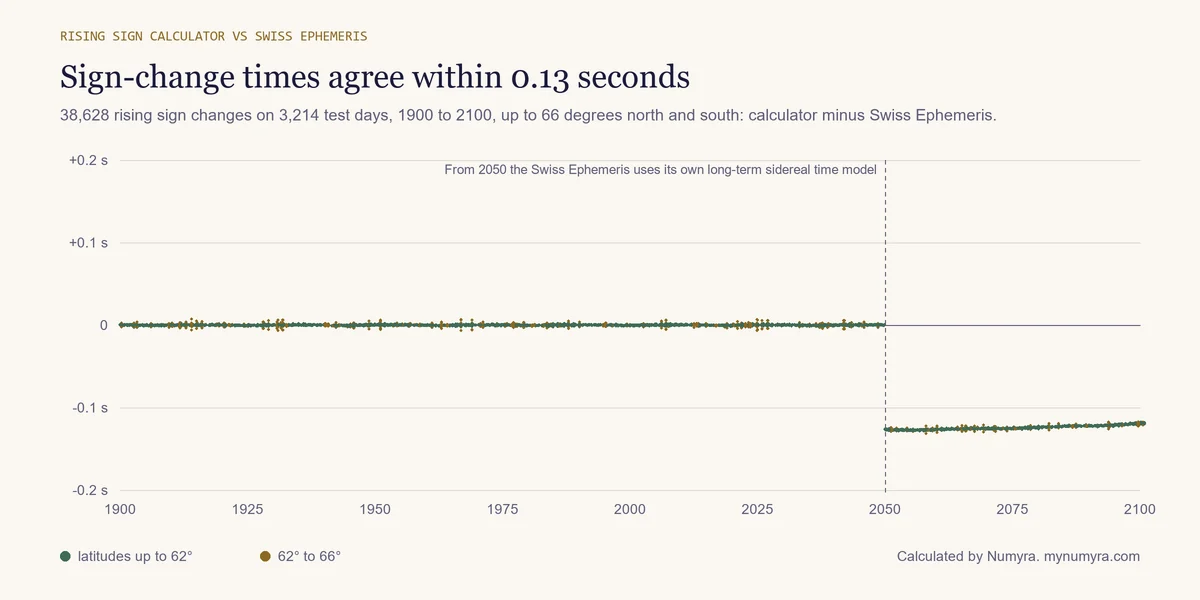
- Against the Swiss Ephemeris, the calculator’s sign changes agree within 0.13 seconds on all 38,628 tested changes from 1900 to 2100, and it gave the same sign for all 44,174 test birth moments, including clock times skipped or repeated by daylight saving changes.
For entertainment and self-reflection. Numerology and astrology are cultural traditions, not sciences, and nothing here is medical, financial, legal, or psychological advice.
What a rising sign is
The rising sign is the sign on the eastern horizon at birth: the point where the ecliptic, the Sun’s yearly path through the zodiac, crossed the horizon in the east. Astrologers call that exact point the Ascendant and the sign it falls in the rising sign. It begins the first house of the chart, and the planet that traditionally rules it is the chart ruler.
Tradition reads the rising sign as the manner you meet the world with, the first impression, where the Sun sign stands for the core self. Our rising sign profiles describe all twelve, and Sun sign vs. Moon sign vs. rising sign explains how the three differ. This page is about finding the sign. What astrologers read into it is tradition, offered for reflection, not a prediction.
Why your birth time decides it
As Earth turns, the whole zodiac passes the eastern horizon once a sidereal day, 23 hours 56 minutes, so the Ascendant moves about a degree every four minutes. A birth date fixes your Sun sign but not your rising sign: every one of the twelve rises at some point of every day.
That is why the result gives a margin. For a birth in Chicago at 8:15 a.m. CDT on July 4, 1990, the Ascendant was at 15°54′ Leo. Leo began rising at 6:53 a.m. and gave way to Virgo at 9:27 a.m., so the true time could have been 81 minutes earlier or 72 minutes later and the answer would still be Leo. A birth a few minutes from a change is flagged as a close call, and the table of the hour either side shows the neighboring sign. How often a 15-, 30- or 60-minute error changes the sign is worked out in how birth time changes your rising sign.
Why your birthplace matters, east to west
The rising sign depends on longitude as well as time, because the horizon of a place farther west reaches the same part of the sky later. Detroit lies about 12 degrees west of Boston, which puts it 48 minutes behind, although both cities keep Eastern time. On June 12, 1998 at 2:00 p.m. EDT, Libra had been rising in Boston for 39 minutes, while Detroit still had Virgo rising, nine minutes short of Libra.
We checked how often that happens. Across 100,000 random moments from 1984 to 2023, the two cities had different rising signs 39.9% of the time. So the calculator uses the coordinates of your birth city, not just its time zone, and if your town is not on the list it asks for the latitude and longitude, which any map app shows.
Short and long ascension: why some signs rise in under an hour
Latitude changes how long each sign takes. The ecliptic is tilted about 23.4 degrees to the equator, so away from the equator it meets the horizon at an angle that changes through the day. Where it lies low, a 30-degree sign slides up quickly; where it stands steep, the same 30 degrees take far longer. North of the equator Capricorn through Gemini are the signs of short ascension and Cancer through Sagittarius the signs of long ascension; south of the equator the two groups swap. Signs the same distance either side of the start of Aries, such as Aries and Pisces, always take the same time.
| City | Latitude | Aries and Pisces (quickest) | Slowest |
|---|---|---|---|
| Honolulu | 21.3° N | 93 min | Cancer and Sagittarius, 134 min |
| Miami | 25.8° N | 89 min | Leo and Scorpio, 138 min |
| Houston | 29.8° N | 85 min | Leo and Scorpio, 141 min |
| Los Angeles | 34.1° N | 80 min | Leo and Scorpio, 145 min |
| New York | 40.7° N | 71 min | Leo and Scorpio, 153 min |
| Chicago | 41.9° N | 70 min | Leo and Scorpio, 154 min |
| Seattle | 47.6° N | 60 min | Leo, Virgo, Libra and Scorpio, 163 min |
| Anchorage | 61.2° N | 25 min | Leo and Scorpio, 200 min |
So the “every two hours” rule holds best in Honolulu and Miami and worst in Anchorage, where Aries rises in 25 minutes and Leo takes over three hours. The minutes for every sign in five US cities, and what they mean for a birth time that is off, are in our birth time guide.
Astrologers have argued about these rising times for two thousand years. Ptolemy complained in the second century that some of his contemporaries worked them out as if they grew in even steps:
“they follow the common method, based upon evenly progressing increases in the ascensions, which is not even close to the truth.”
His example was the latitude of Lower Egypt, where the even scheme gave Virgo and Libra 38⅓ “times” each (a time is one degree of the equator rising, about four minutes) and Leo and Scorpio 35, while his tables showed Leo and Scorpio above 35 and Virgo and Libra below 38⅓. Recomputed for that latitude, 30°22′ N, with the tilt Ptolemy used, Leo and Scorpio take 35.6 times and Virgo and Libra 34.8, so his correction holds. Read more in our guide to the Tetrabiblos.
No birth time? What you can still find out
Leave the time blank and the calculator lists every rising sign of your birth date at your birthplace, from midnight to midnight, with the clock times and how long each lasted. A day usually shows thirteen windows, because a clock day runs four minutes longer than a turn of the sky, so the sign rising at midnight comes up again late in the evening. If you know only the part of the day you were born, such as “early morning”, read the rows for those hours: that is the honest range.
Many websites offer a shortcut instead. We scored four of them against the Swiss Ephemeris on 120,000 random birth moments from 1984 to 2023 in each of eight US cities, assuming births spread evenly over the clock:
The two-hour table. A lookup table found on many astrology sites puts your Sun sign on the horizon between 4 and 6 a.m. standard time and adds one sign every two hours, with an hour subtracted for daylight time. The sunrise rule. Your Sun sign rises at sunrise, then one sign follows every two hours. The noon chart. Many chart services draw the chart for 12:00 when the time is unknown. The solar chart. Your Sun sign is used as the rising sign.
| City | Two-hour table | Same table, daylight hour left in | Sunrise rule | Noon chart | Sun sign as rising |
|---|---|---|---|---|---|
| New York | 44.8% | 33.3% | 39.0% | 9.0% | 8.5% |
| Los Angeles | 48.8% | 33.6% | 43.6% | 8.6% | 8.5% |
| Chicago | 45.2% | 35.0% | 37.9% | 9.1% | 8.3% |
| Houston | 36.5% | 20.9% | 46.0% | 8.5% | 8.3% |
| Miami | 36.8% | 20.2% | 47.9% | 8.6% | 8.3% |
| Seattle | 38.2% | 30.3% | 33.5% | 9.6% | 8.3% |
| Anchorage | 25.5% | 23.8% | 22.3% | 11.5% | 8.4% |
| Honolulu | 29.5% | 29.5% | 49.4% | 8.5% | 8.2% |
None of them gets past a coin flip. The table does best in Los Angeles at 49% and worst in Anchorage at 26%, and if the daylight hour is not taken off it falls to between 20% and 35%. Even a two-hour table retuned for each city’s own solar time would be right only 42% to 70% of the time, 52% in New York, because the signs do not rise in equal two-hour steps, exactly Ptolemy’s point. The table is usually right or one sign off (87% to 97% outside Anchorage), which is the uncertainty you started with. The noon chart and the solar chart are fine for the Sun and most planets but name the rising sign about as often as picking one of the twelve at random.
How to find your birth time
The long-form birth certificate. US birth certificates come in a short form and a long form, and the time of birth is usually on the long one. New York City, for example, lists the time of birth among the details only its long form adds. Order it from the vital records office of the state or city where you were born. There is no national copy:
“The federal government does not distribute certificates, files, or indexes with identifying information for vital records.”
The CDC page links to every state and territory office. Hospital records. The hospital where you were born may still hold the delivery record, which notes the time. Family papers. A baby book, hospital bracelet or birth announcement often gives the time, though memory tends to round it to the nearest quarter or half hour.
If the time you find ends in :00 or :30, enter it and look at the margin and the hour either side in the result. Some astrologers try to infer a missing time from life events, a practice called rectification; it is an interpretation, not a measurement. What to do if your birth time may be off covers rounded times in detail.
Daylight saving time and other clock traps
A birth time is local clock time, and the clock has not always meant the same thing. The calculator converts it with the IANA time zone database built into your browser, which records each zone’s history: New York on daylight time in January and February 1974, war time all year from February 1942 to September 1945, Indiana keeping standard time in summer until 2006, and Arizona and Hawaii without daylight saving time. An hour’s mistake here changes the rising sign about half the time, so it pays to let the database do it.
Twice a year the clock itself is ambiguous. When it falls back, one hour happens twice: in New York 1:30 a.m. comes round twice on November 7, 2027, and the calculator gives the rising sign for both (Virgo either way that night, at 2° and at 14°). When it springs forward, an hour never happens: 2:30 a.m. does not exist in New York on March 14, 2027, so a time of 2:30 on that date was written in the old or the new time, and the calculator shows both readings, Capricorn or Sagittarius, instead of picking one.
How this calculator works, and how accurate it is
The calculator turns your local time into Universal Time, finds the sidereal time at your longitude (the Earth rotation angle with the IAU 2006 sidereal time expression, plus the nutation correction known as the equation of the equinoxes) and the true tilt of Earth’s axis, and solves the standard spherical-trigonometry formula for the Ascendant at your latitude. For the times a sign begins and ends, it solves the same geometry the other way round, for the moment each sign boundary reaches the horizon. Everything runs in your browser; nothing you type is sent or stored.
We tested it against the Swiss Ephemeris, the reference behind most professional astrology software. The Ascendant agrees to a median of 0.006″ (arcseconds) and, from 1900 to 2049 at the latitudes of the listed cities, never by more than 0.08″. From 2050 the Swiss Ephemeris switches to its own long-term model of Earth’s rotation, which accounts for the slightly larger figures after that year. In time, the largest difference in any sign change was 0.13 seconds.
| Check | Result |
|---|---|
| Ascendant at random moments, 1900 to 2100, vs the Swiss Ephemeris | 30,000 moments at 16 test places and 14,000 random places up to 66° north or south; median 0.006″, 95th percentile 2.1″; largest 10.6″ up to 62° and 74″ at 66° south, where the Ascendant moves fastest |
| Every sign change of 3,214 local days, vs the Swiss Ephemeris | 38,628 changes, including every daylight saving change day of 12 test years in 11 time zones; largest difference 0.13 seconds; the order of signs matched on every day |
| Birth moments from local clock times | 42,130 clock times converted to Universal Time and checked against Python’s zoneinfo, including 1,051 skipped and 993 repeated by daylight saving changes; 44,174 birth moments, rising sign matched every time |
| Birth moments right next to a sign change | 47,432 moments 0.5, 2, 30 and 60 seconds either side of a Swiss Ephemeris sign change; rising sign right every time |
Three limits. The calculator works up to 66 degrees north or south; nearer the poles some signs never rise and the Ascendant can jump, so a single answer would mislead. Birth times are civil time, which can differ from the Earth’s rotation time by up to 0.9 seconds, far too little to change a sign. And the signs are tropical, measured from the March equinox as in Western astrology; Vedic astrology’s rising sign (lagna) uses the sidereal zodiac and usually lands one sign earlier, as sidereal vs. tropical zodiac explains. The house system makes no difference: Placidus, whole sign and equal houses all use the same Ascendant, as whole sign vs Placidus houses shows.
Your rising sign is one of three
Astrologers read the rising sign with two other placements, the Sun sign and the Moon sign. The zodiac sign calculator gives your Sun sign from the date alone, the Moon sign profiles describe the twelve Moon signs, and the birth chart calculator puts all three together with every planet and house.
Frequently asked questions
What is my rising sign?
It is the zodiac sign that was rising on the eastern horizon at the moment and place of your birth, also called the Ascendant. Enter your birth date, time and city above to get it, with its degree, element, modality, ruling planet and how many minutes you were from the next sign.
Can I find my rising sign without a birth time?
Not as a single answer. Every rising sign comes up at some point of every day, so the date and place narrow it only to a list. Leave the time blank and the calculator shows every rising sign of your birth date at your birthplace with the clock times. Shortcut tables, the sunrise rule and noon charts were right less than half the time in our test of eight US cities.
Where can I find my exact birth time?
In the US, start with the long-form birth certificate from the vital records office of the state where you were born; the short form often leaves the time out. The hospital’s labor and delivery record, a baby book or a hospital bracelet are the next best sources.
What is my rising sign if I was born at sunrise?
Usually your Sun sign, because the Sun is on the eastern horizon at sunrise. In our test the sign rising at sunrise was the Sun sign on 95% to 97% of days in the lower 48 cities and 87% in Anchorage. The exceptions are days when the Sun is near the end of its sign, so the next sign is already rising.
How common is it to have the same Sun and rising sign?
About 1 person in 12. In our sample of random birth moments in eight US cities, 8.2% to 8.5% had the same sign rising as their Sun sign, which is roughly the share of the day the Sun’s sign spends on the horizon. People born around sunrise are the ones who have it.
Why does another calculator give me a different rising sign?
Usually because of the inputs: a.m. and p.m. swapped, a daylight saving hour added or missed, or a city chosen in the same time zone but far away, which can shift the sky by many minutes. Other causes are the sidereal (Vedic) zodiac, which usually gives the previous sign, and births within a few minutes of a sign change, where tiny differences decide it.
Does the house system change my rising sign?
No. Placidus, Koch, equal and whole sign houses all start from the same Ascendant, the degree on the eastern horizon. Whole sign houses make the whole rising sign the first house; the others start the first house at the Ascendant degree.
Does my rising sign change as I get older?
No. It is fixed by the sky at the moment and place of birth. A different answer later almost always means different inputs, such as a corrected birth time, a different birthplace or a different zodiac setting.
Is my birth information stored or sent anywhere?
No. The calculation runs in your browser, and your birth details are not sent to our servers, stored, or placed in cookies. The text you can copy contains only your rising sign and this page’s address, never your birth date, time or place.
Sources
- Astrodienst. Swiss Ephemeris. Version 2.10 (house routine swe.houses_ex, Moshier mode): the reference for every accuracy test and for the original data on this page.
- Jean Meeus. Astronomical Algorithms, 2nd ed. (Willmann-Bell, 1998), chapters 12, 13 and 22: sidereal time, the Ascendant and nutation.
- N. Capitaine, P. T. Wallace and J. Chapront. “Expressions for IAU 2000 precession quantities.” Astronomy and Astrophysics 412 (2003), 567: the sidereal time and obliquity expressions adopted by the IAU in 2006 and by the IERS Conventions 2010 (IERS Technical Note 36).
- IANA. Time Zone Database. The history of local time and daylight saving rules your browser uses to convert birth times.
- Ptolemy. Tetrabiblos, Book I, chapter 20, translated by F. E. Robbins (Loeb Classical Library, 1940), via LacusCurtius (public domain).
- National Center for Health Statistics, CDC. Where to Write for Vital Records.
- NYC Health. Birth certificates: short form and long form.
- Lunar Living. Ascendant: Rising Sign Astrology. An example of the two-hour lookup table scored on this page.