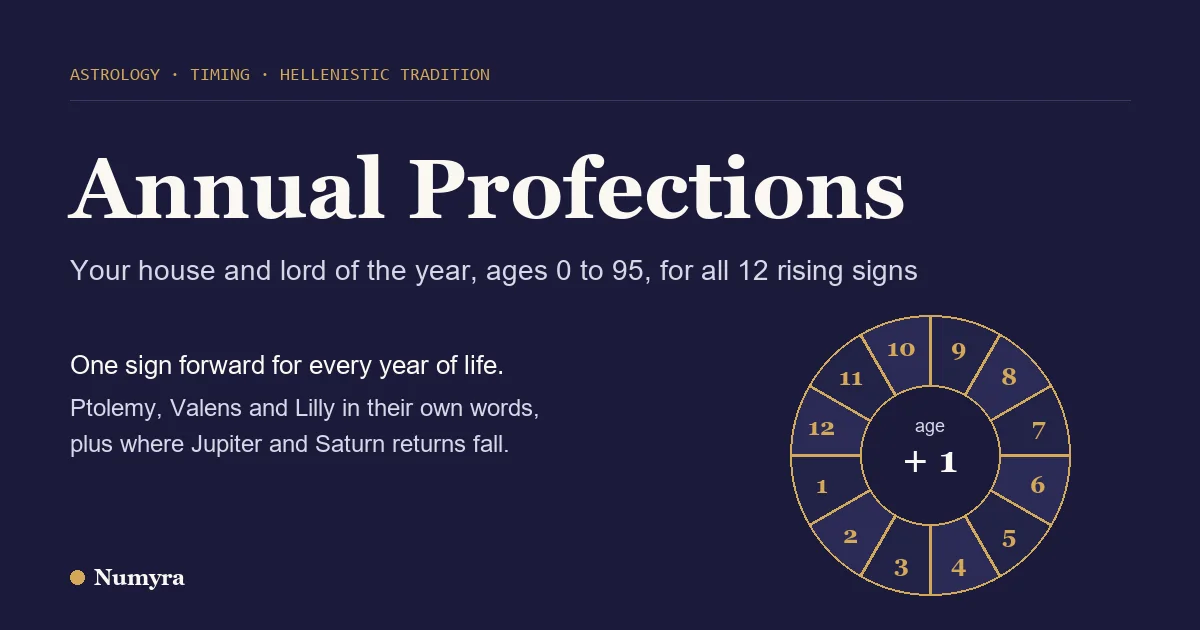
An annual profection moves your rising sign forward one sign for every year you have lived: age 0 is a 1st house year, age 1 a 2nd house year, age 12 a 1st house year again, and the planet that rules the sign you land on is called the lord of the year until your next birthday. This guide gives you the sum in one line, then goes further than a calculator page does. It has a complete age-by-age table from 0 to 95 with the lord of the year for all 12 rising signs, a worked example, the wording of Ptolemy, Vettius Valens and William Lilly (1647) set beside the modern method, and our own count, over 40,542 birth dates, of where Jupiter and Saturn returns fall in the profection cycle. Profections are a traditional timing technique, read as symbolism and not as a forecast.
Key takeaways
- The sum: your profection house is (age divided by 12, remainder) plus 1, and the sign is your rising sign counted forward by that remainder. At age 33 the remainder is 9, so it is a 10th house year; with Libra rising that sign is Cancer and the lord of the year is the Moon.
- It is a 12-year loop. Ages 0, 12, 24, 36, 48, 60, 72 and 84 are all 1st house years, and every house gets exactly eight years between birth and age 95. The year runs from one birthday to the next, not from January 1.
- Every rising sign gets the same total over ages 0 to 95: Mercury, Venus, Mars, Jupiter and Saturn rule 16 years each and the Sun and Moon 8 each. Only the timing differs, and Saturn is the one planet that rules two years in a row, once in every cycle.
- The old sources agree on the counting but not on the details. Ptolemy takes the ruler of the last sign counted, Valens divides the age by 12 and counts the remainder from any point in the chart, and Lilly in 1647 starts the year when the Sun returns to its natal degree and says the lord is the ruler of the sign that ascends.
- Our computed result: across 40,542 birth dates from 1900 to 2010, the first four Jupiter returns fall in a 12th house year every time, and the Saturn return falls in the 6th house year for 77.2% of birth dates and the 5th for 22.8%.
In this guide
- What an annual profection is
- How to find your profection house and lord of the year
- A worked example: Libra rising, age 33
- The age-to-house table, ages 0 to 95
- Sign and lord of the year for each rising sign
- The lord of the year at every age, for all 12 rising signs
- Patterns in the lords: how often each planet rules
- Where Jupiter and Saturn returns fall in the cycle
- What Ptolemy, Valens and Lilly actually wrote
- Old method and modern practice: what changed
- How to use a profection year without over-reading it
- How we built the tables and measured the returns
- Frequently asked questions
What an annual profection is
A profection is a counting technique. You start at a point in the birth chart, normally the Ascendant, and move forward through the zodiac one sign at a time, one sign for each year of life. The sign you reach decides two things: which house the year is “about”, because each sign sits in one house, and which planet is the lord of the year, because each sign has a ruler. Everything else in the method, including the years of life it is applied to and the planets it asks you to check, builds on those two answers.
Two choices make the counting simple. First, houses are whole signs: if Libra is rising, Libra is the whole 1st house, Scorpio the 2nd, Sagittarius the 3rd, and so on round the wheel. How that differs from quadrant systems such as Placidus is covered in our guide to whole sign and Placidus houses, and what the twelve houses stand for is in the houses guide. Second, rulers are the traditional seven: Mars for Aries and Scorpio, Venus for Taurus and Libra, Mercury for Gemini and Virgo, the Moon for Cancer, the Sun for Leo, Jupiter for Sagittarius and Pisces, Saturn for Capricorn and Aquarius. Uranus, Neptune and Pluto were not known to Ptolemy, Valens or Lilly and play no part. The ruler of the 1st house sign is your chart ruler; the essential dignities table shows how strong any of these planets is in the sign it holds.
Profections sit alongside other yearly techniques rather than replacing them. A solar return chart is cast for the moment the Sun comes back to its birth degree, and the progressed Moon moves through the signs more slowly. Traditional astrologers pair profections with a solar return and the slow planets’ transits to see which topics a year puts first. None of this is established science. It is a symbolic framework with a long written history, and this page treats it that way.
How to find your profection house and lord of the year
You need two facts: your rising sign and the number of birthdays you have had. If you do not know your rising sign, the birth chart calculator gives it from your birth date, time and place, and our rising signs guide explains what each one means. A rising sign changes about every two hours, so an unknown or rounded birth time can put you in the wrong sign; how many minutes of margin you have depends on your birth date and latitude.
- Take your completed years. This is the age you reached on your most recent birthday. Someone who turned 33 last month is 33 for the whole profection year, until the 34th birthday.
- Divide by 12 and keep the remainder. The house is the remainder plus 1. A remainder of 0 means the 1st house; a remainder of 11 means the 12th. Age 33 divided by 12 leaves 9, so the year is a 10th house year.
- Count that many signs forward from your rising sign. With Libra rising and a remainder of 9, count Scorpio, Sagittarius, Capricorn, Aquarius, Pisces, Aries, Taurus, Gemini, Cancer: nine steps, landing on Cancer.
- Take the ruler of that sign. Cancer is ruled by the Moon, so the Moon is the lord of the year.
The year turns on your birthday, not on January 1. A person born in December is in one profection year for almost all of January to November and in the next from the December birthday on. William Lilly, writing in 1647, says more exactly that the year begins when the Sun returns to its birth degree and minute, which is why he calls it a solar year. That moment can differ from your clock birthday by as much as a day, and our solar return guide shows why. Most modern guides simply use the birthday.
A worked example: Libra rising, age 33
To see the whole procedure, take a made-up person, Sam, born on November 11, 1993 with Libra rising. Sam is not a real chart; every planet below is invented except the sky of 2026 to 2027, which we computed with the Swiss Ephemeris. Sam turns 33 on November 11, 2026, so the year that starts that day is the 33rd, a 10th house year: Libra is the 1st house, and the 10th is Cancer.
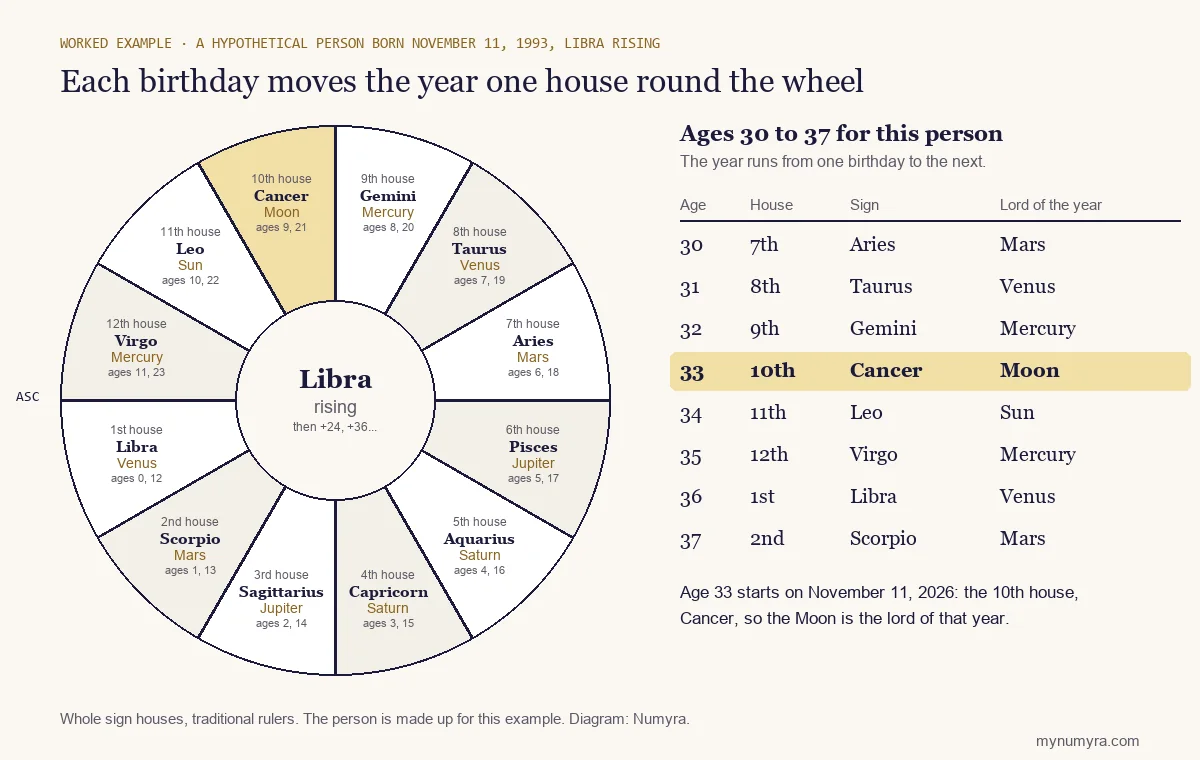
| Age | Year starts | House | Sign | Lord of the year |
|---|---|---|---|---|
| 32 | November 11, 2025 | 9th | Gemini | Mercury |
| 33 | November 11, 2026 | 10th | Cancer | The Moon |
| 34 | November 11, 2027 | 11th | Leo | The Sun |
| 35 | November 11, 2028 | 12th | Virgo | Mercury |
| 36 | November 11, 2029 | 1st | Libra | Venus |
An astrologer in this tradition would then ask three questions about the 33rd year. The first is the topic. A 10th house year is the career and public standing year; Lilly’s seventeenth-century wording for it, summarized in the table further down, is of ambition, seeking preferment and dealing with eminent people. The second is the condition of the lord. Suppose Sam’s natal Moon is in Taurus, in the 8th house. The Moon is exalted in Taurus in the traditional dignity tables, which is read as a well-placed lord, while its 8th house position links the career topic to money shared with others, in the traditional reading of that house. The third is what the sky does. In the 12 months from November 11, 2026, Saturn is in Aries the whole time, which is Sam’s 7th house, and Jupiter is in Leo, Sam’s 11th, until about the end of July 2027, when it moves into Virgo, the 12th. The Moon itself circles the zodiac about thirteen times in a year, so a traditional reader looks at its place in the solar return chart for November 2026 instead of tracking it day by day.
That is a reading procedure, not a forecast. Nothing here says what will happen to Sam, only which parts of the chart a traditional astrologer would put first. The other house years work the same way, and the tables below do the arithmetic for every age and every rising sign.
The age-to-house table, ages 0 to 95
The house depends only on age. Find your age in the right-hand column; the row tells you the house. Each house appears eight times between birth and age 95, and the pattern is the same for everyone whatever their rising sign.
| Profection house | Ages (completed years) |
|---|---|
| 1st house | 0, 12, 24, 36, 48, 60, 72, 84 |
| 2nd house | 1, 13, 25, 37, 49, 61, 73, 85 |
| 3rd house | 2, 14, 26, 38, 50, 62, 74, 86 |
| 4th house | 3, 15, 27, 39, 51, 63, 75, 87 |
| 5th house | 4, 16, 28, 40, 52, 64, 76, 88 |
| 6th house | 5, 17, 29, 41, 53, 65, 77, 89 |
| 7th house | 6, 18, 30, 42, 54, 66, 78, 90 |
| 8th house | 7, 19, 31, 43, 55, 67, 79, 91 |
| 9th house | 8, 20, 32, 44, 56, 68, 80, 92 |
| 10th house | 9, 21, 33, 45, 57, 69, 81, 93 |
| 11th house | 10, 22, 34, 46, 58, 70, 82, 94 |
| 12th house | 11, 23, 35, 47, 59, 71, 83, 95 |
Because the loop is 12 years long, a 12th house year always comes the year before a 1st house year: at ages 11, 23, 35 and 47, just before the 12-year marks at 12, 24, 36 and 48.
Sign and lord of the year for each rising sign
Once you know the house, the sign and the lord come from your rising sign. Each row below is one rising sign; each column is a profection house. The cell gives the sign that house falls in and its traditional ruler. Read across from your rising sign to the house the previous table gave you.
| Rising sign | 1st house | 2nd house | 3rd house | 4th house | 5th house | 6th house | 7th house | 8th house | 9th house | 10th house | 11th house | 12th house |
|---|---|---|---|---|---|---|---|---|---|---|---|---|
| Aries | Aries Mars |
Taurus Venus |
Gemini Mercury |
Cancer Moon |
Leo Sun |
Virgo Mercury |
Libra Venus |
Scorpio Mars |
Sagittarius Jupiter |
Capricorn Saturn |
Aquarius Saturn |
Pisces Jupiter |
| Taurus | Taurus Venus |
Gemini Mercury |
Cancer Moon |
Leo Sun |
Virgo Mercury |
Libra Venus |
Scorpio Mars |
Sagittarius Jupiter |
Capricorn Saturn |
Aquarius Saturn |
Pisces Jupiter |
Aries Mars |
| Gemini | Gemini Mercury |
Cancer Moon |
Leo Sun |
Virgo Mercury |
Libra Venus |
Scorpio Mars |
Sagittarius Jupiter |
Capricorn Saturn |
Aquarius Saturn |
Pisces Jupiter |
Aries Mars |
Taurus Venus |
| Cancer | Cancer Moon |
Leo Sun |
Virgo Mercury |
Libra Venus |
Scorpio Mars |
Sagittarius Jupiter |
Capricorn Saturn |
Aquarius Saturn |
Pisces Jupiter |
Aries Mars |
Taurus Venus |
Gemini Mercury |
| Leo | Leo Sun |
Virgo Mercury |
Libra Venus |
Scorpio Mars |
Sagittarius Jupiter |
Capricorn Saturn |
Aquarius Saturn |
Pisces Jupiter |
Aries Mars |
Taurus Venus |
Gemini Mercury |
Cancer Moon |
| Virgo | Virgo Mercury |
Libra Venus |
Scorpio Mars |
Sagittarius Jupiter |
Capricorn Saturn |
Aquarius Saturn |
Pisces Jupiter |
Aries Mars |
Taurus Venus |
Gemini Mercury |
Cancer Moon |
Leo Sun |
| Libra | Libra Venus |
Scorpio Mars |
Sagittarius Jupiter |
Capricorn Saturn |
Aquarius Saturn |
Pisces Jupiter |
Aries Mars |
Taurus Venus |
Gemini Mercury |
Cancer Moon |
Leo Sun |
Virgo Mercury |
| Scorpio | Scorpio Mars |
Sagittarius Jupiter |
Capricorn Saturn |
Aquarius Saturn |
Pisces Jupiter |
Aries Mars |
Taurus Venus |
Gemini Mercury |
Cancer Moon |
Leo Sun |
Virgo Mercury |
Libra Venus |
| Sagittarius | Sagittarius Jupiter |
Capricorn Saturn |
Aquarius Saturn |
Pisces Jupiter |
Aries Mars |
Taurus Venus |
Gemini Mercury |
Cancer Moon |
Leo Sun |
Virgo Mercury |
Libra Venus |
Scorpio Mars |
| Capricorn | Capricorn Saturn |
Aquarius Saturn |
Pisces Jupiter |
Aries Mars |
Taurus Venus |
Gemini Mercury |
Cancer Moon |
Leo Sun |
Virgo Mercury |
Libra Venus |
Scorpio Mars |
Sagittarius Jupiter |
| Aquarius | Aquarius Saturn |
Pisces Jupiter |
Aries Mars |
Taurus Venus |
Gemini Mercury |
Cancer Moon |
Leo Sun |
Virgo Mercury |
Libra Venus |
Scorpio Mars |
Sagittarius Jupiter |
Capricorn Saturn |
| Pisces | Pisces Jupiter |
Aries Mars |
Taurus Venus |
Gemini Mercury |
Cancer Moon |
Leo Sun |
Virgo Mercury |
Libra Venus |
Scorpio Mars |
Sagittarius Jupiter |
Capricorn Saturn |
Aquarius Saturn |
For Libra rising the 10th house cell reads Cancer and the Moon, which is the answer in the worked example. Two rising signs are worth a glance because their 1st house lord is the Sun or the Moon, which no other rising sign has: Leo rising starts at age 0 under the Sun and Cancer rising under the Moon.
The lord of the year at every age, for all 12 rising signs
The table below puts the whole thing in one place. Pick your rising sign in the column heading and read down to your age; the cell is the lord of the year for that profection year, and the house column gives the house. Scroll inside the box to reach later ages. Lilly wrote that he preferred a separate table drawn up for each birth, but when houses are whole signs the lord depends only on the rising sign and the age, so one table serves everyone.
| Age | House | Aries rising | Taurus rising | Gemini rising | Cancer rising | Leo rising | Virgo rising | Libra rising | Scorpio rising | Sagittarius rising | Capricorn rising | Aquarius rising | Pisces rising |
|---|---|---|---|---|---|---|---|---|---|---|---|---|---|
| 0 | 1st | Mars | Venus | Mercury | Moon | Sun | Mercury | Venus | Mars | Jupiter | Saturn | Saturn | Jupiter |
| 1 | 2nd | Venus | Mercury | Moon | Sun | Mercury | Venus | Mars | Jupiter | Saturn | Saturn | Jupiter | Mars |
| 2 | 3rd | Mercury | Moon | Sun | Mercury | Venus | Mars | Jupiter | Saturn | Saturn | Jupiter | Mars | Venus |
| 3 | 4th | Moon | Sun | Mercury | Venus | Mars | Jupiter | Saturn | Saturn | Jupiter | Mars | Venus | Mercury |
| 4 | 5th | Sun | Mercury | Venus | Mars | Jupiter | Saturn | Saturn | Jupiter | Mars | Venus | Mercury | Moon |
| 5 | 6th | Mercury | Venus | Mars | Jupiter | Saturn | Saturn | Jupiter | Mars | Venus | Mercury | Moon | Sun |
| 6 | 7th | Venus | Mars | Jupiter | Saturn | Saturn | Jupiter | Mars | Venus | Mercury | Moon | Sun | Mercury |
| 7 | 8th | Mars | Jupiter | Saturn | Saturn | Jupiter | Mars | Venus | Mercury | Moon | Sun | Mercury | Venus |
| 8 | 9th | Jupiter | Saturn | Saturn | Jupiter | Mars | Venus | Mercury | Moon | Sun | Mercury | Venus | Mars |
| 9 | 10th | Saturn | Saturn | Jupiter | Mars | Venus | Mercury | Moon | Sun | Mercury | Venus | Mars | Jupiter |
| 10 | 11th | Saturn | Jupiter | Mars | Venus | Mercury | Moon | Sun | Mercury | Venus | Mars | Jupiter | Saturn |
| 11 | 12th | Jupiter | Mars | Venus | Mercury | Moon | Sun | Mercury | Venus | Mars | Jupiter | Saturn | Saturn |
| 12 | 1st | Mars | Venus | Mercury | Moon | Sun | Mercury | Venus | Mars | Jupiter | Saturn | Saturn | Jupiter |
| 13 | 2nd | Venus | Mercury | Moon | Sun | Mercury | Venus | Mars | Jupiter | Saturn | Saturn | Jupiter | Mars |
| 14 | 3rd | Mercury | Moon | Sun | Mercury | Venus | Mars | Jupiter | Saturn | Saturn | Jupiter | Mars | Venus |
| 15 | 4th | Moon | Sun | Mercury | Venus | Mars | Jupiter | Saturn | Saturn | Jupiter | Mars | Venus | Mercury |
| 16 | 5th | Sun | Mercury | Venus | Mars | Jupiter | Saturn | Saturn | Jupiter | Mars | Venus | Mercury | Moon |
| 17 | 6th | Mercury | Venus | Mars | Jupiter | Saturn | Saturn | Jupiter | Mars | Venus | Mercury | Moon | Sun |
| 18 | 7th | Venus | Mars | Jupiter | Saturn | Saturn | Jupiter | Mars | Venus | Mercury | Moon | Sun | Mercury |
| 19 | 8th | Mars | Jupiter | Saturn | Saturn | Jupiter | Mars | Venus | Mercury | Moon | Sun | Mercury | Venus |
| 20 | 9th | Jupiter | Saturn | Saturn | Jupiter | Mars | Venus | Mercury | Moon | Sun | Mercury | Venus | Mars |
| 21 | 10th | Saturn | Saturn | Jupiter | Mars | Venus | Mercury | Moon | Sun | Mercury | Venus | Mars | Jupiter |
| 22 | 11th | Saturn | Jupiter | Mars | Venus | Mercury | Moon | Sun | Mercury | Venus | Mars | Jupiter | Saturn |
| 23 | 12th | Jupiter | Mars | Venus | Mercury | Moon | Sun | Mercury | Venus | Mars | Jupiter | Saturn | Saturn |
| 24 | 1st | Mars | Venus | Mercury | Moon | Sun | Mercury | Venus | Mars | Jupiter | Saturn | Saturn | Jupiter |
| 25 | 2nd | Venus | Mercury | Moon | Sun | Mercury | Venus | Mars | Jupiter | Saturn | Saturn | Jupiter | Mars |
| 26 | 3rd | Mercury | Moon | Sun | Mercury | Venus | Mars | Jupiter | Saturn | Saturn | Jupiter | Mars | Venus |
| 27 | 4th | Moon | Sun | Mercury | Venus | Mars | Jupiter | Saturn | Saturn | Jupiter | Mars | Venus | Mercury |
| 28 | 5th | Sun | Mercury | Venus | Mars | Jupiter | Saturn | Saturn | Jupiter | Mars | Venus | Mercury | Moon |
| 29 | 6th | Mercury | Venus | Mars | Jupiter | Saturn | Saturn | Jupiter | Mars | Venus | Mercury | Moon | Sun |
| 30 | 7th | Venus | Mars | Jupiter | Saturn | Saturn | Jupiter | Mars | Venus | Mercury | Moon | Sun | Mercury |
| 31 | 8th | Mars | Jupiter | Saturn | Saturn | Jupiter | Mars | Venus | Mercury | Moon | Sun | Mercury | Venus |
| 32 | 9th | Jupiter | Saturn | Saturn | Jupiter | Mars | Venus | Mercury | Moon | Sun | Mercury | Venus | Mars |
| 33 | 10th | Saturn | Saturn | Jupiter | Mars | Venus | Mercury | Moon | Sun | Mercury | Venus | Mars | Jupiter |
| 34 | 11th | Saturn | Jupiter | Mars | Venus | Mercury | Moon | Sun | Mercury | Venus | Mars | Jupiter | Saturn |
| 35 | 12th | Jupiter | Mars | Venus | Mercury | Moon | Sun | Mercury | Venus | Mars | Jupiter | Saturn | Saturn |
| 36 | 1st | Mars | Venus | Mercury | Moon | Sun | Mercury | Venus | Mars | Jupiter | Saturn | Saturn | Jupiter |
| 37 | 2nd | Venus | Mercury | Moon | Sun | Mercury | Venus | Mars | Jupiter | Saturn | Saturn | Jupiter | Mars |
| 38 | 3rd | Mercury | Moon | Sun | Mercury | Venus | Mars | Jupiter | Saturn | Saturn | Jupiter | Mars | Venus |
| 39 | 4th | Moon | Sun | Mercury | Venus | Mars | Jupiter | Saturn | Saturn | Jupiter | Mars | Venus | Mercury |
| 40 | 5th | Sun | Mercury | Venus | Mars | Jupiter | Saturn | Saturn | Jupiter | Mars | Venus | Mercury | Moon |
| 41 | 6th | Mercury | Venus | Mars | Jupiter | Saturn | Saturn | Jupiter | Mars | Venus | Mercury | Moon | Sun |
| 42 | 7th | Venus | Mars | Jupiter | Saturn | Saturn | Jupiter | Mars | Venus | Mercury | Moon | Sun | Mercury |
| 43 | 8th | Mars | Jupiter | Saturn | Saturn | Jupiter | Mars | Venus | Mercury | Moon | Sun | Mercury | Venus |
| 44 | 9th | Jupiter | Saturn | Saturn | Jupiter | Mars | Venus | Mercury | Moon | Sun | Mercury | Venus | Mars |
| 45 | 10th | Saturn | Saturn | Jupiter | Mars | Venus | Mercury | Moon | Sun | Mercury | Venus | Mars | Jupiter |
| 46 | 11th | Saturn | Jupiter | Mars | Venus | Mercury | Moon | Sun | Mercury | Venus | Mars | Jupiter | Saturn |
| 47 | 12th | Jupiter | Mars | Venus | Mercury | Moon | Sun | Mercury | Venus | Mars | Jupiter | Saturn | Saturn |
| 48 | 1st | Mars | Venus | Mercury | Moon | Sun | Mercury | Venus | Mars | Jupiter | Saturn | Saturn | Jupiter |
| 49 | 2nd | Venus | Mercury | Moon | Sun | Mercury | Venus | Mars | Jupiter | Saturn | Saturn | Jupiter | Mars |
| 50 | 3rd | Mercury | Moon | Sun | Mercury | Venus | Mars | Jupiter | Saturn | Saturn | Jupiter | Mars | Venus |
| 51 | 4th | Moon | Sun | Mercury | Venus | Mars | Jupiter | Saturn | Saturn | Jupiter | Mars | Venus | Mercury |
| 52 | 5th | Sun | Mercury | Venus | Mars | Jupiter | Saturn | Saturn | Jupiter | Mars | Venus | Mercury | Moon |
| 53 | 6th | Mercury | Venus | Mars | Jupiter | Saturn | Saturn | Jupiter | Mars | Venus | Mercury | Moon | Sun |
| 54 | 7th | Venus | Mars | Jupiter | Saturn | Saturn | Jupiter | Mars | Venus | Mercury | Moon | Sun | Mercury |
| 55 | 8th | Mars | Jupiter | Saturn | Saturn | Jupiter | Mars | Venus | Mercury | Moon | Sun | Mercury | Venus |
| 56 | 9th | Jupiter | Saturn | Saturn | Jupiter | Mars | Venus | Mercury | Moon | Sun | Mercury | Venus | Mars |
| 57 | 10th | Saturn | Saturn | Jupiter | Mars | Venus | Mercury | Moon | Sun | Mercury | Venus | Mars | Jupiter |
| 58 | 11th | Saturn | Jupiter | Mars | Venus | Mercury | Moon | Sun | Mercury | Venus | Mars | Jupiter | Saturn |
| 59 | 12th | Jupiter | Mars | Venus | Mercury | Moon | Sun | Mercury | Venus | Mars | Jupiter | Saturn | Saturn |
| 60 | 1st | Mars | Venus | Mercury | Moon | Sun | Mercury | Venus | Mars | Jupiter | Saturn | Saturn | Jupiter |
| 61 | 2nd | Venus | Mercury | Moon | Sun | Mercury | Venus | Mars | Jupiter | Saturn | Saturn | Jupiter | Mars |
| 62 | 3rd | Mercury | Moon | Sun | Mercury | Venus | Mars | Jupiter | Saturn | Saturn | Jupiter | Mars | Venus |
| 63 | 4th | Moon | Sun | Mercury | Venus | Mars | Jupiter | Saturn | Saturn | Jupiter | Mars | Venus | Mercury |
| 64 | 5th | Sun | Mercury | Venus | Mars | Jupiter | Saturn | Saturn | Jupiter | Mars | Venus | Mercury | Moon |
| 65 | 6th | Mercury | Venus | Mars | Jupiter | Saturn | Saturn | Jupiter | Mars | Venus | Mercury | Moon | Sun |
| 66 | 7th | Venus | Mars | Jupiter | Saturn | Saturn | Jupiter | Mars | Venus | Mercury | Moon | Sun | Mercury |
| 67 | 8th | Mars | Jupiter | Saturn | Saturn | Jupiter | Mars | Venus | Mercury | Moon | Sun | Mercury | Venus |
| 68 | 9th | Jupiter | Saturn | Saturn | Jupiter | Mars | Venus | Mercury | Moon | Sun | Mercury | Venus | Mars |
| 69 | 10th | Saturn | Saturn | Jupiter | Mars | Venus | Mercury | Moon | Sun | Mercury | Venus | Mars | Jupiter |
| 70 | 11th | Saturn | Jupiter | Mars | Venus | Mercury | Moon | Sun | Mercury | Venus | Mars | Jupiter | Saturn |
| 71 | 12th | Jupiter | Mars | Venus | Mercury | Moon | Sun | Mercury | Venus | Mars | Jupiter | Saturn | Saturn |
| 72 | 1st | Mars | Venus | Mercury | Moon | Sun | Mercury | Venus | Mars | Jupiter | Saturn | Saturn | Jupiter |
| 73 | 2nd | Venus | Mercury | Moon | Sun | Mercury | Venus | Mars | Jupiter | Saturn | Saturn | Jupiter | Mars |
| 74 | 3rd | Mercury | Moon | Sun | Mercury | Venus | Mars | Jupiter | Saturn | Saturn | Jupiter | Mars | Venus |
| 75 | 4th | Moon | Sun | Mercury | Venus | Mars | Jupiter | Saturn | Saturn | Jupiter | Mars | Venus | Mercury |
| 76 | 5th | Sun | Mercury | Venus | Mars | Jupiter | Saturn | Saturn | Jupiter | Mars | Venus | Mercury | Moon |
| 77 | 6th | Mercury | Venus | Mars | Jupiter | Saturn | Saturn | Jupiter | Mars | Venus | Mercury | Moon | Sun |
| 78 | 7th | Venus | Mars | Jupiter | Saturn | Saturn | Jupiter | Mars | Venus | Mercury | Moon | Sun | Mercury |
| 79 | 8th | Mars | Jupiter | Saturn | Saturn | Jupiter | Mars | Venus | Mercury | Moon | Sun | Mercury | Venus |
| 80 | 9th | Jupiter | Saturn | Saturn | Jupiter | Mars | Venus | Mercury | Moon | Sun | Mercury | Venus | Mars |
| 81 | 10th | Saturn | Saturn | Jupiter | Mars | Venus | Mercury | Moon | Sun | Mercury | Venus | Mars | Jupiter |
| 82 | 11th | Saturn | Jupiter | Mars | Venus | Mercury | Moon | Sun | Mercury | Venus | Mars | Jupiter | Saturn |
| 83 | 12th | Jupiter | Mars | Venus | Mercury | Moon | Sun | Mercury | Venus | Mars | Jupiter | Saturn | Saturn |
| 84 | 1st | Mars | Venus | Mercury | Moon | Sun | Mercury | Venus | Mars | Jupiter | Saturn | Saturn | Jupiter |
| 85 | 2nd | Venus | Mercury | Moon | Sun | Mercury | Venus | Mars | Jupiter | Saturn | Saturn | Jupiter | Mars |
| 86 | 3rd | Mercury | Moon | Sun | Mercury | Venus | Mars | Jupiter | Saturn | Saturn | Jupiter | Mars | Venus |
| 87 | 4th | Moon | Sun | Mercury | Venus | Mars | Jupiter | Saturn | Saturn | Jupiter | Mars | Venus | Mercury |
| 88 | 5th | Sun | Mercury | Venus | Mars | Jupiter | Saturn | Saturn | Jupiter | Mars | Venus | Mercury | Moon |
| 89 | 6th | Mercury | Venus | Mars | Jupiter | Saturn | Saturn | Jupiter | Mars | Venus | Mercury | Moon | Sun |
| 90 | 7th | Venus | Mars | Jupiter | Saturn | Saturn | Jupiter | Mars | Venus | Mercury | Moon | Sun | Mercury |
| 91 | 8th | Mars | Jupiter | Saturn | Saturn | Jupiter | Mars | Venus | Mercury | Moon | Sun | Mercury | Venus |
| 92 | 9th | Jupiter | Saturn | Saturn | Jupiter | Mars | Venus | Mercury | Moon | Sun | Mercury | Venus | Mars |
| 93 | 10th | Saturn | Saturn | Jupiter | Mars | Venus | Mercury | Moon | Sun | Mercury | Venus | Mars | Jupiter |
| 94 | 11th | Saturn | Jupiter | Mars | Venus | Mercury | Moon | Sun | Mercury | Venus | Mars | Jupiter | Saturn |
| 95 | 12th | Jupiter | Mars | Venus | Mercury | Moon | Sun | Mercury | Venus | Mars | Jupiter | Saturn | Saturn |
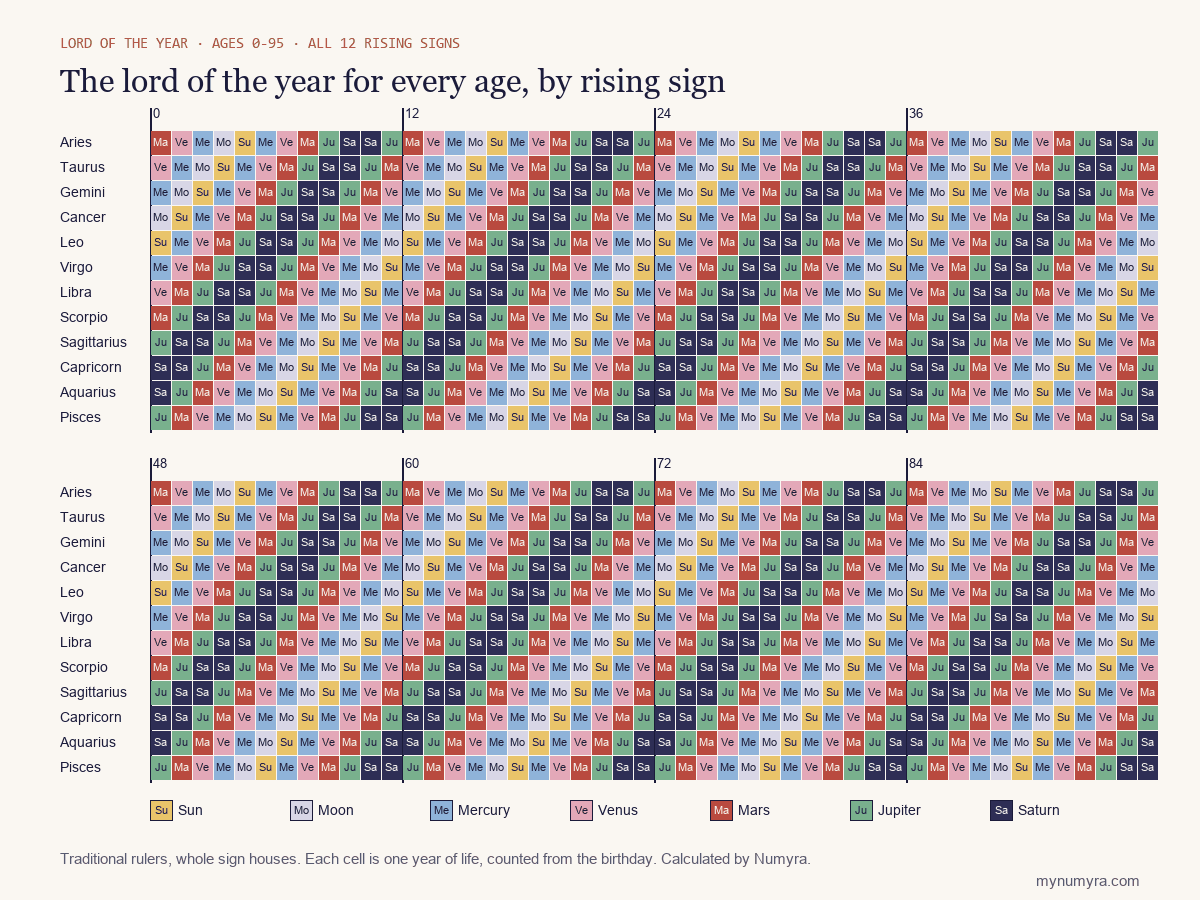
The chart repeats the table as colors, one row per rising sign and one cell per year. Each vertical bar is a 12-year mark, where the row starts again with its 1st house lord. Reading across a row, the sequence of planets never changes; reading down a column, the same sequence is shifted by one sign for each rising sign.
Patterns in the lords: how often each planet rules
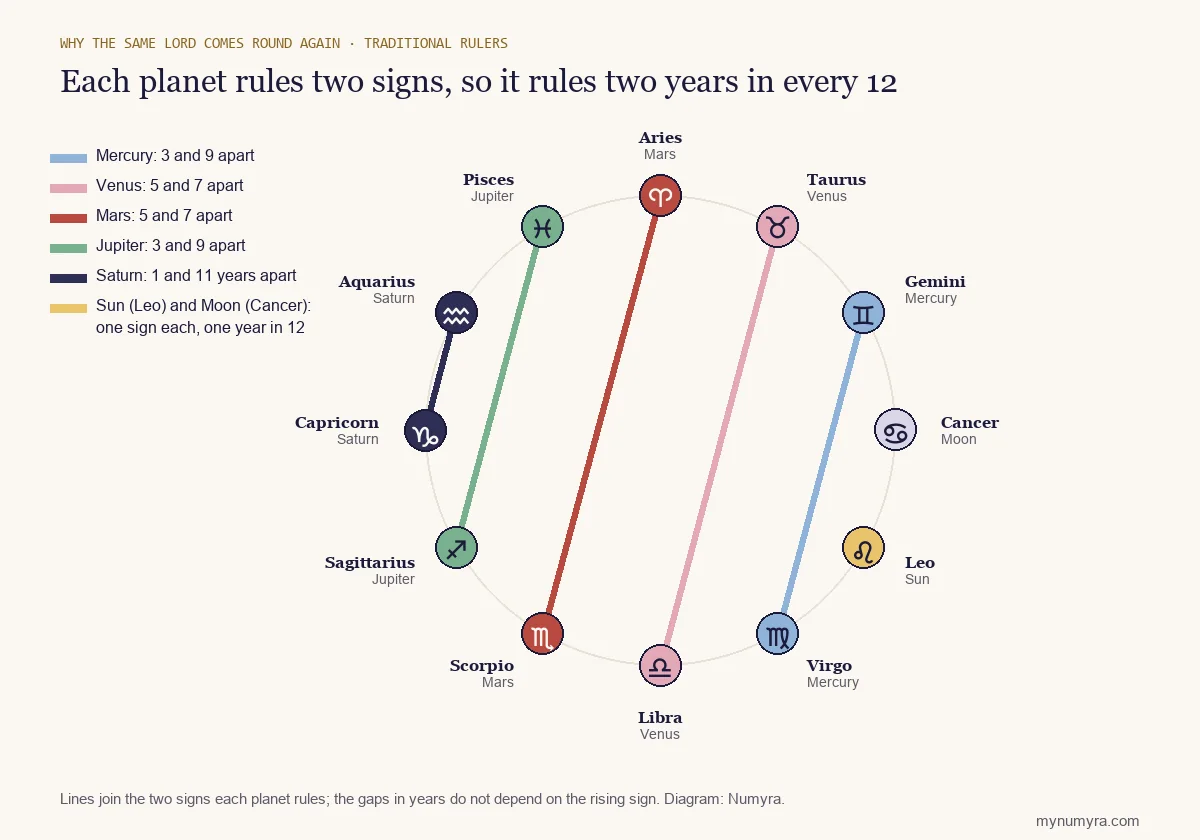
Counting the table gives a result that surprised us: every rising sign gets exactly the same number of years from each planet. Over ages 0 to 95 there are eight full cycles of 12, and in each cycle every sign is used once, so a planet that rules two signs rules two years per cycle and a planet that rules one sign rules one.
| Planet | Signs it rules | Years as lord, ages 0 to 95 | Gap between its two years in a cycle |
|---|---|---|---|
| The Sun | Leo | 8 | Once in every 12 years |
| The Moon | Cancer | 8 | Once in every 12 years |
| Mercury | Gemini and Virgo | 16 | 3 and 9 years |
| Venus | Taurus and Libra | 16 | 5 and 7 years |
| Mars | Aries and Scorpio | 16 | 5 and 7 years |
| Jupiter | Sagittarius and Pisces | 16 | 3 and 9 years |
| Saturn | Capricorn and Aquarius | 16 | 1 and 11 years (two years in a row, then 11 years) |
So no rising sign is “Saturn heavy” or “Sun poor” over a lifetime. What differs is the order and the timing. The gaps in the last column are fixed by the zodiac and do not depend on the rising sign: Saturn’s two signs, Capricorn and Aquarius, sit side by side, so Saturn rules two consecutive years once in every 12. With Aries rising those are ages 9 and 10, 21 and 22, 33 and 34; with Capricorn rising, ages 0 and 1, 12 and 13, 24 and 25. Venus and Mars are 5 and 7 years apart, Mercury and Jupiter 3 and 9. Our assumption is traditional rulers throughout; the picture below shows why the gaps come out this way.
The same table gives a quick measure of how often the lord of the year is also your chart ruler, the planet ruling your rising sign. It is the lord of the year 16 times in 96 years for ten of the rising signs, and 8 times for Leo and Cancer, whose chart rulers, the Sun and the Moon, rule only one sign each.
Where Jupiter and Saturn returns fall in the cycle
Profections count in years, planetary returns count the time a planet takes to come back to its birth degree, and the two clocks interlock in a way none of the guides we read mention. Jupiter’s orbit is about 11.86 years, close enough to 12 that the first four Jupiter returns all land in the same kind of profection year. Saturn’s is about 29.4 years, so its first return falls in the 5th or 6th house year and its second, at 58, always in the 11th. We measured this directly: for each of the 40,542 birth dates from January 1, 1900 to December 31, 2010 we found the age of each exact planetary return and counted which profection year, with age taken in completed years, contains it. The method is the one behind our planetary returns table.
| Event | First exact pass at age | Profection house of that year (share of birth dates) | Rising signs for which the planet is also lord of the year |
|---|---|---|---|
| Jupiter return 1 | 11.27 to 11.96 | 12th (100%) | Aries, Capricorn (100%) |
| Jupiter return 2 | 23.22 to 23.92 | 12th (100%) | Aries, Capricorn (100%) |
| Jupiter return 3 | 35.17 to 35.87 | 12th (100%) | Aries, Capricorn (100%) |
| Jupiter return 4 | 47.13 to 47.83 | 12th (100%) | Aries, Capricorn (100%) |
| Jupiter return 5 | 58.52 to 59.78 | 12th (92.5%), 11th (7.5%) | Aries, Capricorn (92.5%); Taurus, Aquarius (7.5%) |
| Jupiter return 6 | 70.41 to 71.72 | 12th (69.6%), 11th (30.4%) | Aries, Capricorn (69.6%); Taurus, Aquarius (30.4%) |
| Jupiter return 7 | 82.33 to 83.60 | 11th (59.9%), 12th (40.1%) | Taurus, Aquarius (59.9%); Aries, Capricorn (40.1%) |
| Jupiter return 8 | 94.27 to 94.96 | 11th (100%) | Taurus, Aquarius (100%) |
| Saturn return 1 | 28.40 to 29.86 | 6th (77.2%), 5th (22.8%) | Virgo (100%); Leo (77.2%); Libra (22.8%) |
| Saturn return 2 | 58.20 to 58.96 | 11th (100%) | Aries, Pisces (100%) |
| Saturn return 3 | 87.32 to 88.81 | 5th (62.2%), 4th (37.8%) | Libra (100%); Virgo (62.2%); Scorpio (37.8%) |
| Uranus opposition | 37.98 to 44.48 | 8th (19.8%), 7th (18.9%), 9th (14.2%), 6th (13.4%), 4th (12.9%), 5th (12.8%), 3rd (7.9%), 2nd (0.1%) | Not a traditional ruler |
| Uranus return | 82.37 to 83.95 | 12th (75.7%), 11th (24.3%) | Not a traditional ruler |
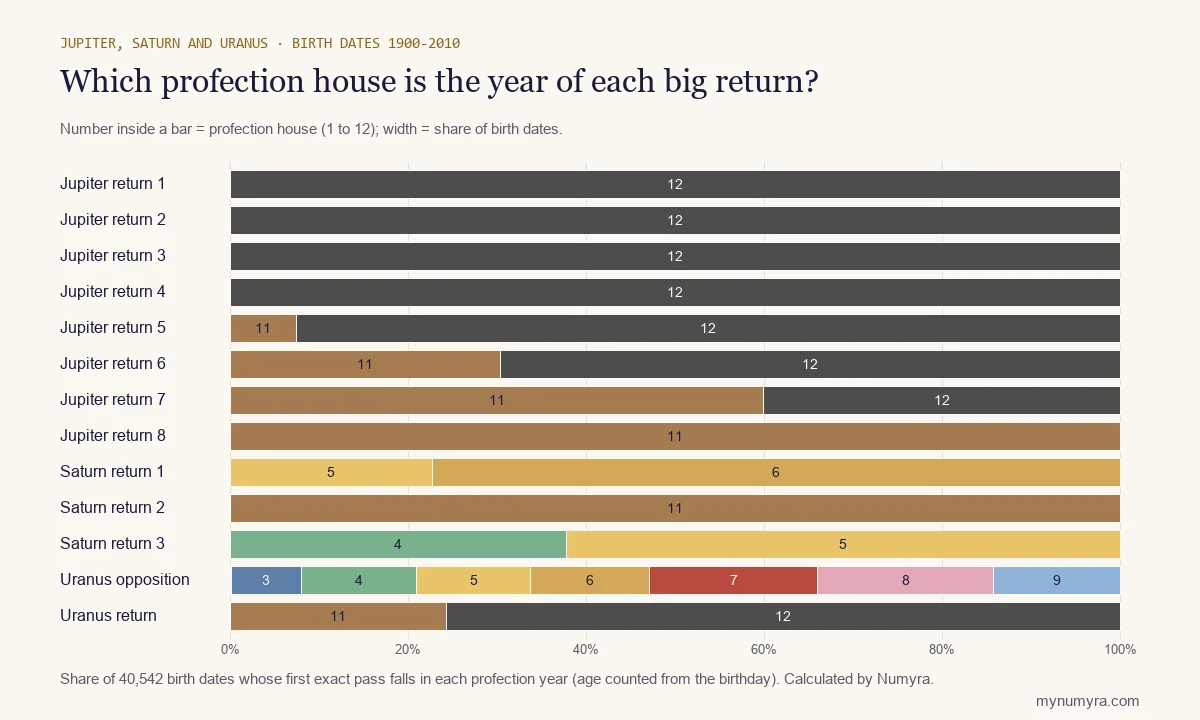
Three results stand out. Every one of the first four Jupiter returns, at 11, 23, 35 and 47, falls in a 12th house year for all 40,542 dates, and the fifth, sixth and seventh drift towards the 11th house year as the extra 0.14 years of each lap add up. The Saturn return falls in the 6th house year, age 29, for 77.2% of birth dates and in the 5th house year, age 28, for 22.8%. And the Uranus opposition, which arrives between 38 and 44, spreads over eight different houses with none taking more than 19.8% of birth dates, so it does not line up with the profection cycle at all.
The last column gives a way to ask whether the returning planet is also the lord. Jupiter is the lord of the year during its own first four returns only for Aries and Capricorn rising, because the 12th house falls in Pisces for Aries rising and in Sagittarius for Capricorn rising. Saturn rules its own first return year for Virgo rising whichever year it falls in, for Leo rising when it falls at age 29, and for Libra rising when it falls at 28. The rising sign and the birth date are independent, so these shares hold for any birth time. Whether coincidences like these mean anything is a matter for the reader; we found no source that tests it, and we make no claim that a return in a year ruled by the same planet is more eventful.
What Ptolemy, Valens and Lilly actually wrote
Many online guides say profections are over two thousand years old without showing a passage. Here are three, in translation or in the original English, each checked against a page or text we could open. Our Tetrabiblos guide places the first of them in context.
Ptolemy, second century
In Book IV of the Tetrabiblos, in the chapter on the division of times, Ptolemy sets out how to find the ruler of each year. After explaining how to give the rulership of longer periods to planets, he turns to the single years:
“the annual chronocrators by setting out from each of the prorogatory places, in the order of the signs, the number of years from birth, one year to each sign, and taking the ruler of the last sign.”
Ptolemy, Tetrabiblos, Book IV, chapter 10, trans. F. E. Robbins, Loeb Classical Library (1940), via LacusCurtius
That is the whole method in one sentence: count from a starting place, one sign per year, take the ruler of the sign where the count ends. Ptolemy continues by counting months from the year’s place at twenty-eight days to a sign, which is the idea our lunar return guide calls monthly profections, and he says the ingresses of Jupiter into the places of the years carry weight. His starting points are the “prorogatory places”, the points he uses elsewhere to measure length of life, not only the Ascendant.
Vettius Valens, second century
Valens, a working astrologer writing in Greek, treats the technique at much greater length. Chris Brennan says on The Astrology Podcast that Valens spends at least three books of his Anthology on it and uses dozens of example charts, and that Hellenistic astrologers do not seem to have had a specific name for the technique. The clearest short statement is in Book IV, chapter 11, in Mark Riley’s translation:
“when investigating the current year of a nativity, we divide by 12. Count the remainder from a star which is able <to transmit> to a star which is able to receive. In this way we will discover to what sign the year transmits.”
Vettius Valens, Anthology, Book IV, chapter 11, trans. Mark Riley (2010), from the annotated edition by Jane Griscti; angle brackets are Riley’s
Two things differ from the popular method. Valens does not start only at the Ascendant: any planet, and also the Ascendant, Sun and Moon, can “transmit” to another, and he checks every pair separated by the right number of signs. And he divides by 12 and uses the remainder, exactly as the sum at the top of this page does. His worked example is the 35th year: he divides by 12, gets a remainder of 11, and looks for points 11 signs apart. In our table age 35 is the 12th house, which is 11 signs on from the 1st, so Valens’s count and the table agree.
William Lilly, 1647
Lilly’s Christian Astrology gives profections several chapters in Book III, from page 715. He describes the annual kind as giving thirty degrees, one whole sign, to each solar year, moving the whole figure forward while keeping every degree and minute and varying only the sign, and says the annual profections repeat every twelfth year. On the lord of the year he writes, on page 720:
“Againe, Profections doe shew who is the Lord or Governour of the yeer; and he is no other then the Lord of that Signe who ascends”
William Lilly, Christian Astrology (London, 1647), p. 720, from the Internet Archive scan, spelling as printed
Lilly adds a refinement that modern whole-sign practice drops. If the beginning of a sign ascends, one planet is lord of that year; if the middle of a sign ascends, he says there will be two lords, one for the first fifteen degrees and one for the next fifteen. He also divides the solar year into thirteen equal parts for monthly profections, in line with Ptolemy’s 28 days to a sign, and he notes that some authors give one general table for all births while he preferred to draw one for each.
His house-by-house judgments, on pages 729 and 730, are what most modern keyword lists descend from, and they are blunter than the modern versions. Lilly writes them for the profection of the Ascendant or the Moon. We summarize them below, in our words, so you can compare them with what a current guide says about the same house.
| House | Lilly (1647), summarized |
|---|---|
| 1st house | Usually cheerful; a fit year to provide what the body needs, such as clothes and food. |
| 2nd house | Good for buying and selling goods; a proper time to increase one’s estate. |
| 3rd house | May prosper in journeys; inclined to talk with relatives and religious men. |
| 4th house | May expect an inheritance, a new house or a blessing from parents, and may build or repair; but may also be sorrowful and fearful, in danger from water, and should avoid long journeys. |
| 5th house | Takes pleasure according to his age; good for making covenants, sending letters, settling accounts and putting on new clothes. |
| 6th house | May fear sickness and the hatred of many common people; beware of ill servants, make no journeys, and expect an ill time for trade, contracts and bargains. |
| 7th house | Impatient and quarrelsome, with many open enemies and suits; but good for marrying, if the other significators agree. |
| 8th house | Body or goods suffer through lies, slander and treachery, and sometimes death if the length-of-life point meets a deadly direction; not a time for new contracts or bold trade. |
| 9th house | A convenient time for long journeys, study and learning, and for curious pursuits such as chemistry. |
| 10th house | Ambitious and seeking preferment; meets eminent men and magistrates, may attain public employment; a fit time for a tradesman to work with industry, and travel is safe and brings reputation. |
| 11th house | A cheerful heart, more friends, a year very prosperous in worldly affairs; it invites him to husband time well. |
| 12th house | Sickly with an unclear cause, enmity from bad neighbors, danger of imprisonment, banishment or hiding, unless the 12th house was fortunate at birth; an unlucky year to deal in cattle, and beware of horsemanship. |
At the end of the chapter Lilly says the ancients left very many rules on the Ascendant, and that, because they were badly translated out of Arabic by people who did not understand astrology, many of them contradict one another, so he leaves out the rest. That is a useful warning for anyone comparing house keywords across modern sources: the lists differ because the tradition itself was never uniform.
One older name is worth knowing. Modern summaries, including a history of profections published by the astrology site Augurine and a guide by Jupiter’s Realm, say Dorotheus of Sidon, a verse astrologer usually placed in the first century, already described the annual profection and the lord of the year. We did not read Dorotheus for this page, so treat that as a secondary claim.
Old method and modern practice: what changed
The modern version is a simplified descendant, and the differences matter if you compare a calculator with a book.
| Question | Ptolemy | Valens (IV.11) | Lilly (1647) | Most guides today |
|---|---|---|---|---|
| Where does the count start? | Each of the prorogatory places | Any planet or point that can “transmit”, including the Ascendant, Sun and Moon | The Ascendant first, then the Moon, Midheaven and Sun in later chapters | The Ascendant |
| How far per year? | One sign | The age divided by 12, remainder counted in signs | Thirty degrees, one whole sign | One sign, one house |
| Who is lord of the year? | The ruler of the last sign counted | He reads the planets and points that stand that many signs apart | The ruler of the sign that ascends; two lords if the middle of a sign ascends | The traditional ruler of the profected sign |
| When does the year begin? | Counted from birth | Counted from birth | When the Sun returns to its natal degree and minute | On your birthday |
The practical consequence is that a calculator and a seventeenth-century text will usually agree on the sign and the lord and differ at the edges: a birthday that falls a few hours before the Sun’s actual return, a rising degree late in a sign, or a point other than the Ascendant used as the start. When a source disagrees with this page on a house keyword, compare it with the table above before assuming either is wrong.
How to use a profection year without over-reading it
Use the house and the lord as prompts for questions, not as answers. Which topics has this house stood for in your own life so far? Where is the lord in your chart, and how strong is it? What do the slow planets do in that house and sign during the year? These are the same questions Lilly asked, and he paired profections with directions and transits, not instead of them. The year’s lord is read together with the solar return chart, which tells you where that planet falls that year.
Keep the limits in view. Sixteen of the 96 years are ruled by each of five planets, so a “Saturn year” is a regular part of every life and not an omen. Old judgments about illness, enemies and death, such as Lilly’s for the 6th, 8th and 12th house years, are historical statements, not warnings; health, legal and money decisions belong with qualified professionals, and this page is educational information about an astrological tradition. If you want a deeper reading of the 12th house year that precedes each 1st house year, our 12th house guide covers what the tradition says. A sensible next step is simply to work out your rising sign, find the house for your current age in the tables above, and look at what the lord’s natal condition suggests, then write down what actually happens and compare at the next birthday.
How we built the tables and measured the returns
The age, house, sign and lord tables follow one rule: the sign is the rising sign index plus the age, modulo 12; the house is the age modulo 12 plus 1; the lord is the traditional ruler of the sign. We generated every cell twice, once by the formula and once by stepping one sign forward for each year, and the two matched for all 12 rising signs and 96 ages. We then checked the rule against Valens’s own example, age 35 with a remainder of 11, which lands on the 12th house in our table.
The return results use the Swiss Ephemeris through the pyswisseph library in Moshier mode, the same calculation as our planetary returns table. For each of the 40,542 birth dates from January 1, 1900 to December 31, 2010 we took the planet’s apparent geocentric tropical longitude at 12:00 UT, unwrapped it into a continuous path, found each moment it crosses the birth longitude plus a multiple of 360 degrees, and recorded the age of the first exact pass in years of 365.2425 days. The profection year of that pass is the number of completed years. Two limits apply: a calendar birthday and a 365.2425-day year differ by less than a day, which could move a pass within a day of a birthday into the neighboring year, and we used noon for every birth because the birth time moves a return by at most half a day. We assumed the rising sign is independent of the date, which is true to a good approximation across a population. The calculations are by the Numyra Methodology Desk and are not a claim about what any return means.
Frequently asked questions
What is an annual profection in astrology?
A traditional timing technique that moves your rising sign forward one sign for each year of life. The sign reached sets the house the year is about and its ruler is called the lord of the year, in force from one birthday to the next.
How do I find my profection year?
Take your completed years, divide by 12 and keep the remainder. The house is the remainder plus 1, so remainder 0 is the 1st house and 9 is the 10th. Count that many signs from your rising sign for the profected sign, then take its traditional ruler as the lord of the year.
Do I need my exact birth time for annual profections?
You need your rising sign, which needs a birth time. The rising sign changes about every two hours, so if your time is uncertain and close to a sign change, the house signs and every lord of the year shift. Without a reliable rising sign the table cannot be used with confidence.
Do profections use Uranus, Neptune and Pluto as rulers?
No. Ptolemy, Valens and Lilly used only the seven visible planets, and the traditional method assigns Aquarius to Saturn, Scorpio to Mars and Pisces to Jupiter. A few modern practitioners add the outer planets, but this page and the tables follow the traditional rulers.
Does the profection year change on January 1 or on my birthday?
On your birthday. Age in the sum is the number of birthdays you have had. Lilly (1647) places the start at the Sun’s return to its natal degree and minute, which can be up to about a day from the clock birthday, but most modern guides use the birthday.
Is the lord of the year the same as my chart ruler?
Only in the 1st house years, and in any year whose sign has the same ruler. The chart ruler rules your rising sign; the lord of the year rules the profected sign, so it is the chart ruler 16 times in 96 years for most rising signs and 8 times for Leo and Cancer.
What are monthly profections?
The same counting at a smaller scale. Ptolemy counts a sign every 28 days from the sign of the year, and Lilly divides the solar year into thirteen equal parts, one sign for each. It is a separate technique with its own calculation, so this page covers only the yearly one.
Is there evidence that profections predict anything?
No scientific evidence supports it, and the old texts give examples chosen by their authors rather than controlled tests. We present profections as a traditional framework for reflection. Use it to ask questions about a year, not to make health, legal or financial decisions.
Sources
- Ptolemy. Tetrabiblos, Book IV, chapter 10, trans. F. E. Robbins, Loeb Classical Library (Harvard University Press, 1940), on LacusCurtius, University of Chicago.
- Vettius Valens. Anthology, Book IV, chapter 11, trans. Mark Riley (2010), in the annotated and reformatted edition by Jane Griscti.
- William Lilly. Christian Astrology (London, 1647), Book III, chapters CLXVI to CLXX, pp. 715 to 730, Internet Archive scan.
- Chris Brennan. “Annual Profections: An Ancient Time-Lord Technique.” The Astrology Podcast, Episode 153 transcript.
- Augurine. “Profections: Hellenistic Time Lords.” Secondary history of the technique, cited for the claim about Dorotheus of Sidon.
- Jupiter’s Realm. “Annual Profections: The Astrology of Your Year Ahead.” Secondary guide, cited for the claim about Dorotheus of Sidon.
- Astrodienst. Swiss Ephemeris, Moshier mode, for all planet positions (calculations by the Numyra Methodology Desk).