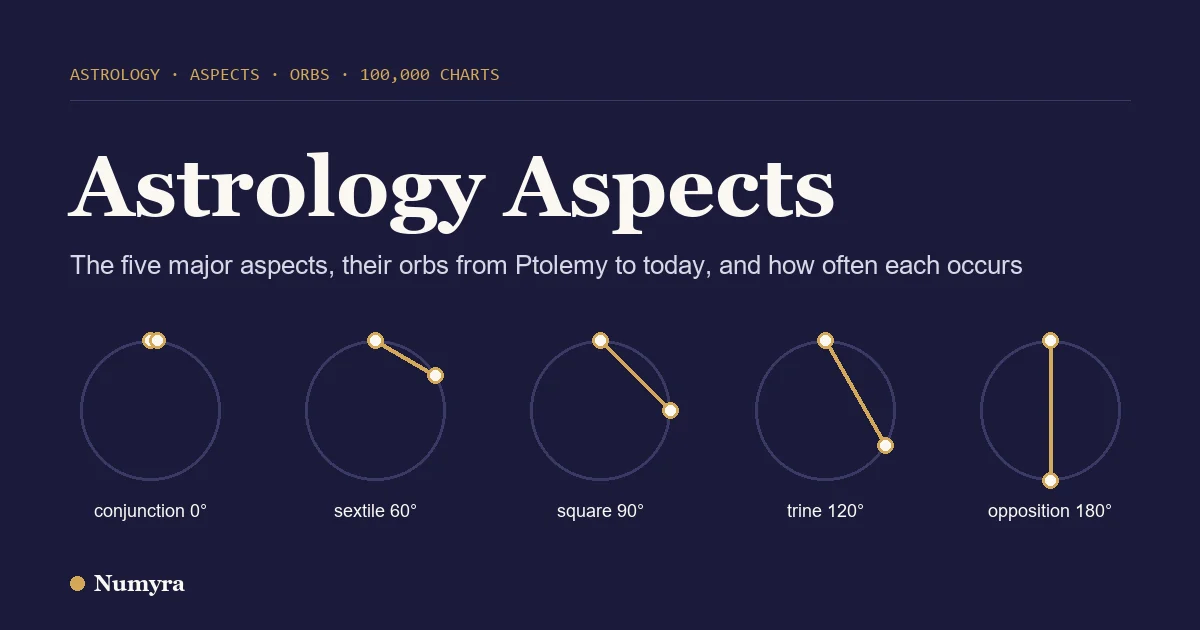
An astrological aspect is the angle between two planets, measured along the zodiac. Five angles are called major aspects: the conjunction (0 degrees), sextile (60), square (90), trine (120) and opposition (180). Two planets count as “in aspect” when their angle falls within an allowed margin called the orb, and that margin decides almost everything. In 100,000 calculated charts the average chart has 11.8 major aspects at a 6-degree orb and 16.1 at 8 degrees, and the orbs published by four well-known sites give the same charts anywhere from 11.8 to 17.5. This guide sets out the five aspects, the orbs William Lilly printed in 1647 next to the ones used today, and how often each aspect between each pair of planets really occurs.
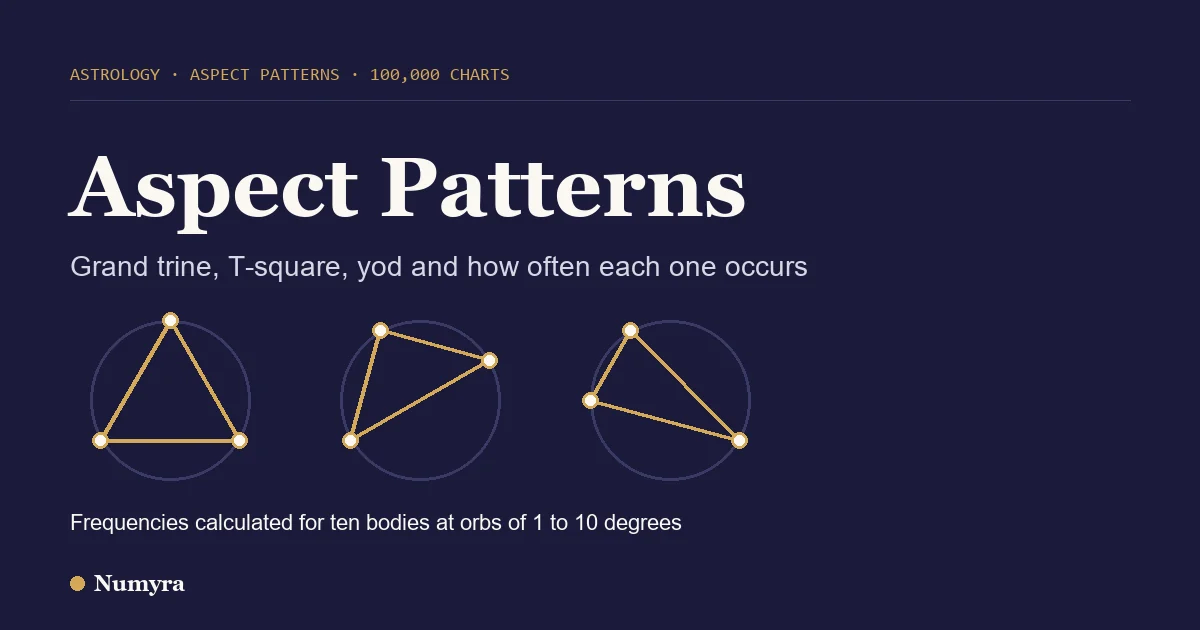
How this page differs from our other aspect guides: our aspect patterns guide counts shapes made by three or more planets, our synastry guide reads angles between two people’s charts, and our guide to zodiac sign compatibility reads angles between signs. This page is the reference for the single aspect between two planets in one chart, with its orbs and its odds.
Key takeaways
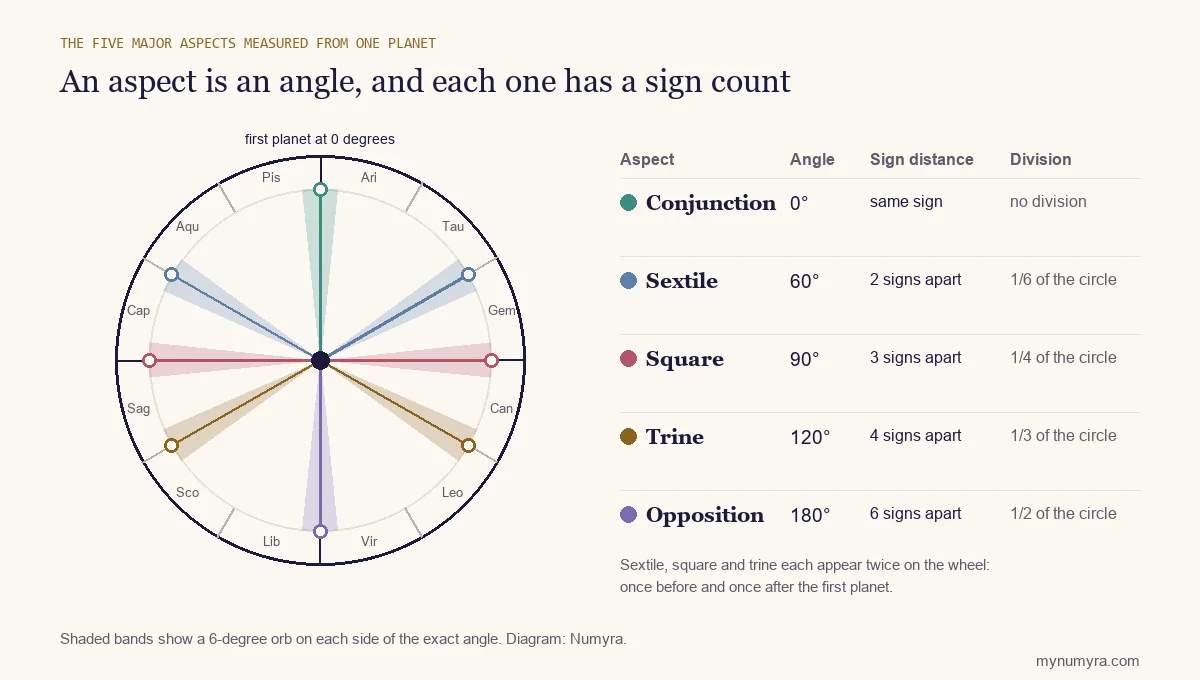
- The major aspects are the angles that cut the circle into whole parts: the sextile (a sixth, 2 signs apart), the square (a quarter, 3 signs), the trine (a third, 4 signs) and the opposition (a half, 6 signs), plus the conjunction at zero.
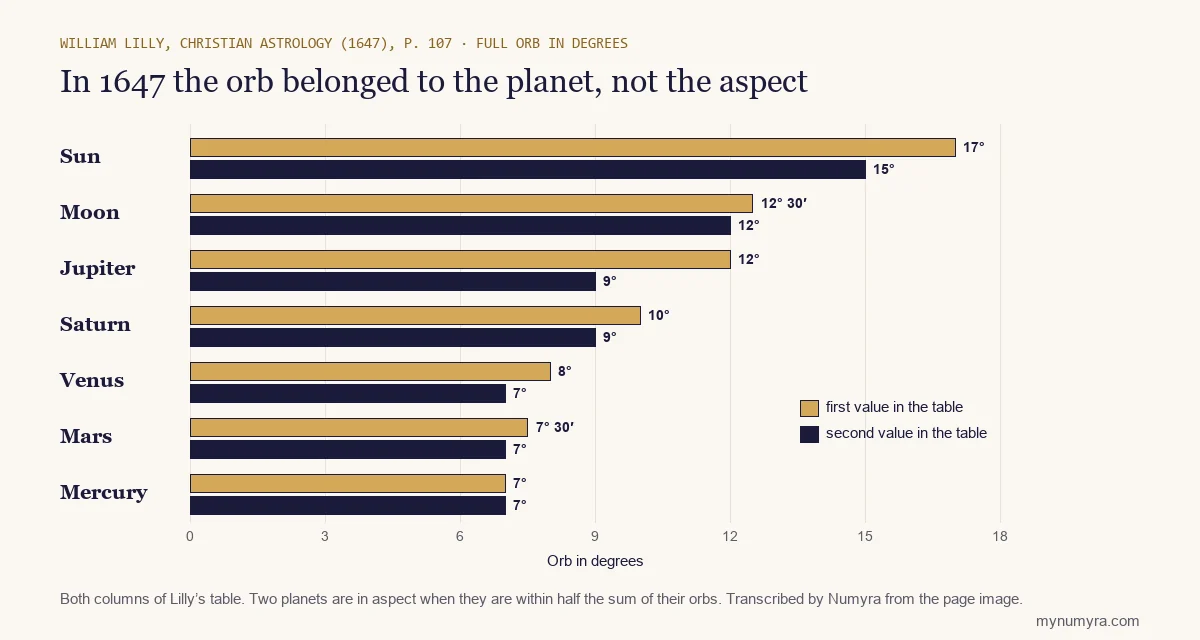
- Ptolemy’s Tetrabiblos (Book I, chapter 13) lists four aspects, not five, defines them between signs, and gives no orb in its aspect chapters. William Lilly’s 1647 Christian Astrology calls the conjunction an aspect “very improperly” and prints orbs by planet: Sun 17 degrees (or 15), Moon 12 degrees 30 minutes (or 12), down to 7 for Mercury.
- Today the orb belongs to the aspect and sources disagree: a conjunction gets 10 degrees at Astrodienst, 10.5 at Astrotheme, 8 in a common textbook convention and 6 at Labyrinthos. Applied to the same 100,000 charts, those orbs find between 11.8 and 17.5 major aspects per chart.
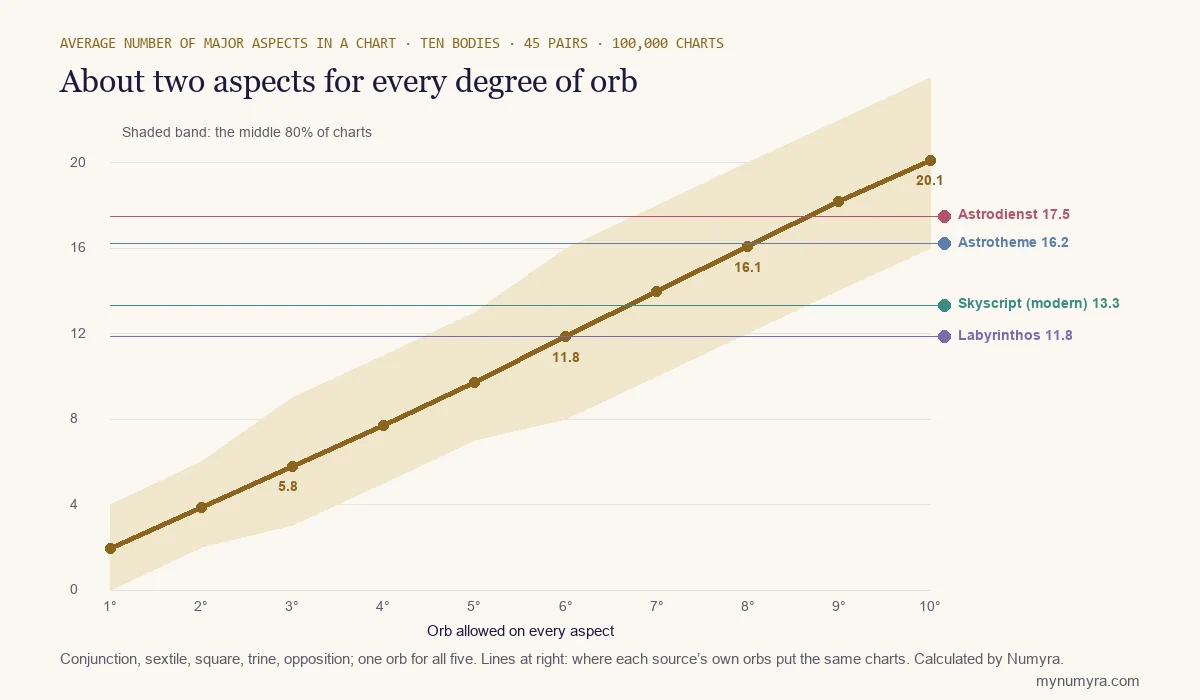
- A rule of thumb from our count: with the ten planets, a chart has about two major aspects for every degree of orb allowed, 5.8 at 3 degrees, 11.8 at 6 and 20.1 at 10.
- Pairs are not equal. Sun and Venus form an aspect in only 9.7% of charts at 6 degrees, Sun and Mercury in 17.5%, both only conjunctions, because those two planets never stray far from the Sun; random positions would give 26.7%. Uranus and Pluto form one in 47.9% of 1994 to 2014 births.
- Every chart mixes easy aspects (sextile, trine) and hard ones (square, opposition). At 6 degrees 69% of charts have more easy than hard and only 1.1% have no hard aspect at all. Aspects are a tradition of interpretation, not a tested prediction.
In this guide
- What an aspect is
- The five major aspects, one at a time
- What Ptolemy and Lilly wrote about aspects and orbs
- How modern sources set their orbs
- How much the orb changes the number of aspects
- How often each major aspect occurs
- Which planet pairs form which aspects
- Aspects by sign versus aspects by degree
- The minor aspects
- Easy and hard aspects
- How to find and weigh the aspects in your own chart
- What aspects cannot tell you
- Frequently asked questions
What an aspect is
Every planet sits at a longitude, a position from 0 to 360 degrees around the zodiac. An aspect is the shorter distance between two longitudes, a number from 0 to 180. Take the example William Lilly used in 1647: Venus at 10 degrees of Taurus (40 degrees on the circle) and Saturn at 18 degrees of Virgo (168 degrees). They are 128 degrees apart, which is 8 degrees short of an exact trine. Astrologers call the exact angle the aspect and the 8 degrees the orb, the margin by which the pair misses it.
Aspects differ from the other things you read in a chart in two ways. They describe pairs, not single planets, so ten bodies give 45 pairs to check. And they describe angles, not signs, although the two are linked: a trine always connects signs four apart, which always share an element, as our guide to the four elements and three modalities explains. The links between signs and angles are why the aspects have the names and sign counts they do.
This page answers three questions that the pages we compared leave open: who set the orb and when, how much the orb changes what you see in a chart, and how common each aspect between each planet pair actually is. The counts come from 100,000 simulated charts; the method is described in the section on counting.
The five major aspects, one at a time
The five major aspects are the conjunction, sextile, square, trine and opposition. Four of them divide the circle evenly: the opposition is half of it, the trine a third, the square a quarter and the sextile a sixth. The conjunction is the zero case. The diagram shows each one measured from a single planet, with the shaded band marking a 6-degree orb.
| Aspect | Angle | Signs apart | What the signs share | Lilly (1647) in brief | Charts with at least one, 6° orb |
|---|---|---|---|---|---|
| Conjunction | 0° | same sign | the same sign | Good or bad, by whether the planets are friends | 84.6% |
| Sextile | 60° | 2 | same polarity, different element | Love, unity and friendship | 97.5% |
| Square | 90° | 3 | same modality, different element | A sign of imperfect enmity | 93.0% |
| Trine | 120° | 4 | same element | Love, unity and friendship, the more forcible of the two | 92.6% |
| Opposition | 180° | 6 | same modality and polarity | A sign of perfect hatred | 70.9% |
Conjunction (0 degrees)
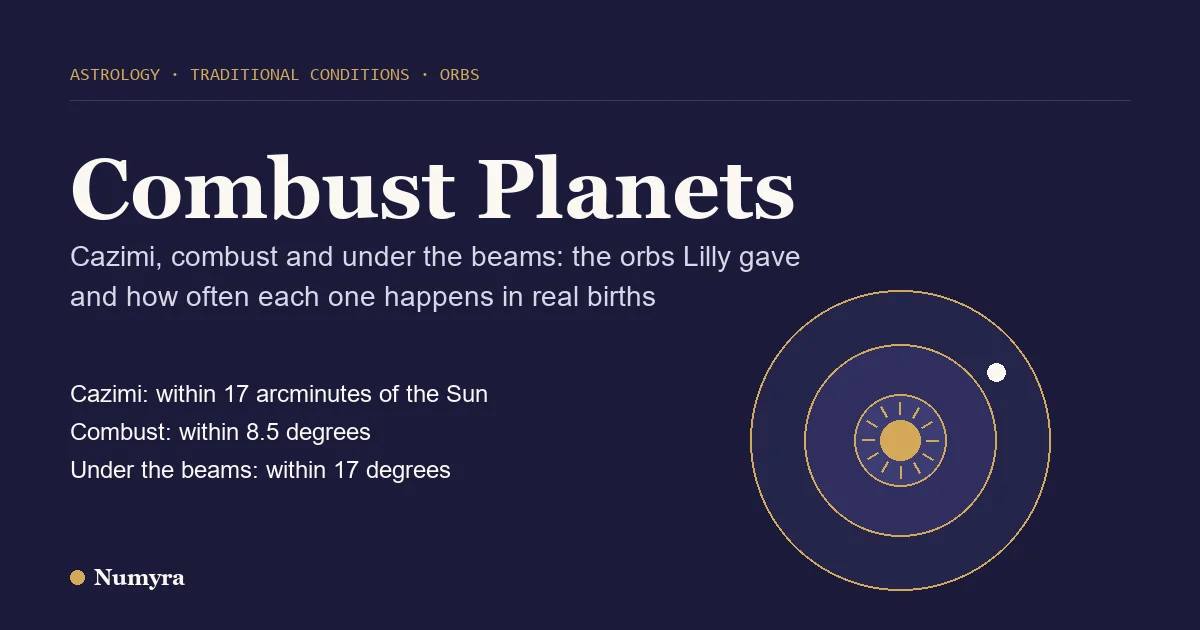
Two planets in the same place, usually in the same sign. Modern guides such as Cafe Astrology read the pair as blended, acting together and hard to tell apart from the inside. Lilly gave no fixed verdict: a conjunction is good or bad according to whether the two planets are friends or enemies by nature. When one of the planets is the Sun, the conjunction has its own vocabulary, covered in our guide to combust planets. Mercury and Venus can form no other major aspect to the Sun than a conjunction, a limit we measure below.
Sextile (60 degrees)
Two signs apart. The signs always come from compatible elements, fire with air or earth with water, so the sextile is read as cooperation. Cafe Astrology distinguishes it from the trine by effort: the talent is available but has to be picked up and used. Ptolemy and Lilly both put it with the friendly aspects, and Lilly rated it weaker than the trine.
Square (90 degrees)
Three signs apart, always the same modality (cardinal, fixed or mutable) in a different element, as Aries and Cancer. It is the aspect of friction. Modern writers describe it as the tension that forces action; Lilly called it a sign of imperfect enmity, and Ptolemy, who used the older name quartile, placed it among the disharmonious aspects.
Trine (120 degrees)
Four signs apart, always the same element. It is read as ease and natural talent, so natural that Cafe Astrology says the person may not notice it. Lilly agreed that it was the stronger of the two friendly aspects. In geometry it is the angle behind the grand trine, which we count in the aspect patterns guide.
Opposition (180 degrees)
Six signs apart, directly across the wheel, with the same modality and a matching polarity. Modern readings stress being pulled two ways and working the tension out through other people. Lilly’s reading was the harshest: his horary example is two opponents in a lawsuit whose planets stand in opposition, for whom peace is unlikely until the case is over. For the sign-level version of all of these angles, see our guide to how zodiac compatibility really works.
What Ptolemy and Lilly wrote about aspects and orbs
The oldest account most astrologers cite is in Book I, chapter 13 of Ptolemy’s Tetrabiblos, written in the second century (our guide to the Tetrabiblos covers the whole book). Reading it in the Robbins translation turns up three things that are easy to miss. First, Ptolemy lists four aspects: opposition, trine, quartile and sextile. The conjunction is not among them. Second, he defines them between signs, by sign count and by angle together: the opposition is “six signs, and 180 degrees”, the trine “four signs, and 120 degrees”. Third, he explains his choice by geometry and by the nature of the signs, and gives a reason why some aspects are friendly and others not:
“Of these aspects trine and sextile are called harmonious because they are composed of signs of the same kind, either entirely of feminine or entirely of masculine signs; while quartile and opposition are disharmonious because they are composed of signs of opposite kinds.”
Ptolemy, Tetrabiblos, Book I, chapter 13, trans. F. E. Robbins (Loeb Classical Library, 1940), via LacusCurtius
What chapters 13 to 16 do not contain is an orb. We read all four of them, on aspects, commanding and obeying signs, signs that behold each other and disjunct signs, and found no number for how far from exact an aspect may be. The ancients did measure it elsewhere. Skyscript quotes an early introduction to the Tetrabiblos by Porphyry that gives each planet a span of rays: 30 degrees for the Sun (15 on each side), 24 for the Moon (12), 18 for Saturn and Jupiter (9), 16 for Mars (8) and 14 for Venus and Mercury (7). We have not checked that quotation against the Greek. What matters here is where the orb sits: it belongs to the planet, not to the aspect.
Fifteen centuries after Ptolemy, William Lilly’s Christian Astrology (London, 1647), the standard English textbook of its day, gathered the rules in one place. In chapter 19 of his “Introduction to Astrologie”, on printed pages 105 to 107, he does three things. He names the aspects, and is blunter than Ptolemy about the conjunction:
“The most forcible or strongest Rayes, Configurations or Aspects, are onely these (nominated before) the Sextil, Quadrate, Trine, Opposition, we use to call the Conjunction, an Aspect, but very improperly.”
William Lilly, Christian Astrology (London, 1647), “An Introduction to Astrologie”, p. 105, Internet Archive scan, transcribed from the page image
Quadrate is his word for the square. He separates the exact aspect from the near one. A partile aspect is when two planets stand exactly the number of degrees apart that makes the aspect perfect. A platick aspect is the looser kind, and he defines it by orbs:
“A Platick Aspect is that which admits of the Orbs or Rayes of two Planets that signifie any matter”
William Lilly, Christian Astrology (London, 1647), “An Introduction to Astrologie”, p. 107, Internet Archive scan, transcribed from the page image
And he prints a table of orbs. It is the first place we found that sets out a number for each planet, and it comes with a candid note that the right-hand column is an alternative, to be used “as my Memory best Remembereth them”. Here are both columns, with half of the first one, the figure Lilly calls the moiety:
| Planet | Orb, first column | Orb, second column | Half of first column (moiety) |
|---|---|---|---|
| Sun | 17° | 15° | 8° 30′ |
| Moon | 12° 30′ | 12° | 6° 15′ |
| Jupiter | 12° | 9° | 6° |
| Saturn | 10° | 9° | 5° |
| Venus | 8° | 7° | 4° |
| Mars | 7° 30′ | 7° | 3° 45′ |
| Mercury | 7° | 7° | 3° 30′ |
The rule for using it is an average. Two planets are in aspect when their distance from exact is no more than the sum of their moieties, which is half the sum of their orbs. Lilly’s own example is the one from the start of this guide. Saturn’s moiety is 5 degrees and Venus’s is 4, so they are in platick aspect when within 9 degrees; they are 8 degrees from an exact trine, so they qualify. On the same rule the Sun and Moon are in aspect at up to 14 degrees 45 minutes (first column) or 13 degrees 30 minutes (second). So the Sun-Moon pair reaches almost 15 degrees, while Mercury and Venus together reach only 7 degrees 30 minutes. Lilly’s table of orbs comes right after his table of essential dignities; our guide to essential dignities covers that one.
Two cautions. Lilly applies the rule to aspects in general, and we apply it to all five in our count below, including the conjunction and opposition, which is our assumption. And he does not say where the numbers come from beyond “the best Authors and my owne Experience”. They are a convention of the time, not a measurement.
How modern sources set their orbs
Since Lilly the orb has moved from the planet to the aspect. Most modern references give one orb per aspect, with a bonus for the Sun and Moon or none at all. They do not agree. The table collects what each source states for natal charts; ranges are shown where the source gives a range.
| Source | Conjunction | Opposition | Square | Trine | Sextile | Minor aspects |
|---|---|---|---|---|---|---|
| Lilly, 1647 | By planet, not by aspect: Sun 17 or 15, Moon 12° 30′ or 12, Mercury 7, other planets 7 to 12 | Not tabled | ||||
| Astrodienst, web default chart | 10° | 10° | 10° | 10° | 6° | 3°, 3° and 2° |
| Astrotheme, natal | 10.5° | 10.0° | 7.8° | 8.3° | 6.1° | 0.8° to 2.7° |
| Skyscript, “many modern astrologers” | 8° | 8° | 8° | 8° | 4° | 2° |
| Kerykeion, common practice | 8 to 10° | 7 to 8° | 7 to 8° | 7 to 8° | 5 to 6° | 1 to 3° |
| Wikipedia, “Astrological aspect” | about 10° (8° without Sun or Moon) | 5 to 10° | 5 to 10° | 5 to 10° | 4 to 5° | about 0.75 to 3.5° |
| Labyrinthos | 6° | 6° | 6° | 6° | 6° | 2 to 3° |
Four things stand out. All of the sources put the major aspects between 6 and 10 degrees, but the same aspect can differ by 4 degrees from one to the next: the conjunction is 6 degrees at Labyrinthos and 10.5 at Astrotheme. The sextile is almost always narrower than the other four. Only Astrotheme puts a number on the extra allowance for the Sun and Moon, 18 minutes of arc, or 36 for a Sun-Moon aspect; Wikipedia and Kerykeion mention a bonus without one. That is the last trace of Lilly’s planet-by-planet orbs, which Skyscript describes as the traditional practice. And minor aspects get 3 degrees or less everywhere.
None of these sources offers evidence for its numbers. They are conventions, chosen by a tradition, a software designer or a teacher’s habit. Astrodienst, for one, says its web chart cannot offer free choice of orbs and suggests desktop software for that; it lets you scale all orbs by a percentage instead. The practical advice from several of the sources is the same: choose one set, state it, and apply it throughout. Our own count below shows why.
How much the orb changes the number of aspects
Method. We drew 100,000 birth moments. Each has a date drawn from real US daily birth counts for 1994 to 2014 (the CDC National Center for Health Statistics for 1994 to 2003 and the Social Security Administration for 2004 to 2014) and a clock time drawn uniformly across the day, in a US time zone weighted by population. We calculated the Sun, Moon, Mercury, Venus, Mars, Jupiter, Saturn, Uranus, Neptune and Pluto with the Swiss Ephemeris (Moshier ephemeris, tropical zodiac) and measured all 45 pairs for the five major aspects. We checked the counter against a separate plain-loop program on 1,493 of the charts at a 6-degree orb and the two gave identical results, 11.8466 aspects per chart. The birth files contain dates only, so clock times are random. The same sample underlies our aspect patterns guide.
With one orb for all five aspects the average number of aspects rises in a straight line: about two for each degree of orb. The reason is geometry. An orb of o degrees makes the conjunction and opposition each o/180 of the possible angles and the sextile, square and trine each o/90, so each pair has a chance of o times 4/90 of forming some major aspect, and 45 pairs make that about 2 times o.
| Orb on every aspect | Average aspects per chart | Middle 80% of charts | Fewest and most in any chart |
|---|---|---|---|
| 2° | 3.8 | 2 to 6 | 0 to 21 |
| 3° | 5.8 | 3 to 9 | 0 to 22 |
| 4° | 7.7 | 5 to 11 | 0 to 26 |
| 5° | 9.7 | 7 to 13 | 2 to 28 |
| 6° | 11.8 | 8 to 16 | 3 to 31 |
| 8° | 16.1 | 12 to 20 | 7 to 38 |
| 10° | 20.1 | 16 to 24 | 11 to 43 |
Real charts follow random positions closely here: at 6 degrees we found 11.8 aspects per chart against 12.0 for ten random longitudes. The total is set by the orb. What the real sky changes is the mix, as the next sections show.
Now apply the published orbs from the table above to the same charts. For Lilly and Porphyry we use the seven traditional planets (Sun to Saturn), because neither has orbs for Uranus, Neptune or Pluto, and the moiety rule; for the modern sources we show both the seven planets and all ten bodies. Astrotheme’s extra 18 and 36 minutes for the Sun and Moon are included.
| Orb system | Seven traditional planets | All ten bodies | Range in a chart, ten bodies |
|---|---|---|---|
| Lilly 1647, first column, moiety rule | 9.3 | not tabled | not tabled |
| Lilly 1647, second column, moiety rule | 8.3 | not tabled | not tabled |
| Porphyry set quoted by Skyscript, moiety rule | 8.4 | not tabled | not tabled |
| Astrodienst web default (10, 10, 10, 10 and 6) | 7.9 | 17.5 | 8 to 41 |
| Astrotheme natal (10.5, 10, 7.8, 8.3, 6.1, Sun and Moon extra) | 7.4 | 16.2 | 7 to 38 |
| Skyscript modern convention (8, 8, 8, 8 and 4) | 6.2 | 13.3 | 5 to 34 |
| Labyrinthos (6 for all) | 5.3 | 11.8 | 3 to 31 |
The same 100,000 charts, with the same planets, get an average of 17.5 major aspects under Astrodienst’s web orbs and 11.8 under Labyrinthos’s: 5.6 more, or 48% more, from the choice of table alone. All three traditional sets are wider than every modern set on the seven traditional planets: 9.3 aspects in an average chart under Lilly’s first column and 8.3 under his second, against 7.9 under Astrodienst’s web orbs, partly because the Sun, Moon and Jupiter reach so far. A statement such as “this chart has a lot of aspects” has no meaning until it names the orb.
How often each major aspect occurs
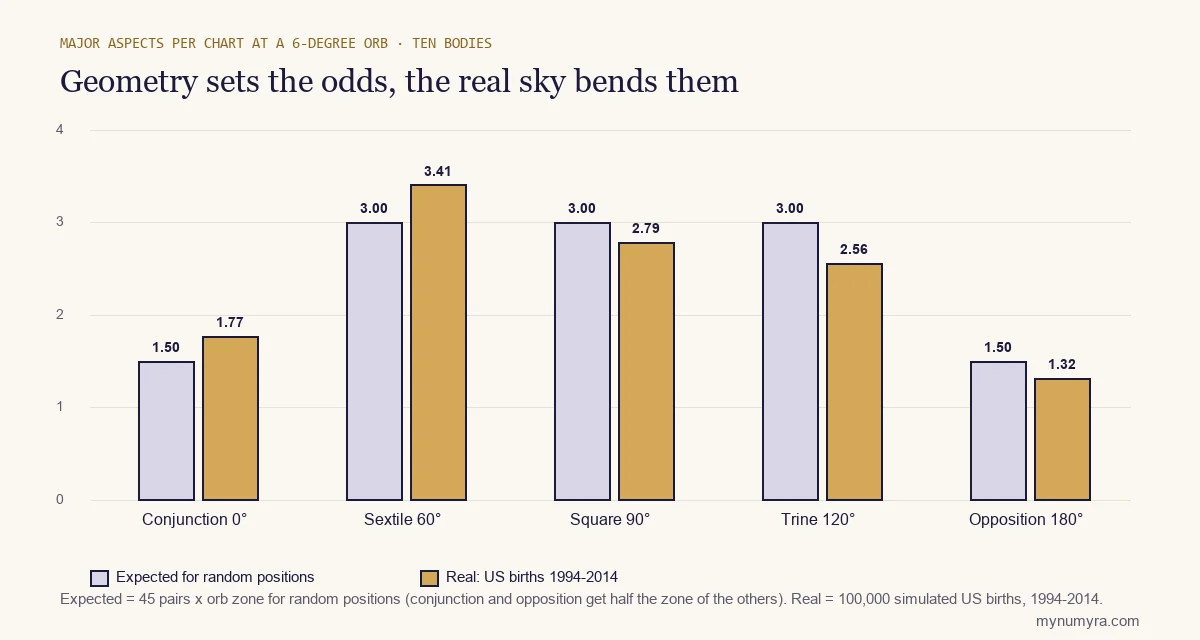
At a 6-degree orb the average chart has 1.8 conjunctions, 3.4 sextiles, 2.8 squares, 2.6 trines and 1.3 oppositions. Random positions would give 1.5, 3.0, 3.0, 3.0 and 1.5, because the sextile, square and trine each cover twice as much of the circle as the conjunction or opposition at the same orb. The table gives the share of charts that contain at least one of each aspect.
| Aspect | Per chart, 6° | At least one, 6° | Per chart, 8° | At least one, 8° |
|---|---|---|---|---|
| Conjunction (0°) | 1.77 | 84.6% | 2.38 | 92.7% |
| Sextile (60°) | 3.41 | 97.5% | 4.80 | 99.8% |
| Square (90°) | 2.79 | 93.0% | 3.70 | 96.5% |
| Trine (120°) | 2.56 | 92.6% | 3.42 | 96.6% |
| Opposition (180°) | 1.32 | 70.9% | 1.76 | 81.3% |
Two readings follow. The sextile is the near-universal aspect: 97.5% of charts have one at 6 degrees and 99.8% at 8. The opposition is the one you can lack: 29% of charts have no opposition within 6 degrees, and 19% have none within 8. If someone tells you they have no oppositions, that is less unusual than it sounds. The real sky also nudges the numbers away from the random ones. We had more conjunctions than chance, 1.8 against 1.5, mostly because Mercury and Venus are tied to the Sun, and the sextile count of 3.4 is lifted mostly by Neptune and Pluto and by Uranus and Pluto, as the next section shows.
Which planet pairs form which aspects
For random positions every pair of planets would have the same chance of an aspect, 26.7% at a 6-degree orb. Real pairs do not. The grid shows the share of charts in which each pair has any major aspect within 6 degrees.
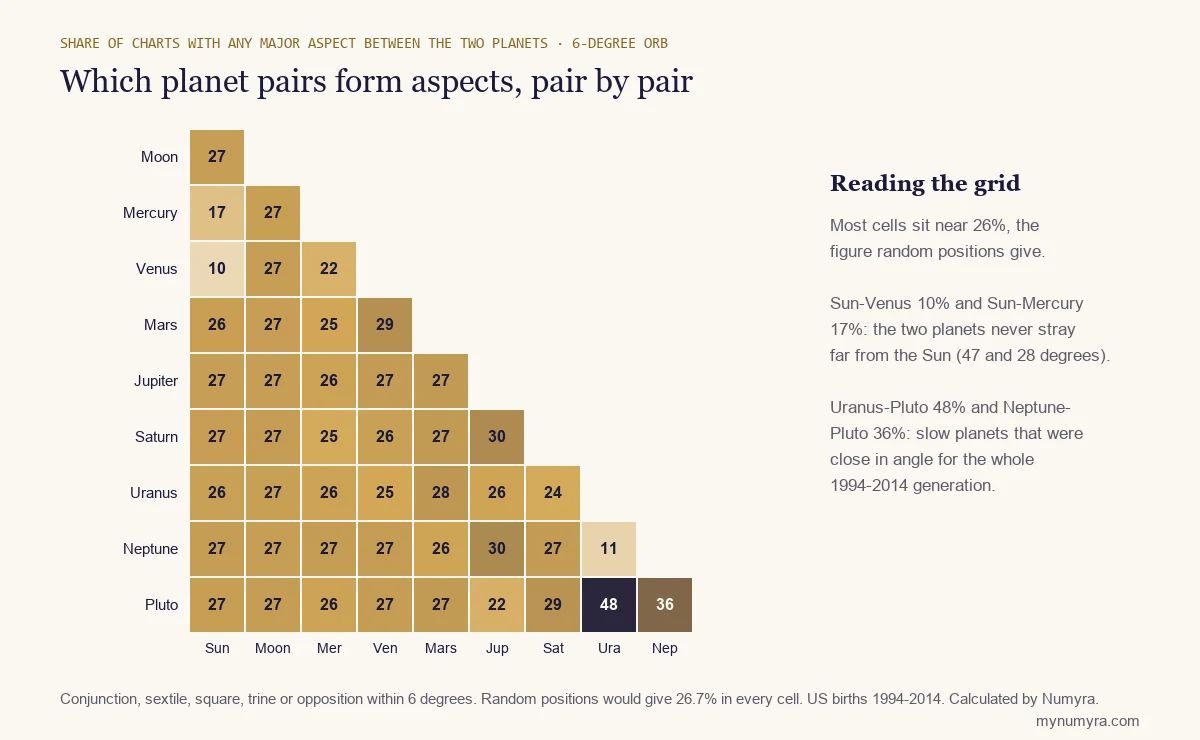
Most pairs sit within a point or two of 26.7%, but a few stand apart for reasons you can state in a sentence. Mercury is never more than about 28 degrees from the Sun (27.8 degrees in our charts) and Venus never more than about 47 (47.1), so neither can form a sextile, square, trine or opposition with it, and their conjunctions are the only aspects: Sun-Mercury 17.5% and Sun-Venus 9.7%. Mercury and Venus themselves can be at most about 75 degrees apart and so can only conjunct or sextile. The slow outer planets are different: Uranus, Neptune and Pluto move so slowly that their angle to each other is nearly the same for everyone born in a few years.
| Pair | Conjunction | Sextile | Square | Trine | Opposition | Any |
|---|---|---|---|---|---|---|
| Sun-Moon | 3.3% | 6.7% | 6.7% | 6.7% | 3.3% | 26.7% |
| Sun-Mercury | 17.5% | 0 | 0 | 0 | 0 | 17.5% |
| Sun-Venus | 9.7% | 0 | 0 | 0 | 0 | 9.7% |
| Mercury-Venus | 9.7% | 12.2% | 0 | 0 | 0 | 21.9% |
| Venus-Mars | 7.1% | 9.5% | 6.9% | 4.5% | 1.2% | 29.1% |
| Moon-Saturn | 3.4% | 6.6% | 6.7% | 6.8% | 3.4% | 26.9% |
| Jupiter-Saturn | 1.5% | 8.0% | 9.3% | 8.0% | 3.3% | 30.0% |
| Saturn-Pluto | 0 | 6.3% | 6.4% | 11.0% | 5.1% | 28.6% |
| Uranus-Neptune | 11.3% | 0 | 0 | 0 | 0 | 11.3% |
| Uranus-Pluto | 0 | 27.7% | 20.2% | 0 | 0 | 47.9% |
| Neptune-Pluto | 0 | 36.4% | 0 | 0 | 0 | 36.4% |
The last three rows are generational, not universal. Everyone in our sample was born from 1994 to 2014. Neptune and Pluto spent part of that period within 6 degrees of a sextile, which shows in 36.4% of the charts, and Uranus and Pluto passed from a sextile to a square, in 27.7% and 20.2% of the charts. The only major aspect between Uranus and Neptune in the sample is the tail of their 1993 conjunction, which 11.3% of the charts carry. A sample from another era would give different figures in these rows and similar ones in the rest. Our guides to Uranus and Neptune signs, Pluto in Aquarius and the Saturn-Neptune conjunction list the dates behind such links, and the Saturn opposition and Uranus opposition guides show the same angles as they turn up in a life.
The practical lesson is to weigh an aspect by how special it is. A Sun-Moon square is about as common as a Mars-Saturn one, since both pairs are free to move. An aspect between two slow planets says more about the year of birth than about the person.
Aspects by sign versus aspects by degree
Ptolemy defined aspects by signs. On a strict sign reading, two planets in signs two, three, four or six apart are in aspect whatever their degrees; signs one and five apart, he said, have none. That whole-sign view is still used in some traditions and is the one behind the “signs apart” column in our table. It has a different answer from the degree-and-orb view, and we can measure the difference.
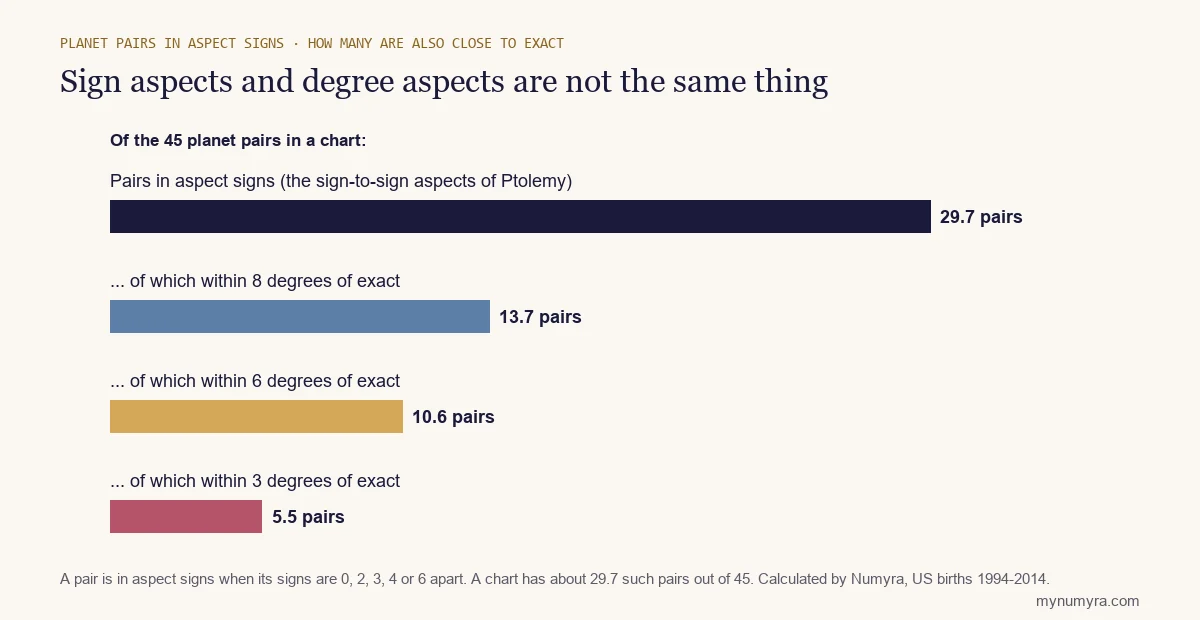
In an average chart 29.7 of the 45 pairs are in aspect signs (including the same sign). Only 13.7 of those are also within 8 degrees of an exact angle, 10.6 within 6 degrees and 5.5 within 3. So by sign about two thirds of all pairs are in aspect; by a 6-degree orb about a quarter. The reverse mismatch also occurs: of all the aspects found within 6 degrees, 10.9% join planets whose signs are not the textbook distance apart, such as a trine between 28 degrees of one sign and 2 degrees of a sign five signs along. At 8 degrees the share is 14.7% and at 10 degrees 18.0%. Astrologers call these out-of-sign aspects, and whether to count them is a choice each tradition makes. The same split between sign and degree appears in houses: see our comparison of whole sign and Placidus houses.
The minor aspects
Minor aspects are further divisions of the circle: the semi-sextile (30 degrees, a twelfth), semi-square (45, an eighth), quintile (72, a fifth), sesqui-square (135, three eighths), bi-quintile (144, two fifths) and quincunx (150, five twelfths). They are newer than the major five. Lilly’s page 32, which we quote in the aspect patterns guide, credits a Kepler with adding some of them to the list; Wikipedia dates Kepler’s Harmonice Mundi to 1619. Lilly gave five of the new angles and said he mentioned them only so that readers would know what they were. The semi-square and sesqui-square are not in his list.
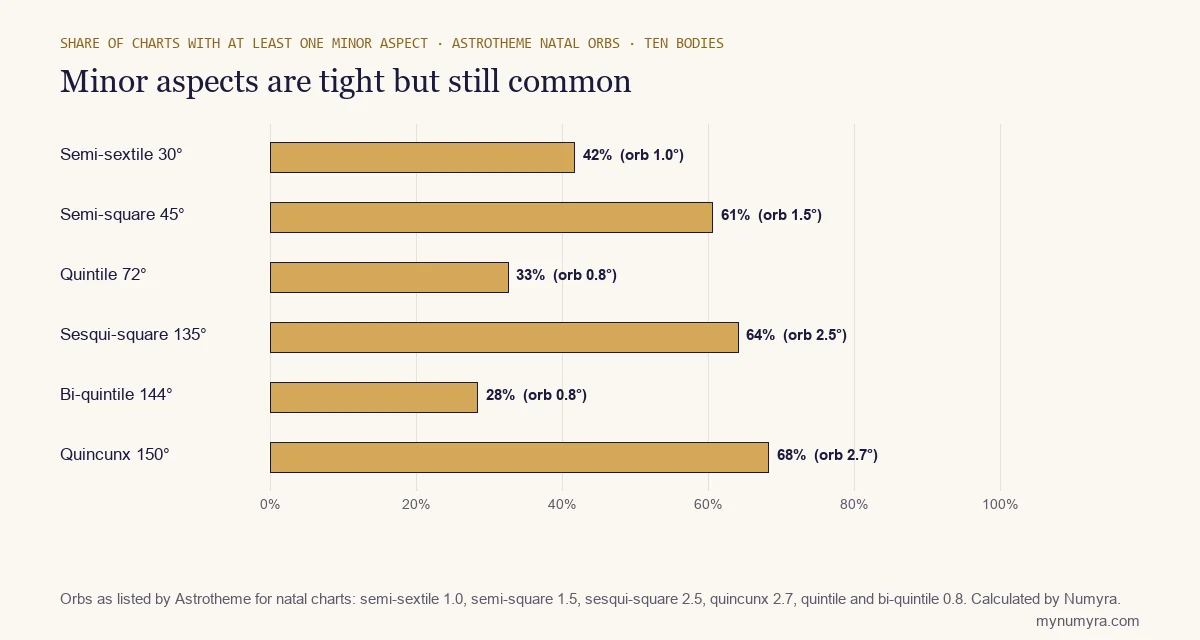
Because they get small orbs, minor aspects are rarer than the major ones, but not rare. Using Astrotheme’s natal orbs, which are the most detailed we found, this is how often each turns up among the ten bodies:
| Aspect | Angle | Part of the circle | Astrotheme orb | Per chart | Charts with at least one |
|---|---|---|---|---|---|
| Semi-sextile | 30° | 1/12 | 1.0° | 0.55 | 42% |
| Semi-square | 45° | 1/8 | 1.5° | 0.91 | 61% |
| Quintile | 72° | 1/5 | 0.8° | 0.39 | 33% |
| Sesqui-square | 135° | 3/8 | 2.5° | 1.04 | 64% |
| Bi-quintile | 144° | 2/5 | 0.8° | 0.34 | 28% |
| Quincunx | 150° | 5/12 | 2.7° | 1.16 | 68% |
A reader who includes the quincunx at 2.7 degrees will find one in more than two charts out of three, which is why a minor aspect is best read when it is tight. The quincunx is also the angle behind the yod, which is why it appears in our guide to aspect patterns.
Easy and hard aspects
Tradition sorts the aspects by temperament. Ptolemy’s reason, quoted above, was the gender of the signs; Lilly’s was friendship and enmity. Modern astrologers keep the grouping: sextile and trine are easy or harmonious, square and opposition hard or challenging, and the conjunction depends on the planets. Our count shows how little a single hard aspect can mean. Because the easy aspects occupy more of the circle, four parts for the sextile and trine against three for the square and opposition, the average chart has more of them: 6.0 easy and 4.1 hard at a 6-degree orb.
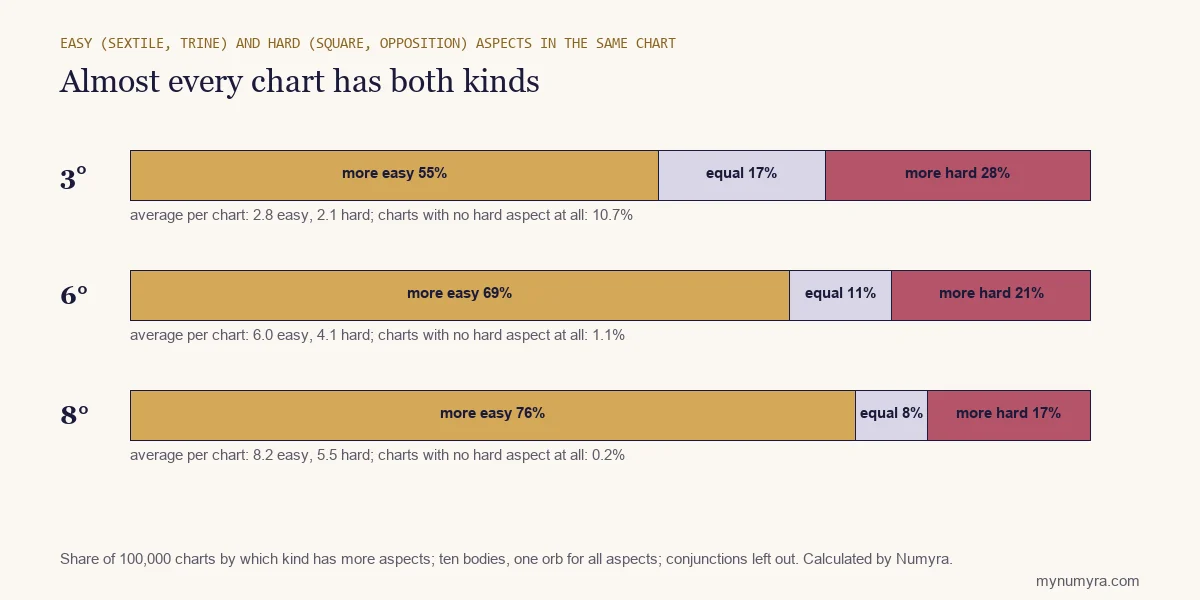
At 6 degrees 69% of charts have more easy than hard aspects, 11% have the same number and 21% have more hard ones. Only 1.1% of charts have no square or opposition at all; at a tight 3-degree orb that rises to 10.7%, and 5.1% have no sextile or trine. In short, practically everyone has both kinds. A chart with a hard aspect is the norm. The comparison matters when someone presents a square or opposition as a notable burden: a square, which 93% of charts contain at 6 degrees, cannot say much on its own about one person.
How to find and weigh the aspects in your own chart
- Get the degrees. You need each planet’s longitude, not only its sign. Our Stellium Calculator shows the sign and degree of all ten bodies for a birth date, and our birth chart calculator adds the rising sign when you have a birth time.
- Convert to the circle. Count Aries 0 to 30, Taurus 30 to 60 and so on, so 10 degrees of Taurus is 40 and 18 degrees of Virgo is 168.
- Find the distance. Subtract and, if the answer is over 180, subtract it from 360.
- Compare with 0, 60, 90, 120 and 180. The gap to the nearest one is the orb. Write it down; Lilly’s partile aspect is the case where it is about zero.
- Choose one orb and say which. If you want one that matches a source you trust, use its table; if you want one that matches this page’s odds, 6 degrees gives about 12 aspects in an average chart.
- Weigh by closeness and by rarity. A 1-degree aspect is read as stronger in the tradition than a 6-degree one, and a pair that is common in your generation, as in the table above, says little about you.
When you move on to what other planets can do, our guides to the chart ruler and to the composite chart show aspects in use. The Moon’s aspects also decide when it is void of course, a rule defined by its last major aspect before a sign change.
What aspects cannot tell you
An aspect is a geometric fact about two bodies and a frequency fact about how often that geometry occurs. What it is said to mean is tradition. Astrology is a tradition of interpretation, not an established science, and a square or a trine does not predict events or fix anyone’s character. The orb you pick can change the number of aspects in your chart by half; the pair you look at may be shared by a whole generation. Use aspects as a way to organize a reading, and give each one the weight its closeness and rarity suggest. This guide is educational information, not advice of any kind.
Frequently asked questions
What are the five major aspects in astrology?
The conjunction (0 degrees), sextile (60), square (90), trine (120) and opposition (180). Ptolemy’s Tetrabiblos lists four of them, without the conjunction, and Lilly in 1647 named the same four as the strongest and called the conjunction an aspect only loosely.
What orb should I use for aspects?
There is no standard. Published tables run from 6 to 10 degrees for the major aspects, with the sextile narrower. In our 100,000 charts the average count is about twice the orb in degrees, so 6 degrees gives about 12 aspects per chart and 10 degrees about 20. Pick one set, state it, and keep it for the whole chart.
Which aspect is the most common?
In our charts the sextile, at 6 degrees: 3.4 per chart, and 97.5% of charts have at least one. The square is next at 2.8 per chart, then the trine at 2.6, the conjunction at 1.8 and the opposition at 1.3. Four of the five are more common than the opposition.
Is the conjunction an aspect?
Not for Ptolemy, whose four aspects are the opposition, trine, quartile and sextile, and not strictly for Lilly, who says astrologers call it one “very improperly”. Modern guides list it as the fifth major aspect.
How many aspects does a birth chart have?
It depends on the orb and on which points you include. With the ten planets and a 6-degree orb, the average is 11.8, with the middle 80% of charts between 8 and 16. Using Astrodienst’s web orbs it is 17.5 and under Labyrinthos’s 6-degree orbs 11.8.
Do two planets have to be in the right signs to make an aspect?
Under Ptolemy’s sign-based definition, yes; under the degree-and-orb method used by most software, no. At a 6-degree orb 10.9% of the aspects found join planets whose signs are not the textbook distance apart, and a sign aspect is within 6 degrees of exact for only about a third of the pairs that qualify.
What are minor aspects?
Angles that divide the circle further: the semi-sextile (30 degrees), semi-square (45), quintile (72), sesqui-square (135), bi-quintile (144) and quincunx (150). They have small orbs, 0.8 to 2.7 degrees at Astrotheme, and 68% of charts have at least one quincunx at that orb.
Is it bad to have hard aspects such as squares and oppositions?
Traditionally they are read as tension, but nearly everyone has them: at 6 degrees only 1.1% of charts have none, and the average is 4.1 per chart. A feature present in almost every chart cannot, on its own, set one person apart.
Are astrological aspects scientifically proven?
No. The angles are geometry and can be measured exactly, but the meanings attached to them are tradition. Numyra presents them as a way of reading a chart, not as a prediction.
Sources
- Ptolemy. Tetrabiblos, Book I, chapters 13 to 16, trans. F. E. Robbins (Loeb Classical Library, 1940), via LacusCurtius. The four aspects, why they are harmonious or not, and the absence of orbs.
- William Lilly. Christian Astrology (London, 1647), Internet Archive scan; “An Introduction to Astrologie”, chapter 19, printed pages 105 to 107, transcribed by Numyra from the page images. Aspects, partile and platick, the table of orbs.
- Skyscript. Glossary: Moiety and Orbs (or rays). The Porphyry span of rays as quoted there, and the modern 8, 4 and 2 degree convention, for which the page points to Nick Campion’s An Introduction to Aspects and Chart Shaping.
- Astrodienst. Overview of chart drawing styles. Web default orbs, read from the table on the page.
- Astrotheme. Astrological aspects, their orb and meaning. Natal orbs, including the extra for the Sun and Moon.
- Kerykeion. Orbs in astrology, Labyrinthos. Planetary aspect meanings and Wikipedia. Astrological aspect. Orb ranges, aspect definitions and the 1619 date of Kepler’s Harmonice Mundi.
- Cafe Astrology. The Major Aspects in Astrology. The modern readings summarized in our words.
- Astrodienst. Swiss Ephemeris. Planet positions for every simulated chart (calculations by the Numyra Methodology Desk).
- FiveThirtyEight. US births data, 1994 to 2014, from the CDC National Center for Health Statistics and the Social Security Administration. Dates only; clock times and time zones in our simulation are random.