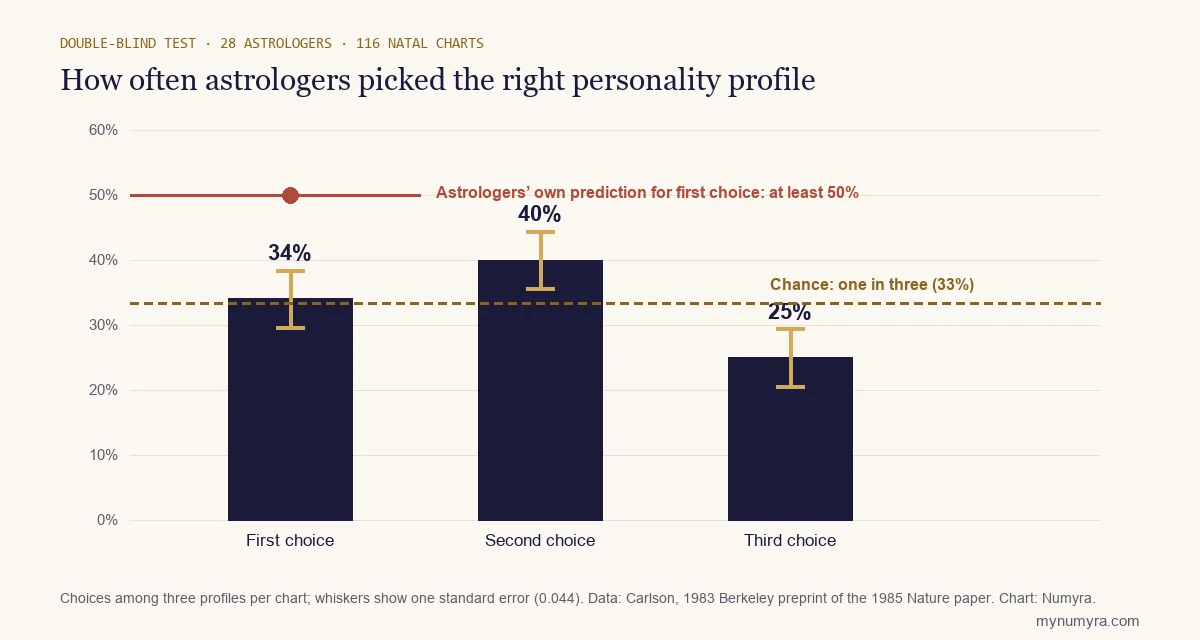
Astrology is real as a tradition, a 2,700-year-old way of reading the sky that millions of people still use, but the controlled tests that exist do not support it as a way to describe personality or forecast a life. In the best-designed test, 28 astrologers matched 116 birth charts to personality profiles and picked the right one 34% of the time, against 33% by chance and against the 50% or more they had predicted themselves. A 2020 study of 173,709 people found that Sun sign predicted neither personality nor job performance. This page reads those studies and the other main ones in their own words, gives the critics’ replies, runs a pre-specified check of our own on 4,360 Olympic gold medallists, and explains why a reading can feel right when the evidence says it is not.
Key takeaways
- In Shawn Carlson’s double-blind test, set up with astrologers and published in Nature in 1985, the astrologers chose the correct personality profile 34% of the time (±4.4 points) when chance is 33%, and they had said they would reach 50%. Their confidence did not track their accuracy. Critics, including an astrology researcher, dispute the analysis, and we give both sides.
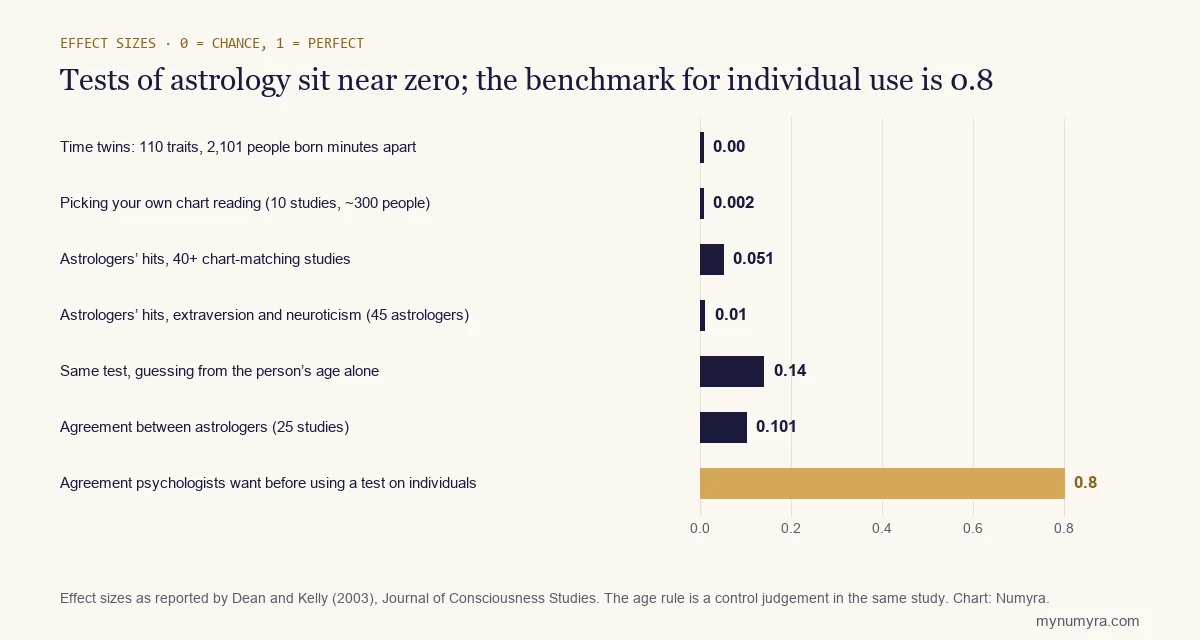
- A test of 2,101 people born in one London week in 1958, on 110 traits, found no similarity between people born minutes apart (effect size 0.00 ± 0.03). A meta-analysis of more than forty astrologer tests found a mean effect of 0.051 (p = 0.66).
- A 2020 paper in the Journal of Personality and Social Psychology found that astrological sign predicted neither personality (173,709 people) nor job performance (32,878 employees).
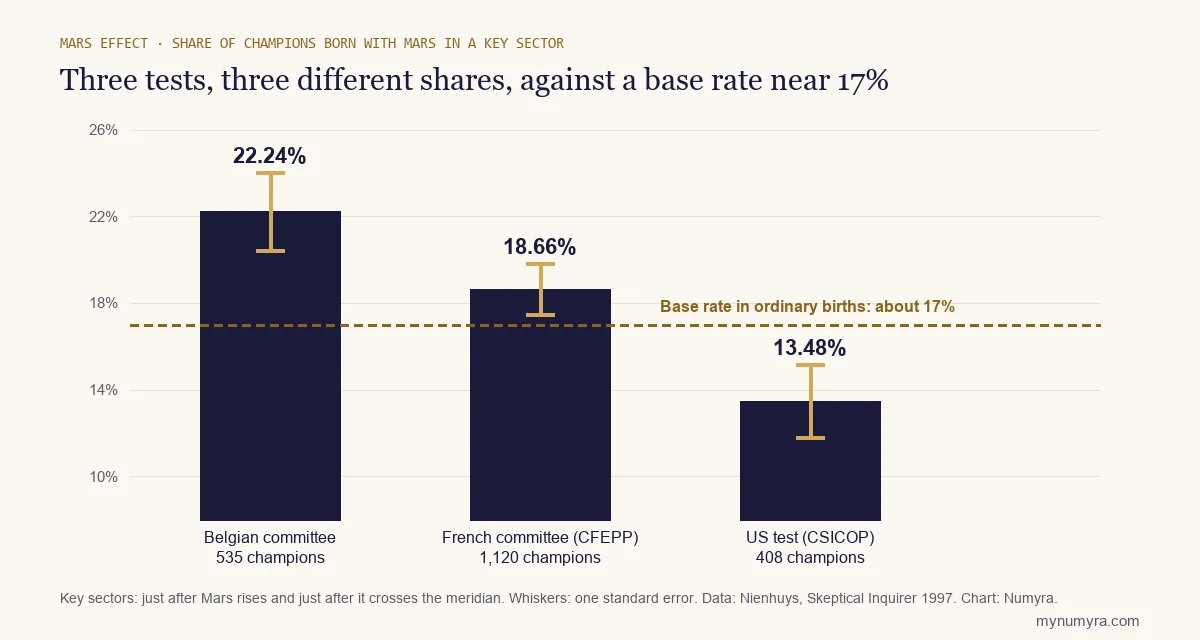
- The best-known positive result, the Gauquelin Mars effect, is about where Mars stood at the daily horizon, not about signs. Three later tests found 22.2%, 18.7% and 13.5% of champions in the key sectors against a base rate near 17%, and its replication is still argued over.
- Our own pre-specified check on 4,360 Olympic gold medallists found Mars in a strong sign (Aries, Scorpio or Capricorn) in 23.6% of births against 23.3% expected (p = 0.29). Winter births ran high, a calendar pattern that looks like a sign pattern.
- Astrology is a tradition for reflection, not a tested way to predict anything, and a sense that a reading fits you is not evidence either way.
In this guide
- What “real” can mean for astrology
- What astrology claims, and which claims can be tested
- The double-blind test: Carlson 1985 and its critics
- Time twins: people born minutes apart
- Do Sun signs describe personality?
- The Mars effect: the strongest claim and its replications
- Can planets reach a newborn?
- Why a reading feels accurate
- Our own check: Olympic champions and Mars
- How to use astrology without believing it predicts
- How we ran the check
- Frequently asked questions
- Sources
What “real” can mean for astrology
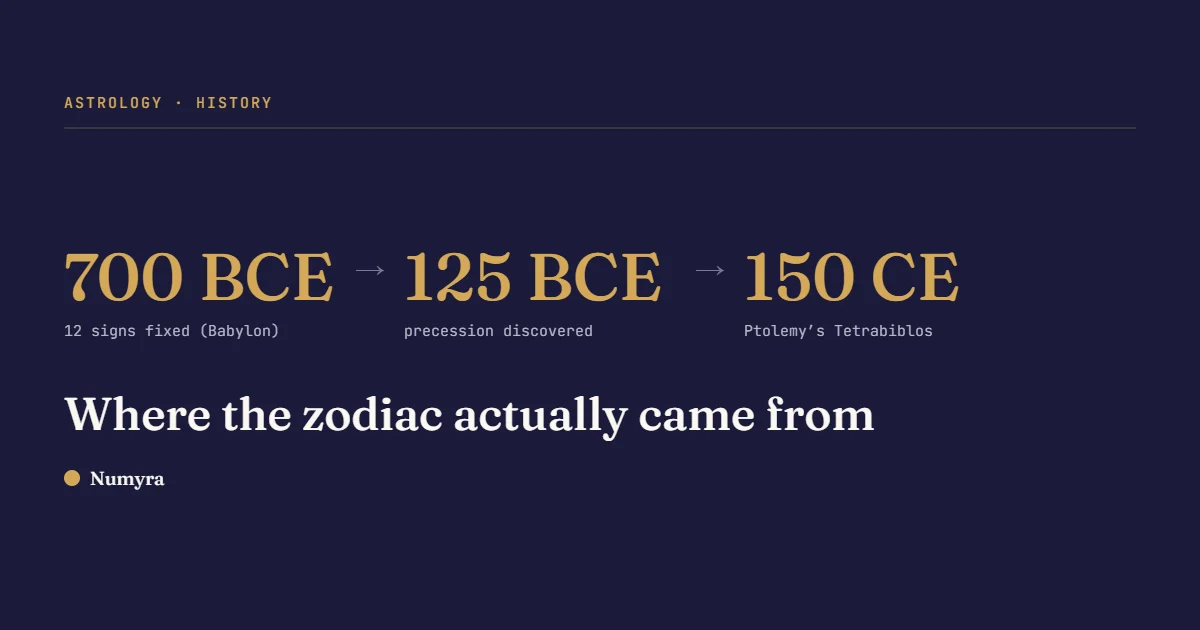
The question has three answers, and arguments go in circles when people mix them. As a cultural practice astrology is real. The Pew Research Center reported in 2018 that 29% of US adults believe in astrology, and the tradition behind them is old: our history of the zodiac signs traces the twelve-sign wheel to Babylonian astronomers by about 700 BCE, and our guide to the Tetrabiblos shows how Ptolemy’s second-century handbook set the Western pattern. The newspaper horoscope column is much younger, as our history of the column shows.
As a calculation, astrology is also real. The sky in a birth chart is ordinary astronomy: where the Sun, Moon and planets stood at a given moment can be computed to a fraction of a degree, and the same chart comes out every time. The sign boundaries are a choice, though. The tropical and sidereal zodiacs are offset by about 24 degrees, so the two systems give the same Sun sign for only about one date in five (six degrees of every thirty), as our sidereal vs tropical guide explains. They cannot both describe the same person’s character.
The third meaning is the one most searchers want: does a chart describe you, or forecast your life, better than chance? That is a question for evidence, and it is what the rest of this page examines.
What astrology claims, and which claims can be tested
A claim is testable when it names something that could turn out wrong. Astrology makes claims of both kinds. The table lists the main ones with the best evidence we could read directly.
| Claim | What a test would look for | What we found |
|---|---|---|
| Your Sun sign shapes your personality | Sign groups differ on measured traits | No difference in 173,709 people (Lu and colleagues, 2020); no similarity among 2,101 people born in one week (Dean and Kelly, 2003) |
| An astrologer can read personality from a birth chart | Blind matching of charts to personality profiles | 34% correct against 33% chance (Carlson); mean effect 0.051, p = 0.66 across 40+ studies (Dean and Kelly) |
| Your own chart reading fits you better than someone else’s | People pick their own reading from several | Mean effect 0.002 across 10 studies and about 300 people (Dean and Kelly) |
| Astrologers agree on what a chart shows | Agreement between astrologers on the same chart | Mean agreement 0.101 across 25 studies, against the 0.8 psychologists expect for use on individuals (Dean and Kelly) |
| People born at the same moment resemble each other | Similarity of births minutes apart | Effect size 0.00 ± 0.03 across 110 traits (Dean and Kelly) |
| Mars at the daily horizon links to athletic eminence | Share of champions born in the key Mars sectors | Claimed 22%; later tests gave 22.2%, 18.7% and 13.5% against a base near 17%; disputed |
| Planets act on people through a physical force | A measurable force that exceeds nearby objects | Gravity from Mars is far weaker than an adult standing next to the baby (our calculation below) |
| A reading feels accurate to the person | High ratings for generic text | Yes, and it feels as accurate when the text is generic (Forer; see our numerology evidence page) |
| Transits and forecasts predict events | Forecasts fixed in advance and scored | We found no controlled test that we could read; see the 1939 miss in our column history |
The double-blind test: Carlson 1985 and its critics
The test astrologers most often argue about was run by the physicist Shawn Carlson at the University of California, Berkeley, and published in Nature on December 5, 1985 (volume 318, pages 419 to 425). Nature’s text sits behind a paywall, so the figures below come from the April 1983 Lawrence Berkeley Laboratory preprint of the same study, which is public. The published version may differ in detail.
The design is worth knowing because it was built with astrologers, not against them. Advisers nominated by the National Council for Geocosmic Research helped write the proposition to be tested, that the positions of the planets at birth can be used to determine a person’s general personality traits and tendencies. They compiled a list of about 90 astrologers with a background in psychology whom their peers held in high esteem, and 28 took part. They also set their own prediction before the data came in: that the astrologers would pick the right profile at least half the time. Carlson set the rule for reading the result in advance, a gap of 2.5 standard deviations either way, and fixed the analysis before any data were opened. Two of the three profiles in each trial came from other people, so chance was one in three.
In the test that counts, each astrologer received a natal chart and three California Psychological Inventory (CPI) personality profiles, one of them the chart owner’s, and chose the best match. There were 116 usable subjects. The astrologers’ first choice was right at a rate of 0.34, with a standard error of 0.044, which is the chance rate and 3.3 standard deviations below their own prediction. Second and third choices came out at 0.40 and 0.25, also consistent with chance. The astrologers also rated each profile from 1 to 10 for how well it fitted the chart, and the correct profiles were no more likely to get high ratings: the fitted slope was -0.01 ± 0.02, so confidence did not track accuracy.
The first test did not count. People tried to pick their own chart interpretation from three, and did poorly, but Carlson drew no conclusion because the same people could not pick their own CPI profile at a better-than-chance rate either. He was open about the limit, and about the state of the field before his test:
“Without committing ourselves to either point of view, we believe that both criticisms are valid.”
Shawn Carlson, Double-blind test of astrology, Lawrence Berkeley Laboratory preprint LBL-20480 (April 1983), on scientists’ and astrologers’ criticisms of earlier tests
The result has been contested. The astrology researcher Suitbert Ertel published a reanalysis in the Journal of Scientific Exploration (volume 23) arguing that the design and statistics were flawed, and Robert Currey’s 2011 summary in the Astrological Association of Great Britain’s journal Correlation reports that Ertel found the astrologers’ 10-point ratings significant at p = 0.037 with an effect size of 0.10. We have not read Ertel’s paper in full. Two points belong beside it. Dean and Kelly equate an effect size of 0.10 with about 52 hits where 50 are expected, and say that at that size birth charts would be worthless for reading individuals. And their meta-analysis of more than forty tests suggests that the weak positive results in this field come from publication bias, not from a signal. A small effect found by reanalysis after the fact is a lead for a new test, not a rescue of the original claim.
Time twins: people born minutes apart
Astrologers read charts with interpretation, which leaves room for error on their side. A cleaner test removes the astrologer. If the sky at birth shapes a person, people born at the same moment in the same place should be more alike than strangers, whatever the chart says. Geoffrey Dean and Ivan Kelly call these “time twins” and describe the test in a 2003 article in the Journal of Consciousness Studies.
Time twins are common. By the Poisson spacing of births, a city of a million people sees about 4,000 pairs born five minutes apart or less every year. The difficulty is finding them with measured traits. Dean and Kelly used a British cohort study that had nothing to do with astrology: 2,101 people born in London from March 3 to 9, 1958, an average of 4.8 minutes apart. Each had 110 measures taken at ages 11, 16 and 23, including IQ, reading and arithmetic scores, teacher and parent ratings of anxiety, aggressiveness and sociability, height, weight, accident proneness, occupation and marital status. As a control they added 16 facts about the mother that seven leading astrologers agreed would not show in the child’s chart.
They sorted the people by birth time and measured the similarity of each neighbouring pair. The mean similarity across the 110 traits was -0.003, against 0.001 for the mother controls, which gives an effect due to astrology of 0.00 ± 0.03. Five of the 110 individual traits were significant at p = 0.05 where 5.5 would be expected by chance. To show that the test could have seen a real effect, they made every 50th person identical to the next in a simulation, and the measure registered the expected rise of about 0.02. Their reading is that this disconfirms the idea of Sun signs and Jung’s synchronicity as well. The caveats are fair ones: it is one week, one city and one cohort, and an astrologer could say that similarity is not what a chart predicts. It is also a test no astrologer’s interpretation can spoil.
The same article reports a 1994 study of 128 people born on six dates between 1934 and 1964, whose authors claimed a slight resemblance that grew as birth times came closer. An independent reanalysis by French and colleagues in 1997 found that the effect came from procedural artifacts in how the pairs were counted, and it disappeared when those were controlled.
“The possibility that astrology might be relevant to consciousness and psi is not denied, but such influences, if they exist in astrology, would seem to be very weak or very rare.”
Geoffrey Dean and Ivan W. Kelly, Is Astrology Relevant to Consciousness and Psi?, Journal of Consciousness Studies 10(6-7), 175-198 (2003), abstract
Do Sun signs describe personality?
The Sun sign is the version most people meet (our zodiac sign profiles describe each one as tradition), and it has the largest samples. The biggest we could verify is Jackson Lu and colleagues’ 2020 paper in the Journal of Personality and Social Psychology, which studied astrological stereotypes in China. Its abstract states that “astrological sign predicted neither personality (N = 173,709) nor job performance (N = 32,878).” The paper’s main finding is about stereotyping: in China, Virgos are stereotyped as disagreeable, likely because of how the sign’s name was translated, and people discriminated against them in dating and in simulated hiring, yet the sign told the authors nothing about real personality or work.
Some small studies did find sign differences, and they have a known explanation. An apparent link between Sun signs and extraversion in the 1970s (Mayo, White and Eysenck, 1978) disappeared in later samples whose members knew nothing about astrology, according to Dean and Kelly. A 1999 study of 422 people by van Rooij found that people who knew their sign and three of its traits were more likely to apply those traits to themselves. People who know the stereotype describe themselves to match it, which is a fact about self-description, not about the sky. Compatibility readings, which pair two signs, rest on the same sign descriptions; how zodiac compatibility really works sets out the aspect rules they use.
Expert judgement does not rescue the sign either. In an experiment by Dean in 1985, 45 astrologers with an average of 10 years’ experience judged 160 people who had scored at the extremes on extraversion and neuroticism. Their hits had an effect size of 0.01. A simple rule using only the person’s age scored 0.14, and judgements made with high confidence were no more accurate than those made with low confidence. The chart did not help, and the astrologers’ certainty was not a guide. The figure below sets the main effect sizes in these studies side by side.
The Mars effect: the strongest claim and its replications
The claim most often cited in astrology’s defence comes from the French psychologist Michel Gauquelin, who died in 1991. In 1955 he reported that sports champions were born more often than expected just after Mars rose or crossed the meridian. Two of the twelve sectors of the daily sky, numbers 1 and 4, are the “key” ones, and he put the champions’ share in them at about 22% against a base rate of about 17%. Two points matter before looking at the replications. The effect is about where Mars stood at the daily horizon at the birth hour, so it needs a birth time (our guide to how birth time changes your rising sign shows how fast the horizon moves) and has nothing to do with Mars in Aries or any other sign. And Gauquelin himself rejected most of the conventions of Western natal astrology.
Three later tests used the same sector definition. The Belgian Comite Para’s test, announced in 1976, found 119 of 535 champions in a key sector (22.24%), but 473 of the 535 had been collected by Gauquelin. The US test by the Committee for the Scientific Investigation of Claims of the Paranormal, published in 1979 and 1980, found 55 of 408 (13.48%). The French committee, CFEPP, using a protocol Gauquelin had insisted on, found 209 of 1,120 (18.66%) against a base rate of 17.70% computed by random coupling of dates, places and times.
Jan Willem Nienhuys, who checked the French data, concluded:
“The test determined what remains of the Mars effect when one starts entirely from scratch, without the help of Gauquelin, and the answer is: nothing.”
Jan Willem Nienhuys, The Mars Effect in Retrospect, Skeptical Inquirer 21(6), 1997
That is not the end of the argument. Ertel, who worked with Gauquelin, objected that the French test included too many mediocre athletes and used too high a chance expectation, and that dividing the athletes by eminence recovers the effect; Gauquelin made a similar objection to the US test. Nienhuys replies that the pattern of which champions Gauquelin did and did not publish points to selection. Geoffrey Dean has suggested a simpler route: if about 3% of birth times in the old records were nudged by parents toward a favourable chart, the effect would appear, and Gauquelin did not find it in later births attended by doctors. Other critics note that Gauquelin searched many planet and profession combinations without correcting for that. No single decisive test has settled it, and that is itself a finding: the strongest claim in the field rests mainly on data Gauquelin collected, and it does not reproduce cleanly in the data others collected.
Can planets reach a newborn?
Many astrologers do not claim a physical force, and a symbolic or “as above, so below” reading cannot be tested by physics. But the old objection to a gravitational route is worth checking with numbers. A distant planet pulls a baby and everything around her almost equally, so only the difference in pull across the baby’s body, the tidal effect, could act on her; a nearby adult is close enough that the pull is direct. We computed the nearest and farthest distances of each body from 1900 to 2100 with the Swiss Ephemeris and found the tidal acceleration across a 0.5 metre body, then set it beside the direct pull of a 70 kg adult at half a metre.
| Source | Distance | Acceleration (m/s²) | Adult’s pull as a multiple |
|---|---|---|---|
| Moon, nearest (tidal) | 356,400 km | 1.1 × 10⁻¹³ | 170,000 |
| Jupiter, nearest (tidal) | 590.7 million km | 6.2 × 10⁻¹⁹ | 30 billion |
| Mars, nearest (tidal) | 55.8 million km | 2.5 × 10⁻¹⁹ | 76 billion |
| Mars, farthest (tidal) | 400.4 million km | 6.7 × 10⁻²² | 28 trillion |
| Adult, 70 kg, at 0.5 m (direct) | 0.5 m | 1.9 × 10⁻⁸ | 1 |
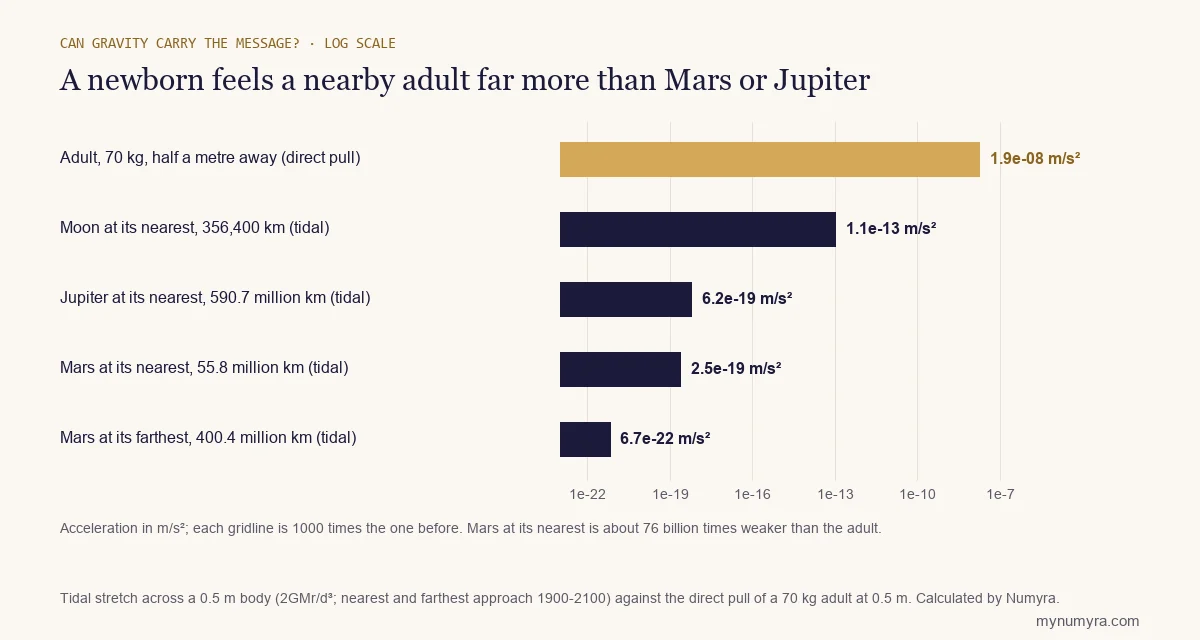
Mars at its nearest acts on a newborn about 76 billion times more weakly than an adult leaning over the cot. Even the Moon, which really does raise ocean tides, has a tidal effect on a baby about 170,000 times smaller than the adult’s pull. This does not show astrology false; it shows that a gravitational story does not get it started, and most defenders of astrology do not tell that story.
Why a reading feels accurate
If the tests are so flat, why do so many people find readings right? Part of the answer is the Forer or Barnum effect: in a 1949 classroom experiment Bertram Forer gave every student the same sketch, assembled largely from a newsstand astrology book, and the students rated it highly accurate for themselves. Our numerology evidence page gives the numbers, and the same effect applies to any generic description, signs included.
Dean and Kelly list other “hidden persuaders” that make an astrologer or a client see hits where none exist: the Barnum effect, cognitive dissonance, cold reading from body language, a claim that cannot fail, and the reinforcement a reader gets from the occasional striking hit. They also report a 1927 contest in which thousands of astrologers tried to win $1,000, the equivalent of roughly a year’s average wage, by describing three people from their birth data; the result, in the words they quote, was that the astrologers were “unanimously unsuccessful in describing the three people.” They add that cash prizes of up to $5,000 in later tests did not improve hit rates. We read the 1927 account second-hand and treat it as reported, not verified.
The point is not that people who like astrology are foolish. A feeling of fit is the wrong kind of evidence, because it would feel the same whether the reading were right or generic. That is why every test above takes the reader’s feelings out of the loop.
Our own check: Olympic champions and Mars
We wanted a test that needs only public data, that a reader can understand, and that astrology could pass. Gauquelin’s real test needs birth times, which public datasets lack, so we tested a claim that needs only a date: that a champion’s Mars was in a strong sign. Mars rules Aries and Scorpio and is exalted in Capricorn in traditional astrology, the strong placements called essential dignities. Mars is also the planet astrologers read as drive, energy and competition.
Before pulling any data we wrote down the hypothesis and the rule in a dated file (it was not filed with a public registry). The group was every person in Wikidata with an Olympic gold medal and a birth date given to the day, 4,360 people born in 1850 or later. The one primary test was whether Mars was in Aries, Scorpio or Capricorn at birth more often than the calendar predicts. For each athlete we worked out what share of days in their own birth year had Mars in those signs, added the shares, and compared the total with the observed count. As a control we ran identical code on 489 Nobel laureates, a group for which astrology claims nothing.
| Group | People | Mars in Aries, Scorpio or Capricorn | Expected | Share, observed vs expected | p (one-sided) |
|---|---|---|---|---|---|
| Olympic gold medallists (the test) | 4,360 | 1,029 | 1,014.1 | 23.6% vs 23.3% | 0.29 |
| Nobel laureates born 1920 or later (control) | 489 | 128 | 114.5 | 26.2% vs 23.4% | 0.06 |
The prediction failed: champions are not born under a strong Mars more often than the calendar says. With 4,360 people the test could have seen a lift of about 1.6 percentage points (from 23.3% to about 24.9%) four times in five, so a large effect would have shown. It cannot rule out a tiny one. The control matters too. The Nobel group, which nobody expects to show anything, came out at p = 0.06, which is the sort of “almost significant” result that appears by chance about once in sixteen looks, and a reader can see how easily a story could be built on it.
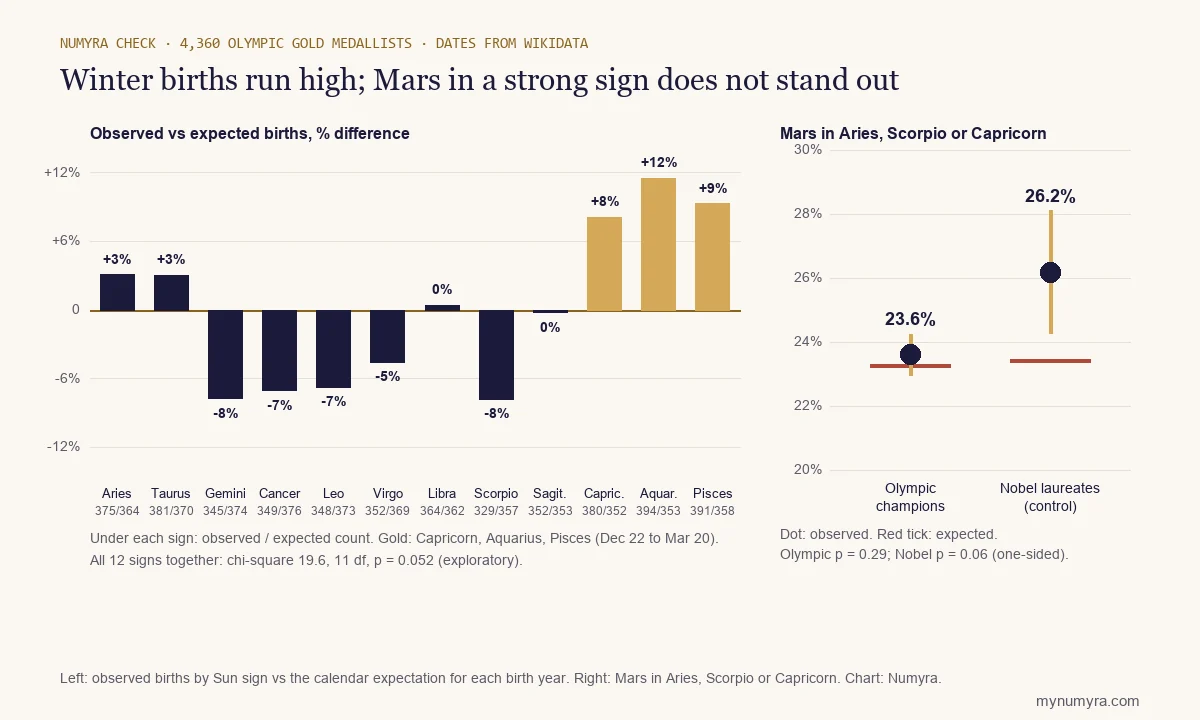
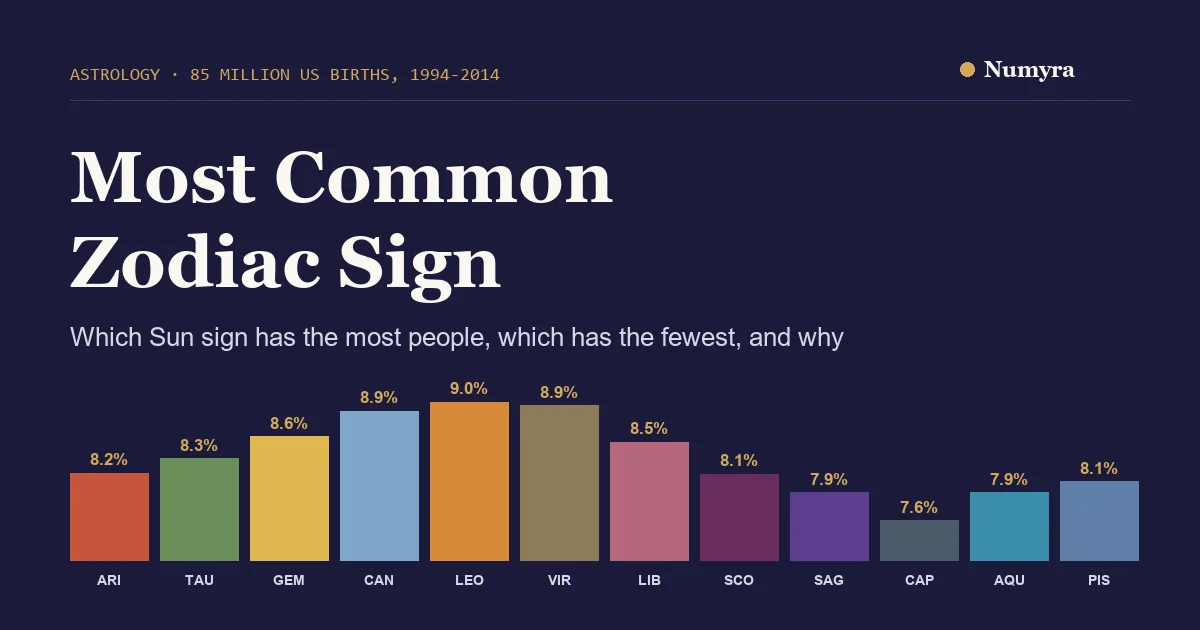
The secondary look, which we labelled exploratory in advance, was the Sun sign. Counts by sign differ from the calendar expectation with p = 0.052 across 11 degrees of freedom, and the gap is not random-looking: Capricorn, Aquarius and Pisces are high, with 1,165 champions where 1,063 would be expected (26.7% against 24.4%). We chose that grouping after seeing the table, so the p-value for it is not clean. The excess sits in the calendar months of January, February and March, 1,180 births against 1,077 expected, and not in Aries, which starts on March 20 or 21 and shows only a 3% lift. That points to the calendar, not the zodiac. Nienhuys notes that the birth dates of proficient sports people are spread very unevenly across the seasons, a phenomenon he cites to Dudink (1994). One commonly proposed explanation, which we did not test, is that youth sport groups children by birth year, so the oldest children in each group get an early advantage. Our count of 85 million US births shows a related point: signs differ in length and births are not even across the year, so a sign’s share is never exactly one twelfth. A horoscope column could easily have turned the same table into “champions are born under water and earth signs”, which is the lesson: a real pattern in the calendar, a wrong cause in the sky.
How to use astrology without believing it predicts
None of this makes astrology useless, only mislabelled when sold as prediction. A chart is a structured set of prompts about your habits, in the way a journaling question is, and many people find that useful, which is how we present it. Our birth chart calculator and Mars sign calculator work out the positions, and our guide to Sun, Moon and rising signs explains what each one is said to mean. The line to hold is that a description that fits you is a reason to reflect, not a reason to take a job, end a relationship, spend money or change your treatment. This is educational information about a cultural tradition, not medical, financial, legal or psychological advice, and nothing here shows that astrology predicts an event in your life.
What would change our view is a pre-registered blind test of the kind Carlson ran, with a protocol agreed by practising astrologers and a sample large enough to see a small effect. Dean and Kelly’s meta-analysis shows how weak the field’s evidence is today; a clean, large, new test is the way an astrologer could show otherwise.
How we ran the check
Data. A Wikidata Query Service pull on October 28, 2026 of people with the participant-in qualifier “Olympic gold medal”: 4,544 records, 4,422 people with a day-precision birth date, 4,367 with one consistent date, and 4,360 born in 1850 or later. Placeholder January 1 dates did not spike (18 against about 12 for an average day), so none were dropped. The Nobel group is the 489 laureates born from 1920 from our October 22 pull. Wikidata is crowd-edited and was not hand-checked. Positions. Swiss Ephemeris (Moshier), tropical zodiac, at 12:00 UT on the birth date, since the data have no birth times. A Sun sign can be wrong on a cusp day (see why zodiac sign dates move from year to year) and Mars changes sign rarely, so the same rule was used for the expectation. Expectation. For each person, the share of days in their own birth year that Mars (or the Sun) was in each sign; one-sided normal approximation to the sum of those probabilities for the single primary test, chi-square for the sign table. Pre-registration. The hypothesis, the group and the cleaning rule were written down on October 28, 2026 before any Olympic data were retrieved. Gravity. Tidal acceleration is 2GMr/d³ for a 0.5 m length; masses and constants are standard values; distances come from the Swiss Ephemeris, 1900 to 2100. Limits. Mars in a sign is a different claim from Gauquelin’s sector effect; public data cannot test that. We did not test transits, forecasts or any astrologer’s actual readings. Our expectation uses an even calendar, not real birth seasonality. Time twins, Carlson, the Mars effect and the Sun-sign studies were read from the sources listed below, and the quotations were matched against saved copies of those sources. We have not contacted any author; if we have misread a source, we will correct this page.
Frequently asked questions
Is astrology real?
It is a real tradition and a real set of calculations, but the controlled tests we read found no evidence that it describes personality or predicts events. In the best-designed one, 28 astrologers chose the correct personality profile 34% of the time against 33% by chance.
Is astrology scientifically proven?
No. A meta-analysis of more than forty tests of astrologers by Dean and Kelly found a mean effect of 0.051 (p = 0.66), which they attribute partly to publication bias. Some astrology researchers dispute individual tests, and we cover their reanalysis of the Carlson test above.
Has astrology ever been tested properly?
Yes, many times, from Carlson’s astrologer-approved double-blind design to the time-twins study of 2,101 people and the 173,709-person study of Sun signs. The tests that avoided hidden cues found nothing. Tests of transits and forecasts are harder to design, and we found none we could read.
Why does my horoscope feel so accurate?
Generic, flattering text feels personal. In Forer’s 1949 classroom experiment every student received the same sketch and rated it highly accurate. A sense of fit cannot tell a valid reading from a vague one.
Do zodiac signs affect personality?
Not in the large samples. A 2020 study of 173,709 people found that astrological sign predicted neither personality nor job performance (32,878 employees), and 2,101 people born in one week showed no similarity.
What is the Mars effect?
Michel Gauquelin reported in 1955 that champions are born more often when Mars has just risen or crossed the meridian, about 22% against 17%. Later tests found 22.2%, 18.7% and 13.5%, and the effect is still disputed. It has nothing to do with Mars in a sign.
Is astrology a pseudoscience?
It is usually classed as one when it claims to predict, because the claims have been tested and have not held up while the practice continues. Many readers use it as a tradition or a prompt for reflection, which makes no testable claim.
How many Americans believe in astrology?
The Pew Research Center reported in 2018 that 29% of US adults believe in astrology.
Can I still enjoy astrology?
Yes, as reflection and entertainment. Avoid using it to decide health, money, legal or relationship questions, since nothing shows it predicts them.
Sources
- Carlson, S. “Double-blind test of astrology.” Lawrence Berkeley Laboratory preprint LBL-20480, April 1983; published as “A double-blind test of astrology,” Nature 318, 419-425 (1985).
- Dean, G., and Kelly, I. W. “Is Astrology Relevant to Consciousness and Psi?” Journal of Consciousness Studies 10(6-7), 175-198, 2003 (author’s web version).
- Lu, J. G., Liu, X. L., Liao, H., and Wang, L. “Disentangling stereotypes from social reality: Astrological stereotypes and discrimination in China.” Journal of Personality and Social Psychology 119(6), 1359-1379, 2020 (abstract).
- Nienhuys, J. W. “The Mars Effect in Retrospect.” Skeptical Inquirer 21(6), 1997 (web version, Skepsis).
- Wikipedia. “Mars effect”, secondary, for the sequence of tests, Ertel’s objections and Dean’s explanation; and Currey, R. “U-turn in Carlson’s Astrology Test?” Correlation 27(2), 2011 (abstract), for the reanalysis.
- Pew Research Center. “‘New Age’ beliefs common among both religious and nonreligious Americans,” October 1, 2018.
- Astrodienst. Swiss Ephemeris. Sun, Mars and planetary distances (calculations by the Numyra Methodology Desk).
- McGreal, S. A. “The Final Word on Astrology and Personality.” Psychology Today, June 30, 2022, secondary, for the van Rooij (1999) self-description study.
- Wikidata Query Service, Olympic gold medallists and Nobel laureates with birth dates, retrieved October 28 and October 22, 2026. Forer, B. R., Journal of Abnormal and Social Psychology 44(1), 1949, as covered in our numerology evidence page.