Your lucky number in numerology is whatever number a particular recipe gives you, and the recipes do not agree. The most common one is the Life Path (month, day and year each reduced to one digit and added). The oldest is Cheiro’s birth number, the day of the month reduced to one digit, from which he builds a whole series of lucky dates and weekdays. A third adds a number from your name. For one birth date they can return three different answers. This guide sets out each method with Cheiro’s own words, counts how common every number is among 85 million US births, and tests the lottery claim directly against the official rules and 1,425 Powerball draws. It is tradition and arithmetic, not prediction, and nothing here is a reason to buy a ticket.
Key takeaways
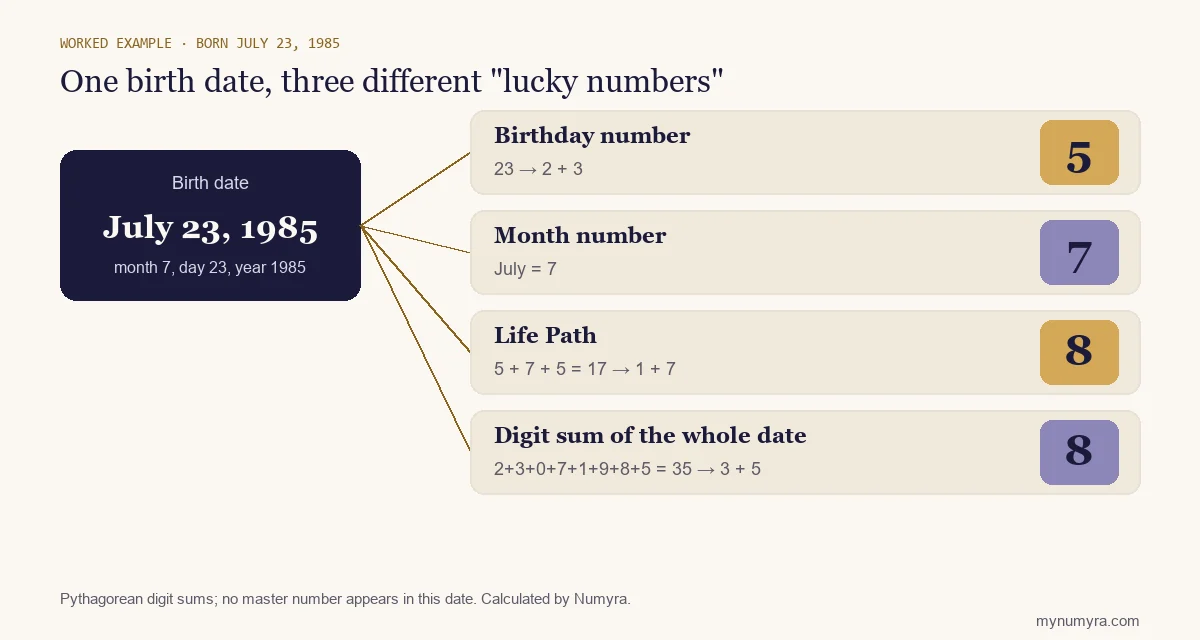
- The pages that rank for “lucky number numerology” use at least four recipes: Life Path, birthday number, name number and blends of them. For a person born July 23, 1985 these give 5 (birthday), 7 (month) and 8 (Life Path).
- Cheiro’s own idea of luck is a calendar, not one number: your birth number’s series of dates (a 1 gets the 1st, 10th, 19th and 28th) plus weekdays he names for each number. In 2027 a birth number 1 has 48 such dates, 15 of them on his lucky weekdays.
- Among 85.4 million Americans born 1994 to 2014, every single-digit Life Path is shared by about 11.1% (one person in nine). The master numbers are rarer: 11 is 5.9%, 22 is 3.6% and 33 is 0.29% (about 1 in 346). The day-of-month birth number favors 1 to 4 (11.6% to 13.2%) over 5 to 9 (about 9.8%).
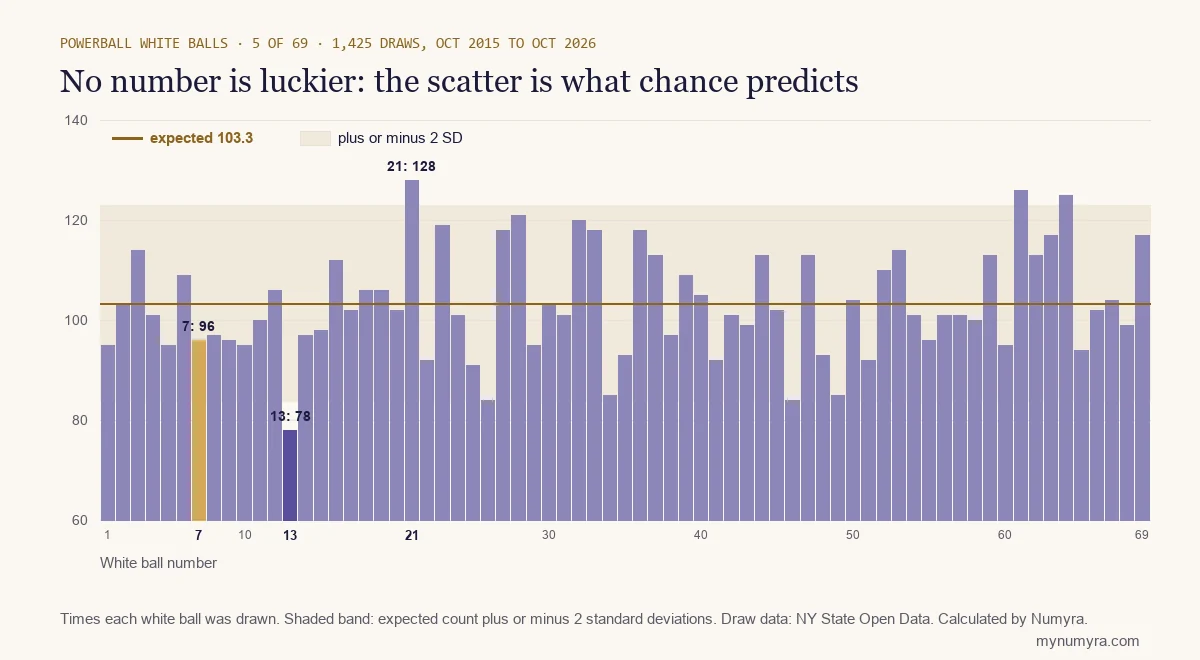
- The lottery rules fix the odds: 1 in 292,201,338 for the Powerball jackpot and 1 in 290,472,336 for Mega Millions. In 1,425 Powerball draws every ball came up about as often as chance predicts; the lucky 7 appeared 96 times against 103 expected.
- What a lucky number does change is sharing. A study of 5.1 million real Dutch Lotto picks found players choose 7 and 11 far more than chance, so popular numbers split a jackpot more ways. It does not change the chance of winning.
In this guide
- Four recipes, four different lucky numbers
- Pythagorean or Chaldean: why a name changes the number
- What Cheiro actually wrote about lucky days
- Cheiro’s lucky dates and weekdays for each number
- How common is your lucky number?
- What the lottery rules say about lucky numbers
- Do lucky numbers turn up more often? 1,425 Powerball draws
- What a lucky number does change: how many people share it
- How to use a lucky number without fooling yourself
- How we ran the numbers
- Frequently asked questions
- Sources
Four recipes, four different lucky numbers
There is no single method behind “your lucky number”. We read six pages that rank for the search on October 28, 2026 (Bing results; Google would not return a results page without a robot check, and we did not try to get around it). Each gives a method, and they are not the same one:
| Page | What it calls your lucky number |
|---|---|
| Astroyogi, “What are the Lucky Numbers in Numerology?” (May 2026) | The birth number: only the day you were born, reduced to one digit (the 23rd gives 5). It also lists a ruling number and a name number. |
| MiniWebtool, “What is my Lucky Number?” (updated January 2026) | Year, month and day each reduced to one digit, added, and reduced again. |
| astrocalculators.com, Lucky Numbers Calculator | The same date method, stopping at 11, 22 or 33, then combined with a number from your full birth name. |
| InstaAstro, Lucky Number Calculator | Reduce the date of birth, reduce the name, combine the two results. |
| wikiHow, “How to Find Your Lucky Numbers Based on Numerology” (updated June 2026) | Quotes numerologist Camber Hill that the Life Path is one of the core types of lucky number, then walks through expression, heart’s desire, personality and birthday numbers as well. |
| AstroFormer, Lucky Numbers Calculator | Six numbers from Chaldean letter values, including the Life Path, a “driver” number from the birth day, a name number and combinations of them. |
Astroyogi says outright that there is no one universal answer, and the table shows why: a person gets a different lucky number depending on which page they use. Take July 23, 1985. The birthday number is 5 (2 + 3). The month number is 7. The Life Path adds the reduced month, day and year, 7 + 5 + 5 = 17, and reduces again to 8. Adding every digit of the date, 2+3+0+7+1+9+8+5 = 35, also gives 8. That last identity is not luck. A Life Path with 11, 22 and 33 folded back to single digits always equals the digit sum of the whole date, which we confirmed for all 7,670 dates in our US birth data.
None of the six pages traces its method to a historical text; wikiHow credits expert interviews instead. That matters, because the earliest lucky-number system in print is not any of these. It is Cheiro’s, and it works differently. For the standard recipes used on this site see our Life Path calculator, our guide to the birthday number, and the explanation of why 11, 22 and 33 are kept as master numbers.
Pythagorean or Chaldean: why a name changes the number
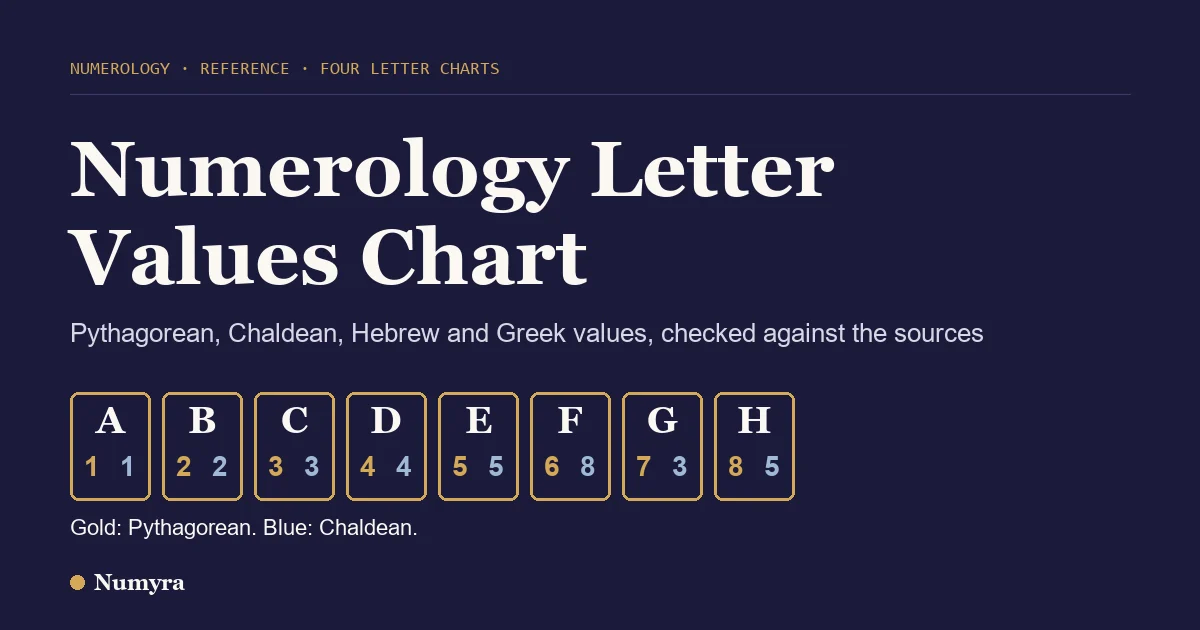
Once a name enters the recipe, a second choice appears: which letter table. The Pythagorean table runs A to I as 1 to 9 and repeats. The Chaldean table gives letters values from 1 to 8 and assigns none to 9. Cheiro, writing in the Chaldean tradition, explains why: he says the ancient masters knew the number 9 stands for the nine-lettered name of God, so no single letter was given to it (pp. 70 and 71). Our letter values chart and our guide to Pythagorean versus Chaldean compare the two letter by letter.
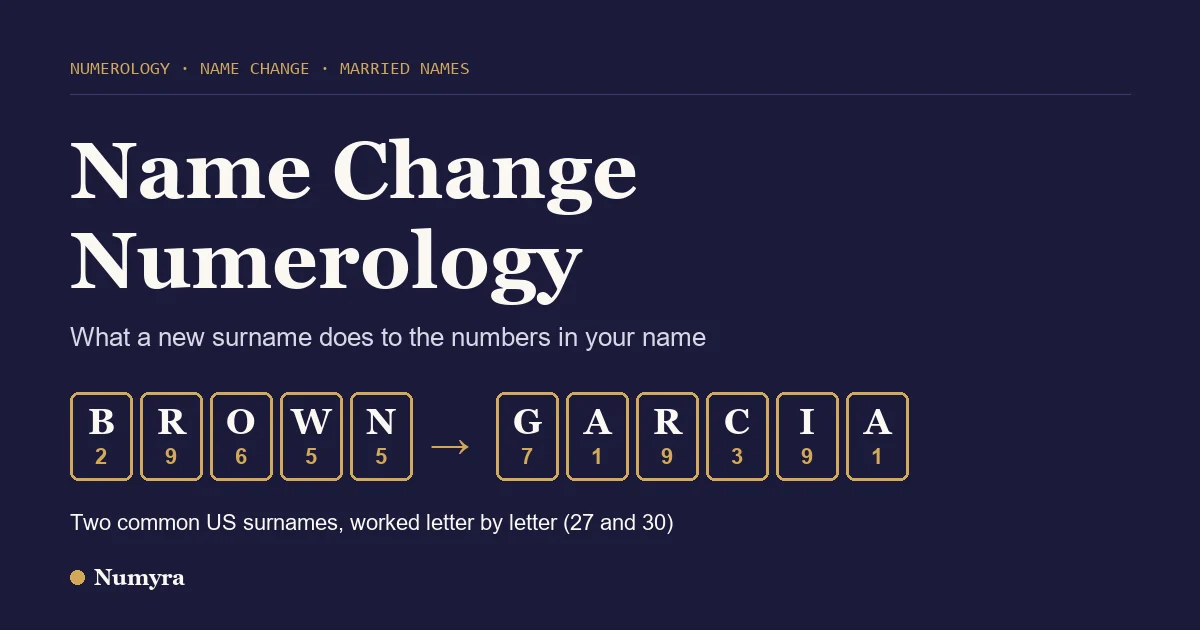
The tables disagree on 16 of the 26 letters, so the same name often lands on a different number. Use the invented name Mary Jones. Pythagorean: MARY is 4+1+9+7 = 21 and JONES is 1+6+5+5+1 = 18, a total of 39, reduced to 3. Chaldean: MARY is 4+1+2+1 = 8 and JONES is 1+7+5+5+3 = 21, a total of 29, reduced to 2. In the Chaldean tradition the compound 29 is also read in its own right, which our guide to Cheiro’s compound numbers covers. Cheiro adds one more rule that changes the answer: use the name a person is most used by, not necessarily the full legal name (p. 71). Our page on name change numerology shows what that does to a married name.
What Cheiro actually wrote about lucky days
Cheiro treats luck as a matter of days. In the edition we read, there is a chapter titled “How to find the ‘lucky’ day” (chapter XXII), and the book’s own method for it is stated on page 70:
To find the exact day in any month of the year whose vibration will be favourable, or in other words “lucky” to any individual, the simplest rule is to work out by the following table the occult number produced by the letters of their name.
Cheiro, Cheiro’s Book of Numbers, London: Herbert Jenkins, p. 70 (Internet Archive scan)
So his first route runs through the name, using the Chaldean table above. His second route, set out in chapter XXII, runs through the birth date and gives a whole series of days, not a single number:
A person we will say born on the 1st of a month will find for all general purposes that if he or she will use all dates making the Number One series, such as the 1st, 10th, 19th or 28th of any month
Cheiro, Cheiro’s Book of Numbers, p. 123, excerpt (Internet Archive scan)
That is the whole principle: reduce the day of the month to one digit to get the birth number, then treat every date that reduces to the same digit as lucky. He adds that any number in the series “is equally important” with the day of birth (p. 123). He also uses a third test for a single date: add the name total, the single number of the date and the birth number, and read the compound result in his tables. His worked example is a man asking his employer for a raise, which came out as 15, a number he reads as favorable for obtaining favors. Then he qualifies it (p. 124): the date test was an illustration “for that special purpose”, the series is the rule for “continual action all through the year”, and when another person is involved the rule “would not work out with such certainty”.
Two further points from the book are worth keeping. First, Cheiro does not promise quick results:
Naturally, when people begin to follow this idea, they must not expect to find their luck change in an instant, as if by magic.
Cheiro, Cheiro’s Book of Numbers, p. 124 (Internet Archive scan)
Second, the nearest he comes to gambling is a temperament, not a tip. He calls number 5 people “born speculators”, prone to Stock Exchange transactions and ready to run risks (p. 49), and describes the 5 as a “lucky” number for people whose careers involve risk, change and speculation (p. 74). That describes a type of person, and he never claims the 5 improves the result of a draw. We also searched the scan’s text for the phrase “Life Path” and found none. It belongs to later authors, which is why the recipes in the first table diverge. Our history of Cheiro and the name he used covers who he was.
Cheiro’s lucky dates and weekdays for each number
Each number’s chapter gives its own dates, a planet, and the weekdays he calls lucky. His table on page 33 pairs weekdays with numbers: Sunday 1 and 4, Monday 2 and 7, Tuesday 9, Wednesday 5, Thursday 3, Friday 6, Saturday 8. The planets are Sun 1, Moon 2, Jupiter 3, Uranus 4, Mercury 5, Venus 6, Neptune 7, Saturn 8 and Mars 9. Every number’s lucky weekdays include its own weekday from that table. The table below lists what each chapter says and, in the last column, how many dates fall in each series in 2027, and how many of those land on a weekday he names.
| Birth number | Dates in his series | Weekdays he calls lucky | Page | 2027 dates: all / on a lucky weekday |
|---|---|---|---|---|
| 1 | 1, 10, 19, 28 | Sunday, Monday | 38 | 48 / 15 |
| 2 | 2, 11, 20, 29 | Sunday, Monday, Friday | 40 | 47 / 18 |
| 3 | 3, 12, 21, 30 | Thursday (most important), Friday, Tuesday | 44 | 47 / 21 |
| 4 | 4, 13, 22, 31 | Saturday, Sunday, Monday | 47 | 43 / 21 |
| 5 | 5, 14, 23 | Wednesday, Friday | 50 | 36 / 10 |
| 6 | 6, 15, 24 | Tuesday, Thursday, Friday | 53 | 36 / 13 |
| 7 | 7, 16, 25 | Sunday, Monday (his text says “the same as for the number 2”) | 56 | 36 / 10 |
| 8 | 8, 17, 26 | Saturday (most important), Sunday, Monday | 59 | 36 / 15 |
| 9 | 9, 18, 27 | Tuesday (most important), Thursday, Friday | 66 | 36 / 16 |
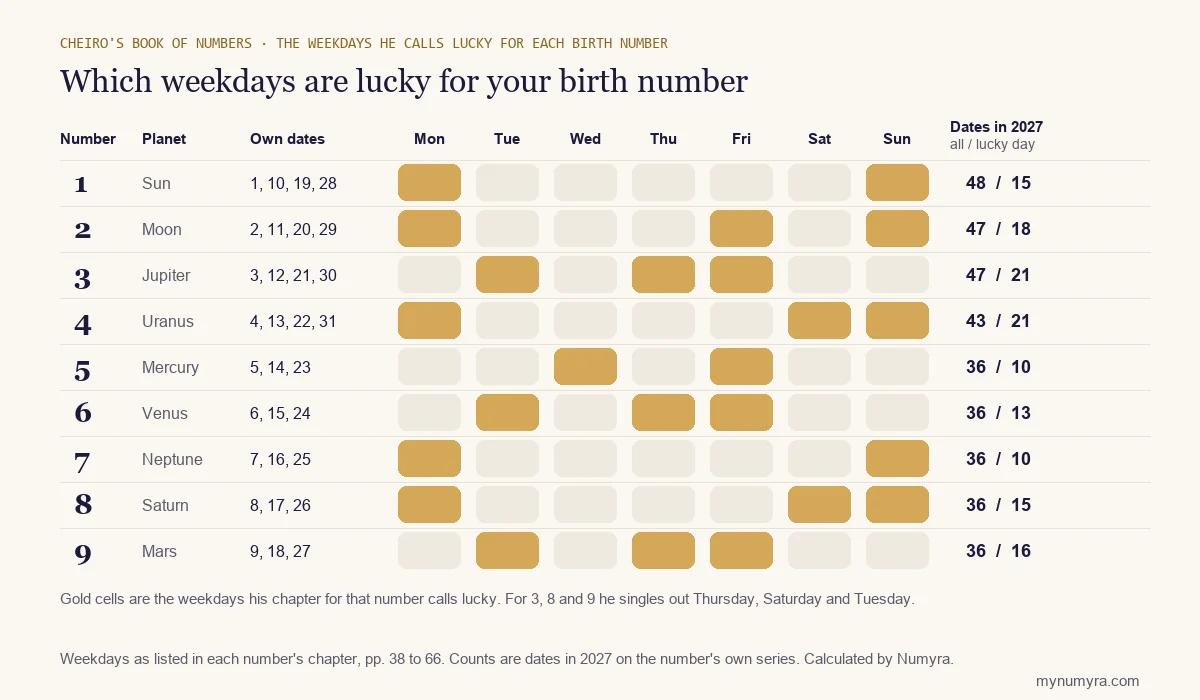
Two things stand out. The book is not fully consistent: page 40 gives the 2 three weekdays including Friday, while page 56 says the 7 shares the 2’s days and lists only Sunday and Monday. And the series are unequal in length. Numbers 1 to 4 each have four dates in a 31-day month and 5 to 9 have three, so a 4 has 43 dates in 2027 and a 7 has 36. Cheiro also gives each number “periods” of the year (a 1 is strongest from July 21 to August 28 and from March 21 to April 28, p. 37 to 38), plus lucky colors and stones, which we leave out here. If you want a calendar for your own number, the table above is the whole rule. Treat it as a way to pick days for a fresh start, not as evidence about the days themselves; our test of whether numerology works explains what has and has not been checked.
How common is your lucky number?
None of the six pages says how many people share each number, so we counted. The method: for every date from January 1, 1994 to December 31, 2014 (7,670 days) we took the number of US births recorded that day, from the CDC National Center for Health Statistics for 1994 to 2003 and the Social Security Administration for 2004 to 2014, and worked out each date’s numbers. That is 85,386,227 births. It describes Americans now in their twenties to forties and says nothing about personality. These are the same counts behind our test of whether numerology works, which checks whether the Life Path split is even, and our birthday number guide; the table puts the lucky-number recipes side by side, which is new here.
| Number | Life Path (11, 22, 33 kept) | Life Path (11, 22, 33 folded) | Birth number (day of month) |
|---|---|---|---|
| 1 | 11.14% | 11.14% | 13.16% |
| 2 | 5.23% | 11.11% | 13.00% |
| 3 | 11.12% | 11.12% | 12.97% |
| 4 | 7.54% | 11.13% | 11.62% |
| 5 | 11.08% | 11.08% | 9.86% |
| 6 | 10.79% | 11.08% | 9.82% |
| 7 | 11.12% | 11.12% | 9.80% |
| 8 | 11.10% | 11.10% | 9.86% |
| 9 | 11.12% | 11.12% | 9.90% |
| 11 | 5.89% | folded into 2 | not used |
| 22 | 3.59% | folded into 4 | not used |
| 33 | 0.29% | folded into 6 | not used |
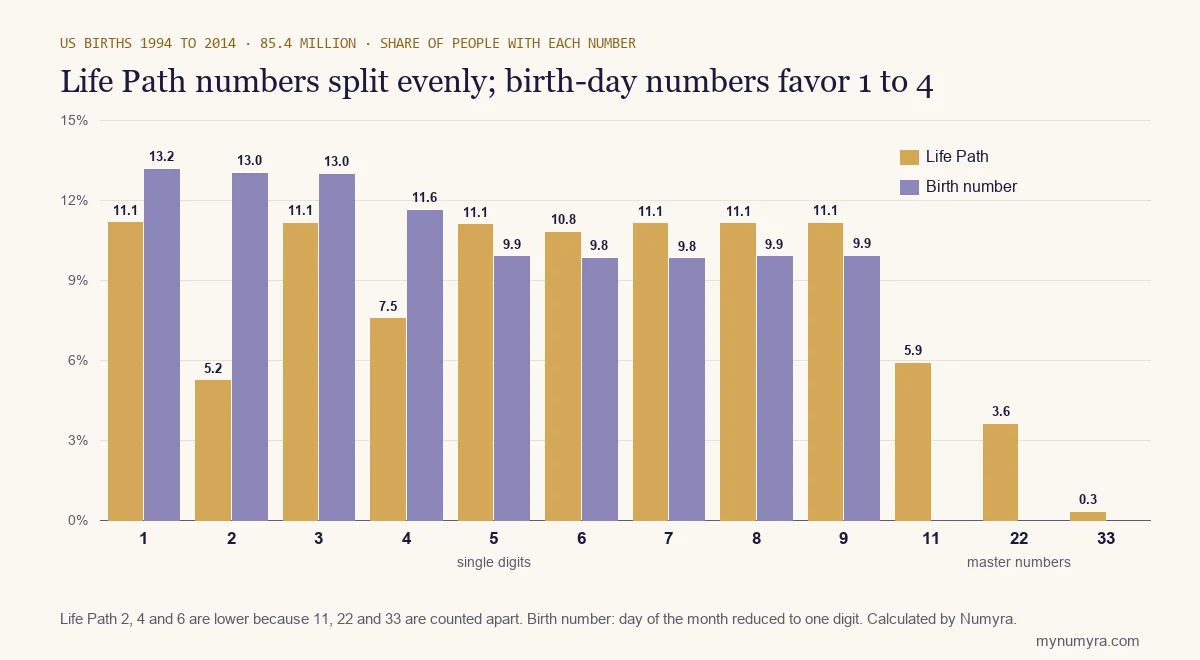
Three results follow. First, no single-digit lucky number is more common than another: Life Path 1 to 9 each cover about one American in nine (about 9.5 million people each in this sample). This is arithmetic, because repeated digit sums cycle through 1 to 9 evenly over the calendar; it is not a quirk of US births. Second, the master numbers are where rarity lives: 11 is about 1 in 17, 22 about 1 in 28, and 33 about 1 in 346, roughly 247,000 people. Third, the day-of-month birth number is uneven for a calendar reason. The numbers 1 to 4 each collect four dates and 5 to 9 only three, so a 1 is 13.2% of people and a 7 is 9.8%. Our birthday number guide reports the same birth-number shares and adds that the birthday number equals the Life Path for roughly one person in ten; we reuse its sample so the numbers match.
The reader who loves 7 should notice the combination: 7 is a Life Path for one American in nine but a birthday number for fewer than one in ten, and, as the next sections show, it is also the favorite pick of lottery players around the world. Popular and common are different things.
What the lottery rules say about lucky numbers
The odds are set by the rules of the game, not by anyone’s number. Powerball players choose five white numbers from 1 to 69 and one red Powerball from 1 to 26, as the Texas Lottery and the Florida Lottery both state. Mega Millions players choose five numbers from 1 to 70 and one Gold Mega Ball from 1 to 24, with a $5 ticket and a multiplier included, as the Mega Millions how-to-play page states.
| Game | Numbers drawn | Ways to choose them | Jackpot odds | Any prize |
|---|---|---|---|---|
| Powerball | 5 of 69 white, 1 of 26 red | 11,238,513 white sets x 26 | 1 in 292,201,338 (our arithmetic from the stated rules) | 1 in 24.87 (Florida Lottery) |
| Mega Millions | 5 of 70 white, 1 of 24 gold | 12,103,014 white sets x 24 | 1 in 290,472,336 (stated by Mega Millions) | about 1 in 23.0 (our sum of its prize-tier odds) |
The Powerball row rests on the two state lottery pages and our own count of combinations. Every one of those 292 million tickets is equally likely, including 1-2-3-4-5 plus 6 and a ticket built from your Life Path. No recipe in the first table, and not Cheiro’s calendar, changes the chance of any ticket.
Do lucky numbers turn up more often? 1,425 Powerball draws
If a number such as 7 were luckier, it would show up in the results. New York State publishes every Powerball and Mega Millions draw as open data, so we tested it. We used the 1,425 Powerball draws from October 7, 2015 (the game’s change to 69 white balls; none above 59 appears before it and numbers up to 69 appear after) to October 26, 2026, and for comparison 938 Mega Millions draws from October 31, 2017 (no white ball above 70 appears from then on).
| Test | Result | Expected by chance |
|---|---|---|
| Powerball: all 69 white balls, chi-square test | 77.6 on 68 degrees of freedom, p = 0.20 | no departure from even |
| Powerball: the number 7 | drawn 96 times | 103.3 (give or take 9.8) |
| Powerball: most and least drawn | 21 (128 times) and 13 (78 times) | about 95% of numbers fall between 84 and 123 |
| Powerball: balls outside the 2-standard-deviation band | 4 of 69 (13, 21, 61, 64) | about 3.1 of 69 |
| Powerball: draws with all five white balls 31 or lower | 22 draws | 21.5 draws (1.51% of all white sets) |
| Powerball: red ball, all 26 numbers | p = 0.50; the red 7 drawn 48 times | 54.8 for any one number |
| Mega Millions: all 70 white balls | p = 0.73; the number 7 drawn 65 times | 67.0 for any one number |
| Mega Millions: draws with all five white balls 31 or lower | 21 draws | 13.2 draws (p = 0.04) |
The pattern is what a fair draw looks like. The most-drawn Powerball number, 21, beat the average by about 2.5 standard deviations and the least-drawn, 13, fell short by about 2.6; among 69 numbers a few outliers of that size are expected, and four turned up where about three were predicted. The lucky 7 came in a little below average, and so did the unlucky 13, which says nothing about either. There are two results we want to be honest about. Mega Millions had more all-31-or-lower draws than expected (21 against 13.2); that is a gap chance produces about once in 27 tries, and with this many comparisons one of that size is not surprising. And the counts in the first and second halves of the Powerball period correlate weakly (a rank correlation of 0.26, p = 0.03), yet only 2 of the 10 most-drawn numbers in the first half were in the second half’s top ten, against 1.4 expected. Neither would help anyone choose a number. A draw has no memory of the last one.
What a lucky number does change: how many people share it
There is one place where a lucky number has a measurable effect, and it is on the player’s side of the counter. Players do not pick at random. In a 2016 paper in the journal Judgment and Decision Making, Tong Wang, Rogier Potter van Loon, Martijn van den Assem and Dennie van Dolder analyzed 5,108,343 combinations chosen by 131,407 players in 175 draws of the Dutch Lotto (6 of 45), from April 2010 to December 2012. Players favored numbers from their birthdate, age and postal code, with the day of birth the most popular of these, followed by the year and month of birth. The two most-picked numbers were 11, in 16.5% of combinations, and 7, in 16.3%; the least picked were 37 and 38, at 10.3% and 10.5%. Random picking would put each number in 13.3% of combinations. The authors note that earlier studies generally find numbers from 1 to 31 (days), and especially 1 to 12 (days and months), more popular than other numbers.
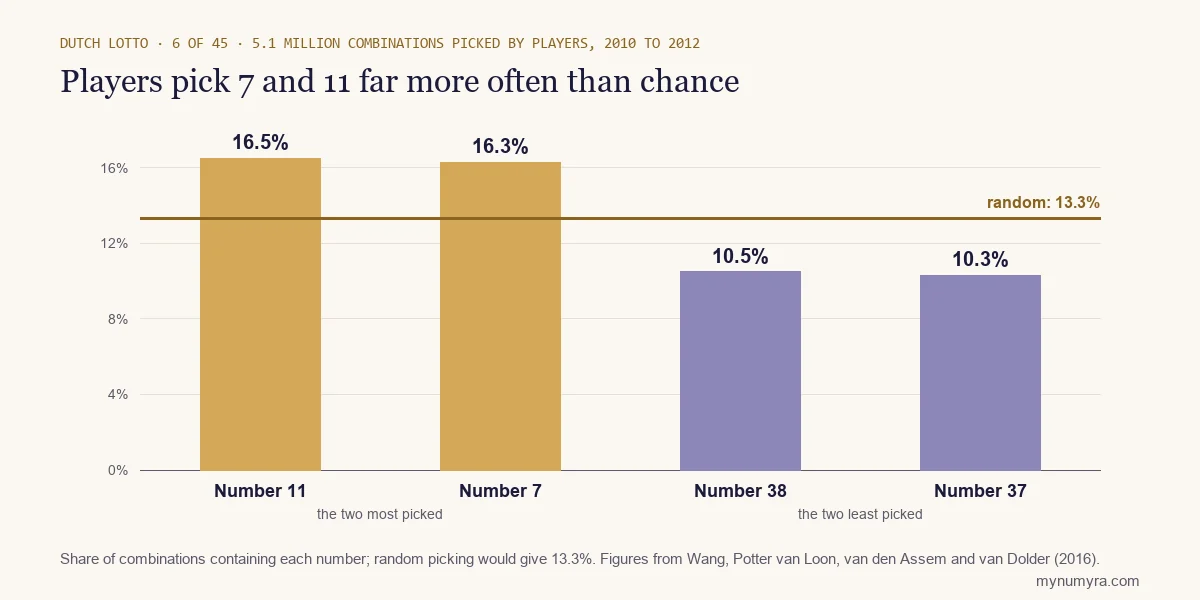
That is Dutch data, and we did not find equivalent pick data published for US games, so treat it as evidence about human behavior, not about Powerball in particular. It also fits the numerology. A lottery number drawn from a birthday is bounded by the calendar, and a bounded set is small. If a Powerball player used only numbers from 1 to 31, there are 169,911 ways to choose five white balls, or 1.51% of the 11,238,513 possible sets; limited to 1 to 12, there are 792, or about 0.007%. The real draws behave like random ones, with 22 of 1,425 falling in the 1 to 31 group. The practical meaning is about prizes, not odds: when a jackpot is split among all winners, a combination that many people chose shares the prize with more of them. It leaves the chance of winning exactly where the rules put it.
This guide is educational information about a numerology tradition and lottery arithmetic, not gambling, financial or professional advice. If gambling is causing harm to you or someone close to you, the National Council on Problem Gambling lists the National Problem Gambling Helpline: call or text 1-800-MY-RESET (1-800-697-3738).
How to use a lucky number without fooling yourself
The honest use of a lucky number is as a reminder, not a lever. Pick one recipe and name it, so you know which number you are calling yours. Use Cheiro’s series to choose days for starting things you were going to do anyway: a first day at work, a fresh habit, a date for a conversation. Keep the weekday list with it if you like. Write down what happens. Because Cheiro himself says results do not arrive “in an instant” and that a date rule is less certain when someone else’s life is involved, a record kept over months will tell you more than a good week.
If you are curious about the cultural side, a lucky number is also a market signal: the Wang paper notes that 8 is valued as lucky and 4 as unlucky in markets such as car license plates and housing. Our pages on phone number numerology and business name numerology test the same idea in those settings, and why you keep seeing the same number covers the noticing effect. The method notes follow.
How we ran the numbers
- Birth numbers. Daily US birth counts from the CDC National Center for Health Statistics (1994 to 2003) and the Social Security Administration (2004 to 2014), as compiled by FiveThirtyEight: 7,670 days and 85,386,227 births, dates only. Life Path follows the rule on our methodology page: month, day and year each reduced with 11, 22 and 33 kept, then added and reduced. We checked our code against figures in our birthday number guide (9.7% exact match with the birthday number, 11.4% for the same single digit) and they reproduce.
- Cheiro. Every weekday list, date series, page number and quotation was checked against page images of the Internet Archive scan (pages 33, 38, 40, 44, 47, 49, 50, 53, 56, 59, 66, 70, 71, 74, 123 and 124), not only the machine-read text. The 2027 counts are calendar arithmetic.
- Lottery rules. The matrices come from the Texas Lottery, Florida Lottery and Mega Millions pages as fetched on October 28, 2026. Powerball’s 1 in 292,201,338 is 11,238,513 x 26, our calculation. Mega Millions’ figure is as stated on its page; its “any prize” figure is the reciprocal of the sum of the reciprocals of its nine prize-tier odds.
- Draw tests. Draw results are from NY State Open Data (Powerball: 1,425 draws; Mega Millions: 938 draws). We started each game on the date its white-ball range reached its current top number, found from the data itself. We used a chi-square test on the white-ball counts, an exact binomial test for the all-31-or-lower draws, and a rank correlation between the two halves of the Powerball period.
- What this is not. It is not a prediction of any draw, and it says nothing about whether any number suits any person. Numerology is a tradition; see our disclaimer.
Frequently asked questions
What is my lucky number by date of birth?
It depends on the recipe. The two most common are the birthday number (the day of the month reduced to one digit; the 23rd gives 5) and the Life Path (month, day and year each reduced, added and reduced again; July 23, 1985 gives 8). Use our Life Path calculator for the second.
Is the Life Path number the same as the lucky number?
Some pages treat it that way and some do not. Cheiro’s book does not use the term Life Path at all; he anchors luck to the birth number and the name number. Across US births the two match, as single digits, for about 11.4% of people.
What is the luckiest number in numerology?
None is crowned. Cheiro writes that 7 and 9 are “the most important of all” for occult calculation (p. 66), which is about importance, not luck. Modern pages call different numbers lucky, and Astroyogi says there is no one universal answer.
Is 7 a lucky number?
It is the most popular pick among lottery players in the Dutch data we cited (16.3% of combinations against 13.3% for random picks). In Cheiro it is a Neptune number whose lucky weekdays are Sunday and Monday. In 1,425 Powerball draws the 7 came up 96 times against 103.3 expected, so it is not luckier in the draw.
Which days are lucky for my birth number?
Cheiro’s rule is to use dates in your number’s series and the weekdays he names; both are in the table above. A birth number 3, for example, uses the 3rd, 12th, 21st and 30th, with Thursday the most important weekday.
Can I use my lucky number to pick lottery numbers?
You can choose any numbers you like, but no choice changes the odds: 1 in 292,201,338 for the Powerball jackpot and 1 in 290,472,336 for Mega Millions. Lucky or popular numbers, such as birthdays, can mean a shared prize if you win. We do not suggest buying tickets.
How many people share my lucky number?
Among Americans born 1994 to 2014, about 11.1% for each single-digit Life Path from 1 to 9, 5.9% for 11, 3.6% for 22 and 0.29% for 33. For the day-of-month birth number it is 13.2% for a 1 down to 9.8% for a 7.
Can my lucky number change?
Date-based numbers never change, because the birth date does not. A name number can change if the name you use changes, and Cheiro advises using the name you are best known by (p. 71). See our guide to name change numerology.
Sources
- Cheiro. Cheiro’s Book of Numbers (London: Herbert Jenkins, seventh impression), Internet Archive scan; pp. 33, 38 to 66 (the number chapters), 70 and 71, 74 and 123 to 124.
- Mega Millions, How to Play: 5 of 70 and 1 of 24, $5 ticket, prize-tier odds including the jackpot at 1 in 290,472,336 (fetched October 28, 2026).
- Texas Lottery, Powerball: 5 numbers from 1 to 69 and 1 Powerball from 1 to 26.
- Florida Lottery, Powerball: the same matrix and overall odds of 1 in 24.87.
- NY State Open Data, Lottery Powerball Winning Numbers: Beginning 2010, and the matching Mega Millions dataset.
- Wang, T. V., Potter van Loon, R. J. D., van den Assem, M. J. and van Dolder, D. “Number preferences in lotteries.” Judgment and Decision Making 11(3), 243 to 259 (2016), doi:10.1017/S1930297500003089.
- National Council on Problem Gambling, Help and Treatment: National Problem Gambling Helpline.
- FiveThirtyEight. US births data: daily counts from the CDC National Center for Health Statistics (1994 to 2003) and the Social Security Administration (2000 to 2014); we use the SSA file from 2004. Dates only. Analysis by the Numyra Methodology Desk.
- Pages read for the first table, as of October 28, 2026: Astroyogi, MiniWebtool, astrocalculators.com, InstaAstro, wikiHow and AstroFormer.