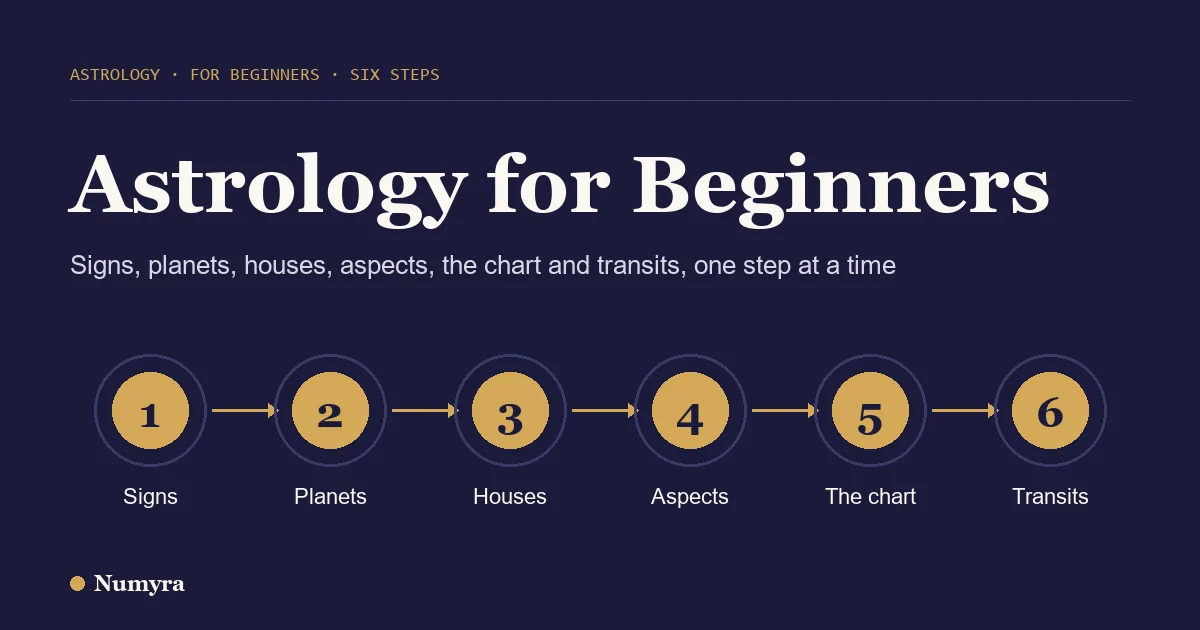
Astrology for beginners comes down to six building blocks, best learned in this order: the twelve signs, the ten bodies (the Sun, the Moon and eight planets) that move through them, the twelve houses, the angles called aspects, the whole chart read together, and transits, which compare today’s sky with your chart. Each step below ends with one job for your own chart, using Numyra’s Birth Chart Calculator and a pencil. We also separate what you can read in the old books, Ptolemy’s Tetrabiblos and William Lilly’s Christian Astrology of 1647, from what was added later. And we computed what we found in none of the seven beginner guides we read: in 400,000 simulated US birth charts the ten bodies fall in only 6.6 of the 12 signs on average, about 5 of the 12 houses are empty, and 76% of people have three different Sun, Moon and Rising signs.
How this page differs from our other guides: it is the roadmap, and it hands you on. The Sun, Moon and Rising sign guide explains the big three in depth, the houses guide and the whole sign versus Placidus comparison cover house systems, the aspects guide covers orbs, and Is astrology real? covers the tests. Here you get the order to learn things in, the sources behind each layer, and a short job to do at each step.
Key takeaways
- Learn in six steps: signs, the ten bodies, houses, aspects, the whole chart, transits. Your Sun sign needs only a birth date; the Rising sign and the houses also need the birth time and place.
- Old and documented: the zodiac counted from the spring equinox (Ptolemy, Tetrabiblos I.10), planet qualities (I.4), aspects counted in signs (I.13), a meaning for each house (Lilly, 1647) and transits found with an ephemeris (Lilly, 1647). Later: Uranus, Neptune and Pluto (found 1781, 1846 and 1930) and the Sun-sign newspaper column (1930).
- A typical chart is less crowded than people expect. Across 400,000 simulated US births the ten bodies use 6.6 of the 12 signs on average, 82.6% of charts use 6 to 8, and 5.4 of the 12 whole-sign houses are empty. An empty house is normal.
- Three different Sun, Moon and Rising signs is the usual case: 76.3% of charts. Exactly two match in 23.0%, and all three match in 0.7%, about 1 chart in 147.
- At a 6-degree orb the average chart has about 12 major aspects, but 30 of the 45 planet pairs sit in aspect signs, so the orb you choose matters more than the aspect names.
- The slow planets set the transit calendar: Jupiter leaves Leo for Virgo on 26 July 2027 and Saturn leaves Aries for Taurus on 13 April 2028 (UT, checked against JPL Horizons). Astrology here is a tradition of interpretation, not a tested prediction.
In this guide
- What you need before you start
- What is documented and what came later
- Step 1: the twelve signs
- Step 2: the ten bodies
- Step 3: the twelve houses
- Step 4: aspects, the angles between bodies
- Step 5: reading the whole chart
- Step 6: transits
- What astrology cannot do
- Where to go next
- Frequently asked questions
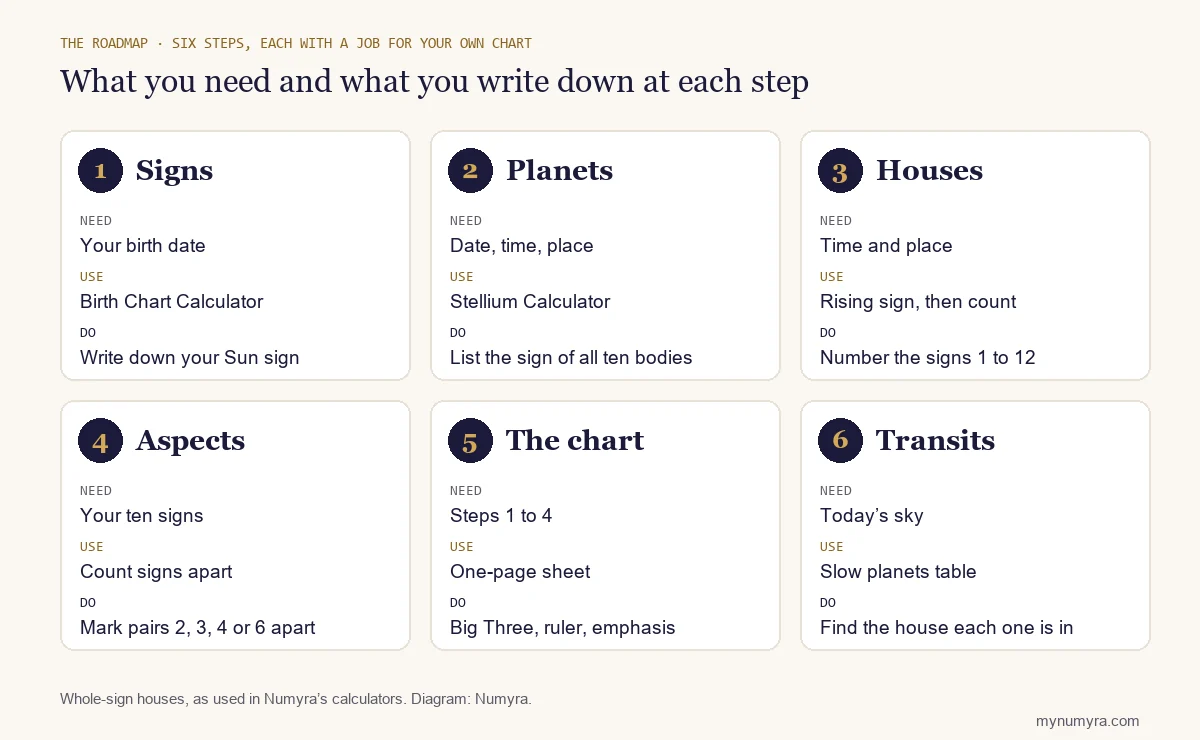
What you need before you start
Three facts about your birth: the date, the clock time and the place. The date gives your Sun sign. The time and place give your Rising sign, and through it your houses. If you do not know the time, a birth certificate or hospital record is the usual place to look; if you cannot find it, do steps 1, 2 and 4 now and treat the house work in step 3 as provisional. Our guide to how birth time changes your Rising sign shows how many minutes you have before the sign flips, and why daylight saving time is the commonest mistake.
Two free tools cover the whole job. The Birth Chart Calculator gives your Sun, Moon and Rising signs and your Midheaven. The Stellium Calculator lists where all ten bodies were, and places them in whole-sign houses. Both run in your browser, and your birth data is not sent to our servers. Open the first one now, and keep a sheet of paper next to it.
What is documented and what came later
Beginner guides usually blend several centuries into one voice. The table separates the layers. “Documented” means you can read the claim in a text from that period; we quote or cite each one below. “Later” means it was added after the old books were written. Neither column says the tradition is true; it says where a claim comes from.
| Building block | Documented in | Added or changed later |
|---|---|---|
| The zodiac of twelve signs | Babylonian astronomy, with equal 12-sign division dated by Wikipedia’s Zodiac article to around the end of the 5th century BCE; Ptolemy starts the circle at the spring equinox (Tetrabiblos I.10) | The sidereal zodiac, and arguments over a 13th sign |
| The seven classical planets | Ptolemy I.4 gives each its qualities; Lilly (1647) works with “the seven Planets” | Uranus (1781), Neptune (1846) and Pluto (1930) were found after both books; their meanings were assigned by later astrologers |
| Houses | Lilly, Christian Astrology, chapter VII, gives each house a signification; whole-sign houses go back to Hellenistic astrology | Placidus and other quadrant systems; the modern one-line labels for each house |
| Aspects | Ptolemy I.13 defines four, by counting signs; Lilly (1647) lists orbs by planet | Today’s orb tables differ from source to source; the conjunction is now listed as the fifth aspect |
| Transits | Lilly (1647), chapter 174, “Of the Transit of the Planets” | The modern habit of reading daily and weekly transit forecasts |
| Sun-sign horoscopes | Nothing in Ptolemy or Lilly; the short Sun-sign column format traces to 1930 (our history of the column) | Everything about reading a person from the Sun sign alone |
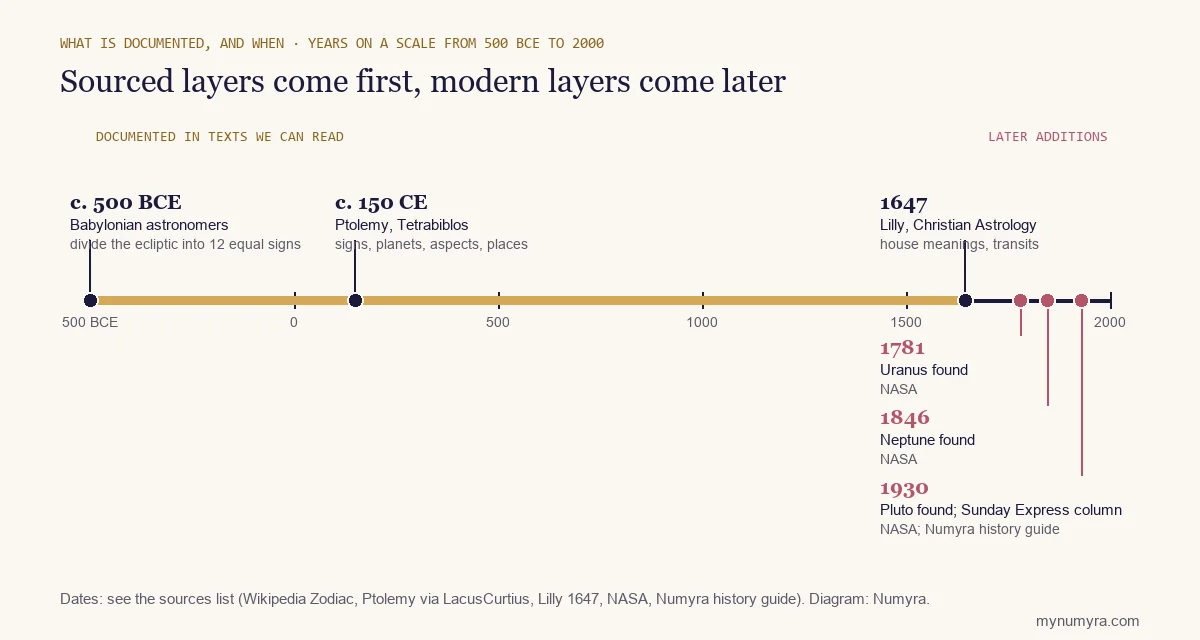
Notice what the old books are not: neither Ptolemy nor Lilly reads a chart as a modern personality profile. Our guide to Ptolemy’s Tetrabiblos covers the first book, and where the 12 zodiac signs came from covers the older layer under it.
Step 1: the twelve signs
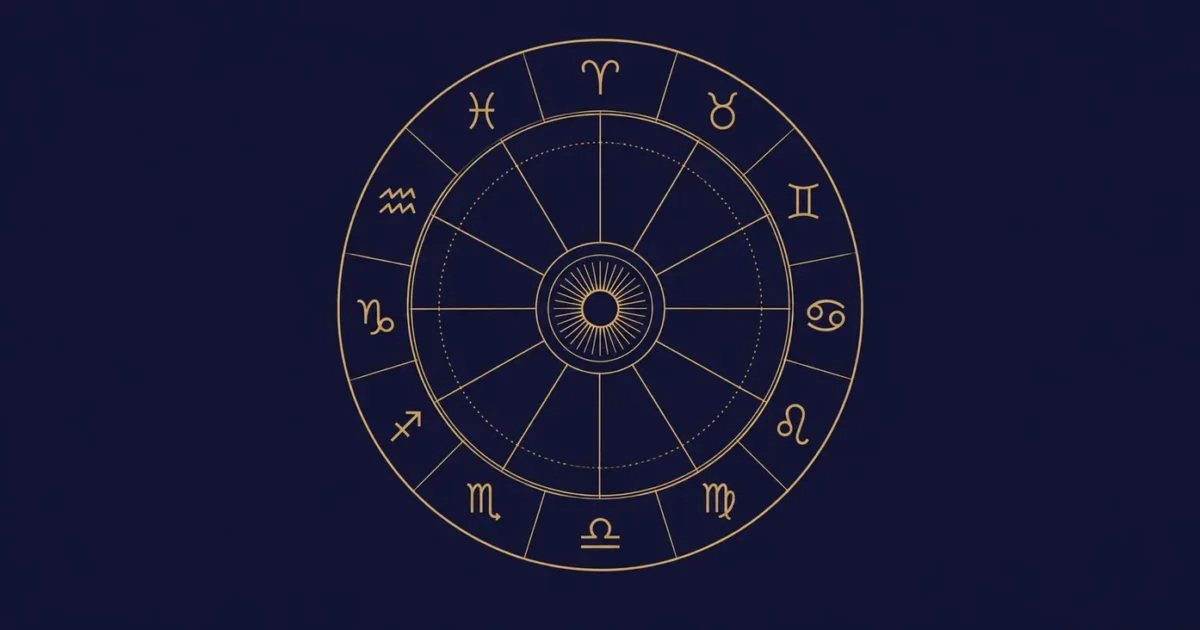
The zodiac is a circle of 360 degrees cut into twelve signs of 30 degrees each: Aries, Taurus, Gemini, Cancer, Leo, Virgo, Libra, Scorpio, Sagittarius, Capricorn, Aquarius and Pisces. A circle has no natural beginning, and Ptolemy says so in the chapter on the seasons:
“although there is no natural beginning of the zodiac, since it is a circle, they assume that the sign which begins with the vernal equinox, that of Aries, is the starting-point of them all”
Ptolemy, Tetrabiblos, Book I, chapter 10, trans. F. E. Robbins (Loeb Classical Library, 1940), via LacusCurtius
That choice is why Western astrology uses the tropical zodiac, whose signs follow the seasons instead of the constellations. Each sign also carries an element (fire, earth, air or water) and a modality (cardinal, fixed or mutable); the elements and modalities guide sets out all twelve, and the zodiac signs reference has each sign’s profile. If you are wondering about the thirteenth constellation, read what the Sun really does in Ophiuchus; for the tropical and sidereal split, read why your sign can differ.
Signs are not equally common among people. Matching 85.4 million US births from 1994 to 2014 to the Sun’s sign, the Birth Chart Calculator page reports shares from 7.60% for Capricorn to 8.96% for Leo, because births peak in late summer and the signs differ in length; the full breakdown shows the method.
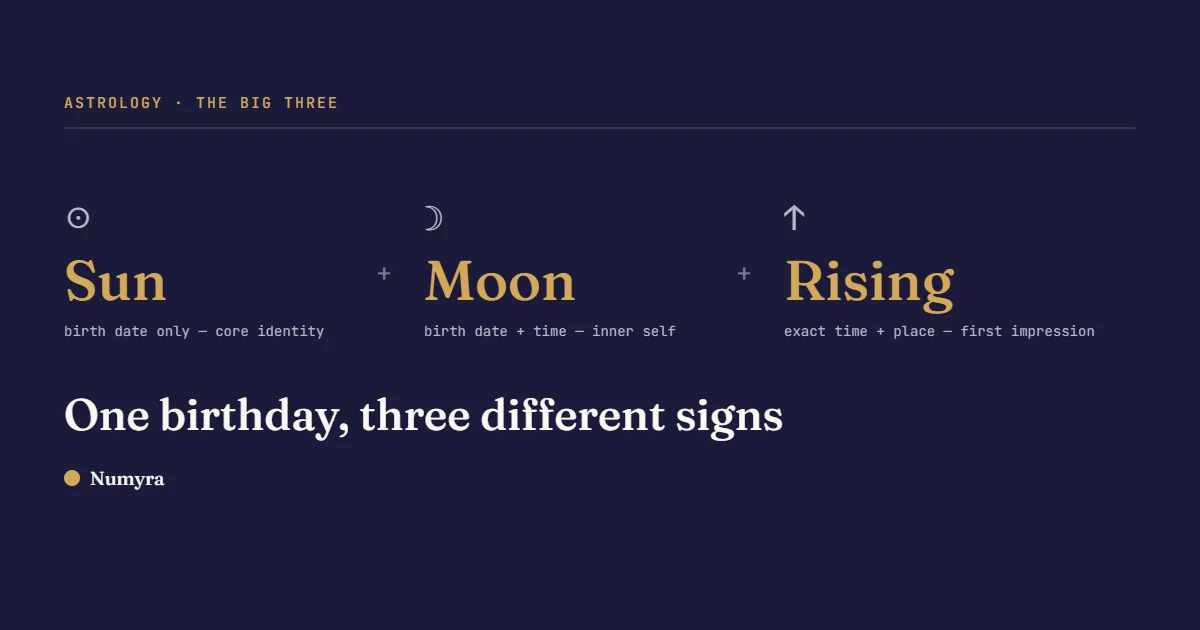
Your job for step 1. Enter your birth date, time and city into the Birth Chart Calculator and write down three things: your Sun sign, your Moon sign and your Rising sign. Together they are the “big three”, explained in the Sun, Moon and Rising guide, with a profile for every Moon sign and Rising sign. If you were born within a day of a sign change, check your birth moment against the exact times in zodiac sign dates.
Step 2: the ten bodies
Astrologers call the Sun and Moon “lights” and the other eight bodies “planets”, although the Sun is a star and the Moon is a moon. Each body is read as a different part of life, and each moves through the signs at its own speed. The speed is the only part of the table below that is astronomy rather than interpretation.
| Body | Traditionally read as | In Ptolemy and Lilly? | Sign changes in 2027 |
|---|---|---|---|
| Sun | Identity, vitality | Yes | 12 |
| Moon | Feelings, habits | Yes | 160 |
| Mercury | Thinking, speech | Yes | 18 |
| Venus | Affection, values | Yes | 15 |
| Mars | Drive, conflict | Yes | 6 |
| Jupiter | Growth, belief | Yes | 1 |
| Saturn | Limits, duty | Yes | 0 |
| Uranus | Change, invention | No, found 1781 | 0 |
| Neptune | Imagination, illusion | No, found 1846 | 0 |
| Pluto | Power, endings | No, found 1930 | 0 |
The first seven rows are the classical planets. In Tetrabiblos I.4, Ptolemy ties each planet to a physical quality: of Saturn he says that his quality is “chiefly to cool and, moderately, to dry”, because he is the planet furthest from the Sun’s heat. That is the style of the oldest sources: planets are described by temperature and moisture, not by psychology. The three outer planets have no classical text. NASA dates the discovery of Uranus to 1781 (William Herschel), Neptune to 1846 (found by Johann Galle after Urbain Le Verrier predicted its position) and Pluto to 1930; the International Astronomical Union reclassified Pluto as a dwarf planet in 2006, and astrologers kept it in the chart.
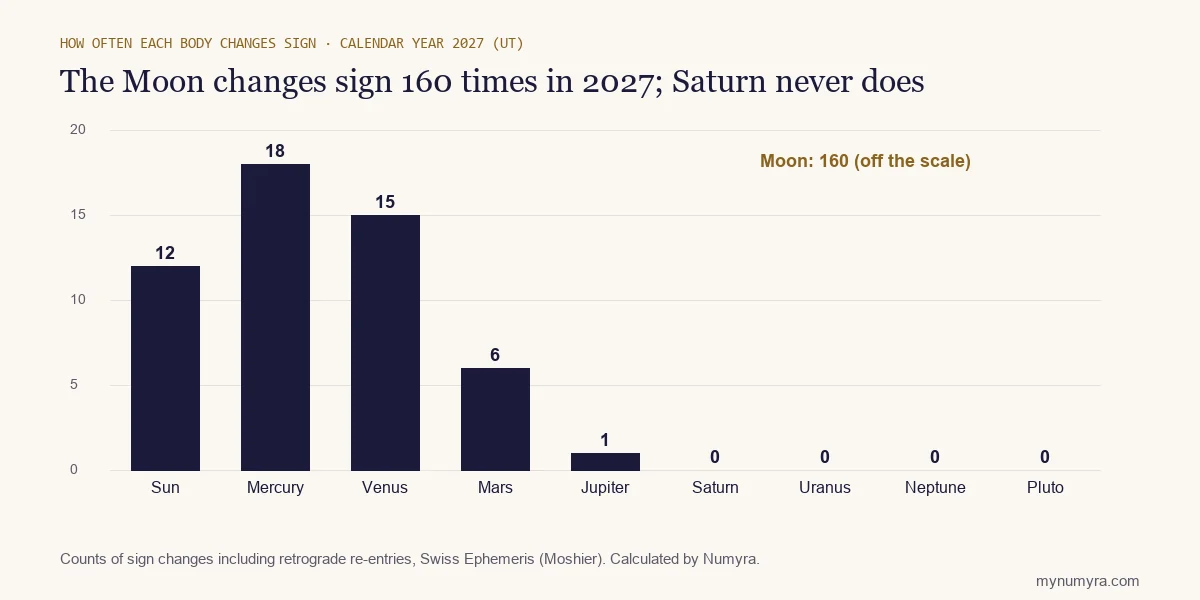
The last column explains why astrologers call the Moon, Sun, Mercury, Venus and Mars “personal” and the outer planets “generational”. In 2027 the Moon changes sign 160 times, so two classmates can have different Moon signs, while Jupiter changes sign once and Saturn, Uranus, Neptune and Pluto not at all, so a whole school year shares them. Counts include retrograde re-entries; we checked them at a finer time step.
Two facts from the geometry help a beginner. Mercury is never more than about 28 degrees from the Sun and Venus never more than about 47, so your Mercury is in your Sun sign or one sign either side, and your Venus is within two signs of it. In 400,000 simulated US births, Mercury was in the Sun’s own sign 50.9% of the time, one sign before 24.1% and one sign after 25.0%; Venus shared the Sun’s sign 24.8% of the time and was never three or more signs away. The pages on Mercury sign, Venus sign and Mars sign go further.
Your job for step 2. Open the Stellium Calculator, enter the same birth details, and copy the sign of each of the ten bodies onto your sheet. If you only want the inner planets, the Mercury, Venus and Mars sign calculators give each one on its own. You now have ten signs, and the next step turns them into places in your life.
Step 3: the twelve houses
The signs say how a body behaves; the houses say where in life it is read. William Lilly gave the houses their importance in plain terms in 1647:
“There is nothing appertaining to the life of man in this world, which in one way or other hath not relation to one of the twelve Houses of Heaven”
William Lilly, Christian Astrology (London, 1647), “An Introduction to Astrologie”, chapter VII, p. 50, Internet Archive scan, transcribed from the page image
Lilly then lists a signification for each house. The first house covers the life, stature, colour and shape of the person; the third covers brothers, sisters, kindred, neighbours and short journeys. Modern guides keep the same skeleton in shorter words: the 1st house is self and appearance, the 4th is home and family, the 7th is partners and the 10th is career and public standing. The labels are tradition, and the 12th house guide shows how one house’s reputation changed across the centuries.
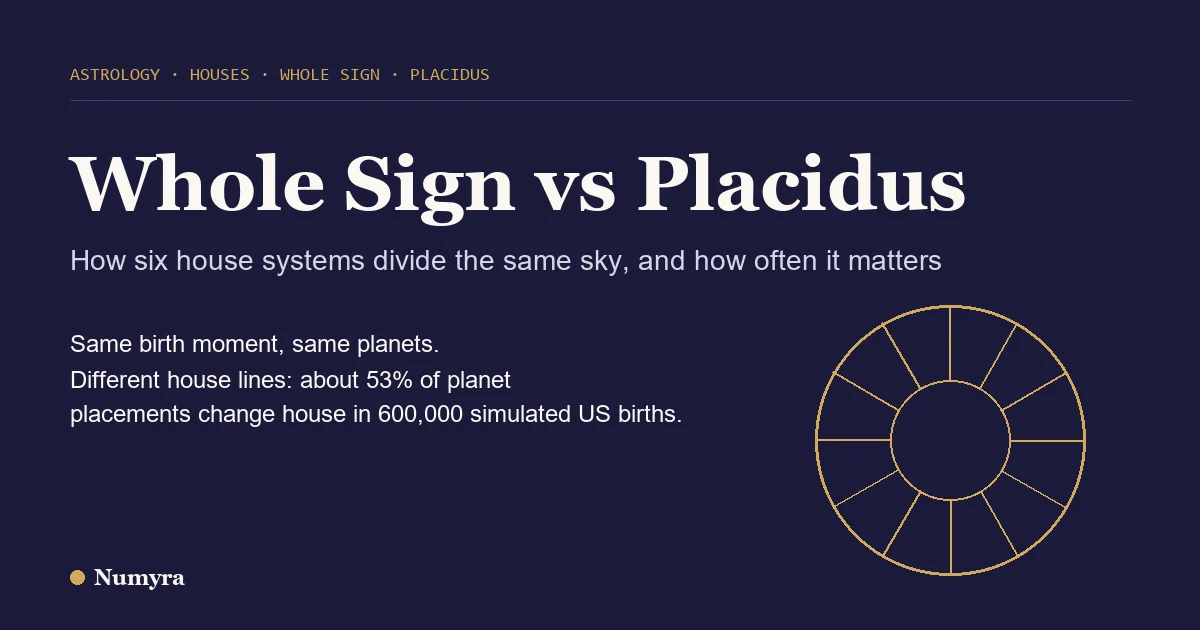
There is more than one way to draw the boundaries. Numyra’s calculators use whole-sign houses, the oldest system, in which each house is exactly one sign. That makes houses easy to do by hand, which is why we use it here. The houses guide tells the history of Whole Sign and Placidus, and our comparison measures how often they put a planet in different houses.
Your job for step 3: number your signs.
- Take your Rising sign from step 1. That sign is your 1st house.
- Write the signs in zodiac order starting from it, and number them 1 to 12. The 2nd house is the next sign, and after Pisces the count wraps back to Aries.
- For each body on your sheet, write the house number of its sign.
- Mark your Midheaven sign too. In whole-sign houses it is the 10th house in about 61% of our simulated US charts and the 9th or 11th in nearly all the rest (19.2% and 19.3%); the Midheaven guide explains.
Example, for an invented person with Virgo rising: Virgo is the 1st house, Libra the 2nd, Scorpio the 3rd, Sagittarius the 4th, Capricorn the 5th, Aquarius the 6th, Pisces the 7th, Aries the 8th, Taurus the 9th, Gemini the 10th, Cancer the 11th and Leo the 12th. A Sun in Leo is then in the 12th house, and a Moon in Pisces in the 7th.
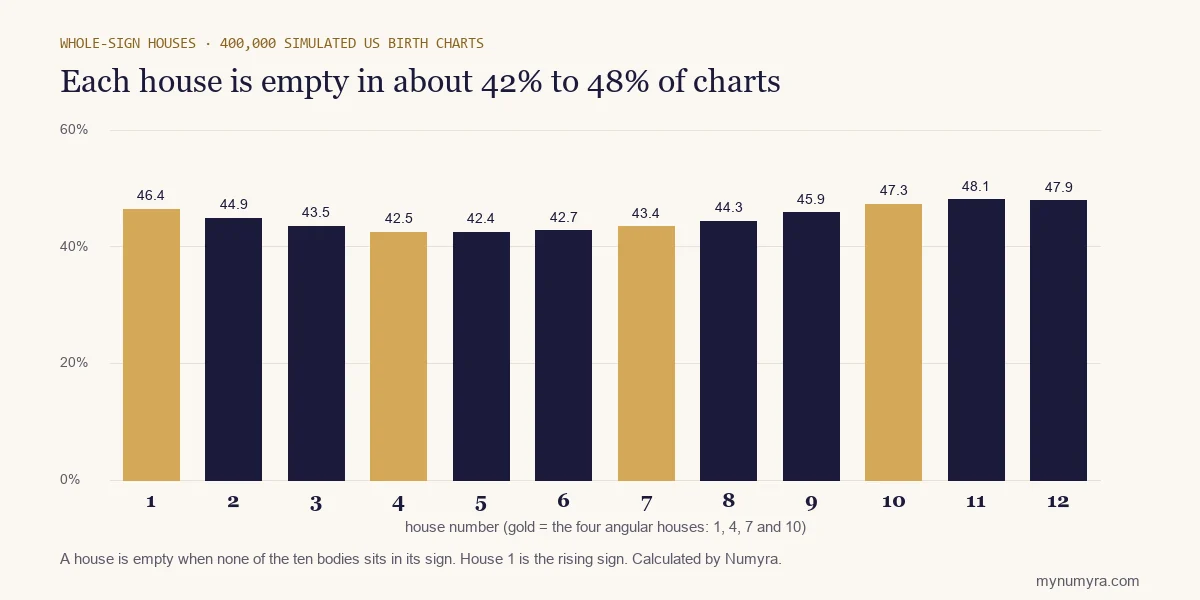
When you finish, you may find houses with nothing in them. That is the usual case. In our 400,000 simulated charts, whole-sign houses were empty on average 5.4 times out of 12, and each individual house was empty in 42% to 48% of charts. The 1st house, the rising sign itself, was empty in 46.4%, and the 11th in 48.1%. Empty houses are not read as missing parts of life: the house still has a ruler, the planet that rules its sign, and the ruler’s own placement is what tradition reads. The chart ruler guide shows that move for the 1st house.
Step 4: aspects, the angles between bodies
An aspect is the angle between two bodies, measured along the zodiac. The five major aspects are the conjunction (0 degrees, the same place), sextile (60), square (90), trine (120) and opposition (180). Ptolemy defined them in the language of signs, counting how many signs two places are apart. Of those in opposition he writes “six signs, and 180 degrees”, and of those in trine, “four signs, and 120 degrees” (Tetrabiblos I.13). His four aspects exclude the conjunction, and Lilly in 1647 also says the conjunction is an aspect only loosely; our aspects guide quotes both.
| Aspect | Angle | Signs apart | In Ptolemy’s four? | Charts with at least one, 6° orb | Average per chart |
|---|---|---|---|---|---|
| Conjunction | 0° | 0 | No | 84.4% | 1.8 |
| Sextile | 60° | 2 | Yes | 97.5% | 3.4 |
| Square | 90° | 3 | Yes | 93.0% | 2.8 |
| Trine | 120° | 4 | Yes | 92.6% | 2.6 |
| Opposition | 180° | 6 | Yes | 71.2% | 1.3 |
The two right-hand columns come from the same 400,000 charts, among all 45 pairs of the ten bodies. The total is 11.8 major aspects per chart at a 6-degree orb, and the middle 80% of charts have between 8 and 16. The orb is the margin allowed on either side of the exact angle, and it is the decision that matters: there is no single agreed orb, and the same chart gets between about 12 and 17 aspects depending on which published table you use, as the aspects guide shows. Counting by sign, the way Ptolemy did, finds far more: on average 30 of the 45 pairs sit in signs that are in aspect, about 2.5 times as many as pairs within 6 degrees of exact.
Your job for step 4. Pick two bodies on your sheet, for example your Sun and Moon, and subtract their sign positions on the zodiac, counting Aries as 1: if they are 2 or 10 signs apart they are in sextile signs, 3 or 9 square, 4 or 8 trine, 6 opposite and 0 conjunct. Then repeat for the pairs that matter to you. Do not try all 45 on day one; the guide to aspect patterns shows which combinations of three or more are worth looking for later. If you want a sign-based reading of two people, how zodiac compatibility works applies the same sign counts.
Step 5: reading the whole chart
A chart is the signs, bodies, houses and aspects together, and a beginner needs an order of attack so the page of symbols does not overwhelm. This is a common order, which you can change:
- The big three. Your Sun, Moon and Rising signs, with the readings in the guides linked in step 1.
- The chart ruler. The traditional ruler of your Rising sign, and where it sits. Our chart ruler guide shows how to find it, and essential dignities explains how a planet is scored in each sign.
- Bodies by house. Read each body as “this drive, in this area of life”.
- Tight aspects. Start with aspects within 2 or 3 degrees; looser ones count for less in the tradition.
- Emphasis. Look for a sign or house holding three or more bodies, called a stellium. It is common: 62.6% of our simulated charts have one, which matches the 62.7% the Stellium Calculator reports for real US births.
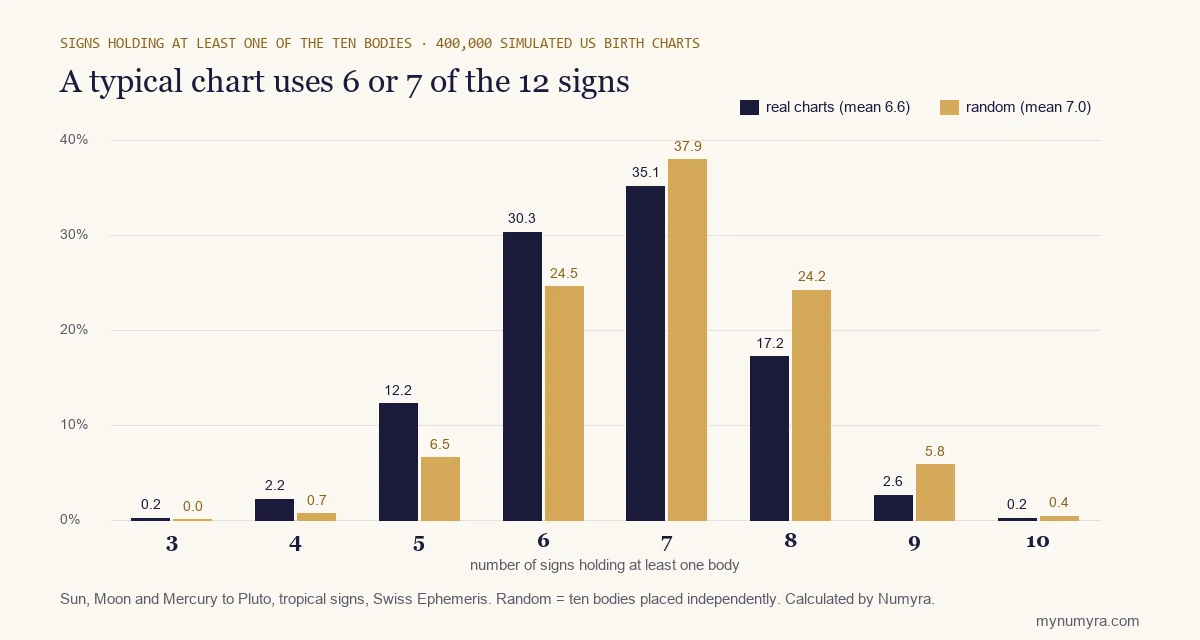
Before you read a lot into any one placement, it helps to know what an ordinary chart looks like. Counting the signs that hold at least one of the ten bodies, the average chart uses 6.6 of 12, the middle value is 7, and 82.6% of charts use 6, 7 or 8. Only 2.8% use 9 or more, and 14.6% use 5 or fewer. If the ten bodies were placed at random, a chart would use 7.0 signs on average; real charts use fewer because Mercury and Venus never stray from the Sun and the slow planets spend years in one sign. The other side of the count is the empty signs: 5.4 per chart on average. Missing an element is also normal: only 78.7% of charts have all four elements represented among the ten bodies, so 21.3% lack at least one.
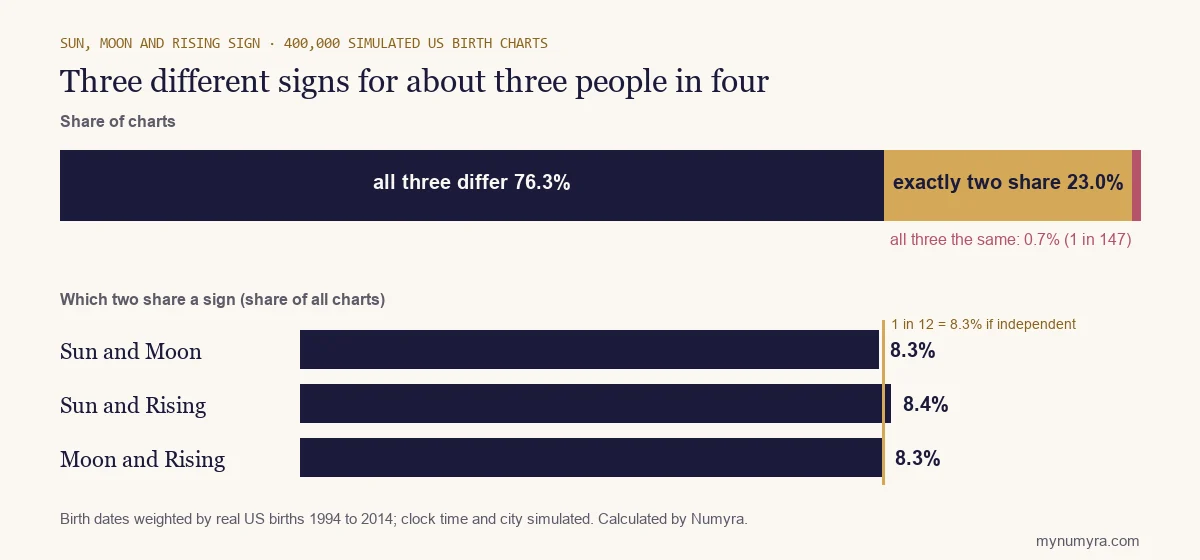
The big three behave almost as if they were independent. In 76.3% of charts the Sun, Moon and Rising signs are all different, against 76.4% if each were an independent random sign (11/12 times 10/12). Exactly two share a sign in 23.0% of charts, and all three in 0.7%, roughly 1 in 147. Each pairing is close to 1 in 12: Sun and Moon 8.3%, Sun and Rising 8.4%, Moon and Rising 8.3%. So if your three signs are all different, you are in the majority; and if two match, you are in the second most common group, not a rare case.
Your job for step 5. On one page, write your big three, your chart ruler, the number of signs your ten bodies use and which houses are empty, and any sign or house with three or more bodies. Then write one sentence about each placement, in your own words, beginning “this tradition says”. If a sentence will not come, that is a sign to read the relevant guide rather than guess.
Step 6: transits
A transit is where a body is in the sky now compared with where the bodies were at your birth. Lilly describes the method in 1647, in a short chapter called “Of the Transit of the Planets”:
“The Transit of the Planets is best found out by an Ephemeris, observing therein what day of every moneth any of the Planets by their Bodies, doe passe by any of the cusps of the houses of the Radicall Figure”
William Lilly, Christian Astrology (London, 1647), chapter CLXXIIII, p. 741, Internet Archive scan, spelling as printed, transcribed from the page image
In Lilly’s words the “Radicall Figure” is the birth chart, and the instruction is the one still used: look up where each body is today and see which of your houses or placements it crosses. The slow planets matter most for a beginner because each stays for years. In whole-sign houses the question is simply which of your houses holds the sign a planet is in. The table lists the five slow planets as of the date this page was scheduled, and their next sign changes, calculated with the Swiss Ephemeris and checked against JPL Horizons.
| Planet | Sign on 23 Nov 2026 (since) | Next sign change (UT) |
|---|---|---|
| Jupiter | Leo (30 Jun 2026) | Virgo, 26 Jul 2027, 04:49 |
| Saturn | Aries (14 Feb 2026) | Taurus, 13 Apr 2028, 03:40 |
| Uranus | Gemini (26 Apr 2026) | Cancer, first on 3 Aug 2032, then back and forth to 2033 |
| Neptune | Aries (26 Jan 2026) | Taurus, first on 22 May 2038, final on 23 Mar 2039 |
| Pluto | Aquarius (19 Nov 2024) | Pisces, first on 9 Mar 2043, final on 19 Jan 2044 |
Check on the table’s accuracy: at each of the 64 sign changes of these five planets between November 2026 and 2046, and at the five “since” dates, JPL’s Horizons system puts the body within 0.0003 degrees of the sign boundary, which for Neptune, the slowest mover, is about an hour of time. Random checks of the Sun, Moon, Saturn and Pluto at 40 times from 1994 to 2014 agreed within 0.001 degrees. “Back and forth” means retrograde motion: a planet can slip back into the previous sign for months and then re-enter for good.
To read it for yourself, use your numbered signs from step 3. The lookup table gives the house for the two planets whose signs change soonest, for every Rising sign.
| Your Rising sign | Saturn in Aries (to 13 Apr 2028) | Jupiter in Leo (to 26 Jul 2027) | Jupiter in Virgo (26 Jul 2027 to 24 Aug 2028) |
|---|---|---|---|
| Aries | 1st | 5th | 6th |
| Taurus | 12th | 4th | 5th |
| Gemini | 11th | 3rd | 4th |
| Cancer | 10th | 2nd | 3rd |
| Leo | 9th | 1st | 2nd |
| Virgo | 8th | 12th | 1st |
| Libra | 7th | 11th | 12th |
| Scorpio | 6th | 10th | 11th |
| Sagittarius | 5th | 9th | 10th |
| Capricorn | 4th | 8th | 9th |
| Aquarius | 3rd | 7th | 8th |
| Pisces | 2nd | 6th | 7th |
These houses are whole-sign houses; under Placidus the house can differ. Fast bodies move through your chart too, which is where retrograde periods come in: see the retrograde calendar for 2027. For the traditional timing methods built on your chart’s own cycles, see annual profections, the solar return and the Saturn return, and for the two planets in the table see Saturn in Aries and Jupiter in Leo.
Your job for step 6. Find your Rising sign in the table and write down the house each of Saturn and Jupiter is in now, then the house each moves to next. Then look at what your sheet says is in those houses. That is a transit reading in its simplest form: a body in a sign, the sign in a house, and a tradition of what that house is about. Whether any of it predicts anything is a separate question, taken up next.
What astrology cannot do
Everything above is geometry plus tradition. The geometry, where a body is and what angle it makes, can be calculated exactly and checked against NASA’s JPL. The meanings attached to it cannot be measured the same way. Controlled tests have not found that signs or chart factors predict personality or events, and our review of the tests sets out what was tested and what we checked ourselves. Use astrology as a language for reflection and a window into history, not as advice. Nothing here is medical, financial, legal or psychological advice.
Where to go next
Your sheet now holds a Sun, Moon and Rising sign, ten placements, a house for each, a count of aspects and two transits. Pick the next page by the question you have:
| If you want to | Read |
|---|---|
| Understand the big three | Sun, Moon and Rising sign |
| Check that your Rising sign is right | How birth time changes your Rising sign |
| Learn why houses disagree | Whole sign versus Placidus houses |
| Work with aspects and orbs | Astrology aspects explained |
| See where the system came from | Where the 12 zodiac signs came from |
| Judge the claims | Is astrology real? |
| Compare two charts | Synastry chart |
Frequently asked questions
What do I need to start learning astrology?
Your birth date, birth time and birth city, and a chart tool. The Birth Chart Calculator gives your Sun, Moon and Rising signs from those three facts, and the Stellium Calculator lists all ten bodies. A pencil and one page are enough for the rest.
In what order should a beginner learn the parts of a chart?
Signs first, then the ten bodies, the houses, the aspects, the whole chart and finally transits. Each layer uses the one before it: houses are numbered signs, aspects are angles between bodies you have already placed, and transits are today’s bodies placed on your houses.
How many signs does a typical chart use?
About 6.6 of the 12 on average across 400,000 simulated US birth charts, with 7 the middle value and 82.6% of charts using 6, 7 or 8. That leaves about 5.4 empty signs, which in whole-sign houses means about 5.4 empty houses.
Is it normal that my Sun, Moon and Rising signs are all different?
Yes. In 76.3% of the simulated charts all three differ, and in 23.0% exactly two match. All three matching happens in about 0.7%, or 1 chart in 147.
Do I need my exact birth time?
Not for your Sun sign, which needs only the date. The Rising sign and the houses need the time and place, and the Rising sign can change roughly every two hours. The Moon changes sign about 160 times a year, roughly every two and a half days, so on about four dates in ten the time decides which of two signs your Moon is in.
Which house system should a beginner use?
Whole-sign houses are the easiest to do by hand and are the oldest documented system, so this page uses them. Placidus is the default in much modern software and can put a planet in a different house. The two are compared in our whole sign versus Placidus guide.
Is astrology real?
The positions are real and can be calculated exactly. The meanings are a tradition of interpretation, and controlled tests have not found that they predict personality or events. Our page on the tests sets out what was tested.
Sources
- Ptolemy. Tetrabiblos, Book I, chapters 4, 10 and 13, trans. F. E. Robbins (Loeb Classical Library, 1940), via LacusCurtius. The vernal-equinox starting point, Saturn’s quality, and the aspects counted in signs.
- William Lilly. Christian Astrology (London, 1647), Internet Archive scan; “An Introduction to Astrologie”, chapter VII (p. 50) on the twelve houses, and chapter CLXXIIII (p. 741) on transits, transcribed by Numyra from the page images.
- Wikipedia. Zodiac. The Babylonian division of the ecliptic into twelve equal signs, dated there to around the end of the 5th century BCE; other sources and our history guide give earlier dates for the sky-watching behind it.
- NASA. Uranus facts, Neptune facts, Pluto facts and Pluto overview. Discovery years 1781, 1846 and 1930, and the 2006 IAU reclassification of Pluto.
- NASA JPL. Horizons system. Independent check of every slow-planet sign change and of random Sun, Moon, Saturn and Pluto positions.
- Astrodienst. Swiss Ephemeris (Moshier mode). Positions of the ten bodies and the Ascendant for every simulated chart and for the sign-change dates (calculations by the Numyra Methodology Desk).
- FiveThirtyEight. US births data, 1994 to 2014, from the CDC National Center for Health Statistics and the Social Security Administration. Dates only. Birth dates are drawn in proportion to real daily births; the clock time (uniform over the day, with daylight saving applied) and the city (26 large US cities, weighted by population) are simulated, so the results describe a typical US birth, not real birth times.
- Seven beginner guides we read before writing: AstroChartus, Astrostyle, AstroLibrary, Dawn Mountain, The Old Farmer’s Almanac, Two Wander and Dummies. We found no mention of Ptolemy or Lilly and no data on typical charts in any of them.