An astrology transit is the current position of a moving planet compared with a point in a birth chart: when the planet reaches the same degree as one of your natal planets, or forms an angle to it, astrologers say it is transiting that planet. How long that takes depends almost entirely on which planet it is. Measured with the Swiss Ephemeris, a transiting Moon stays within 1 degree of a natal point for about 3.6 hours and the Sun for 2 days, while Saturn, from first entry to last exit and counting its backward loop, averages 6.6 months and Pluto 2.7 years. This guide gives the speed, sign-stay and orb figures for every planet from the Moon to Pluto, what two historical texts said about transits next to what astrologers do now, and how to find your own.
How this page differs from our other guides: our planetary returns table covers one kind of transit, the planet’s return to its own birth degree, with the exact ages at which it happens. This page is the general explainer: what a transit is, how long any planet’s transit to any natal point lasts at any orb, with every retrograde pass counted, and where each specific transit guide on Numyra picks up.
Key takeaways
- A transit compares the sky now with the sky at your birth. The old texts did it by place (Vettius Valens listed the houses in which each planet’s transit was good or bad) and by degree (William Lilly in 1647 told readers to find the days a planet passes a natal degree “by an Ephemeris”). Modern software mostly uses a 1-degree orb.
- Speed sets everything. The Moon covers 13.2 degrees a day, the Sun 0.99, Mars 0.52, Jupiter 0.083, Saturn 0.034 and Pluto 0.004. From first ingress to last egress a planet stays in one sign for 2.3 days (Moon), 30 days (Sun), 14 months (Jupiter), 2.8 years (Saturn), 7.7 years (Uranus), 14.7 years (Neptune) and 12 to 34 years (Pluto).
- The orb you choose sets the duration. Pluto’s transit to one natal point averages 2.7 years at a 1-degree orb, 5.3 at 3 degrees and 12 at 8, so the figures online disagree because they use different orbs.
- Slow planets rarely cross a degree once. Counting every pass, Saturn crosses a natal degree three times in 53% of encounters, Uranus in 93%, and Neptune and Pluto three, five or seven times in virtually every encounter. Mean passes equal 1 plus twice the planet’s backward arc divided by its net advance, a check that matched all eight planets to within 0.02 passes.
- A single pass is quick and a looped one is slow: at a 1-degree orb a single Saturn pass has a median of 17 days, a three-pass transit spans 284. Mercury’s single pass is 1.2 days, its looped transit 46.
- Several widely quoted figures fail when measured: Pluto does not stay in a sign “12-20 years” (it is 12.0 to 33.8), and the Moon never stays three days. Transits are a tradition of interpretation, not a tested prediction.
In this guide
- What a transit is, and what it is not
- What the old texts said, and what modern practice counts
- How fast each planet moves
- How long a planet stays in one sign
- Orbs: how wide a transit window is
- How long each planet stays within 1 or 3 degrees
- One pass, three or five: the retrograde effect
- Rules of thumb, tested
- A worked example: a Sun at 5 degrees Aquarius
- How to find your own transits
- Where to go next: the transit guides on Numyra
- What transits cannot tell you
- Frequently asked questions
- How we calculated and checked this
- Sources
What a transit is, and what it is not
Your birth chart is a snapshot: where each planet stood when you were born. The planets keep moving, and a transit is any later moment at which one of them sits on, or at a standard angle from, a point in that snapshot. The moving planet is the transiting planet and the fixed point is the natal planet, the Ascendant or another chart point. A transiting Saturn at 10 degrees of Aries opposite your natal Venus at 10 degrees of Libra is a transit; so is the Moon crossing your natal Sun for a few hours.
The word gets used loosely, so it helps to separate it from its neighbours:
- A transit is not an aspect inside your chart. Natal aspects join two points that are both fixed. Transits join one moving planet to one fixed point. Our guide to astrology aspects and orbs covers the angles themselves.
- A return is one special transit. A planet returns when it reaches its own natal degree, as in the Saturn return, Jupiter return or the birthday solar return.
- A progression or profection is a different clock. Those methods move the chart forward by a rule, such as the progressed Moon or the annual profection, instead of using where the planets really are today.
- A retrograde is a motion, not a transit. Retrograde describes a planet that appears to move backward, as in our 2027 retrograde calendar. It matters here because it makes one transit happen more than once.
- A sign change is a sign-based transit. When a planet enters a new sign, as Jupiter does in Leo or Saturn in Aries, astrologers read it through the house of your chart that sign occupies.
Most references also separate the planets by speed. The Sun, Moon, Mercury, Venus and Mars move fast and their transits are brief; Jupiter, Saturn, Uranus, Neptune and Pluto move slowly and their transits are the ones usually given the most weight, a rule stated in Wikipedia’s article on astrological transits. The rest of this page puts numbers on that split.
What the old texts said, and what modern practice counts
Transits are old, but the earlier versions are not the modern one. In the Anthology of Vettius Valens, Book I, chapter 21 is headed “Transits and The Combination of the Stars”. It does not measure degrees. It lists, for each planet, the places (the houses) in which its passage is helpful or harmful. For the Sun, Valens names the second, sixth and twelfth places as good and the fourth and seventh as “rotten”, and then explains how the verdict is formed:
“If the stars are in the previously mentioned places in their transits, particularly when they hold the chronocratorship in operative places, with benefics or malefics in aspect, then they are bestowers of good or evil depending on whichever aspect prevails.”
Vettius Valens, Anthology, Book I, chapter 21, trans. Mark Riley, via an annotated edition on GitHub
So a transit in Valens is a planet’s passage through a house, judged together with the planet’s role in the person’s timing scheme (the chronocratorship, a ruler of a stretch of time, which our profections guide explains) and with the aspects it makes. There is no orb in the passage and no instruction to watch a particular degree.
By 1647 the emphasis had moved to degrees and days. William Lilly’s Christian Astrology, in the chapter “Of the Transit of the Planets”, says the transit is “best found out by an Ephemeris”, the daily table of planetary positions, and tells the reader to note the day of each month on which a planet passes the cusp of a house of the birth figure or the degree where a planet, the nodes or the Part of Fortune stood at birth, and also when it looks at those points from a sextile, trine, square or opposition. His judgments are short and measured in days. Of Mars:
“If [Mars] doe transit the degree ascending, he moves the Native to Choller or Passion for two or three dayes, or gives the occasion whereby he is stirred up to Wrath”
William Lilly, Christian Astrology (London, 1647), p. 741, chapter CLXXIIII, Internet Archive scan, spelling as printed; the planet’s symbol is replaced by its name in brackets
Lilly’s whole chapter is about one page. It treats Jupiter and Venus passing the Ascendant degree as making the native “healthfull” and “cheerfull” that day, Saturn as exciting “Gravity” and “Melancholy”, and calls days fortunate when Jupiter, Venus, the Sun or the Moon make a sextile or trine to the Ascendant or midheaven, and unfortunate when Saturn or Mars transit those degrees. He gives no orb for transits and no forecast beyond days. The scan of the first line is damaged at one word, so we quote only the part we can read.
Modern practice is closer to Lilly than to Valens in using degrees, but it has added three things the texts above do not contain: a standard orb, a weight for slow planets, and a preference for exact timing. Wikipedia says transiting aspects are usually limited to an orb of one degree on either side of the natal planet and that transits of the slow planets are more powerful; the Astrodienst help pages and The Astrology Podcast (episode 365) describe the same 1-degree convention, and the podcast adds that many astrologers also read the whole sign a planet is in, with the effect growing as the planet nears the exact degree and still active at 2 to 3 degrees. That sign-based plus degree-based reading is the nearest modern echo of Valens, whose places were whole houses.
How fast each planet moves
Speed is the first thing to know because every duration below follows from it. We calculated each planet’s daily longitude with the Swiss Ephemeris and took the average speed, the fastest and slowest speeds (negative means backward) and the share of time it spends retrograde. The Moon was sampled over 40 years, the Sun, Mercury and Venus over 100, Mars over 300 and Jupiter to Pluto over 1,000.
| Planet | Average speed (degrees a day) | Degrees a year | Fastest | Slowest (backward) | Share of time retrograde | Retrograde stretches a year |
|---|---|---|---|---|---|---|
| Moon | 13.2 | 4,813 | 15.4 | – | 0% | none |
| Sun | 0.986 | 360 | 1.02 | – | 0% | none |
| Mercury | 0.986 | 360 | 2.20 | 1.39 | 19% | 3.2 a year, about 22 days each |
| Venus | 0.984 | 360 | 1.26 | 0.633 | 7.3% | 0.63 a year, about 42 days each |
| Mars | 0.524 | 191 | 0.791 | 0.402 | 9.5% | 0.47 a year, about 74 days each |
| Jupiter | 0.0832 | 30.4 | 0.243 | 0.137 | 30% | 0.92 a year, about 121 days each |
| Saturn | 0.0335 | 12.2 | 0.131 | 0.0830 | 36% | 0.97 a year, about 138 days each |
| Uranus | 0.0118 | 4.30 | 0.0633 | 0.0439 | 41% | 0.99 a year, about 152 days each |
| Neptune | 0.00602 | 2.20 | 0.0385 | 0.0284 | 43% | 0.99 a year, about 158 days each |
| Pluto | 0.00403 | 1.47 | 0.0405 | 0.0283 | 44% | 1.00 a year, about 162 days each |
Three things stand out. First, Mercury, Venus and the Sun have almost the same average speed, 0.99 degrees a day, because seen from Earth all three circle the zodiac once a year; Mercury and Venus just wobble back and forth around the Sun. Second, the share of time spent retrograde climbs with distance, from 7% for Venus to 44% for Pluto, and Jupiter and the planets beyond it are going backward for between three and a half and five and a half months of every year. Third, the retrograde stretches are one a year almost exactly for Jupiter to Pluto, because those planets turn retrograde each time Earth overtakes them. Our 2027 retrograde calendar has the dates.
How long a planet stays in one sign
A planet’s visit to a sign runs from its first ingress to its last egress, and for the planets that turn retrograde that includes dipping out and back in. The table gives the average, the shortest and longest visit, and, for comparison, the time the planet is actually inside the sign. The orbital period in the second column is the heliocentric figure from the NASA planetary fact sheet.
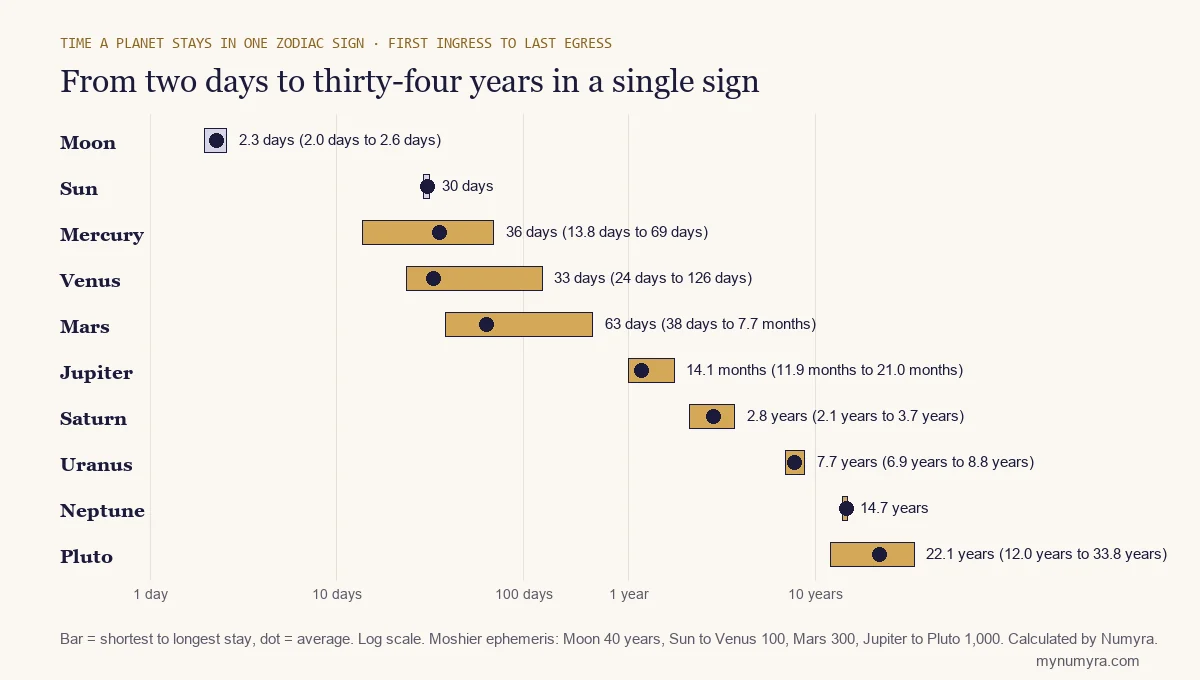
| Planet | Orbit around the Sun (NASA, days) | Average stay, first ingress to last egress | Shortest to longest | Average time actually inside the sign |
|---|---|---|---|---|
| Moon | 27.3 | 2.3 days | 2.0 days to 2.6 days | 2.3 days |
| Sun | 365.2 | 30 days | 29 days to 32 days | 30 days |
| Mercury | 88.0 | 36 days | 13.8 days to 69 days | 30 days |
| Venus | 224.7 | 33 days | 24 days to 126 days | 30 days |
| Mars | 687.0 | 63 days | 38 days to 7.7 months | 57 days |
| Jupiter | 4,331 | 14.1 months | 11.9 months to 21.0 months | 11.9 months |
| Saturn | 10,747 | 2.8 years | 2.1 years to 3.7 years | 2.5 years |
| Uranus | 30,589 | 7.7 years | 6.9 years to 8.8 years | 7.0 years |
| Neptune | 59,800 | 14.7 years | 14.0 years to 14.9 years | 13.6 years |
| Pluto | 90,560 | 22.1 years | 12.0 years to 33.8 years | 20.7 years |
The last column is a clean rule: the time a planet spends inside a sign averages one twelfth of the time it takes to go once around the zodiac as seen from Earth. For Jupiter NASA’s 4,331 days divided by 12 is 360.9 days and our measured average is 361.1; for Mars 687.0 divided by 12 is 57.25 against our 57.2. The rule fails for Mercury and Venus if you use their orbits (88 days divided by 12 is 7 days, not 30) because Earth’s own motion makes their trip around the zodiac take a year. The average stay runs 7 to 18 percent longer than the time actually inside because of the retrograde re-entries: Jupiter’s average visit is 14.1 months but it is inside the sign for 11.9 of them.
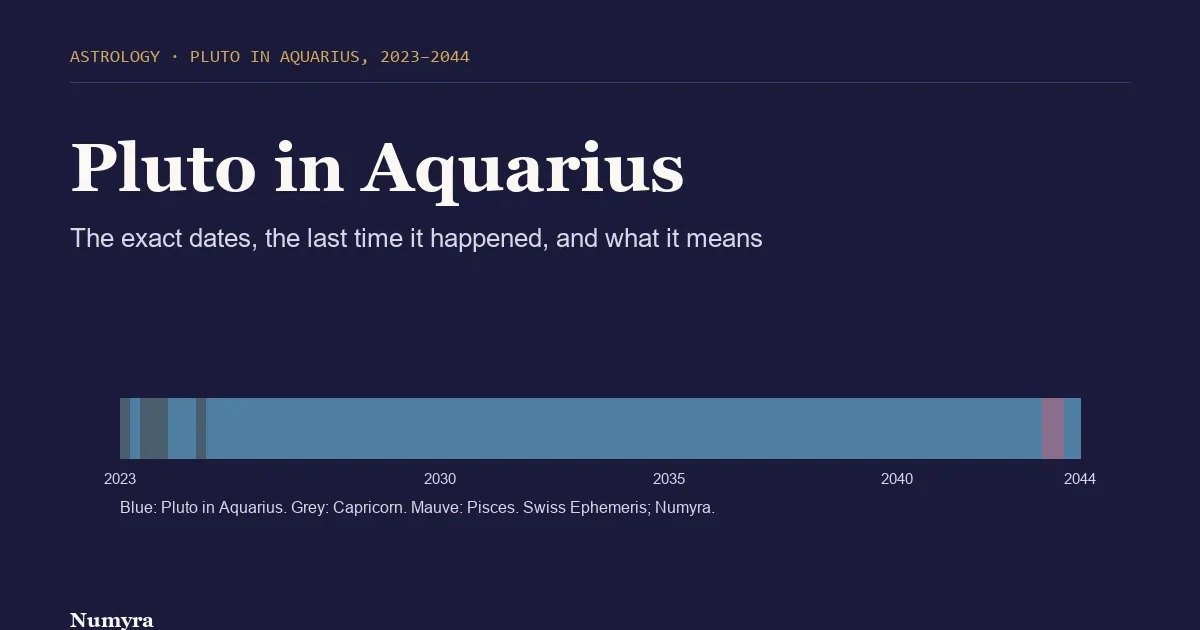
Pluto is the outlier because its orbit is the most elongated. Averaged over 1,000 years its stays are 12.6 years in Scorpio, 12.9 in Libra, 13.9 in Sagittarius, 15.8 in Virgo, 16.9 in Capricorn, 20.8 in Leo, 21.3 in Aquarius, 25.8 in Pisces, 27.0 in Cancer, 30.8 in Aries, 32.1 in Gemini and 33.3 in Taurus. Its stay in Aquarius, which began in 2023 and ends in 2044, is covered in our Pluto in Aquarius guide.
Orbs: how wide a transit window is
The orb is the margin on either side of the exact angle within which a transit still counts. Transit duration is therefore a product of two things, the planet’s speed and the orb, and the orb is a convention. The sources we read use:
- one degree on either side, as Wikipedia states for transiting aspects, and as Astrodienst applies in its daily horoscope and in its Astrotext Forecast;
- one degree as the peak of intensity, with two to three degrees still “really operative” and up to three degrees across a sign boundary, in The Astrology Podcast (episode 365);
- ten degrees, in an example Refinery29 gives of Mercury moving within 10 degrees of the point where Venus stood at birth.
Even sources that agree on the orb disagree on when a transit starts and stops. Astrodienst’s FAQ describes two different counting styles. One counts a transit only while the planet is inside the orb, and the transit reappears if the planet turns retrograde and returns. The other counts from the first entry into orb to the last exit:
“consider transits to be active from the first entry into orb up to the last exit”
Astrodienst, Frequently asked questions: Daily Horoscope, Duration
We use the second method throughout, because it is the one that gives a duration you can plan around, and we also report the time the planet is actually inside the orb. The same page adds the caveat that matters most for anyone weighing a transit: what is really reliable is the date a transit is exact; the build-up and the calming-down vary. The figure below shows how strongly the orb alone changes the answer for the slow planets.
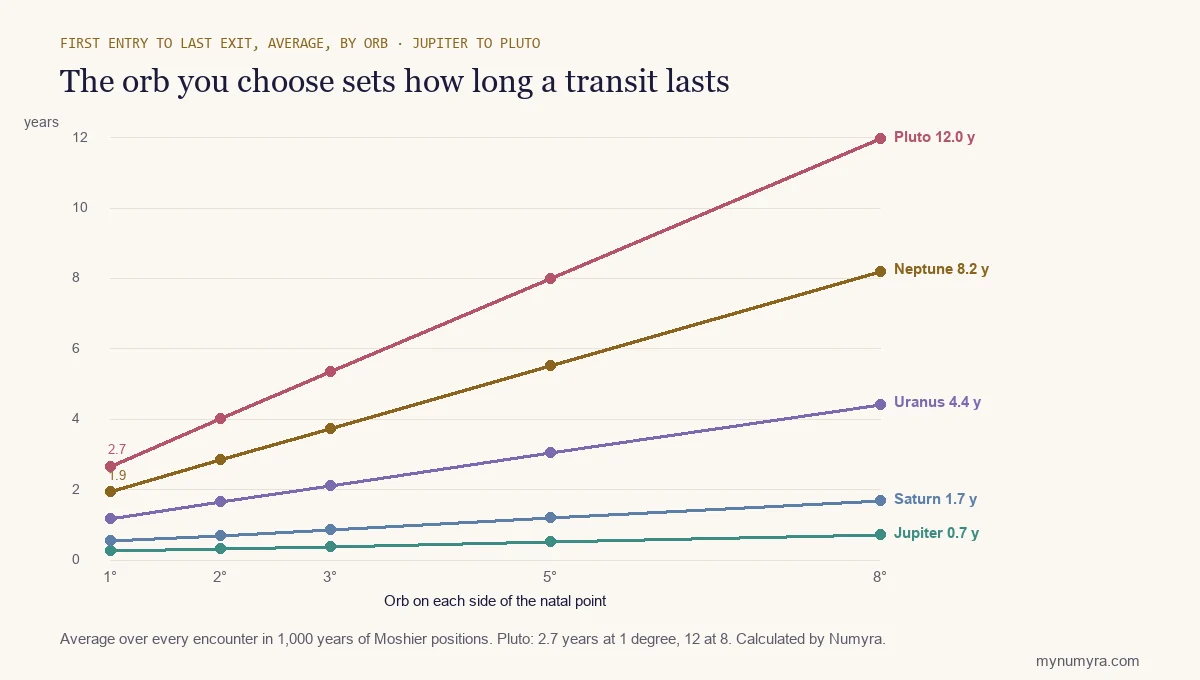
| Planet | 1° orb | 2° | 3° | 5° | 8° |
|---|---|---|---|---|---|
| Jupiter | 93 days | 118 days | 142 days | 6.2 months | 8.6 months |
| Saturn | 6.6 months | 8.5 months | 10.5 months | 14.4 months | 20.3 months |
| Uranus | 14.3 months | 19.9 months | 2.1 years | 3.0 years | 4.4 years |
| Neptune | 23.3 months | 2.8 years | 3.7 years | 5.5 years | 8.2 years |
| Pluto | 2.7 years | 4.0 years | 5.3 years | 8.0 years | 12.0 years |
Read across a row and you see why a search for “how long does a Saturn transit last” returns answers from a few weeks to more than two years. A 1-degree orb gives 6.6 months from first entry to last exit, a 3-degree orb 10.5 months and an 8-degree orb 20.3 months; all three are correct answers to different questions.
How long each planet stays within 1 or 3 degrees
This is the table most readers came for. It gives the average, over every encounter between the planet and a natal point at any degree of the zodiac, of the time the planet is inside the orb and of the span from first entry to last exit. The last column shows how often the encounter is a single pass or a looped one.
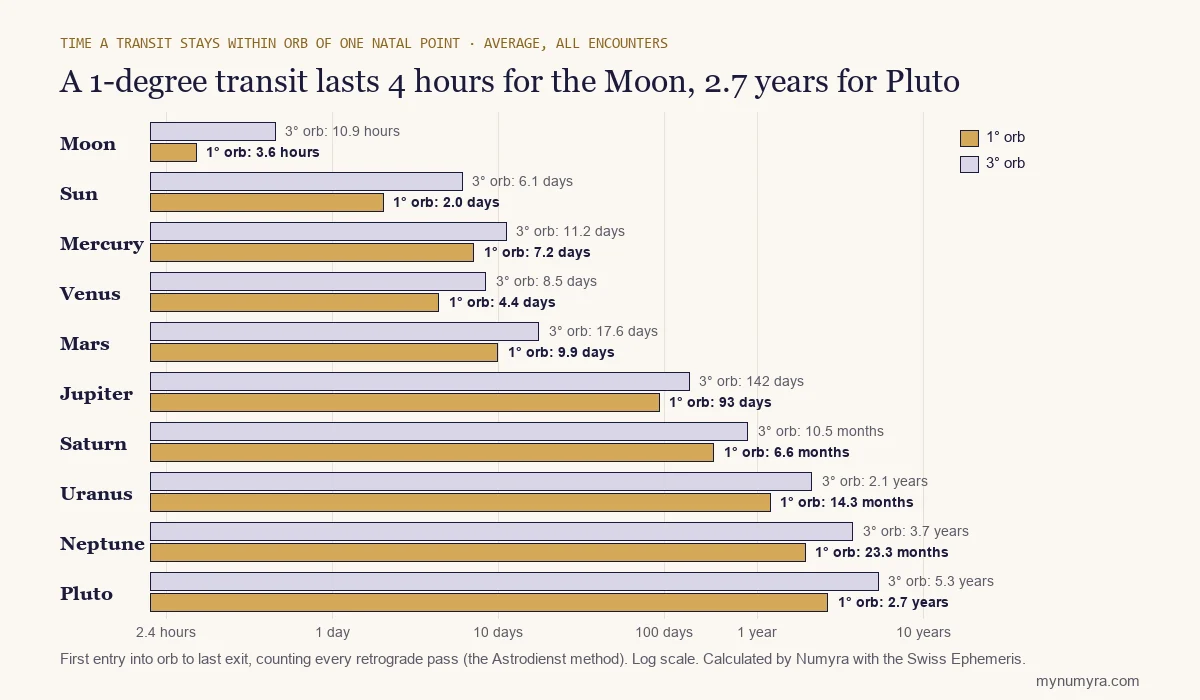
| Planet | Inside 1° | First entry to last exit, 1° | Inside 3° | First entry to last exit, 3° | Encounters with 1, 3 or 5+ exact passes |
|---|---|---|---|---|---|
| Moon | 3.6 hours | 3.6 hours | 10.9 hours | 10.9 hours | 100% / 0.0% / 0.0% |
| Sun | 2.0 days | 2.0 days | 6.1 days | 6.1 days | 100% / 0.0% / 0.0% |
| Mercury | 2.0 days | 7.2 days | 6.1 days | 11.2 days | 88% / 12% / 0.0% |
| Venus | 2.0 days | 4.4 days | 6.1 days | 8.5 days | 97% / 2.8% / 0.0% |
| Mars | 3.8 days | 9.9 days | 11.5 days | 17.6 days | 96% / 4.0% / 0.0% |
| Jupiter | 24 days | 93 days | 72 days | 142 days | 70% / 30% / 0.0% |
| Saturn | 60 days | 6.6 months | 5.9 months | 10.5 months | 47% / 53% / 0.0% |
| Uranus | 5.6 months | 14.3 months | 16.7 months | 2.1 years | 7.4% / 93% / 0.0% |
| Neptune | 10.9 months | 23.3 months | 2.7 years | 3.7 years | 0.0% / 74% / 26% |
| Pluto | 16.2 months | 2.7 years | 4.0 years | 5.3 years | 0.1% / 45% / 54% |
The time inside the orb follows a simple formula. Averaged over all encounters, a planet spends 2 times the orb divided by 360 of its lap around the zodiac inside the orb. For Saturn, NASA’s 10,747 days times 2 divided by 360 gives 59.7 days for a 1-degree orb, and that is what we measured. For Jupiter the formula gives 24.1 days and we measured 24.0; for Mercury and Venus, whose lap seen from Earth is a year, it gives 2.03 days, the same as the Sun. The span from first entry to last exit is always longer, and the gap is the retrograde effect described next.
One pass, three or five: the retrograde effect
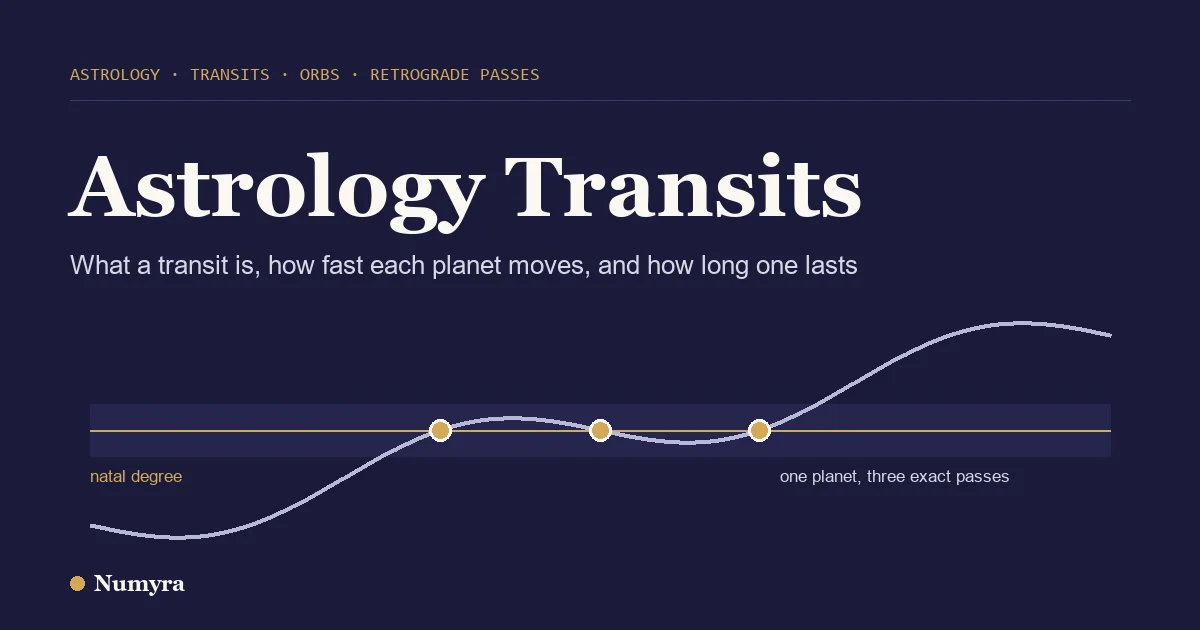
Because every planet except the Sun and Moon turns retrograde, a transit often crosses the same degree more than once: forward, back and forward again. We counted the exact passes in every encounter. For the slow planets one pass is the exception.
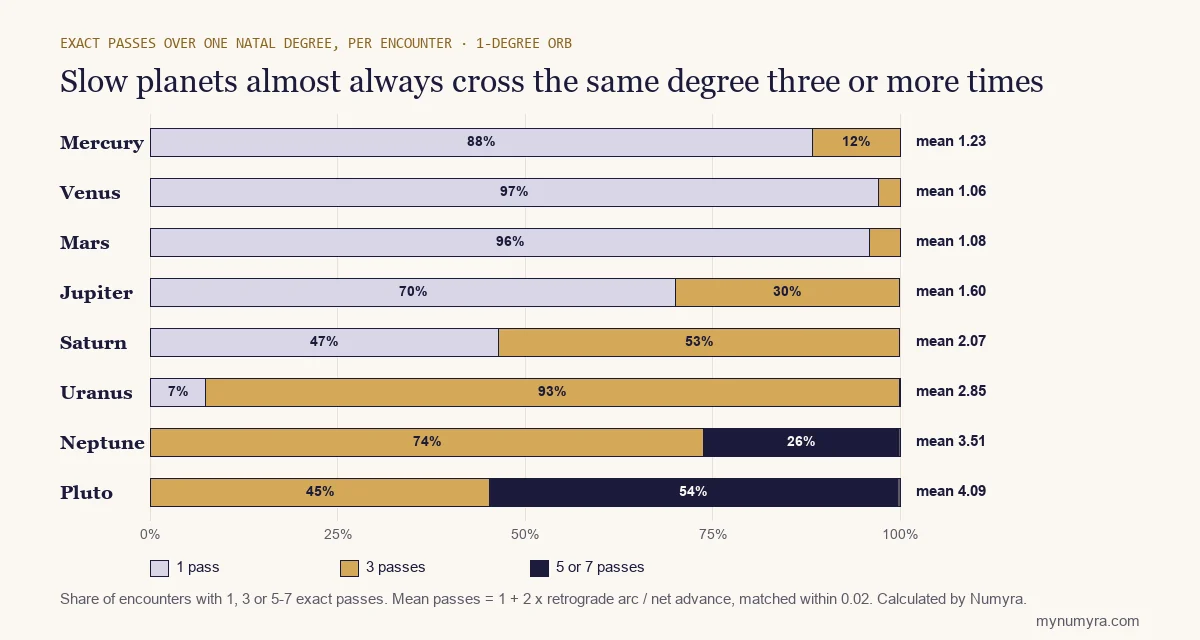
The share of looped encounters follows from geometry. Saturn’s backward arc averages 6.8 degrees per loop against a net advance of 12.7 degrees from one loop to the next, so the loops cover about 53% of the zodiac and the natal degrees inside one get three passes. In general the average number of passes equals 1 plus twice the total backward arc divided by the net advance. That formula gives 1.23 for Mercury, 1.06 for Venus, 1.08 for Mars, 1.60 for Jupiter, 2.07 for Saturn, 2.85 for Uranus, 3.53 for Neptune and 4.09 for Pluto, against the counted 1.23, 1.06, 1.08, 1.60, 2.07, 2.85, 3.51 and 4.09. For Neptune and Pluto the loop is wider than a year’s progress, so the loops overlap and the same degree is crossed five or even seven times.
A single pass and a looped one are very different events. At a 1-degree orb the median span from first entry to last exit is:
| Planet | Single pass (median) | Looped, three passes (median) | |
|---|---|---|---|
| Mercury | 1.2 days | 46 days | – |
| Venus | 1.6 days | 87 days | – |
| Mars | 3.0 days | 5.3 months | – |
| Jupiter | 9.1 days | 8.1 months | – |
| Saturn | 16.7 days | 9.3 months | – |
| Uranus | rare (7%) | 10.9 months | – |
| Neptune | almost none | 21.9 months | 21.9 months |
| Pluto | almost none | 21.7 months | 3.7 years |
Single passes are short because they happen while the planet is moving fast and forward, away from its loop. The looped transits are the long ones, and they are the reason an Astrodienst-style listing shows a Mercury or Venus transit lasting weeks. For Neptune and Pluto there is no single-pass row because almost none exist: the three-pass Neptune transit spans a median 665 days (22 months), the five-pass Pluto transit 1,336 days (3.7 years). Our planetary returns table uses these counts for returns, with the share of birth dates that get one, three or five passes at each return, and the Uranus opposition and Saturn opposition guides give the three exact dates for every birth year.
Rules of thumb, tested
Because we have measured durations, we can check the figures that astrology references repeat. The table lists each claim as it appears, where it appears, and what the Swiss Ephemeris gives.
| Claim | Source | What we measured | Verdict |
|---|---|---|---|
| Transiting Moon “lasts a few hours at most” | Wikipedia, Astrological transit | 3.6 hours inside 1°, 10.9 hours inside 3° | Holds |
| Transiting Sun is at its peak “for about two days” | Wikipedia | 2.0 days inside 1°, 6.1 days inside 3° | Holds |
| Mars on the Ascendant degree acts “two or three dayes” | Lilly, 1647 | 3.0 days (median single pass) inside 1°; 2 to 3 days fits an orb of 0.7 to 1° | Holds at 1° or less |
| Mercury and Venus transits last weeks or months when retrograde | Astrodienst FAQ | Looped transits: 46 days (Mercury), 88 days (Venus); single pass 1.2 and 1.6 days. Only 11.7% and 2.8% of encounters loop | Holds for the minority that loop |
| Moon leaves a sign after “two and a half to three days” | The Astrology Podcast, ep. 365 | 2.3 days on average, 2.0 to 2.6 over 40 years, never 3 | Slightly high |
| Pluto is in a sign “12 to 31 years” | The Astrology Podcast, ep. 365 | 12.0 to 33.8 years, average 22.1 | Low end right, top 3 years short |
| Pluto is in a sign “12-20 years” | Astrostyle | 12.0 to 33.8 years; 27 of 47 stays exceed 20 | Fails |
| Saturn 2.5 to 3 years, Uranus 7, Neptune 13 to 15 per sign | Astrostyle | Saturn 2.1 to 3.7 (average 2.8), Uranus 6.9 to 8.8 (7.7), Neptune 14.0 to 14.9 (14.7) | Holds |
| Mercury three weeks, Venus five, Mars eight weeks per sign | Astrostyle | Medians 19, 25 and 45 days; averages 36, 33 and 63; time actually inside 30, 30 and 57 days | Roughly right, Mars high |
| Saturn “can spend more than two years transiting a natal planet” | EBSCO Research Starters | Averages 6.6 months at 1°, 10.5 at 3°, 20.3 at 8°; longest 2.5 years at 8° | Only with a very wide orb |
| Jupiter about one sign a year, Saturn “maybe a third” of a sign | The Astrology Podcast, ep. 365 | 30.4 and 12.2 degrees a year: 1.01 and 0.41 signs | Holds roughly |
The pattern is that short-term, fast-planet figures hold up and long-term, slow-planet figures drift, mostly because they use a round number for something that depends on the orb or the orbit. The sources are not wrong about the general rule; they are imprecise at the top end.
A worked example: a Sun at 5 degrees Aquarius
To see the numbers in use, take a hypothetical chart with the Sun at exactly 5 degrees 00 minutes of Aquarius, which is 305.0 degrees on the zodiac; a birthday around January 25 has a Sun near there. We found every transit by Jupiter, Saturn, Uranus, Neptune or Pluto to that point from the five major angles within a 1-degree orb, from late November 2026 to the end of 2028. Pluto, at 3 degrees 27 minutes of Aquarius on November 25, 2026, is the one approaching the Sun itself.
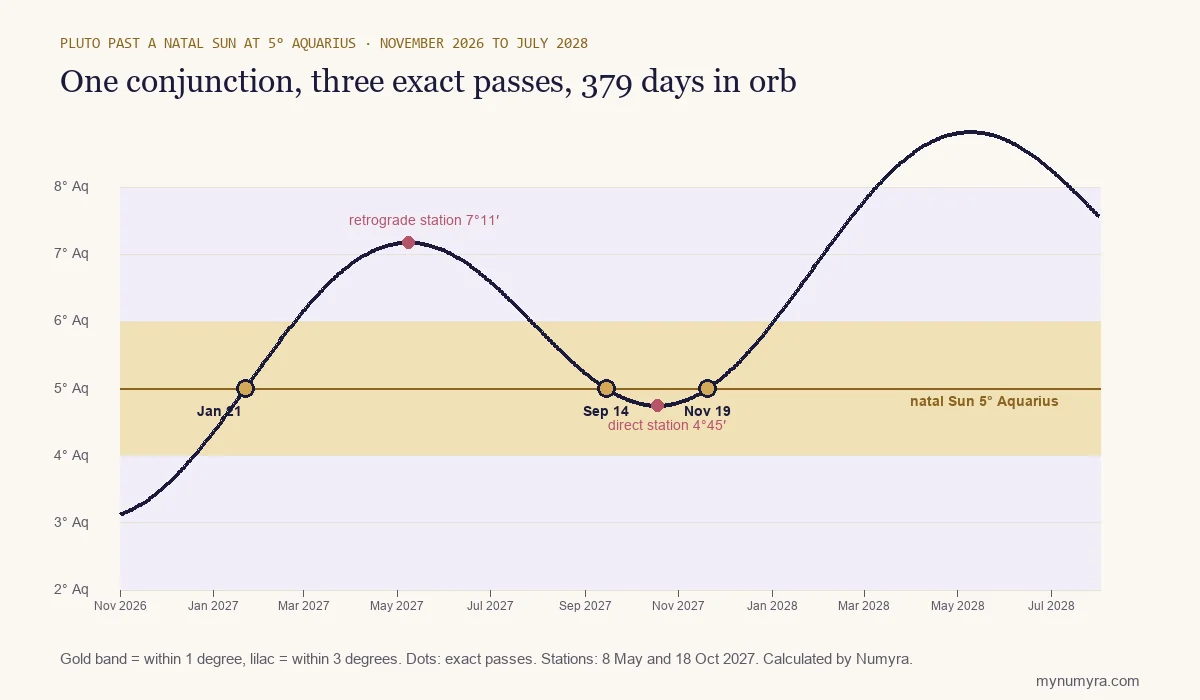
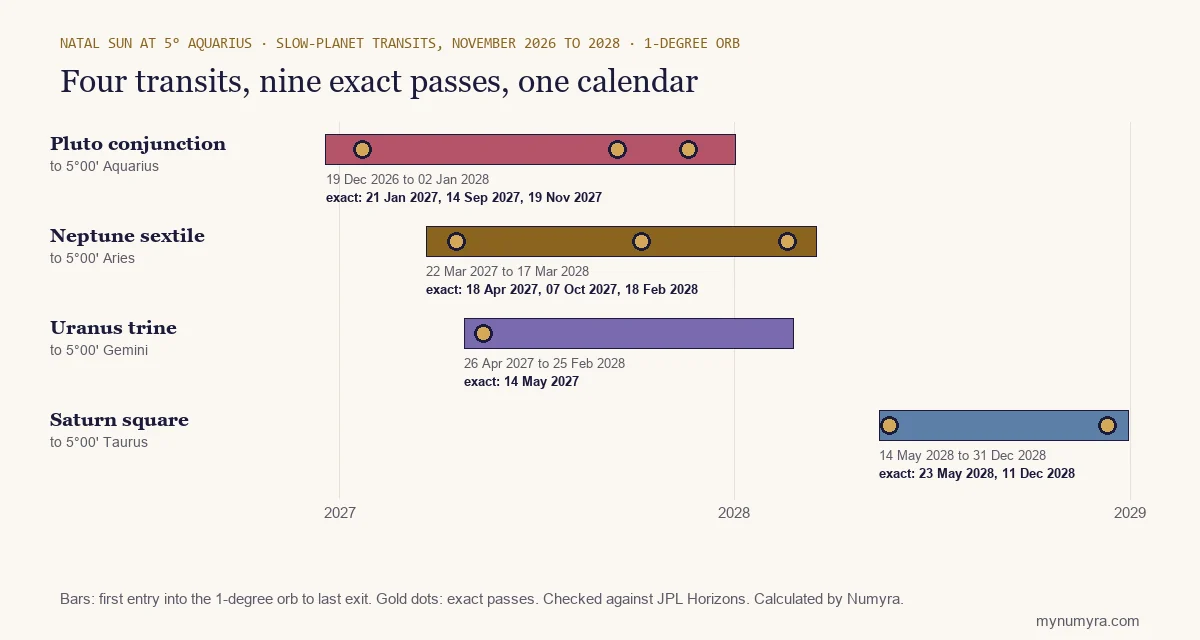
Pluto’s conjunction with the natal Sun is a textbook looped transit. Pluto enters the 1-degree orb on December 19, 2026, is exact on January 21, 2027, turns retrograde on May 8 at 7 degrees 11 minutes, comes back to be exact on September 14, stations direct on October 18 at 4 degrees 45 minutes, and is exact a third time on November 19. It leaves the orb on January 2, 2028, 379 days after it entered. It is inside the orb for only 224 of those 379 days, because between February 23 and July 27 the retrograde carries it just past 6 degrees; counting from first entry to last exit gives 379, counting time inside gives 224 in two stretches. The three exact dates are the only fixed points: the build-up and the leaving are what Astrodienst calls the variable parts.
| Transit to natal Sun, 5° Aquarius | Target degree | Enters 1° orb | Exact | Leaves orb |
|---|---|---|---|---|
| Pluto conjunction | 5°00′ Aquarius | Dec 19, 2026 | Jan 21, 2027, Sep 14, 2027, Nov 19, 2027 | Jan 2, 2028 |
| Neptune sextile | 5°00′ Aries | Mar 22, 2027 | Apr 18, 2027, Oct 7, 2027, Feb 18, 2028 | Mar 17, 2028 |
| Uranus trine | 5°00′ Gemini | Apr 26, 2027 | May 14, 2027 | Feb 25, 2028 |
| Saturn square | 5°00′ Taurus | May 14, 2028 | May 23, 2028, Dec 11, 2028 | Dec 31, 2028 |
Notice the Uranus trine. Uranus is exact only once, on May 14, 2027. It leaves the 1-degree orb on May 31, turns retrograde, and drops back into the orb on January 31, 2028, only to turn direct again on its way to the degree and leave on February 25 without a second pass. Counted from first entry to last exit that is one transit of 305 days; counting only time inside the orb it is 60 days in two short stretches. Neither answer is wrong, which is the argument for always saying which method you use.
How to find your own transits
You need two lists: where your planets were at birth, and where the planets are on the day you care about. Then you compare them.
- Get your natal degrees. You need your birth date, time and place for the Moon and Ascendant. Our birth chart calculator gives the Sun, Moon and rising sign, and the Mercury, Venus and Mars sign calculators give those planets. For exact degrees of every planet, a full chart service or an ephemeris is needed. Write each position as degrees of the zodiac, adding 30 for each sign passed: Aries 0, Taurus 30, Gemini 60, Cancer 90, Leo 120, Virgo 150, Libra 180, Scorpio 210, Sagittarius 240, Capricorn 270, Aquarius 300, Pisces 330. A planet at 5 degrees of Aquarius is at 305.
- Look up the planets’ current positions. Lilly’s advice still works: use an ephemeris. NASA’s JPL Horizons system gives the apparent ecliptic longitude of each planet for any date, which is what we used to check our own calculations. The table below gives the five slow planets as of November 25, 2026.
- Subtract. For each pair, take the transiting longitude minus the natal longitude. An answer near 0 is a conjunction, near 60 or 300 a sextile, 90 or 270 a square, 120 or 240 a trine, 180 an opposition. The distance from the exact angle is the orb.
- Apply an orb and say which one. One degree is the convention for timing; three degrees is where the podcast above says transits remain operative. Decide before you look, so the orb does not follow the story.
- Check whether the planet is retrograde. If it is, or is about to station, expect the same degree to be crossed again, and list every pass. The table shows each planet’s next station.
- Read the house. A transit also falls in a house of your chart. With whole-sign houses it is the house that holds the sign the planet is in, as our guide to whole-sign and Placidus houses explains.
| Planet (November 25, 2026, 12:00 UT) | Position | Motion | Next station | First change of sign after that |
|---|---|---|---|---|
| Jupiter | 26°32′ Leo | direct, 0.056° a day | December 13, 2026, retrograde at 27°01′ Leo | Virgo, July 26, 2027 |
| Saturn | 8°09′ Aries | retrograde, 0.028° a day | December 10, 2026, direct at 7°56′ Aries | Taurus, April 13, 2028 |
| Uranus | 3°42′ Gemini | retrograde, 0.042° a day | February 8, 2027, direct at 1°41′ Gemini | Cancer, August 3, 2032 |
| Neptune | 1°42′ Aries | retrograde, 0.010° a day | December 12, 2026, direct at 1°37′ Aries | Taurus, May 22, 2038 |
| Pluto | 3°27′ Aquarius | direct, 0.019° a day | May 8, 2027, retrograde at 7°11′ Aquarius | Pisces, March 9, 2043 |
As a practice case, take a natal Venus at 27 degrees 00 minutes of Leo, which is 147.0 degrees. Jupiter was at 146.53 on November 25, 2026, about half a degree short. It is exact on December 9, stations retrograde on December 13 at 27 degrees 01 minute, only a minute and a half past the natal degree, crosses back on December 16 and crosses forward for the last time on July 11, 2027, fifteen days before it enters Virgo. That is three exact passes in seven months from a planet that is at its natal degree for a handful of days each time. Everything in the table was checked against JPL Horizons.
Where to go next: the transit guides on Numyra
This page is the general reference. The specific transits each have their own guide, with exact dates and ages:
- Returns: the planetary returns table for every planet, then the Saturn return, Jupiter return, Chiron return, nodal return, solar return and lunar return.
- Opposition and square cycles: the Saturn opposition, the Uranus opposition and the Saturn-Neptune conjunction.
- Retrogrades: the 2027 retrograde calendar, Mercury retrograde 2027 and what Mercury retrograde actually means, Venus retrograde and Mars retrograde 2027.
- Sign changes: Pluto in Aquarius, Jupiter in Leo and Saturn in Aries, with the 2027 eclipses as the other recurring sky events that fall on chart points.
- Related timing and technique: annual profections, the progressed Moon, combust planets and our guide to astrology aspects and orbs.
What transits cannot tell you
A transit is a calculation about where a planet is, and that part is exact: the dates on this page were checked against NASA’s ephemeris. What a transit means is a different matter. It is a tradition of interpretation, and nothing here shows that a planet’s position makes anything happen to a person. Our guide on whether astrology is real sets out what tests have found. Treat any reading of a transit as a prompt for reflection, not a forecast, and for money, health or legal decisions rely on qualified professionals, not on a chart.
Frequently asked questions
What is a transit in astrology?
A transit is the current position of a moving planet compared with a point in a birth chart. It counts when the planet reaches the natal point’s degree or forms an angle to it, such as a square or trine, within an orb of usually 1 to 3 degrees.
How long does a transit last?
It depends on the planet and the orb. Within 1 degree of a natal point, the Moon stays 3.6 hours, the Sun 2 days, Mars about 4, Jupiter 24 days, Saturn 60 and Pluto about 16 months, and counting from first entry to last exit with retrograde passes the averages are 2 days for the Sun, 3 months for Jupiter, 6.6 months for Saturn and 2.7 years for Pluto.
What orb should I use for transits?
One degree is the most common convention for timing, and the sources we read treat 2 to 3 degrees as still active, so use 1 for exact dates and 3 for the wider season. State your choice, because it changes the length of a Pluto transit from 2.7 years to 5.3.
Which transits matter most?
Tradition gives most weight to the slow planets, Jupiter to Pluto, and to transits that touch the Sun, Moon, Ascendant or a planet’s own degree. That is a convention, not a measurement, and the page on whether astrology is real explains why such weights are untested.
Why does a planet cross my natal degree three times?
Because it turns retrograde near the degree. It crosses forward, back and forward again. Saturn does this in 53% of encounters, Uranus in 93%, and Neptune and Pluto cross three, five or seven times in virtually every encounter.
What is the difference between a transit and a return?
A return is a transit of a planet to its own natal degree, like the Saturn return at about 29. A transit can be any planet to any point, at any angle.
How do I find my transits today?
Write your natal planets as longitudes, look up today’s longitudes in an ephemeris such as NASA’s JPL Horizons, and subtract. An answer near 0, 60, 90, 120 or 180 degrees within your orb is a transit. The steps above show how.
Do the fast planets’ transits matter?
Traditionally less, because they pass quickly: the Moon in hours, the Sun in two days. They matter when they look at a slow planet’s transit or when Mercury or Venus loops, which stretches a 2-day transit to 46 or 88 days.
Are transits scientifically proven?
No. The positions are astronomy and can be checked exactly, but the meanings are interpretation. Numyra presents transits as a tradition, not as a prediction.
How we calculated and checked this
Positions are apparent geocentric ecliptic longitudes of date from the Swiss Ephemeris through pyswisseph, using the Moshier analytical ephemeris. The sample was the Moon for 40 years at 1-hour steps, the Sun, Mercury and Venus for 100 years at 6-hour steps, Mars for 300 years at 12-hour steps, and Jupiter to Pluto for 1,000 years (1500 to 2500) at 1-day steps. For each planet we placed 360 natal points one degree apart, found every encounter within the orb with boundary times interpolated between samples, and merged episodes into one encounter when the planet came back within the orb before leaving the neighbourhood of its loop (gaps under 100, 150 and 250 days for Mercury, Venus and Mars, and under 600 for the slow planets). For the fast planets a histogram of the gaps has a clear empty band between the gaps inside one loop and the gaps between separate visits, and the cutoffs sit in that band; for Jupiter and Saturn, cutoffs of 300, 600 and 1,200 days gave identical results. A sign visit is the span from first ingress to last egress, with the same merging.
We checked this in three independent ways. First, we recomputed everything for 1850 to 2150 from NASA JPL’s DE440s ephemeris with Skyfield and compared it with the Swiss Ephemeris run on the same window: longitudes differ by at most 0.004 degrees, and every average we computed on that window (times inside the orb, first-to-last spans, sign stays, retrograde shares, pass shares) agreed between the two ephemerides to the digit shown, apart from Neptune, where the first-to-last spans differ by 0.4 day. Second, two exact identities hold for all planets: mean time inside the orb equals 2 times the orb divided by 360 of the zodiac lap, and mean passes equal 1 plus twice the backward arc divided by the net advance. Third, we compared every date stated here, the exact passes, stations and sign changes, with hourly positions from JPL Horizons: exact passes agree within 12 minutes, the Jupiter, Saturn, Uranus and Neptune stations within 4 minutes, Pluto’s station within about an hour (it is extremely flat) and every sign change within 12 minutes.
Limits: the averages are over all zodiac degrees and all orbits in the sample, so a particular degree in a particular decade can differ, above all for Pluto, whose speed changes with its place in the orbit. Our counts of passes agree with the independent figures in our returns table for Uranus and Neptune. For Saturn they differ (53% looped here, 38% there) because that table counts the first return of real 1900 to 2010 birth dates, not every degree of the zodiac: running our code on 5,792 such birth dates reproduces the table’s 62% single and 38% triple, so the gap lies in the sample, not the method. Chiron and the lunar nodes are not included. Astronomical times are given in UT.
Sources
- William Lilly. Christian Astrology (London, 1647), Internet Archive scan, chapter CLXXIIII “Of the Transit of the Planets”, printed page 741, transcribed by Numyra from the page image (one word in the first line is damaged in the scan).
- Vettius Valens. Anthology, Book I, chapter 21, trans. Mark Riley, in an annotated edition on GitHub. The chapter is headed “Transits and The Combination of the Stars”.
- Astrodienst. FAQ: Daily Horoscope, Duration. The 1-degree orb, the two counting styles and the Mercury and Venus loops.
- Wikipedia. Astrological transit. The one-degree orb and the durations for the Sun and Moon.
- The Astrology Podcast, episode 365 transcript: Transits in Astrology (2022). Sign-based and degree-based transits, orbs, and the Moon and Pluto sign durations.
- Astrostyle. Transiting planets and EBSCO Research Starters. Astrological transit. The rule-of-thumb durations tested above.
- Refinery29. What It Actually Means When Your Horoscope Mentions A “Transit”. An example of a wider orb.
- NASA. Planetary Fact Sheet. Orbital periods.
- NASA JPL. Horizons System and the DE440s planetary ephemeris. The independent check on every position, date and duration.
- Astrodienst. Swiss Ephemeris. Planet positions (calculations by the Numyra Methodology Desk).