In modern numerology each single digit has a one-line meaning: 1 begins, 2 partners, 3 expresses, 4 builds, 5 changes, 6 cares, 7 searches, 8 organizes and 9 completes. Those meanings are younger than the numbers. Read the older texts and several of them turn around: in Cheiro’s Book of Numbers (1926) the 4 is a rebel and the 8 a number of fate and loneliness, and in the Pythagorean lore that Agrippa collected, in an English edition of 1651, the 2 can stand for discord. This page sets the three layers side by side, quotes the pages (checked against scans) and counts how often each number turns up in the birth dates of 85.4 million Americans.
Key takeaways
- Today’s one-line meanings, from Numerologist.com, Hans Decoz and our own Life Path profiles, are close to each other: 1 initiates, 2 relates, 3 expresses, 4 gives structure, 5 seeks freedom, 6 cares, 7 seeks understanding, 8 manages power and 9 completes.
- Older sources are not that tidy. Cheiro (1926) gives each number a planet, and his 4 (Uranus) is a rebel who takes “the opposite side”, his 8 (Saturn) “lonely” and “fatalistic”, his 9 (Mars) a fighter. Agrippa (English 1651) gives the 2 both “mutuall love” and “discord”.
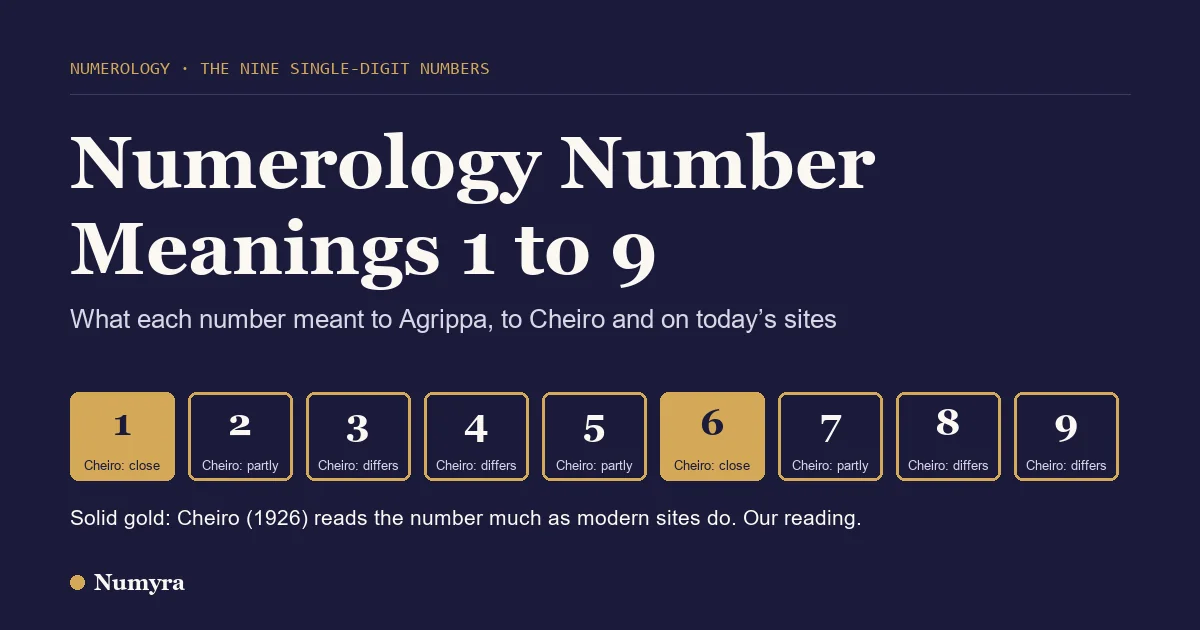
- In our reading Cheiro matches the modern meaning closely for two numbers (1 and 6), partly for three (2, 5 and 7) and differs for four (3, 4, 8 and 9). The older sources also disagree with each other: “justice” is the 2, 4 and 5 in the Greek Theology of Arithmetic and the 5 and 8 in Agrippa.
- Original data from 85,386,227 US births (1994 to 2014): 71.9% of people have three different numbers among their Life Path, birthday number and attitude number, 27.3% have two the same and 0.84% have all three the same. Any given digit appears in at least one of the three for between 28.7% (the 8) and 32.0% (the 3). Per-number shares for Life Path and birthday number are on our numerology test and birthday number pages and are reused here.
- These are traditional readings, not tested predictions. Nothing here is medical, financial, legal or psychological advice.
In this guide
- The nine meanings most sites give today
- Where the meanings come from
- Number by number: what each source says
- Where the layers agree and where they split
- How common each number is in a US birth date
- How to read the meanings
- How we checked this
- Frequently asked questions
The nine meanings most sites give today
The first results for the numbers 1 to 9 (Numerology.com, Numerologist.com and Hans Decoz’s World Numerology) give each digit a title and a theme. The AI answer Google showed on 28 October 2026 listed the same nine themes, each with a “shadow” such as dominance for the 1 or restlessness for the 5. The table sets their labels beside the names our own Life Path profiles use, each linked to its profile.
| No. | Our Life Path name | Numerologist.com | Hans Decoz | Core idea in plain words |
|---|---|---|---|---|
| 1 | The Initiator | Individuation | The Primal Force | Starting things, independence, leadership |
| 2 | The Mediator | Relation | The All-Knowing | Partnership, tact, sensitivity to others |
| 3 | The Communicator | Expression | The Creative Child | Creativity, self-expression, optimism |
| 4 | The Builder | Limitation | The Salt of the Earth | Structure, discipline, reliability |
| 5 | The Explorer | Constructive Freedom | A Dynamic Force | Change, freedom, curiosity |
| 6 | The Nurturer | Responsibility | The Caretaker | Care, family, harmony |
| 7 | The Seeker | Understanding | The Philosopher | Analysis, inner life, search for truth |
| 8 | The Organizer | Stewardship | Balance & Power | Authority, material success, balance |
| 9 | The Humanitarian | Completion | Global Awareness | Endings, compassion, the wide view |
Labels from Numerologist.com’s “Number Meanings at a Glance” and Decoz’s “The Single Digit Numbers”, both read 28 October 2026; the last column is our summary. The master numbers 11, 22 and 33 sit outside the nine; why they are kept whole is a separate question.
How this page differs from our Life Path pages: each of those describes one number as a birth-date result, and the Life Path hub lists all twelve. This page is about the number itself in any position, Life Path, birthday, Destiny or Soul Urge, and about where its meaning came from. If you want your own number, the Life Path calculator finds it, and the numerology guide shows the five core numbers.
Where the meanings come from
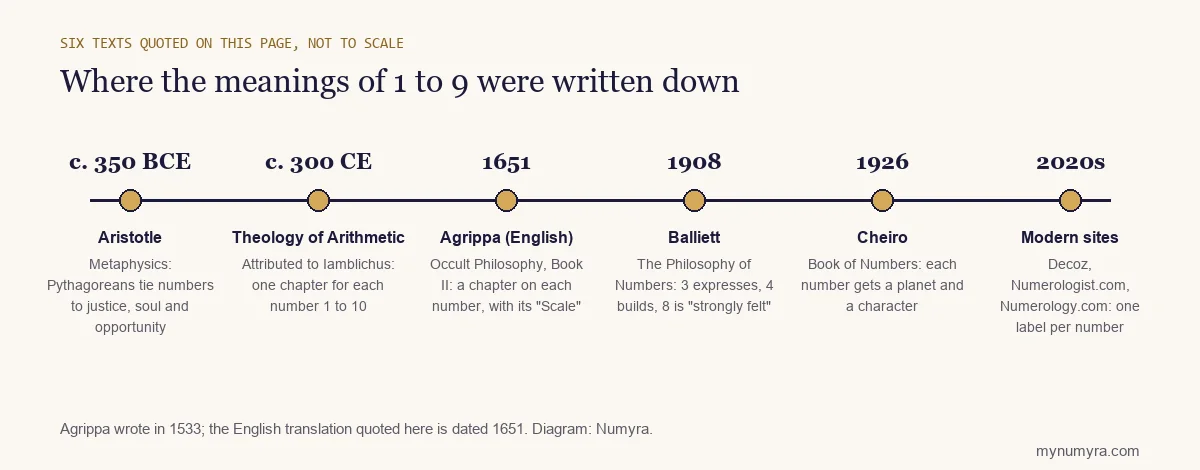
Aristotle’s Metaphysics reports that the Pythagoreans saw numbers in things, “such and such a modification of numbers being justice, another being soul and reason, another being opportunity”. He does not say which number is which, so the one-by-one meanings come from later writers (our history of numerology shows how little of the modern method is ancient). Four texts matter here.
The Theology of Arithmetic, attributed to Iamblichus and built from Nicomachus and Anatolius, gives each of the first ten numbers a chapter. In Robin Waterfield’s translation the pentad is called marriage because it joins the first even number (2) and the first odd number (3), the tetrad is justice because a square with sides of 4 has an area equal to its perimeter, and the heptad is named for Athena, a virgin number with neither mother nor father. Agrippa’s Three Books of Occult Philosophy (1533; the English translation by J.F. is dated 1651) devotes a chapter and a “Scale” to each number, repeating what “the Pythagorians” called it and adding Christian and Hebrew material.
Mrs. L. Dow Balliett’s The Philosophy of Numbers (1908) ties single digits to birth numbers and name numbers, with a musical note and a colour for each, and already says that 3 expresses and 4 builds. Cheiro’s Book of Numbers (dated 1926 on our Cheiro page) gives each number a planet and a character; our page on who Cheiro was sorts out what is documented about him.
Number by number: what each source says
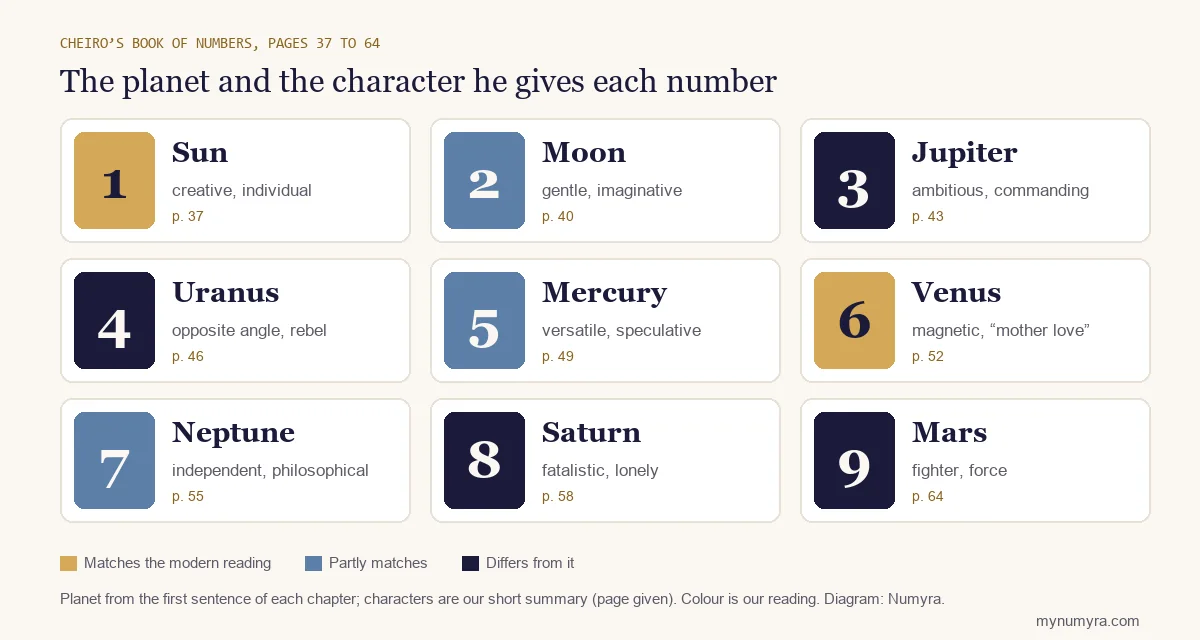
Quotations are word for word from the pages named. Planets and page numbers are Cheiro’s. “Close”, “partly” and “differs” are our reading of how an older layer lines up with today’s one-line meaning, not a measurement.
Number 1: the same story in every layer
Agrippa opens his chapters on the numbers with unity, which “is therefore the one beginning, and end of all things” (Book II, chapter 4). Cheiro makes the 1 the Sun and starts from the same thought: “The basis of all numbers is one” and “the basis of all life is one” (p. 37). His 1-people are “creative, inventive, strongly individual” and “more or less obstinate and determined”. Today’s pages say initiator and leader. All three layers agree that 1 is the origin and the self-starter; the older ones add a weight, the source of every other number, that modern profiles leave out. The birth-date version is Life Path 1.
Number 2: from first split to peacemaker
Agrippa gives the 2 two faces in one chapter. It is “the number of charity, and mutuall love, of marriage, and society”, and it is also the beginning of division and “signifies matter”. Then comes the darker line:
“This is also sometimes the number of discord, and confusion, of misfortune, and uncleanness.”
Henry Cornelius Agrippa, Three Books of Occult Philosophy, Book II, chapter 5 (English, 1651)
The Theology of Arithmetic likewise treats the dyad as the first step away from the monad, the number of difference and inequality. Cheiro’s 2 is the Moon, “gentle by nature, imaginative, artistic, and romantic”, less forceful than the 1 (p. 40). Modern profiles make the 2 a mediator, and Google’s overview pairs it with a shadow of “shyness or codependency”. The partnership reading is old; the old dark side (discord) and the modern one (dependence) are different. See Life Path 2.
Number 3: ruler, holy number, then artist
Agrippa calls three “an incompounded number, a holy number, a number of perfection, a most powerfull number”, made of beginning, middle and end. Cheiro’s 3 is Jupiter, and his 3-people are “decidedly ambitious”: their aim “is to rise in the world, to have control and authority over others”, and their faults include being “inclined to be dictatorial” (p. 43). Balliett already reads the number the way later sites do: “it is the mission of 3 to express” (p. 54). Decoz calls the 3 “The Creative Child” and Numerologist.com “Expression”. This is the biggest change of job description in the nine, from commander to artist, and Cheiro’s 3 is the odd one out. See Life Path 3.
Number 4: foundation or rebel
Cheiro’s 4 is Uranus, and his chapter begins with a character most modern profiles would not recognise:
“They appear to view everything from an opposite angle to everyone else. In an argument they will always take the opposite side.”
Cheiro, Cheiro’s Book of Numbers, p. 46
He adds that they “instinctively rebel against rules and regulations” and are “seldom as successful in worldly or material matters”. Agrippa’s 4 is the opposite: the Pythagoreans call it the Tetractis and “prefer it before all the vertues of Numbers, because it is the foundation, and root of all other numbers”, and the Theology of Arithmetic calls the tetrad justice. Balliett’s 4 “means physical and mental strength” (p. 58) and builds “landmarks along life’s pathway”. Today’s builder, “Salt of the Earth”, follows Agrippa and Balliett, not Cheiro, which makes the 4 the sharpest reversal in the nine. See Life Path 4.
Number 5: marriage, Mercury and freedom
For Agrippa the five is “called by the Pythagoreans the number of Wedlock, as also of justice, because it divides the number ten in an even Scale”, and the heathen philosophers dedicated it to Mercury. The Theology of Arithmetic gives the same marriage reason, 2 plus 3. Cheiro keeps Mercury: his 5 is “versatile and mercurial”, “born speculators, prone to Stock Exchange transactions” (p. 49). Modern pages keep the versatility and call it freedom, adventure and change. Mercury links all three layers; marriage and justice have dropped out entirely, so a reader looking for the 5 as marriage in a current guide will not find it. See Life Path 5.
Number 6: perfect, loved and caring
“Six is the number of perfection, because it is the most perfect in nature”, Agrippa writes, and here the reason is arithmetic: 6 equals 1 + 2 + 3, the sum of its own parts, which the Theology of Arithmetic also calls the first perfect number. Cheiro’s 6 is Venus: “extremely magnetic”, “loved and often worshipped by those under them”, with a love that is “more the ‘mother love’ than the sensual” (p. 52). Modern profiles say nurturer, caretaker and responsibility. This is the closest fit of the nine, and the only digit whose oldest reason is a fact you can check on paper. See Life Path 6.
Number 7: Athena, Neptune and the seeker
Agrippa says the Pythagoreans call seven “the Vehiculum of mans life”, because it joins the body’s four elements to the soul’s three powers. The Theology of Arithmetic names the heptad for Athena and for the idea of a critical time. Cheiro’s 7 is Neptune, “very independent, original, and have strongly marked individuality”, with “a peculiar philosophical outlook on life” (p. 55), though he also gives them a love of change and travel. He adds that for occult calculation the 7 and 9 “are considered the most important of all” (p. 66). Modern profiles keep the thinker and drop the traveller: the seeker and philosopher is solitary and analytical. See Life Path 7.
Number 8: justice, Saturn and money
Agrippa writes that “The Pythagoreans call eight the number of justice, and fulness”, and also the number of safety and conservation. Cheiro’s 8 is Saturn, and his verdict is stark:
“These number 8 people are either great successes or great failures, there appears to be no happy medium in their case.”
Cheiro, Cheiro’s Book of Numbers, p. 58
They play a part “which is fatalistic, or as the instrument of Fate for others” (p. 58); “At heart they are lonely; they are misunderstood” (p. 60); yet he also says its symbol is called the “symbol of human justice” (p. 61). Balliett has the 8 “generally strongly felt in a community” (p. 71). Today’s 8 is authority, material success and balance, “Stewardship” on Numerologist.com. The justice thread ties 1651 to 1926 and survives as “balance”. The link to money does not: Cheiro’s chapter on the 8 (pp. 58 to 62) has no mention of money or wealth in our text, and he calls it not “a fortunate number to be born under” from “a worldly standpoint” (p. 58). See Life Path 8.
Number 9: limit, Mars and completion
Agrippa dedicates nine to the Muses, with nine heavenly spheres and nine orders of angels, “Yet sometimes it signifies imperfectness, and incompleatness”. The Theology of Arithmetic calls the ennead the greatest of the numbers within the decad, an unsurpassable limit. Cheiro’s 9 is Mars: “fighters in all they attempt in life” (p. 64), “the number of force, energy, destruction and war in its most dominant quality” (p. 67). He also sees a limit, in “the 9 numbers upon which man builds all his calculations, and beyond which he cannot go”. Balliett puts it differently: “8 stands for body, 9 for soul” (p. 71). Modern pages say completion, compassion and humanitarian. The idea of an end point is old; the martial tone has gone and the humanitarian one arrived later. See Life Path 9.
Where the layers agree and where they split
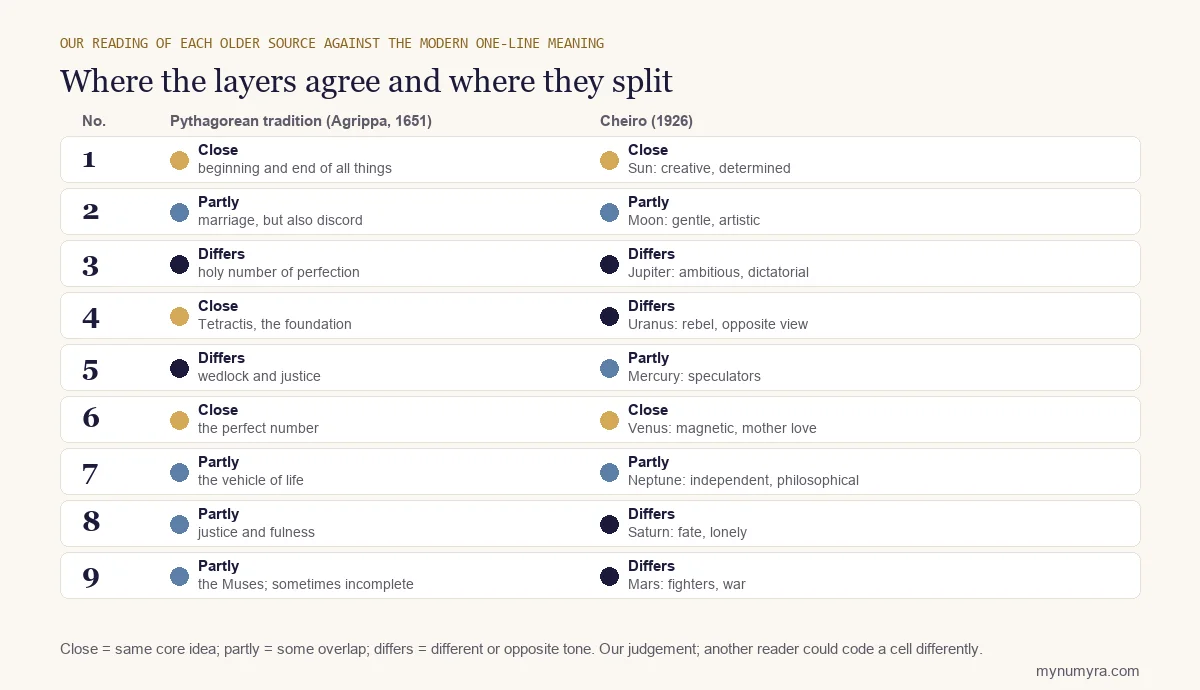
The table gives each number’s older readings beside today’s one-liner. In our reading Cheiro lines up with the modern meaning closely for 1 and 6, partly for 2, 5 and 7, and differs for 3, 4, 8 and 9. The Pythagorean tradition as Agrippa and the Theology of Arithmetic give it lines up closely for 1, 4 and 6, partly for 2, 7, 8 and 9, and differs for 3 and 5.
| No. | Pythagorean tradition (Agrippa, Theology of Arithmetic) | Cheiro, 1926 | Modern | Cheiro against modern |
|---|---|---|---|---|
| 1 | Beginning and end of all things | Sun: creative, determined | Initiator, leader | Close |
| 2 | Marriage and charity; also division and discord | Moon: gentle, artistic | Mediator, diplomat | Partly |
| 3 | Holy, perfect: beginning, middle, end | Jupiter: ambitious, dictatorial | Creative communicator | Differs |
| 4 | Tetractis, foundation; justice (Theology) | Uranus: rebel, opposite view | Builder, structure | Differs |
| 5 | Wedlock and justice; Mercury | Mercury: versatile, speculative | Freedom, change | Partly |
| 6 | Perfection; marriage by multiplication | Venus: magnetic, mother love | Nurturer, caretaker | Close |
| 7 | Vehicle of life; Athena, virgin | Neptune: independent, philosophical | Seeker, thinker | Partly |
| 8 | Justice and fulness; safety | Saturn: fatalistic, lonely; human justice | Authority, balance, success | Differs |
| 9 | The Muses; limit; sometimes incomplete | Mars: fighters, war | Completion, humanitarian | Differs |
Cheiro’s planets are easier to see in one place.
The old sources also disagree with each other, which is the point most guides skip. The Theology of Arithmetic calls the 2, the 4 and the 5 “justice” in different passages, while Agrippa gives the word to the 5 and the 8. “Marriage” goes to the 3, 5 and 6 in the Greek text and to the 2, 5 and 6 in Agrippa. So a modern site that tells you your 4 “builds” is reading closer to Agrippa and Balliett than to the man whose name many numerology sites borrow. Neither choice is wrong. They are different traditions that now share nine digits, and our guide to Pythagorean, Chaldean and Kabbalah numerology covers the same split for names. For Cheiro’s two-digit totals, the compound numbers 10 to 52 show the same habit of old readings that modern pages soften.
How common each number is in a US birth date
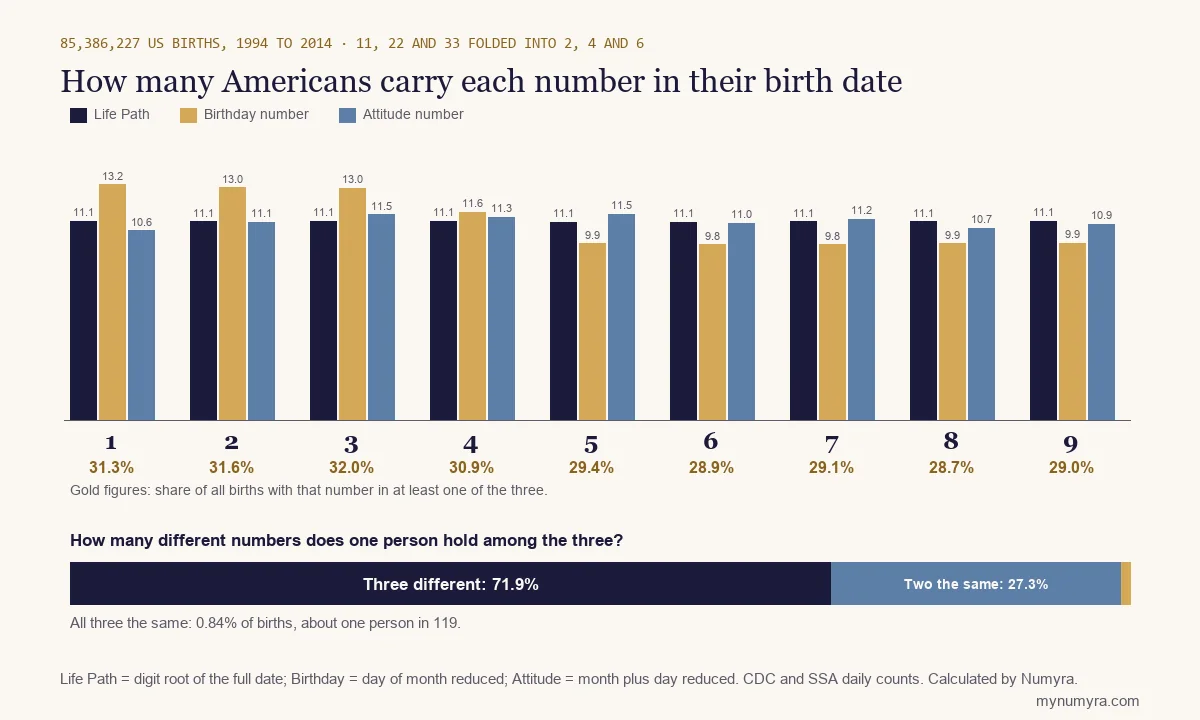
Three of the five core numbers come from the birth date: the Life Path (every digit of the date added and reduced), the birthday number (the day of the month, reduced) and the attitude number (month plus day, reduced). Our other pages count each one alone. The numerology test found each Life Path from 1 to 9 holds 11.08% to 11.14% of US births, the birthday number page found the days 1 to 4 outnumber 5 to 9 because each gathers four calendar days, and the attitude number page gave the third column. We reuse those figures so the numbers match across the site. What is new here is how the three combine in one person.
| Number | Life Path | Birthday number | Attitude number | In at least one of the three |
|---|---|---|---|---|
| 1 | 11.14% | 13.16% | 10.61% | 31.3% |
| 2 | 11.11% | 13.00% | 11.09% | 31.6% |
| 3 | 11.12% | 12.97% | 11.49% | 32.0% |
| 4 | 11.13% | 11.62% | 11.34% | 30.9% |
| 5 | 11.08% | 9.86% | 11.52% | 29.4% |
| 6 | 11.07% | 9.82% | 11.03% | 28.9% |
| 7 | 11.12% | 9.80% | 11.23% | 29.1% |
| 8 | 11.10% | 9.86% | 10.74% | 28.7% |
| 9 | 11.12% | 9.90% | 10.95% | 29.0% |
Source: 85,386,227 US births, 1994 to 2014; 11, 22 and 33 folded into 2, 4 and 6. The last column is new; the first three repeat our earlier pages. Calculated by Numyra.
If the three numbers were evenly spread and independent, any given digit would appear in at least one of them for 29.8% of people. In fact it ranges from 28.7% for the 8 to 32.0% for the 3, because the birthday number favors 1 to 4. What matters more for reading is the count of different numbers: 71.9% of Americans have three different numbers, 27.3% have two the same and 0.84%, about one person in 119, have the same number in all three. The typical reader has to hold two or three of the meanings above at once.
Does one number tend to travel with another? We cross-tabulated all 81 pairs of Life Path and birthday number. Each row adds up to its Life Path share (about 11.1%) and each column to its birthday share, so most of the pattern is the 1-to-4 skew in birthdays. After allowing for that, no pair sits more than 8% above or 4% below what independent numbers would give, so your birthday number says almost nothing about your Life Path. The diagonal, where both are the same digit, adds up to the 11.4% on the birthday page.
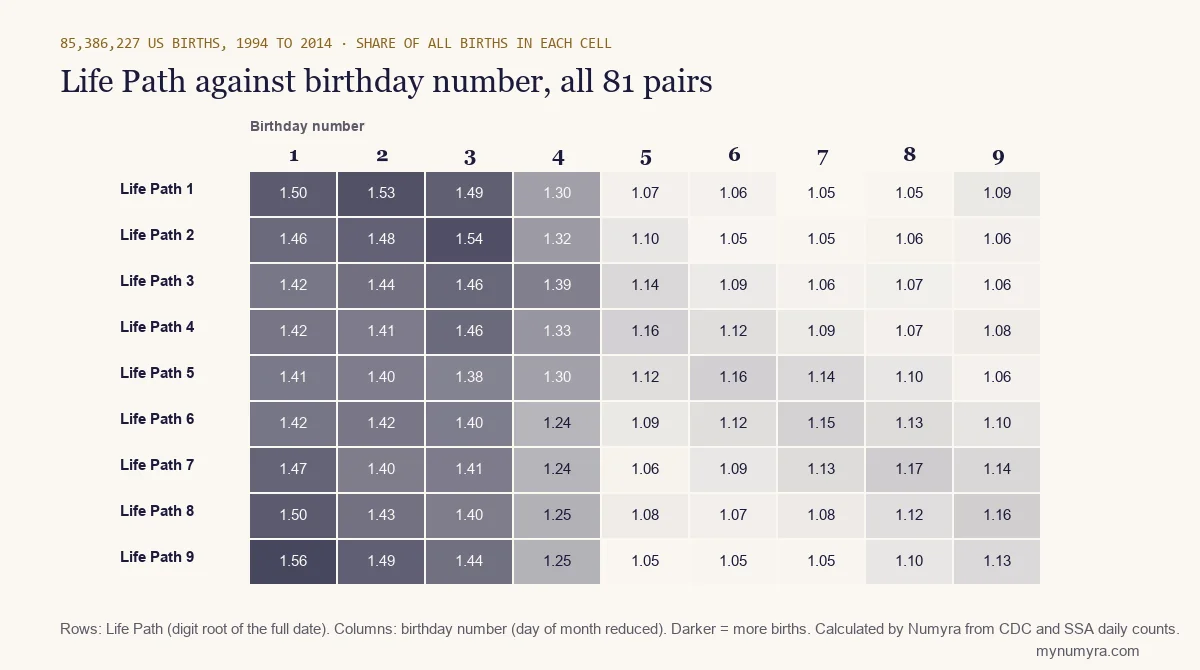
Two limits. These are US births from 1994 to 2014, now about 12 to 32 years old, and the shares come from the calendar, so they say nothing about personality. We did not count name-based numbers here; our pages on the letter values and lucky numbers cover those.
How to read the meanings
Position matters more than the digit. A 4 as a Life Path is read as a lifelong theme, as a birthday number as one talent, and as a Destiny number as what a name points toward; our guide to the three name numbers shows the difference. Check which tradition a source follows before you compare two readings: if your chart has a 3, 4, 8 or 9, a page that credits Cheiro may describe someone quite different from a page that follows Decoz.
Treat a meaning as a prompt for reflection. The one controlled test of birth numbers we found, on Nobel laureates, found nothing beyond chance; our test of whether numerology is real sets out what has and has not been checked. A description that fits you is a reason to think, not a reason to take a job, end a relationship or spend money. This is educational information about a cultural tradition, not medical, financial, legal or psychological advice. If numbers keep appearing around you, why you keep seeing the same number covers the psychology.
How we checked this
Cheiro. We read pages 37 to 67 of the Internet Archive scan of the seventh impression (Herbert Jenkins, London; Digital Library of India copy) as page images and matched every quotation to the image. The scan prints many sentence-ending full stops faintly or not at all; we supplied a stop where needed and changed no words. Agrippa. Joseph H. Peterson’s transcription of the 1651 English edition, original spelling kept, bracketed modernizations left out. Balliett. Pages 54, 58 and 71 of the Cornell copy, matched to the page images. Aristotle. W. D. Ross’s translation. Theology of Arithmetic. Read in Waterfield’s 1988 translation and paraphrased, not quoted, because it is in copyright; we did not check the Greek.
Modern labels were read on 28 October 2026. The data are the CDC (1994 to 2003) and Social Security Administration (2004 to 2014) daily birth counts compiled by FiveThirtyEight, 7,670 days and 85,386,227 births, dates only, with 11, 22 and 33 folded into 2, 4 and 6 and each date weighted by its births. Our single-digit Life Path and birthday shares reproduce the figures on our earlier pages. The coding of close, partly and differs is our judgement; another reader could code a cell differently.
Frequently asked questions
What do the numbers 1 to 9 mean in numerology?
In current usage: 1 is initiative and independence, 2 partnership, 3 self-expression, 4 structure, 5 freedom and change, 6 care and responsibility, 7 inner search and analysis, 8 authority and material matters, and 9 completion and compassion. Older sources differ for several numbers, as the comparison table above shows.
What is the most important number in numerology?
No source we read measures this. Cheiro writes that for all purposes of occult calculation “the numbers 7 and 9 are considered the most important of all” (p. 66). In current practice the Life Path is the most-cited of the five core numbers, because it comes from the birth date alone.
What does the number 4 mean in numerology?
Most modern sites read the 4 as structure, discipline and reliability; Agrippa and Balliett lean the same way. Cheiro’s 4 is the opposite, a person who views everything “from an opposite angle to everyone else” and rebels against rules (p. 46).
Is the number 8 lucky or unlucky in numerology?
It depends on the source. Modern pages link it to authority and material success. Cheiro writes that “from a worldly standpoint” it is not a fortunate number to be born under (p. 58), and Agrippa ties it to justice and safety. Our lucky numbers guide compares the recipes.
Are there good and bad numbers in numerology?
Modern guides usually say no, and give every number a strength and a shadow. Older writers were less even-handed: Cheiro calls the 8 not fortunate, and Agrippa calls the 2 “sometimes” a number of misfortune. Whether a number counts as good depends on the tradition you read.
How many numbers are there in numerology?
Nine single digits, 1 to 9, plus the master numbers 11, 22 and 33 in most modern systems. Two-digit totals are reduced by adding their digits, and master numbers are the usual exception to that step.
Is any single-digit number rarer than the others?
Not as a Life Path: each of 1 to 9 covers about 11.1% of US births when 11, 22 and 33 are folded in. As a birthday number the 5 to 9 are rarer (about 9.8% to 9.9%) than the 1 to 3 (about 13.0% to 13.2%).
Do the meanings of the numbers predict anything?
There is no controlled evidence that they do. The meanings are a tradition of symbols, and a description that feels accurate is expected from broad wording alone; see what the research shows.
Sources
- Cheiro. Cheiro’s Book of Numbers. London: Herbert Jenkins, seventh impression. Internet Archive scan (Digital Library of India), pp. 37 to 67.
- Agrippa, Henry Cornelius. Three Books of Occult Philosophy, Book II, chapters 4 to 11 (English translation by J.F., London, 1651), and chapter 12 (the number nine). Digital edition by Joseph H. Peterson, Esoteric Archives.
- Balliett, Mrs. L. Dow. The Philosophy of Numbers: Their Tone and Colors. Atlantic City, 1908 (seventh edition). Internet Archive (Cornell University Library), pp. 54, 58 and 71.
- Wikipedia. “De occulta philosophia libri tres.” Source for the 1533 publication date of the complete work and the 1651 English translation by “J. F.”.
- Aristotle. Metaphysics, Book I, part 5, translated by W. D. Ross. The Internet Classics Archive.
- Iamblichus (attributed). The Theology of Arithmetic, translated by Robin Waterfield. Grand Rapids: Phanes Press, 1988. Chapters on the dyad, tetrad, pentad, hexad, heptad and ennead (paraphrased).
- Numerologist.com. “What the Numbers Actually Mean.” Read 28 October 2026.
- Decoz, Hans. “The Single Digit Numbers.” World Numerology. Read 28 October 2026.
- Numerology.com. “Numerology Numbers 1-9.” Read 28 October 2026.
- FiveThirtyEight. US births data, 1994 to 2014, from the CDC National Center for Health Statistics and the Social Security Administration. Dates only.